Posted in prophecy, Uncategorized

Is it the birth pangs?

Tuscany was lashed with torrential rains and floods. There were fatalities.
Bangalore is flooded. Water levels rose over 5 feet. And it’s drought season.

Mexico was subjected to a 8.1 earthquake with many dead. The President of that nation declared a three-day period of national mourning.

Hurricane Harvey inundated the US city of Houston this week.

Wildfires are raging in three US states.

Of course Hurricane Irma devastated the Carribbean and also the SE of the US, where it is predicted that it will take billions of dollars to reconstruct.
A new hurricane is in the Atlantic, Jose.

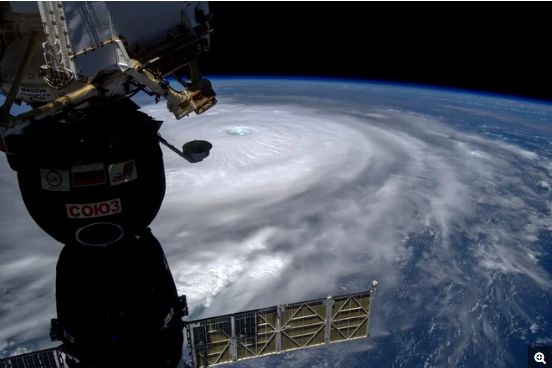
The Guardian has a run-down of the disasters currently in play. Below, Hurricane Irma photo taken by Russian Cosmonaut Randy Bresnik aboard the International Space Station.

irma

We live in a society unlike any in the past, a world of electronic media, a world of mass communication, a world of overexposure to relentless visual images and enhancements.  We see everything and we see it constantly.  In fact, we’re not isolated from anything that happens anywhere in the world.

Every catastrophe, every calamity, every cataclysm, every disaster, every tragedy everywhere eventually comes to us through the media and we vicariously experience all the pain and sorrow and suffering and death, whether it’s earthquakes in Mexico, or Japan, or Indonesia, or whether it’s famine in Africa or volcanic eruptions on various islands of the sea, or whether it’s horrific hurricanes in Asia or in Florida, whether it’s plagues in India, avalanches in Europe, wars in Iraq, whether it’s genocide, whether it’s suicidal terrorists in Israel or New York City or Washington D.C. or in a Russian school, whether it’s a plane crash, a train disaster, the sinking of ferry boat in a choppy sea in the English Channel, whatever it is, we are not isolated from these disasters, …

Whatever it is, we get it all. We cannot escape the information about catastrophic car wrecks that kill people. We see them replay it again and again on the nightly news, or house fires that burn up entire families.

And the truth is, if we weren’t living in this particular era of human history, we would not experience all of this. We would live in a little world somewhere and that little world would have its share of disasters and sometimes pretty devastating ones. But we at least wouldn’t have to bear the weight of all the disasters of all the world all the time. There is no little world for us anymore, not in western society. The weight of the tragedies of the world finds its way onto our emotional backs. The tragedies of the globe become ours to process in our beleaguered minds. Supernatural lessons from a natural disaster, John MacArthur

Is it the apocalyptic birth pangs? Yes. But the pangs have been appearing for 2000 years, since Jesus ascended. The two men in white announced to the men staring into the sky as Jesus had just been lifted out of their sight,

and said, “Men of Galilee, why do you stand looking into heaven? This Jesus, who was taken up from you into heaven, will come in the same way as you saw him go into heaven.” (Acts 1:11).

This is just the beginning. (Matthew 24:8). Earthquakes, floods, death, and disasters have always happened, since after the time of Genesis 3. Do you know why?

The curse. Sin. The earth groans under it.

For we know that the whole creation has been groaning together in the pains of childbirth until now. (Romans 8:22)

The simple verb to travail, occurs Gal. 4:19, 27; and the kindred noun birth-pang, in Matthew and Mark, Acts, and 1 Thess. 5:3.

Together refers to the common longing of all the elements of the creation, not to its longing in common with God’s children. “Nature, with its melancholy charm, resembles a bride who, at the very moment when she was fully attired for marriage, saw the bridegroom die. She still stands with her fresh crown and in her bridal dress, but her eyes are full of tears” (Schelling, cited by Godet). M.R. Vincent, Word studies in the New Testament

And this-

(1.) That there is a present vanity to which the creature, by reason of the sin of man, is made subject, v. 20. When man sinned, the ground was cursed for man’s sake, and with it all the creatures (especially of this lower world, where our acquaintance lies) became subject to that curse, became mutable and mortal.

(2.) That the creatures groan and travail in pain together under this vanity and corruption, v. 22. It is a figurative expression. Sin is a burden to the whole creation;

There is a general outcry of the whole creation against the sin of man: the stone crieth out of the wall (Hab. 2:11), the land cries, Job 31:38. Source: Matthew Henry’s commentary on the whole Bible

God is sovereign. God either allows a storm (satan can whip up a wind, he has that power, Job 1:19); or for His purposes God creates one. (Deuteronomy 11:17, James 5:17, Numbers 16:30-34). Either way, the earth originally was not home to this kind of trouble. In Eden, things were perfect. Not a harsh wind, not a tornado, not an earthquake, not even a stinging insect. Placid, dew-perfect life for Adam and Eve. Until the serpent tempted the humans to sin, and the humans fell. So did creation.

Paul cried out famously, Wretched man that I am! Who will deliver me from this body of death? (Romans 7:24). We could equally cry ‘who will rescue us from this planet of death?’ We groan and the creation groans. The most we can do in the face of these storms is remember who God is. We remember why this is happening (sin’s curse). We pray that those who do not know these things will turn to God and repent. Today because in all likelihood, the news will bring us another one tomorrow and we will we vicariously experience all the pain and sorrow and suffering and death all over again. MacArthur’s prayer-

We’re reminded of the words of the apostle Paul borrowing from the Old Testament, “Today is the day of salvation.” Lord, we have time now. We have opportunity now. We don’t know what the future has. We don’t know what calamity awaits. But we know we are experiencing Your patience and forbearance now. We know it’s not because You’re slack with Your promise. It’s not because You’re impotent, or powerless. It’s not because You’re indifferent. You could take us at any moment. You could snuff our lives out and You would be just in doing that.

But You have given us life and time and gospel opportunity to repent. And we…we have to see that opportunity for what it really is and we have to hear what our Lord said, “Repent or perish.” Death comes suddenly, unexpectedly, and if we have not repented with a repentance of not just turning, as turning from sin but turning to Christ, then eternal judgment awaits and forever we pay the penalty. What a horrific thought. While there is time, while there is opportunity, while there is the knowledge of the truth, I pray, oh God, that hearts would turn to You even now. Father, now we ask that You would do Your work. We’re so grateful for the fact that You have been gracious to us, those of us that know You.

We were given time and space and opportunity to repent. We were given the truth to hear and to believe and, oh Lord, we pray that You would so move in the hearts of those who have heard now and have not yet repented. May they be warned and shaken to the seriousness of the jeopardy in which they exist. And we ask that many would repent before they perish. And Lord, use us to spread this word of warning and of mercy to sinners everywhere. May they know that judgment comes but that mercy waits. And now send us out to be used to Your glory, we pray in Your Son’s name.

Supernatural lessons from a natural disaster, John MacArthur

PS, the sermon above and quoted up at the beginning was delivered 13 years ago, in 2004.
Posted in bible study, Uncategorized

Biblical Doctrine Study week 1 thoughts

Are you desiring to try a thorough study in Systematic Theology but don’t know where to start? Have you excitedly bought or were given the John MacArthur/Richard Mayhue tome Biblical Doctrine but are too intimidated to start?

Jessica Pickowicz of Beautiful Thing has written a Study Guide to go along with the book. She has also created a Facebook group of women to gather and discuss it. The Study will take about two years. It just began this week and it is certainly not too late to join!!! I blogged about it earlier.

This is the first essay with thoughts from what I’ve studied.

I love theology. I love knowledge, and I love wisdom. The word “theology” comes from two Greek words that combined mean “the study of God.” Knowledge is the accumulation of facts and information. Wisdom is the synthesis of knowledge with appropriate applications to life. If you study God through His Bible and speak about Him in ways where people can find application of His precepts to their life, you are a theologian speaking knowledgeably with wisdom.

The first lesson was to read the preface. I found this passage to be worthwhile:

The ultimate goal of writing such a systematic theology and to study such a systematic theology is

“to elevate one’s holy worship. The posture of theology is on one’s knees. The model of theology is repentance.”

The quote is from Sinclair Ferguson who was quoted in James Boice and Philip Ryken’s book “The Doctrines of Grace.”

I think that quote cuts to the chase. If I have any inclinations of accumulating knowledge for knowledge’s sake, this cuts me off at the knees. More importantly, it brings me to my knees. The only purpose of such study is to better know God and to offer him increasingly elevated holy worship. This is His due. This is the chief end of man and the reason for our existence: relationship though worship and giving Him glory.

beach sandcastle
EPrata photo

Posted in discernment, Uncategorized

Biblical Doctrine: Ladies, Study along with Jessica Pickowicz, & #ReadWritePlan2017

Ladies, Jessica Pickowicz, wife of Nate Pickowicz, who authored Why We’re Protestant and Reviving New England, wrote a Bible study to go along with MacArthur’s and Mayhue’s tome, “Biblical Doctrine.”

I have a dear friend who is attending The Master’s University. He returned home for summer break and arrived at my door in July with a surprise gift of this wonderful book. Even more wonderful, it is signed by John MacArthur and a verse was selected to include with the signature!

readwriteplan 5

I can’t figure out if the verse is an encouragement or a warning to me. Hmmm. Likely both, since I need both!

I love that he did this and I put it proudly on my theological bookshelves. And there is sat, all 1000 plus pages of it. Once in a while I’d look at it as I passed my shelf, and mourned its size and how I was going to approach this study.

Providentially, Jess had been writing a study guide and lessons to go along with the book, and announced it about a month after I’d received the book! The study began this week.

Concurrently, an internet annual organization plan for writers is going on. It’s by Alexandra Haughton and it’s called #ReadWritePlan. What you do it post one photo a day for a month, according to their schedule, showing your favorite pens, planners, papers, highlighters, bulletin boards, desk area, etc. In other words, what does it look like where you write and study?

I love this stuff! But I missed the first week of ReadWritePlan2017 and decided to forgo it until next year. Then the Biblical Doctrine study came up, complete with its choice of binder covers (color, or B&W), papers to be printed, and pads and pens and highlighters suggested. So now I’m back in on ReadWritePlan.

Here is my first post, the preface to ongoing thoughts about the Biblical Doctrine Study I plan to post, combined with a ReadWritePlan once for all post. This is my place, the spot where I study the Bible, read the Bible, listen to sermons, and write my blog essays.

I live in a 425 sf apartment. Mainly it’s two rooms with a small kitchen and a tiny bathroom. I love it. My dining table was a garage sale find of one of those 1950s with formica top and metal legs. Since everything HAS to be both organized and available, yet fit into the tiny space, here is what I did. The dining table has become my office with the laptop prominently located. Next to the table is a bookcase containing a good light, speakers, and office supplies as normal. It is all within reach without me having to get up out of my office chair.

readwriteplan 2

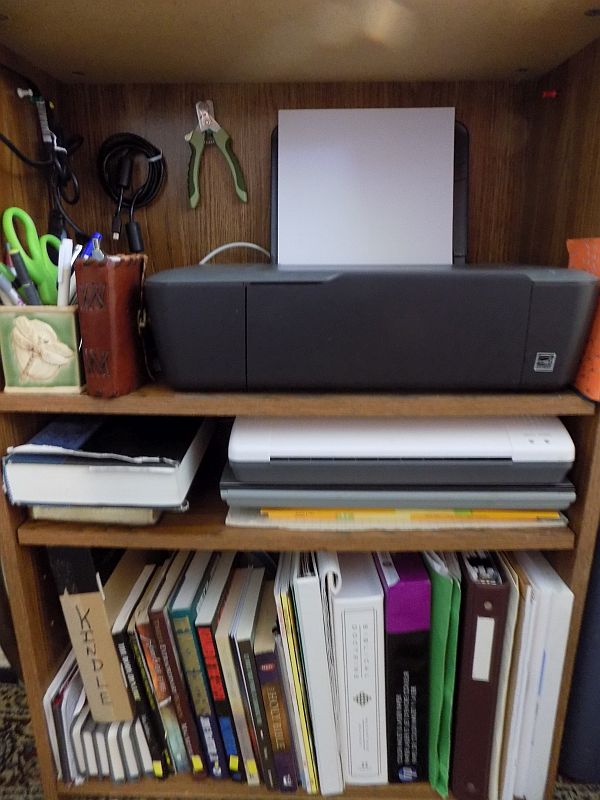
Coffee, tea, or water is always on the coaster, out of the way of the cat who likes to jump on the table and curl up on his bed. Below, take a tour of my bookcase with me. Top shelf, printer, pencil and pen cup, brown leather notebook I take to church. Second shelf, MacArthur Study Bible and smaller Bible with Grant Horner bookmarks for my ongoing Reading Plan.

Next to that is the laminator and the scanner. Bottom shelf, notebooks, legal pads, printer paper, binders of ongoing studies, like the Biblical Doctrine textbook, and books I’m currently reading.

readwriteplan 1

The weekly Biblical Doctrine Pickowicz Study is issued on Thursdays but my Thursdays are straight out 14 hours, and I don’t arrive home until about 9:30pm. So I dedicate Friday evenings for delving into the week’s study. It’s perfect. I come home, take a nap, awake refreshed and settle in to the quietude with a cuppa and all the time in the world.

Below, doing the first week’s lesson, yay!

readwriteplan 6

Jessica offers tips on highlighting for various study-reasons. However, I never, ever, ever, ever write or highlight in any of my books. Ever. Instead, I buy thousands of transparent Post-It arrows in neon colors and put them happily all around. I love my Post-It arrows.

readwriteplan 3

readwriteplan 4

I encourage you to look into the Biblical Doctrine Bible Study. Jess has not only created a Study Guide but also a Facebook Group of like-minded women who are participating in the study, which is expected to last two years. Women from their 20s to their 70s have been added, women who are homeschooling or not, married and not, disabled and healthy, living rural or citified. We are all different but have Christ in common.

Here are the pertinent links for you.

Jess Pickowicz at Beautiful Thing: Biblical Doctrine study, articles

Beautiful Thing’s Biblical Doctrine Facebook Study Group

Biblical Doctrine the book for purchase at Grace To You

For purchase at Amazon, it’s $20 off right now.

Posted in picture mixture, Uncategorized

Picture Mixture Saturday

Neat pictures from around the web for you. I plan to make this a regular feature.

From Dr Steven Lawson’s Instagram (drstevenjlawson):
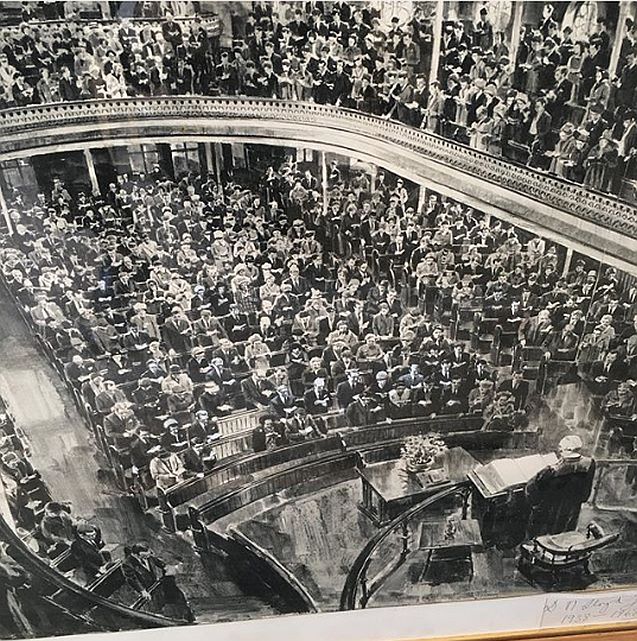
“Here is a great picture of Dr. Martyn Lloyd-Jones preaching to a full congregation at the Westminster Chapel. I saw this picture yesterday at The Banner of Truth office in Edinburgh.”

MLJ’s sermons were recorded and can be heard here.

mlj

~~~~~~~~~~~~~~~~~~~~~~

Pixlr is one of my favorite free picture editing apps, and people submit their photos after having used the app. Gorgeous. I would love to go to Georgia’s Callaway Gardens Blue Morpho Month September event. Anyway, Pixlr said: “Such an exquisite photo of a butterfly. Thanks @tbisdd for sharing it with us!”

butterfly

~~~~~~~~~~~~~~~~~~~~~~

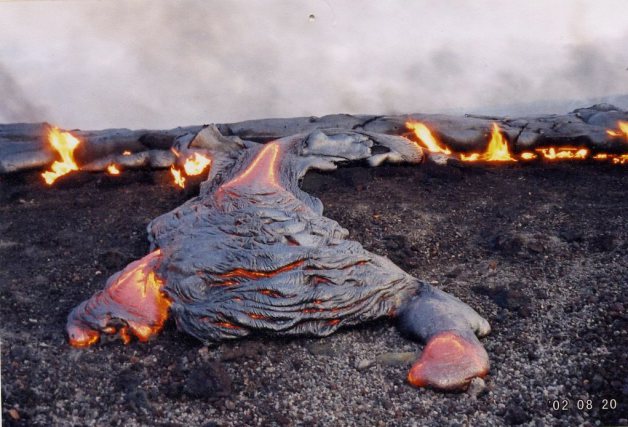
Photo from A Day in the Life of volcanologists seriesmoderated by Sandie Will. This is a lava flow in Hawaii, from Volcanologist Dr. Rebecca Williams @Volcanologist: A Day in the GeoLife Series #geolife #geology

Lava-flow-hawaii

~~~~~~~~~~~~~~~~~~~~~~

Speaking of fire, this is a non-photoshopped, real live picture of men finishing their golf game with the hills ablaze behind them. The person who took the shot explains how it happened and its context, which if possible, is even more crazy-surreal than the photo!

fire golf

~~~~~~~~~~~~~~~~~~~~~~

Hurricane Irma from space. Caption: “Russian cosmonaut Sergey Ryazanskiy took this photo of Hurricane Irma from orbit on Sept. 7, 2017 while he flew overhead aboard the International Space Station. A Soyuz crew capsule is visible at left. Credit: Roscosmos/Sergey Ryazanskiy”. At the time Irma was a category 5 storm.

I’m glad God is in control, yet, His we fear when it’s manifested and evident in seeing the scope of his power and the ease with which He ordains these events.

irma from space

~~~~~~~~~~~~~~~~~~~~~~

Hurricane Irma and Hurricane Andrew comparison. We traveled on our yacht to Florida after Andrew and Hugo and the devastation was still evident.

“Hurricane Andrew was a Category 5 Atlantic hurricane that struck the Bahamas and Florida in mid-August 1992, the most destructive hurricane to ever hit the state. Wikipedia.”

hurricane

~~~~~~~~~~~~~~~~~~~~~~

It’s Fall. I love this season. For many people the decorating motif changes with the seasons. Even if you don’t have a mantel, you can use these ideas for fall tablescapes or vignettes in and among your home, for your hospitality or your Bible study group.

40 Brilliant Mantel Decoration Ideas for Thanksgiving

fall

Blessings to you, all the readers.

Posted in discernment, Uncategorized

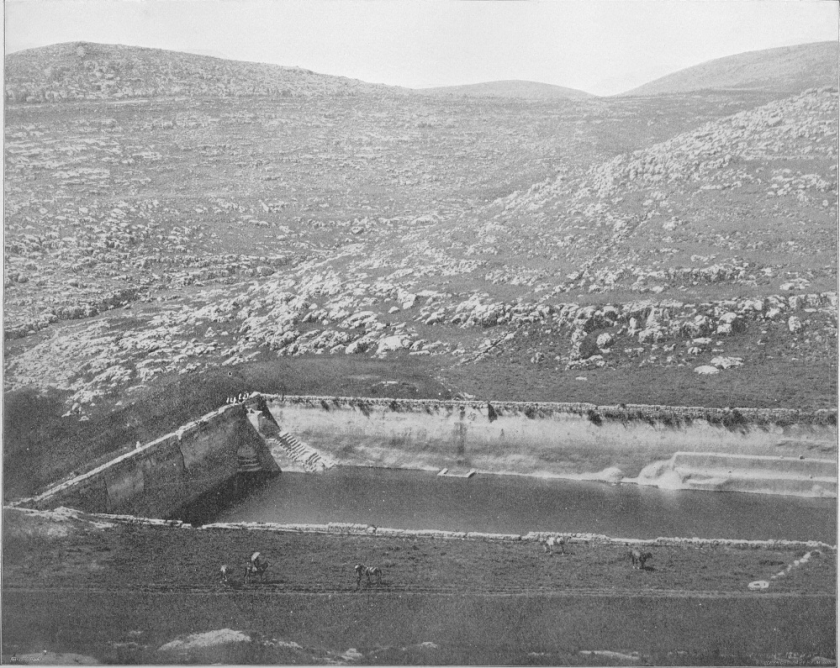
Lower pool of Solomon: ancient photo

Most of the changes that have occurred in the Middle East in Israel’s area occurred after the early 1900s when loads of immigrants resettled there subsequent to WWI. SO when you see photos of the area taken in the late 1800s and early 1900s, it’s isn’t like looking at a 100 year old photo, it’s like looking at a 1000 year old photo.

I like to look and think about when Jesus walked. The book Earthly Footsteps of the Man of Galilee contain 384 Original Photographic Views and Descriptions of Places Connected with Earthly Life of Our Lord and His Apostles, Traced with Note Book and Camera. It was published in 1894.

lower pool of Solomon.png

Here is the caption given in the book Earthly Footsteps:

‎The above view of the lowest and most extensive of the Pools of Solomon gives one an idea of the masonry used in the structure of this remarkable reservoir. Our artist stood upon a hill to the north of this pool. You may see in the picture our horses and dragoman down in the valley, and the few people at the further corner of the pool look like Liliputians. To the south beyond we see one of the Judean hills. If this reservoir were full it would float one of the largest of ocean steamers. In the narrow valley a short distance below the pools is the little village of Urtâs, with ancient ruins, which is supposed to be the Etham where Josephus says were the Gardens of Solomon. There are gardens and fountains there at this day, and it is very probable that upon those fertile slopes running down to the green cup of the hills lay the vineyards, orchards and pleasure grounds of Solomon; and he, walking through his great plantations here, may have communed with his own spirit and arrived at the solution of the problem that “all is vanity and vexation of spirit.” Perhaps here after the cares of state he “went down into the garden of nuts to see the green plants of the valley; to see whether the rose budded and the pomegranates were in flower.” Near by on the summit of her hill, “clothed with the olive, vine and figs,” sits “the little town of Bethlehem,” where in a low khan was born “a greater than Solomon,” who “opened a fountain in the house of David for sin and uncleaness.”

You can also learn more here about the Jerusalem aqueduct system.

When you study the Bible, it’s also good to look at maps, atlas, photos, and geography, as well as history so that when a verse describes activity at an aqueduct or pool, or stopping up a well, or the caves etc., you can really visualize it.

When we read the Bible we know it’s real, but sometimes tend to think that the events and people depicted are far away or even characters instead of living people. King David lived then and he lives now. Being able to have a picture in your head brings things more to mind and helps set events in context.

Posted in encouragement, Uncategorized

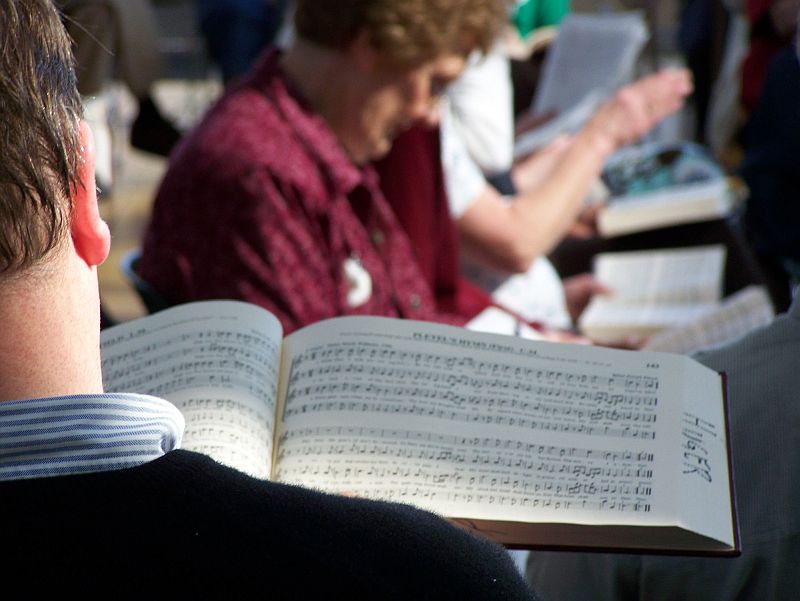
Who was Asaph?

We read the Psalms and think of David. Slayer of giants, musician, singer, King, David was a man after God’s own heart. He was multi-talented and wrote many of the Psalms, which are songs. But did you know that David wrote only half of the Psalms? Solomon, David’s son and successor wrote 2 of them. Moses is assigned authorship of Psalm 90, a prayer. The sons of Korah wrote 11 psalms while Psalm 88’s authorship is attributed to Heman, and one is assigned to Ethan the Ezrahite.

Another group of 21 psalms is ascribed to the Asaph and his descendants. Asaph is assigned authorship of Psalms 50 and 73-83. So, who was Asaph?

Asaph was a Levite music leader, leading the Tabernacle choir. (1 Chronicles 6:33, 39). His name means “to gather together” which is a great name for a congregational music leader. He is mentioned along with David as skilled in music, and of course not only did he write songs and play instruments but he was also a skilled singer. Interestingly, Asaph is also a seer, (2 Chronicles 29:30) which is a prophet who sees visions.

SEER (chozeh). Generally synonymous with the role of the prophet (e.g., 2 Sam 24:11; 1 Chr 21:9; Amos 7:12). However, at times, it is used as a distinct term from that of prophet (2 Kgs 17:13). Seer, by connotation of the Hebrew word affiliated with it being connected to the idea of receiving a vision (חֹזֶה, chozeh), may be more connected to the idea of visions than the prophetic word, although this is not necessarily the case in all usages. Barry, J. D. (2016). Seer. The Lexham Bible Dictionary. Bellingham, WA: Lexham Press.

In Psalm 73, of Asaph, we read that the author was angry and discontent with the sleekness and seeming prosperity of the wicked. He mourned their health and prosperity, and wondered if his own efforts at a narrow walk and holiness were in vain. Then comes the turning point of the Psalm at verse 16-17-

But when I thought how to understand this,
it seemed to me a wearisome task,
until I went into the sanctuary of God;
then I discerned their end
. (Psalm 73:16-17).

It is this way with us. Until you enter the prayer closet, or the sanctuary, and inquire of God, you will be disgruntled. Communing with God in prayer or song relieves the stormy heart and soothes the troubled mind.

We’re grateful that the Spirit inspired the Psalms and included them in the Bible for us to be refreshed by. We see that the human condition of faltering, wondering, coveting the wicked’s prosperous way are not new. We see also that our faithful God is always there, and can and does comfort us. As Asaph ended his Psalm,

For behold, those who are far from you shall perish;
you put an end to everyone who is unfaithful to you.
28But for me it is good to be near God;
I have made the Lord GOD my refuge,
that I may tell of all your works
.

Let us tell of Jesus’ works today.

old harp singing
EPrata photo

Posted in encouragement, Uncategorized

His Mercy is More

Our music leader introduced a new-to-us song this past Sunday. This is a new-ish contemporary hymn written by Matt Papa and Matt Boswell. I loved it. I am not a fan of new music, not because it is new, but because it is theologically light, theologically aberrant, or too hard to sing congregationally. The Boswell/Papa duo write songs that are the opposite of those negatives. This is one of the good new songs.

I positively like this song. I commend it to you.

Have a merciful day!

Live recording of “His Mercy is More”, a powerful new congregational worship song by Matt Boswell and Matt Papa. Filmed and recorded live at Providence Church in Frisco, Texas with worship leader Matt Boswell and Boyce College Choir.


VERSE 1
What love could remember no wrongs we have done
Omniscient, all knowing, He counts not their sum
Thrown into a sea without bottom or shore
Our sins they are many, His mercy is more

VERSE 2
What patience would wait as we constantly roam
What Father, so tender, is calling us home
He welcomes the weakest, the vilest, the poor
Our sins they are many, His mercy is more

VERSE 3
What riches of kindness he lavished on us
His blood was the payment, His life was the cost
We stood ‘neath a debt we could never afford
Our sins they are many, His mercy is more

CHORUS
Praise the Lord
His mercy is more
Stronger than darkness, new every morn
Our sins they are many, His mercy is more

Posted in discernment, Uncategorized

Dancing at the Pour-off

Camping is fun … as long as I don’t have to sleep on the ground, lol. In the mid 1990s my husband and I bought a WV Westphalia pop-up Camper van and we traveled across the USA at the southern tier. We fell in love with Texas, and especially Big Bend National Park.

Here we are in the Chisos campground. Yes, we brought our cat. Hiking and exploring was part of the allure, and in examining the trail brochures, one day we decided one day to hike the Window trail.

The Window Trail is a 5.5 mile lightly trafficked out and back trail located near Terlinguo, Texas that features a waterfall and is rated as moderate. The Window Trail begins near the Chisos Basin lodge, descending 800 feet over about two miles through rolling hills and vertical rock walls to a narrow pouroff, which overlooks the surrounding Chihuahuan Desert. The trail is usually dry, but the pouroff area is very dangerous during flash-floods. Source

We were strongly warned, very strongly, not to step too close to The Window, which is an opening in the mountains to a view over the desert. Very high up. The continual water at what’s called The ‘pour-off’ had smoothed the rocks at the pour-off and it was slippierer than it looked, even in dry conditions. The drop is thousands of feet.

Not my photo.”The Window is a slit in Chisos Mountain Ranges where one could
glimpse the Chihauhuan Desert plain below. ” Source

I am a bit hesitant of heights and a scaredy cat in general, so I heeded the warnings and stayed back. My husband thought it was funny to go closer and do a dance. Ha. Ha.We were warned how fast the fall could happen, even if you’re wearing appropriate footwear. The rocks are smooth as glass, they provided no traction and no grip. It was pure luck he didn’t fall.

~~~~~~~~~~~~~~~~~~~~~~

When you’re saved, your eyes are opened and you realize there is no such thing as luck. The LORD has numbered the days of each person on earth. We are immortal until that day arrives. However, the walk is still slippery. Any Christian could fall at any time, me included. And unlike in other life experiences where the longer you go the easier it gets due to your accumulated experience, in Christian life, the longer you go the harder it gets.

This is because we increasingly mourn over our and others’ sin. Or we get casual and then comes Jesus’ chastisement in order to grow us. Or we love people more and become sensitive to their burdens. There are lots of reasons why life with Jesus grows sweeter, but harder.

The Bible warns of the way of the slip. He who thinks that apart from Jesus he has sure footing is likely due for a slip. These verses make it clear that our ultimate security in Christ is permanent, but our walk is fraught with temptations and dangers. Take care not to temporarily slip.

They will lift you up in their hands, so you will not slip and fall on a stone. (Psalm 91:12)

My steps have held fast to Your paths. My feet have not slipped. (Psalm 17:5)

He will not let your foot slip– he who watches over you will not slumber; (Psalm 121:3).

For all that, Paul warns the Christian,

Therefore let anyone who thinks that he stands take heed lest he fall. (1 Corinthians 10:12)

I think of the dance at the edge of The Window where the pour-off was so slippery. Do we treat sin that way? Dance up to the edge of it, abusing God’s grace and tempting the devil?

We have to do our part. Resist sin, follow His commands. A true Christian can never irrevocably fall from grace, but we can slip and fall into sin. Over-confidence can be an enemy.

Let no one say when he is tempted, “I am being tempted by God”; for God cannot be tempted by evil, and He Himself does not tempt anyone. But each one is tempted when he is carried away and enticed by his own lust. (James 1:13-15).

I was listening to Martyn Lloyd Jones yesterday. He was talking about the simplicity of the Gospel and clarity of the Gospel life. Sometimes we over-complicate things, making them out to be more opaque than they are. Life in Christ is simple, very simple. Resist sin, do not tempt it, and heed the Bible’s commands.

If you do well, will you not be accepted? And if you do not do well, sin is crouching at the door. Its desire is contrary to you, but you must rule over it. (Genesis 4:7).

Posted in encouragement, Uncategorized

The House on the Rock

The Ocean State is aptly named Growing up in Rhode Island in the 1960s was a fun experience. The nation’s smallest state is beautiful and the ocean and bay is never far from anyone who lives there. We happened to live just a few miles from the ocean and most Sundays we took a drive south to Saunderstown, crossed the Jamestown bridge, and then took the ferry to Newport. Dad would drive us around the island on Ocean Drive past all the mansions, and then we’d have a picnic by the sea at the Park.

There was no Newport Bridge at that time. On the bridge and the ferry, we passed boats, the islands with lighthouses, and other sights. One sight always captured my attention.

Clingstone.

Clingstone
Source. CC BY-SA 4.0

Clingstone is a house built in 1905, perched atop a small, rocky island in an island group called “The Dumplings” in Narragansett Bay, near Jamestown, Rhode Island. It withstood the devastating 1938 Hurricane, (though was damaged) faced other hurricanes, storms, decay, renovation, and more. The house is known by locals as “The House on a Rock”.

Even to my young eyes the house looked strong. I mean, it’s built on a rock! I often wondered what it was like to live there.

I don’t have to wonder any more what it is like to build my house on the rock. In His grace, He saved me and taught me to cling to the rock. I have my own Clingstone now. Isn’t it funny how life goes. Jesus, who was so far from my mind for over 40 years, is my All in All now. The little girl with big eyes looking at the House on a Rock, has one of her own now.

The verses below are familiar but please slow yourself and read them carefully. Then really think about it for a minute, before you go on to other things. The verses are soul-soothing. Be encouraged.

Everyone then who hears these words of mine and does them will be like a wise man who built his house on the rock. 25And the rain fell, and the floods came, and the winds blew and beat on that house, but it did not fall, because it had been founded on the rock. (Matthew 7:24-25).

Posted in encouragement, Uncategorized

What Does Prayer Do?

Sometimes we pray and we feel energized and sense that the presence of the Lord is close by. Other times, we feel dry and cracked, parched. We feel that the Lord is distant.

He is always near, of course. (Psalm 145:168). How we feel about it or what we sense doesn’t matter much and doesn’t alter the fact that He is always near. (Psalm 34:18, Matthew 28:20).

However sometimes these feelings do tend to color and tinge our communion with Him. We’re human. That means we’re sinful and we have an inclination to follow our deceitful heart with its emotions, rather than in trust and knowledge of the faith in God and His promises.

rejoice in hope prayer

What does prayer do, actually? Whether we feel Him near or whether we don’t, prayer is prayer and it avails much when uttered from a righteous man. (James 5:16).

1. Prayer combats discouragement.

The conclusion is clear: therefore confess your sins to each other and pray for each other. A mutual concern for one another is the way to combat discouragement and downfall. The cure is in personal confession and prayerful concern. Source: The Bible Knowledge Commentary: An Exposition of the Scriptures

2. Prayer gives strength both spiritual and sometimes physical.

In times of affliction Christians are to pray to God for help and strength. In times of blessing believers are to praise God instead of congratulating themselves (5:13b). In instances of critical sickness the sick person was to summon the leaders of the church for prayer. Prayer for the sick could result in either physical healing or spiritual blessing. In times of sin and struggle mutual intercession could promote spiritual victory. Elijah prayed with such force that God withheld rain from the earth for three and a half years and gave it again at his request. Source: Holman concise Bible commentary

3. Prayer gives us good gifts.

Don’t shrink from this. We are told we have a Father who gives good gifts to His children. (Matthew 7:11). If we do not have good gifts it is because we do not ask. (James 4:2b).
Spurgeon spoke eloquently of Achsah, daughter of Caleb, who asked.

She was newly-married and she had an estate to go with her to her husband. She naturally wished that her husband should find in that estate all that was convenient and all that might be profitable. And looking it all over, she saw what was needed. Before you pray, know what you are needing. That man, who blunders down on his knees, with nothing in his mind, will blunder up, again, and get nothing for his pains. When this young woman goes to her father to ask for something, she knows what she is going to ask. She will not open her mouth till first her heart has been filled with knowledge as to what she requires.

4. Prayer is part of the process the Spirit uses to transform our minds. (Romans 12:2). People can externally exhibit morality as if they’d put it on as a garment, without having their minds transformed as the mind of Christ. The new creation is not just a new soul, but a new mind so that we can think in righteousness and in truth. Prayer helps this transformation along.

What then do we do in obedience to Romans 12:2, “Be transformed in the renewal of your mind”? We join the Holy Spirit in his precious and all-important work. We pursue Christ-exalting truth and we pray for truth-embracing humility. … And form the habit of meditating on the perfections of Christ. And in it all pray, pray, pray that the Holy Spirit will renew your mind, Piper, The Renewed Mind

5. Prayer nourishes us.

Prayer is the way that the life of God in us is nourished. Our common ideas regarding prayer are not found in the New Testament. We look upon prayer simply as a means of getting things for ourselves, but the biblical purpose of prayer is that we may get to know God Himself. Oswald Chambers, The Purpose of Prayer

6. Prayer is a love offering to Christ.

“But” someone says, “I don’t feel that I have any special things to pray about.” Ah! My dear friend, I don’t know who you are, or where you live, to not have any thing to pray about, for I find that every day brings either a need or trouble, and that I have every day something to ask of my God. But if we still insist that have no troubles, that we have attained to such a level of grace that we have nothing to ask for, then I ask, do we love Christ so much that we have no need to pray that we may love him more? Spurgeon, True Prayer-True Power

Of course there are many, many more ways that prayer works in us, in our lives, and as a method of communion with God. What are some ways you can think of?

————————————————-

Further resources:

The Hidden Life of Prayer, free online book by David MacIntyre (1859-1938)

The Hidden Life of Prayer PLUS study guide and 8-week free course

4-part Sermon series, John MacArthur, Elements of True Prayer

Valley of Vision, excerpt from

The Prayer of Love
Grant me more and more
to prize the privilege of prayer,
to come to thee as a sin-soiled sinner,
to find pardon in thee,
to converse with thee;
to know thee in prayer as
the path in which my feet tread,
the latch upon the door of my lips,
the light that shines through my eyes,
the music of my ears,
the marrow of my understanding,
the strength of my will,
the power of my affection,
the sweetness of my memory.