Posted in encouragement, Uncategorized

Various exhortations: Luther on tickled ears, suffer the children to come, be not troubled, etc

Various biblical thoughts for you today-

Jesus said in the Olivet Discourse that the end times will be such as they were in the ‘Days of Noah’ and the ‘Days of Lot.’ (Luke 17:26-30, NIV; cf. Matt 24:37-39). That, in the mad search for pleasure and prosperity, mankind sank into such great depravity, the Scripture says, “every imagination of the thoughts of his heart was only evil continually” (Genesis 6:5; cf. 18:20-21). Further, Jesus said social wickedness would increase prior to His Return: “Because of the increase of wickedness, the love of most will grow cold” (Matthew 24:12, NIV). A thoroughly drenched, wicked and evil society was happening then and it’s happening now. is occurring now. In the Ark days, Noah held his eyes on God and remained rooted in Him. We must do that as well.

—————————————-

In prayer and bible reading mode this week, the phrase came to me: “Be not troubled.” Prayer and close relationship with Jesus alleviates our strongest fears, troubles, distress. Let us always exhibit the peace that passes all understanding in the face of incomprehensible headlines. And then share that peace with urgency and mindfulness with people who have no hope. He will come. Until then, we run the race.

—————————————-

I used to teach kids at church on Wednesday nights. I love their conversations and their thoughts and their joy. One night they were asking about Jesus and heaven. They got so excited when they figured out that their Christian friends will be in heaven too. They practically jumped out of their seats when they made the connection that they will actually see Jesus and hang out with Him. They started making plans, clapping their hands … Ironically, the story this night was of Mark 10:13-16, “suffer the little children to come unto Me, do not hinder them, for the Kingdom of God belongs to such as these.” Boy, does it ever. Let US be excited, innocent, planning, expectant, too. Are we? We should be!

Do you feel joy? Do you feel fear? It is normal to be anxious in these times, but oh, joy, bathe yourselves in His Holy and experience all the comfort of eternity in there. I recommend reading Psalm 34 yesterday and it is very good advice! If you feel caught up in the events of the day, remember that He is in command if every situation. As is often said, “Satan is on the prowl, but Jesus in in control!” Take a bath, friends, bathe in His word, and you will feel His arms and return to the blessed peace that is our to claim by His grace!

—————————————-

Martin Luther said:

“The ears of our generation have been made so delicate by the senseless multitude of flatterers that, as soon as we perceive that anything of ours is not approved of, we cry out that we are being bitterly assailed;” This same theme of tickled ears carries through to the end generation, the one living through the reign of the antichrist.

—————————————-

Christians know true freedom, whether incarcerated within walls or confined by duties or confronting an addiction, we are free, truly free. “It is for freedom that Christ has set us free. Stand firm, then, and do not let yourselves be burdened again by a yoke of slavery.” Galatians 5:1.

—————————————-

DSCN1739praising god
EPrata photo
Posted in discernment, Uncategorized

Tips and resources on using Social Media

social-media-2636256_960_720
Photo Pixabay ,CC

Do you feel trapped by social media? Does it make you sad, or anxious? Do you waste time? Many people say yes to all of the above.

I like social media. I have an account at Pinterest, Twitter, 2 Facebook pages- (a theological page and a personal page), two blogs (one theological and one personal) and an Instagram. My personal blog is 11 years old, my theological blog is 9 years old. I have 4,325 essays at my theological blog.

I am also on GroupMe, a mass group text messaging service. LOL I obtained my very first cell phone last month, solely for the purposes of calling AAA when my car breaks down (and is always does) and to receive church messages. I have photo accounts at Flickr and Unsplash. My account at Flickr is 11 years old and I have 1,936 pictures there. Unsplash is newer. I joined when it began, three years ago.

So you can see that I enjoy social media, to say the least. But then again, I have a lot of time, being unmarried without children. I like to stay-at-home and use the internet for witnessing in discrete and selective quantities. (I also attend church, go to small groups, disciple, and witness in real life, to be clear.) I also use it for my entertainment, having no television.

I’m old enough to remember when the internet didn’t exist, and it was hard to get your message out. I mean in that era when I was unsaved, my message was my secular writing. It was hard to break the gates of publishing in the 80s and 90s. So when self-publishing on blogs and such came along in the 2000s, I was thrilled. No gatekeepers except my conscience.

Being unsaved for most of my early adult life, until age 43, I didn’t have a Jesus message to share. But now that there are so many venues to share about Him and learn about Him from others’ social media pages, I enjoy using it all for that purpose. I like being able to get the message itself out more widely. Therefore, I have a goal, to use social media as a platform to share the beauty and truth of Jesus Christ. I use it to encourage, exhort, teach, and edify. I use it to learn from others.

Even then, I still have to limit my use of it. Temptations abound! I think long and hard about who I am going to ‘Follow’ or ‘Friend’. I do not want excessively negative things passing before my eyes. I liked when FB implemented an option to mute friends, that is, not to unfollow them but to not see their posts. I don’t like to see continual political posts. I won’t look at abortion photos. I won’t follow someone rambunctious or rebellious. Constant ‘woe is me’ pity parties get a mute.

As for my ministries, I also work to get the me-centeredness out of my fingers typing, and stick with my goal and plans: focus on saying something scriptural, something positive about Jesus, and something encouraging to my friends and church members every day. If I don’t, what is the point of all these social media accounts?

Still with all that social media can be very depressing. Often, it displays the worst of man, unsaved and saved. Here are four essays that I hope will help bring perspective and encouragement regarding social media.

~~~~~~~~~~~~~~~~~~~~

Social media requires a different kind of brain work than does sitting for long periods with a book. Personally I think the two kinds of reading are at odds. I strive to maintain the ‘book reading’ skills I’d taken for granted most of my life. I do feel a negative impact in this area from social media use. So does Michael Harris:

I have forgotten how to read

For a long time Michael Harris convinced himself that a childhood spent immersed in old-fashioned books would insulate him from our new media climate – that he could keep on reading in the old way because his mind was formed in pre-internet days. He was wrong

Some people take long breaks from social media, or take the drastic step of abandoning it altogether. Here, Aaron Armstrong has some tips for using (or not using):

You don’t need social media (even if your brain tells you otherwise)

This weekend, my wife and I spent a great deal of time talking about social media—specifically how she responds to it. For a few years she was on Facebook, up until a particularly negative incident led her to abandon it.

In the old Bulletin Bard days (with 300 baud, remember that? lol) something called “flame wars” would erupt. That’s just internet lingo for people fighting online. Arguments are easier online because we forget there are actual people on the other side of the screen. Somewhere. Flame wars ignite on Twitter, Facebook…anywhere there are people. Here, Michael Coughlin reminds us at Things Above Us that

You Don’t Have To Enter Every Argument You’re Invited To

Everyone you meet is made in the image of God. Thus, each person you encounter has a level of dignity because of his or her Creator, and you are responsible to treat folks with respect as a consequence of this fact.

I was a journalist for almost 6 years. I hunted stories, dug up stores, investigated, published. Of course, a reporter is driven to get the story first. That drive still ignites me when a major even happens, but as a Christian, even a Christian ex-reporter/now-blogger needs to hold back and ‘consider these things’ first. And pray. When everyone is jumping on the bandwagon is takes maturity, patience, and wisdom to know when to speak and when not to speak. Not everyone needs to know my opinion. But then again, if we have some insight that might help a local body, then by all means publish. The wisdom is to know which to do when. Chris Martin has a few ideas for us.

3 Ways NOT to Use Social Media Immediately Following a Tragedy

I made a concerted effort to stay off of social media most of this past weekend because I was already a bit exhausted at a lot of the response I was seeing to the tragedy last Wednesday. … I should say before I continue, what follows are my opinions. These suggestions are not stone-cold social media sins. So, take them as you will. Here are three ways NOT to use social media immediately following a tragedy:

Posted in Uncategorized, encouragement

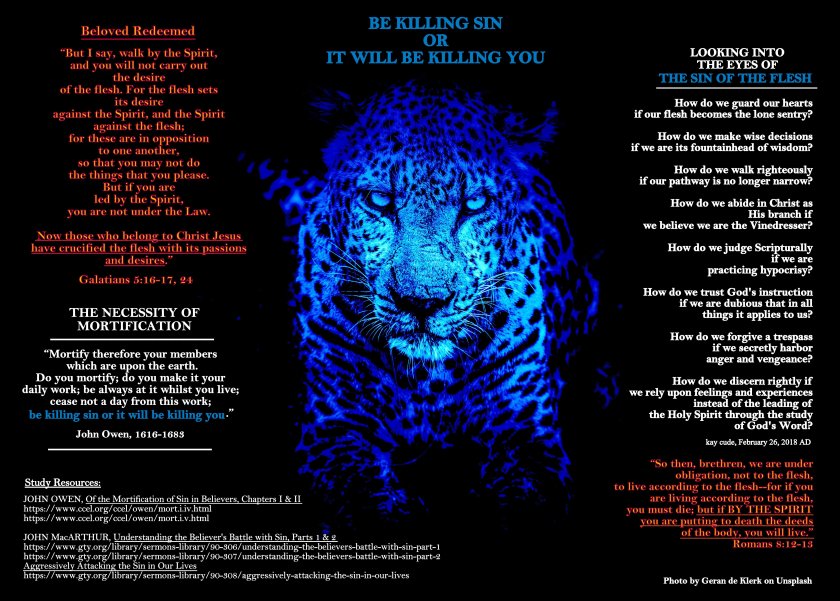
Killing sin, Kay Cude poetry, and John Owen

Killing sin in ourselves is a tricky and delicate operation. How to slice marrow from bone without damaging the bone? The Holy Spirit is in us and He is the glory and purity we need, but surrounding Him inside us is all our depravity. We are so dark inside that often, we can’t even see our sin!

Puritan John Owen wrote a monumental book addressing this very issue. It’s called The Mortification of Sin. (1656). Mortification means, “The action of subduing one’s bodily desires.”

Owen wrote another monumental book called The Nature, Power, Deceit & Prevalency of Indwelling Sin In Believers. (1675). They are scriptural, convicting, towering books of the faith. They are also dense, difficult, and full of antiquated language. Sadly, for many people these books aren’t read, because they are just too difficult.

But they need to be read. To that end, Kris Lundgaard wrote a book called The Enemy Within. He said that reading Owen was difficult but he stuck with it. He said he benefited greatly from Owen’s treatment of sin in us, our sin nature and the Christian’s duty to slay it. He knew though, that the many Christians would likely not read Owen, of if s/he started, would probably give up. It’s a slog. (I can testify to that, I tried to read Mortification of Sin and stopped).

Fervently believing that the important treatment of killing sin in ourselves, principles Owen had outlined in his book, should be available to the widest audience, Lundgaard wrote a sort of Cliff’s Notes to the Owen book on Indwelling Sin. It’s an adaptation of Owen’s work, modernized and synopsized. Hence his title, The Enemy Within. This and other books by Lundgaard are –

adaptations of works by English Puritan John Owen [1616-1683]. Someone has suggested these books should be subtitled: “John Owen for Dummies” (not to be confused with John Owen’s original works that simply make most of us feel like dummies).

I had to read with a dictionary in one hand and Owen in the other, and until I got the hang of his style I had to read many sentences several times over. But the value of Owen had been undersold: I was underlining more than half of every page. In his works on Temptation, Indwelling Sin, and Mortification, my heart was being laid bare. How did he know me so well?

But he didn’t just cut me up and leave me to pick up the pieces. He offered help, strong medicine—lots of strong medicine. And by God’s grace things began to change for me. I’ll always be grateful to Owen for that—I hope to tell him so when I see him.

Owen’s ability to exegete my heart overwhelms me. He exposes my flesh’s defense strategies, which leaves me vulnerable—vulnerable to the gospel. He doesn’t just tear down; he builds up. And he helps me to see Christ more clearly, so that I may adore him more fully. Lundgaard in an interview with Tony Reinke

I have read half Lundgaard’s book. I’m 6 1/2 chapters into a 13 chapter book. It’s highly readable, and it’s helpful. It actually makes me want to read Owen! I’ve got both of Owen’s books queued up at Amazon for purchase. Killing sin in ourselves, an essential subject.

Meanwhile, my friend and poet Kay Cude had sent me her latest piece. She didn’t know I was reading The Enemy Within. The topic of her poem is about indwelling sin. How perfectly providential! She wrote,

A “take heed” to my fellow beloved redeemed in Christ from my personal experience of walking in the flesh and being caught in its snare. The immediate results were heart-wrenching and slammed me to my knees. And that is good place from where to repent and examine myself as I look up into the face of the forgiveness and mercy of God.

I was quite taken by her poem. This is a wonderful piece of poetry inspired by scripture reading and life application. Please take a moment to bask in this quality work. There are further resources at the bottom of the picture.

geran-de-klerk-546769

Kill your sin, or it be killing you.

Posted in prophecy, Uncategorized

Prophecy: The restrainer and salt

Now concerning the coming of our Lord Jesus Christ and our being gathered together to him, we ask you, brothers, 2not to be quickly shaken in mind or alarmed, either by a spirit or a spoken word, or a letter seeming to be from us, to the effect that the day of the Lord has come. 3Let no one deceive you in any way. For that day will not come, unless the rebellion comes first, and the man of lawlessness is revealed, the son of destruction, 4who opposes and exalts himself against every so-called god or object of worship, so that he takes his seat in the temple of God, proclaiming himself to be God. 5Do you not remember that when I was still with you I told you these things? 6And you know what is restraining him now so that he may be revealed in his time. 7For the mystery of lawlessness is already at work. Only he who now restrains it will do so until he is out of the way. (2 Thessalonians 2:1-7).

I posted the full passage so that you can read the main verse under discussion today in context. For the mystery of lawlessness is already at work. Only he who now restrains it will do so until he is out of the way.

The Second Letter to the Thessalonians was a very early letter. Paul wrote it in about AD 51, just a few months after he had written his first letter to the church at Thessalonika. In his first letter to the Thessalonians, Paul had obviously spent some time teaching the new Christians in their new church about the end times. Now, there’s proof positive that eschatology is not only for the mature, nor is it a marginal doctrine to be learned after all the other, more important doctrines have been taught. Paul launched right in to teaching about the rapture and the Day of the LORD (The Tribulation) to the newest Christians. He reminded them in the 2nd letter about the important points, probably to refute false teachers who had come in to tell the Thessalonians that the Day of the LORD had come.

dr nathan busenitz

By the way, this is another proof the rapture will happen before the Tribulation. If the sequence of events was that the rapture happens at the end of the Day of the LORD, why were the Thessalonians so concerned and sought Paul’s advice? They should have been happy. And encouraged.

Why did Paul have to calm them down and remind them of what he had already taught? And further, the pre-tribulation rapture was supposed to be an encouragement. (1 Thessalonians 4:18) if the sequence was post-tribulation rapture then they should have been encouraged, not concerned, becuase it was almost here.

Today’s verse involves the One who restrains. In the passage above, Paul is describing someone who is powerful enough to restrain the man of Sin (antichrist) and to restrain sin itself. Who is powerful enough to do that? No human, certainly. The Holy Spirit.

Paul is saying here that when the Holy Spirit ceases His ministry of restraining sin, the Man of Perdition will be revealed. The Tribulation will come into full swing.

Barnes’ Notes describes the restraining ministry’s effect:

It was some power which operated as a check on the growing corruptions then existing, and which prevented their full development, but which was to be removed at no distant period, and whose removal would give an opportunity for these corruptions to develop themselves, and for the full revelation of the man of sin.

Did you ever stop to think about the restraining power the Spirit does while He is inside of us,the Church, while we are on earth?  We hear people say that America is or was “A Christian Nation.” No, we never were. But it seemed like we were because so many people were Christians. Many of those were not, of course, but they modeled the precepts and behaved morally because so many other Christians were around. They might have had poor motivations to behave as a Christian, for business purposes, or for a social network, of for help with provision, but nevertheless, they adopted an external morality because that was the way to get along in society. Cultural pressure was brought to bear. The real Christians acted as salt.

We see this in 2 Corinthians 10:15. “We do not boast beyond limit in the labors of others. But our hope is that as your faith increases, our area of influence among you may be greatly enlarged,” When the crisis at Corinth as resolved, Paul expanded the ministry to new areas.

Salt is preservative holding back decay. We are that salt. Each Christian with the Holy Spirit in him or her, acts as salt in the world. Salt prevents flesh from putrefying. When the Holy Spirit ceases His major ministry of restraining sin, and then He takes us out of the world in the rapture, each of us as a little salt crystal-Christian will disappear. There will be nothing left to stop the remaining flesh from corrupting. When we are removed the sin of the flesh will blossom, and quickly.

To be sure, the Holy Spirit is the power. We’re not. But us as little salt sprinkles around the world…when we AND the Spirit are removed out of the way, pow! Sin will be unrestrained in the world. Just think on it.

salt

Posted in encouragement, Uncategorized

Hate Week Essay #7: Hating Jesus, once


Hate week essay #1
Hate week essay #2
Hate week essay #3
Hate week essay #4
Hate week essay #5
Hate week essay #6

For we also once were foolish ourselves, disobedient, deceived, enslaved to various lusts and pleasures, spending our life in malice and envy, hateful, hating one another. Titus 3:3

I was saved in my early 40’s. I vividly remember my antipathy toward Jesus for most of my adult life. I conceded that there was likely a God, that part was easy. Just look at the Creation. It’s obvious someone made it all.

A distant God who didn’t meddle in my affairs, but was intelligent, provided this earth to dwell on, and was amiable in His looking down at us was the God I’d made up in my mind.

The notion that God judged, was involved in our affairs, and created heaven and hell as well as earth, was unconscionable to me. I was a good example of the people described in Romans 1:21.

The Jesus, blood, sin, wrath, resurrection thing was beyond me. I thought the cross was ridiculous and gross. I wanted nothing to do with any part of the Jesus story. I hated Jesus with all my body, soul, strength, and mind. As a result, I hated others too, as the verse says. This world is full of haters, the satanic hatred only the unregenerate, darkened heart knows.

I was a terrible sinner, going about my sins, cherishing them, justifying them, and loving them. I hated Jesus and I loved my sin. I hated others, as the verse today states.

Thus, unbeknownst to me, I had many woes laying on my shoulders, for doesn’t the scripture say-

Woe to those who call evil good and good evil, who put darkness for light and light for darkness, who put bitter for sweet and sweet for bitter! (Isaiah 5:20)

I was in this wretched state when in His timing, God sent the Holy Spirit to open my eyes. I suddenly saw my sin and it was terrible. I cried out to God, yet He had even given me the voice and the urging to do it. Though I’d spent so long in the wilderness, darkened and debased, He loved me. My hate for Him was deep and abiding, but His love for me was everlasting.

Anyone who is saved now hated Jesus once, also. In our daily lives we often get so busy that we forget this great love and our former great hate, at least I do. Would you love anyone who hates you outright? My goodness, that’s a tough one. We’re called to, but actual implementation of it, even to our death, is something that mystifies me. Yet Jesus did it. He lay down His life for His friends, gave himself totally to His Father for our benefit. He died for people who hated him with a worldly, satanic hate.

Let our hate go. We should harbor none of it in ourselves after salvation. We should only hate the things that Jesus hates. As our sanctification grows, our worldly hatreds diminish because love increases. The scale should be moving in the other direction. Giving up worldly hatreds is hard, but look at the sweet exchange. We can all cry out as David did,

Remember not the sins of my youth or my transgressions; according to your steadfast love remember me, for the sake of your goodness, O LORD! (Psalm 25:7)

prickly 7

Hate week essay #1
Hate week essay #2
Hate week essay #3
Hate week essay #4
Hate week essay #5
Hate week essay #6

Posted in discernment, Uncategorized

Hate Week Essay #6: When will we hate Jesus? Answer inside

No one can serve two masters, for either he will hate the one and love the other, or he will be devoted to the one and despise the other. You cannot serve God and money. (Matthew 6:24)

Jesus is an all-or-nothing proposition. This is because He is all. He is the all in all (Colossians 3:11). He is everything good, He is sufficient. Nothing should compete with Him. Hence the warning about two masters.

Barnes’ Notes on the Bible

No man can serve two masters … – Christ proceeds to illustrate the necessity of laying up treasures in heaven from a well-known fact, that a servant cannot serve two masters at the same time. His affections and obedience would be divided, and he would fail altogether in his duty to one or the other. One he would love, the other he would hate. To the interests of the one he would adhere, the interests of the other he would neglect. This is a law of human nature. The supreme affections can be fixed on only one object.

Please be aware of any growing idols in your (and my) life, whom you (and I) are serving. We cannot have two masters else we will hate the one. Jesus is too precious to risk hating Him, even if for a short while before realizing and then repenting.

Answer to the Title’s question: We will hate Jesus when we serve another master.

prickly 6

Posted in encouragement, Uncategorized

Hate Week Essay #5: Jesus said to hate our family? Can this be true?

If anyone comes to me and does not hate his own father and mother and wife and children and brothers and sisters, yes, and even his own life, he cannot be my disciple. (Luke 14:26).

This seem harsh. This seems contradictory to the God of Love that we know Jesus to be. So what can it mean?

By the way, that its the first question we should ask when we see something we don’t understand in the Bible, or when we see something that seems to contradict. There are no contradictions in the Bible. If we can’t reconcile two verses, i.e. ‘God is love’ and ‘hate your mother’ or ‘Honor your mother and father’ but ‘hate your mother’ then there is something I must do to understand it, because I’m wrong.

I like Gill’s Commentary. Many commentaries are available for free at biblehub.com. There are concordances, lexicons, devotionals, and more.

Gill’s says of the Luke verse:

and hate not his father and mother, and wife and children, and brethren and sisters, yea, and his own life also, he cannot be my disciple: not that proper hatred of any, or all of these, is enjoined by Christ; for this would be contrary to the laws of God, to the first principles of nature, to all humanity, to the light of nature, to reason and divine revelation:

but that these are not to be preferred to Christ, or loved more than he, as it is explained in Matthew 10:37

Ohhhh! Getting clearer now.

A parallel verse was mentioned so let’s take a look at it. Scripture interprets scripture. Commentaries are helpful, but scripture is best. That’s where parallel verses come in.

He that loves father or mother more than me is not worthy of me: and he that loves son or daughter more than me is not worthy of me. (Matthew 10:37)

Christ should be primary in life and love. Paul carries this sense of highest love for one, that by comparison it’s hate for the other in Romans 9:13-

As it is written, “Jacob I loved, but Esau I hated.”

The verse to which Paul was referring is from Malachi 1:2-3. GotQuestions is helpful here,

So, considering the context, God loving Jacob and hating Esau has nothing to do with the human emotions of love and hate. It has everything to do with God choosing one man and his descendants and rejecting another man and his descendants. God chose Abraham out of all the men in the world. The Bible very well could say, “Abraham I loved, and every other man I hated.”

Yes, context is king when studying scripture. The Malachi/Romans verse isn’t referring to one man, but nations from one man.
There’s one more parallel verse to the Luke verse I’d posed at the start. John 12:25-

Whoever loves his life loses it, and whoever hates his life in this world will keep it for eternal life.

S Lewis Johnson of Believers Chapel Dallas had preached on this verse. He’s a preacher I like.He explained

What does he mean by that? Why, you know he means that it is possible for us to be so desirous of life as we want to live it that we actually are unfruitful in our lives. We may desire the kind of existence that we desire, we want the world’s wealth, we want the world’s power, we want the world’s pleasure, we want the world’s glory, we want to live our lives as we wish to live them and that’s right, you may live for a time but you abide alone. … In other words, if you want to keep your life you can keep it, but you’ll lose it. And if you’re willing to lose your life, if you are willing to have your set of priorities such that Jesus Christ is first in your life, then you’ll gain it. And furthermore, you will gain it unto life eternal and fruitfulness.

Hate is complicated, isn’t it? There’s things God hates, things we should hate because God does, the world’s hate, our hatred of even our parents or our own life in comparison to the life we should live in Christ…

The Bible is an endless wealth and treasure of precepts and doctrines, all pointing to the One alone who is worthy: Jesus Christ. Emmanuel, God with us. Our love for Him should be the primary orientation of our lives.

prickly 5

Posted in encouragement, Uncategorized

Hate Week Essay #4: Hate Equals Darkness

Whoever says he is in the light and hates his brother is still in darkness. (1 John 2:9)

What does this mean? Can we hate our brother if we’re saved? I thought our lives were supposed to be characterized by love?

Yes, that is true, but the sin nature is still inside us, crouching at the door and waiting to leap. Since our lives are supposed to be characterized by love, our lives should reflect the highest and best love: love for Jesus and love for our brethren. Sadly, it doesn’t always happen that way.

Else, as Paul put rhetorically but actually to the Corinthians,

For I fear that perhaps when I come I may find you not as I wish, and that you may find me not as you wish—that perhaps there may be quarreling, jealousy, anger, hostility, slander, gossip, conceit, and disorder. (1 Corinthians 12:20)

Else, why would Jesus and Paul admonish those who take the Lord’s Supper to reconcile with brethren or examine one’s self before doing so, in order that taking the Supper would not be done in an unworthy manner? (1 Corinthians 11: 27; Matthew 5:23-24).

Jamieson-Fausset-Brown Bible Commentary puts it simply

his brother—his neighbor, and especially those of the Christian brotherhood. The very title “brother” is a reason why love should be exercised.

The command to love one another is an old one, says John in 1 John 2, but with a new twist. John uses the analogy of light and dark throughout his epistle. The command to love is nothing new, but it is a specific and foremost spiritual test to determine who is in the faith and who is not. John MacArthur here in his sermon Live Life By a New Love:

If you hate your brother, if you hate others, if you hate those in the Kingdom, if you hate anyone essentially, if you don’t see people the way God sees them then He’s not in control of your heart. Love proves everything when connected to sound doctrine.

But in 1 Corinthians 15, if you don’t have love it’s all noise, it’s all noise. So the practicality of it is, if you’re a true Christian it’s going to show up in your love, not perfect love, love is not going to be the perfection of your life but it will be the direction of it. You’re going to have a heart of love for those around you, not a heart of hatred. You’re going to want to serve those around you, not demand from them. You’re going to want to help those around you, not harm them. You’re going to want to come to the aid of those around you, to lift them up not to step on them. And particularly is that true among believers. If you don’t have a love to be with God’s people, it’s a clear evidence that you’re in the darkness no matter what you claim.

The Light is warm and bright, it’s where love is.
prickly 4

Posted in Uncategorized

Is Billy Graham in heaven? (Updated) By Elizabeth Prata

Update: I added a link to a video and a book review. Both involve Iain Murray’s book Evangelicalism Divided: A Record of Crucial Change in the Years 1950 to 2000.

The book is a historical record of the ecumenical movement in the United States and Great Britain in the latter half of the twentieth century. In it, Murray traces the developments in the ministries of several key figures in the era, most notably Billy Graham, J.I. Packer, and John Stott. His conclusion is that because of a desire to have a place at the table of ecumenical discussion, a long series of what seemed at the time to be relatively innocuous decisions eventually blurred the bright line that marks out what it means to be a Christian.

Graham has much to do with the divide, having been an active ecumenical preacher for most of his life. Graham’s legacy impacted much of the evangelical world for half of the last century. Please read the review, the book, or watch the video. It’s highly interesting.

Book review: https://www.9marks.org/review/evangelicalism-divided-iain-murray/
Video Evangelicalism Divided

———————–original essay——————————
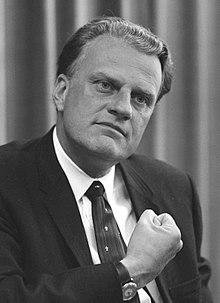
220px-Billy_Graham_bw_photo,_April_11,_1966Billy Graham, aged 99, has passed away. Best known for his itinerant global evangelism, his Decision Magazine, his Billy Graham Evangelistic Association, and the popular radio show Hour of Decision from 1950 to 1954, Graham spent his life preaching to the masses.

He developed mass evangelism events that came to be known as “Crusades”. His first major outdoor preaching Crusade occurred in Los Angeles in 1949, with 350,000 attending over 8 weeks. Afterward, when Singer-songwriter Stuart Hamblen announced on air that he had been converted, national newspapers and radio personalities perked up over this new fiery preacher. Newspaper Magnate William Randolph Hearst telegrammed his editors across America to “puff Graham” meaning, to write pleasant and complimentary features on Graham in order to promote him. As a result, Graham rapidly became a coast-to-coast figure. His fame and name only increased since that moment to within five years, Graham was featured on the cover of the national magazine of Time, an enormous honor for a personality in the public eye for so short a period. He retired from public Crusades in 2005.

Graham perfected the ‘aisle walk’ introduced by Charles Finney, usually to the tune of Just As I Am. At the conclusion of the music and preaching, Graham invited those who were seeking to “accept Christ” to stream down the aisles and speak to counselors in the front. There, they would receive further information or answers to their questions. Some would ‘decide’ to become Christian there on the spot.

Graham was also the author of what is now known as The Billy Graham Rule, a short version of his original Modesto Manifesto. The Manifesto was a white paper generated by Graham and his inner circle outlining a rigid set of rules to which the association would adhere as they traveled the road with the Crusade, so as to encourage accountability and limit temptation of all kinds, sexual and financial, foremost. The rules were:

  1. The Graham team would avoid any appearance of financial abuse.
  2. They would exercise extreme care to avoid the appearance of sexual impropriety.
  3. They would cooperate with any local churches that were willing to participate in a united evangelism effort.
  4. They would be honest and reliable in their publicity and reporting of results and
  5. never argue with local journalists reporting about the numbers of participants in the crusades.

Through 2016, Gallup Poll’s “Most Admired Man and Woman Poll” showed Graham with 60 appearances in the top 10, the most of anyone, with eight second-place finishes.

——————————————

The above is the Billy Graham the world knows. It is the Graham most of the evangelical world knows. But the truth is available and it’s public and can be seen by those willing to look.

Mr Graham no doubt preached with fervor and intensity, at least in the early days, However soon enough, as early as 1952-54, he began to compromise his message. Some say it was even before that, when Roman Catholic Bishop Fulton Sheen took a young Graham under his wing in 1944. In 1954 Graham spoke to the Liberal Union Theological Seminary in NY, repeatedly calling his ministry “ecumenical”. By 1957 Graham’s split from conservative fundamentalist preachers was complete.

Graham believed that if a person was sincere enough, even if they didn’t know Jesus or hadn’t repented, they would go to heaven. In fact, Graham held to what is known as a “Wider Mercy” view, that God, in the end, will have a wide mercy on all, not just those who are in Christ. He stated this not only on the Hour of Power with Robert Schuller in 1997 but to Larry King in a televised interview, to McCall’s Magazine in 1978, and the BGEA affirmed this has been Graham’s belief since 1960 when he wrote about it in his own Decision Magazine. (Source). Youtube video here.

In 2005 he refused to state the Gospel clearly and affirm Jesus’ exclusivity as the Door to heaven. (source here.)

Those counselors at the front? They included people from liberal Protestant churches, rabbis, and Catholic priests. This was because in order to obtain sponsorships, Graham had promised ‘we wouldn’t try to compete with their churches’ nor ‘to draw congregants away from their churches’. Seekers would be asked which church bus they came in on or which church they attended or which friend they came with, then shuttled to the appropriate counselor. Billy’s son Franklin works with Catholic priests in the same way at his events that he calls Festivals.

A major research project was done some years after the major crusade at Harringay, London. It found no lasting effect from the Crusade, though there had been thousands who professed Christ at that time. Belfast native Cecil Andrews of Take Heed Ministries has more in his sensitively done video, Billy Graham, the Man & His Message.

Unfortunately, Graham’s unorthodox views did not end with his denial of Jesus as exclusive way to heaven.

Graham didn’t believe that a literal fire and torment was part of hell, that the virgin birth wasn’t necessary for belief, and that Roman Catholics were brothers who differed with Protestants only in later church tradition. Graham was a Legalist who even threw his own daughter under the altar of popularity and reputation, reversed himself on AIDS, reversed himself on Mormonism (all when it as politically expedient), perfected “decisional regeneration,” believed in baptismal regeneration, thought that not everything in the Bible was literally true, said he didn’t feel called to state the dividing line between truth and false, heaven and hell (to Larry King in 1997), and more. Harry Truman called him a counterfeit in 1950. Editor-Publisher of the Sword of the Lord, John R. Rice broke with Graham in 1956.

I have many, many links and video and written newspaper proof of these assertions. They exist. I don’t present them lightly. Or you can search. One wonders how many aberrant beliefs one can hold before one is declared a false teacher.

Now to turn to Matthew 7:21-23.

Jesus said,

Not everyone who says to me, ‘Lord, Lord,’ will enter the kingdom of heaven, but the one who does the will of my Father who is in heaven. On that day many will say to me, ‘Lord, Lord, did we not prophesy in your name, and cast out demons in your name, and do many mighty works in your name?’ 23And then will I declare to them, ‘I never knew you; depart from me, you workers of lawlessness.’

I pray that Billy Graham had indeed repented in his youth and was truly saved. At the same time I don’t know how someone with the Holy Spirit in them could say that if you’re just sincere and know there’s a God you go to heaven, even if you don’t know Jesus. If that Matthew verse wasn’t written for someone like Billy Graham, I don’t what is. He lived a life harboring aberrant beliefs from the start, compromised the Gospel from the start, sought fame and popularity from the beginning. The world loved him. Look at these verses:

If you were of the world, the world would love you as its own; but because you are not of the world, but I chose you out of the world, therefore the world hates you. (John 15:19).

I repeat, the world loved him.

Woe to you, when all people speak well of you, for so their fathers did to the false prophets. (Luke 6:26).

I repeat, all the world speaks extremely well of Graham.

Should we be surprised that someone like Billy Graham could spend his life as a counterfeit? It’s possible, if you know how deep sin goes and what the Bible says about false conversions, like the Luke verse.

What I hope is that Billy Graham will be in heaven. What I fear is, that he is not.

Posted in discernment, Uncategorized

Hate Week Essay #3: The World will hate you

If the world hates you, know that it has hated me before it hated you. (John 15:18)

The kind of hate we discussed on Monday was the kind of righteous holy hate that God has against sin, divorce, lying, and the 6 other things the Proverbs listed. On Tuesday I followed that up with looking at our hate against those things that God hates, which, mirroring our God, is also a righteous hate (hopefully).

But the world’s hate comes from a completely different fountain. It comes from satan’s river of hate, and the world not only drinks from that fountain, but is immersed and submerged in it.

For what reason does the world hate Jesus? He explained that in John 7:7b

but it hates me because I testify about it that its works are evil.

The Gospel is a command. It is a command for repentance and to obedience to God. People are commanded to repent because, as the other part of the Gospel so clearly says, people’s works are evil and do not please God. They will be judged one day.

No one likes to be told they are sinners, evil, and judged as wanting. In fact, the reprobate mind (as the unsaved possess) cannot understand those things. Therefore they will hate the one who tells them. They hated Jesus for it, and they hated it so much they killed Him.

Gill’s Commentary: how they had expressed their hatred, not only by words, calling him a gluttonous man, and a winebibber, a sinner, a Samaritan, a madman, one that had a devil, yea, Beelzebub himself, but by deeds; taking up stones to stone him more than once, leading him to the brow of an hill, in order to cast him down headlong, consulting by various means to take away his life, as Herod did in his very infancy;

And as Paul alluded to here, they will hate the Apostles and disciples for it.

Am I therefore become your enemy, because I tell you the truth? (Galatians 4:16).

Stephen told the Jewish leaders the truth, and they were cut to the heart, but as Ellicott’s Commentary explains, it wasn’t a righteous anger over their own sin, it was a hatred of the one who told them.

They were cut to the heart.—Literally, were sawn through and through. The word describes a keener pang than the “pricked” of Acts 2:37, producing, not repentance, but the frenzy of furious anger.

The world has a killing hatred of Christ and His people.

Some Christians think that if we make the church friendly, those who are seeking will eventually relax into repentance. But it is not so. There is no one seeking after God, no not one, Romans 3:11 says. Therefore there are no seeker friendly churches. And secondly, the Gospel is tampered with to make it palatable to those whom people think are seeking. But the Gospel is a violent thing, it commands what doesn’t want to submit, it reveals what doesn’t want to be revealed. It judges, it forces. Any Gospel that’s changed in any aspect is no Gospel at all.

Paul said in Galatians 1:8,

But even if we or an angel from heaven should preach to you a gospel contrary to the one we preached to you, let him be accursed.

No, we must carry the exact message the King sent to His Ambassadors, whether it’s received eagerly or in rejected in hatred.

Barnes’ Notes on the Bible reminds us not to be deterred.

If the world hate you – The friendship of the world they were not to expect, but they were not to be deterred from their work by its hatred. They had seen the example of Jesus. No opposition of the proud, the wealthy, the learned, or the men of power, no persecution or gibes, had deterred him from his work. Remembering this, and having his example steadily in the eye, they were to labor not less because wicked men should oppose and deride them. It is enough for the disciple to be as his Master, and the servant as his Lord, Matthew 10:25.

They hated Jesus. At some point, someone will hate you (and me) for sharing the Gospel, or for witnessing with our life and deeds. And that is good, for we would be like our Master. It’s hard to slough off the world’s hatred, but this world is not our home. We are from a far country, where no hatred exists, only love and devotion to our Master.

prickly 3