Posted in prophecy, Uncategorized

Living in interesting times

columns 2
EPrata photo

Praise the Lord, we live in interesting times!*

There is a proverb/curse of alleged Chinese origin, “May you live in interesting times.” The implication is that a life lived in interesting times is less desirable than one lived in peace and tranquility. To be sure, the danger and uncertainty and lack and want of these years are difficult to manage sometimes, but surely it is better to live in interesting times than uninteresting. Why? Jesus.

We could change that phrase to “May you live in prophetic times” and it would be better applicable for the believer. For those who are IN the Lord, believers in Jesus and saved by His grace, we know that though difficult, the times that are more “interesting” offer more growth in sanctification than times when everything is going along peacefully.

The tremendous opportunity we have to actually watch God at work in the world in such an interesting and visible way fuels my love for Him and my amazement at His sovereignty. Providentially, He sustains the world and universe in general. Providentially, He specifically ordains each and every breath, event, and movement for all His creatures, human and otherwise. How can we not be satisfied with that, when we know that whatever happens is for our good and His glory?

Yes, a life in a previous time might well have been more peaceful, but less astonishing. And the difficult times offer us the opportunity to grow in Jesus. He is the Potter. He sanctifies us and shapes us through trials and challenges. And my, what challenges these times offer. There is such violence in the world- hate, persecution against Christians and His church. Therefore the growth in Christlikeness would be even greater than when living in uninteresting times.

We give thanks to you, O God; we give thanks, for your name is near. We recount your wondrous deeds. “At the set time that I appoint I will judge with equity. When the earth totters, and all its inhabitants, it is I who keep steady its pillars. (Psalm 75:1-3).

*Part of this essay appeared on The End Time in 2012.

Posted in prophecy, Uncategorized

Stephen Hawking, coffins, & other thoughts

Noted theoretical physicist Stephen Hawking died this week. He was brilliant, no doubt about that. His nickname in school was “Einstein”, and he lived up to name by contributing mightily to the areas of cosmology, particularly in Big Bang Theory and Black Holes.

He died of a rare form of Lou Gehrig’s disease (ALS) in that it progressed very slowly. He was 76.

Mr Hawking applied his mind in attempting to unlock the secrets of the universe, its forms and origins, functions and future. Though he made many discoveries, he never discovered the basic truth: God made it. In fact, the further Hawking went along, the more entrenched he became in denying the Designer and Sustainer of life. He made flatly rejecting statements about God and religion, such as these quoted in The UK Guardian in 2011-

The belief that heaven or an afterlife awaits us is a “fairy story” for people afraid of death, Stephen Hawking has said. In a dismissal that underlines his firm rejection of religious comforts, Britain’s most eminent scientist said there was nothing beyond the moment when the brain flickers for the final time.

“I regard the brain as a computer which will stop working when its components fail. There is no heaven or afterlife for broken down computers; that is a fairy story for people afraid of the dark,” Source

‘There is no heaven’. This is a true statement- for Mr Hawking- if indeed he maintained his rejection of God to the end.

‘There is no afterlife’. This is an untrue statement for Mr Hawking. He is discovering now that he is indeed alive, and further, has been granted a fresh body, albeit one that will be withstanding the fires and punishments of hell for all eternity (if indeed he did not repent at an unknown time.)

Hawking was the smartest man, as smart as than Einstein…seeking the mysteries of the universe all the days of his life- it was only death that revealed those mysteries to him. Sadly, it is too late.

Hawking went the way of all flesh (with a nod to Samuel Butler). The way of all flesh is death, either to resurrected life in glory with Jesus, or to eternal death & punishment apart from Jesus. Answers In Genesis has a sensitive and thoughtful epitaph on Mr Hawking’s life, here.

It’s times like these, when a famous atheist dies, that one ponders hell all over again. Hell is a monstrous doctrine. Not monstrous as in evil, for God is holy and just and all those who are sent there deserve it. Even those who are forgiven, like me, deserve it. It’s only the imputed righteousness of Jesus that diverts us from our fleshly final fiery resting place.

I mean monstrous as in the definition of “extremely and dauntingly large; as in, “the monstrous tidal wave swamped the surrounding countryside”.

It’s a huge thing to ponder hell, because it is for all eternity. Who can know?

In a similar vein, I saw this photo on Facebook this week.

Some people around here think it’s funny, others amusing, others intrigued. I never knew how much the idol of college football was alive and active until I came to Georgia. The University of Georgia Bulldogs’ arena is the Temple and the ‘Dawgs’ are worshiped by thousands of adoring fans.

I don’t think it’s amusing. I think it’s blasphemous. Sure, people, bring your idol with you to eternity. What could go wrong?

When my husband and I were in Puyo, Ecuador, a town then on the edge of the Amazon Rainforest and very remote, we spent a week. There were few industries in this one-dirt-road town. It truly was a frontier town, with one main road, plank sidewalks, a lonely hotel, and a few stores. One industry was coffin making. The people in that part of the South American country loved their highly decorated coffins. They would be made of heavy wood, and at the corners, one or all four, there would be clear glass. Inside the headlight-like small alcove would be blinking lamps, candles, statues of Mary, jewelry, or just lights. Perhaps they thought the lights could aid Charon as he guided the casket across the river Styx to the abode of the dead.

Do you know what I wish? I wish that all coffins would have two pictures on them, one at either end. One, a picture of glory and the New Jerusalem. The other, a picture of the Lake of Fire. That would give funeral-goers something to contemplate. There is an afterlife, and all flesh is consigned to one of them.

The difference is your position on Jesus. If you believe He is your risen God, having trusted in Him as savior and repented of sins which He forgave, you go to heaven. If you have rejected Him and failed to repent of your sins, you go to the Lake of Fire to be punished for your sins. You have committed cosmic treason, which must be justly punished..

Hell is a big subject. So is heaven. We will all have an eternity to contemplate it. After death it is too late to change your location. Repent now, while it is still day

Therefore having overlooked the times of ignorance, God is now declaring to men that all [people] everywhere should repent, because He has fixed a day in which He will judge the world in righteousness through a Man whom He has appointed, having furnished proof to all men by raising Him from the dead.” (Acts 17:30-31).


Posted in discernment, Uncategorized

The entertainment-driven church

I love a serious church.

When I attend a worship service on Sunday that has all gravitas, seriousness, and intent to learn about, praise, and glorify the Lord, I am lifted up to great heights.

Our church is a Reformed-doctrine church that adheres to the ecclesiology of a plurality of elders. Our main teaching pastor exposits the scriptures verse by verse, book by book. He is good at it. We also have a confession time, where one of the elders gives us some scriptures to think about as he explains them, and then there’s a time of silence to repent or plead with God in any way we need to in order to prepare for receiving the preached word. Our music is doctrinal and Christ-exalting too. We do not pass the offering plate, but instead we have spots around the sanctuary during the service to place our money. Also we can give online.

It’s a serious church, all the more remarkable by the fact that we have many young adults (college students, grad students, and folks just beyond college) who are members. Their presence is encouraging. This is because of their dedication to learning the word, speaking the word in Godly conversations, and participation in local and far-off missions. Some of these ‘kids’ have already gone to Indonesia, South America, Seattle, and to other locations near and far to share the word of God. It’s joyous to be around them because of their zeal.

I realize I’m currently blessed, because many churches are not serious. There are things at the pulpit that take place that are far from explaining the word of God, the main reason for a pulpit. There are dances, skits, jokes, comedy routines, feel-good lectures, book promotions, smoke machines, rock bands, concerts that do not look any different from the world’s…

For example, from the Museum of Idolatry:

“Villains, Bad Guys and Minions” —series at Church by the Glades
Hillsong, 2015 Vision Sunday

I was speaking with a young student at school. She said she used to go to church before she moved here. I asked about her old church. She said that at her old church they served big snacks. She loved the snacks. Then after a while the church went to smaller snacks, so they tried to find a church that served big snacks. Then they moved here. They haven’t found a church with snacks yet. It was all about the snacks. She never mentioned Jesus or anything she’d learned.

I can’t fault her for that, she’s young. If we attract kids to church on the basis of snacks, then that is what they will associate with church, not Jesus.

Many churches’ Vacation Bible School budgets are larger in the snack department than the Bible materials department. Snacks are getting more and more elaborate, and the time to eat them longer and longer, and the Bible time shorter and shorter. Or, the craft time exceeds the Bible teaching time, or the song and dance moves with hand motions are the major part. I long for the old days of Bible Drills, Bible quizzes, and mini-sermons.

I don’t know who said it first, but “What you win them with is what you win them to.” If you attract people with prizes & trinkets, promises of fun, snacks, entertainment and the like, then you will always have to provide that so they’ll stick around. As people become more bored with what you’re presenting, you have to go bigger and more elaborate, to retain their attention. It brings to mind Janet Jackson’s secular song, “What Have You Done For Me Lately?” The people eventually only want entertainment and not sermons. So many churches are entertainment-driven and consumer oriented, not worship-driven and service oriented.

Charles Spurgeon was a preacher in the mid-to-late 1800s. He is called The Prince of Preachers. His pastorate in London lasted 38 years. During that time he preached numerous times per week, and

founded a pastors’ college, an orphanage, a Christian literature society and The Sword and the Trowel magazine. Over 200 new churches were started in the Home Counties alone, and pastored by his students. His printed sermons (still published) fill 63 volumes. Source

His sermons at the Metropolitan Tabernacle and then the Royal Surrey Gardens Music Hall drew 10,000 people on a Sunday. His work has held up to this time. He seems almost prescient, and that is because he stayed strictly within the narrow road of God’s Word, and thus he always seems fresh. Here is something he said-

Within suitable bounds, recreation is necessary and profitable; but it never was the business of the Christian Church to supply the world with amusements. Source

The above from which I’d excerpted the Spurgeon quote is a good one. It is titled, Spurgeon on the Entertainment-Driven Church and goes on with other reasons that a focus on entertainment in the church,

–Our Mission Is Not Entertainment
–Entertainment Negates the Weightiness of the Cross
–Entertainment Attacks the Preaching of Christ

I recommend the article.

Another article about trinkets and winning people to Christ (though not entertainment) caught my eye. I’ve been involved with the Christmas Shoeboxes at a previous church. It is a well-intentioned mission where people fill a shoebox with “stuff” for disadvantaged or impoverished children in Third World countries, along with Gospel tracts and/or Bibles. Operation Christmas Child (OCC) boxes are shipped through Samaritan’s Purse. The items OCC recommends items to put in the shoebox are

quality ‘wow’ item such as a stuffed animal, soccer ball with pump, or clothing outfit that will capture the child’s attention the instant he or she opens the box. Operation ShoeBox

At the GilandAmy blog, we read that Amy has some thoughts about Operation Christmas Child, prompted from some experiences a Tanzanian church planter shared with her. Thoughts such as,

“What happens when the life-transforming gospel of Jesus Christ is associated with dollar-store trinkets from America?” and, “…we don’t see in the Bible this model of ‘gift giving’ being used for disciple-making and planting churches,” and “So I started to wonder: Do we want children to expect toys at Christmas? Has that tradition produced good fruit within our own culture? Is that a Christmas tradition that Americans want to export to the rest of the world?” (Source)

Instead of skits at the pulpit, its own smaller way, have we paired games and entertainments with the Gospel in a shoebox?

We need serious church.

John MacArthur has some thoughts about the necessary gravitas for serious church:

We should be characterized by the worship of God. It should be lofty. It should be exalted. It should have a gravitas, a seriousness about it. Christ should be constantly being exalted. It ought to be Christ-centered, not man-centered. It’s not about you, it’s about Him. Here we should be engaged in endless praise. We should be learning, so that the knowledge of divine truth is increasing. We should be pursuing holiness and serving with joy. That’s how heaven comes down. That only happens in the church, the ordinary church. I love the church because it is heaven on earth.

I began these thoughts with Spurgeon about the need for seriousness of worship and in church and I’ll end with him. These words are true today as when he uttered them 150 years ago:

A time will come when instead of shepherds feeding the sheep, the church will have clowns entertaining the goats.

If you have to give a carnival to get people to come to church, then you will have to keep giving carnivals to keep them coming back.

An unholy church! It is useless to the world, and of no esteem among men. It is an abomination, hell’s laughter, heaven’s abhorrence. The worst evils which have ever come upon the world have been brought upon her by an unholy church.

I pray you as well as I are mindful of the gravity and privilege of worshiping the Great and Holy God in truth. He made Himself known to us in special revelation, and it’s His due to be worshiped seriously, intentionally, and as purely as possible, according to His word.

Paul wrote of church services:

But all things must be done properly and in an orderly manner. (1 Corinthians 14:40)

 

Posted in encouragement, Uncategorized

New mercies every day

The steadfast love of the Lord never ceases;
his mercies never come to an end;
they are new every morning;
great is your faithfulness.
Lamentations 3:22-23

I was thinking about that this morning…as many mornings as there are, the Lord’s mercies are new every day. Any fresh day that comes, His mercies are new to go along with it. Such a sign of His infinity and everlasting-ness. That is so good because I need His mercy every day!

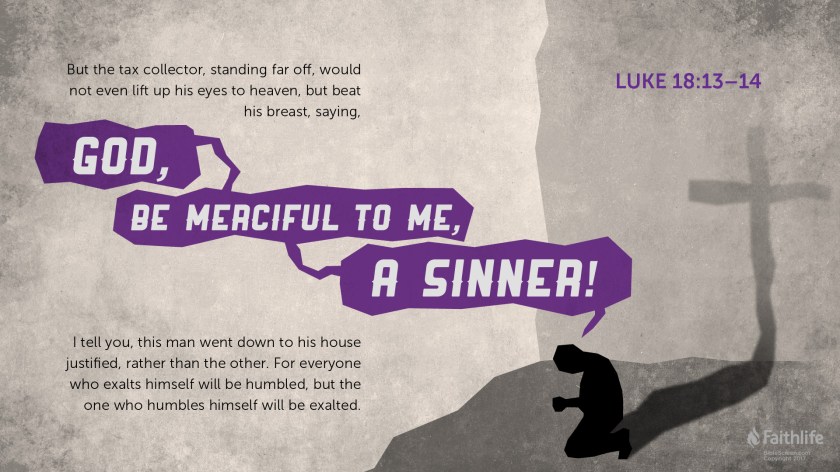
I think of the humble tax collector, But the tax collector, standing far off, would not even lift up his eyes to heaven, but beat his breast, saying, ‘God, be merciful to me, a sinner!’ (Luke 18:13)

Jesus said that man went home justified, as opposed to the Pharisee who pridefully listed all his accomplisments for God. I need to remember the Tax Collector’s humility and position before our Great God.

I’m praising Him for His infinite mercy and the days upon days we as His children are privileged to experience it.

Mercy is at the heart of redemptive ministry. Mercy is to extend to all without regard for race, or status, or gender, or age. And mercy is to be offered patiently toward those who are ignorant in unbelief. And by the way, Micah 7:18, “God delights in mercy.” And He’ll delight in you if you are a merciful Christian. John MacArthur, sermon, A Mission of Mercy

The Trinitarian God of the Father-Son-Holy Spirit is highly exalted. May He be blessed and praised.

Lk18
Source: https://biblia.com/verseoftheday/image/Lk18.13-14
Posted in encouragement, Uncategorized

Still Speaking

Amon, Asherah, Bel, Dagon, Molech, Artemis, Zeus, Ganesh, Mot, Pele, Gok Tengri, Tekkeitsertok, Auseklis…

These are false gods. Every culture from Inuit to Polynesian, European to Mongolian, has created a god of their own making. There are many more false gods than just those few listed.

Yahweh the True and Only God created man and gave him imagination. Sadly, using his God-given imagination, man rejects Yahweh and formulates gods of his own creation. The creature creates gods, how absurd. Yet these gods abound.

These gods do not speak.

The idols of the nations are silver and gold, the work of human hands. They have mouths, but do not speak; they have eyes, but do not see; they have ears, but do not hear, nor is there any breath in their mouths. (Psalm 135:15-17).

They have never spoken, and they never will. These gods do not exist.

God is the only God. He is the only deity who speaks! More than that, He is an involved God. He listens and He hears. See below, the rapidity with which He responds at times!

He was still speaking when, behold, a bright cloud overshadowed them, and a voice from the cloud said, “This is my beloved Son, with whom I am well pleased; listen to him.” (Matthew 17:5).

Mt17

While I was speaking in prayer, the man Gabriel, whom I had seen in the vision at the first, came to me in swift flight at the time of the evening sacrifice. (Daniel 9:21)

While Peter was still speaking these words, the Holy Spirit fell upon all those who were listening to the message. (Acts 10:44).

While the word was in the king’s mouth, a voice came from heaven, saying, ‘King Nebuchadnezzar, to you it is declared: sovereignty has been removed from you, (Daniel 4:31).

It will also come to pass that before they call, I will answer; and while they are still speaking, I will hear. (Isaiah 65:24).

What a great God we have, who is so involved with us. He hears, He listens, and in His timing He even responds while still speaking! While. Still. Speaking.

Our glorious God is involved, compassionate, and interested in His people. Praise Him in thanks.

Posted in encouragement, Uncategorized

Don’t leave the Baby in the manger or the Man on the cross

When Christmas comes around, everyone loves the thought of the baby in the manger. The story is so precious, and the swaddling cloths, and the animals milling around, and the Shepherds who came to see…

So cute!

But not cute.

This Grace To You essay brings the point home.

What do you think about when you see a nativity scene? We might recognize the baby in the manger as God in flesh. But seeing Christ as a helpless and vulnerable infant can delude us into thinking that the humility of the incarnation was not isolated to His physical form—that somehow, His deity was also diminished.
And it’s easy to read the birth narratives in the gospel accounts without gaining a full sense of Christ’s eternal glory and supremacy. Those attributes figure more prominently at the end of His earthly sojourn rather than the beginning.

Where can we see that glory and supremacy? Is it on the cross? The Man-God hung on that tree, He was perfect in every way yet absorbing all God’s wrath for sin, separated from His eternal father for agonizing hours. He was the suffering servant, bleeding and wounded and humble, and scorned and rejected. He hung there…

But He is not still there.

We look to Jesus when we want to praise or seek comfort, and we often think of the cross. The cross is the symbol of death, new life, eternity. We respect the cross as the execution method of what Jesus suffered for us in obedience to the Father. The cross is everything to us, but it is not all.

Because Jesus rose.

So the bloody, unrecognizable fleshly Man is not still on the cross. He is in heaven, robed majestically, at the right hand of the Father, ministering as KING OF THE UNIVERSE!

12Then I turned to see the voice that was speaking to me, and on turning I saw seven golden lampstands, 13and in the midst of the lampstands one like a son of man, clothed with a long robe and with a golden sash around his chest. 14The hairs of his head were white, like white wool, like snow. His eyes were like a flame of fire, 15his feet were like burnished bronze, refined in a furnace, and his voice was like the roar of many waters. 16In his right hand he held seven stars, from his mouth came a sharp two-edged sword, and his face was like the sun shining in full strength. (Revelation 1:12-16)

Don’t leave the baby in the manger or the man upon the cross. When you think of Jesus daily, remember Him as He is now.

cloud

Posted in Uncategorized

Re-Post: Why can some women spot a false teacher and avoid them, but others follow them instead?

This was first published in January 2017. It’s been updated in minor ways and some resources added. Enjoy!

Q. A reader emailed and asked how can she understand that Beth Moore and Joyce Meyer and other false teachers like them go dramatically outside of Scripture, while other women don’t?

A. The Holy Spirit is giving discernment. Discernment is a skill. We as believers pray, study, read, and work the scriptures through your mental capacities and reactions. Like any skill, it grows muscular through use. Other women who don’t use it, are weak. They are the ones who get captured, laden down by many sins. The Bible says “For among them are those who creep into households and capture weak women, burdened with sins and led astray by various passions,” (2 Timothy 3:6.)

It is a process. If you do not read scripture and study it and allow it to divide marrow from bone (Hebrew 4:12), then we have these ladies who are laden down, confused. They are unable to endure sound doctrine because the sin in them prevents clear thinking. The longer it goes, the worse it gets. Then they seek a false teacher to suit their passions so the sin in them won’t collide so harshly with the sound doctrine of the Bible.

Last, they begin heaping these teachers up. (2 Timothy 4:3). There is a flavor of a false teacher for every flavor of sin. Beth Moore offers psychology and self esteem, also emotionalism. Joyce Meyer offers health-wealth. Christine Caine offers social justice. IF:Gathering women offer a faux-discipleship/fellowship.

Some women (and men) have been given the gift of Discerning of Spirits (1 Corinthians 12:4-11). They are the ones whom the Holy Spirit has installed in a local congregation for the purpose of edifying others, building up the body through their extra dose of the gift, if you will. They are the encouragers, gentle path-correcters, alarm ringers.

Discernment begins with prayer, study, and repentant worship. The exercise of the discernment muscle comes in when you check the scriptures to see if the things you are taught are so, as Paul noted that the Bereans did. (Acts 17:11). Hebrews 5:14 says that we train ourselves in discernment to go from milk to meat. It is by ‘constant use’ of the skill that it is honed, the verse says.

The more you listen, check, pray, and read from the Bible, the more you are exercising that muscle, and it will get strong. The discerning ones who diligently strive to retain clear vision can spot and resist these false teacher. The Word has divided false from true, not man’s wisdom.

This is my take on it. Other thoughts and verses welcome. As always, check the Bible and test what is written her and anywhere. 🙂

———————————————-
Further Reading:

Expository Listening: A Practical Handbook for Hearing and Doing God’s Word

“Do not merely listen to the word, and so deceive yourselves. Do what it says.”––James 1:22 In many people’s mind, if they don’t get anything out of the sermon, it’s the preacher’s fault. But that’s only half true. The Bible teaches that listeners must partner with the preacher so that the Word of God accomplishes its intended purpose of transforming their life. Expository Listening is your handbook on biblical listening. It is designed to equip you not only to understand what true, biblical preaching sounds like, but also how to receive it, and ultimately, what to do about it. You need to know how to look for the Word of God, to love the Word of God, and to live the Word of God. In this way, God and His Word will be honored and glorified through your life

John MacArthur: A Plea for Discernment, sermon series

Tim Challies: The Discipline of Spiritual Discernment (a book)

Posted in death, Uncategorized

Suddenly, I’m old

I was looking through my laptop files for a photo to go with my blog essay. The writing of the essay is easy for me, but finding a photo to visually represent what sometimes are very abstract concepts is hard. I am fairly literal, so it takes me a good while to come up with something.

So I was looking and looking at many photos I’ve taken since moving to Georgia 12 years ago. It seems like just yesterday, but it’s in fact over a decade since I got here. Time flies.

I noticed after a while in looking at photo after photo, that a lot of the people I’d taken photos of are dead now. More than a few. Most of them were elderly, but one sweet little boy I’d had in school died very young.

I pondered this for a few days.

Meanwhile, I received a Facebook message from someone I didn’t know but I knew her name. That is because I knew her dad. We never met in real life, but he was stuck with my writing ministry and occasionally corresponded. I had not heard from him in a while. She was messaging me to let me know he had died after a struggle with cancer.

We never really know what kind of effect we have on people. In real life or online, we affect the fellow believers, like a rock plunked into a pond. The daughter wanted me to know that he expressly wanted me to know of his passing. This was impactful to me.

Meanwhile, my father had passed away three years ago, the first significantly close-to-me person to leave this earth and fly toward the final destination. He was 81. My mother is 80. Her sister is 85. Other aunts are over 80. Life might be long on this earth, but it’s not eternal. I read the obituaries regularly now.

I used to think that was funny, or weird, or morbid, when my relatives did it. Now I’m their age when I saw them do it and I do it too now. I’ve turned in to my grandmother.

You get older and you realize that something you remember or that happened was not ‘just a few years ago’ but a few decades ago. I have more than 5 decades under me. I have active memories that span 55 years. I remember when the Beatles played on Ed Sullivan in February 1964. The men who walked on the moon. The 1968 Democratic Convention riots. Civil rights marches, hippies, burning bras, openly gay people in the streets for the first time, Reagan getting shot, Berlin Wall coming down, the US Hockey team beating the Russians at the Olympics, American hostages released from Iran, OJ Trial, 9/11, Arab Spring, and so on.

It really makes you wonder about the brevity of life. The Bible tells us it is a vapor. (James 4:14). When you get older, you begin to realize just how vaporous life is.

To that end, I recommend a book I’ve just finished reading. It’s Living Life Backward: How Ecclesiastes Teaches Us to Live in Light of the End, by David Gibson. The book blurb says:

What if it is death that teaches us how to truly live?

Keeping the end in mind shapes how we live our lives in the here and now. Living life backward means taking the one thing in our future that is certain—death—and letting that inform our journey before we get there

Looking to the book of Ecclesiastes for wisdom, Living Life Backward was written to shake up our expectations and priorities for what it means to live “the good life.” Considering the reality of death helps us pay attention to our limitations as human beings and receive life as a wondrous gift from God—freeing us to live wisely, generously, and faithfully for God’s glory and the good of his world.

Here is another resource: an article titled

The Stings of Death: An Article Not Just for Old People

However, in today’s world, there are practical, earthly matters that intensify the sting of death for those left behind. There are stings still related to death. Burying a loved one can be a complex and confusing matter that feels like an intrusion in one’s time of grieving. The good news is that there are several ways to take care of these practical matters surrounding death ahead of time so those you leave behind will be more able to mourn in peace.

The good news of Jesus sacrificial death and resurrection mans that we do not have to live an eternal life in punishment in hell. We who have repented and believed on Him will live forever in bliss, joy, and glory with Him. He has imputed His righteousness to us, and when God looks at us, He sees us through His Son.

Our death is simply a transition from one state of being to another. And I’m glad that we will not mourn in heaven, and He will wipe all tears from our eyes. Our joy will be complete.

Then I heard a voice from heaven say, “Write this: Blessed are the dead who die in the Lord from now on.” “Yes,” says the Spirit, “they will rest from their labor, for their deeds will follow them.” (Revelation 14:13)

marble rose

Posted in puritans, Uncategorized

Why we should read the Puritans (and resources on how to build a Puritan Library and actually read them!)

Does it ever make you feel awe-inspired to know that you and I are in a line that extends all the way back? That people like Ruth and David and Paul and Justin Martyr and Jonathan Edwards and Charles Spurgeon and John MacArthur are in the same line we are in? Because of Christ’s blood, we are part of a Godly lineage that from one generation to another that is passing the baton of faith forward.

It’s a shame more people don’t study and read about church history. It’s fascinating.

One thing I do know, our elder says that it’s good to read ‘old books’, you know, the dead old guys. We in the present time can’t see our blind spots, but when we read the older tomes, we can. Here is John MacArthur’s take on it:

If I want to test my interpretation of Scripture, invariably I go backwards to those in the past who have the noble, proven, interpreters of Scripture whose books are still in print because they have stood the test of time and the scrutiny of scholarship. And I go back to make sure that I’m not inventing something. I just want to take the baton from somebody. I want to interpret the Word of God the way it’s always been interpreted and I want to be faithful to those in the past who were led by the Spirit of God to understand the Word of God. ~Source

Our elders quote the Puritans a lot. Currently Jonathan Edwards and John Owen are getting heavy rotation, lol, to use old disc jockey lingo. There are a lot of Puritans worth reading. They are so edifying. John Bunyan for example, wrote so much more than Pilgrim’s Progress, though that book is the most famous Christian book after the Bible and has never been out of print for 340 years!!

From a purely literary viewpoint, The Pilgrim’s Progress is without a doubt the greatest allegory ever written. Critics have called it “a hybrid of religious allegory, the early novel, the moral dialogue, the romance, the folk story, the picaresque novel, the epic, the dream-vision, and the fairy tale” (Lynn Veach Sadler, John Bunyan, Twayne Publishers, 1979). The world over, The Pilgrim’s Progress is the second best-selling book in history (the first is the Bible) and has been translated into over 200 languages. ~Source

John Flavel, Thomas Manton, Thomas Brooks, Richard Sibbes…and so many more are worthy of a good visit.
Admittedly, some of the Puritans are an easier read than others. Tim Challies has a list that progresses from recommendations for beginners to all the way up. Beginners should definitely read Richard Sibbes’ The Bruised Reed, hope for the suffering. Flavel’s Providence is a little harder and John Owen, well, he takes some commitment. But they are worth it.
As a bonus, many of these Puritan books are free on ccel.org, free on Kindle, or discounted in hard copy at places like Monergism, Ligonier, Banner of Truth, or Westminster Books.

~~~~~~~~~~~~~~~~~~~~~~~~
Where does one begin, though? Tony Reinke has a wonderful series of a type of “Puritan Reading Plan”.  Here is the link and his introduction to the study-

The Puritan Study (Part 1) The Delights and Pains of a Puritan Study

Here begins a several part study on building (and using) a Puritan library of your own. Of all the areas of my library, the Puritan section is the most useful.

The “Puritans” are a group of people I (very) loosely define as faithful Christians of the 16th and 17th centuries, as well as those who carried on the Puritan tradition into the 18th and 19th centuries. My definition includes John Bunyan and John Owen (true Puritans), Jonathan Edwards (post-Puritan), and Charles Spurgeon (who carried the Puritan tradition). Other names you may not be familiar with include Brooks, Boston, Burgess, Sibbes, Flavel, Reynolds, Ames, Manton, Rutherford, Newton and Clarkson. You will become more familiar with the names as we continue on.

This series is based upon two fundamental convictions.

First, the church today benefits most from leaders and preachers who are burdened to present expositional messages – sermons drawn from principles clearly demonstrated in scripture. The preacher is to “preach the Word” by taking every precaution in the name of accuracy and then exhorting and encouraging by earnest application.

Secondly, an efficient and workable library of the best Puritan literature is a great way to faithfully preach and apply scripture to the hearts of your hearers. The Puritans are no substitute for careful exegesis and use of contemporary commentaries. But once the foundational research is complete, the Puritans will open up new threads of understanding and application on your text. Pastors and congregations today truly need the Puritans.

I would not be writing this series if I were not personally acquainted with the great fruitfulness of Puritan study. The Puritans have matured my understanding of God, the Christian life, the idols of my heart, marriage and parenting. I have a deeper appreciation for the Cross, grace and the resurrection because of their words.

Well, there ya go.

Click here to access all posts in Reinke’s The Puritan Study series.

Part 1: The delights and pains of Puritan study
Part 2: The rules of a Puritan library
Part 3: The people of a Puritan library
Part 4: Why our effective use of the Puritans begins with our Bibles
Part 5: Print book searches
Part 6: Electronic searches
Part 7: Using the Christian Classics Ethereal Library
Part 8: To quote or not to quote?
Part 9: The strategy of building a Puritan library
Part 10: Concluding thoughts, part 1
Part 11: Concluding thoughts, part 2
Part 12: Q&A > Which Puritan should I start with?
Part 13: Photographs of the Puritan Library

And under that, there’s another set of links reviewing various Puritan books.

Here are even more resources for you.

~~~~~~~~~~~~~~~~~~~~~~~

Tim Challies:

Recommended Puritans

The Puritans: John Bunyan, Thomas Boston, Stephen Charnock, Richard Baxter (and so on!)

A few practical lessons from the Puritans

Search at his site challies.com by plugging in ‘Puritans’, there are even more search results that come up than I have posted here

~~~~~~~~~~~~~~~~~~~~~~~

Mt. Zion Library

Phil Johnson says of the Mt. Zion Bible Chapel online library

A wonderful collection of literature and sermons from Mt. Zion Bible Church in Pensacola, FL. This church’s literature ministry has quietly, faithfully been sowing seed for years. Only heaven will reveal how bountiful the harvest has been. The Web site has an amazingly full collection of choice documents—including the complete works of John Bunyan. Mt. Zion supplied many Spurgeon sermons for The Spurgeon Archive

They have free study guides and courses. For example, there’s a study guide to go along with reading Bunyan’s Pilgrim’s Progress. So wonderful! A plethora of resources.

~~~~~~~~~~~~~~~~~~~~~~~

Enjoy!

ship rose
HMS Rose (I THINK!) in the Chesapeake in the early 1990s.
Hey, it looks like a ship the Puritans could have come over on. I was struggling
to find a photo to go with the essay! Don’t judge me…