Posted in encouragement, Uncategorized

Praises to God for Spring and Beauty

It’s been a long spring here in north Georgia, but a very cold one. That’s OK, the forsythia, crocuses, robins, dogwood, buds, and grass are all growing pleasantly nonetheless.

I hope this fine spring time has offered you beautiful glimpses of God’s creative intellect and His wonderful power. We always enjoy the march of the seasons. “He appointed the moon for seasons: the sun knoweth his going down.” (Psalm 104:19, KJV). Wherever we are in the world, we see and understand the times and seasons. We look for the robin, the crocus, the ladyslipper. The orderliness and consistency of the seasons since His ordination of them is a comfort. Yet even in Jeremiah 8:7 it is said of the seasons, meaning HIS season, “Yes, the stork in the heaven knows her appointed times; and the turtle and the crane and the swallow observe the time of their coming; but my people know not the judgment of the LORD.”

In the natural history of Israel, Barnes notes explains,

“Jeremiah appeals to the obedience which migratory birds render to the law of their natures. The “stork” arrives about March 21, and after a six weeks’ halt departs for the north of Europe. It takes its flight by day, at a vast height in the air (“in the heaven”). The appearance of the “turtle-dove” is one of the pleasant signs of the approach of spring.”

Spring is a time of renewal, refreshing, and new life. There is a bird who builds a nest in my living room windowsill, and soon enough, babies will come along. They chirp so cute, they grow bigger, and then one day they will be gone, and a strange silence will come over the living room.

Is it wonderful to contemplate that the LORD knows the comings and goings of each bird in the world?

Are not two sparrows sold for a penny? And not one of them will fall to the ground apart from your Father. (Matthew 10:29).

How much more does He care for His own children. How great that He upholds the march of seasons, their orderliness and beauty. The unfurling of a bud, the flowering of a leaf, the business of the insects feasting on the pollen and nectar. How much more should we enjoy His creation, praising Him for all He is and all He does to maintain this beautiful world for His children.


Posted in prophecy, Uncategorized

Spring bounty and God’s prophecies

The spring has been gentle and the Lord is providing bounty from the earth. The summer garden crops are about to be planted in and they will be plenteous. The figs leaves are coming in. The muscadine vines are thriving. It reminds me in particular of two verses in the Bible. They are promises. That is what prophecies are, you know. Promises of positive things the Lord has in store for the people who love Him and promises of negative things to come for those who don’t love Him.

vine.jpg
EPrata photo

Every man will sit under his own vine and under his own fig tree, and no one will make them afraid, for the LORD Almighty has spoken. (Micah 4:4)

In that day, declares the LORD of hosts, every one of you will invite his neighbor to come under his vine and under his fig tree. (Zechariah 3:10)

In the Bible, vines (usually grape) and fig trees were emblematic of agricultural abundance and that abundance bespoke wealth. Many fig trees meant prosperity. The promised land was described in Deuteronomy 8:8 as “a land of wheat and barley, and vines and fig-trees and pomegranates.” It was not described as a land flat and therefore ripe for land prospecting development. It was not described as a land full of silver and gold mines. It was not described a land of great cities producing a rich population with guilds and markets. The prosperity the land promised was riches from a bountiful earth. Remember that after the Fall, Adam was cursed with toil, and that the land would not yield unless he toiled with sweat and labor. What was it like before the Fall? I can’t wait to find out, and that is what these prophecies promise.

Cursed is the ground because of you; through painful toil you will eat of it all the days of your life. It will produce thorns and thistles for you, and you will eat the plants of the field. By the sweat of your brow you will eat your food until you return to the ground, (Genesis 3:17b-19b).

That curse will be reversed and the land will pop with generous abundance. Remember the two spies who came back, in Numbers 13:23 reporting that they saw huge grapes and figs and pomegranates?

Doesn’t sitting under our own fig tree and our vine and sound relaxing? Refreshing? Cool? Like walking with God in the garden in the cool of the day. And Jesus said, I am the vine; you are the branches. Whoever abides in me and I in him, he it is that bears much fruit, for apart from me you can do nothing. (John 15:5).

grapes
EPrata photo

And look what Jesus did! He did everything! He accomplished redemption for mankind, by breaking His own body and allowing it to be poured out! We are His branches, connected to the Great Gardener whose vine covers us, and which provides all sustenance.

When you’re out haying this summer, sweat running down your face, or you’re out mowing this summer, and thirsting because of the heat, or you’re gardening and battling the bugs who are killing your bean plants, remember the prophecies.

My people will live in peaceful dwelling places, in secure homes, in undisturbed places of rest. (Isaiah 32:18).

I will sing for the one I love a song about his vineyard: My loved one had a vineyard on a fertile hillside. (Isaiah 5:1).

As for the saints in the Church, our dwelling place will be New Jerusalem, and it will be just as beautiful as earth’s bounty, glittering and pure.

And he carried me away in the Spirit to a great, high mountain, and showed me the holy city Jerusalem coming down out of heaven from God, 11 having the glory of God, its radiance like a most rare jewel, like a jasper, clear as crystal. 12 It had a great, high wall, with twelve gates, and at the gates twelve angels, and on the gates the names of the twelve tribes of the sons of Israel were inscribed— 13 on the east three gates, on the north three gates, on the south three gates, and on the west three gates. 14 And the wall of the city had twelve foundations, and on them were the twelve names of the twelve apostles of the Lamb. (Revelation 21:9-14)

How beautiful the relationship. We are the branches, closely grafted into the true vine. The true vine covers us, and we sit under it in peace and abundance. The abundance comes from the Vine Dresser who is the Father (John 15:1), who cares for the true vine in love and cares for his children, the branches.

Our God is a tremendous God!!!!!

Posted in discernment, Uncategorized

Beth Moore’s Legalism: A Discernment Lesson applicable to any teacher

I have written about Beth Moore’s legalism in the past (2011). It’s hard to believe that was 7 years ago. Here is a refresher course on how, while seeming to speak a Gospel-infused sermon, Beth Moore’s speeches are really just a ‘try harder’ legalism. This is a lesson in discernment.

You have to listen carefully and do a lot of note-taking because Moore speaks so fast, or if you listen online, use the pause button a lot. Her ‘try harder’ theology is also in her books as you will see, so the issue is not just her speaking style, but her theology. You will hear that Beth Moore shapes the scriptures away from pure faith and toward legalism. She splits sentences, putting a crowbar between words and inserting things you’ve ‘got’ to do. There is a lot of ‘do this or else’. There are also lots of warnings about the dire conditions of our walk, without real explanations. Like this from a few days ago.
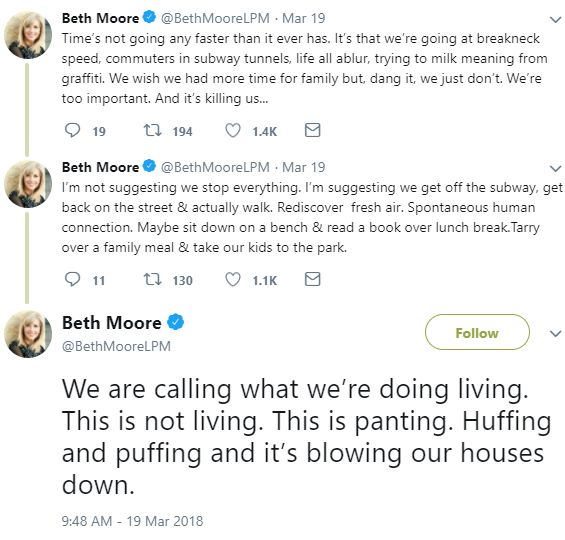
moore tweet

It seems she is trying to say that we shouldn’t be too busy. Too busy for what, she never says. Yet after more than three successive tweets (yes, it went on) she never got to any clear point. Milk meaning from graffiti? Huffing and puffing? And what does it mean, exactly, that we are ‘blowing our houses down’?  A teacher is supposed to be “able to teach.” (2 Timothy 2:24).  Not vaguely warn. Or be so in love with her writing that plain meaning is obscured…

Our precious Lord gave salvation as a gift. No matter how we stumble, or no matter how many times we enter a sin-repent-forgive cycle, we are saved and effective for His glory. He gave us a GIFT of salvation. It is the gift of redemption, a gift of imputed righteousness. Here are some examples of how Moore diminishes the gift of the Gospel and makes it a confusing, burdensome, treacherous walk among the heavy stones of the Law.

Example #1:

Her contemplative prayer quote: “[I]f we are not still before Him, we will never truly know to the depths of the marrow of our bones that He is God. There’s got to be a stillness.”

According to Moore, we will “never” “truly” know who God is UNLESS we are still. Beware of Bible teachers who frequently use absolute words.

Example #2:

In one study, Beth Moore is speaking of ‘confidence and competence’ that Christ gives us. The study is based on Hebrews 10:19-20 but her interpretation of the verse is wrong from the beginning. Once the basic interpretation is wrong it is no surprise that what follows falls into even worse error. Watch carefully as she inserts conditions to salvation. She even outlines the effect of not believing the new add-ons that she includes.

…but what can happen is this … If we receive Christ as our Savior but we never recognize and by faith believe Him to also be our healer and our restorer then we just stay just as cracked as when we got here.

The Gospel is now Law. According to Moore, we have to believe some things above and beyond what the Bible says we need to believe for salvation. According to Moore, we must believe in a different Christ than the Jesus presented in His Word. I certainly don’t see anything in His word about having to believe that Jesus is our Savior AND our Healer AND our Restorer or else we stay “cracked”. And what does cracked mean, exactly? This is some vague warning of looming disaster, the kind of warnings Moore loves to issue.

Now as for this cracked business, the Bible does speak of being cracked:

For My people have committed two evils: They have forsaken Me, The fountain of living waters, To hew for themselves cisterns, Broken cisterns That can hold no water. (Jeremiah 2:13).

The cracked ones were the ones who forsook God. They were the evil ones.

But when Jesus saves us, we are sealed! “Now He who establishes us with you in Christ and has anointed us is God, who also has sealed us and given us the Spirit in our hearts as a guarantee.” (2 Corinthians 1:21-22).

There is no in-between in the New Testament, being saved but leaking through a crack.

Example #3:

…it [confidence] just bleeds out everywhere, we can’t keep any confidence in there. Because we have never trusted Him to put three pieces of our lives back together. Is this making any sense to anybody? We have all these cracks and all these pieces. … And we’re supposed to be effective here on earth. … Salt and light and profoundly effective, but we can’t be any of that unless we have our God-confidence.

Again with the “we can’t…unless”. Note those words.

As to Moore’s addition of confidence as a necessary condition of keeping our salvation or being effective or something, Jeremiah wasn’t confident. His first worry was that he was too young for the job. (Jeremiah 1:6-8). By any standard, Jeremiah was an effective man of God.

Moses wasn’t confident. He worried he wasn’t eloquent enough to be a spokesman. (Exodus 4:10-12). By any standard, Moses was not too confident, but he sure was effective.

So far, from just three of her teachings we learn that —

1. Unless we accept Jesus as savior AND Healer AND Restorer, His work is not sufficient.
2. Unless we get some God-confidence, we are not effective.
3. Unless we believe certain things about Jesus, we will stay cracked.
4. Unless we are still, we will never truly know God.

The legalistic conditions pile up fast.

Example #4:

Moore’s book Breaking Free: Making Liberty in Christ a Reality in Life was reviewed by Paige Britton.

Britton says, “One rather ironic element of Moore’s teaching is her definition of “legalism,” one of the roadblocks we must remove if we want to journey on to authentic freedom. According to Moore, legalism occurs whenever one studies the Word but fails to enjoy God; it is the absence of relationship, passion, engagement of the heart (pp.75, 77). This definition is fine as far as it goes, but it effectively obscures the fact that Breaking Free is all about applying new rules in order to gain what God meant for us as a gift in Christ.

Isn’t that ironic. A book called Breaking Free is really just a new way to enslave you. Moore makes up and applies new rules to gain what was given as a gift says Britton, and I have noticed this too. So we have issues with new rules in Moore’s speaking ministry and in her tweets and in her books. Her theology, no matter where it’s publicly proffered, is a problem.

Once you start hearing the “got to” and “must do” and “unless you” you will hear her new rules permeating her teaching everywhere.

What does the Bible say about new rules for salvation? It says that adding an unbiblical load kills us.

“Woe to you as well, experts in the law!” He replied. “You weigh men down with heavy burdens, but you yourselves will not lift a finger to lighten their load. (Luke 11:46).

Now, therefore, why are you putting God to the test by placing a yoke on the neck of the disciples that neither our fathers nor we have been able to bear? (Acts 15:10).

Don’t listen to Moore or any teacher who imposes conditions on your walk that are absent from the Bible. Or who uses absolute words like unless, can’talways, never, all the time, and so on. The Father loves us with an enduring, everlasting love that is perfect. Moreover, He is our priest who prays for us. He sends angels to minister to us. He gave us the Spirit to grow us. We are not cracked, leaking, unconfident, missing out on what we need, ineffective, on the verge of disaster, or any of the things Moore says we are. Moore’s world must be dark and heavy indeed.

Our world, though a mindful one and filled with obedient striving, is one of light and freedom from the very conditions Moore seeks to impose. This is because we are in Christ, and He met all the conditions necessary on the cross and broke that chain, in order to set the captives free.

It is for freedom that Christ has set us free. Stand firm, then, and do not be encumbered once more by a yoke of slavery. (Galatians 5:1).

chain

Posted in discernment, Uncategorized

Apostasy: What is it?

Apostasy is defined as ‘a defection or revolt’. It is the formal disaffiliation from or abandonment or renunciation of a religion by a person. One who commits apostasy (or who apostatizes) is known as an apostate. It is important to remember that apostates never really were saved. 1 John 2:19 says, “They went out from us, but they did not really belong to us. For if they had belonged to us, they would have remained with us; but their going showed that none of them belonged to us.”

There are two kinds of apostasy. It shows that apostasy is a process. No one wakes up one day and says “Gee, I hate Jesus and I’m not going to church anymore.” The first kind of apostasy is a drifting away of the key doctrines of the faith. The second is a complete abandonment of Christianity. Remember, if you are saved, your salvation is eternally secure. If you have submitted to Christ no one can snatch you out of His Hand. (John 10:28 says “I give them eternal life, and they shall never perish; no one can snatch them out of my hand.” so we read that if He gives eternal life, then no one can take you away from Him. Equally, because it is He who gives eternal life, mere man cannot nullify His decision.

The primary essential doctrines of the faith one must stick to, According to Christian Apologetics and Research Ministry, (scriptures supporting them are here) and I agree with these as the essential ones, are–

1. Jesus is God in flesh, and Jesus is the proper object of faith. The Doctrine of the deity of Christ includes:

–The Trinity
–There is only one God in all existence
–That Jesus is both God and man.

2. Salvation is by Grace alone
3. The resurrected Christ
4. The Gospel

They are called the primary essentials because the Bible declares them to be essential to the faith. Secondary essentials are necessary truths, but there is no declared penalty for their denial — yet they are still essential to the Christian faith. Those include:

–Jesus is the only way to heaven
–Mary’s virgin birth

FYI, the recently departed evangelist Billy Graham denied both of the above.

An apostate very slowly starts to doubt the essentials. He or she begins to read and absorb other things that are contrary to those doctrines. Paul called false teachings gangrene because they quickly pollute the body and mind. (2 Timothy 2:17).

The Bible says that at the time of the end there will be a great falling away from the truth. Look to 2 Thessalonians for the prediction regarding the “falling away.” 2 Thess. 2:3-7 says, “Let no one deceive you by any means; for that Day will not come unless the falling away comes first, and the man of sin is revealed, the son of perdition, who opposes and exalts himself above all that is called God or that is worshiped, so that he sits as God in the temple of God, showing himself that he is God. Do you not remember that when I was still with you I told you these things? And now you know what is restraining, that he may be revealed in his own time. For the mystery of lawlessness is already at work; only he who now restrains will do so until he is taken out of the way.

The lawlessness is sinfulness and the fact that Paul says it is already at work means that there have been apostates throughout the Church Age, even in Paul’s day. The verse I mentioned above in 2 Timothy 2:17 speaks of Hymenaeus and Philetus who spread false teachings, two men who “wandered away from the truth” and became “more and more ungodly”. (2 Timothy 2:16; 18). So you see, apostasy is a process.

Sanctification is a process, too. Just as apostates-in-the-making drift away from the faith, either fast or slow, those being sanctified progress toward holiness, either fast or slow. The Lord’s people will never, ever be lost to Him nor will they even become apostate. Ever.

I give them eternal life, and they will never perish, and no one will snatch them out of my hand. (John 10:28).

Praise Him for all His ways, His grace, and His priestly ministrations, and His sovereignty that keeps His sheep.

sheep

Posted in Uncategorized

Is the Rapture Imminent?

rapture1
Where are we in light of God’s plan and in His time? What does today’s news say about what God previously said will happen? A lot – not in terms of marking the timing, but in terms of showing that humans are depraved and consistent in their evil deeds throughout history. The rapture could always have come at any time. Are we very far along in His plan for the Church Age? Yes, because we know that we are 2,000+ years further along than when Paul said the rapture is imminent, and thus, 2000 years closer to that amazing day.

The end time Doctrine of Imminence is explained thus:

The New Testament is consistent in its anticipation that the return of Christ might occur at any moment. That pervading perspective of imminence prompts three questions.

The first question pertains to whether the Tribulation will precede Christ’s coming for the church. The answer to that question is that it will not because the church is never asked to look forward to the tribulation, but they are asked to look forward to Christ’s coming.

The second question revolves around how the return of Christ could have been imminent in the early church. The answer here is that no one but the Father knows when the coming will occur, so that Christians including the early church must always be ready.

The third question asks why Christ’s imminent return is so important. This answer relates to the motivation it supplies for believers to purify their lives and thereby progress toward the goal of sanctification and Christlikeness. The threefold call of the imminence doctrine is to wake up and obey right now, to throw off the works of darkness, and to put on the garments of holy living.

When the rapture happens, the snatching up of all true believers, it closes the Church Age. This then opens the door to the last 7 years of time outlined for the Jews & remaining non-believers. It will be a time when Jesus brings the earth and its dwellers under His subjection by judging sin. Remember, when the Tribulation (last 7 years) is concluded, Jesus will be King of Kings and Lord of Lords. New Jerusalem will have descended, and Jesus will physically and presently rule the people and they will worship Him. (Psalm 2:9; Revelation 19:15-16; Isaiah 45:23).

Today, the Tribulation has not begun yet, though for many who are persecuted, it may feel like it has. It certainly felt like it to the Thessalonians, who asked Paul that very question. Paul replied with an explanation that the Tribulation will not begin until certain other things happen in a certain sequence. (1 Thessalonians 5:1–9).

In fact, that time will be so distinctive that many of the people who are left behind will know that it is the time spoken of by Jesus, who prophesied, “For then there will be a great tribulation, such as has not occurred since the beginning of the world until now, nor ever will.” (Matthew 24:21; Revelation 11:13, Revelation 16:9). If you think about that deeply for a moment, and compare it to some of the worst times we’ve ever had on earth till now: for example, Russian pogroms, Cambodian Killing Fields, the Holocaust, Gettysburg, Medieval times bubonic plague, and then roll them ALL into one, the Tribulation will make them all seem like a picnic./ That is hard to believe but it’s true.

Verses that support the doctrine of Imminence and are further explained in the above article are-  James 5:8, James 5:9, 1 Peter 4:7, Hebrews 10:24–25, 2 Peter 3:11, 1 John 3:2–3). The article also goes on to explain why the rapture will precede the Tribulation, giving biblical support, of course.

Our goal each day is to pursue holiness. The Spirit’s sanctifying work goes on, whether the rapture will imminently happen in the next second of time, or in another thousand years. Our task is to be ready. One way to be ready, and to aid the Spirit in His work, is to eagerly anticipate the Lord’s return. Our eagerness prompts us to holiness, for, when He comes, do we want to be engaging in sin, or pursuing purity? His soon appearing is a catalyst for us to be doing good when He calls.

The hope of Christ’s imminent return is therefore the hinge on which a proper understanding of sanctification turns. Source

I pray you read the article Is Christ’s Return Imminent? linked above or below, study these things, pray for His return, and that you are as eagerly awaiting his return as I am and all the others who are alive or asleep. What a day that will be!

Is Christ’s Return Imminent?

Other Resources

The Rapture: What is it? Who will it affect? When is it most likely to take place?

Why I Believe in the Pre-Trib Rapture 

Posted in encouragement, Uncategorized

Imagine the dawn chorus in heaven!

By Elizabeth Prata

I love the pre-dawn. It is quiet and cool and dark but the light is coming, and already is.

I live in an area which is fairly rural, and there is not much traffic. Though I live on a major artery in the county, there isn’t enough traffic even during the day to really bother me. However, in the pre-dawn, there is none at all. I can hear from afar off the dogs bark, cows moo, occasional owl screech, an early rooster…

At about 6 am there is always one bird. From out of the darkness, suddenly, there will be a happy series of lone chirps. He is loud, and the sound is joyous to me. Not to anthropomorphize too much, but the bird really does sound happy. The piercing, lengthy call sounds like he is waking up his brethren. Perhaps it is an ovenbird.

After the first bird goes first, then in a few moments the dawn chorus begins. The dawn chorus is a worldwide event. At Cornell, they wrote, “The dawn chorus is one of the most conspicuous vocal behaviors of birds, and one of the least understood. Near sunrise, birds often sing more loudly and vigorously than they do at other times of the day.

I like to think they are thanking their Creator. He knows them, and I like to think they know their Creator back. God says, “I know all the fowls of the mountains: and the wild beasts of the field are mine.” (Psalms 50:11). We know that all creation groaneth in travail until now, (Romans 8:22). They groan…do they sing in joy as well?

Birds suffer for man’s sin, (Genesis 6:7; Jeremiah 12:4; Ezekiel 38:20; Hosea 4:3). The Bible says they flee away when calamity comes as well. (Jeremiah 4:25; Jeremiah 9:10)

Yet they sing:

10You make springs gush forth in the valleys;
they flow between the hills;
11 they give drink to every beast of the field;
the wild donkeys quench their thirst.
12 Beside them the birds of the heavens dwell;
they sing among the branches.
13 From your lofty abode you water the mountains;
the earth is satisfied with the fruit of your work
. (Psalm 104:10-13)

Imagine the ‘dawn chorus’ in heaven! Birds will sing all the time because there is no dusk and no dawn, only day! (1 John 1:5, Revelation 21:25).

I believe that in heaven when He brings His bride to her place and presents our dwelling place to us, our rooms will not have screens on the windows. Because why would they? No biting insects or animals will creep in and harass us. All creation will be reconciled to its Creator and there will be no reason to have bars or screens to keep things out, or in. Maybe a bird will swoop in to my room and sing in joy at the perfection of the Creator and gladness to be part of it, and I will join. Together we are all groaning now, but the Day will come when we will all sing in joyous praise to the One who made us. Birds too.

In the meantime, I’ll enjoy the first bird each morning, knowing that before the day’s groaning begins, there is joy in creation among the created.

you lookin at me

Posted in discernment, Uncategorized

Why every woman should be a theologian: The Master’s University Table Talk

womenThe advent of the internet has afforded Christian men and women opportunity to learn from many credible teachers and pastors, and to access a variety of different theological resources.

For example, all of Charles Spurgeon’s sermons and writings are online. John Owen is online. Pilgrim’s Progress is online. John MacArthur’s sermons, over 3000 of them, are online. Martyn Lloyd Jones, S. Lewis Johnson, BB Warfield sermons and materials, online, Valley of Vision, online. Blogs, podcasts, courses both free and paid (i.e Mt Zion Chapel Library, free; Ligonier, affordable paid), books, pamphlets, art work, lexicons, concordances, and more are available tot he  believer as resources.

Wow.

In some ways, this period of time has given people, women in particular, opportunity to become deeply involved with the Word, especially if (other than her pastor) she has no males in her life, such as a Godly husband or brothers, father, etc. It is a rich time.

Alternately, the potential for deception among women has never been greater, either. Women are especially vulnerable to false teaching (2 Timothy 3:6, 1 Peter 3:7) and we must guard ourselves by all the means available to us. While many online ministries are solid, many other ministries online promote false teaching. Even church sermons posted on the internet can contain false teaching, as well as the false doctrine perpetuated by ministries that exist online only. So much falsity.

Now the Spirit expressly says that in later times some will depart from the faith by devoting themselves to deceitful spirits and teachings of demons, 2 through the insincerity of liars whose consciences are seared… (1 Timothy 4:1-2).

For certain people have crept in unnoticed who long ago were designated for this condemnation, ungodly people, who pervert the grace of our God into sensuality and deny our only Master and Lord, Jesus Christ. (Jude 1:4).

While it is true that the Bible prohibits women from operating in some roles (teaching men, pastoring), the Bible encourages all believers, women included, to be theologians. Being a theologian simply means you study God in His revealed self, via the Bible.

To that end, this Table Talk discussion from The Master’s University was helpful. The topic was Why Every Woman Should be A Theologian. Professor Abner Chou facilitated, and several other professors answered questions as the discussion went on.

The opening question was asked:

In light of complementarianism, we often emphasize things in light of what women cannot do; she cannot teach (men) she cannot preach or be a pastor. But let’s turn this around and ask what does the Bible encourage women to do? How can women can be active participants in the church?

One of the Professors answered (I’m sorry, his introduction was not contained in the tape):

Every believer is a theologian. Theology is simply asking and answering, ‘Who is God?’ Every time we ask ‘Who is Jesus’ we are engaging in theology. Believers should be about understanding who God is and how He has revealed Himself. Pursuing who He is is a key aspect that should fill the lives of every believer.

The talk went on from there. Betty Price, Associate Professor of Biblical Studies; Women’s Ministries, noted :

For too many years women’s Bible studies have been too light and fluffy, and not have been a serious study. It’s really hard to find something that gives much depth at all. They’re always quick little surface study guides that have a Bible clip and a few fill-in-the-blank questions in a workbook. Perhaps women have not been encouraged enough. … [Women’s studies] are geared around fellowship and social times, probably more than being a theologian. That’s not all bad, many of the women are stay-at-home moms and need the social times to come together with other adults. But I’d like to see deeper studies.

Here is the link. The talk is about an hour click here.

Mentioned in the Talk:

Book- To Preach or Not To Preach? By Professor William Varner

A study of the religious role of women in the Old Testament through the New Testament periods. Emphasis is placed on both the privilege and the limitations of women’s ministry in the early church.

Other resources:

Todd Friel’s Drive By series. He titled the series Drive By, and deliberately made the lectures short because the Internet was that student-theologians like you and me could listen to them in the car, even if the commute was short. However, these are also perfect for the stay-at-home mom who doesn’t often have a long, lingering hour to delve into a Bible study, but can find 8-15 minutes to listen to a lecture (and follow up in the Word later).

I’ve listened to the lectures in all three of these, they’re good. There are also other Drive By series, such as Drive By Biblical Counseling, etc.

Drive By Theology
35 Systematic Theology Lessons- Join Todd Friel and Dr. Steve Lawson (Dr. Metaphor) as they take you through 35 short lectures on every theology from bibliology to soteriology and every other “-ology” and you will see that the Bible is exactly what it says it is, “profitable for all of life and godliness.” $24.99

Drive By Pneumatology (Study of the Holy Spirit)
Drive By Pneumatology will provide a thorough, thoughtful and Biblical presentation on the doctrine of the Holy Spirit. $19.99

Drive By Discernment
Wolves are leaping over the fence. The sheep seem to be oblivious to their wiles. Drive By Discernment is designed to sharpen your skill to help you separate the true from the almost true. $19.99 – $24.99

Ladies, every woman should be a theologian. Priscilla was. Anna was. Mary was. The Bereans were. We can be too. Being a theologian simply means looking into His word to discover more each day who God is.

Posted in potpourri, Uncategorized

Prata Potpourri: Contending, Cougars, Spurgeon, Movie about a Song, more

What’s been goin’ on in Christian spheres lately? Let’s take a peek. Here are some links for your interest and edification-


A lot of people are talking about this movie. Is the positive talk warranted? It seems that it is. The Story of a Song: Movie Review by The World

Anyone who’s been to church in the last decade probably knows or has sung it, but in a culture where un-Biblical heaven tourism books and movies abound, the song’s simple, sound reminder that no eye has seen what God has prepared for those who love Him is especially welcome.


Please remember our persecuted brethren.
Hindu-on-Christian Persecution
India: the 11th worst place on earth for Christians.

During this Lenten season when Christians are preparing themselves for Easter Sunday, those of us who are living in relative peace and affluence should remember and pray for those brothers and sisters in the faith whose circumstances are not as friendly.


Judge Not? A good, scriptural look by Bob Utley at the famous verses thrown at our faces when confronting sin or false teachers.

Answer this question – ‘Who removes the speck from his brother’s eye in verse 7’?


Jen Oshman has a bit about sisters helping sisters: The Power of Sisterhood: Women Spurring Women to Do Hard and Good Things

I am convinced the best way women can serve one another—and even the entire world—is to meet together and to encourage one another to love and good works.


Rebecca Stark with some good thoughts about contending. Would you stand idly by and watch your young son get mauled by a cougar?

Faced with a dangerous attack on a beloved child, would any mother simply stand and watch? No, a mother’s love for her child compels her to protect and defend—and fight to the death if necessary.


The lead article on a credible blog is about eschatology? I’m so there!

As we go about daily routines, too often our lives become routine. It seems as if there is a missing purpose at times to simple conversations in the community and other less-than-glorious responsibilities like changing diapers or mopping the kitchen floor. Are you anxiously anticipating the return of King Jesus or do you find yourself reading your Bible and doing life disconnected from the precious promise that Jesus will return?


Are parables just simplistic stories teaching a moral lesson? No. For the Church has more. By the way, John MacArthur’s book Parables is fantastic.

The parables Jesus tells in the four Gospels are peculiar kinds of stories that too many readers read very wrongly. It’s important, then, to clear up some common misconceptions about these important stories. I want to share with you what the parables are, but first, it is helpful to establish what they are not.


DID YOU KNOW?

Spurgeon read The Pilgrim’s Progress at age 6 and went on to read it over 100 times.


DID YOU KNOW?
The collected sermons of Spurgeon during his ministry fill 63 volumes? Phil Johnson curates The Spurgeon Archives. Most of Spurgeon’s sermons are there, along with Morning & Evening, Sword & Trowel, and other material. The Spurgeon Center also has much material.


I have been enjoying Derek Thomas’ daily 22 minute videos at Ligonier.org going through John Bunyan’s Pilgrim’s Progress. Wonderful!

Thomas’ lectures on The Pilgrim’s Progress here (so far). The series began on March 13, 2018

The City of Destruction
The Wicket Gate
The Interpreter’s House
The Cross & the Sepulcher
The Hill Difficulty
The Palace Beautiful

This photo, just because I like it. Have a good day!

dials
EPrata photo

Posted in Uncategorized

It is true that the Prodigal Son only needed a sandwich and a bed?

Phil Johnson posted a quote by Vince Havner the other day. Here it is:

“If they had a social gospel in the days of the prodigal son, somebody would have given him a bed and a sandwich and he never would have gone home.”

That resonated with me because I’d just an hour before finished listening to Tom Pennington’s sermon at Shepherds’ Conference 2018 about the Mission of the Church. He opened his sermon with refuting the social gospel AKA social justice, and went on to convincingly and convictingly exhort to his listeners about our true mission. Matthew 28’s passage known as The Great Commission is our true and only mission.

Tom Pennington asking about the Social gospel AKA Social justice AKA Missional:

Instead of social gospel the new label became social justice. Its rebranding of liberal theology remains. The priority of social justice has become extremely popular even among those under that broad term evangelicalism.

The question is this, is this redefinition of mission a biblical redefinition? Or, is social justice either the church’s primary mission, or part of the church’s primary mission? What does the scripture say?

Pennington went on to read the following passage, stating that nowhere in scripture is our primary mission clearer.

Now the eleven disciples went to Galilee, to the mountain to which Jesus had directed them. 17 And when they saw him they worshiped him, but some doubted. 18 And Jesus came and said to them, “All authority in heaven and on earth has been given to me. 19 Go therefore and make disciples of all nations, baptizing them in the name of the Father and of the Son and of the Holy Spirit, 20 teaching them to observe all that I have commanded you. And behold, I am with you always, to the end of the age. (Matthew 28:16-20)

Here is GotQuestions with a definition of The Social Gospel:

The phrase “social gospel” is usually used to describe a Protestant Christian intellectual movement that came to prominence in the late 19th and early 20th centuries. Those who adhered to a social gospel sought to apply Christian ethics to social problems such as poverty, slums, poor nutrition and education, alcoholism, crime, and war. These things were emphasized while the doctrines of sin, salvation, heaven and hell, and the future kingdom of God were downplayed. Theologically, the social gospel leaders were overwhelmingly postmillennialist, asserting that Christ’s Second Coming could not happen until humankind rid itself of social evils by human effort.

Another explanation I liked as to what the Social Gospel is comes from a secular Australian website I’m unfamiliar with, called The Conversation:

The social gospel’s origins are often traced to the rise of late 19th-century urban industrialization, immediately following the Civil War. Largely, but not exclusively, rooted in Protestant churches, the social gospel emphasized how Jesus’ ethical teachings could remedy the problems caused by “Gilded Age” capitalism.

Movement leaders took Jesus’ message “love thy neighbor” into pulpits, published books and lectured across the country. Other leaders, mostly women, ran settlement houses designed to alleviate the sufferings of immigrants living in cities like Boston, New York and Chicago. Their mission was to draw attention to the problems of poverty and inequality – especially in America’s growing cities.

Charles Sheldon, a minister in the city of Topeka, Kansas, explained the idea behind the social gospel in his 1897 novel “In His Steps.” To be a Christian, he argued, one needed to walk in Jesus’s footsteps.

The book’s slogan, “What would Jesus do?” became a central theme of the social gospel movement which also became tied to a belief in what Ohio minister Washington Gladden called “social salvation.” This concept emphasized that religion’s fundamental purpose was to create systemic changes in American political structures.

So that is the social gospel. I don’t know who said it first, but the phrase goes something like this: “If you have to put any adjective in front of ‘gospel’ it ceases to the the Gospel.” The phrase refers to newly coined movements like ‘prosperity gospel’, ‘social gospel,’ ‘health-wealth gospel” and the like.

With that foundation laid, the clarification I saw from Phil Johnson follows-

“I was surprised at the number of people who seemed confused by the Vance Havner quote. Here it is again, with an explanation.

The social gospel is not Christian altruism. For a great sermon on The Prodigal Son and how caring for his immediate temporal needs would not have helped him, HB Charles explains well, here.

For a great sermon on the actual mission of the church, Tom Pennington convincingly brings it home powerfully at this year’s Shepherds Conference as already mentioned, here.

As Mr Pennington said, a refutation of the social gospel/social justice/missional is not a call to ignore needs of the people around us. Christian charity meets people’s needs. But as far as a heavy emphasis and/or a reorientation of our mission toward Christian acts of charity with intent to bring economic justice or material harmony to the world? No. Just no.


Posted in encouragement, Uncategorized

Even more than the watchmen of the night!

My soul waits for the Lord more than watchmen for the morning, more than watchmen for the morning. (Psalm 130:6)

In this Psalm, the Psalmist is comparing his wait for the LORD to a watchman in the night. The Psalmist is waiting on the light, or fruition, but it is his very soul waits. For what or for whom? The LORD Himself.

Being a watchman in the deep night is lonely. Time itself seems to drag.

I am witness to the darkness before the dawn myself. I lived on a sailboat with my husband for two years, making sea journeys overnight offshore through day and night and a day and a night. Standing watch through the night, being out in the weather, alone on the sea, makes one desperately appreciate the light. All you do is stand, and watch. You watch the dark, you look at the sky, which is also dark if it’s covered in clouds. One is insignificant against the yawning, grasping dark surrounding you on all sides. You stand, and look, and wait.

The 3:00am watch is dark, cold, and seemingly endless. Time seems to expand into an eternity of nothingness and blackest of black coal. When one glimpses the first glimmer of a change from blackest coal sky to indigo then blue then the pink and golds of sunrise, the heart lifts and one feels that one has emerged from an endless tunnel in which one’s very soul had been swallowed.

This is the allusion the Psalmist is making here in the Psalm. He is watching and waiting for the sunrise of glory to come, eager for it, even more than those watchmen who wait in the night through the deepest dark!

We, sisters, should live in hope of His coming. The greatest burst of light at dawn dispelling the deep black of life here on earth will not compare to His return in glory. Eager expectation should be our attitude. Our very soul to its depths should long for our Groom. Redemption is coming!

sunrise 2 verse