Posted in poetry, Uncategorized

Kay Cude poetry: Risen and Ascended

Resurrection Sunday is past, the day we mark as the day to specifically celebrate Christ’s resurrection. However, Christians know that each Sunday in attending the gathering of the saints, hearing the preaching, singing the praises, giving cheerfully, we celebrate the resurrection again and again. Just the gathering is signal that we know and believe that Christ is alive, on His throne, hearing and receiving praises and worship. His glory and power are to be wondered at and praised.

Here is a beautiful work by poet Kay Cude. First, her Artist’s Statement:

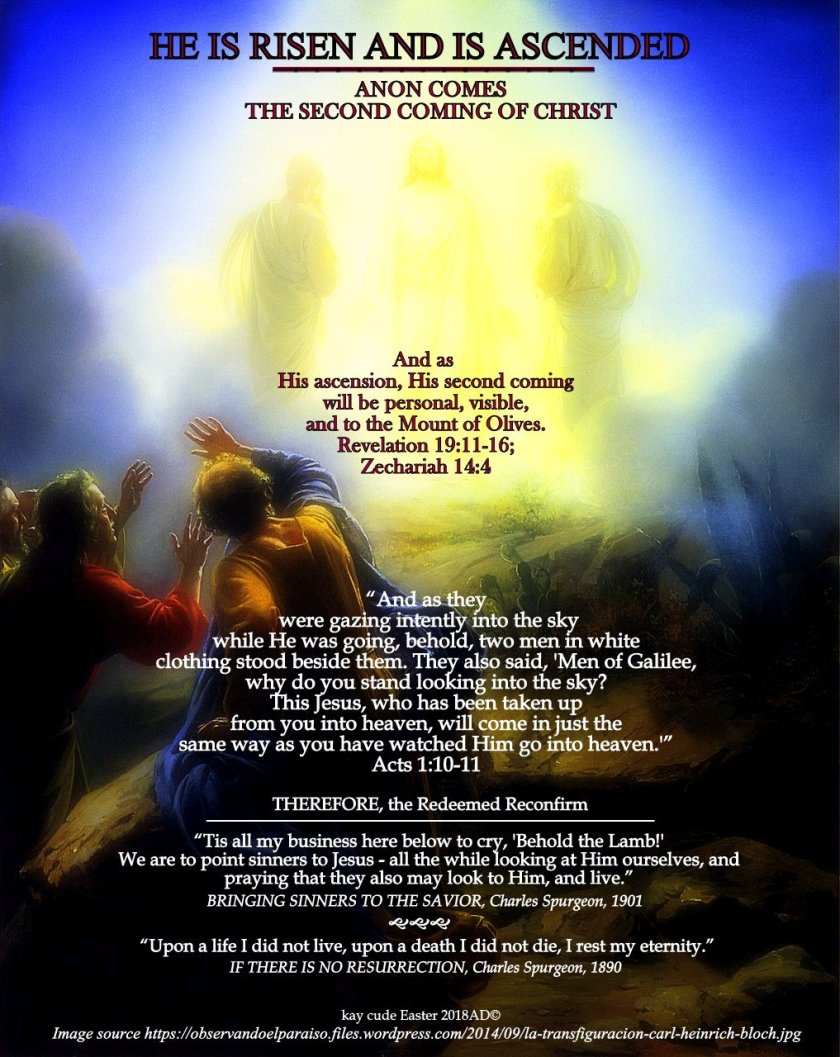
I had begun this piece several months ago with only Spurgeon’s one quote, “Tis all my business here and below to cry, ‘Behold the Lamb!’ We are to point sinners to Jesus – all the while looking at Him ourselves, and praying that they also may look to Him, and live.” I was captivated by the image of the radiant glory of Christ in His transfiguration and subsequent ascension, but couldn’t settle on what I needed to say to complete the message, for it is directed at the unregenerate and the redeemed of Christ.


Thank you for your piece, “The Power of the Resurrection vs. the Stupidity of Easter,” for within it I found John MacArthur’s “The Power of the Resurrection” and within it another Spurgeon quote that completed the intent the first quote and Acts 1:10-11.

HE IS RISEN AND IS ASCENDED

Posted in encouragement, Uncategorized

A simple reminder about hope

Blessed be the God and Father of our Lord Jesus Christ! According to his great mercy, he has caused us to be born again to a living hope through the resurrection of Jesus Christ from the dead, (1 Peter 1:3)

Well that says a lot! Each phrase is an encouragement. I’m focusing on living hope this morning. Our living hope is not a dead hope. It is not surmise, speculation, or empty ‘what if’. It is a living hope because we are IN Christ and He is living and *He* is our Hope.

Gill’s Commentary says

Saints are both begotten again to the grace of hope, and to the glory which that grace is waiting for”. Our hope is because of Christ, it is in Christ and it is Christ. It is a living hope

hope

Posted in encouragement, Uncategorized

The Pilgrim’s Progress, John Bunyan, and Helpful Resources

Pilgrim's_Progress_2I really love this book. I’ve read it once, picked through it several times, and now I’m listening to Derek Thomas lecture on it at Ligonier.org’s Daily Video. (1st lecture in the series here).

There is a part 2 to Pilgrim’s Progress that Thomas urges us to read, as both parts are meant to be a coherent whole. I had not known that.

Pilgrim’s Progress was written by John Bunyan while he was in prison for 12 years for preaching the Gospel. Wilkipedia has a bio of the man, more at link

John Bunyan (unknown birth date, baptised on November 30, 1628 – August 31, 1688) was an English writer and Puritan preacher best remembered as the author of the Christian allegory The Pilgrim’s Progress. In addition to The Pilgrim’s Progress, Bunyan wrote nearly sixty titles, many of them expanded sermons.

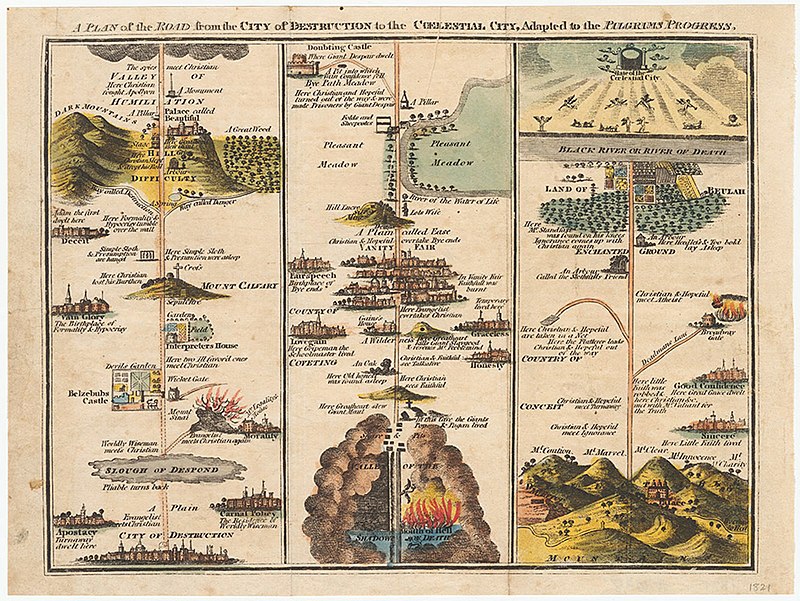
He also penned the world’s first recognized visual theology, the Mapp Shewing Order and Causes of Salvation & Damnation“. Tim Challies updated the Map to modern graphical styles, though let it be said I enjoy the original, with its angels and dragons and soaring language. Challies said of the maps,

In a pair of side-by-side timelines he traced the salvation of the believer (or the elect) and the damnation of the unbeliever (or the reprobate). …

Let me start you with a hint: Begin on the left side and read through circles one to 25 as a big, long sentence. When that’s complete, do the same for the other side. Finally, go back to read the verses and additional information. I think you will find, as I did, that the first sentence is terrible and chilling while the second is beautiful and encouraging. Whatever you do, linger. Bunyan has a lot to teach us through this infographic.

Here’s a link to Bunyan’s original (and IMO, better) map. Bunyan’s spiritual autobiography, Grace Abounding to the Chief of Sinners, is also a wonderful book. You can find a free text version online here. Or here in .pdf form, which you can download and then send to your Kindle via Kindle email attached as a file and it will be installed on your device.

Since Bunyan is so well known for Pilgrim’s Progress, few people know he wrote so many other books.

Anyway back to the book Pilgrim’s Progress. Why is this book important?

Leland Ryken said in a foreword at Desiring God about the 2 books(s) The Pilgrim’s Progress parts 1 & 2,

The book that became known to posterity as The Pilgrim’s Progress is a Christian classic whose importance is impossible to overstate. For more than two centuries after its first publication, The Pilgrim’s Progress ranked just behind the King James Bible as the most important book in evangelical Protestant households. Te book has been translated into some two hundred languages, including eighty in Africa. Any book that has achieved such popularity has a very large claim to our attention. Facts of Publication The Pilgrim’s Progress actually has two publication dates, corresponding to the two books that comprise it. The first book was published in 1678 and bore the title The Pilgrim’s Progress: From This World to That Which Is to Come, Delivered Under the Similitude of a Dream. It tells the story of the spiritual journey of the protagonist named Christian from the City of Destruction to the Celestial City (meaning heaven).

Book II was published six years later as part of an old artistic tradition known as a “companion piece.” It tells the story of the same journey, this time undertaken by Christian’s wife, Christiana, and their four sons.

The hard part for me when reading Pilgrim’s Progress is not the 350-year-old language. Though, if the language presents a difficulty, there are free updated, modern language versions available, both for free online and in hard copy.

800px-John_Bunyan,_The_Road_From_the_City_of_Destruction_to_the_Celestial_City_1821_Cornell_CUL_PJM_1038_01

A Plan of the Road From the City of Destruction to the Celestial City, Adapted to The Pilgrim’s Progress, 1821. Public Domain

What I find hard is the abstractness of it, because I’m very literal. I do not understand allegory or symbols in literature.

Pilgrim’s Progress is an allegory. An allegory is a literary device. Here is allegory defined

Allegory is a figure of speech in which abstract ideas and principles are described in terms of characters, figures, and events. It can be employed in prose and poetry to tell a story, with a purpose of teaching or explaining an idea or a principle. The objective of its use is to teach some kind of a moral lesson.

Difference Between Allegory and Symbolism
Although an allegory uses symbols, it is different from symbolism. An allegory is a complete narrative that involves characters and events that stand for an abstract idea or event. A symbol, on the other hand, is an object that stands for another object, giving it a particular meaning. Unlike allegory, symbolism does not tell a story.

I enjoyed Ligonier Theologian Derek Thomas in these free 23-minute lectures explaining Pilgrim’s Progress, both parts one and two. I found them extremely helpful in understanding the book. In addition to explaining the allegories and what they (likely) stood for, Thomas folded in Puritan history and culture of Bunyan’s day and set the context for how Bunyan thought and what was happening in his life as he wrote the book. This information gives depth and nuance to understanding it.

The City of Destruction
The Wicket Gate
The Interpreter’s House
The Cross & the Sepulcher
The Hill Difficulty
The Palace Beautiful
The Valley of Humiliation
The Valley of the Shadow of Death
The Godless City: Vanity Fair
The Castle of Giant Despair
The Delectable Mountains
The Celestial City

Another resource for this marvelous book is Notes & Commentary, Guide to Pilgrim’s Progress by Ken Puls.

An additional resource is Mt Zion Chapel Library, Pilgrim’s Progress for Everyone

I hope you enjoy the resources and would consider reading The Pilgrim’s Progress.

Posted in discernment, Uncategorized

How to Do Online Discernment Ministry, part 2

Yesterday I opened part 1 with a short look at the biblical cause for discernment, and distinguished between the every day Christian (who must discern) and the Christian who has been specifically given the Gift of Discernment (who must discern).

Discernment is important.

I also mentioned the incredible technologies the Lord has allowed to be invented and how we can share the Good News of Jesus Christ by using these various platforms in ways never before seen.

However, I cautioned that since the internet is egalitarian and unregulated (yay!) that any ole person, from vaunted theologian to cranks and nutcases, all issue theological material that range from Gospel gold to cow patties. It’s up to the Christian to learn how to assess credibility of who they follow and use as a resource.

To that end, ask yourself,

–Is the writer/blogger transparent?
–Do they have any credentials? Did you follow up on researching those credentials? (someone did just that on Ravi Zacharias and it turned out his credentials were not exactly what he said they were.)
–If you follow the writer/blogger for any length of time, is he/she growing in maturity toward Christ, or drifting away from Christ?
–And, of course, does their output solidly handle the word of God?

Today I’d like to offer you some tips on assessing whether an online discernment ministry is operating appropriately within an edifying sphere of the gift, or is just a critical crank out to get someone or has an ax to grind.

The ultimate aim of discernment is to edify the saints, either by encouragement, or by warnings so they do not stumble or fall.

Tim Challies wrote a book on discernment, and he defined the skill this way

Discernment is the skill of understanding and applying God’s Word with the purpose of separating truth from error and right from wrong.

No matter if you are in your pew listening to a sermon, choosing a book at the Christian bookstore, or reading some essays online, you need discernment to determine if what you are absorbing aligns with God’s word or is a lie designed to incrementally steer you away from the narrow path.

Primary Sources

1. Does the discernment ministry use primary sources? The internet allows for pasting and re-pasting and re-pasting endlessly. But if you track down the original quote often you find that it isn’t even attributed correctly to the person you’re reading about, or has been ripped out of context and made to say what it was never intended to say.

My stance is that I track down the primary source as often as I can. When I wrote about Melissa Moore’s divorce (Beth Moore’s daughter) I went online to the Texas court sites and read the notarized court papers. Same with RC Sproul’s son when RC Sproul Jr was arrested for felonious DUI, I read the court papers. Same with Chip & Joanna Gaines of Waco TX and their businesses, those are available on the Secretary of State business listing site. Same with many other charitable ministries, their tax returns are available for free online and open to public inspection.

Google has a function where you can read archived newspapers. I strive to read the newspaper of record, not just a penny journal limping along in a corner of the internet somewhere. If the quote or issue arose from a video, I watch the video- all of it. Primary sources are best. I go to lengths to obtain them. I do not rely on hearsay or narrowly selected quotes. This is to honor the person I am writing about. Slander is a sin. I also want to satisfy my own conscience that I’ve done diligence. It is also because I do not want any of my material to cause another to stumble.

So ask, did the discernment ministry go the extra lengths to ensure the information is as close to primary as possible, and therefore of the highest credibility?

Context

2. Context is king. You’ve heard that in Bible study, it also is important in journalism. Discernment research is actually investigative journalism, and the same ethics apply. Has the online discernment ministry writer used ethical standards and looked at the situation/quote/issue in context? Has he or she been fair?

Anyone can take anything out of context and make something of it. Someone sent me a couple of photos that had no provenance to them (origin) and tried to make a claim that something occult was going on at a credible ministry. It turned out to be college kids painted up for a celebration after winning a championship trophy. The link that was sent along with the pictures was to a website whose author sneered that of this Christian college, they sure didn’t see many of the youths carrying around Bibles. But, it turned out that they were, in many other photos on their Facebook page. Context!!

Time/Age

3. Another important factor to look at is, is the online discernment ministry cherry picking non-representative statements? Someone sent me one statement an elder pastor made once at the onset of his ministry, which was 47 years ago. For the ensuing 47 years, the pastor preached a fuller and more nuanced version of the statement. The person was attempting to claim that ergo, the pastor was false due to this statement made long ago. This isn’t judicious, charitable, or even fair. So look at whether the online discernment ministry is taking statements that never did or no longer represent the teacher’s stance. How old is the material the online discernment ministry is using to “prove” their case? How narrow is it? How representative is it?

When I was editor of a weekly newspaper, sometimes issues would heat up the town. People would send letters to the editor, lots of them. Of course I did not have room to print them all. I chose representative letters that seemed to capture the stream of thought and feeling overall. What would be wrong would be to choose the one letter that opined Yea on the situation, if the letters were running 9-1 Nay. It’s the same with online discernment ministry. The writer should chose statements that are representative of the overall doctrinal stances.

Secondly, time. Has the ministry under investigation or the teacher being scrutinized developed over time? It was not fair for the person contacting me to choose one statement from a young pastor and pretend that encapsulates all of his attitudes on the subject of, for example, Calvinism to date, for the last 50 years. We learn, we grow, we mature.

But solid food is for the mature, for those who have their powers of discernment trained by constant practice to distinguish good from evil. (Hebrews 5:14).

Martyn Lloyd-Jones had 1,600 sermons recorded and published. S. Lewis Johnson has over 1,500 sermons recorded and transcribed. John MacArthur has over 3,300 sermons recorded, transcribed, and published. Those are a lot of words. It’s a lot to be responsible for. How would you like your 1st grade report on ‘apples’ published and used as a representative example of what you speak and believe now, 40 years later? You would not. When it comes to a discernment ministry being critical of teachers and pastors, are they charitable? Did they look to see how the teacher is doing over time? Or are they taking one aged, anomalous stumble and making a mountain out of a molehill?

Weasel Words, Hyperbole, Conspiracies, Tenuous Connections

4. I pile these three into one section.

Weasel words according to Merriam Webster Dictionary are “words used in order to evade or retreat from a direct or forthright statement or position.” This sales site explains,

Weasel words are used when the speaker wants to make it seem like they’ve given a clear answer to a question or made a direct statement, when actually they’ve said something inconclusive or vague. Fortunately, weasel words are easy to spot.

A lot of the worst online discernment ministries (which are not discerning and minister to no one) are just plain lazy. It takes time to search out primary sources. It takes time to watch a teacher over time. It takes time to write and edit what you’ve written so it reflects fairness and charity. So they get lazy. They try to make their ‘discernment expose’ sound legitimate by using these words.

Sources say that the teacher did…”
So-and-So would often be seen drinking at a neighborhood bar…”
Most scholars today believe Jesus likely never existed”

Does your favorite online discernment ministry use these vague but important sounding weasel words?

Hyperbole are wildly exaggerated statements. “At Thanksgiving your mom cooked enough food to feed and entire army!” “That teacher is constantly seen with other heretics!”

Conspiracies are just that, conspiracies. No, that gesture isn’t a hidden signal indicating Freemasonry, or showing occult ties, or revealing an Illuminati guy. It’s just a hand, OK?

Tenuous connections. Sometimes, when there’s no proof at all, the poorer of the online discernment ministries will try to insinuate guilt by association. “He shares the stage with so-and-so, who had a second cousin in the last century in another country who might have been Illuminati!! Therefore the guy is definitely a heretic!” I am not exaggerating too much on some of the stuff I receive that say almost exactly that kind of thing.

“I heard that the guy has links to an underground movement that you can clearly see in the photograph by this hand signal!” Sigh. If I had a dime for everyone who sends me stuff charging that so and so ‘has links to.’ Of course when I ask for proof, the person evaporates. Watch your discernment ministry if they publish nebulous charges of someone having links to or being connected to.

Separation issues/Partnering

This gets complicated. Partnering with someone who is a false teacher may not necessarily be a nail in their coffin. When Beth Moore was starting to show she was going off the rails, Kay Arthur tried to stick with her to steer her back, and they partnered for a few more conferences together. Then when it became obvious that it was not working, Mrs Arthur separated. (source). Ok, that makes sense.

John Piper partners with lots of people that have us scratching our heads, like Louis Giglio at the Passion conference, or sharing the Passion stage with Beth Moore. Sticking with Mark Driscoll long after most had separated from him. Piper has been pretty solid for over 50 years. The last few he has had questionable associations and chosen not to separate. Does this mean Piper is a false teacher himself? Or lacks discernment? Or is solid but making unwise choices for reasons of his own?

But the worse of the online discernment ministries claim that so-and-so shared a stage last year with Piper, who shared a stage this year with Moore, and that means that so-and-so is false, is not discernment and displays a lack of understanding about biblical separation. Separation is serious. It means when a teacher publicly separates, that they are in effect declaring the person they are separating from a false teacher. We don’t do that lightly in real life, and online discernment ministries should not demand separation at every turn from everyone. If they do, there is a problem with the online discernment ministry. Here is a discussion between Phil Johnson and Todd Friel at Wretched regarding separation.

Anger

Last, is the discernment ministry perpetually angry? Is their pen always wagging in the air, their pulpit pounding all the time? Some things we learn in the discernment world are anger-inducing, but mainly, discernment ministry is saddening. It’s depressing to see how many people are taken in, sad to see how deeply some false teachers can be embedded. It’s a sorrow to know their future, which will be justly tormented in the fires of hell. (2 Peter 2:12, Jude 1:10).

If an online discernment ministry is perpetually outraged, it is not a healthy ministry. Ministry of any kind is supposed to point to Christ and be edifying to the saints. Constant outrage at “the latest” isn’t healthy for the ministry or its readers.

Look for online discernment ministries that are charitable, even-keeled, fair, and point to Christ. Look for online discernment ministries that use primary sources, embeds things in context, are willing to review a teacher over time, aren’t perpetually angry, doesn’t push for instant separation from everyone, and uses appropriate proofs to support their contentions. And not least, adheres to a commonly understood interpretation of the Bible verses in the discernment realms. I found this essay helpful:

10 invalid arguments in defense of false teachers

Thank you!

Posted in discernment, Uncategorized

How To Do Online Discernment Ministry, part 1

Part 2 here

There’s online discernment ministry, and there’s online “discernment ministry.” I hope I’m the former. The latter is often discussed negatively. When “scare quotes” are put around the name of discernment ministry, it’s a pejorative. Scare quotes in journalism are sometimes called sneer quotes, so you get the idea.

Though I post articles about a trio of topics, including encouragement and prophecy, I do post articles about discernment. I post articles naming names of false teachers. One-third of what I do online regarding my blog is online discernment. So, am I one of the good ones, or one of the bad ones doing “discernment ministry”? Let’s have a two-part lesson on how to do online discernment ministry, and through it I’ll reveal what I do and how I go about it, and I’ll challenge you to test the discerners you follow, (including me), by sharing how.

What Is Discernment and is it Biblical?

One of the gifts given to people by the Spirit is discernment. (1 Corinthians 12:10). This is one of the spiritual gifts given to me. I primarily serve in my local church, which I believe is extremely important because it’s a command (Ephesians 4:12, Romans 15:2 etc). Spiritual gifts are meant to be used in a local body of believers, for edification and for accountability purposes.

Biblically, discernment is important. It’s a skill all believers must hone, but some were given ‘an extra dose’ if you will, in the form of a specific gift. In the days when the canon was not set, prophecies and revelations and epistles were coming in to the believers. Some of the letters were false. Each local body needed to be able to determine which messages were truly from a designated apostle, and which were false. The church at Ephesus was praised for having developed worthy discernment, (Revelation 2:2) while the church at Thyatira was rebuked for their lack of it. (Revelation 2:20).

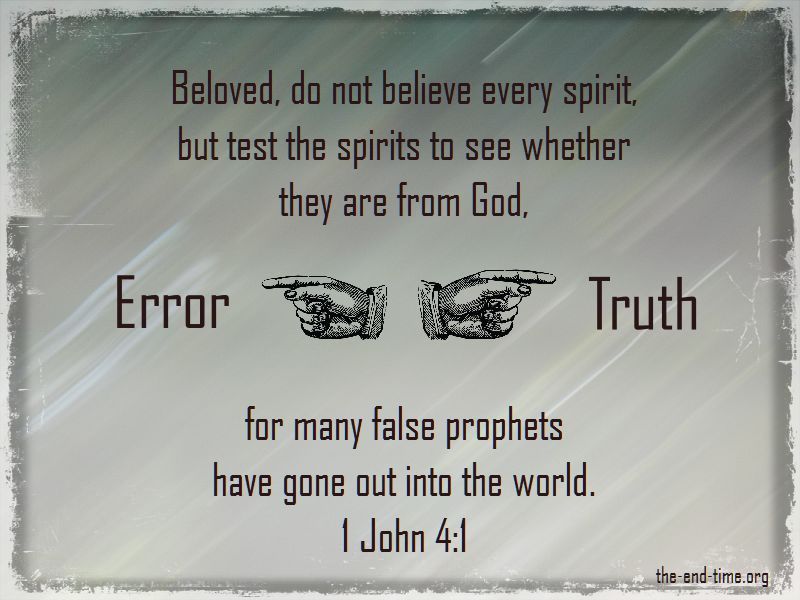
The gift is still in force today, much needed, as many false prophets have gone out into the world, and we must test the spirits now as then (1 John 4:1).

By 2003, user-friendly blog platforms had come along, and Blogger announced it had a million users. Christians rapidly gravitated to this new publishing method and pastors and theologians were setting up blogs to push the message. So were lay theologians, cranks, wingnuts, and anyone with a theory or opinion, including me. My first blog came along in 2006 but after two and a half years of writing increasingly Christian content, I separated the content and started a second blog, this one, in January 2009. It is solely focused on Christian content while my other one remains personal. I’ve blogged just about every day on The End Time blog ever since.

By now in the new millennium, many other means have been invented with which to share the message of the Gospel and to maintain its purity. Podcasts, websites, blogs, movies, texts, simulcasts, and more are blessedly available to get our message out. I believe those methods should be used. In Paul’s day there was no internet. But he wrote letters, the internet of his day. Whatever means that the Lord has allowed to be invented to share Christian doctrine, testimonies, missionary reports, and the like, is a good thing in my opinion.

A Little About Me

I’ve published 4,370 essays. That is a lot to say. Yet, who am I? Just some lady in a corner of the internet. I’m not a celebrity. I haven’t gone to seminary. I am just someone taking advantage of the platforms available to share my opinion and perspective. You need discernment to ensure that I am worthy of your time and attention.

I have been a writer all my life and before the internet was available, it was hard to get published. I had been published a few measly times, in a journal or magazine here or there. But it took enormous effort to send pieces for publication to Publishing Houses or Magazines and the monoliths would send rejection letters back after many weeks, if they sent anything at all. It was frustrating.

So when easy platforms like Blogger, LiveJournal (remember them?) and WordPress came along with the touch of a button, anyone could publish, including me! So I did.

An egalitarian publishing world has its downsides too. People can and do propagate error. Not just in theology but in politics, sociology, psychology; in any -ology there will be people who want to push their message. The internet is unregulated, (yay!) but it takes wisdom and discernment to sift through increasingly unhealthy, errant, or just plain rotten content to find the gold. Or just the good.

What are the Blogger’s Credentials? Track Record?

So when you look for a blog to follow, especially a discernment blog or an eschatology blog (those Christian subjects seem to draw the more wonky theorists and unstable theologians), look to see who is writing. Do they have a track record? Do they have credentials? Not that credentials are of sole importance, but sometimes it counts- and that can be for or against. A blogger might say in his ‘About,’ that “I have a Masters of Religious Education” but upon searching further you discover the MA is from Brigham Young University, the Mormon college.

As to the track record, look for their trajectory. Did they start off solid and weaken over time? Do they quote the Bible appropriately? Do they quote the Bible at all? Or are they drifting into theories and conspiracies? Are they focused on secular controversies or extra-biblical prophecies, personal revelations?

When I first started blogging I did newspaper eisegesis. I looked at the news and looked at the Bible and then made statements about it. Israel really is the center of it all! There’s a reason Israel is always in the news! The Middle East is volatile because of the Esau-Jacob struggle! People really are horrible, not basically good, and the news confirms it! I don’t think I ever crossed a line, but you can determine that. I didn’t focus solely on that, though, which is another important measure of a credible discernment ministry. If someone is always writing about and researching the bad, that colors one’s perspective. Soon one can lose perspective.

As for my early days, I don’t apologize for the interest in global affairs as they related to biblical prophecy. My eyes had been opened to another world, the Christian worldview through a biblical lens, and it was wonderful and amazing. I loved that time. I remember distinctly the amazement I felt when learning that the Christian world had been there all along. I was aroused with wonder to learn that God’s plan is orderly and may come to an end any day. That sense of wonder and imminence has never left me and I hope it never will.

But I grew out of the newspaper stuff by the Lord’s grace and went on to study deeper theology. That is what to look for. Is a discernment ministry writer growing up toward Christ, or growing away from Christ?

My credentials…I am loathe to share lest it seem like boasting, but the few times I’ve mentioned this in 9 years perhaps will be forgiven.

I am a writer & researcher, having been published in The Reading Teacher and The LAB at Brown University, in literary journal Brownstone Review and Glamour Magazine. I have helped edit Chicago’s National Association for the Study of Education 98th and 99th Annual Yearbook of Education Research. I was a newspaper publisher, editing a New England Press Association award-winning weekly newspaper. I’ve also been employed by the daily paper Athens Banner Herald as a features writer and have written for the Madison County Journal.

I was and am a educator. I worked as a short and long term substitute, a para-professional and as a certified elementary school teacher. I took some years off to attain a Masters Degree in Literacy Education, and to travel widely, before resuming work as a para-professional, of which I am employed to this day.

Is the Blogger a Lone Ranger, Not a Member of any Church?

I am a member of a local church, fully participating by steady attendance at Sunday worship service as well as weekly attendance in several small groups overseen by the church elders.

Those are my professional and personal credentials. I have no theological credentials. I have taken several for-credit classes through Ligonier. I listen to The Master’s University lecturers online. I applied to and was accepted at Reformed Theological Seminary but after the very first class taught a possible young earth and long years evolution, I quit. Other than daily study in diligence and submission, regular church attendance, and listening multiple times per week to credible pastors, I have no official theological credentials.

When you visit a discernment ministry online, assess who is in charge of it. Who is writing and sending out theological messages? I can’t tell you to do that without giving you some idea of who I am, and whether I should be read or followed. Transparency is important. Hence the above paragraph.

I do not agree with those writers who blog anonymously. I understand the issues around privacy and safety, especially for women, but if one is going to proclaim Christ, one does so openly. Jesus said He did nothing in secret (John 18:20). Paul said he works openly, nothing is done in secret (Acts 26:26).

That is the how and the why. Part 2 will discuss how to assess whether someone is a credible online discernment ministries such as discussing the importance of primary sources, and other tips such as separation issues and solidity and growth over time. I’ll look at how unscrupulous “discernment bloggers” use tenuous connections, weasel words, out-of-context material and quotes, and unrepresentative doctrine.

Till then, thank you and bless you for reading.

error and truth discernment

Part 2 here

Posted in discernment, Uncategorized

“Demons are troubling you. What you need is some harp music!’ said only 1 person ever

Now the Spirit of the LORD departed from Saul, and an evil spirit from the LORD terrorized him. Saul’s servants then said to him, “Behold now, an evil spirit from God is terrorizing you. “Let our lord now command your servants who are before you. Let them seek a man who is a skillful player on the harp; and it shall come about when the evil spirit from God is on you, that he shall play the harp with his hand, and you will be well.’ So Saul said to his servants, “Provide for me now a man who can play well and bring him to me.’ (1 Samuel 16:14-17)

Can you see what’s wrong with this picture?

In the previous verses, Prophet Samuel has just anointed David. The Spirit rushed powerfully onto David, and the Spirit departed from Saul. David’s rise begins, and Saul’s descent has begun.

It was obvious to onlookers that Saul was being tormented by an evil spirit. This should have given Saul pause. It did not.

Did Saul examine himself to see if he was in the faith? No, he didn’t.

Instead, Saul addressed the symptom. Let’s soothe the demon, not investigate why I have a demon. Saul did not appeal to the LORD, he did not pray, he did not sacrifice.

A band-aid on a gushing artery will never solve the problem.

Here is another resource in which we look at practical ways to examine ourselves to see if we are in the faith. JC Ryle’s first chapter in his book Practical Religion, the chapter is called Self-Inquiry. Ten questions for self-examination.

Examine yourselves, to see whether you are in the faith. Test yourselves. Or do you not realize this about yourselves, that Jesus Christ is in you?—unless indeed you fail to meet the test! (2 Corinthians 13:5)

Saul failed to meet the test. Christians if they are true believers will never have the Holy Spirit completely removed from them. God’s hand will never completely release them, they (we) can and do endure seasons where God has withdrawn temporarily.

Grace To You: I Feel Abandoned in My Trial

Ligonier: Grieving the Holy Spirit

Mike Ratliff: When God Leaves us to Ourselves

Naylor’s Heart Talks: When God Withdraws Himself

The good news is that if one is a true Christian, the withdrawal in New Testament times is only ever temporary. Naylor again:

If God apparently withdraws from us, it is only because he sees that we need to be left alone for a season. He sees that the heart must be drawn away from selfish interest; and when this is accomplished, he comes back and reveals to us anew the fulness and richness of his love.

Saul sinned. He never took spiritual inventory. He never went to the source. He only salved the symptom. William Congreve famously said, “Musick has charms to soothe a savage breast,” but the savagery always returns. Repentance and dependence on the LORD will quell the terror. Harps only go so far.

harp

Posted in discernment, Uncategorized

Weepers and gnashers: the importance of examining ourselves

I saw this clip on Todd Friel’s Wretched Youtube page last night and it was extremely moving to me. It was also convicting. It DID spur me to check myself and examine as to whether I am in the faith.

This is important to do, because as the video title suggests, there will be two types of people in hell. The two types are based on the verse from Matthew 13:50, where at the end of the age, angels will

throw them into the fiery furnace. In that place there will be weeping and gnashing of teeth.

By the way, when you study angels you notice how active they are in executing all God’s commands, especially in Revelation. Anyway, in the clip, Dr Sproul explains what the weeping and what gnashing of teeth is.

The weepers are weeping because they were self-deceived all along and were not saved when they thought they were. Jesus will declare to them, “Depart from me you workers of iniquity, I never knew you.” (Matthew 7:21-23). Hence the urgency to check one’s self to see if we are in the faith. (2 Corinthians 13:5).

The gnashers are angry. They refuse to acknowledge God for who He is, even while they are justly tormented in the fires of hell. How can this be, one might wonder, when the entire lake of fire has been prepared by God for the devil and his angels, and the unforgiven sinners? The fires are real, they are in them. How can they not acknowledge God?

Revelation gives us a clue as to the depth of sin and the anger at God’s authority. Even while they were alive and under punishment of God’s plagues, they did not repent. Revelation 9:20-21 has the first instance. The Lord sent an angel to open the pit and release hordes and billions of demons, which were so many they clouded the sun upon their release. The demons were given authority to plague mankind with sores and pain. A third of all mankind is killed! Further billions will be laying around writhing at the sting of demons, and yet-

The rest of mankind, who were not killed by these plagues, did not repent of the works of their hands nor give up worshiping demons and idols of gold and silver and bronze and stone and wood, which cannot see or hear or walk, 21 nor did they repent of their murders or their sorceries or their sexual immorality or their thefts.

To make the depth of their depravity even more pointed, the next verse from Revelation shows clearly that they KNOW it is God sending the plagues, and they did not repent. Instead, they cursed his very name!

They were scorched by the fierce heat, and they cursed the name of God who had power over these plagues. They did not repent and give him glory. (Revelation 16:9).

And again in verse 11 when another plague was sent, they did not repent but instead cursed the name of God again. Instead, they began assembling at Armageddon to fight him!

This all goes to show the power of sin. The power of sin to delude us as to its power. It can blind us. Am I self-deceived? Am I not in the faith? Will I hear those dread words ‘depart from me?’ Will I be weeping?

Please watch the short video and ponder the gravity of it all. The cross of Jesus split history. It split the whole of humankind into two types of people- saved and unsaved. It split the world into Gospel-loving and hell-bound. The cross stands alone as the point of beginning or the point of departure.

There will be two types of people in hell…


I thank God that there are and were men to preach the truth, even the unpleasant truths of scripture, such as hell, self-delusion, and false conversion. It’s important. Now, how do we examine one’s self? Further resources are listed below.

Sermon series:

Undoubtedly the sincere claims people make are sometimes far from reality. As chilling as that thought may be, there are countless well-meaning people who believe they’re saved, but they aren’t. Could you or someone you know be one of them? How do you know your faith is built on a solid foundation? Or is that something you can ever know this side of eternity?
Determine for yourself whether you are a Christian. John MacArthur shows you how to assess your spiritual condition in Examine Yourself.

If you don’t want to go through a series of sermons, here is a 15-page free booklet called Is it Real? 11 Biblical Tests of Salvation.

If you don’t want to read a 15 page booklet, here is a 5-page free booklet called Examine Yourself.

If you don’t want to read 5 pages, here is a 515 word essay from GotQuestions on What does it mean to examine yourself?

If you don’t want to read 500 words to examine yourself, then I direct you back up to the top to re-watch the clip, where there will be two types of people in hell. I’m not saying that if you don’t follow through in looking at these particular resources you’l go to hell, but I’m emphasizing that the power of sin to delude us is great and must be constantly watched against. There is nothing more important than checking one’s self to make sure we are not one of the two types. It’s the best thing you could do all day or for all eternity. 🙂 If nothing else, you will receive assurance! This illustration by artist Boris Sajtinac is all too vivid!

apostate church by boris sajtinac

Believe me, I checked myself immediately after watching the clip. I know the power of sin to delude me is too great. I’ve seen it happen to others and I know it dwells inside myself. Please, pray and check, and be assured, dear sister.


Posted in encouragement, Uncategorized

“O that there were a mediator between us!”

For He is not a man as I am that I may answer Him, That we may go to court together. There is no umpire [daysman] between us, Who may lay his hand upon us both. Let Him remove His rod from me, And let not dread of Him terrify me.” (Job 9:32-34).

Job is thought to be one of the oldest written books of the Bible, and its events some of the oldest as well, its events occurring possibly pre-Exodus during the patriarchal age. Possibly 2000BC.

We know Job was a righteous man (Job 1:1, 1:8, Ezekiel 14:14). He abhorred sin. He mediated for his family in priestly functions, He devoted himself to the one True God. He knew Yahweh, and Job knew enough to be terrified.

Job is complaining that though he knows the depravity of his sin, God is so far above man and so terrifying that Job wished there was an arbiter, or an umpire, between them to advocate for him in God’s holy court. Yet who could that be? A mere man might be a good arbiter for Job but no mere man can stand before God. So, who? Who can lay his hand on both man and God?

We know that it was God’s providential plan to send Jesus, the God-Man. The cross is that bridge which re-unites man and God after the dreadful separation that occurred in the Garden. It is Jesus who lays His hand on both man, and God. Amen!

Jesus was fully man, but not an ordinary man. He had to live a sinless life so that His sacrifice at Calvary would be perfect, his blood shedding for man in obedience to God. He did so. He fulfilled it all and it was finished at the cross.

They laid His body in a borrowed tomb. It lay there scarred and wrapped and alone in the dark. Then on resurrection morning, He arose! It is finished, and there He comes, ascending back to glory, having fulfilled ALL.

daysman—“mediator,” or “umpire”; the imposition of whose hand expresses power to adjudicate between the persons. There might be one on a level with Job, the one party; but Job knew of none on a level with the Almighty, the other party (1 Sa 2:25). We Christians know of such a Mediator (not, however, in the sense of umpire on a level with both)—the God-man, Christ Jesus (1 Ti 2:5).

Jamieson, R., Fausset, A. R., & Brown, D. (1997). Commentary Critical and Explanatory on the Whole Bible (Vol. 1, p. 318). Oak Harbor, WA: Logos Research Systems, Inc.

God. Let us not make ourselves equal with God, but always eye him as infinitely above us. [2.] That there was no arbitrator or umpire to adjust the differences between him and God and to determine the controversy (v. 33): Neither is there any days-man between us. This complaint that there was not is in effect a wish that there were, and so the Septuagint reads it: O that there were a mediator between us! Job would gladly refer the matter, but no creature was capable of being a referee, and therefore he must even refer it still to God himself and resolve to acquiesce in his judgment.

Our Lord Jesus is the blessed days-man, who has mediated between heaven and earth, has laid his hand upon us both; to him the Father has committed all judgment, and we must. But this matter was not then brought to so clear a light as it is now by the gospel, which leaves no room for such a complaint as this.

Henry, M. (1994). Matthew Henry’s commentary on the whole Bible: complete and unabridged in one volume (p. 675). Peabody: Hendrickson.

Praise God for His Gospel, His mediator, His plan! Praise God that He resurrected Jesus from the dead, forevermore to be our Savior. For He is no longer in the tomb, He is alive, He is not there, He has risen!

risen easter

Posted in encouragement, Uncategorized

He will not let the Holy One see corruption

Therefore he says also in another psalm, “‘You will not let your Holy One see corruption.'”  (Acts 13:35).

Oh, to think of His precious body, broken, speared, beaten, nailed… wrapped in a shroud and and now laid in a grave!

Chris Powers of Full of Eyes ministry (fullofeyes.com) drew this wonderful illustration today:

Joseph took The Body and wrapped it in a clean linen shroud and laid it in his own new tomb… (Matthew 27:59-60).

I can’t fathom what grief the disciples felt as the death happened and the precious body was brought to Joseph’s tomb…and the rock slid shut. How alone they must have felt! How perplexed and upset. Their lives must have seemed devoid of meaning. After all, Peter said to Jesus when Jesus had asked “Are you going to leave me too?” and Peter uttered his words, “Where would we go? You have the words of life”. Now the Word of life was dead. Or it seemed so. Where would they go? What would give their life meaning, now?

They must grieve for a few more agonizing hours, before all would become clear.

However, the wondrous Father will not let Jesus molder in the tomb. Jesus rose before that could ever happen! Oh, the joy of Sunday!

Our Savior lives!!

Good Friday the most evil day in all of history. Saturday the most grief-stricken day in all of history. Sunday the most joyous day in all of history!