I was years and years upon the brink of hell—I mean in my own feeling. I was unhappy, I was desponding, I was despairing. I dreamed of hell. My life was full of sorrow and wretchedness, believing that I was lost. ~ Charles Spurgeon as a teenager
Charles Spurgeon’s torments in wanting to be saved are well-known. Spurgeon knew he needed salvation because of his sins, but also knew he couldn’t decide to save himself. He needed the external specific call.
He didn’t just sit around and wait though. He read his Bible, he prayed, and he sought- resolving to visit every church in his district one at a time, repeatedly.
John Bunyan’s experience was similar. In his spiritual autobiography, Grace Abounding to the Chief of Sinners, he was tormented by his sin and knew he needed Jesus. He read his Bible, tried various things, until he realized conversion is all of God, election. He wrote,
With this scripture I could not tell what to do: for I evidently saw, unless that the great God, of His infinite grace and bounty, had voluntarily chosen me to be a vessel of mercy, though I should desire, and long, and labour until my heart did break, no good could come of it. Therefore this would stick with me, How can you tell that you are elected? And what if you should not? How then?
O Lord, thought I, what if I should not indeed? It may be you are not, said the Tempter; it may be so indeed, thought I. Why then, said Satan, you had as good leave off, and strive no farther; for if indeed, you should not be elected and chosen of God, there is no talk of your being saved; For it is not of him that willeth, nor of him that runneth; but of God that showeth mercy.
By these things I was driven to my wits’ end,
But Bunyan didn’t leave off, and didn’t sit and wait for grace to drop into his lap as Spurgeon didn’t wait around for grace to fall into his lap. Though conversion is only from Jesus, the sinner can prepare, inquire, be active. Bunyan kept reading the scriptures, pleading, and praying.
At one point in his faith journey, Bunyan had been wracked with torment, and he laid down to rest and nap. He had a dream that he was trying to get thru a wall to go from the cold side of a great mountain into the sun on the other side. Eventually he found a passageway but it was exceedingly narrow. He got his head in, barely, and wriggled his body sideways, very narrow and could hardly get thru. He realized he had dreamed of the narrow gate. He wrote,
that none could enter into life, but those that were in downright earnest, and unless also they left that wicked world behind them; for here was only room for body and soul, but not for body and soul and sin.
But what now? Bunyan asked. What if one is not elected? And if one was elected, how would one know that salvation had come? Bunyan again-
Neither as yet could I attain to any comfortable persuasion that I had faith in Christ; but instead of having satisfaction here, I began to find my soul to be assaulted with fresh doubts about my future happiness, especially with such as these: Whether I was elected. But how if the day of grace should be past and gone? By these two temptations I was very much afflicted and disquieted, sometimes by one and sometimes by the other of them.
The wind blows where it wishes and you hear the sound of it, but do not know where it comes from and where it is going; so is everyone who is born of the Spirit. (John 3:8)
We don’t know who will be saved or when. We can’t control the wind.
We can see its effects, though. Here is my favorite Paul Washer story. It’s 3 minutes and I think it will bless you. It seems to me to be a good example of the Wind moving in a soul. When one isn’t saved one can read the Bible and read it and read it, but it will not make sense because one cannot discern spiritual things, as the verse says-
But a natural man does not accept the things of the Spirit of God, for they are foolishness to him; and he cannot understand them, because they are spiritually appraised. (1 Corinthians 2:14).
But when the wind moves in a man’s soul, it moves so we can see the effect! Suddenly the scales fall and the Bible’s verses have extreme meaning!
The wind blows where it will…but keep praying for salvation for your dear lost ones, and keep looking for fruit in those who say they have felt the Spirit move in them. Tomorrow, more on fruit.
Last week the word was Transcendence. God is apart from His creation, different from it. This week the word is Immanent or Immanence,
God’s immanence refers to His presence within His creation. (It is not to be confused with imminence, which refers to the timing of Jesus’ return to earth.) A belief in God’s immanence holds that God is present in all of creation, while remaining distinct from it. In other words, there is no place where God is not. His sovereign control extends everywhere simultaneously. Source GotQuestions
Immanence: God’s presence and activity within the creation and human history. Source: Biblical Doctrine, MacArthur/Mayhue, p 931
God is so majestic! Mysterious! How can He be both apart from His creation, and present within it?! At the same time? It shows who our God is. It’s why I chose these two words one after the other to demonstrate His essential otherness.
One other notion that is important to emphasize.
Pantheism and deism twist many people’s view of how God relates to His creation. Pantheists believe that everything is God or is a part of God, making Him equal with His creation and unable to act upon it. Deists hold that God is distinct from His creation but deny that He plays an active role in it. Contrary to these and other false views of God, the Bible says that God is both different from His creation and actively upholding it.
We must not stress His immanence at the expense of His transcendence, and vice versa.
That they should seek God, in the hope that they might feel their way toward him and find him. Yet he is actually not far from each one of us, (Acts 17:27).
Note: Modern pantheism is seen in William P. Young’s The Shack, Oprah Winfrey’s promotion of Eckart Tolle, and in Ann Voskamps’s book One Thousand Gifts as an offshoot of pantheism, panentheism. It is easy to twist both immanence and transcendence, either by direct twisting or omitting one in favor of the other. It is why it is important to learn these terms so we retain a balanced view of God.
The title for my pithy sayings comes from Proverbs 1:8-9,
Hear, my son, your father’s instruction,
and forsake not your mother’s teaching,
for they are a graceful garland for your head
and pendants for your neck.
My church family is a family of readers. That’s good. I am a reader too. That means we are also talkers about books. We love to interact mindfully and intentionally about spiritual things. Our elders model this and encourage it. Our Family Groups, Book Clubs, and get-togethers are rife with conversations that are sparked with questions like, “Can you share any insights from your latest Bible reading?” “What do you think of the Bible Reading Plan segment for today?” “What books are you reading?”
The penetrating questions perform two functions. One function is that we are a like-minded bunch who love to read! We unite around literacy. This is good because it means we also read the Bible. Secondly, it keeps us accountable. It keeps me accountable anyway. When I read, I need to comprehend, and then retain and then share.
I’ve noticed that though I love reading and I’ve been a reader all my life, lately I was reading less. I read fewer books and the time I spent reading them was growing shorter and shorter. I was comprehending less too, and retaining almost nothing. I realized that most of my reading was done on a laptop. And that was weird because I dislike reading on screen.
I soon realized the type of reading I was doing was the issue. With my limited time to read after work, I was reading tweets, GroupMe chats, Facebook shares, short blogs, and the like. Digital reading predisposes us to reading superficially and quickly. Bible reading demands the opposite. Uh-oh.
In his book 12 Ways Your Phone is Changing You, author Tony Reinke exposed the issue. Several experiments had been done on reading and they were summarized in The New Yorker. (July 16, 2014). Turns out there is a difference in the way people read depending on if the text is on a screen or on a page.
On screen, people tended to browse and scan, to look for keywords, and to read in a less linear, more selective fashion. On the page, they tended to concentrate more on following the text. Skimming, [Ziming] Liu concluded, had become the new reading: the more we read online, the more likely we were to move quickly, without stopping to ponder any one thought.
Of Rakefet Ackerman and Morris Goldmsith’s experiment, published in the Journal of Psychology Applied it was discovered,
The screen, for one, seems to encourage more skimming behavior: when we scroll, we tend to read more quickly (and less deeply) than when we move sequentially from page to page. Online, the tendency is compounded as a way of coping with an overload of information. There are so many possible sources, so many pages, so many alternatives to any article or book or document that we read more quickly to compensate.
In addition, of Mary Dyson’s research, we read,
The online world, too, tends to exhaust our resources more quickly than the page. We become tired from the constant need to filter out hyperlinks and possible distractions. And our eyes themselves may grow fatigued from the constantly shifting screens, layouts, colors, and contrasts, an effect that holds for e-readers as well as computers.
Of Anne Mangen’s research,
The shift from print to digital reading may lead to more than changes in speed and physical processing. It may come at a cost to understanding, analyzing, and evaluating a text. Much of Mangen’s research focusses on how the format of reading material may affect not just eye movement or reading strategy but broader processing abilities.
Goodness! Reinke interviewed Trip Lee for the 12 Ways book, and Lee said the following. See if it resonates with you:
The more time I spend reading ten-second tweets and skimming random articles online, the more it affects my attention span, weakening the muscles I need to read scripture for long distances.
I certainly noticed a decline in my own analyzing, processing, and retention abilities. I needed to do something about this! I purposed to make a schedule of all the books I wanted to read this summer. I had a bunch laying around that were half read and others had been ‘on deck’ for over a year.
I’m blessed to have 9 weeks off from school during the summer, and my deep desire was to use the time well for Jesus. I also wanted to revive that atrophying reading muscle. So here’s what’s on my nightstand so to speak:
I am going through Exodus with Dr Abner Chou’s lectures, and Romans 1-8 with my church family on Tuesday nights. Also, I’m reading John MacArthur’s Romans commentary. Review: What can you say about the Bible! It’s great! A JMac Commentary? It’s great!
A few months ago, I read Erik Lundgaard’s The Enemy Within, a summarized version of Puritan John Owen’s Indwelling Sin. I was irked that I remembered little of it. I decided to read it again, and pair it with Owen’s actual book Indwelling Sin (an abridged and slightly modernized version.)
I like this pairing. The topic is difficult, as it necessitates a deep look into one’s own heart to purposely uproot the sin there. Lundgaard’s version is sort of like a Cliff’s Notes which gets me ready to read the same chapters in Owen the next day. Owen’s Indwelling Sin in Believers is a monumental, wonderful, convicting book. I highly recommend it. I bought the Banner of Truth Puritan Paperbacks version.
Here is a resource for Owen. He wrote three towering books on the subject of sin, a trilogy if you will, Indwelling Sin as mentioned, Mortification of Sin, and Overcoming Sin and Temptation. This writer has created a “Monster Cheat Sheet for the Mortification of Sin in Believers” that you might find helpful if you decide to read that Owen book.
Grace Abounding in the Chief of Sinners is a book by Pilgrim’s Progress author John Bunyan, another Puritan. The version I’m reading has not been modernized and I love it. Owen’s language is dense with lengthy run-ons. Bunyan’s isn’t, hence is easier to read. Hugh Martin said of the book,
Grace Abounding is among the greatest stories of God’s dealings with the human soul– to be put on a shelf beside such treasures as Augustine’s Confessions, Law’s Serious Call, and Baxter’s Autobiography, and Wesley’s own account of his spiritual travail.
One great thing about reading the Puritans and older books is that the thread of sin, evil, guilt, despair, salvation, comfort, and assurance is the same no matter what century one lives in. Here is a resource on Bunyan’s works- 3 Lessons from the Life of John Bunyan.
Art and the Bible is a small book dealing with the topic of beauty. We should use the arts to the glory of God, author Francis Schaeffer wrote, and I agree. “Francis Schaeffer first examines the scriptural record of the use of various art forms, and then establishes a Christian perspective on art.” Recommended.
It seems that every time a writer picks up a pen or turns on his word processor to compose a literary work of fiction, deep in his bosom resides the hope that somehow he will create the Great American Novel. Too late. That feat has already been accomplished and is as far out of reach for new novelists as is Joe DiMaggio’s fifty-six-game hitting streak or Pete Rose’s record of cumulative career hits for a rookie baseball player. The Great American Novel was written more than a hundred and fifty years ago by Herman Melville. This novel, the one that has been unsurpassed by any other, is Moby Dick.
I agree. Moby Dick is THE Great American Novel. It’s towering, lyrical, breathtaking. It is also demanding, difficult, cumbersome. Is it worth it? YES. But again with this one, I needed notes. I use Read Moby: A Guide for First Time Readers. Why did Sproul believe this is one of the greatest hundred books, ever?
its greatness is found in its unparalleled theological symbolism.
Read Dr Sproul’s recommendation above for why we should read this book.
Some Writer! The Story of EB White by Melissa Sweet. This is a graphical book, one that includes ephemera, notes, and drawings. It’s a sweet and lovely book and I’m enjoying it tremendously.
PS if you like graphical books, Up The Down Staircase is another one that contains ephemera to tell the story.
“largely assembling her story through an accretion of found objects: bureaucratic circulars, homework assignments, wastebasket contents, doodles, and interoffice memos among teachers”
I am also reading a hilarious and wildly interesting book about the summer of 1927 in America by Bill Bryson aptly called One Summer 1927 America. He is such a good writer that the detailed sections on aviation (It was a Charles Lindbergh summer) and baseball (Babe Ruth summer) interesting, and I don’t gravitate to either subject but he makes them so fascinating I can’t put the book down. Recommended.
The Guernsey Literary and Potato Peel Pie Society by Mary Ann Shaffer, Annie Barrows. A friend sent me this book and it is soooo good. It is a story told through the exchange of letters. This, like Up the Down Staircase the Some Writer! are episolary novels.
Fun Fact: An epistolary novel is a novel written as a series of documents. The usual form is letters, although diary entries, newspaper clippings and other documents are sometimes used. Recently, electronic “documents” such as recordings and radio, blogs, and e-mails have also come into use. The word epistolary is derived from Latin from the Greek word epistolē, meaning a letter (see epistle).
The Elusive Mrs Pollifax is on deck for August when school starts again.
I am noticing that when I push away from the laptop and just read, whatever book it is, I feel more relaxed. Moreover, my mind is slowly adapting to literature again, and my comprehension is lengthening. Slowly.
Watch out that digital reading might be changing your mind for the worse. Set aside a time to read without distraction some good theological books, leisure books, and of course the Bible. The Bible demands attention, study, and meditation. Our minds are being shaped away from that kind of reading and this impacts our Bible reading.
The thing I hated worst was that after I read the Bible, I’d remember some fun insight or nugget about it to share the next day at work. Of late, I’ve not done that, because I can’t really remember. I dearly want to proclaim His glories among the people with whom I work. Hence, my summer of reading recovery.
I will meditate on Your precepts And regard Your ways. I shall delight in Your statutes; I shall not forget Your word. (Psalm 119:15-16)
Nice slow-motion footage of smaller magnets engulfing larger magnets. The self-organization is beautiful to watch…
I love magnets. Don’t you love magnets? I remember in grade school, science lessons where they gave you magnets to experiment with. It was fun and absorbing.
As is this video is absorbing, mesmerizing, actually!
And now for the spiritual twist. As I was watching the little magnets be drawn to the Master Magnet, I was reminded of the verse from John 12:32,
“And I, if I am lifted up from the earth, will draw all men to Myself.”
Salvation is like that in the video. The little magnets were minding their own business, at enmity with God, apart from Him. And along comes Jesus, inexorably drawing the ones He has elected since before the foundation of the world, to draw unto His grace, His body, his faith.
“God’s grace is so powerful that it has the capacity to overcome our natural resistance to it.” RC Sproul
Think on that ladies. He sought us, easily overcame our formidable enmity, cleaned us with His righteousness, and is now interceding for us at the throne as we draw ever nearer to Him!
Therefore He is able also to save forever those who draw near to God through Him, since He always lives to make intercession for them. (Hebrews 7:25).
There is nothing that will happen to us today that is stronger than that reality.
All that the Father giveth me will come to me. (John 6:37).
Satan tempted Jesus with life, to avoid the cross. (Matthew 16:23).
Jesus resisted it all, answered with the word of God. He remained sinless, never falling into any of satan’s wiles.
He went to the cross, taking all of God’s wrath, dying as a humiliated sacrifice, separated in darkness for hours, “Father why have you forsaken me?” and then He died.
He did this,
Illustration by Chris Powers, fullofeyes.com
The Father resurrected Jesus. He took our wrath because God placed our sin onto Him…He gave us His righteousness, which we could never possess.. Double imputation. (2 Corinthians 5:21).
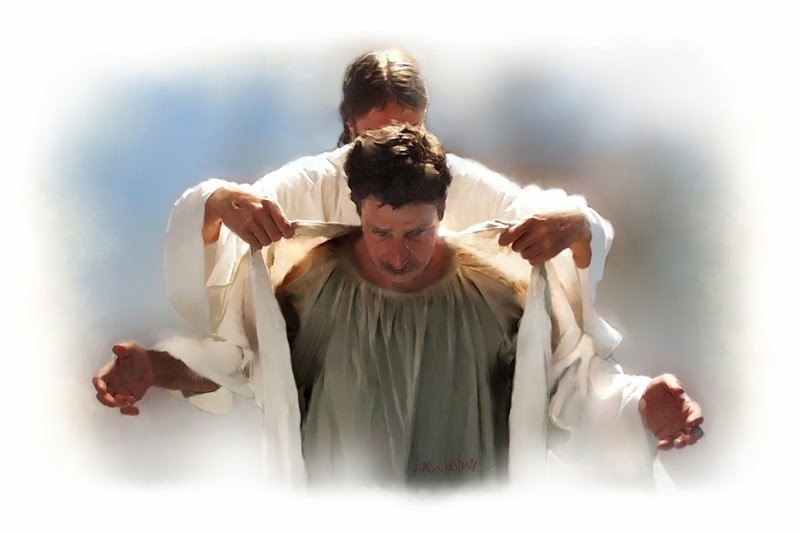
So He could do this:
Robe of Righteousness, by Lars Justinen
Let us take a moment to praise, honor, and glorify our precious Savior.
Today’s question was Do people who commit suicide go to hell?
The query came on the heels of fashion designer and celebrity Kate Spade’s suicide on June 5, 2018 and celebrity chef, television personality, and author Anthony Bourdain’s apparent suicide on June 8. It was a devastating week for those two families, their work families, and the watching world. Once again people questioned why, if someone has it all, depression still creeps and suicide becomes a solution. The Christian knows it is the vanity of vanities to pursue all of life’s offerings without Christ, it only ever adds up to emptiness. One should read Ecclesiastes for wisdom on emptiness in life without Christ.
But the non-Christian world still reels in shock when they look to the pinnacle of success, see their idols up there, only to see them cast it all away and tumble.
David Leavitt, a freelance writer for CBS, Yahoo, and the Examiner, tweeted,
If you’re religious, then you believe there’s a special place in hell or purgatory for people like Anthony Bourdain who take their own lives.
His is a common view if one has been raised Catholic. They teach that to take one’s own life (and anyone helping to take a life) is in mortal sin. A mortal sin means you’ve now lost your salvation forever. They base their teaching not on the Bible, but on principles that the Christian can identify with nonetheless. For example, to take one’s life is to assert lordship over it, when it is God who gives and takes life. It is God who counts your days and sets the boundary line for when you step into eternity. Suicide also lets down the people you are connected to, either family by blood or church family by Jesus’ blood. We are each given the gift of the Holy Spirit to operate with in the gifts the Spirit in us has dispensed, and to take one’s life leaves a hole in the family fabric where God has installed you. Even the Christian can understand that suicide is a heavy sin.
But can we go so far as the Catholic to say that a Christian who takes his own life for sure will go to hell? No. Again, no. If a person is indeed saved by faith, they can never lose their salvation. The Spirit indwelling us is the secure guarantee of that. (Ephesians 1:14, 2 Corinthians 1:22).
We are careful with terms here, the original tweet said the religious believe there is a special place in hell for the successful suicide. Muslims actually believe jihadi suicide in Allah’s name gets you INTO heaven, so, not ‘religious’, but if one is Catholic, then they do believe there’s a special place in hell or purgatory for people like suicides.
Christians know than any person would be in hell only because they rejected the Gospel. The people in hell are the people who died in sin and not in Christ. The only unforgivable sin is rejecting the offer of salvation by Jesus. It stands to reason, though, that any other sin is possible for a Christian to still commit.
Can a truly Christian person even contemplate suicide, let alone successfully throw their life away? Perhaps, or perhaps not. It is not for me to say. I do believe that it’s possible there are many Christians struggling with depression. Charles Spurgeon famously struggled with depression, though he never attempted suicide.
Suicide is detailed in the Bible. Many people did kill themselves. Judas, King Saul, King Saul’s armor bearer, and many others. They were all men and they were all apostasizing or non-believers. No truly saved person is documented in the Bible as attempting or carrying out suicide, not even King David in the throes of his deepest depression. Jonah in fact, though seemingly depressed and unhappy, pleaded for his life in the belly of the whale.
Observations;
All of the biblical examples of successful suicide are men.
All of the biblical examples are dubious characters and none are personally praised for their actions.
All were spiritually bankrupt or went through a period of spiritual collapse before their suicide.
Many of the biblical examples were in pain and/or afraid before suicide.
Scripture generally presents these examples of suicide as a fitting end to a wicked and unrepentant life (cf. Judg. 9:56; 1 Ki. 16:19). (Source)
D. Martyn Lloyd-Jones wrote an enduring and classic Christian book called Spiritual Depression: Its Causes and Its Cure. He and preached on spiritual depression also, here. The entire series of 24 sermons on spiritual depression is here.
I think suicidal deaths could be the group referred to in 1 Corinthians 3:15,
If anyone’s work is burned up, he will suffer loss, though he himself will be saved, but only as through fire.
Here, Paul was teaching about the levels of rewards in heaven. Believers will appear before Christ to account for their lives, how they worked for His glory and in what level of obedience. Any person’s work that is not worthy will be burned up and works done in His name that glorify Him will be turned to gold and silver. (1 Corinthians 3:10-15).
In verse 15, there will be people who will have all their works burned up. Will some of those people lose their rewards because they ended their own life, effectively supplanting God for their own will be done, to the uttermost? Perhaps, because in throwing their own life away, they thus became God of their own days. It may be also that in so doing, they threw away all their works done in His name, their rewards, too. What else could engender a complete loss of rewards? Even the thief on the cross made three good stabs at bearing fruit; confessing his guilt, proclaiming Jesus as Christ, and rebuking the other thief for his blasphemies. It may well be that 1 Corinthians refers to some people who ended their life and thus, though salvation is eternal, they lost their reward in heaven.
The recent suicides are truly sad. It is written in the news reports that Bourdain was seeking help but had ignored his doctor’s advice. However, it is also reported that Kate Spade was doing everything right, heeding doctor advice, calling and checking in with her family. She still went through with it.
The ultimate tragedy and one that is unalterable, is that if a non-believer seeks suicide as a solution to their pain or despair, they wake up the next second in worse pain, unimaginable pain, and one that they can never escape. Not because they committed suicide, but because they had rejected Christ. Their hopelessness will go on and on.
In the Christian, depression is real, spiritual depression is real. One never knows what is going on in the mind of another. But we do have the mind of Christ. (1 Corinthians 2:16). The best we can do is encourage each other, come along side to help and love. We are not alone, we are tied with a threefold cord of scarlet to the King of eternal life. Cling to that.
The title for my pithy sayings comes from Proverbs 1:8-9,
Hear, my son, your father’s instruction, and forsake not your mother’s teaching, for they are a graceful garland for your head and pendants for your neck.
A theological term referring to the relation of God to creation. God is “other,” “different” from His creation. He is independent and different from His creatures (Isaiah 55:8-9). He transcends His creation. He is beyond it and not limited by it or to it.
Source unknown, found at Bible.org
Transcendence: God’s separateness or otherness from the creation and the human race.
Source Biblical Doctrine, MacArthur & Mayhue Eds
Oh, the depth of the riches and wisdom and knowledge of God! How unsearchable are his judgments and how inscrutable his ways! “For who has known the mind of the Lord, or who has been his counselor?” “Or who has given a gift to him that he might be repaid?” For from him and through him and to him are all things. To him be glory forever. Amen. (Romans 11:33-36).
For my thoughts are not your thoughts, neither are your ways my ways, declares the Lord. For as the heavens are higher than the earth, so are my ways higher than your ways and my thoughts than your thoughts. (Isaiah 55:8-9)
Can you find out the deep things of God? Can you find out the limit of the Almighty? (Job 11:7).
Today in evangelical circles we are dealing with an unthinkable situation: serious discussions of the possibility of a female President of the Southern Baptist Convention, and it’s Beth Moore of all people. I don’t think it will actually happen, but the trail has been blazed. The tweets have been sent. News articles have been written. The discussions have been significant. The possibility has been raised and not rejected. Next time the discussions will go further. That is the nature of sin.
And we wonder, how did we get here? Slowly, incrementally, just as all sin happens. Sin has been tolerated, and once the camel has his nose under the tent, soon he enters fully.
Back in 2012 I wrote about how this creeping feminism would affect and harm the greater body. I said that the constant scenes of forward living women preaching and teaching men, being CEO of their own corporations ministries, globe-trotting, leaving children at home, and living lives that in the secular world are be called feminist, will come to roost.
Well, it has.
What you read below is an edited re-post of what I wrote in 2012. I pray that God has mercy on the young women who see the Christian feminists and become confused as to their roles. I pray that He is forbearing and patient a while longer, so the Bible teachers who live these Christian feminist lives would come to repentance. I pray He has mercy on the husbands who allow it. God did give the metaphorical Jezebel time to repent, and her daughters too, in Revelation 2 letter to the church at Thyatira. But He also threatened to strike her and her followers dead if they did not, and to repay those who tolerated her according to their deeds. Sin of whatever nature is serious, as when it is in the form of tolerating a false prophetess!
_____________________________
There are some celebrity woman Bible teachers today who say that they live a life of biblical womanhood but their lives show something different- and it’s equal to the secular feminists. Let’s take a look at what the new Christian feminism is.
“A woman needs a man like a fish needs a bicycle” was the feminist motto of the 1970s. The implication was that women didn’t ‘need’ a man at all.
Readers of the blog already know that I am not a fan of feminism. I wrote an essay called “The Eternal Discontent of Feminists“, in which I looked at the hypocritical standard secular feminists themselves apply to other women who are perceived as not doing feminism right. That, more than anything, lets us know that feminism is not about equal rights for women, it is about satan’s sowing of discontent among women and causing a division away from the Godly roles He has set up.
Feminism has encroached into Christianity. I think most people are still slumbering because I haven’t seen a hue and cry against it. Granted, it is subtle, especially in the women who claim to be evangelical in words but actually live a feminist life.
There are now a number of popular Bible teachers/preachers who travel widely, filling arenas, marketing their books, selling their products, and leaving the husband at home to take care of the kids. These women have assumed the lead role in the marriage and are the main breadwinner, and/or the husband is the helpmeet, usually having set aside his career to work in his wife’s corporation ministry. While these women call what they are doing “ministry,” I call it “feminism”.
As with so much in evangelical Christianity, the waters are increasingly muddied on what should be clear. What is biblical womanhood? In today’s world is it the Bible preaching, sometimes ordained woman, traveling cross country, her husband at home helping with the kids, often having quit his job to help his famous wife perform her ministry?
Or it is a new feminist who is open to women being ordained, to preaching, and/or to acceptance of gays into leadership positions while touting the rising up of women from subjugated roles?
There is something in between. It’s women who claim to be submitted Christian wives who just happen to teach the Bible but really are feminists living a life Gloria Steinem would envy. They are a new crop of what I’ll call Christian secret feminists. They live a feminist life inside of Christianity but call it ministry.
One woman who has much to answer for about this new role is Beth Moore. She was the one who broke new ground in how far a woman could go in attaining celebrity status, in workplace and homelife gender reversals, in being the main and sustained breadwinner of the family, and pr/teaching in a church and in the world. Mrs Moore, while speaking conservative values cloaked in all the right Christianese, lives a very forward life. You will see more details on this below.
A spiritual daughter of Mrs Moore in this generation of new Christian secret feminists is Christine Caine. Mrs Caine’s language is less cloaked in her declarations of what women can or should see as their roles in Christian home and work life. Mrs Caine is an ordained minister and part of Hillsong Church in Australia.
For example, in an interview reassuring Pastor’s wives that despite Caine’s visible usurpation of the traditional husband-wife roles, that their stay-at-home role is still viable: “Predominantly I might teach a little bit and I step out into what would be the more classic leadership gift, so a lot of people say ‘I’m not that, so therefore I must not have a role to play…'”
It is no wonder that woman are confused when they see leaders or peers taking on the ‘classic leadership gift’. And that is one way they cloak their rebellion in Christianese: it is not a role or a job, it is a ‘gift’.
Christine continues in the interview by acknowledging that there are “women who are gentle and loving and nurturing”, and there are other “women who come along side and do a bit more “non-gentle prodding help people go to the next level.” But that in “no way diminishes your role.”
Really? Sure it does. It sets up women to be discontent. By justifying herself in the leadership role as a gift from God (and who can argue with that?) and acknowledging that there are ‘levels’ and women need to get to, but at the same time saying it is important to stay at home and be nurturing…she has completely confused any listener as to the clear guidelines of the notion of what Biblical womanhood is. She says one thing (and not too clearly, either) and does another.
Jennie Allen is founder of of If:Gathering and one of the youngest of the feminist-living ladies on this list. IF is a tax exempt corporation, and shows founder Jennie as President and CEO, working 40/hours week, with husband Zac as board chair working 10 hours week. Allen is quoted in Christianity Today article as saying, “We’ve been slow to step into our giftedness or strengths. For a long time, that wasn’t an option,” said Allen.”
Discernment tip: one way to detect if a person is in the Word is to see if what they say and what they do match up over time. If what they say and what they do are different, run away.
Mrs Caine’s reassurances use a neat scriptural twist. The way satan works with any woman’s objection to women taking on home or ministry leadership roles is to acknowledge that the women feel weak or unsure in them, but to get around it by assuring them that all they need to do is have courage to step out and let Jesus work through their weakness, citing 2 Corinthians 12:9. Or simply as Jennie Allen encourages, ‘just do it because the time is now’.
In that same interview, Mrs Caine said, “The only way I was able to continue in my role is that my senior pastor’s wife stepped into her role and chose not to be threatened or intimidated because the giftings were different.”
Oh, I get it. Women are now complementarians to each other. It’s the height of irony that again, unwittingly, Mrs Caine acknowledges that these new ‘roles’ set up discontent and that she is glad that in her situation at least, the pastor’s wife wasn’t jealous of her fabulous gift of leadership. A good portion of the middle of the interview is Caine’s description of how women are to be complementarian of each other in church settings. One takes the wifely nurturing role so that the younger ones coming up can step out, so to speak.
Now, female support between and among ministries is a good thing, and it is biblically commanded. (Titus 2:4) but the description in Titus is for elder women to teach the younger is in their biblically defined helpmeet role, not to be a helpmeet to other women who usurp into classic male roles. It is another twist of using the Bible to justify what is not proper.
Priscilla Shirer is another of these new Christian secret feminists whose life is more forward than their spiritual mothers. I’ve posted this before but it bears repeating:
“This NY Times article notes that “Priscilla Shirer’s marriage appears to be just the sort of enlightened partnership that would make feminists cheer.”
The article describes what makes the liberal and secular newspaper and their readership, cheer. Mr Shirer, who quit his job to serve his wife’s organization ministry, spends much of the day negotiating Priscilla’s speaking invitations and her book contracts. In the afternoon it’s often Mr Shirer who collects the boys from school. Back home, Priscilla and Jerry divide chores and child care equally.
“Jerry quit his job to run his wife’s ministry. Priscilla now accepts about 20 out of some 300 speaking invitations each year, and she publishes a stream of Bible studies, workbooks and corresponding DVDs intended for women to read and watch with their girlfriends from church. Jerry does his share of housework and child care so that Priscilla can study and write. He travels with his wife everywhere. Whenever possible, they take their sons along on her speaking trips, but they often deposit the boys with Jerry’s mother,”‘ states the article.
If you delete the name Priscilla Shirer and substitute Gloria Steinem, and change the word ministry to job you have a description of a life that any feminist would be proud of.
By now Beth Moore is one of the elders in this realm. Moore has been “on the ministry circuit” for 15 years. Thus, her rebellious example has been long in view for many women who have watched her since they were an impressionable teen. So is Sheryl Brady and Joyce Meyer. Those women were the trailblazers for women in male leadership ministry. Newcomers arriving on the scene such as Priscilla Shirer or Christine Caine, and the younger Rachel Held Evans and Jennie Allen, have learned from the best of the Christian secret feminists. For example:
Beth Moore said to Christianity Today in 2010 that her man demanded a regular home life so she only travels every other Friday and comes right back home the next day.
“We walk the dogs together and eat out together all the time and lie on the floor with pillows and watch TV,” Moore says. “My man demanded attention and he got it, and my man demanded a normal home life and he got it.”
Aww, isn’t that nice. But it’s disingenuous in the extreme. The reality is that Mrs Moore is not only gone from home at least 20 times per year on her Living Proof tours, which is a lot if you have kids and a husband. Mrs Moore appears weekly on the Life Today television show, travels for weeks on book tours, where she expounds on the burning question all women in America are apparently asking, “How can women find validation without a man’s affirmation?” and which her book So Long, Insecurity apparently attempts to answer.
She also spends extended private time for weeks in a cabin by herself in Wyoming to write (as stated in the preface to “When Godly People Do Ungodly Things”). She is the President of her own company that in 2011 brought in 4.1 million dollars, with an excess after expenses of 1.3M, stated working hours of 40/week. If you think all she does is lay around on pillows gazing adoringly at her man then all I can say is look at what she does, not what she says. Beth Moore is a Christian secret feminist because for years she has lived that way, no matter what blather she tells Christianity Today.
It is no wonder women are confused when they see Beth Moore telling us that you can have it all, and still be a Christian woman, if you call it ministry. Enjoli.
Rachel Held Evans “is one of the better known Christian writers in mainline and progressive circles these days. Her new book examines what it would mean to live life as a woman according to the Biblical laws for a year. It’s in the vein of books like AJ Jacobs’ “The Year of Living Biblically” and other “human guinea pig” projects. The book is funny, thoughtful and empowering for women seeking to understand where they fit within a faith that has largely been controlled by men for centuries” writes Patheos.
Ms Evans says she is an accidental feminist, writing on her blog, “Most of all, if these critics knew me, they would know that it isn’t feminism that inspires me to advocate gender equality in the Church and in the world; it is the gospel of Jesus Christ.”
That seems to be another approach to justifying Christian feminism, “it was an accident”, or “God surprised me with this ministry” as Priscilla Shirer says, as if stating that since it was all out of their hands they are not nor will be morally and spiritually culpable on the Lord’s day of Judgment. I can assure Mrs Evans that Jesus did not deliver the Gospel by His blood so she could use it to promote a different role for women than He has already ordained.
We have looked at some of today’s most popular Christian secret and open feminists, the old guard and the new pups coming up. I offered you some examples from their own statements of how their lives in reality more match the secular world’s view of a strong feminist woman rather than the biblical helpmeet.
The old saying from the 70s, “A woman needs a man like a fish needs a bicycle” was the feminist motto. Now the only difference for today’s Christian secret feminist is the logo on her purse.