Posted in encouragement, testimony, Uncategorized

Sipping wine in the place where the grape is grown

By Elizabeth Prata

In the late 1980s I was inspired by the movie Shirley Valentine, a film that depicted a middle-aged London wife unhappy with her boring husband and her dreary life. “I want to sip wine in the place where the grape is grown” Shirley had said. So she chucked her husband and her life and jetted off to sunny Greece, swam topless, had an affair, and decided to stay. I guess she liked the wine better than her husband.

grapes
Vineyard, Chiusi, Tuscany. EPrata photo

I was very much taken with the notion of changing one’s life. I was entranced by Shirley’s life mantra, of ‘sipping wine in the place where the grape is grown’. I had tried a conventional life, but my husband had chucked me, I was saddled with a house in a dreary climate and three jobs to pay for it. I wanted more. Sipping wine in places where it’s grown was certainly not the dying mill city of snowy Maine. It bespoke of gentle Tuscan hillsides, green California dreams, or Greek whitewashed stucco. What a goal, Shirley, what a goal.

I went to wine places. California, Tuscany, South of France, rolling hills and grape vines abounding. But wine was just wine and the problem was the same. I met my goal. It was empty.

I searched with my heart how to cheer my body with wine—my heart still guiding me with wisdom—and how to lay hold on folly, till I might see what was good for the children of man to do under heaven during the few days of their life. … Ecclesiastes 2:3

What was the meaning of life? Where was permanence, solidity, something that would not disappear in a breath? Something that would give lasting joy, meaning, and purpose? What is man’s chief end??

Then I considered all that my hands had done and the toil I had expended in doing it, and behold, all was vanity and a striving after wind, and there was nothing to be gained under the sun. (Ecclesiastes 2:2-4, 11).

Question. 1. What is the chief end of man?
Answer. Man’s chief end is to glorify God, and to enjoy him for ever. Westminster Shorter Catechism

The Puritan Thomas Watson preached on this in his sermon, Man’s Chief End is to Glorify God

Here are two ends of life specified. 1. The glorifying of God. 2. The enjoying of God.

First. The glorifying of God, 1 Pet. 4:11. “That God in all things may be glorified.” The glory of God is a silver thread which must run through all our actions. l Cor. 10:31. “Whether therefore ye eat or drink, or whatsoever ye do, do all to the glory of God.”

Everything works to some end in things natural and artificial; now, man being a rational creature, must propose some end to himself, and that should be, that he may lift up God in the world. He had better lose his life than the end of his living.

The great truth asserted is that the end of every man’s living should be to glorify God. Glorifying God has respect to all the persons in the Trinity; it respects God the Father who gave us life; God the Son, who lost his life for us; and God the Holy Ghost, who produces a new life in us; we must bring glory to the whole Trinity.

Q. What is it to glorify God?
A. Glorifying God consists in four things: 1. Appreciation, 2. Adoration, 3. Affection, 4. Subjection. This is the yearly rent we pay to the crown of heaven.

Watson continued in his sermon to explain what and how to appreciate, adore, love, and submit to God.

King Solomon, who wrote Ecclesiastes concludes with the eternal wisdom:

Now all has been heard; here is the conclusion of the matter: Fear God and keep his commandments, for this is the duty of every human being. (Ecclesiastes 12:13).

Wine is vanity, travel is vanity. All we do when we relocate is bring our depravity with us. We are the problem. Godless, we are adrift in a sea of evil, wafting from one vain flurry to another. Drifting as dust motes upon an acid air, we leave evil, bring evil, and expire as evil. We believe ourselves to be maidens of rosy blush and coy innocence, when we are simply mud mounds cast upon miry shores. Godless, we are drenched with corruption.

The Lord saw that the wickedness of man was great in the earth, and that every intention of the thoughts of his heart was only evil continually. And God saw the earth, and behold, it was corrupt, for all flesh had corrupted their way on the earth. (Genesis 6:5,12).

When we are saved by His grace through faith, we are cleansed, our sin nature is given a Helper. We are dressed in white robes and stood on our feet, no longer to crawl in the dust like the serpent. We are given a will and testament that promises eternal peace, treasures, crowns, and dwellings in glory with the Savior. Our goal shifts to one of giving Him glory and enjoying Him forever.

What a goal, what a goal.

Posted in discernment, Uncategorized

Satan can snatch away the seed from the hard ground – but how?

By Elizabeth Prata

EPrata photo

In one of Jesus’ parables, we read,

When anyone hears the word of the kingdom and does not understand it, the evil one comes and snatches away what has been sown in his heart. This is what was sown along the path. (Matthew 13:19).

In the beginning parts of the parable, Jesus had given the vivid picture of the sower scattering seeds along the ground. The seeds fell on different types of ground, hard, rocky, thorny, and good. Later, the disciples asked Jesus to explain the meaning of the parable. He did, and His explanation of the different types of ground and the destinies of each seed is above.

The “path” mentioned is the path that the farmers and other people would walk in between fields. It was so heavily trod that they became hard packed, almost like cement. In Leviticus 23:22 it’s mentioned as a rule that the farmers were not to harvest to the very edges of the field, so that those who are traveling or poor could glean from the stalks that were alongside the path. You might remember Ruth gleaning Boaz’s field. (Ruth 2:2-3). As Jesus and His disciples walked along the fields, they plucked some grain to eat as they passed. (Matthew 12:1). These paths were very hard and well-traveled.

In Barnes’ Notes it’s explained about the paths. As expected, the vivid picture of the hardened path, the seed, and the birds scooping away the exposed seeds is visually understandable.

He is represented by the fowls that came and picked up the seed by the way-side. The gospel is preached to people hardened in sin. It makes no impression. It lies like seed on the “hard path;” it is easily taken away, and never suffered to take root.

But I’d like to focus on the part of the parable verse that mentions that the evil one comes along and snatches the seed away. I ask myself, how does the evil one do this? In what manner? Thanks to the visual nature of the parable we can readily understand that he does, but how?

Someone asked me recently how does the devil do his work, how does spiritual warfare operate. It’s a good question and it is something that though the parable’s images are understood, it what is meant by ‘digging deeper.’ Ask yourself questions as you read. Listen to others ask questions. Pray and ponder a while. Do a parallel verse search. Look up the important words in the verse in Greek or Hebrew. Consult commentaries.

In the Greek, the word for hearing is in the continuous present tense, setting an immediacy to the situation. As stated here in Vincent’s Word studies in the New Testament, “the action is exhibiting action in progress, and the simultaneousness of Satan’s work with that of the gospel instructor. ‘While any one is hearing, the evil one is coming and snatching away, just as the birds do not wait for the sower to be out of the way, but are at work while he is sowing.'”

I am reminded of fishing boats and shrimp boats pulling up a catch, and the cloud of seagulls and other scavenging birds are plucking the fish from the nets even as they are pulled to the boat’s deck. The ground is so hard the seed of the Word never makes any impression in it, and the birds come snatch it almost immediately.

Here is Gill’s Commentary on the subject of how the devil snatches away the seed. This is aimed at the unsaved, but the point has lessons for the saved, which I’ll explore below.

Besides, the word only fell “upon”, not “into” his heart, as into the good ground, as the metaphor in the parable shows; and it made no impression, nor was it inwardly received, but as soon as ever dropped, was “catched” away by the enemy; not by frightening him out of it, by persecution, as the stony ground hearer; nor by filling the mind with worldly cares, as the thorny ground hearer; but by various suggestions and temptations, darting in thoughts, presenting objects, and so diverted his mind from the word, and fixed his attention elsewhere; which is done at once, at an unawares, secretly, and without any notice of the person himself; so that the word is entirely lost to him, and he does not so much as remember the least thing he has been hearing:

The saved can never have the Gospel seed snatched away from Jesus’ hand. This is because it takes root immediately. John 10:28 explicitly says so. But even though satan cannot destroy the salvation of the saved by snatching the gospel seed from the ground into which it is sown, he can diminish our effectiveness. We, too, can be tempted as the unsaved Gospel-hearers can be tempted. The word will never be “entirely lost” to us, as Gill said it will be of the hard ground unsaved, but we can be tempted by–

–various suggestions and temptations,
–darting in thoughts,
–presenting objects,
–and so diverted his mind from the word, and fixed his attention elsewhere
–which is done at once, at an unawares, secretly, and without any notice of the person himself;

Here is John MacArthur on his version of how the devil snatches the seed away from the unsaved, but has application for us in satan’s ever-present attempt to divert us from our effectiveness:

In other words, when someone does not respond to the gospel initially, when they’re hardhearted and stiff necked, Satan just snatches it away. He just blinds them to its true value. How does he do that? Well, there are a lot of ways. One way he does that is send false teachers along to say all of that stuff was lies. Don’t believe that stuff. Another way he snatches the seed is by the fear of man. People don’t respond to it because they’re afraid they might lose their reputation or they might be kicked out of their little group or somebody might think they’re a religious fanatic.

Sometimes Satan uses pride. People are just know-it-alls. They just don’t want to admit that they need some help, that they need some information, that there’s some things they don’t know. Sometimes Satan snatches it away through doubt. Sometimes he snatches it away through prejudice, sometimes through stubbornness. Sometimes through the love of sin the person doesn’t want to give up. Sometimes through procrastination. But one way or another or a combination of ways, when it hits that hard stuff, Satan snatches it away and the person so easily forgets that it ever came.

When we believers procrastinate in repenting, delay reading the word, become only intermittent church-goers, become stubborn, prideful, doubtful, follow false teachers, or fear man, satan is snatching away our effectiveness of His word and our growth. He cannot snatch away the gospel, because that has already entwined with our soul and the Holy Spirit proptects it, but we can reduce our effectiveness for the Lord.

Snatching the seed of the word away from a non-believer and reducing a believer’s effectiveness is spiritual warfare. Spiritual warfare isn’t done by being against people. No, our battle is against the evil one who is prince of the power of the air. Also, it is a battle of the mind. Spiritual transformation happens in the mind, and what we think becomes what we say and then what we do. Don’t let satan steal your effectiveness. If we’re saved then that means the word was sown on good soil. Keep aerating the soil of our heart by turning over His word constantly in our minds. Unearth sin and reject it, confessing and repenting. Let the roots of His truths grow deep into our heart and then we will stand like trees beside the waters, and cannot be moved. (Jeremiah 17:8, Psalm 1:3).

Maranatha!

crackSatan snatches away the seed that falls on the hard ground almost immediately as it it sown.

——————————————–
Further Reading

Truth Or Territory: A Biblical Approach to Spiritual Warfare

Posted in encouragement, Uncategorized

The House on the Rock

By Elizabeth Prata

The Ocean State is aptly named.

Growing up in Rhode Island in the 1960s was a fun experience. The nation’s smallest state is beautiful and the ocean and Narragansett Bay is never far from anyone who lives there. We happened to live just a few miles from the ocean and most Sundays we took a drive south to Saunderstown, crossed the Jamestown bridge, and then took the ferry to Newport. The ferry was a blast.

Newport is home to all those Jacob Astor mansions from The Gilded Age. Dad would drive the kids and mom around the island on Ocean Drive past all the mansions, past the smaller mansions on the water’s edge with their lovely lawns and rocky outcrops reaching for the sea, and then we’d have a picnic by the park and watch the boats

There was no Newport Bridge at that time. You had to take the ferry. On the ferry, we passed boats, the islands with lighthouses, and other sights. One sight always captured my attention.

“Clingstone”.

Clingstone
Source. CC BY-SA 4.0

Clingstone is a house built in 1905, perched atop a small, rocky island in an island group called “The Dumplings” in Narragansett Bay, near Jamestown, Rhode Island. It withstood the devastating 1938 Hurricane, (though was damaged) faced other hurricanes, storms, decay, renovation, and more. The house is known by locals as “The House on a Rock”.

Even to my young eyes the house looked strong. I mean, it’s built on a rock! I often wondered what it was like to live there.

I don’t have to wonder any more what it is like to build my house on the rock. In His grace, He saved me and taught me to cling to the rock. I have my own Clingstone now. Isn’t it funny how life goes. Jesus, who was so far from my mind for over 40 years, is my All in All now. The little girl with big eyes looking at the House on a Rock, the Rock all for her own now and a house that will never fall.

The verses below are familiar but please slow yourself and read them carefully. Then really think about it for a minute, before you go on to other things. The verses are soul-soothing. Be encouraged.

Everyone then who hears these words of mine and does them will be like a wise man who built his house on the rock. 25And the rain fell, and the floods came, and the winds blew and beat on that house, but it did not fall, because it had been founded on the rock. (Matthew 7:24-25).

Posted in encouragement, Uncategorized

Jewels: About pearls…

By Elizabeth Prata

I’ve written about the brilliance of the sparkling jewel that is Jesus. That brought to mind other jewels. I am a girl, after all, lol.

The Parable of the Pearl of Great Value
Again, the kingdom of heaven is like a merchant in search of fine pearls, who, on finding one pearl of great value, went and sold all that he had and bought it. (Matthew 13:45-46).

pearl

In the time when this text was written, pearls were the most valuable item of all. The most precious wasn’t gold, though gold was precious. Not diamonds, or other gems which are mentioned, (e.g. rubies, Prov 3:15) or silver, pearls where the most sought-after item. This makes sense, being a desert region.

The pearl oyster is found in the Persian Gulf and the Red Sea.

Pearls are mentioned often in the New Testament. Jesus said for believers not to throw their pearls before swine. This is a contrast of the hightest vs. lowest. Pearls, being the most expensive, are representative of God’s truth, His word. Pearls are not to be thrown before swine, the lowest of all animals to the Jews. Swine in the metaphor is representative of the worst pagans who reject, mock, and dismiss Jesus and His word.

Temple prostitutes often braided pearls into their hair as a show and display. Paul was saying in both 1 Peter 3:3-4 and 1 Timothy 2:9-10 not to dress the same as the pagan women and especially not even close to looking like the temple prostitutes. Here in 1 Timothy 2:9-10 we read,

likewise also that women should adorn themselves in respectable apparel, with modesty and self-control, not with braided hair and gold or pearls or costly attire, but with what is proper for women who profess godliness—with good works.

That’s why Paul connected respectability and modesty in the verse with pearls and costly attire. Culturally, it was pagans and loose women who made a show of their wealth through the way they dressed, especially with the pearls, if they had them.

Pearls are also mentioned in Revelation 21:21. It is where we get the colloquial reference to “pearly gates”.

And the twelve gates were twelve pearls, each of the gates made of a single pearl, and the street of the city was pure gold, like transparent glass.

Since the walls are 1500 miles high and the gates in the walls would also have to be 1500 miles high, these pearls might be symbolic and not actual. Or they are real and made by Jesus and not by an oyster. Either way…Read this quote John MacArthur offers from his sermon on the verse, “The Capital City of Heaven“.

And then, we’ll close with this tonight, John describes the gates. And this is mind boggling. Now remember, these gates could well run the full height of the city. Verse 21, “And the twelve gates were twelve pearls.” That is some oyster. No, these have to be pearls of God’s own making. These pearls are like nothing ever produced by an oyster. Each one of the gates was a single pearl, a 15-mile-high pearl…1500-mile-high pearl. Why? Well maybe there’s some marvelous spiritual symbolism there.

John Phillips writes this, “How appropriate. All other precious gems are metals or stones, but a pearl is a gem formed within the oyster. It is the only one formed by living flesh. The humble oyster receives an irritation or a wound and around the offending article that has penetrated and hurt it, the oyster builds a pearl. The pearl, we might say, is the answer of the oyster to that which injured it. And the glory land is God’s answer in Christ to the wicked men who crucified heaven’s beloved and put Him to open shame. How like God it is to make the gates of the new Jerusalem pearls. The saints as they come and go will be forever reminded as they pass the gates of glory that access to God’s home is only because of Calvary.

“Think of the size of those gates. Think of the supernatural pearls from which they are made. What gigantic suffering is symbolized by those gates of pearl? Throughout the endless ages we shall be reminded by those pearly gates of the immensity of the sufferings of Christ. Those pearls hung eternally, as it were, at the access routes to glory will remind us forever of One who hung upon a tree and whose answer to those who injured Him was to invite them to forever share His home,” end quote.

Beautifully said, isn’t it? Heaven is entered through suffering by a wounded Redeemer. And we’ll always be reminded of it as we pass the pearls.

Pearls are beautiful, but Jesus is the most beautiful of all. That was a little information on pearls in biblical times. The luster and polish of a gorgeous pearl will be nothing compared to the glory of Jesus we will see when we get there.

Posted in discernment, Uncategorized

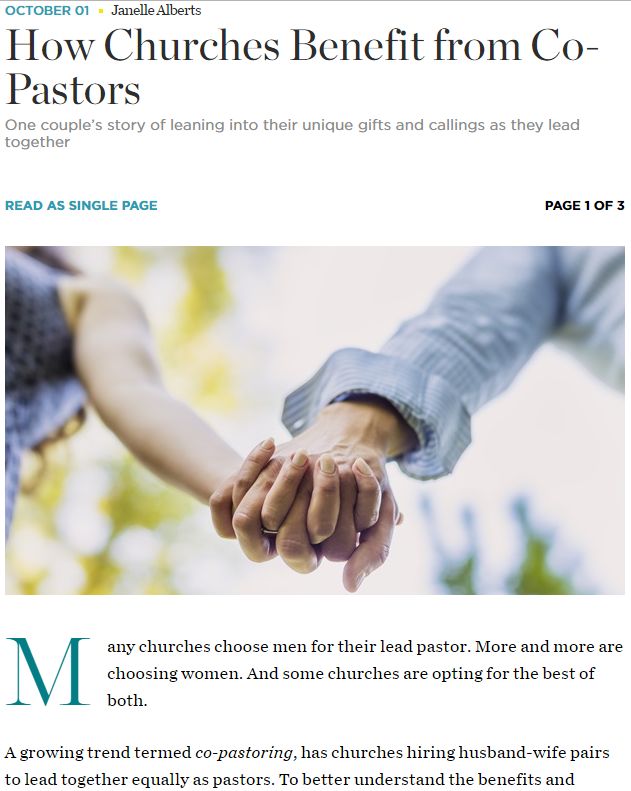
When did co-pastor married couples become acceptable?

By Elizabeth Prata

In 2007 Thabiti Anyabwile wrote:

It was once a rising trend. It’s now a model for ministry for significant numbers of churches and pastors. It simultaneously offers itself as an example of deep partnership between husbands and wives, and dismisses biblical instruction. What am I talking about? The widespread approach to pastoral ministry where a husband and a wife “co-pastor” a local church.

Co-pastoring in this case refers to churches where the male pastor and his wife are listed as equal pastors of the flock. Since that article above was written sixteen years ago, co-ed co-pastors are touted as something acceptable – desirable even. Recently, then-retiring pastor Rick Warren chose a duo replace him, sparking a brouhaha and subsequently splitting the Southern Baptist Convention meeting over this contentious issue.

These two are not married but are in a co-ed, egalitarian pastorate.
Not just co-pastor, but co-SENIOR pastor.
V. Osteen: co-pastoring, which dilutes her motherly duties, is not a good trade.
This article is from Christianity Today. No wonder
the magazine’s nickname is Christianity Astray

I remember the Presidential election of 1992. Bill Clinton was running. His wife is Hillary Clinton. Clinton used to brag that “America was getting two for the price of one.”

It was during the 1992 presidential campaign that Arkansas governor Bill Clinton — the nation’s first baby-boomer presidential candidate, running against President George H. W. Bush — used the phrase “two for the price of one.” This twofer concept was Clinton’s quaint way of bragging (to the delight of feminists) that his wife, Hillary, an accomplished corporate lawyer and fellow Yale Law School graduate, was going to play a major role in his administration well beyond that of a traditional First Lady. (National Review) emphasis mine

How did that work out for them? Hillary led a Health Care Reform that crashed spectacularly and she was publicly humiliated. Then Whitewater Scandal happened and things got worse.

From the moment she dazzled Capitol Hill last autumn (‘In future the President will be known as your husband,’ Dan Rostenkowski, who chairs the House Ways and Means Committee, gushed at one appearance) Hillary has been her plan’s most potent weapon. No longer. In Washington more than anywhere, vulnerability equals weakness. Today Hillary Clinton is vulnerable; so, therefore, is Bill Clinton. ‘Two for the price of one’ has turned from blessing into curse. (The Independent UK, 1994

America was not impressed with the twofer Presidency. Even less so, are biblically obedient to the Bible Christians impressed with a twofer pastorate.

Simply put, the Bible forbids women preaching. Church teaching is meant for the men to execute. The leading is to be done by the men.

I do not permit a woman to teach or to exercise authority over a man; rather, she is to remain quiet. (1 Timothy 2:12).

Elders/overseers/pastors are to be “above reproach”, and “a man”. (Titus 1:5-8).

Installing a “twofer” pastorate, whether both are paid or not, formal or informal, defacto or explicit, is unbiblical.

At a Grace Community Church Q&A a man asked John MacArthur,

“Would you ever allow your wife to preach?” His response was of course, his wife would not want to do that, and the Bible forbids it.

Slide to 16:46 for the question & answer

Two pastors for the price of one is a curse, because it is a sin.

Posted in encouragement, Uncategorized

Jesus is the I AM

By Elizabeth Prata

I’m so glad I have a Savior who is eternal. Because He is eternal, He is independent, self-sustaining, and forever self-sufficient. He is outside of time and matter, therefore He is the I AM, as seen in these statements-

I AM the Bread of Life (John 6:35, 41, 48, 51);
I AM the Light of the World (John 8:12);
I AM the Door of the Sheep (John 10:7, 9);
I AM the Good Shepherd (John 10:11,14);
I AM the Resurrection and the Life (John 11:25);
I AM the Way, the Truth and the Life (John 14:6);
I AM the True Vine (John 15:1, 5).

And these absolute statements:

Jesus said to them, “Truly, truly, I say to you, before Abraham was, I am.” (John 8:58)

God said to Moses, “I am who I am.” And he said, “Say this to the people of Israel: ‘I am has sent me to you.’ ” (Exodus 3:14).

Praise Him today for one of His attributes. Or all of them!


Further Resources

GotQuestions: What are the seven I AM statements in the Gospel of John?

Ligonier: The Great “I AM”

Posted in discernment, Uncategorized

How do we see ourselves, ladies?

By Elizabeth Prata

I had heard of you by the hearing of the ear, but now my eye sees you; therefore I despise myself, and repent in dust and ashes. ~Job

“Woe to me!” I cried. “I am ruined! For I am a man of unclean lips, and I live among a people of unclean lips, and my eyes have seen the King, the Lord Almighty.” ~Isaiah

But when Simon Peter saw it, he fell down at Jesus’ knees, saying, “Depart from me, for I am a sinful man, O Lord.” ~ Simon Peter

Man was created to glorify God. (Isaiah 43:7). Our inherited sin nature makes it impossible to do that without His redemptive work in our heart. It’s important to see ourselves as we are (were). Ladies, yes, it’s good to have “self-esteem” to the extent that we know who we are: We’re sinners, saved by grace alone.

Women’s Ministries these days over-emphasize that we are women of valor, courage, of worth, esteem, and bravery. We’re princesses, running around sunlit meadows in wedding dresses dripping pearls.

Or we are as Isaiah, Job, and Peter saw themselves when they saw God: as worms in the dust, sinning with the pigs and needing to rely totally on the Father for any scrap of righteousness we might possess.

Praise the Lord He came, died for sin, was buried and resurrected. He glorified the Father and His reward will be…us. The Father will give Him a Bride, redeemed and washed. It is all about the Trinity and His work. It is not about us, our worth, our esteem, dignity, or “who we are.”

O Lord, depart from me, I am a sinful woman. Yet He lifted me from the muck and mire and gave me His righteousness, robes, Spirit, and future. From that moment, when I search inside myself to see my worth, esteem, or dignity, what I see is His.

Posted in Uncategorized

Is the Storm Gathering?

By Elizabeth Prata

You know the story of Esther and her Uncle Mordecai. She was a Jewess in Persia who was chosen via contest by King Ahasuerus to be his wife. Except that Ahasuerus didn’t know she was Jewish and when evil Second-in-Command Haman whispered to Ahasuerus to make a decree killing all the Jews, she was then in a real bind. It all had started when Uncle Mordecai, who had by then been promoted to an inside the court job in the King’s administrative palace, refused to bow to Haman. Though apparently Mordecai had lived a fairly secular life, and perhaps for a while had traded wealth, influence, and power for Yahweh, when pressed, his faith rose up and he came through. It was his defining moment. Who will he bow to? Not Ahasuerus. God only. Mordecai chose. Haman reacted.

All the royal officials at the king’s gate knelt down and paid honor to Haman, for the king had commanded this concerning him. But Mordecai would not kneel down or pay him honor. Then the royal officials at the king’s gate asked Mordecai, “Why do you disobey the king’s command?” Day after day they spoke to him but he refused to comply. Therefore they told Haman about it to see whether Mordecai’s behavior would be tolerated, for he had told them he was a Jew.” (Esther 3:2-4)

Soon after, Esther was faced with her defining moment. She could lay low, hiding her religion, but Mordecai told her,

“Do not think that because you are in the king’s house you alone of all the Jews will escape. For if you remain silent at this time, relief and deliverance for the Jews will arise from another place, but you and your father’s family will perish. And who knows but that you have come to your royal position for such a time as this?” (Esther 4:13-14)

So then, her other option was to tell the truth, approach the king, and plead for her people, even at peril for her own life. It was a defining moment for Esther.

In the 1960s and 1970s Firestone had a jingle in which the last line included the now-familiar phrase “Where the rubber meets the road.” The phrase has come to mean not just good tires, lol, but a defining moment of truth, the most important point. It is like an Olympic Athlete who has trained for years, but everything only really counts at the moment of the race. Will he put all his training into a glorious and successful effort? Or will he stumble?

Is America approaching an Esther moment for her Christians living inside her borders? Is there a gathering storm? Will that moment reveal which kind of soil resides in our hearts? I think so. It may not happen today or tomorrow, but soon each Christian in America will have to choose his or her path in the public sphere. We have great privilege here in the US where we can gather on any Sunday, or any day, freely to worship our sovereign. We can claim Him as sovereign and proclaim Him as sovereign, without another competing sovereign quelling our exultation. We can share the Gospel in the public sphere and set up monuments, signs, statues, crosses or whatever we want in certain places, with or without permits in certain circumstances. We can pray in public and we can speak of Him to friend and stranger.

Don’t take these privileges for granted. Freedom to worship is being chipped away at and redefined every day. Be prepared for a chilling effect or even a forced cessation of them. We saw the attempts and even the successful thwarting of the church’s ability to gather in the so-called pandemic era of 2020-2021.

Individually, we have many defining moments day by day or week by week. There are little decisions we make that are either honoring to Jesus or are conscience violations due to compromise. These little decisions accumulate.

Eventually, though, we individually may be faced with a bid, more public decision to honor Jesus but suffer for it. Pastor James Coates did in Canada, and so did Pastor Tim Stephens, as well as the Elders of Grace Community Church in California when they defied the tyrannical government to remain open and worshiping during the so-called pandemic. Coates and Stephens counted the cost, and it was heavy. They were forcibly removed from their families and jailed. The GCC men were threatened with jail and hefty fines, though the court system eventually resolved that situation to the church’s good.

Less publicly, people lose their jobs every day these days for their stance for Christ. They are denied promotions. They are marginalized socially, even have crimes done against them, all for being a Christian.

Your time to make such a decision that has a heavy cost attached to it may come soon. Are you ready?

No matter what though, our King’s throne is secure and His Kingdom is permanent. His church will thrive no matter the man-made pressure brought to bear against it. His people will be brought home to freely worship Him forever.

For at that time I will change the speech of the peoples to a pure speech, that all of them may call upon the name of the LORD and serve him with one accord. (Zephaniah 3:9).

storm
EPrata photo
Posted in encouragement, Uncategorized

Was Achsah’s request too bold?

By Elizabeth Prata

You do not have, because you do not ask. (James 4:2b)

So if you who are evil know how to give good gifts to your children, how much more will your Father in heaven give the Holy Spirit to those who ask Him! (Luke 11:13)

The second scripture above from Luke is a story Jesus delivered just after teaching the disciples ‘The Lord’s Prayer’, in the section on how to pray.

We know of the more familiar examples of Bible people asking things boldly. David, Jeremiah Habakkuk, Job, Hannah…they all asked for things of the Lord and did so honestly, with raw intensity. There is no doubt that they were sincere believers who felt awe and reverence for God. They feared Him. Yet when it came time to pour out their heart in naked emotion or bold prayer requests, they did.

Here is a less well known example of someone in the Bible asking for something of her (earthly) father, boldly. Achsah. Here she is in scripture, Judges 1:12-15,

Toshiba Exif JPEG
EPrata photo

And Caleb said, “He who attacks Kiriath-sepher and captures it, I will give him Achsah my daughter for a wife.” 13And Othniel the son of Kenaz, Caleb’s younger brother, captured it. And he gave him Achsah his daughter for a wife. 14When she came to him, she urged him to ask her father for a field. And she dismounted from her donkey, and Caleb said to her, “What do you want?” 15She said to him, “Give me a blessing. Since you have set me in the land of the Negeb, give me also springs of water.” And Caleb gave her the upper springs and the lower springs.

Was Achsah too bold? Was she greedy? Was she rebellious in her asking when she should have remained meek and submissive? The Jamieson Fausset Commentary explains it this way

that is, when about to remove from her father’s to her husband’s house. She suddenly alighted from her travelling equipage—a mark of respect to her father, and a sign of making some request. She had urged Othniel to broach the matter, but he not wishing to do what appeared like evincing a grasping disposition, she resolved herself to speak out. Taking advantage of the parting scene when a parent’s heart was likely to be tender, she begged (as her marriage portion consisted of a field which, having a southern exposure, was comparatively an arid and barren waste) he would add the adjoining one, which abounded in excellent springs. The request being reasonable, it was granted; and the story conveys this important lesson in religion, that if earthly parents are ready to bestow on their children that which is good, much more will our heavenly Father give every necessary blessing to them who ask Him.

The last sentence of the commentary explanation harks back tot he verse from Luke above. And here is another short explanation of this small incident from Judges about Achsah, it is Matthew Henry from his Complete Commentary. The tenth commandment was “Do Not Covet.”

From this story we learn,

1. That it is no breach of the tenth commandment moderately to desire those comforts and conveniences of this life which we see attainable in a fair and regular way.

2. That husbands and wives should mutually advise, and jointly agree, about that which is for the common good of their family; and much more should they concur in asking of their heavenly Father the best blessings, those of the upper springs.

3. That parents must never think that lost which is bestowed upon their children for their real advantage, but must be free in giving them portions as well as maintenance, especially when they are dutiful. Caleb had sons (1 Chr. 4:15), and yet gave thus liberally to his daughter.

Ye have not because ye ask not! Now, just because we ask, doesn’t mean we will get what we ask. God is not a magic genie, bestowing upon us all that we desire. There are conditions to asking boldly of our Father in prayer. First, the rest of the James verse explains that sometimes we do not receive because we ask wrongly. If we are asking in order to indulge our passions, it will not be granted. If we regard iniquity in our heart, prayer will not be heard. (Psalm 66:18). There are other conditions, too, which if in place mean the prayer will not be heard, no matter how bold it is. (source with scriptures here,please look at the list).
Conclusion:

Prayer: Nothing is too great and nothing is too small to commit into the hands of the Lord!
— A. W. Pink

Our Father who is holy, will give good gifts. Be bold in prayer, be diligent in asking, be sure of the result.

———————————————————

Further resources:

Sermon “Pray Boldly“, here John MacArthur explains the weird scene from Luke 11
jmac sermon “don’t be afraid to ask’

Charles Spurgeon’s sermon Have not because ye ask not? exposits the scene with Achsah.

Thomas Watson quotes on prayer, here at Grace Gems

Valley of Vision, The Prayer of Love