The discussion revolves around whether pets will be present in heaven, from a Christian perspective. Although humans uniquely reflect God’s image, there is speculation about the fate of animals post-New Earth. The article emphasizes God’s care for animals and suggests trust in His intentions, ultimately asserting joy in heaven will be fulfilled in Christ.
We sang Christ the Sure and Steady Anchor at church yesterday. I love the marine references in the Bible, and as I sang I thought about anchors.
I lived by the water growing up and most of my adult life, mainly the ocean. Some years were spent on a lake. I loved it.
The ocean has moods, a personality, mystery, and power. Who doesn’t love a day at the beach? Even better, who doesn’t love a day ON the water? When we got a chance, we got on a boat. After a while, we had a boat. LOL, back in the day, a bunch of teenagers zooming around the bay on a 20 foot Boston Whaler wasn’t unusual.
We grew up knowing how to use our knees to ride the waves, could look at the rocks to spot the state of the tide, knew how to anchor, dock or throttle up to reach plane. We kept a weather eye on the clouds, watched the whitecaps, and had a grand time.
Despite having such familiarity with the water, and were so comfortable on it, we knew its dangers. On Narragansett Bay there was a navigational hazard called “boiler awash”.
It is a shallow patch of water near Hope Island near Prudence Island. A Navy tug sank there and its boiler, being tall, presented a hazard to the keels of boats passing over it. To make the shallow water issue worse, its boilers came to just under the surface of the water at low tide. It was a hazard all right. We always gave it a wide berth.
As an adult, I lived on a sailing yacht for two years and we sailed from Maine to Florida, crossed the Gulf Stream, and went on to the central Bahamas. We returned with the weather following the same route. Our route took us on almost every coastal river, sound, bay, and canal along the entire eastern seaboard as well as the Atlantic ocean waters off it.
Because we lived on the boat and were no longer teenagers messing around near shore, we well knew the hazards. Our VHF radio was full of calls from mariners in distress, the squawk of the marine weather station, and calls from the Coast Guard to alert to hazards (container awash, drifting and disabled boat, etc). Sailing in New England meant having intimate knowledge of reefs, shoals and rocks, and sailing in Florida meant having intimate knowledge of drunken fools, wannabe mariners and rich guy weekend warriors. In between, we learned to respect the fishermen, shrimpers, oystermen, and all the others trying to make a living.
We quickly acclimated to the water living and became respectful of the hazards. When you are underway, you are always on guard, even if it’s familiar water. Always, every second. Because any second, anything could happen, and since your boat was both your home and your transportation as well as your life, well, if it required being vigilant, that is what you did.
That is why, when the anchor was set and the engine turned off, you breathed a special sigh of relief. Oh, anything could still happen, but the ratcheting down of the vigilance was considerable. As long as the anchor held, you were all set. We just had to trust that it would hold.
I remember feeling a wonderful sense of relief when the day’s run was ended and we anchored. The engine turned off and all we could hear were the sounds of the birds and the waves. We were still, secure, and finished for the day.
When we’d traveled a thousand nautical miles were under our keel over the dark and murky waters, wondering ‘what’s down there?’ when we got to The Bahamas, the waters were clear to the bottom! We could SEE the anchor! We could determine if it was set or not, It was such a comfort after all those miles of trusting but not seeing the anchor, now to SEE it with our eyes. Our faith had become sight.
Our anchor 20 feet below, we could see it even at night! EPrata photo
In Bible days there were only three ways to travel. You got there by walking, riding an animal, or boat. Paul traveled a lot and because of that, he was on a boat a lot. He used many marine references in his letters, examples that the people of the era would know well and understand immediately. Here are a few examples Paul and the other Apostles used:
But let him ask in faith, with no doubting, for the one who doubts is like a wave of the sea that is driven and tossed by the wind. (James 1:6)
…tossed to and fro by the waves and carried about by every wind of doctrine (Ephesians 4:14)
These are hidden reefs at your love feasts, as they feast with you without fear, shepherds feeding themselves; waterless clouds, swept along by winds (Jude 1:12)
holding faith and a good conscience. By rejecting this, some have made shipwreck of their faith, (1 Timothy 1:19)
Therefore we must pay much closer attention to what we have heard, lest we drift away from it. (Hebrews 2:1)
The interesting thing about that last one is that the drifting away in the Greek literally means from God’s anchor.
Strong’s explains, to “drift away from,”pararrhyéō, only occurs in Hebrews 2:1 where it refers to going spiritually adrift – “sinning by slipping away (from God’s anchor)”. It means to “lapse” into spiritual defeat, describing how we slowly move away from our moorings in Christ.”
Friends, stay moored to Christ. He is our anchor. One day, ourfaith will become sight and we will see Him as He is.
Though our journey is tense, and long, imagine the sweet relief we will feel when we get there! When all storms are over, and there are no more hidden reefs. The empty clouds deceive us no more, and our friends and family’s spiritual shipwrecks (so hard to watch!) are but a distant memory gentle Christ wipes from our mind. The sweetness and rest awaiting us beside the glassy sea is unimaginably wondrous. Rest in that assurance 🙂
Here is “Christ the Sure and Steady Anchor” performed by Matt Papa, Matt Boswell, Keith & Kristyn Getty-
I work with 5 to 8 year old children for my job at a public elementary school. I love children and I contend that I have the best job in the world.
Sometimes it’s a little disheartening, though. I just want the best for every kid, and some kids never get the best.
The Lord is THE most sensitive about children. He spoke much about them and this is recorded in the Bible. We know one of the most famous verses about children:
“Behold, children are a heritage from the Lord, the fruit of the womb a reward. Like arrows in the hand of a warrior are the children of one’s youth. Blessed is the man who fills his quiver with them! He shall not be put to shame when he speaks with his enemies in the gate.” (Psalm 127:3-5)
“Whenever a woman is in labor she has sorrow, because her hour has come; but when she gives birth to the child, she no longer remembers the suffering because of the joy that a child has been born into the world.” (John 16:21).
Therefore you can guess what the Lord thinks of abortion. (Molech)
“Grandchildren are the crown of old men, And the beauty of sons is their fathers.” (Proverbs 17:6)
“And sitting down, He called the twelve and said to them, “If anyone wants to be first, he shall be last of all and servant of all.” And taking a child, He set him before them. And taking him in His arms, He said to them, “Whoever receives one child like this in My name receives Me; and whoever receives Me does not receive Me, but Him who sent Me.”’
Not just what He said but the scene. Picture it in your mind. Jesus had been teaching The Twelve all day and then they came to the house at Capernaum where they stayed. He continued teaching. And to illustrate His point, “He took a child”. So I ask, what child? Where did the child come from? Luke 9:47 says the child “was by His side.” Usually didn’t the children remain outside the adults’ purview, especially when important matters were being discussed? Yet Jesus hadn’t dismissed the child when He continued teaching the Twelve inside the house.
The idea in the verse was that children are weak, powerless and innocent. You come to the Kingdom like that, with no achievements, no portfolio of awards, nothing to commend one’s self. Like a child.
Susannah Wesley, the mother of John and Charles Wesley, raised seventeen children and had these words to say about raising children:
“The parent who studies to subdue [self–will] in his child works together with God in the renewing and saving a soul. The parent who indulges it does the devil’s work, makes religion impracticable, salvation unattainable, and does all that in him lies to damn his child, soul and body forever” (cited in The Journal of John Wesley [Chicago: Moody, n.d.], p. 106).
In other words, children are important to Jesus.
O, come, Lord Jesus, remove us, and the children from the world. Its sinful effects are so towering and so devastating, and wear down the most on those least powerful or able to comprehend.
I’m asked more often lately about what will happen to our pets when we’re raptured. Some ask about the animals we keep, being a farm community. My county abounds with cows, bulls, buffalo, mules, goats, chickens, sheep, pigs and more. I find the question fascinating, and also encouraging. I’m personally invested in the question, too, being an inside cat owner.
The book of Genesis tells us that we are unique in God’s creation, being made in His image and likeness. Also, though we and the animals have the breath of life in us, we were made to have dominion over the animals. Jesus died on the cross for salvation of his people, not animals, who as far as I know do not have a soul, at least, not an eternal soul. It is reasonable to assume that our futures will be different, being of different flesh and having had different roles on earth.
Any sensitive Christian these days is probably be feeling what I am feeling. The gravity of the times and the perilousness of the dwindling time for the lost weighs heavily on me. I mourn the lost: the hand of Jesus is outstretched to one and all, but many bat it away, or refuse to see it in the first place. The knowledge that millions will be lost forever is truly an ache in my heart. As the time of rapture grows closer, and their moment of deadline for the closing of the church age grows nearer, that ache grows worse. Jesus said that many will be lost, the way is broad, and books will be opened (while the saved are so few their names can be contained in one book). Knowing how terrible hell is, and knowing how the perishing have to literally step over Jesus to get there, the horror of their eternal loss is absolutely crushing to me. But we are told these days would come, and that they would be perilous: “But know this, that in the last days perilous times will come: “For men will be lovers of themselves, lovers of money, boasters, proud, blasphemers, disobedient to parents, unthankful, unholy, unloving, unforgiving, slanderers, without self-control, brutal, despisers of good, traitors, headstrong, haughty, lovers of pleasure rather than lovers of God, having a form of godliness but denying its power.” (2 Timothy 3:2-5)
The violence in the world is another ache. Some days the ache is only dull, other times, like today, the ache is sharp. The regard for human life is at a low, but I won’t say an ‘all-time low’ because that low regard for life and the high violence will get worse during the Tribulation. In these last days of the Church Age, though, the violence is certainly bad enough. The commonness of child-murder in the form of abortion has lent itself to this low regard for life. Lately there have been so many shootings.
I hear of tragedies and shootings and rebellious atheism and hatred of Jesus, and I just weep for Jesus. He is so good, so kind, so patient, dying for us, and we simply spit at Him and His love. I was asking in prayer today “Why, Oh, Lord? Why do you wait so long? Why do the unjust prosper? Why do the children suffer?” and He led me to Habakkuk, an Old Testament prophet asking the same questions 2700 years ago.
O LORD, how long shall I cry,
And You will not hear?
Even cry out to You, “Violence!”
And You will not save.
Why do You show me iniquity,
And cause me to see trouble?
For plundering and violence are before me;
There is strife, and contention arises.
(Hab 1:2-3)
The Lord replied:
“Write the vision
And make it plain on tablets,
That he may run who reads it.
For the vision is yet for an appointed time;*
But at the end it will speak, and it will not lie.
Though it tarries, wait for it;
Because it will surely come,
It will not tarry.”
The *cross reference in His answer is to Daniel 8:17, which is: “So he came near where I stood, and when he came I was afraid and fell on my face; but he said to me, ‘Understand, son of man, that the vision refers to the time of the end.’ ”
The LORD answered Habakkuk in chapter one that He was planning to take care of the immediate problem in Habakkuk’s days, by raising up the Babylonians to punish the Israelites. But more importantly, God said in Chapter 2 that overall justice would come, but in the last days.
I pray that people will come to know Jesus’ love. I also pray that His justice will be done. He will not be mocked. Killings and murders and knifings and beheadings and most important, hatred of God and His glory are equally tragic and troublesome to my spirit as those who refuse His love. He came as the Lamb. He will come again as the Lion. Are you ready? May His will be done.
*This essay first appeared on The End Time on August 2010.
There are niche segments of study within the theological world that are more valued than others. Discernment gets a bad name, often rightly, because many discernment writers tend to drift toward a more “censorious spirit” as Gill said in his Exposition, stating, “Censorious persons rarely have the good will of their fellow creatures” in mind. However as the pendulum tends to swing, it makes a full arc and for a while discernment receives a poor reputation in total, even while there are good discernment writers and speakers out there (Justin Peters comes to mind) mixed in with the cranks and angry ones.
Though all Christians are called to discern between right and wrong, some have been given extra discernment as a gift of the Holy Spirit (1 Corinthians 12:10). While on the one hand it’s not to be abused, it’s also not to be dismissed. (FMI on the gift of discerning of spirits, go here).
Eschatology is another area of study which also receives a poor reputation, in no thanks to many Christians themselves. Eschatology is the study of last things, AKA, prophecy, especially the period since the First Coming of Jesus Christ. Though it’s forbidden, some date-set and of course the end date at which their predictions pass with no fulfillment make a mockery of Christ’s name to unbelievers and a disappointment to the believers who were drawn in. Others who study eschatology badly simply perpetuate ridiculous theories concerning the end times. Others wrongly insist that eschatological subjects are biblically unknowable.
My blog covers three areas; discernment, prophecy and encouragement. I’ve seen the pendulum swing from side to side in each of these areas over the last 7 years of daily blogging here at The End Time. I have maintained from the beginning of my blogging life and my Christian witness in real life, that prophecy is important – because it was important to Jesus. Last days are spoken of in almost every book of the New Testament. Paul spent a good deal of time teaching it to the Thessalonians. Even as the babes in Christ that they were, Paul pulled out all the stops to ensure that these Thessalonian Christian babies knew the importance of living with a very present knowledge of Christ’s imminent return. Doing so gives us a heart for the lost, a fervency in life, and a strength to look forward beyond persecution or trouble. I refuse to marginalize prophecy as a legitimate area of study.
Here is Michael Holst stating the point of eschatology so much better than I ever did.
One of the Apostle Paul’s great preoccupations in both of his letters to the church at Thessalonica is the second coming of Christ. He was not only concerned with getting the doctrine “right” but also with the great pastoral implications of such teaching. In 1 Thessalonians he writes concerning the second coming of Christ in relation to the resurrection of the dead and the gathering together of saints who are alive at that time. In 2 Thessalonians he reinforces what he had already taught at Thessalonica (2 Thess. 2:5) concerning the dangers of the last days, specifically with regard to the great apostasy in the church induced by the revelation of the Man of Lawlessness.
Depending on your eschatological framework, your identification of the Man of Lawlessness and his activities may differ from what I wish to offer in this post. Coming to terms with the fact that there will indeed be a Man of Lawlessness plays an important role in the life of the believer as he or she eagerly waits for the day of Christ’s coming. In days of relative peace, we must ready ourselves and forthcoming generations–especially our own children–for the days of anarchic deception that will accompany the Man of Lawlessness.
We, in the Calvinistic and Reformed church, have not done justice to the Scripture’s teaching on this matter. We often rightly respond to the “Left Behind” industry with dismay and sarcasm. In so doing, however, we have, perhaps inadvertently failed to sufficiently and soberly grasp Scripture’s teaching on this period of history which will be instrumental in bringing about a catastrophic and irreversible apostasy. Here then, are twelve biblical observations about the Man of Lawlessness (MoL) to help prepare us for that day.
I’d like to reiterate that the Rapture (when Christ calls for His Bride in the air, 1 Thessalonians 4:15-17) and the Second Coming (when His feet touch down at the Mount of Olives at the end of the Tribulation, Mt 16:27, Zechariah 14:4) are two separate events.
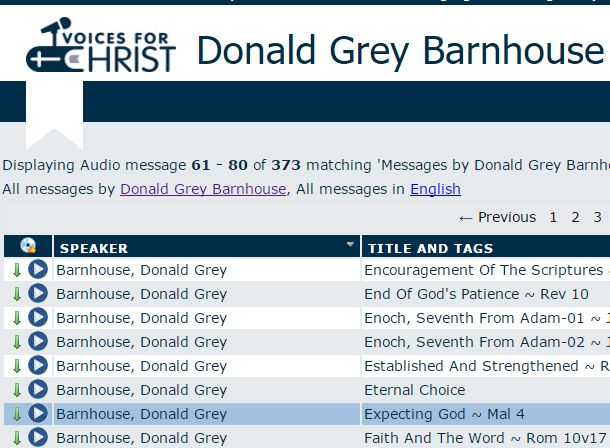
Dr Donald Gray Barnhouse preached a great 22 minute message called “Expecting God”. In it, he ties together prophecy from Matthew and Malachi, regarding the Tribulation and the removal of the Church prior to that Great Day of the Lord. He teaches this so clearly and concisely but so insightfully that I wanted to share.
One thing Dr Barnhouse said was that the coming of Jesus we are eagerly expecting will be in several stages. This is a notion that even recently in one particular comment stream on this blog, people have a hard time understanding. It is an obstacle which often makes them want to deny the literality of the coming 1000-Year Kingdom, AKA the Millennium Kingdom.
Just as Jesus came the first time over 33 years, Barnhouse said, His second coming will be 7 years plus 1000 years. (Tribulation plus Millennium).
I can only link to the sermon, it is not on Youtube to embed. When you go to this link, the screen shot below is what you’ll see. Just click on “Expecting God” and enjoy!




 the-end-time.org