Posted in false religion, ISIS, islam, muslim, prophecy

Islam is not a religion, it is a government

Shah’s official portrait. Wikipedia

I remember the overthrow of the Shah of Iran, Mohammad Reza Pahlavi, in 1979. Shah is another name for king. As world events went, it was right up there in terms of impact and import, even to my then college-aged sensibilities. Wikipedia says

A secular Muslim, Mohammad Reza gradually lost support from the Shi’a clergy of Iran as well as the working class, particularly due to his strong policy of modernization, secularization, conflict with the traditional class of merchants known as bazaari, relations with Israel, and corruption issues surrounding himself, his family, and the ruling elite. … By 1979, political unrest had transformed into a revolution which, on 17 January, forced him to leave Iran. Soon thereafter, the Iranian monarchy was formally abolished, and Iran was declared an Islamic republic led by Ruhollah Khomeini. (source)

The revolution was considered a surprise to most Western observers. Unlike in other revolutionary situations, there had not been an extended period of demonstrations or protests, nor did unrest seem to have permeated the kingdom to any threatening extent. Yet between September 1978 and February 1979, Iran was transformed.

Ruhollah Mūsavi Khomeini known in the Western world as Ayatollah Khomeini, was an Iranian Shia Muslim religious leader, revolutionary, politician, the founder of the Islamic Republic of Iran and the leader of the 1979 Iranian Revolution which saw the overthrow of the Pahlavi monarchy and Mohammad Reza Pahlavi, the Shah of Iran. Following the revolution, Khomeini became the country’s Supreme Leader, a position created in the constitution of the Islamic Republic as the highest-ranking political and religious authority of the nation, which he held until his death. He was succeeded by Ali Khamenei. Khomeini was a marja (“source of emulation”) in Twelver Shi’a Islam, a Mujtahid or faqih (an expert in Islamic law) and author of more than 40 books. (source)

The Ottoman Empire was in existence from 1299 to 1923, yet we forget the power, force, violence, Mohammedans” if they mentioned Muslims at all, apart from the oil.

Ayatollah Khomeini

and duration of the historical Islamic kingdom. That’s one reason why the Iranian Revolution was such a shock, at least to us lay people. The tectonic shift in the balance of power and stability in the Middle East with the coming of the revolution in the Middle East cannot be overstated. Prior to the Ayatollah Khomeini’s appearance and elevation to power, mostly we were only familiar with Islam when we saw flashes and clips on the news of desert people wearing turbans and the announcer was speaking of oil. We were not familiar with Islam, and indeed many of the Western religious leaders of the times prior to the 1970s simply referred to the adherents as “

Then came the Ayatollah Khomeini. His influence and power was another thing that was underestimated.

He was named Man of the Year in 1979 by American news magazine TIME for his international influence, and has been described as the “virtual face of Islam in Western popular culture” where he remains a controversial figure. He was known for his support of the hostage takers during the Iran hostage crisis, his fatwa calling for the death of British Indian novelist Salman Rushdie, and for referring to the United States as the “Great Satan”. Khomeini has been criticized for these acts and for human rights violations of Iranians (including his ordering of execution of thousands of political prisoners), and the pursuit of victory in the Iran–Iraq war that ultimately proved futile.

He has also been lauded as a “charismatic leader of immense popularity”, a “champion of Islamic revival” by Shia scholars, who attempted to establish good relations between Sunnis and Shias, and a major innovator in political theory and religious-oriented populist political strategy. (source)

All this to set the foundation for what I’m writing next. The above quote mentioned that Ayatollah Khomeini wrote 40 books. He was a revered figure in Islam, who lectured often. One series of those lectures was made into a book and is the foundation for the political attitude of his and succeeding generations of Iranians.

In Iran, the Revolution was not merely an outgrowth of economic unrest or instability. It was not merely dissatisfaction with political status quo. Islam is not a religion. It is a government.

One of the books that Ayatullah Sayyid Imam Ruhallah Musawi Khomeini wrote was, Islamic Government: Governance of the Jurist. From the website Al-Islam.org, we read the Ayatollah’s works. Remember, the concepts contained in the Khomeini lectures a mere 8 years later formed the basis for the government that Iran governs itself still today. In the Introduction of the book,

This book originated in a series of lectures given at Najaf between January 21 and February 8, 1970. Three major points emerge from the lectures. The first is the necessity for the establishment and maintenance of Islamic political power for Islamic goals, precepts, and criteria. The second is the duty of the religious scholars (the fuqahā) to bring about an Islamic state. Third, a program of action for the establishment of an Islamic state, including various measures for self-reform by the religious establishment.

The faith branch of Islam is the mechanism by which citizens of the Caliphate learn about how to live their lives under the Law- Sharia law. The faith IS the government, because the Quran is their constitution given by Allah through Mohammad. The mosque is where they go to learn about how to govern themselves, according to Allah’s dictates, which again, is contained in the Quran. I will quote from Ayatollah Khomeini’s book, Islamic Government: Governance of the Jurist. This is from the chapter, The Form of Islamic Government

Islamic government is neither tyrannical nor absolute, but constitutional. It is not constitutional in the current sense of the word, i.e., based on the approval of laws in accordance with the opinion of the majority. It is constitutional in the sense that the rulers are subject to a certain set of conditions in governing and administering the country, conditions that are set forth in the Noble Qur’an and the Sunnah of the Most Noble Messenger (s). It is the laws and ordinances of Islam comprising this set of conditions that must be observed and practiced. Islamic government may therefore be defined as the rule of divine law over men.

You are beginning to see that Muslim faith and Muslim governance are intertwined and never shall an adherent reject one or the other. He would not be a Muslim if he did. To continue with quotes from the Ayatollah’s book, the chapter on The Necessity for Islamic Government,

A body of laws alone is not sufficient for a society to be reformed. In order for law to ensure the reform and happiness of man, there must be an executive power and an executor. For this reason, God Almighty, in addition to revealing a body of law (i.e., the ordinances of the sharī‘ah), has laid down a particular form of government together with executive and administrative institution. The Most Noble Messenger (s) headed the executive and administrative institutions of Muslim society. In addition to conveying the revelation and expounding and interpreting the articles of faith and the ordinances and institutions of Islam, he undertook the implementation of law and the establishment of the ordinances of Islam, thereby, bringing into being the Islamic state.

He did not content himself with the promulgation of law; rather, he implemented it at the same time, cutting off hands and administering lashings, and stonings. After the Most Noble Messenger (s), his successor had the same duty and function. When the Prophet (s) appointed a successor, it was not only for the purpose of expounding articles of faith and law; it was for the implementation of law and the execution of God’s ordinances.

The precepts are not for a previous time, with only the faith portion of Islam to be followed by the faithful Muslim. No, the intertwining of with and government is inextricable and permanent. Islamic government includes performing all the typical tasks as, say the United States Government does. I’d remind us all again that these quotes are from the book which formed the foundation for the successful revolution of the nation of Iran and is their basis for governance today. They are not cherry-picked quotes from an obscure Imam or from a discredited segment of Islam.

According to one of the noble verses of the Qur’an, the ordinances of Islam are not limited with respect to time or place; they are permanent and must be enacted until the end of time. They were not revealed merely for the time of the Prophet, only to be abandoned thereafter, with retribution and the penal code no longer be enacted, or the taxes prescribed by Islam no longer collected, and the defense of the lands and people of Islam suspended. The claim that the laws of Islam may remain in abeyance or are restricted to a particular time or place is contrary to the essential creedal bases of Islam.

Therefore as the Ayatollah outlined the Necessity of Islamic Government, and then the Form of Islamic Government, he instructs on the Program for the Establishment of Islamic Government. Here is how to get the job done, and remember, he actually did:

You teach the people matters relating to worship, of course, but more important are the political, economic, and legal aspects of Islam. [underline mine] These are, or should be, the focus of our concern. It is our duty to begin exerting ourselves now in order to establish a truly Islamic government. We must propagate our cause to the people, instruct them in it, and convince them of its validity. We must generate a wave of intellectual awakening, to emerge as a current throughout society, and gradually, to take shape as organized Islamic movement made up of the awakened, committed, and religious masses who will rise up and establish an Islamic government.

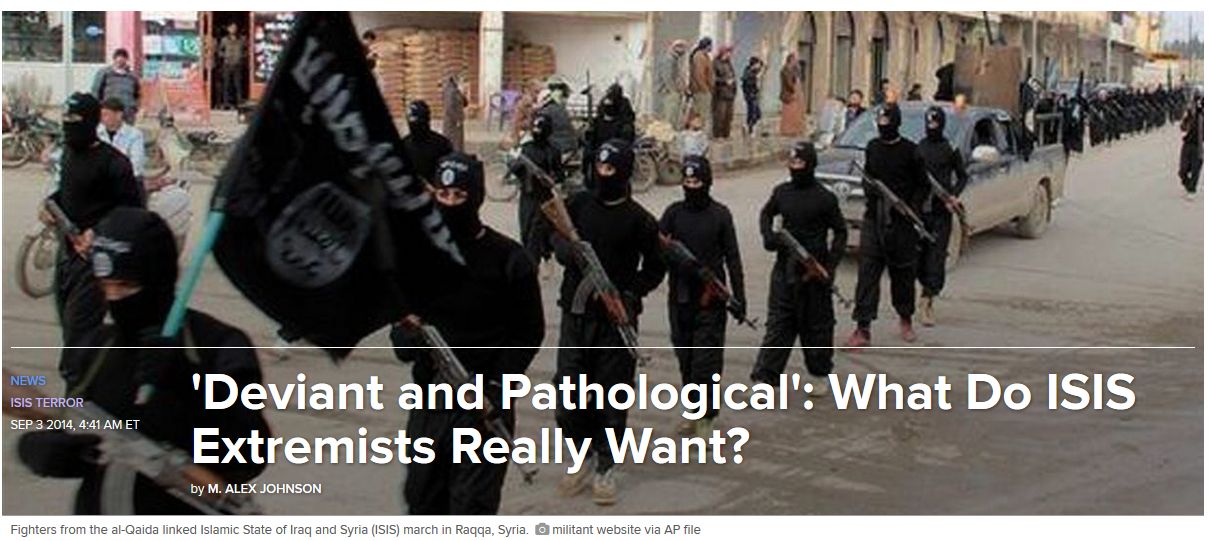
It worked in Iran, and it is working in the rest of the coming caliphate with al-Qaeda and ISIS.

Source NBC

The major point here is that the religion aspect of Islam is NOT the important aspect. It is only the important aspect in that it teaches the men who attend mosque as to the duties and rules regarding ‘Allah’s’ divine command for establishing an Islamic government. Here is the Ayatollah again-

Propagation and instruction, then, are our two fundamental and most important activities. It is the duty of the fuqahā to promulgate religion and instruct the people in the creed, ordinances, and institutions of Islam, in order to pave the way in society for the implementation of Islamic law and the establishment of Islamic institutions. [underline mine] In one of the traditions we have cited, you will have noticed that the successors of the Most Noble Messenger (s) are described as “teaching the people”—that is, instructing them in religion.

Many of the ordinances of Islam that refer to worship also pertain to social and political functions. The forms of worship practiced in Islam are usually linked to politics and the gestation of society. For example, congregational prayer, the gathering on the occasion of hajj, and Friday prayer, for all their spirituality, exert a political as well as moral and doctrinal influence.

Ayatollah Khomeini was not simply a religious figure, as some biographies put it. For a decade he was formerly the Supreme Leader of Iran, a nation with borders and a population of 40 million people at the time. Islam is a government, and they want and are aiming for global theocratic rule by Islamic jurists.

The Ayatollah and Iran itself are Shia Muslim, one of two branches that comprise the major points of Islam. However Shia Muslims  comprise only 15% of all Islam, Sunni Muslims make up the rest. The Iranian Revolution was an empowering event for Shias, which make up most of Syria also.

There are a few differences between Shia and Sunni but they are not major in terms of how non-Muslims are to be treated, nor do they wildly differ in terms of Sharia Law.

The important thing about Sharia law is that it is perfect and sacred. Law based upon democratic process is offensive to Islam because such law is based upon people. Sharia law is based upon the Koran and Mohammed, the only perfect guidance. Therefore, it is an offence to Islam for Muslims to have to live under democratic constitutional law. (source)

Because Islam is a political institution which rejects government by democracy, Islam and a Constitutional Republic are incompatible. A Muslim who lives under a democracy and not Sharia is living treasonously to Islam and if they are a Muslim living under Sharia Law in the US (or working toward that end) they are living treasonously to the Republic.

In my own opinion we can safely say that to deny a Muslim’s practice of his religion is not a violation of the Second Amendment protection of religion, because it is not a religion- it is a government. A divided government cannot stand. Just as Jesus said that one cannot live divided between the world governance of satan and the kingdom of God, so our democracy and a Sharia enclave of Muslims cannot live peacably together (as we have repeatedly seen in Beirut, Baghdad, Paris, San Bernardino CA and elsewhere).

And knowing their thoughts Jesus said to them, “Any kingdom divided against itself is laid waste; and any city or house divided against itself will not stand. “If Satan casts out Satan, he is divided against himself; how then will his kingdom stand? (Matthew 12:25-26)

Our spiritual loyalties are with the One True God, but in our earthly life as Christians we submit to government. Ours in America happens to be a Constitutional Republic. We look forward to the day when we will become not only full citizens of the Kingdom of Heaven as we are now, but are physically present in our homeland. Until then, if you are an American as I am, it is sad to see our once-great nation and our once-strong country succumb to divided loyalties and self-indulgence and outright sin.

EPrata photo

Due to America’s continued rebellion against God, I fully expect His wrath to be poured out on us as Romans 1:18-32 states. The Wrath of Abandonment is a difficult thing to watch, and I am sorrowful that God may indeed decide to use Islam as the hammer against which He will render His verdict against us here in America. It seems that in coming months or years, it may be a bloody time, a difficult time, and a sorrowful time. The flood of false religion will not be stopped,because it is prophesied that apostasy will rise (Matthew 24:10, 1 Timothy 4:1, 1 John 4:3) until the Great Apostasy takes over and the world staggers under the sin of its one world religion. (2 Thessalonians 2:3-4).

We have hope, a secure and a glorious hope. We cling to the promises of His soon return, His everlasting kingdom, and the TRUE theocracy under which we Christians are subject. The Lamb reigns!

And on His robe and on His thigh He has a name written, “KING OF KINGS, AND LORD OF LORDS.” (Revelation 19:16)

—————————————–

Further reading:

Shia and Sunni Muslims: Do You Know the Difference? The link goes to a page with nation-by-nation listing of who is what and also the main differences between the two branches.

Thefts of propane tanks and bulk cell phone buys in Missouri puts FBI on alert

Posted in book of life, daniel, judgment, prophecy

"and the books were opened…"

Even in these casual, pagan, secular days, there are still a few places which engender a gravitas and causes proper behavior to be displayed and proper clothing to be worn: funerals, and court.

The somber scene where the anticipation of the gallery, the nerves of the plaintiff and defendant, the busyness of the defense and prosecuting lawyers as they bustle to their seats and open attache cased and extract papers and files…then the bailiff comes and says ALL RISE! and the gravity of the scene deepens as the Judge enters. You stand before the judge, you don’t lounge, sit, squirm, or are in any way inattentive. He commands the courtroom! Then He opens his file and the proceedings begin. It is a somber and serious scene.

Imagine, then, the exponentially deeper gravity of that scene when the JUDGE comes to hear the cases of each and every person who ever lived.

“He told me all I ever did!” (John 4:39).

Jesus will judge each person and the proceedings will be the most serious, the most grave that were ever conducted anywhere ever. Here is from Daniel 7:9-10. Please read it slowly and ask the Spirit to impress the scene upon your heart. There is little attention paid to prophecy, judgment and accountability these days. This scene will happen for the hundreds of millions of people who do not know Christ. Is your colleague, friend, loved one going to be among them?

Is the name of your friend, loved one or colleague’s name in the Lamb’s Book of Life? Or is their name in the Books that recount all they ever did, which was sin against our Holy God unto everlasting judgment. Share the Gospel and the reason for the season today. Jesus our Savior, Hallelujah, the Lamb has come!

“As I looked,
thrones were placed,
and the Ancient of Days took his seat;
his clothing was white as snow,
and the hair of his head like pure wool;
his throne was fiery flames;
its wheels were burning fire.
10A stream of fire issued
and came out from before him;
a thousand thousands served him,
and ten thousand times ten thousand stood before him;
the court sat in judgment,
and the books were opened…
Daniel 7:9-10

EPrata photo

——————————-

Further Reading

The Holy Spirit: God’s Prosecutor

Posted in prophecy, rapture, salvation, tribulation

Will any people be saved after the rapture, during the tribulation?

A friend on Facebook asked me a question. I like questions. They send me searching the Bible for a Spirit-led answer. I enjoy studying for a purpose. Here is the question:

How it can be that the bible states that most people will go to hell, yet in the tribulation, so many are saved they can’t be counted? Is the dynamic different in the Tribulation?

As for most people going to hell, yes that’s true. The Bible says that Jesus promised-

Enter through the narrow gate; for the gate is wide and the way is broad that leads to destruction, and there are many who enter through it. For the gate is narrow and the way is hard that leads to life, and those who find it are few. (Matthew 7:13-14)

A specific answer as to how many will be saved during the wrath known as the Tribulation period can’t be given, because we cannot quantify “many” and “few”. We know for example, that many people died in the Flood (most actually). Few were on the narrow way, (only 8 people actually. Noah and his family). We know that most were sent to destruction when four of the five cities of the plain were destroyed. Admah, Zeboiim, Sodom and Gomorrah were thriving cities full of people, and most were sent to destruction when the angels came to destroy them with brimstone. (Genesis 19:13, 24-25; Deuteronomy 29:23). Only a few were saved (4 actually, and one of those turned out to be a false convert).

Over the course of world history we can’t know how many means few and how many means many. But we notice the fact that as soon as Jesus began teaching the hard truths, most left him. (John 6:60, 66). If we look at the scene in context as a microcosm of the world population, most people throughout history have either rejected Him outright or left the faith showing they never were of Him at all.

Therefore I believe the dynamic in the Tribulation is different. I base this on the verse in Matthew where Jesus said the Tribulation will be a unique time in world history. (Matthew 24:21,

For then there will be great tribulation, such as has not been from the beginning of the world until now, no, and never will be.

As for why so many would be saved, it is because the Tribulation is the fulfillment of the Bible’s promises. John MacArthur says in his sermon “Tribulation Saints part 1”,

“We have prayed that some day there would be a sweeping revival across the world that would bring millions of souls into the Kingdom. It has been the prayers of God’s people through the centuries that God would bring a great harvest of souls. And He will. One day it will come. It will be the greatest movement of God’s saving power in terms of sheer numbers that the world has ever known. Now that anticipation of that should not shock us because God longs to save…”

Revival is something we always pray for, but we don’t often realize that the revival that comes might look very different than the revival we envision in our head. Usually we envision a peaceful, joyful revival that sparks cultural change and personal peace. Yet the revival ahead in the Tribulation will be in a time of blood and war and grief and widespread martyrdom.

The reasons so many will be saved are found in Romans 11:26, that all Israel will be saved, and in Genesis 12, the fulfillment of Abraham’s covenant that all (pagan) nations through Abraham will be blessed.

If you’re interested, you can hear about salvation during the Tribulation explained more fully in John MacArthur’s sermon “Tribulation Saints” parts 1 and 2, expositing these verses from Revelation 7 under discussion.

After this I looked, and behold, a great multitude that no one could number, from every nation, from all tribes and peoples and languages, standing before the throne and before the Lamb, clothed in white robes, with palm branches in their hands, 10 and crying out with a loud voice, “Salvation belongs to our God who sits on the throne, and to the Lamb!” (Revelation 7:9-10).

Then one of the elders addressed me, saying, “Who are these, clothed in white robes, and from where have they come?” 14 I said to him, “Sir, you know.” And he said to me, “These are the ones coming out of the great tribulation. They have washed their robes and made them white in the blood of the Lamb. (Revelation 7:13-14)

Praise the Lord who saves!!

Posted in encouragement, jesus, john bunyan, lion, pilgrim's progress, prophecy

Lunging Lions along the Way

Pilgrim’s Progress by John Bunyan is a tremendous book. It’s an allegory of the Christian’s life from salvation to heaven (“The Celestial City”). In the book, there is a scene where Christian Pilgrim is attempting to climb the way to Porter’s Lodge Up ahead he can see two lions crouching at the edge of the path. What Pilgrim doesn’t know is that the lions are chained, and if Pilgrim stays in the middle of the path, he will not be harmed by the lunging lions. Here is the excerpt:

Now before he had gone far, he entered into a very narrow passage, which was about a furlong off the Porter’s lodge, and looking very narrowly before him as he went, he espied two lions in the way. Now, thought he, I see the dangers that Mistrust and Timorous were driven back by. (The lions were chained, but he saw not the chains.) Then he was afraid, and thought also himself to go back after them; for he thought nothing but death was before him. But the Porter at the lodge, whose name is Watchful, perceiving that Christian made a halt, as if he would go back, cried unto him, saying, Is thy strength so small? Mark 4:40. Fear not the lions, for they are chained, and are placed there for trial of faith where it is, and for discovery of those that have none: keep in the midst of the path, and no hurt shall come unto thee.

We ourselves are pilgrims in a strange land. Our way is clear because, “Thy word is a lamp unto my feet, and a light unto my path.” (Psalm 119:105). The way is lit by His word and it is made clear, but it is a narrow way. Take care to stay on the middle line of that Way, dear friend, as I strive to do myself. And look, see what good promises are ahead for His people the Jews and those of us grafted in!!

Isaiah 35:1-9

The Ransomed Shall Return

1The wilderness and the dry land shall be glad;
the desert shall rejoice and blossom like the crocus;
2it shall blossom abundantly
and rejoice with joy and singing.
The glory of Lebanon shall be given to it,
the majesty of Carmel and Sharon.
They shall see the glory of the LORD,
the majesty of our God.

Pink flowers bloom after a rare rain ignited seeds
 that had lain dormant in the desert for years
.

3Strengthen the weak hands,
and make firm the feeble knees.
4Say to those who have an anxious heart,
“Be strong; fear not!
Behold, your God
will come with vengeance,
with the recompense of God.
He will come and save you.”

5Then the eyes of the blind shall be opened,
and the ears of the deaf unstopped;
6then shall the lame man leap like a deer,
and the tongue of the mute sing for joy.
For waters break forth in the wilderness,
and streams in the desert;
7the burning sand shall become a pool,
and the thirsty ground springs of water;
in the haunt of jackals, where they lie down,
the grass shall become reeds and rushes.

Rushes thriving by a pond. EPrata photo

8And a highway shall be there,
and it shall be called the Way of Holiness;
the unclean shall not pass over it.
It shall belong to those who walk on the way;
even if they are fools, they shall not go astray.
9No lion shall be there,
nor shall any ravenous beast come up on it;
they shall not be found there,
but the redeemed shall walk there.

The redeemed shall walk there. A promise we can cling to, hope on, and await expectantly. How beautiful the feet…

How beautiful upon the mountains
    are the feet of him who brings good news,
who publishes peace, who brings good news of happiness,
    who publishes salvation,
    who says to Zion, “Your God reigns.” (Isaiah 52:7)

Posted in Lamb, prophecy, sacrifice

Did Jesus perform sacrifices at the Temple?

I was asked a good question by a friend. I like questions. They send me searching into the Bible and I spend happy moments or hours delving into the mysteries of God in the Bible to unearth a Spirit-filled answer. The question was, did Jesus offer animal sacrifices at the Temple, even though HE was going to be the sacrifice? And was sinless?

After some thought and biblical research, this was my answer. As for Jesus offering animal sacrifices, I am not personally aware of any scene in the Bible that depicts this, but I am pretty sure that He did. How can I be pretty sure?

First, Jesus lived the Law perfectly–

Do not think that I have come to abolish the Law or the Prophets; I have not come to abolish them but to fulfill them.” (Mt 5:17)

Though the Bible does not offer extensive information about the early or childhood life of Jesus, there are a few glimpses of Jesus and His keeping of the Law. We know his parents Joseph and Mary kept the Law, and they taught Jesus to do the same. The pair came to the temple on the 8th day after Jesus birth to fulfill the Law of Moses (Luke 2:21-22).

Skip forward to a few years, we know the family went up to Jerusalem to fulfill the Law concerning the festivals. (Luke 2:41-42). And Jesus was submissive to his parents in all things [according to the Commandment honor thy parents]. (Luke 2:51)

Jesus was baptized, certainly He did not need to go through a ritual that represented repentance and cleansing from sin! But He did.

For our sake he made him to be sin who knew no sin, so that in him we might become the righteousness of God.” (2 Cor 5:21).

This means that God treated Jesus AS a sinner, even though He was not.

So therefore we can extrapolate that He likely also performed sacrifices when He came to the proper age. If He didn’t do sacrifices, He would not have fulfilled the Law as Matthew recorded Jesus statement. Animal sacrifices foreshadowed Christ’s sacrifice on our behalf and Jesus performing the sacrifices was still a picture of that, until the cross and the torn veil in the Temple.

Behold the Lamb of God, who takes away the sin of the world!” (John 1:29b).

Posted in courage, overcomers, prophecy, strong

America is raising fragile kids traumatized by words, supporting coddled youths with snowflake spirit

The above photo was on Twitter and I liked it. There has been a brouhaha these last few weeks over the sensitivity of college aged youth and their tolerance levels. I’ve watched this thing unfold, with different articles coming out, different opinions on social media…and I’ve been thinking.

The National Review published an article titled:
Campus Commotions Show We’re Raising Fragile Kids

It seems like every week there’s a new horror story of political correctness run amok at some college campus. A warning not to wear culturally insensitive Halloween costumes sparked an imbroglio at Yale, which went viral over the weekend. A lecturer asked in an e-mail, “Is there no room anymore for a child to be a little bit obnoxious . . . a little bit inappropriate or provocative or, yes, offensive?” Students went ballistic. When an administrator (who is the lecturer’s spouse) defended free speech, some students wanted his head. One student wrote in a Yale Herald op-ed (now taken down): “He doesn’t get it. And I don’t want to debate. I want to talk about my pain.”

Their pain. Their pain is king. ‘All I want to do is talk about meeeee.’ There is a new movement afoot on colleges to allow students to ‘opt-out’ of an assignment if it is too sensitive for them to handle and causes too much pain.

Some colleges are now instituting a ‘trigger warning’ that some material may be sensitive for students who have experienced trauma. In the article below, notice some of the listed content that may trigger a warning: “colonialism”. Depictions of colonialism are deemed sensitive material, enough so that students are warned about it prior, so they can opt out? In my day material covering colonialism was called “history.” [Ed. Note: in the following article the professor quoted is this author’s sister].

Warning: This education might trigger trauma. Are we coddling college students?
A “trigger warning” informs readers who have experienced trauma — be it war or sexual assault — that content in an article or book may “trigger” them and cause them to re-experience that trauma

That doesn’t sound too threatening, but a September article in the The Atlantic magazine argues the use of these content advisories, taken to the extreme on college campuses, effectively “coddles” students by shielding them from ideas and words they may find unpleasant. Oberlin College in Ohio, for example, had recommended that professors include an advisory when assigning Chinua Achebe’s “Things Fall Apart” because students may be triggered by its depictions of “racism, colonialism, religious persecution, violence [and] suicide.”

Todd Friel has some information about the coddling of America in this 7 minute video.

I was amused by a viral video of a mom of a school-aged student ranting about the elementary school car rider line. Some parents who choose to drive their children to school rather than put them on the bus are also choosing to be a traffic hazard and endanger others so that they can drop off their children at the closest door rather than have their child walk an extra 50 feet. Then I was reminded of the documentary called On the Way To School, where children in four different countries are chronicled getting to school and overcoming hazards way worse than walking an extra 50 after being personally driven by mommy- like avoiding being eaten by lions, or pushing your brother in a wheelchair over dirt and miry clay 10 miles, or walking up and down whole MOUNTAIN RANGES. The documentary shows kids from South America, India, Africa and Morocco walking to school in extreme conditions- just for the privilege of being educated.

And the American children who are driven to school and dropped off in the car rider line grow up to be the wimps who opt out of a college level assignment because they are allegedly traumatized by colonialism.

The sensitive college students problem has also infiltrated Christian universities.  These same sentiments are appearing in Christian schools and becoming a problem for Christians outside universities, as noted by Friel in the video above and in Dr. Piper’s message below. Those who are offended by colonialism, or, words, will certainly be offended by the Gospel! Yet there has been some push-back regarding the hot house flower sensitivity of these American college students at a Christian University, by President of Oklahoma Wesleyan University wrote,

This is Not a Day Care. It’s a University!
Dr. Everett Piper, President
Oklahoma Wesleyan University

This past week, I actually had a student come forward after a university chapel service and complain because he felt “victimized” by a sermon on the topic of 1 Corinthians 13. It appears that this young scholar felt offended because a homily on love made him feel bad for not showing love. In his mind, the speaker was wrong for making him, and his peers, feel uncomfortable. 

I’m not making this up. Our culture has actually taught our kids to be this self-absorbed and narcissistic. Any time their feelings are hurt, they are the victims. Anyone who dares challenge them and, thus, makes them “feel bad” about themselves, is a “hater,” a “bigot,” an “oppressor,” and a “victimizer.” 

I have a message for this young man and all others who care to listen. That feeling of discomfort you have after listening to a sermon is called a conscience. An altar call is supposed to make you feel bad. It is supposed to make you feel guilty. The goal of many a good sermon is to get you to confess your sins—not coddle you in your selfishness. The primary objective of the Church and the Christian faith is your confession, not your self-actualization. 

So here’s my advice:

Read the rest of his message for his advice. So what does this mean for Christians? The most basic and literal meaning is that when we proclaim the Gospel, the FULL Gospel, which includes discussion of sin and judgment, it will not be tolerated. At all. The article above says caving in to trigger warnings and opting out ‘effectively “coddles” students by shielding them from ideas and words they may find unpleasant.’ And the Gospel is the most unpleasant news there can be until the Good News is added to it. If they find mere college content unpleasant, how will it be when a Christian tells them they are sinners, angering God every day and headed for judgment and hell? It won’t be tolerated, at all, and not just from cultural pressure or outcry. By law.

Secondly and more symbolically, since leak-over occurs from the world to the faith all the time and our Christian youth will be affected, it means we have wimpy soldiers of the faith to look forward to. I think of the youth in the Bible and wonder where our stalwart soldiers of the faith are going to come from. The Lord our God is always raising up youth for His name, but it seems to me they are becoming scarcer, these brave and strong men and women of the faith.

David was a young man, a boy really, and he was a shepherd. What that means is he was in the rugged outdoors all day and all night. He watched over the sheep and protected them from bears and wolves and lions at the risk of his own life, with only a rod and a slingshot for a weapon. He walked miles and miles leading them to different pastures because grass was scarce. He was alone, out in the open, and had a great responsibility. It is estimated David was between 13 and 15 years old when he was anointed. (1Sam 16:12-13). And then, David slew Goliath. And some youth today are upset because words hurt their feelings.

Timothy was young. Paul admonished Timothy not to let anyone despise him because of his youth. Timothy was pastor and leader of a church with all that entailed, especially the honor of preaching the everlasting Gospel. Timothy was urged despite his relative youth to be so Godly that his life would be a pattern for others to imitate.

Mary was young, maybe 14 or 15, when the angel Gabriel told her she was going to be pregnant. This is normally an event that destroys lives. Yet she humbly said ‘Let it be done to me as God wills’, then at 9 month gestation, got on a donkey and rode to Bethlehem, then fled to Egypt.

Daniel was young, very young when he was taken in Babylonian captivity. Those taken were being groomed for service, these young moldable youths. Except Daniel was not moldable. He refused the wine and foods because ingesting them would have defiled him. hHe brought his complaint respectfully to the authority, politely asking to be excused from eating and drinking it, but still, in the face of enormous pressure to cave in, Daniel rejected the training and stood for God. (Daniel 1:8). And some youths these days are upset at a sermon on love because it pricked their conscience. Some young men say all they want to do is talk about their pain. Their thoughts go no higher than their own navel gazing.

In reading widely about this trigger warning and trauma pain the sensitive snowflakes are going on about, I notice that when professors tend to use trigger warnings it is due to graphic sexual content. They assign novels that contain sexual violence or graphic sexual scenes among lesbians or homosexuals. In my opinion, the problem is not that trigger warnings are necessary, it is that the trauma-triggering material is even being presented in the first place. For those who are traumatized by violence, then learning about the Civil War, or the Cambodian Killing Fields should be a problem. Yet most professors do not use trigger warnings for that content. But assigning novels to impressionable youth containing multiple rape scenes is OK? I don’t think so.

The prophecy says,

For people will be lovers of self, lovers of money, proud, arrogant, abusive, disobedient to their parents, ungrateful, unholy,  (2 Timothy 3:2)

Below is where we are headed. This is a very true and chilling preview of what American higher education is coming to. And for all that, we who have the holy and pure Spirit inside of us, rest assured He will strengthen us and make us stand, just as He did with David and Mary and Timothy and David. Our home is not on earth but in heaven. We have an opportunity to be like Timothy, live a life that others would want to pattern after us, a noble, upright, strong life- In Christ. While the rest of the world sinks into a victim mentality, let us be overcomers displaying a victor mentality. Through God, we truly can do anything.

The video below is 7 minutes and I recommend seeing it.

Modern Educayshun
Neel Kolhatkar’s “Modern Educayshan” gives us a glimpse into the future of American education if things keep going on their present course. If you watch the first 1:20, you’ll see why this video is striking a chord among citizens who fear what our schools and universities are becoming.

Posted in government, jesus, prophecy

Christ is Prince of Governments

But Peter and the apostles answered, “We must obey God rather than men. 30The God of our fathers raised Jesus, whom you killed by hanging him on a tree. 31God exalted him at his right hand as Leader and Savior, to give repentance to Israel and forgiveness of sins. 32And we are witnesses to these things, and so is the Holy Spirit, whom God has given to those who obey him.” (Acts 5:29-32).
tot he
During this long Thanksgiving Break, I’ve listened to many sermons. i Heard a good sermon on the aspect of Jesus as Prince. On Expositor.fm my usual morning line-up to which I dedicate some time in the AM includes wonderful sermons from Barnhouse, Boice, MacArthur, or Lloyd-Jones. A sermon from Acts 5:29-32 delivered by Martyn Lloyd-Jones struck me. Two Lines of History, looked at Jesus as Prince over governments.

The following represents my personal interpretation & spiritual absorption of the Acts verses and the exposition of them.

We must obey God rather than men is not a license to run amok and freely break the law and become rebellious, of course. God instituted Governments. He is sovereign over them. What is meant here is that where a choice comes to obey God OR man, we obey God. That was the choice given to Peter and he chose wisely.

The concept is, Jesus is savior but also Prince- Governor of nations! He is the Prince of the Universe, thee only one who can govern, the only one who has a right to govern, the only one who is going to govern. But the world rejects this. It needs to be convinced of this, convicted of it.

Of man’s history, man’s government, what are the characteristics of this? It is quite clear in history and in the bible is that government has been appropriated by man who rejects the voice Divine. Despite all of man’s efforts to produce order, the jungle is always encroaching. Man sweats, labors, cuts back the jungle of immorality and yet strife, lawlessness, dictatorships, wars always encroach.

The Decline and Fall of the Roman Empire by Edward Gibbon is a monumental work. He listed five reasons why civilizations decline and fall.

1. The undermining of the dignity and sanctity of the home, which is the basis of human society.

2. Higher and higher taxes and the spending of public money for free bread and circuses for the populace.

3. The mad craze for pleasure; sports are becoming more and more exciting and brutal every year.

4. The building of gigantic armaments when the real enemy was within the decadence of the people.

5. The decay of religion–faith fading into mere form, losing touch with life, and becoming impotent to warn and guide the people.

(Edward Gibbon, The Decline and Fall of the Roman Empire, 1787).

Geographically, Paul was a resident of Jerusalem but a citizen of Rome. Spiritually we are residents of Georgia (or Kentucky or Washington) but our citizenry is in heaven. We owe respect and allegiance to those whom God has set over us in government, but our highest loyalty is toward the Prince of Governments.

For to us a child is born,
to us a son is given;
and the government shall be upon his shoulder,
and his name shall be called
Wonderful Counselor, Mighty God,
Everlasting Father, Prince of Peace.
Of the increase of his government and of peace
there will be no end,
on the throne of David and over his kingdom,
to establish it and to uphold it
with justice and with righteousness
from this time forth and forevermore.
The zeal of the LORD of hosts will do this.
(Isaiah 9:6-7)

Let us sort out out our loyalties and allegiances. Let us look inward in order to prepare for a moment which may come to us as it did to Peter, and make our decisions regarding God and man.Will we obey man, or will we obey the Prince of Government?

A polling station, with watchful Jesus over the government…EPrata photo
Posted in eternity, God, heaven, prophecy, ten thousand year clock

Clock of the Long Now

A man is building a clock in the West Texas Mountains that will keep time for 10,000 years. It is a 10,000 year clock, and the foundation supporting this enterprise is called The Long Now.

It is written about the clock

Designed by Danny Hillis, the Clock is designed to run for ten millennia with minimal maintenance and interruption. The Clock is powered by mechanical energy harvested from sunlight as well as the people that visit it. The primary materials used in the Clock are marine grade 316 stainless steel, titanium and dry running ceramic ball bearings. The entire mechanism will be installed in an underground facility in west Texas.

Why is this man building a clock that will keep time for 10,000 years? Well, why does any man do anything? Why did they climb Everest? Why do they go down to the sea in ships? Why do they tramp the Arctic?

But this man, why is he building a long now clock?

I wanted a symbol of the future, in the same way that the pyramids are a symbol of the past. I wanted to build something that gave us that sense of connection. 

I’m Danny Hillis and I’m building a clock that will last for 10,000 years. ..One of the ways we keep the clock accurate is that we synchronize it to the sun… Exactly at solar noon the chimes begin to play. … They worked out a way of ringing ten bells in a different sequence each day, for ten thousand years. … We’re invested in generational thinking, and answering the question, ‘were we good ancestors?’ 

There’s a problem of people not believing in the future, a long-term clock challenges those short-term civilizational stories. I’m very optimistic about the future. I’m not optimistic because I think our problems are small. I’m optimistic because I think our capacities are great. 

Oh. I see. Like the Tower of Babel.

To see the Clock you need to start at dawn, like any pilgrimage. Once you arrive at its hidden entrance in an opening in the rock face, you will find a jade door rimmed in stainless steel, and then a second steel door beyond it. These act as a kind of crude airlock, keeping out dust and wild animals. You rotate its round handles to let yourself in, and then seal the doors behind you. It is totally black. You head into the darkness of a tunnel a few hundred feet long. At the end there’s the mildest hint of light on the floor. You look up. There is a tiny dot of light far away, at the top of top of a 500 foot long vertical tunnel about 12 feet in diameter. There is stuff hanging in the shaft.

And they said to one another, “Come, let us make bricks, and burn them thoroughly.” And they had brick for stone, and bitumen for mortar. 4Then they said, “Come, let us build ourselves a city and a tower with its top in the heavens, and let us make a name for ourselves, lest we be dispersed over the face of the whole earth.” (Genesis 9:3-4)

The first part of the Clock you encounter on the ascent up the spiral staircase is the counterweights of the Clock’s drive system. This is a huge stack of stone disks, about the size of a small car, and weighing 10,000 pounds. Depending on when the clock was last wound, you may have to climb 75 feet before you reach the weights. 

You keep climbing. For the next 70-80 feet of ascent you pass 20 huge horizontal gears (called Geneva wheels), 8 feet in diameter, each weighing 1,000 pounds. This is the mechanical computer that calculates the over 3.5 million different melodies that the chimes will ring inside the mountain over the centuries. 

And the LORD came down to see the city and the tower, which the children of man had built. 6And the LORD said, “Behold, they are one people, and they have all one language, and this is only the beginning of what they will do. And nothing that they propose to do will now be impossible for them. 7Come, let us go down and there confuse their language, so that they may not understand one another’s speech.” (Genesis 9:5-7)

This is what happens when man worships created things instead of the Creator. Man has an inherent notion of time. Man knows he is in a great slip-stream current of time, connected to those who have passed before us and linked to those yet to come. That is because God has put eternity into man’s heart. (Ecclesiastes 3:11).  Man seeks the great questions, desires to know the end of things, wants to achieve greatness under the sun- or on the plains of Shinar.

The 10,000 year clock’s design and these beginning moments of its construction are truly remarkable. That men could design such a thing does seem to indicate a nearly bottomless well of capacity for accomplishment. Yet man’s capacity is only as deep or as long as the Holy God allows it, as we know the end of the story of the Tower of Babel. What the 10,000 year clock really is, is a monument to man. What a shame to use all that money, time, skill, and labor for something that is really an ode to man.

What blessings he has given us to enter His courts and see the angelic beings with wheels within wheels, TRUE machinery that lasts ten thousand upon tens of thousands of years, eternities.  What greatness He has bestowed on us to hear the trumpet and harps and worship songs that are the chimes of heaven.

In Jesus we have the eternal questions answered. We know that we know we are in His slip-stream of time and in the current that is endless and infinite. We know we are good ancestors because He is our father, the root ancestor, having in us His greatness. Apart from Him we can do nothing, but in Him we can do whatever His will allows and sustains in us to do. From man’s perspective, the clock in the mountain in West Texas is a remarkable thing. It really is. Personally, I’m in awe of it and wonderstruck at the men who are creating it. From God’s perspective it is a mote on a gnat on a flea. My true awe is of the God who invented time. What a blessing He gave His children the eternal answers. We do not have the restlessness of clockmakers, but possess an eternal peace. In Him, in heaven, there is no time, and no need for clocks.

Posted in courts, encouragement, jesus, mansions, new jerusalem, prophecy

East Greenwich High School senior privileges: The Courtyard

I attended High School between 1974 and 1978. It was an excellent high school, offering high-end academics, a thriving sports program, a beautiful campus, and star teachers. To us, though, it was just high school, and the best thing about it was none of those things.

It was Senior Privileges.

Seniors were allowed entry to spaces in the school that no other students were allowed to enter. These spaces were severely restricted, and anyone who was not senior was barred.

For example, the Health Room was once a senior-only room, and was furnished with couches, a television, and refrigerator, if you can believe it. Even more unbelievable in this generation’s health-conscious era, of the area of the school’s inner courtyard where three brick walls connect was once reserved as a smoking area for students. Smoking is now banned on the entire campus.

I never took advantage of those privileges but there were two others that I enjoyed.

Seniors during the 1970’s and 1980’s could sign themselves in and out of school. If we had a study hall first period of the day, we were able to come in late. We were able to sign out of school in the case of a last period study hall. I used to sign out and go to McDonald’s and get breakfast, which was a new offering back then. McDonald’s introduced the Egg McMuffin in 1972 and a full breakfast in 1977. That was the year I became a senior and the novelty of the McMuffin and hash browns was too luscious to resist. I signed myself out of study hall and drove to get breakfast a la McD’s style, also bringing back orders for friends who didn’t have a car.

But the greatest privilege to me was that seniors-only could use the courtyard. The courtyard was not an arborist’s dream. It was a scrubby place, not really a greenspace, just well-worn paths amid gasping grass, concrete benches, the aforementioned smoking area, and some trees. But the school was large and being able to cut down travel time between classes to beat the bell was extremely compelling. Plus only seniors could go there.

All the Freshmen knew about senior privileges. We’d look upon the seniors emerging from the courtyard with awe, and excitedly talk about the day we, too, would be allowed entry into this most prized restricted area. I don’t have enough words to relate to you the thirst, angst, and yearning for senior privileges. WE were blocked out, but THEY could go hang out! They could go in and come out! They could remain in a private area just for them! We wanted that!

Courtyard at Hotel Inca Real, Cuenca, Ecuador.
EPrata photo

The parallel to God’s courts is the point I want to make here. Do we possess the same fervency to be in God’s courts? Do we yearn for the privilege of being in His courts?

The Psalmist said,

For a day in your courts is better than a thousand elsewhere. I would rather be a doorkeeper in the house of my God than dwell in the tents of wickedness. (Psalm 84:10)

The righteous man will flourish like the palm tree, He will grow like a cedar in Lebanon. Planted in the house of the LORD, They will flourish in the courts of our God. (Psalm 92:12-13)

Enter his gates with thanksgiving, and his courts with praise! Give thanks to him; bless his name! (Psalm 100:4)

I know when the time comes to enter His fabulously luxuriant and holy courts, it will be with thanksgiving and praise. But until then, do we yearn for His home, which is our home? Do we look with joy and anticipation when it will finally be our turn to enter the restricted area, the private area reserved for only those chosen? Do we crave to be there, enjoying the privilege of being in His court?

I can’t imagine what it will look like or what it will be like to enter His courts. The Bible tells us that we can’t conceive of it. My juvenile mind could not conceive of any privilege or any courtyard sweeter than the High School Courtyard reserved for those of a certain age. Just as now, my juvenile Christian mind cannot conceive of a courtyard sweeter or more tranquil that, say, the one at the Hotel Inca Real in Cuenca Ecuador, adorned with plants, tiled floors, resting benches, beauty and peace.

But, as it is written, “What no eye has seen, nor ear heard, nor the heart of man imagined, what God has prepared for those who love him”– (1 Corinthians 2:9)

But I can and do joyfully anticipate His courts even without being able to visualize them. It is quite humbling to think of Jesus preparing this place for us.

EPrata photo
Posted in behold, bible, prophecy, thankful

Behold the man! And The Four Beholds

We know Jesus is the Man-God. His divinity was on display when He healed, did miracles, or taught with such authority that the hearers were astounded.

His human nature was on display when He was weary (John 4:6), hungry (Mark 11:12), or thirsty (John 19:28).

When Jesus appeared before the magistrate, Pilate said to the crowd, Behold the man. Here is the verse:

So Jesus came out, wearing the crown of thorns and the purple robe. Pilate said to them, “Behold the man!” (John 19:5)

Most of us are familiar with that phrase, and that momentous event in the life of Jesus. But did you know that Zechariah said it first? In one of the many visions God gave the prophet Zechariah, the phrase appears. Thus Pilate’s utterance was a fulfillment of an Old Testament picture pointing to a New Testament truth.

And say to him, ‘Thus says the LORD of hosts, “Behold, the man whose name is the Branch: for he shall branch out from his place, and he shall build the temple of the LORD. (Zechariah 6:12)

Though the vision actually shows Joshua being crowned, it is in reality a picture of the crowning of Jesus. The Jamieson Fausset Commentary explains further:

Behold, the man—namely, shall arise. Pilate unconsciously spake God’s will concerning Him, “Behold the man” (Jn 19:5). The sense here is, “Behold in Joshua a remarkable shadowing forth of Messiah.” It is not for his own sake that the crown is placed on him, but as type of Messiah about to be at once king and priest. Joshua could not personally be crowned king, not being of the royal line of David, but only in his representative character.

[Source: Jamieson, R., Fausset, A. R., & Brown, D. (1997). Commentary Critical and Explanatory on the Whole Bible (Vol. 1, p. 723). Oak Harbor, WA: Logos Research Systems, Inc.]

Roy Gingrich’s outlines on the prophetic books are helpful here explaining Zechariah’s vision of Joshua’s crowning, and the Heavenly utterance “Behold the Man whose name is the branch!”

THE SYMBOLISM OF THE CROWNING OF JOSHUA 

The crowning of Joshua, a priest, with a regal crown symbolizes the future crowning of Christ, a priest (after the order of Melchisedec), with a regal crown (as Israel’s and the world’s, King) at His Second Advent. 

During Christ’s earthly ministry, He was crowned with a crown of thorns, Matt. 27:29; during His present sitting at His Father’s right hand, He is crowned with a crown of glory and honor, Heb. 2:9; at His Second Advent, He will be crowned with many crowns, Rev. 19:12 (as the King of Israel, Matt. 27:37, and as the King of all the earth’s Kings, Rev. 19:16). 

THE PROPHECIES CONCERNING THE MESSIAH (Zechariah 6:12, 13, 15) 

(Here we have one of the Old Testament’s most complete, yet concise, prophecies concerning the person, the office, and the work of the coming Messiah.) 

1. The Messiah will be the antitype of Joshua (6:12). 

To “behold the man,” Joshua, was to “behold the man,” the Messiah, for the one is typical of the other. The Jews, at Christ’s first advent, “beheld the man,” the Messiah, crowned with thorns, John 19:5. The Jews, at Christ’s second advent, will “behold the man,” the Messiah, crowned with many crowns, crowns of glory, Rev. 19:12.
See the four “beholds,” Zech. 6:12; Isa. 42:1; Zech. 9:9; Isa. 40:9.

[Source: Gingrich, R. E. (1999). The Books of Haggai and Zechariah (p. 34). Memphis, TN: Riverside Printing.]

Here are the four Beholds Mr Gingrich mentioned.

Behold the Man!

And say to him, ‘Thus says the Lord of hosts, “Behold, the man whose name is the Branch: for he shall branch out from his place, and he shall build the temple of the Lord. (Zechariah 6:12)

Behold the Servant!

Behold my servant, whom I uphold,
my chosen, in whom my soul delights;
I have put my Spirit upon him;
he will bring forth justice to the nations.
(Isaiah 42:1)

Behold the King!

Rejoice greatly, O daughter of Zion!
Shout aloud, O daughter of Jerusalem!
Behold, your king is coming to you;
righteous and having salvation is he,
humble and mounted on a donkey,
on a colt, the foal of a donkey.
(Zechariah 9:9)

Behold your God!

Go on up to a high mountain,
O Zion, herald of good news;
lift up your voice with strength,
O Jerusalem, herald of good news;
lift it up, fear not;
say to the cities of Judah,
“Behold your God!”(Isaiah 40:9)

We’re entering the Thanksgiving season, and gratitude and thankfulness are much on our minds. I am thankful for the fact that I shall behold Him! All knees will bow and all tongues will confess, meaning all peoples will behold Him, their God. But I’m grateful I shall behold Him as one who is forgiven by His grace, not ashamed or crushed by fear – but worshiping Him rightly- in Spirit and in truth. My gratitude for Him having delivered the means by which to dwell in righteousness now and forever and to behold His face in love knows no bounds. Brethren, WE SHALL BEHOLD HIM, OUR MAN-GOD, Savior, Lord and King!