|
| Wikipedia |
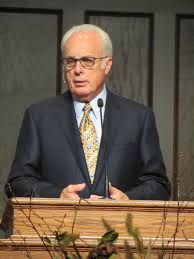
The Lord sends us honorable and trustworthy overseers, no matter the generation in which we live. He sent the early church fathers, the generation after the Apostles, many of them martyrs: Polycarp, Ignatius, Clement…and He has sent us men from then until now. I’d like to focus on the now and one of these trustworthy and honorable men: Dr. John F. MacArthur
Dr John Fullerton MacArthur was born on June 19, 1939, last week he turned 76 years old. He has been serving as a pastor continuously since 1964. He is pastor of Grace Community Church in Sun Valley California, part of LA and has been the senior pastor-teacher there for 46 years.
He has preached over 3000 sermons. He has written over 150 books. He has authored innumerable essays. He is currently President of The Master’s College and The Master’s Seminary, the seminary he founded specifically to raise up men in the faith and strengthen them in solid doctrine. He has participated in countless conferences, one of which he founded, The Shepherds’ Conference, a gathering designed to minister to men.
I could list all his accomplishments and activities but this isn’t a reproduction of his resume. Instead, this bare listing of achievements and activities is presented to illustrate a commitment, diligence, and a Godly effort all in the sphere of tasks in which God has put forth in certain, specific men of the faith.
I consider him part of the theological genealogy of extraordinary men the Lord has raised up, and many others do as well. This is a line that includes Hus, Edwards, Spurgeon. Moreover, Jesus not only planted him in a place where ministry flourished, but He then allowed MacArthur to stay and stay and stay. In these years of church-hopping, ambitious pastors whose length of term usually only lasts 3-5 years, staying at one church and preaching 30, 40, 50 years is unheard of. During a sermon some years ago, MacArthur joked that the Lord led him to Grace Community Church in 1969 and “sort of just left me here.” As a result, we are blessed with sermons explaining each and every verse of the New Testament. To my knowledge MacArthur is the only preacher to have taught expositorily through the whole New Testament, and from one church no less. Even more of a blessing, each and every one of those sermons are recorded and transcribed. And best of all, they are all available for free online for the edification of the body.
Here is a first-hand account of the unprecedented achievement of having preached through the entire New Testament verse-by-verse from a congregant who was there as MacArthur closed in on the last verse.
Sunday, June 05, 2011
John MacArthur – Unprecedented Preaching Achievement
By any standard Grace Community is a big and successful Church, and with good reason, for sound fundamental Christianity is taught there verse by verse every week. The teaching of John MacArthur feeds the need for honest down to earth understandable exposition of God’s Word. You can doubt all you want, but once you have heard it you will know the truth of it.
Today was a milestone in the history of this amazing worship center. In a sanctuary packed as usual, John MacArthur brought to a close what can only be described as a nearly unprecedented achievement in his or any other preacher’s long career as shepherd of his flock. Today as he brought to a conclusion his study of the Gospel of Mark, he completed a forty three year sojourn through the entire New Testament. All these sermons were from the same pulpit.
John MacArthur is firm and forthright, never wavering in his criticism of sins of our time. He fully recognizes that Christianity is under attack and teaches us the basic truths to which we must attend if we are to achieve the gift of eternal life with our Lord.
His sermons are packed with substantial insights into the real meaning of every verse. Never have I enjoyed the Word of God so clearly explained.
Together with his unfaltering teaching style there is a humor that is playful and understanding of our human foibles. Showing his humanity and ongoing love for his wife, John presented Patricia with a beautiful rose to thank her for all her support during this academic and preaching epic.
I asked John how he managed to collect and collate all the information he has used to produce the over three thousand five hundred sermons, which are all recorded and available on line through Grace To You, and how big his staff was. His answer, “Neil, I mine all my own data.”
Dr. MacArthur, President of the Master’s College, and pastor of Grace Community Church is nothing short of phenomenal.
His Spirit-led ministry has delivered spiritual blessings to me and many others, as the above testimony attests. The emails and comments my sisters send me that bring me to tears the most are the ones where someone says they found MacArthur through my site or another’s, and were led out of a Charismatic church…or their faith was strengthened, or they now understand the Doctrines of Grace, or they have been blessed spiritually in some other way from material MacArthur has preached or written. He has touched countless lives for the betterment of the faith, more than any other one person in this generation, I maintain.
He is not only learned, but he lives the life that is expected of pastors. He’s wise, kind, and humble. There has never been a hint of a scandal nor a waver of one inch, not even an hour, from solid doctrine. Those qualities are in such short supply it is refreshing to be given opportunity to revel in preaching that is from God’s heart and not man’s pride or the devil’s error.
In example of his wisdom and caring for his flock and the flock in general, on May 24 he preached a sermon called “Hope for a doomed nation.” He usually goes on vacation in June for three or four weeks. He prepared this sermon for his flock just prior to his departure, saying,
So as we look at our nation – and I don’t know what’s going to happen in the next few weeks when I’m not here. I’m just kind of preempting that a little bit by helping you to be able to think through whatever happens.
Since that date we as a nation have experienced the Charleston SC church shootings, the embarrassing mega-pastor Tullian Tchividjian adultery and resignation from one of the most famous churches in America, and the Supreme Court’s nationalization of homosexual perversity and with it, opening the door to actual Christian persecution in the US.
Even then, on vacation but never vacating his duty as an under-shepherd, MacArthur issued a sensitive and wise statement on the Charleston church shooting, prescient blog essays just days before the Tchividjian resignation naming Tchividjian as a hyper-grace addict and warning us of it, and sent an open letter to all Master’s Seminary alumni comforting and advising them in the aftermath of the SCOTUS decision. He is a calming influence.
In addition, there is solace in trusting a man who has continued to live a holy life and is a leading example of godliness right before our eyes. We mourn but are also saddened and angry when authors, theologians, professors and pastors we had trusted fall, one after another.
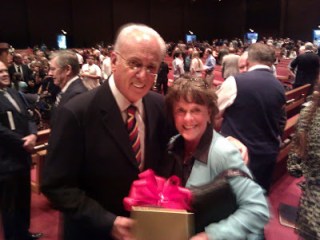 |
MacArthur with his wife Patricia on the day he completed
preaching the New Testament verse by verse. 43 years! Source |
MacArthur preached at the 2001 Ligonier Conference titled Holiness. The sermon MacArthur delivered is “A Call to Holiness“. It is one of those sermons where the listener feels even after years have passed since it was spoken, the strength of the Spirit’s presence within the words uttered is tangibly felt. There is no transcript but I transcribed the part which speaks to a pastor persevering in a long, well-lived, holy life. He said:
“People come to me so often, if I can be personal for a moment, and say, “I’m praying for you”. A lady stopped me out in the hall and said ‘I’m praying for you. We’re praying that you don’t fall into some sin… as so many have and disappointed us so greatly. People will ask me, how do you live your life to prevent that? To whom are you accountable? Do you have an accountability group? Let me tell you something. I have a group of elders that surround me. Among those elders are some very precious friends. They spend a lot of time with me day in and day out. They’re exposed to everything there is to see and know about me. I’m a fairly transparent person. They are there and I want them to tell me whenever I’ve overstepped a line that would bring dishonor to the Lord.
Even tighter than that, I have four children that love Christ and walk with Christ. The three older ones are married. The three older ones and their spouses have these immense and probably unrealistic expectations of me. My son who lives in Chicago called me a few months ago. “Dad I’ve just been thinking about you and praying about you and I called to tell you, ‘don’t mess up.’ ” [audience laughter]. This is my son, this is what I told him. “Dad do you know what it would do to me and the other kids if you ever messed up your life and did something immoral?” I told him, Mark, thank you for your prayers and your concern. It means everything to me.”
And then, I have 11 little grandchildren. They expect their Papa to live the way God expects us to live. I look into their little faces and I read them bible stories and I pray with them so often as Patricia and I gather with them around our kitchen table. And I look into their shining faces and I cannot find it in me to do anything to destroy their trust in Christ. It would kill me.
But the most intimate point of accountability humanly speaking is my beloved treasure Patricia. She is right here in the second row. Most of you don’t know her, you should. [gesturing for her to stand]. Honey let them see how God blessed me. Now, this lady expects me to live what I preach all the time. I want to be Christ to her. I don’t want her to be disappointed in her pastor. I don’t want her heart turned away from Christ. I don’t want the standard lowered. That’s the accountability. Her expectations and my love for her is the accountability.
But you know in the end, as precious as all those people are, as intimately as they are connected to my life, even they don’t know what I think. And if you are going to be holy, my friends, you have to win the battle on the inside.
He continued the sermon from the text explaining just how to do that. And for the last 58 years since he committed his life to Christ, MacArthur has remained above reproach, with no scandal. You notice in the text his focus was first on not bringing reproach onto the Lord, and also being an example to his children, grandchildren, and to properly lead his wife. His life as a witness is powerful and his credibility as a preacher of the holy word is thus credible in the highest order.
This last one is a double blessing because over time, one can listen to sermons from MacArthur from every decade since he arrived at GCC in February 1969 and bask in the pure, unadulterated Word of God. I’ve done so, having listened to sermons from every era in which he has preached, and have not found any major threads of apostasy, error, or swerving from the narrow path the Lord has laid out to us in His word. Oftentimes pastors have a blind spot or some kind of error in one area. Sometimes they start out well, like Andy Stanley, and then just kind of collapse in front of our eyes, descending into liberalism and then error. Not so John MacArthur. The Lord has kept him.
My friend R. Craig Fulford wrote in an email (and gave permission for this to be excerpted and published):
Dr. MacArthur’s Grace to You Website has always been amazingly good but over the last year they have made huge efforts to increase the user friendly aspect.
When you have made the many contributions he has, it becomes quite difficult to archive those efforts. However, his staff has really improved on how to search his efforts in any number of different ways. Frank Barker told me once that Dr. MacArthur was the most prolific contributor to the Reformed Doctrine he had ever seen. But with that comes the difficult task of making sure all of those wonderful efforts do not get lost in the shuffle.
Over the last several months, I have spent a great deal of time just examining his web site and discovering the many different ways to locate what I’m interested in whether it be by exposition, topic, scriptural reference or any other of the myriad of ways we might want to examine Scripture. You would think with the amount of his available documentation, created over almost a half a century of time, you would see a number of contradictions within his teachings but that is just not the case. There is, however, a notable growth in the level of his discernment and Christian maturity, as you might expect.
There is also a conspicuous lack of “fund raising” activities and over a period of time there are few resources left with any cost, except for his most current publications. That is particularly impressive when you stop and consider the millions and millions of dollars that could have been generated by his efforts. As a matter of fact, when “The Gospel of Jesus” was first published, the only book that out sold it under the category of Christianity was the Bible itself.
And now Dr. MacArthur has completed decades of work on his 33 volume commentary of the New Testament. It is available in print and in a Kindle format. I have both and don’t know why every Christian on planet earth doesn’t if they don’t. Especially at its hugely discounted price.
Do you get the idea that MacArthur is a gift to us, a blessing of manifold and untold reverberations throughout Christendom? I do not exaggerate. In listening to many of his sermons, occasionally he offers a small glimpse of his behind-the-scenes work. He doesn’t say much about himself or his interactions with others, lay-people or fellow pastors. Only once in a while. His call to Mark Driscoll after the Scotland debacle where Driscoll shocked the people with his profane and lascivious “sermon” on the Song of Solomon…an encounter with Robert Schuller, counseling a prostitute, dealing with an unwarranted lawsuit, holding the hand of a homosexual man in the hospital dying of AIDS, flying hours upon hours to remote nations to teach new pastors in closed countries eager for the word, smuggling bibles into China… his tireless work seen and unseen for the cause of Christ is an example to us.
In 2010, a brand-new volume by Hughes Oliphant Old was published. It is titled, The Reading and Preaching of the Scriptures in the Worship of the Christian Church, Volume 7: Our Own Time, (Grand Rapids: Eerdmans, 2010), The guys at TeamPyro (at that time led by Phil Johnson, Executive Director of John MacArthur’s Grace To You website and one of the preachers at MacArthur’s Grace Community Church, published an excerpt from Olds’ book. Between pages 551 and 558, one of the pastors the book highlights is the preaching of Dr. John MacArthur.
Now, the Hughes Olds is kind of a strange duck. He openly admits to disbelieving in satan, demons and demon possession. He admits to having doubts about the authority of scripture. Yet he marvels at the authority that MacArthur preaches, noting “part of the foundation of his effectiveness as an interpreter” is that his “basic assumption [is] that the text of Scripture is reliable.” His review should be taken as someone who is perhaps an unbeliever or a weak believer astonished at the preaching of a man with a settled belief in the integrity, authority, and reliability of scripture. From that perspective, Olds’ review is remarkable. Here is an excerpt.
In the review, Olds wrote in his conclusion,
Why do so many people listen to MacArthur, this product of all the wrong schools? How can he pack out a church on Sunday morning in an age in which church attendance has seriously lagged? Here is a preacher who has nothing in the way of a winning personality, good looks, or charm. Here is a preacher who offers us nothing in the way of sophisticated homiletical packaging. No one would suggest that he is a master of the art of oratory. What he seems to have is a witness to true authority. He recognizes in Scripture the Word of God, and when he preaches, it is Scripture that one hears. It is not that the words of John MacArthur are so interesting as it is that the Word of God is of surpassing interest. That is why one listens.
Now, I am not a sycophant. I’m not an uncritical flunky mindlessly parroting plaudits. I still do test what he says against scripture. I do listen to other pastors, my own, of course, and Phil Johnson, S. Lewis Johnson, Adrian Rogers, Lloyd-Jones, Don Green, Paul Washer… I do read other commentaries besides his, including Gill’s Exposition and Matthew Henry. I do enjoy other authors on the topics of scripture besides MacArthur, including Bridges, Spurgeon, Flavel, and Edwards. I think it would be a problem to follow one man alone and proclaim him to the world, that would be idolatry.
But I do adore John MacArthur for all the right reasons. I commend him and his vast ministry to you. I proclaim him in the strongest possible terms as trustworthy and edifying. When Charles Haddon Spurgeon died in January 1892, a Memorial Edition of his Life and Works was published that same year. I am serious when I say MacArthur is in a genealogical line of specially empowered raised up men who edify the brethren and advance the faith. Here is one of the tributes to Spurgeon written in the biography:
You ask a brief estimate of Mr Spurgeon’s life and work. Volumes would not do them justice. The world is his debtor. Charles Haddon Spurgeon was called a Baptist, but was one of those men too great to be claimed by any denomination. Millions of believers of every name were edified by his words, and quickened by the example of his wonderful life.
Among his many admirable traits, and at the root of them, lay his clear apprehension of divine truth, his firm grasp of it, inflexible loyalty to it, and incessant proclamation of it. He was a man of a whole Bible. From Genesis to Revelation it was to him “the true Word of the true God.”
If he was conspicuous for anything, he was conspicuous for his unswerving allegiance to ‘the Word.’ His theology was as broad and as narrow as the Bible. With him, “thus saith the Lord” settled everything.
With a warm heart and a very clear head, a very busy hand and a supreme devotion to the Master he served, men may call him narrow if they please. God has set the seal of divine approval, passing contradiction, on the work of the London Tabernacle pastor, and called him to his reward. What a reward!”
In 2006 I was a new Christian, having moved from my home environment in New England all the way to Georgia, where I knew no one. I was alone. I began attending church for the first time in my 43 years of life, and I had not a clue as to how to study the bible, much less read it. I mentioned before that prior to moving to Georgia I had not gone to church but had relied on radio and TV for preaching. I listened to Joel Osteen, the biggest and most popular tv preacher in the US, which I thought was the proper barometer for assessing the ministry of preachers. I also listened to Endtime Ministries’ radio prophecy personality Irvin Baxter. After a short while, Baxter’s fervent fixation on the post-tribulation rapture began to bother me. The Spirit graciously led me away from that man’s erroneous and personally unique interpretations of eschatology. However I began to realize that it was a wild and woolly, sometimes scary, world of preaching out there and I felt adrift and exposed. I had not known that there were different interpretations of scripture and that many men preaching it were just plain wrong. This was a new idea to me. I sought the Holy Spirit’s wisdom to know whom to listen to and whom to trust.
That was when He led me to John MacArthur. It was, as so many sisters have commented and emailed me, literally a God-send. I tested what was being preached against scripture and happily found it to be true. The reliability of his preaching, his humble and clean life, and frankly, the free or nearly free resources at his website were a boon to my impoverished but seeking heart and my poor battered checkbook. From there, I grew. I found Phil Johnson, his editor and executive director of Grace To You, and I found S. Lewis Johnson, a pastor of a former generation MacArthur recommended. And so on, the circles widened.
The tribute I posted above which is dedicated to Spurgeon contains similar if not exact words that can be applied to the life and ministry of Dr John F. MacArthur. Too much? Hardly. The benefit we as Christians have received from this tireless man’s Godly dedication and efforts in Christ’s name are uncountable, and manifold. I can’t wait for the day they will be revealed in the throne room of heaven. He is the Pastor for our generation.
I believe that recognizing this and affirming this glorifies Christ because it acknowledges His Spirit’s work in the Body. I began this essay by saying “The Lord sends us honorable and trustworthy overseers” and I end it with praise and thanks by saying the same thing. He used MacArthur to snatch me from the jaws of a wolf like Osteen and confusing men like Baxter and only the Lord knows who else if I had stayed on that muddled path. Who knows what other wolf would have dragged me off in false doctrine and poor Godly examples. Raising up good men is the Lord’s doing because He has care and concern for the people of His church. Peter wrote of overseers,
So I exhort the elders among you, as a fellow elder and a witness of the sufferings of Christ, as well as a partaker in the glory that is going to be revealed: shepherd the flock of God that is among you, exercising oversight, not under compulsion, but willingly, as God would have you; not for shameful gain, but eagerly; not domineering over those in your charge, but being examples to the flock. And when the chief Shepherd appears, you will receive the unfading crown of glory. (1 Peter 5:1-4)
——————————
Further Reading
Website, many resources: Grace To You
Church: Grace Community Church
John MacArthur’s Biography (and book list)