Now Israel went out to battle against the Philistines. They encamped at Ebenezer, and the Philistines encamped at Aphek. 2The Philistines drew up in line against Israel, and when the battle spread, Israel was defeated before the Philistines, who killed about four thousand men on the field of battle. 3And when the people came to the camp, the elders of Israel said, “Why has the LORD defeated us today before the Philistines? Let us bring the ark of the covenant of the LORD here from Shiloh, that it may come among us and save us from the power of our enemies.” 4So the people sent to Shiloh and brought from there the ark of the covenant of the LORD of hosts, who is enthroned on the cherubim. And the two sons of Eli, Hophni and Phinehas, were there with the ark of the covenant of God.
5As soon as the ark of the covenant of the LORD came into the camp, all Israel gave a mighty shout, so that the earth resounded. 6And when the Philistines heard the noise of the shouting, they said, “What does this great shouting in the camp of the Hebrews mean?” And when they learned that the ark of the LORD had come to the camp, 7the Philistines were afraid, for they said, “A god has come into the camp.” And they said, “Woe to us! For nothing like this has happened before. 8Woe to us! Who can deliver us from the power of these mighty gods? These are the gods who struck the Egyptians with every sort of plague in the wilderness. 9Take courage, and be men, O Philistines, lest you become slaves to the Hebrews as they have been to you; be men and fight.”
10So the Philistines fought, and Israel was defeated, and they fled, every man to his home. And there was a very great slaughter, for thirty thousand foot soldiers of Israel fell. 11And the ark of God was captured, and the two sons of Eli, Hophni and Phinehas, died.
~~~~~~~~~~~~~~~~~~~~~~
So many of the things…
Hindsight is golden, isn’t it?
In verse 3a, we see that the Israelites are aware that it is the LORD who gives them the victory in any particular battle. So they are aware of the LORD and His power and His presence. That’s good.
But then they show their misguidedness in verse 3B. The defeat of their army was a sure sign that the LORD was displeased. They acknowledged the LORD’S power, but then went on a misconceived plan of action. They did not consult the LORD. They embarked on a course absent His will.
1 Samuel is a record of an actual event, with real people in a real place, in a past actual time. Picture the hills and the camp all around. Picture the Israelites in their gear going to and fro in hastened activity. Picture their confidence and their purposefulness as they decide to bring the ark. Picture the men being selected to go up to Shiloh, and then came back down in a great burst of energy, carrying the ark. The ark arrived in camp and all the preparations had been made ready. As it was settled to its place, there was a great shout from the Israelites.
Their feeling was, ‘NOW we have the ark! NOW we will be victorious! We are doing the right thing!’
Wrong.
They thought they were worshiping. They thought they were obeying. They thought they were going to have what they wanted, which in this case, was victory over an army that they hated. Yet was it only a wayward scheme full of self-reliance and self-assurance.
How often is it that we see some kind of massive Christian event going on, just like this one depicted in 1 Samuel? IHOP OneThing. An Angus Buchan Mighty Men event. The Send. Benny Hinn Holy Spirit Miracle Healing Service.
We see the hustle and bustle of the people there. They think they are worshiping. They think they are obeying. They think they will soon be in favor with the Lord. They think they will be able to obtain what they want.
The Israelites in 1 Samuel had made two fatal errors. These are the same errors that we see today in the large-scale events of the wrong-headed.
1. They failed to consult God before embarking on their plan to go to war. They acknowledged God, but then did not consult Him. Classic example of Proverbs 14:12,
There is a way that seems right to a man, but its end is the way to death.
And
In those days there was no king in Israel. Everyone did what was right in his own eyes. (Judges 21:25).
2. They substituted the power of God from God for a talisman, good luck charm in the form of the ark. The ark itself had no power. God had made a conditional covenant with the people of Israel through Moses. It was an if-then promise. If you do this, then that will happen. If you do not do this, then that will happen. As a sign of this promise, He told the Israelites to make a box according to His design and in it was placed the ten commandments. The ark was a sign. When you’re traveling on the highway and you see “Welcome to Maine” it’s announcing something, but the sign is not the state of Maine. That’s something else entirely. There is a vast difference between the sign of God and Gd Himself.
Today we see a focus on seeking signs. When they allegedly manifest, the sign is worshiped. Today’s people (many of them) have substituted the sign for the reality.
As French writer Jean-Baptiste Alphonse Karr said, “The more things change, the more they stay the same.”
Have you had a good week in Jesus? I have. I wrote a praise poem recently, thanking Him for His manifestation in my life of His patience, (through loving kindness from fellow church members), His sovereignty as Creator (the full moon so beautiful over the silvery lit pastures), and His providential care (even the smallest needs do not escape His notice.) His involvement in our lives is thorough and constant. The more I walk with Him the more I see this, and I praise Him. But the more I praise Him the more I see His faithfulness and His constancy. It is a glorious circle, one that will never be broken.
It is good to begin with praises, because, as we know, the news in the world is not so good, but we are not of the world. If you walk closely with Jesus the news of the world will affect you only in that it helps you see and understand God is sovereign and everything He does is good. Actually, it is awe-inspiring because the closer I walk with Him and the more news I read that lines up with what He said would happen, it makes me feel more humble and grateful that a God such as He wants to interact on a personal basis with His people.
No matter how serious the news is, His constancy, His sovereignty, His plan, and His ways are Good. Even if you feel you do not have much to praise Him for, you DO! Seek ways to thank Him. He is active in our lives to the n-th degree. Nothing escapes His hand, from the most high work of salvation of souls, to the smallest sparrow’s needs. How much more, then, are YOU valuable to Him? (Matthew 6:25-26).
I will bless the Lord at all times;
his praise shall continually be in my mouth.
2 My soul makes its boast in the Lord;
let the humble hear and be glad.
3 Oh, magnify the Lord with me,
and let us exalt his name together!
Psalm 34:1-3
It’s the question of the week. Our school’s Spring Break is coming up beginning Friday and extending into the first week of April. The week off is very much cherished and also needed. If you’ve ever watched Principal Gerry Brooks‘ hilarious videos about life as an educator, he nails it humorously every time. Teaching is tiring.
A lot of my friends are headed to the beach for a half-week or week of fun in the sun. Ohters are going to various cities, on cruises, or to sports events or festivals, and the like. I’m staying home.
For many years before I was saved, I traveled. I went places in Europe, South America, North America, and the Bahamas. We traveled at the drop of a hat and I was extremely blessed to have done all the things I did. So for the last 11 years or so, I’ve been content to remain home living a quiet life and doing smaller things near home on Spring Break.
This year I felt a restlessness in me and I wanted to GO. Then started up an envy of others’ plans, and a discontent with my inability to go anywhere. There is a cute studio Air BnB an hour and a half away on a lake I’ve been wanting to spend a couple of days in. There is a cosmpolitan and trendy boutique hotel right in Athens I’d like to stay, and I’d do a historical tour through Athens, or spend afternoon at the Botanical Garden. Even that is out of financial reach. I started to get upset.
Discontent is a new thing for me. I’m generally content with what I have and pleased with the opportunity to stay alone and quiet. School is wonderful but on occasional days it is a trial for someone sensitive to noise and clamor. I am blessed to come home to peace and quiet to recharge.
I needed to deal with my discontent before it settled into me like a sticky dark cloud clinging to nooks and crannies of my mind and heart, ready to grow tentacles and grab other sins. Because, discontent with what the Lord has given me is a sin, wanting more or something different is a sin, and sin always only grows unless it is dealt with.
I love my apartment. I love my work. I love my church. I love my life. I have everything I need. I even have a bunch of things I’d wanted above the basic need. The Lord graciously provides lavishly. There is really no reason to be upset. After 11 years of watching other people go away to beautiful places and feeling only happiness at their opprtunity to experience something wonderful, thinking ‘I got this, suddenly sin zoomed in from left field when I wasn’t expecting it. Whoa. Sin really IS crouching at the door. I repented and asked the Lord to puncture this sin like the flimsy balloon that it is.
He did.
My calm and patient and peaceful-in-the-soul plans for Spring Break now include reading these fine books, some of them having been given to me, free! Blessing! I am still plugging along on the Challies Annual Christian Reading Challenge. (I chose Avid Level, 26 books/year 2019). I’ve experienced a slow-down in March but I hope to use the time during April Break to catch up.
On Friday after school in order to inaugurate my week off, I’ll go to The Special Store in hunt of a particular teacup I know they have. Hopefully it’s been unpacked from their storage building and put on the browsing shelves. On the following Saturday, April 6, there is a major ‘Junkin & Pickin’ day at a fairgrounds 2 miles from my home. The organizers have over 85 vendors already. I’ll look forward to ambling about in the spring sunshine looking over the handicrafts and antiques.
On one of the other days when it’s sunny, I’ll likely go into Athens on a photo expedition. I like photos of gritty urban landscapes and architecture. I have chosen a particular area to haunt and stroll, perhaps sipping a fancy coffee and taking photos as I go. Maybe meet up with friends for lunch. Those things, plus reading outside in the sun at my patio table, decorating it and rearranging the springtime decor I’ll put out, at home will be plenty fun for me.
Will this be as pretty in real life when I shop for it? Time will tell.
And to be honest, when it comes down to it, the idea of going far afield to some exotic beach or lake location appeals to me more than the actual going. Discontent really isn’t rational.
The Lord is kind to accept our repentance of sins. The Spirit is kind to enlarge our thankfulness in an ever growing sanctification.
Happy Spring, and if you’re an educator, Happy Spring Break!
It’s spring, full-on, here in the South. I was reading a passage with one of my students this week called From Chrysalis to Butterfly. It’s that time of year we start seeing the flowers bloom and then come the butterflies. I started thinking about butterflies. I like butterflies. See?
Throughout history butterflies have fascinated artists and philosophers, scientists and school children with their profound mystery and beauty. In METAMORPHOSIS you will explore their remarkable world as few have before.
Spectacular photography, computer animation and magnetic resonance imaging open once hidden doors to every stage of a butterfly’s life-cycle. From an egg the size of a pinhead…to a magnificent flying insect. It is a transformation so incredible biologists have called it “butterfly magic.”
The superbly engineered body of a butterfly is magnified hundreds of times to reveal compound eyes made of thousands of individual lenses, wings covered with microscopic solar panels that warm the insect’s muscles for flight, and navigational systems that unerringly guide Monarch butterflies on their annual migration from Canada to Mexico.
How did these extraordinary creatures come into being? Are they the products of a blind, undirected process? Or, were they designed by an intelligence that transcends the material world?
Filmed in the rain forests of Ecuador, Mexico’s Trans-Volcanic mountain range, and leading research centers, METAMORPHOSIS is an unforgettable documentary filled with the joys of discovery and wonder.
—end documentary description—-
Here is the trailer for it
It is told from a Christian perspective. The movie is great family viewing, for adults just wanting some encouragement of the beauty of creation, or for homeschooling parents doing a science unit (aimed at adults, some of the documentary will have to be explained to little ones). The photography is super and it leaves you with the unavoidable conclusion that God and only God can have made this amazing creature.
Happy Spring!
For behold, the winter is past; the rain is over and gone. The flowers appear on the earth, the time of singing has come, and the voice of the turtledove is heard in our land. (Song of Solomon 2:11-12)
Does the Bible speak to which doctrines are necessary for belief and faith in Christ? Yes. iIn it we find what one must believe or be condemned, and it states what not to believe.
The primary essential doctrines of the faith one must stick to, According to Christian Apologetics and Research Ministry, (scriptures supporting them are here) are–
1. Jesus is God in flesh, and Jesus is the proper object of faith. The Doctrine of the deity of Christ includes:
–The Trinity
–There is only one God in all existence
–That Jesus is both God and man.
2. Salvation is by Grace alone
3. The resurrected Christ
4. The Gospel
They are called the primary essentials because the Bible declares them to be essential to the faith. Secondary essentials are necessary truths, but there is no self-declared penalty for their denial — yet they are still essential to the Christian faith. Those include:
–Jesus is the only way to heaven
–Mary’s virgin birth
An apostate very slowly starts to doubt the above. He or she begins to read and absorb other things that are contrary to those doctrines. Paul called false teachings gangrene because they slowly pollute the body and mind. (2 Timothy 2:17).
The Bible says that at the time of the end there will be a great falling away from the truth. Look to 2 Thessalonians for the prediction regarding the “falling away.” 2 Thess. 2:3-7 says,
Let no one deceive you by any means; for that Day will not come unless the falling away comes first, and the man of sin is revealed, the son of perdition, who opposes and exalts himself above all that is called God or that is worshiped, so that he sits as God in the temple of God, showing himself that he is God. Do you not remember that when I was still with you I told you these things? And now you know what is restraining, that he may be revealed in his own time. For the mystery of lawlessness is already at work; only he who now restrains will do so until he is taken out of the way.
The lawlessness is sinfulness and the fact that Paul says it is already at work means that there have been apostates throughout the Church Age, even in Paul’s day. Demas fell away and went back to the world. (2 Timothy 4:10). The verse in 2 Timothy 2:17 speaks of Hymenaeus and Philetus who spread false teachings, two men who “wandered away from the truth” and became “more and more ungodly”. (2 Tim 2:16; 18).
Where does the prosperity gospel fall into this continuum? One comment I often receive when writing a discernment article about a prosperity preacher, or any other false teacher, is that they can’t really be falling/fallen away from the truth, “because they declare Jesus as Lord” or some other affirmation of one of the primary essentials of the faith.
Of course they affirm Christ. If they didn’t, they would be immediately identifiable as false. Yet, in discernment, A teacher’s doctrine and life must match up. What they teach in one place must be the same as they teach in another.
For example, 1 Corinthians 16:22 makes our love for Christ a fundamental issue: “If anyone does not love the Lord, let him be accursed.” A false teacher may say they love Jesus, but their life betrays the truth. If they twist scripture consistently and grossly, if they sin unrepentantly, if they continually violate standards for behavior listed elsewhere in the Bible, they do not live Christ. They might have been reproached several times by an elder of colleague, and rejected that rebuke. Any or all of these show that the person does not love Christ.
Anyway, be sure of what you believe and why. Examine yourself to be sure you are in the faith (2 Corinthians 13:5). Drifting away is easy to do. (Therefore we must pay much closer attention to what we have heard, lest we drift away from it. Hebrews 2:1)
Yesterday I wrote a comprehensive article documenting the slide from orthodoxy in Francis Chan. These things grieve me, but they are necessary to look into. Here is yesterday’s piece:
**Phil Johnson and Todd Friel discuss this article and the issues within on Too Wretched for Radio, below. Phil articulates the issues so much better than I did, please take a listen- https://wretched.org/radio/wretched-radio-08-19-2019/
The link below was the original talk, I am not sure if the one above is the same one. The link below has a 404 not found error message. I find that a lot wit Wretched links, they are hard to retrieve after a month or so. https://www.wretched.org/wretched-radio-04-15-2019/
—————–
Apostasy is defined as ‘a defection or revolt’. It is the formal disaffiliation from or abandonment or renunciation of a religion by a person. One who commits apostasy in religion (or who apostatizes) is known as an apostate. In Christianity, it is important to remember that apostates never really were saved. 1 John 2:19 says,
They went out from us, but they did not really belong to us. For if they had belonged to us, they would have remained with us; but their going showed that none of them belonged to us.
Apostasy is a process. No one wakes up one day and says “Gee, I hate Jesus and I’m not going to church anymore.” The first part of apostasy is a (usually slow) drifting away of the key doctrines of the faith. That’s the beginning. With that comes an eventual abandonment of the things of God and an attraction to the world and to the false teachers of the world. Unless a drastic repentance occurs this slide will grow and grow. Demas apostatized, we don’t know if he ever corrected course.
The second part of the process is the final abandonment of Christianity. Apostasy is in fact a process that progressively reveals the truth of one’s inner self, that one was never saved at all. Judas is the example here. He enacted a total repudiation of Jesus and what He stands for. Judas’s apostasy was hidden from even his close intimates, the disciples, until the very end. But it was there all along.
Apostasy begins with sinfulness. Sometimes it’s corrected by repentance, sometimes not. If not, it’s the first slide toward apostasy. An example of how apostasy is born of sinfulness might be that a woman wants to live with a man in sexual sin. Someone from church approaches her about her sin, and she rejects it as sin, perhaps saying that “The Bible never explicitly addresses this,” or “Only Paul wrote about that, not Jesus”. They present an excuse that in some way rejects the authority of the word of God. They might be approached about it again, and reject again, saying, “The Bible never says we have to gather for church, I’m going to worship at home.” Then after a while they don’t worship at all. They hang around with like-minded people who affirm their sin, they sin some more, and eventually they abandon the faith totally.
Francis Chan has been the object of much ink of late. Chan is a former graduate of The Master’s Seminary. He started Cornerstone Church in Simi Valley CA in 1994 with his wife and 30 other people. Eight years later the church had grown to 1600 members. By 2010 the church was a bona fide megachurch, and Chan decided to resign.
His reasons were, among others, due of the failure of the people in the church, Chan said. They ‘weren’t using their gifts’ and they were only ‘sitting around listening to my sermons’ Chan explained. It is ungracious and unhumble to blame your members for your departure. After 16 years no one would really fault a pastor for ‘feeling called’ to move on to another pastorate or position, though leaving the church you started IS a very big deal. However, to blame the resignation on your congregants and not yourself reveals a great deal about a pastor. It wasn’t even true. According to this essayist, the members were using their gifts and vibrantly serving.
If your members are not using their gifts, whose fault is that? Were they false converts allowed in as members to a rapidly growing church focused on growth and not souls? Or were they genuine converts not using their gifts due to unaddressed sin and thus a failure of church discipline? Both of these reasons lay at the pastor’s feet.
His second reason for resigning from Cornerstone Church was that his church ‘cost too much to run.’ He felt that there were too many wasted dollars. Chan continues at length in the above link and in other interviews about the money. In fact, his subsequent project, We Are Church, a house church movement, touts that it’s free and costs nothing. Not even the pastor gets paid. Hmmm. Isn’t that a violation of 1 Corinthians 9:14?
Anyway, that was the beginning, and a clue. He left his church, and not well, either.
Secondly, the We Are Church movement is another clue to Chan’s growing apostasy. Chan was obviously disillusioned with his megachurch, Cornerstone. Did you know that Chan founded Cornerstone in the first place because he had been disappointed and discontent with his previous church? That same old discontent reared its head again. Here is what he said about his discontent with Cornerstone:
But over the years, I couldn’t shake the feeling that something was still missing. It wasn’t a problem with the church members or with the staff that God brought to help me lead. We were successful in staying on target with the goals that had set the DNA for the church. But something was off.
He readily admits that the church was loving, giving, hearing the word of God, and vibrant. Yet “Something was missing.” I recall Sarah Young saying much the same thing when she stated why she wrote the heretical book Jesus Calling. ‘The Bible wasn’t enough’, and she yearned for more.
So Chan resigned from the church he founded, even though he said “God was stirring hearts,” “There was so much life at our services”, and “Lives were being changed.” He said, “There was no church I would rather have been a part of.” Yet…for Chan, something was missing. Remember, apostasy is inner sin, the flesh wants something other than Jesus.
When Chan resigned from Cornerstone in 2010, he took his family traveling in Asia to rethink church. At this point in his publicly recounted history Chan admits that his “theology leaves some room for hearing directly from God.” And on a certain day, Chan says he did. Yes. He heard directly from God. What did God say? “He was telling me to go back to the States and plant churches.”
That is clue #3. First it was disappointment with the churches he had been a part of, despite his own church admittedly doing well. Secondly it was a feeling that he needed to “rethink church”. The normal church model had disappointed Chan. Chan wrote that many people want the early Acts church’s “unstoppable power, miraculous love, and outrageous sacrifice of the first church” and in order to get that, it is more likely found in home churches, not the regular structure of churches ‘in big, expensive buildings’ we have come to know. In other words, he yearned for more.
It can be said that though megachurches are more difficult to manage, Charles Spurgeon’s church was mega, and clicked long just fine. There were regularly 800 or so weekly in his “Boiler Room’ AKA the prayer closet in the basement. John MacArthur’s Grace Community Church is a megachurch that also does well. 900 volunteers last week served in various areas at The Shepherds’ Conference. There are many small groups and fellowships ongoing. Megachurches can work just fine.
But Chan’s disappointment with Cornerstone generalized to the point where in 2013 he decided that home church, not a traditional church, was the way to go. Sadly, these home churches have as part of their model, an unhitching from the traditional sermon exposited by a qualified leader or pastor. Instead, they just all get together and “as a body we can wrestle with Scripture together.” (Source)
He also places man-made numerical limits on how many can join a home church until it needs to split and form another one. Nothing about submitting to the authority of the Spirit who sends however many people He wants. Nothing about 2 Timothy 2:15, only another man made limit on how long the home facilitator (not pastor) can speak (5-10 min, and only if he really feels the need).
Pastors shouldn’t be the ones to speak for the majority of the time in our gatherings. If they do, it subconsciously teaches people that they don’t have as much to offer. Source
Well they don’t have as much to offer, at least as far as biblical insights go. A new Christian needs the word explained to him so he can be trained in righteousness and teaching. (2 Timothy 3:16-17).
This is stepping stone #3 on the dark road of apostasy. We’ve seen Chan’s disappointment with his former churches. His ungracious throwing of his former church fellow members under the bus. His discontent with traditional church model. He mourns that “all the gifts aren’t being used” (Code for being a secret continuationist). He leaves church. He hears personally from God. He rethinks church. He creates a home church model that has no eldership in authority. He unhitches from the Word explained in a sermon. He begins to speak at heretical churches and partners with heretics.
In addition to being busy in 2013 planting home churches with that aformenentioned numerical limit, it was also in 2013 that Chan spoke for the first time at OneThing conference, the heretical International House of Prayer annual gathering. Chan stated that he loved its main speaker and founder, Mike Bickle, affirming him as a brother.
Chan spoke again at OneThing in 2015, 2016 and again in 2017, which included a Catholic Ecumenical track and a speaker who is a Catholic nun in the Society of Our Lady.
In 2018 Chan revealed that he is a continuationist, and likely always has been. “All his life” he’s felt a “disconnect” between voices in his head & inner feelings, and “what I would read”. He said he previously preached through Acts, but he “didn’t like reading Acts.” [the 6:40 mark & onward]. He now believes it was “the worst sermon series in history.” Why? Because though he preached, it “I didn’t believe it” [that the gifts in Acts were only for that generation].
Chan has admitted publicly that he wants to speak in tongues. He has asked God to give him that gift. He believes speaking in tongues is possible today. He pleaded with the IHoP crowd to affirm Chan as a brother to them even though he doesn’t speak in tongues.
He uses charismatic language to describe personal revelations from God. “On the plane here, it was revealed to me…” He said the Lord began instructing him to give away specific amounts of money, $50,000, $1M and so on. During The Send pre-rally in January 2019, Chan said he was given a room for an hour alone to commune with God in scripture and prayer. It was during this meditative moment that Chan divulged exact words God said to him,
“the Lord revealed something to me tonight, just a couple hours ago,” … “He said, ‘Francis, you’re not supposed to be Moses. You’re not supposed to go up on that mountain top and have everyone go, ‘What’d He say?’ See, something happened at the crucifixion: The veil was torn. (The Send pre-rally)
And remember that it was allegedly God who spoke to Chan in telling him to start home church network in back in 2013. Note that a “voice from the sky” also told Jennie Allen to start the IF:Gathering, a parachurch discipleship movement separate from the church.
Let me say this. Cessationists that turn into continationists that turn into charismatics, always apostatize. Always. Why? Because they are separating themselves from the Bible as their sole authority, an act that always leads away from Christ.
Very worrisome is Chan’s stance on the role of the sermon. I’ve read and listened to buckets of material in preparation for this essay. One constant thread is that Chan disbelieves that a person should preach from the word authoritatively, explaining it to hearers. It’s one reason he said he was quitting the church he founded. It is a hard and fast practice of his home network not to preach. Chan is fascinated with Acts and the notion of a group breaking bread in homes and poring over scripture together. This is a good thing of course, but it is not a substitute for regular church. To Chan, it is.
He doesn’t think people should ‘show up just to sit and listen to him’. He mentions it again and again in various sermons (But that has not stopped him to speak incessantly through the year at mega conferences where people show up just to sit and listen to him).
The Send, Orlando, January 2019
In 2019 Chan has been soundly criticized for appearing at The Send event, a pit of percolating heresy and suppurating false teachers. Speakers included Lou Engle, Todd White, Benny Hinn, Bill Johnson, Mike Bickle, Heidi Baker, who are all noted as the worst of the worst.
No excuse. None.
Chan has been coy in his public speech. He carefully crafts responses. I noticed this since the beginning of his downward journey. One response he has made to the current criticism for partnering with the heretics listed above, is to say
“It has not been my practice to ask who will share the platform with me and to research the other speakers.”
Yet at the first IHoP OneThing conference he opened his speech by saying that research was the first thing he did after receiving an invitation to speak there. Quote,
This is the first time I’ve ever been to an IHoP event. It’s kind of crazy to me, because I didn’t know that much, so I kind of went on the internet and started looking things up. And, man, there’s a lot of great things going on here.
As I mentioned, apostasy is a process. Hebrews 2:1 says “We must pay more careful attention, therefore, to what we have heard, so that we do not drift away.” The moment Chan left his church (and I have not been able to discover if he is in submission and fellowship at any other church since then) and formed a home church movement that deliberately did NOT teach the word of God to the people, he was well on his way to apostasy.
Francis Chan sadly is apostatizing before our eyes. He hasn’t just begun. He isn’t in the kiddie pool. He is in the deep end, swimming with sharks, coyly denying that they’re sharks in the first place, and saying the water’s fine.
If you do well, will you not be accepted? And if you do not do well, sin is crouching at the door. Its desire is contrary to you, but you must rule over it. (Genesis 4:7).
Then when lust hath conceived, it bringeth forth sin: and sin, when it is finished, bringeth forth death. (James 1:15)
I value what my wiser brothers have had to say on this subject the past month. I’ve read most of it, and I’ve pondered and thought deeply. I’ve watched Mr Chan for many years, because I know many young people who like him and are confused by his actions and words (because they don’t match up). I write this with no joy. I pray he comes back to the fold, and reconciles his errant views on the role of and structure of the church, the role of pastors, his partnering with and affirmation of heretics, his direct revelations, and his stance on the continuation of charismatic gifts, before it is too late.
It is hard to ignore how many highly visible men in recent years (indeed, months) have behaved in sexually self-destructive ways. Some powerful men have long been sexually voracious; unlike today, though, they were far more discreet and generally used much better judgment in order to cover their tracks.Of course, the heightened technological ability nowadays to expose private behavior is part of the reason for this change. But that is precisely the point: so many of the men caught up in sex-tinged scandals of late have exposed themselves – sometimes literally – through their own willing embrace of text messages, Twitter, and other indiscreet media.What is driving this weirdly disinhibited decision-making? Could the widespread availability and consumption of pornography in recent years actually be rewiring the male brain, affecting men’s judgment about sex and causing them to have more difficulty controlling their impulses? … The hypothesis among the experts was that pornography was progressively desensitizing these men sexually.
She asks a good question, especially in light of the fact that the past 8 years has seen a precipitous plunge into depravity at a speed one would not have guessed. Same-sex-marriage, trans-gender, the advent of ‘non-binary’, even many Christian pastors unveiled as plumbing the depths of all kinds of sexual sin.
Wolf offers a different possible answer to it than I would. I say it is the fallen-ness of our sinful world and the fact that satan inhabits it, provoking our own sin-nature He is actually the god of this world and operates within it through the boundaries that God sets. On the other hand, Wolf could be unknowingly exactly right when she speaks of ‘desensitizing’, because Paul spoke of some people who, “Speaking lies in hypocrisy; having their conscience seared with a hot iron;”
The full verse from 1 Timothy 4:1 is: “The Spirit clearly says that in later times some will abandon the faith and follow deceiving spirits and things taught by demons. Such teachings come through hypocritical liars, whose consciences have been seared as with a hot iron“. The Matthew Henry commentary on this verse explains,
It is done by their hypocrisy, professing honor to Christ, and yet at the same time fighting against all his anointed offices, and corrupting or profaning all his ordinances. This respects also the hypocrisy of those who have their consciences seared with a red-hot iron, who are perfectly lost to the very first principles of virtue and moral honesty.
We get desensitized to sin. The ‘desensitization’ Wolf noticed is the seared conscience of a sin-scarred soul. Once engaging in it, unless we repent and confess immediately, presenting ourselves for a spiritual bath by the Holy Spirit, we remain unclean in that little spot, and we get used to the unclean feeling. We decide that it wasn’t really so bad, and we do it again. And again. Until we’re so strewn with scar tissue from the searing of our consciences, we become inured to the effects of sin and never even feel its pricks any more. And before long we have men exposing themselves publicly in ridiculous ways that they have convinced themselves are fun because they have lost any ability to feel shame.
God told Jeremiah to tell the Israelites:
Are they ashamed of their loathsome conduct? No, they have no shame at all; they do not even know how to blush. So they will fall among the fallen; they will be brought down when they are punished,says the LORD. (Jeremiah 8:12).
God spoke that to Jeremiah for His people at the end of a long list of sins they were committing, which also included deceit, straying from the ways of God, listening to false prophets who say all is well, being greedy, and rejecting God. He punished them. Will He do less with us here in America? Surely not!
Edward Gibbon wrote the book The Decline and Fall of the Roman Empire. He spent twenty years researching it. Through his research Gibbon realized that all great nations, Rome included, have fallen for the same reasons. Those reasons can be boiled down to just five, usually occurring in sequence-
1. The undermining of the dignity and sanctity of the home, which is the basis of human society.
2. Higher and higher taxes; the spending of public money for free bread and circuses for the populace.
3. The mad craze for pleasure; sports becoming every year more exciting, more brutal, more immoral.
4. The building of great armaments when the great enemy was within; the decay of individual responsibility.
5. The decay of religion, fading into a mere form, losing touch with life, losing power to guide the people.
So is there any good news?
Though there is much to be mournful about, there is also much to be joyful about! Each day we are not raptured is a day closer to when it happens. Each day we are on earth is a day we can obey the Lord, celebrate the Lord, proclaim the Lord, and do the work of the Lord. Each day that passes is another day in which the Holy Spirit regenerates us more into His likeness. Each day that passes is a day we can thank Him for the many, many blessings we receive from Him, beginning with salvation. And each day that passes and our country and the world dies a bit more, we know that it is one day closer to when our new home will be ready to receive us. We celebrate worship, His glowing church, and His sovereignty.
Take heart, as Jesus promised Simon,
Blessed are you, Simon Bar-Jonah! For flesh and blood has not revealed this to you, but my Father who is in heaven. 18 And I tell you, you are Peter, and on this rock I will build my church, and the gates of hell shall not prevail against it. (Matthew 16:17).
What rock is Jesus talking of? Peter’s confession! He knew, as we do, that Jesus is the Christ, (the Rock), the Son of the living God. And nothing thwarts the Living God’s plans and decrees.
We can work hard in obedience and repentance and prayer, not to spark a seared conscience in ourselves. We can be strong and bright lights for His name. We can anticipate the day of our homecoming, whether by death or rapture.
And if I go and prepare a place for you, I will come back and take you to be with me that you also may be where I am. (John 13:4).
Keep praying, keep confessing, keep loving, even though it gets hard sometimes. Keep thinking of the lovely things. “”Finally, brothers, whatever is true, whatever is noble, whatever is right, whatever is pure, whatever is lovely, whatever is admirable–if anything is excellent or praiseworthy–think about such things.” (Philippians 4:8)”
And one day when we least expect, we will suddenly be clothed in new flesh, glorified and able to see Him as He is!
I like Ayanna Mathis’s writing. Her name was Ayanna Thomas, but she was married last week, congratulations! So now she is Ayanna Mathis. I’ve re-posted one or two things from her before. Ayanna is young, but wise. She makes sense, is gentle, humble, and a good writer.
She posts on Instagram ayannazariya. She had a blog called The Biblically Sound Woman with lots of good stuff, but stopped updating on it, though her writing is still there to be read and enjoyed. She stopped her podcast a year ago, too, choosing to drive most of her material to Instagram, where she also posts ‘Stories’ (videos). In addition to videos on Bible topics, she creates videos on the topics of healthful living and also makeup.
Ayanna posted this week on the notion of ‘Quiet Time’. Do you struggle to carve out a quiet time to read your Bible, pray, journal, or do a devotional? There are many young mothers in our church. It seems like a baby is being born just about every week! LOL seriously, about 6 or 8 babies have been added to the church family in the last year. Another baby came home from the hospital just last night! But that’s to be expected, our main demographic when we founded the church three years ago was college and just beyond, so this is the season for folks to marry and start families. It’s wondrous to see.
But with that comes time management issues, exhaustion, and bewilderment! So I thought of the young moms, busy moms, or any woman who struggles with finding a quiet time, and I repost this piece for your perusal. I hope it edifies you as it did me. I broke the chain in my Bible reading plan and got a week behind, and felt bad about that. I’m caught up, but even with the pleasure of reading His word in an organized way, as through this plan, there is a mild pressure to ‘perform’ and guilt when I don’t.
And be sure to check out Ayanna’s Instagram. Her photos are gorgeous too. She is one talented lady.
It’s been said that if you miss your quiet time for whatever reason, some how you’re lacking whatever instructions God wants to give you for your day. What can often be well-intentioned admonitions, can turn into a legalistic, “do this or you don’t get that” approach to meeting with God. And the way our busy schedules, course loads at school, children waking up at all odd hours of the night and sleep deprivation being so real are set up, we cannot afford to buy into self-deprecating messages that do us no eternal good.
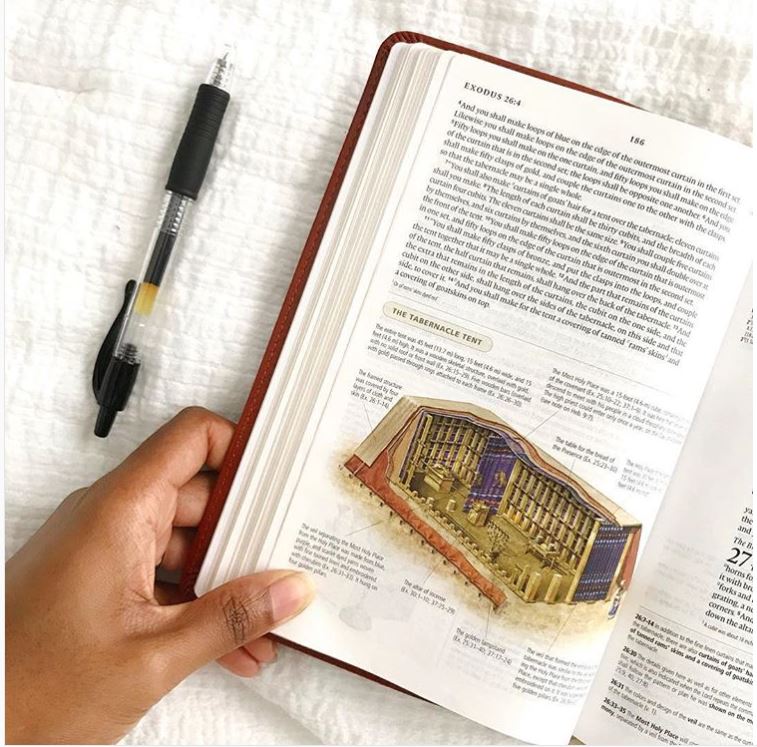
I’m reminded of Exodus 25:1-9 when I think of what God does when He calls us to dwell with Him. He never said that the conditions would be perfect. He never said that He wasn’t sovereign enough to not make a ripe environment for the wayward people He chose to know Him. You know what He did instead? He spoke to Moses, told him to tell the people to take up a contribution for Him and gave specific instructions on how to build a sanctuary for God to what? DWELL IN THEIR MIDST.
God doesn’t approach quiet times the way that we often do, just as He didn’t lay on these thick, unachievable expectations on the people of Israel. He GAVE them the contributions needed from when they plundered Egypt before they got out of there. He GAVE them instructions on what to use, how to use it and how to build. And He GAVE them the knowledge that this wasn’t a little Pinterest project. This was purposed so, “that I may dwell in their midst.” (Ex. 25:8)
Your Bible is not a weapon to be used to beat yourself up with for not getting to it quick enough. It is an invitation from The Lord to see one of the means He has chosen to use to dwell in the midst of His people. Christian Woman, God is invading your space with provision for you to know Him. He’s The One working out pockets in your day to afford you the great opportunity to dwell with Him.
The Bible isn’t ineffective because we miss a few days. God by His Spirit is going to lead you even if you broke the streak in your Bible reading plan. Open up The Scriptures today, not out of a defeated mindset, but out of one that is encouraged. God is bigger than YOU.