Posted in automatic writing, beth moore, channeling, deception, discernment, jesus calling, sarah young

The church is rapidly accepting occult, channeled books as divinely inspired

Here is a definition of automatic writing, or spirit writing from the Free Dictionary,

Writing performed without conscious thought or deliberation, typically by means of spontaneous free association or as a medium for spirits or psychic forces.

Automatic writing is the process, or product, of writing material that does not come from the conscious thoughts of the writer. It differs from inspired scripture in that in inspired scripture,

The process of inspiration was not a mechanical dictation where the apostles heard a voice and wrote down what they heard. Nor does it mean that they went into some sort of a trance and God wrote through them without their knowledge. Instead, the writers were free to write what they wanted as they were moved by the Holy Spirit. In fact, the writings reflect the personality and style of the various writers. Yet, the personality and style of the writers did not degrade the quality or authority of the biblical writing.(source)

Automatic writing is Ouija Board with a pen. Some of the more remarkable things about automatic writing is that the people through which these written products emerge describe a very similar experience. No matter which millennia or decade they participate in their writings, they describe similar sensations, similar feelings, and the same process. Where I quote their descriptions of their own process, I put in bold type the similar phrases they use to describe it.

You would be surprised at how many people have produced written works of novel, poetry, plays and even music by this occult process. It is an old, old practice. I suppose because fascination with the “other side” by pagans is also a constant throughout time. It is a fascination for the Christian, too, but we are fortunate to have THE authoritative and perfect, inerrant, infallible bible. It is God’s revelation of Himself to us, and it in its entirety is profitable for reproof, correction, training in righteousness. (2 Timothy 3:16).

For those without a relationship with God and an inability to understand the bible, they still long for eternity. So they seek it anyway, but unknowingly through satan.

Hildegarde receiving a writing,
tentacles from the other side, reaching into her brain

Hildegarde of Bingen was a Catholic mystic. (1098 – 1179). Her visions became important content for the Catholic Church and eventually were accepted as theological works. In one vision she wrote of her process, “And it came to pass … when I was 42 years and 7 months old, that the heavens were opened and a blinding light of exceptional brilliance flowed through my entire brain. And so it kindled my whole heart and breast like a flame, not burning but warming… and suddenly I understood of the meaning of expositions of the books…”

You hear the automatic writers use the word “suddenly” quite often.

William Butler Yeats is an infamous occultist, participating in automatic writing for a decade, having been introduced to it by his wife Georgie. His famous poem Second Coming (Slouching Toward Bethlehem) was written in 1919. During the first years of his marriage, he and his wife Georgie experimented with automatic writing, and he and George contacted and were contacted by many spirits and guides they called “Instructors”. The pair also experienced flashing lights, cracking sounds and breaths of warm air as signals of the entity’s presence.

Automatic writer Rudyard Kipling said circa 1915, “My Daemon was with me in the Jungle Books, Kim, and both Puck books and good care I took to walk delicately, lest he should withdraw. I know that he did not because when those books were finished they said so themselves… When your Daemon is in charge, do not try to think consciously. Drift, wait and obey.”

The main difference between holy inspiration of the bible writers, and occult practice of automatic writing, is that in the former, hard thinking was required. Study, thought, and knowledge was demanded of the men and is still demanded of all Christians today. In Galatians 6:11, Paul wrote,

See with what large letters I am writing to you with my own hand.

Pulpit Commentary says,

Through some cause or other, we know not what the cause was, writing with his own hand was not a welcome employment to him; so far unwelcome that he generally devolved the actual penning of his letters upon an amanuensis, merely authenticating each letter as his own by a postscript added in his own hand (see 2 Thessalonians 3. fin.). Perhaps Philemon forms the only’ exception (see ver. 19), apart from this letter to the Galatians. We may, therefore, imagine the apostle as painfully and laboriously penning one portion after another of the Epistle; often pausing weariedly in the work as he came to the end of each γράμμα, that is, to the end of each section of his argument, each seeming to him a long and toilsome effort. And now at last he exclaims,” Look, what long, laborious performances of handwriting I have achieved in writing to you! And from that learn how deeply I am concerned on your behalf, and how grave your present spiritual peril appears to me to be!” Ordinarily it was only a brief “piece of writing” that he wrote with his own hand; here, long pieces, added one after another with painful effort.

The bible writers prayed, and then used their minds to produce what the Spirit wanted them to produce. Today, preachers, writers, commenters, seminary students, bloggers, and theologians do the same. (Though their words are not inspired). Their minds are completely engaged, because the Spirit transforms the mind. How many times we are urged to think, study, wrestle, renew your mind, do not be double minded but single-minded, etc. See the verses here that speak to the thoughts and mind of a Christian:

93 verses about Thoughts And The Mind

Contemplative prayer is to automatic writing as marijuana is to crack. It is the beginning of a practice that, seemingly benign or innocent, will drag you down to the depths of Sheol and ultimately to death. In contemplative prayer and automatic writing, the directive is the opposite. Rather than engage the mind with the text of the bible, we are told to “Drift, Wait, and Obey.” Clear your mind. Be still. Be quiet. GotQuestions describes the process,

Contemplative prayer begins with “centering prayer,” a meditative practice where the practitioner focuses on a word and repeats that word over and over for the duration of the exercise. The purpose is to clear one’s mind of outside concerns so that God’s voice may be more easily heard. After the centering prayer, the practitioner is to sit still, listen for direct guidance from God, and feel His presence.

In Occult writing, and in Contemplative-meditative prayer (which I mentioned is a precursor for deepening occult activities), the point is to DISengage from the process, free the mind, and let someone or something else take over.

Leaving Catholic Hildegard of Bingen in the 1100s behind, we now shoot up to the 1820s. Joseph Smith received the Book of Mormon from an alleged holy angel named Moroni. In his 2002 book, “Automaticity and the Dictation of the Book of Mormon“, Scot C. Dunn wrote,

“In this essay, automatic writing refers to the ability to write or dictate text in a relatively rapid, seemingly effortless and fluent manner with no sense of control over the content. A consideration of this phenomenon is important for Mormons since a number of authors have asserted that this was the method through which Joseph Smith produced the Book of Mormon. Such a claim, if correct, can have important implications for the way Latter-day Saints approach their scriptures.” … It is clear that Smith’s translation experience fits comfortably within the larger world of scrying, channeling, and automatic writing.”

“Scriptures”. You see that yet again, as Hildegarde’s writing was taken as theological treatises, Smith’s are also taken for theological treatises, going so far as to call them ‘scriptures’. Just because the heathen senses an other-worldly presence, it does not mean it is a holy presence. The holy presence for the Christian is the Spirit dwelling inside us, a presence we usually cannot feel but know by faith is there. For unsaved people any presence they feel will be an evil, demonic presence.

There is a whole slew of writers throughout the 1900s who channeled their books. You would be surprised at how many. The famous writer, Richard Bach who wrote Jonathan Livingston Seagull got his book from channeling an entity through the practice of automatic writing. Bach was influenced by by occultist Jane Roberts,

In late 1963, Roberts and Butts, living in the Elmira, New York area, experimented with a Ouija board as part of Roberts’ research for a book on extra-sensory perception. According to Roberts and Butts, on December 2, 1963 they began to receive coherent messages from a male personality who eventually identified himself as Seth. Soon after, Roberts reported that she was hearing the messages in her head. [inner voice] She began to dictate the messages instead of using the Ouija board, and she eventually abandoned the board. Roberts described the process of writing the Seth books as entering a trance state. She said Seth[the entity] would assume control of her body and speak through her, while her husband wrote down the words she spoke. They referred to such episodes as “readings” or “sessions”. Ten volumes of “Seth books” emerged.

That’s the way it goes. One person gets a piece of writing from the spirits on the other side, and a friend says, ‘hey, that’s cool, I want to do that too’, and the first occultist becomes a mentor to the second. Yeats was a student who became a mentor/teacher in His occult club known as Golden Dawn. Roberts taught Bach. In a circle of friends, a little leaven spoils the whole lump. Occult practices don’t stay politely to one side, but soon permeate the entire sphere of friends, and then soon goes looking for other spheres to pollute.

“Now when the unclean spirit goes out of a man, it passes through waterless places seeking rest, and does not find it. 44″Then it says, ‘I will return to my house from which I came’; and when it comes, it finds it unoccupied, swept, and put in order. 45″Then it goes and takes along with it seven other spirits more wicked than itself, and they go in and live there; and the last state of that man becomes worse than the first. That is the way it will also be with this evil generation.” (Matthew 12:43-45)

Like Hildegarde heard an inner voice, so did Bach. Richard Bach was on a walk one day when he heard an inner voice declare, “Johnathan Livingston Seagull.” There was more. He went home and began writing immediately, furiously, trying to keep up with the flow of words that were coming spontaneously to mind.” He said his book came in one sitting.

In 1923, AJ Russell “authored a book called “For Sinners Only.” One day, he was gardening. He wrote,

“I worked on, thinking of nothing in particular. Suddenly a strange experience came to me. There seemed to be a faint electrical crackling in the clear air about me. There was positively nobody else in the garden, but someone or something spoke to me: a voice that was audible and yet (paradoxically enough) quite soundless. That seems the only way to express what I shall always believe was a supernatural experience. I felt a message impinge on my brain from the air. It alighted softly like the caress of a leaf or the touch of a gentle zephyr. It was accompanied by a sense of exaltation both pleasurable and unforgivable.

Russell’s experience sparked the interest of two ladies in the 1930s, who were curious to try Russell’s recommended method of “Quiet Time”. (AKA Automatic writing). Russell had recommended sitting down with pencil and paper, letting the mind go blank, cleared of thought, and then allowing any entity to impinge a message to it and through the listener writes it down.

The two ladies did so and God Calling was the result. God Calling is yet another book received by an unknown entity from the other side via automatic writing. The people being used for this channeling were unknown, only calling themselves Two Listeners, because they wish to remain anonymous. All we know is that they are women, one Catholic and one Anglican. They sent their manuscript to Russell and so impressed, he published it.

The For Sinners Only book caused the Two Listeners to write God Calling and God Calling caused Sarah Young to do some automatic writing of her own, and Jesus Calling was the result.

“I began reading God Calling, a devotional book written by two anonymous “listeners.” These women practiced waiting quietly in God’s Presence, pencils and paper in hand, recording the messages they received from Him. The messages are written in first person, with “I” designating God…this little paperback became a treasure to me. It dovetailed remarkably well with my longing to live in Jesus’ Presence. (Sarah Young)

Sarah Young wrote the pseudo-Christian book Jesus Calling in exactly the same way as all the other automatic writers. Young describes her process:

“One night I found myself leaving the warmth of our cozy chalet to walk alone in the snowy mountains. I went into a deeply wooded area, feeling vulnerable and awed by cold, moonlit beauty. … Suddenly I felt as if a warm mist enveloped me. I became aware of a lovely Presence, …When I prayed for myself, I was suddenly enveloped in brilliant light and profound peace. Yearning to hear the Lord’s voice isn’t complicated. But it does require some discipline to find a quiet place and to allow some time just listening. Perhaps the hardest part is clearing your mind. With all the noise of life regularly cascading through your mind, it can be hard to hear God’s voice.”

A Course In Miracles is another pseudo-Christian book gotten through automatic writing. Author Dr. Schucman said,

“That was my introduction to the Voice. It made no sound, but seemed to be giving me a kind of rapid, inner dictation which I took down in a shorthand notebook”. And, “I call it a voice, but “a voice” has sounds…or sounds as though it has something to do with hearing. And I didn’t hear anything. I think it’s the sort of hearing that you can’t really describe.” (A Course in Miracles, Schucman)

In 2008, William P. Young wrote a story for his kids about God, Jesus, and the Holy Spirit that his wife encouraged him to publish. It became the runaway bestseller The Shack. Christian apologist Norman Geisler wrote of The Shack‘s origins by quoting from The Shack‘s afterword,

“In the final section of the book titled “The Story behind THE SHACK,” he reveals that the motivation for this story comes from his own struggle to answer many of the difficult questions of life. He claims that his seminary training just did not provide answers to many of his pressing questions. Then one day in 2005, he felt God whisper in his ear that this year was going to be his year of Jubilee and restoration. Out of that experience he felt lead to write The Shack. According to Young, much of the book was formed around personal conversations he had with God, family, and friends (258-259).” Toward the end of writing the book, Mr Young had said that he spent one weekend writing four chapters, and one chapter, came out whole and he never edited it.”

Neale Donald Walsch wrote a trilogy called Conversations with God. In this interview with Walsch, we learn that it is also is a book born from hell through automatic writing.

Interviewer: Since your original “Conversations With God,” has your communication with God continued, and if so, is your experience akin to channeling or automatic writing?
Neale: Yes, although sporadically, the communications do continue. The process is quite simple. First, it must be absolutely quiet because I can’t do this work with anything or anyone distracting me, even in the slightest way. So generally, these communications occur at 4:00 in the morning, when there is no sound of any kind. It’s not channeling or automatic writing, but more like taking dictation. [automatic writing IS dictation & vice-versa]. What it feels like is someone is whispering into my right ear. There is a voice inside my head, a voiceless voice saying things to me, and I write down what’s being said, literally one sentence at a time. It’s as if I were listening to a voice that doesn’t have a voice.

Neale: The feeling is always a physical warmth, and a kind of joy that makes me want to cry. I find myself often moved to tears by what is being written in front of me. Sometimes, I just sit on the couch and write the words down and cry because the beauty of the thoughts and how exquisitely they are being expressed. It’s 5:00 in the morning, and there’s no one around, mind you. I feel like I’m being embraced in the kindest, gentlest way one could even hope to imagine.

Interviewer: What are some of the ways each of us can begin to strengthen our personal communication and rapport with God?
Neale: One way is to sit and be absolutely still and quiet, and go to a wonderful secret place. I don’t necessarily mean sit in meditation, but be somewhere absolutely quiet.

Beth Moore wrote When Ungodly People Do Ungodly Things, or rather, God wrote it for her. Moore was only the channel for it. Moore describes her process-Moore says-

In conscious writing it is the writer who moves the pencil; in automatic writing it is the pencil that moves the writer. Source
“When the message for this book was complete (in His estimation — not mine!), [just like Kipling’s Daemon said, too] God compelled me to ink it on paper with a force of the Holy Spirit unparalleled in my experience. He whisked me to the mountains of Wyoming where I entered solitary confinement with Him, and in only a few short weeks, I wrote the last line.”

Screen shot from Moore video where Moore describes her vision
of a coming outpouring, a vision she says God gave directly to her.
In my opinion, Moore does not look too stable there.

Whisked her? Like He did to Philip? “And when they were come up out of the water, the Spirit of the Lord caught away Philip, that the eunuch saw him no more: and he went on his way rejoicing.” (Acts 8:39). Moore continues,

“Oddly, the concept for this book came complete, God delivering the title to me in full. My Bible was open to these verses for the first time in a long while, and the instruction from the Lord came so unmistakably that I dated it in the margin: April 19, 2000. My pen still didn’t touch the paper until almost exactly a year later when I knew His Spirit was saying to me, ‘Now.’ I headed to the mountains, and within a few weeks it was done.”

Not so odd, as we have learned. Just satanic.

We have learned that any heathen in any era can be used for automatic writing. We know that the bible says,

No wonder, for even Satan disguises himself as an angel of light. 15Therefore it is not surprising if his servants also disguise themselves as servants of righteousness, whose end will be according to their deeds (2 Corinthians 11:14-15)

Automatic writing is one way the unholy angels masquerade as righteous, delivering the age-old satanic promise of wisdom from beyond.

For God knows that when you eat from it your eyes will be opened, and you will be like God, knowing good and evil.” When the woman saw that the fruit of the tree was good for food and pleasing to the eye, and also desirable for gaining wisdom, she took some and ate it. (Genesis 3:5-6).

It goes without saying that the work-product received always, ALWAYS is at contradiction to one or more doctrines of the bible. Invariably. Including Beth Moore’s books. These so-called godly books are from satan, who is the father of lies. The only book from the other side worth trusting is the bible. Period.

Brethren, gain your wisdom from the perfect Word. If you read Jesus Calling, or Beth Moore’s ungodly channeled books, or The Shack, or any of these supposedly divinely delivered books and writings, then aren’t you, too, eating the fruit of the tree from which you were commanded not to? Do not ingest poisonous fruit from a subtle schemer such as satan. Stay in the pure word, a lovely and wonderful holy book given to us by our precious Jesus. It is good fruit from the Firstfruit of all. (1 Corinthians 15:23)

CONCLUSION-

1. Automatic writing is an occult activity,
2. Automatic writing is an occult activity encroaching into the true church,
3. Automatic writing is an occult activity rapidly being accepted by the true church,
4. Now you know the buzz words regarding automatic writing,
5. Do not purchase, read, or accept automatic writers, including Sarah Young, Beth Moore, and William P. Young, Marianne Williamson, etc.,
6. Do not do automatic writing yourself.

~~~~~~~~~~~~~~~~~~~~~~~~~~~

Further Reading

The End Time: Ungodly Channelers and Automatic Writers, three part series

Pastor Mike Abendroth: Escaping Mysticism, Jesus is NOT Calling, (15-minute video)

Wikipedia, List of Modern Channeled Books

Posted in encouragement, flax, jesus, robe of righteousness

"It was granted her to clothe herself with fine linen, bright and pure”: All About Linen

and out of the sanctuary came the seven angels with the seven plagues, clothed in pure, bright linen, with golden sashes around their chests. (Revelation 15:6)

Flax, Linum usitatissimum, Wikipedia

Linen as a garment and flax workers as a commerce occurs throughout the bible. Did you ever wonder about linen? After all, we are going to be given linen to wear when we are finally glorified. The angels that appeared to men on earth were noted as wearing linen. What about this linen we read so much of?

It starts in Egypt. Linen is made from flax, an easily grown plant but one that is very difficult to extract the linen fibers from. Apparently, it was worth it. The ancient Egyptians called linen “woven moonlight”.

Flax working was a huge industry for agricultural workers along the banks of the Nile. It was a major, major industry in Egypt 4000-5000 years ago. There are even prophecies about the flax workers.

The workers in combed flax will be in despair, and the weavers of white cotton. (Isaiah 19:9)

Smith’s Bible Dictionary says of flax,

“cloth made from flax. Several different Hebrew words are rendered linen, which may denote different fabrics of linen or different modes of manufacture. Egypt was the great centre of the linen trade. Some linen, … a flax that grew on the banks of the Nile, was exceedingly soft and of dazzling whiteness. This linen has been sold for twice its weight in gold. Sir J.G. Wilkinson says of it, “The quality of the fine linen fully justifies all the praises of antiquity, and excites equal admiration at the present day, being to the touch comparable to silk, and not inferior in texture to our finest cambric.”

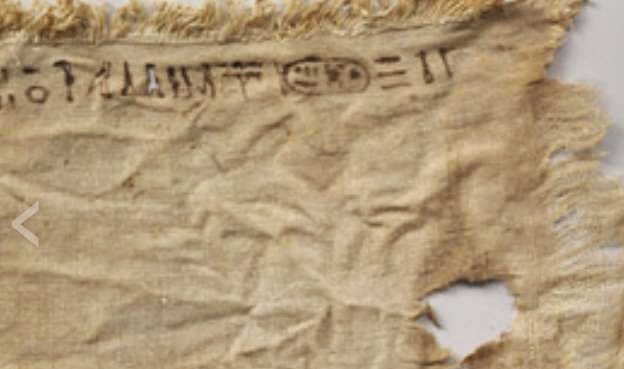
The Egyptians used it to wrap their mummies. The flax woven to soft linen was durable and so fine that when King Tut’s tomb was opened, the linen still looked fresh.

King Tut’s Linen. Source

In the bible, the finest of the woven linen was reserved for the priests.

When they enter the gates of the inner court, they are to wear linen clothes; they must not wear any woolen garment while ministering at the gates of the inner court or inside the temple.” (Ezekiel 44:17)

The International Standard Bible Encyclopedia says of fine linen,

Ancient Egypt was noted for its fine linen (Genesis 41:42 Isaiah 19:9). From it a large export trade was carried on with surrounding nations, including the Hebrews, who early learned the art of spinning from the Egyptians (Exodus 35:25) and continued to rely on them for the finest linen (Proverbs 7:16 Ezekiel 27:7). The culture of flax in Palestine probably antedated the conquest, for in Joshua 2:6 we read of the stalks of flax which Rahab had laid in order upon the roof. Among the Hebrews, as apparently among the Canaanites, the spinning and weaving of linen were carried on by the women (Proverbs 31:13, 19), among whom skill in this work was considered highly praiseworthy (Exodus 35:25). One family, the house of Ashbea, attained eminence as workers in linen (1 Chronicles 4:21 2 Chronicles 2:14).

Flax in the field

In religious services by others than priests, white linen was also preferred, as in the case of the infant Samuel (1 Samuel 2:18), the Levite singers in the temple (2 Chronicles 5:12), and even royal personages (2 Samuel 6:14 1 Chronicles 15:27). Accordingly, it was ascribed to angels (Ezekiel 9:2, 3, 11; Ezekiel 10:2, 6, 7 Daniel 10:5; Daniel 12:6, 7). Fine linen, white and pure, is the raiment assigned to the armies which are in heaven following Him who is called Faithful and True (Revelation 19:14). It is deemed a fitting symbol of the righteousness and purity of the saints (Revelation 19:8).

This site is excellent in recounting the history of flax, and linen-making, complete with a how-to.

Blue flowering flax

Linen is made from Flax

Linen is woven from the spun fibers of the flax plant, Linum usitatissimum. Flax grows wild in the region extending from Northern Africa to India and north to the Caucasus Mountains in Western Europe. Long before we lounged on sunny yacht decks on gauzy linen towels, prehistoric man was busy spinning these exceptionally-strong fibers into the simple thread that changed the world.

The Taming of the Flax

Intentional cultivation of the wild flax plant likely began sometime between 5,000-4,000 BCE in the regions of North Africa and the Fertile Crescent, and from the beginning, linen was holy.

In ancient Mesopotamian city-states like Babylon and Ur, linen fabric was rare and accounted for only 10% of textile production. While the flax plant is not difficult to grow and reaches maturity in about 100 days, it also leaches most of the nutrients from the soil such that the fields must be let lie fallow for several years after a harvest. The laborious process of linen-making then took an additional 130-150 work days. Because production was so labor-intensive, only members of the elite like priests and royal figures could afford clothing and other articles made of linen. Cuneiform sources tell of thrones and statues of deities draped in bolts of fine linen inside temples.

Across the Sinai Peninsula not too many years later, the fertile Nile river valley provided a much more agreeable ecology for flax cultivation. The annual flooding of the Nile brought alluvial deposits that replenished the nutrients in the soil that had been depleted by the flax plant. Coupled with the surplus of the same slave labor that built the pyramids, flax quickly became ancient Egypt’s number one non-foodstuffs crop.

An excellent wife who can find? She is far more precious than jewels. … She seeks wool and flax, and works with willing hands. (Proverbs 31:10, 13)

The armies of heaven were following him, riding on white horses and dressed in fine linen, white and clean. (Revelation 19:14)

Continuing with flax history,

Unlike the Mesopotamians, the Egyptians prized linen fabric for much more than its exclusiveness. Linen fabric is durable, lightweight and wicks moisture away from sweaty skin. Linen thus became the favored material for clothing under the scorching desert sun, from the coarse linen garb of the slaves to the intricately-woven finery of the high priests.

Linen is also resistant to insects and microbial growth, and has a smooth, lint-free surface. Egyptians were obsessed with hygiene, so for these qualities, linen was considered pure. The whiter the fabric, the purer Egyptians believed it to be. By far, the greatest demand for linen was for ritual purposes.

Priests were permitted to dress only in linen. “Chief Royal Bleacher” was an actual job title, though an unenviable one. Tomb paintings and models from across the region depict the repetitive process of washing the wet linen cloth, rubbing it with detergent, pounding it on a smooth stone with wooden clubs, rubbing the surface with balls of leather, rinsing, repeating, again and again; then finally laying it out to bleach dry in the hot sun.

In Revelation 18:12-13 robust trade from Babylon in luxuries is ongoing, including fine linens.

And the merchants of the earth weep and mourn for her, since no one buys their cargo anymore, 12cargo of gold, silver, jewels, pearls, fine linen, purple cloth, silk, scarlet cloth, all kinds of scented wood, all kinds of articles of ivory, all kinds of articles of costly wood, bronze, iron and marble…

So that is probably more than you wanted to know about linen. This link [ How Linen is Made: From Flax to Fabric ] describes the laborious process to make fine linen, and I recommend reading it. It is very interesting. But for the saints, we have to do nothing to be clothed in righteousness, for it was Jesus’ work on the cross that brought us to and through the cross of salvation where righteousness reigns. His righteousness is granted to us, energizes us, and empowers us to works of righteousness in His name.

It was granted her to clothe herself with fine linen, bright and pure”— for the fine linen is the righteous deeds of the saints.” (Revelation 19:8)

I will greatly rejoice in the LORD; my soul shall exult in my God, for he has clothed me with the garments of salvation; he has covered me with the robe of righteousness, as a bridegroom decks himself like a priest with a beautiful headdress, and as a bride adorns herself with her jewels. (Isaiah 61:10)

Robe of Righteousness, Lars Justinen


Posted in charles spurgeon, encouragement, phil johnson, providence, sermons

Preaching Divine Providence: A pair of timeless and wonderful sermons, one old and one new, to bookend your weekend

In 1857, Charles Haddon Spurgeon ascended the pulpit at New Park Street Chapel, Southwark, and delivered a wonderful sermon called God’s Providence.

Charles Spurgeon was an absolutely amazing pastor. His very life defines both submission, and workhorse. Of Spurgeon, Justin Taylor sums up Spurgeon’s prodigious output,

He often worked 18 hours a day. His collected sermons fill 63 volumes (the largest set by a single author in church history). He read six books a week and could recall their contents. He read through The Pilgrim’s Progress more than 100 times. 14,460 people were added to his church’s membership, and he did most of the membership interviews himself. He trained 900 men to the pastorate. He founded an orphanage, edited a magazine, produced more than 140 books, and is said to have received 500 letters a week to respond to. More than 25,000 copies of his sermons were printed each week. He often preached 10 times a week in various churches. He did all this while suffering from gout, rheumatism, and Bright’s disease—living only to the age of 57. And I think his wife was sick most of that time.

One of Spurgeon’s early sermons was called “God’s Providence.” Spurgeon set his reasoning forth at the beginning of his text.

I am constantly talking about providence in my preaching, and I thought it quite as well to devote a whole sermon to explain what I believe are God’s great wonder-working processes which we call Providence.

I love God’s providence because I love God’s sovereignty. The doctrine of Providence is a favorite doctrine of mine, as regular readers know. Providence of God is defined

The providence of God may be defined as His guardianship and care for His creatures and creation. Also, any manifestation of such care may be described as providence. “There is probably no point at which the Christian doctrine of God comes more into conflict with contemporary worldviews than in the matter of God’s providence. Providence means that God has not abandoned the world that he created, but rather works within that creation to manage all things according to the “immutable counsel of His own will” (Westminster Confession of Faith, V, i).

It’s a comfort to ponder how involved God is in the affairs of men, His care of the saved, and His working all things together for the good of those who love Him. (Romans 8:28).

In Spurgeon’s exposition of a passage from Ezekiel, he used the biblical remarkable imagery of the wheels within wheels and the cherubim who are unique and distinct from all other creatures to illustrate Providence.

The sermon was delivered in 1857 but published October 15th, 1908. Spurgeon opened with comforting words:

WHILE READING THE SCRIPTURES, we tried to hint at the practical benefits of the doctrine of Providence. We attempted to explain that portion of Scripture which teaches us to “take no thought for the morrow, for the morrow will take thought for the things of itself.” Our blessed Lord had there uttered very precious words to drive away our fears, to keep us from distrust and from distress, and to enable us so to rely upon Providence that we may say, he that feeds the ravens, and clothes the lilies, will never suffer me to famish nor to be naked.

He is a good God. Spurgeon’s sermons are a blessing and this one in particular is a favorite of mine. I hope you like it too.

~~~~~~~~~~~~~~~~~~~~~~~~~~

In October 2013, Pastor Phil Johnson delivered a sermon as part of the Strange Fire conference at John MacArthur’s Grace Community Church. It is called Providence IS Remarkable. The Conference was a direct rebuttal to the Charismatic movement, which is polluting the minds and hearts of Christians and false Christians all over the world. In this sermon, Johnson relates the true reasons for the miracles of times past and points to the miracle of today, God’s providence. In his sermon, Johnson explained:

Verse 29, “Are not two sparrows sold for a penny? And not one of them will fall to the ground, apart from your Father.” That doesn’t merely mean that God watches and observes that. It means without His expressed decree and permission, even a sparrow doesn’t die. But even the hairs of your head are all numbered. “Fear not, therefore, you are of more value than many sparrows. Really He gives them miraculous power and He tells them, “I’m sending you out in the midst of wolves, you’re going to be attacked,” and instead of saying use that power to silence your opposition, He says, “Just bear in mind God’s there and He’s involved with you.”

I cannot stress this enough. When the Lord wants to reassure the Apostles that Almighty God is directly and personally and lovingly involved in their experience, and not only in their triumphs and successes, but also in their trials and sufferings. Jesus doesn’t point them to the miracles. He doesn’t talk about dreams and visions, or other mystical phenomena. He doesn’t tell them to listen for a still small voice inside their own heads, and He certainly doesn’t tell them that their words have creative power, so, you know, when you encounter opposition, just go ahead and make a positive confession.

Instead, Jesus teaches them a truth we know as the doctrine of providence. He stresses the fact that God is intimately involved in all the details of our lives, even when we can’t consciously sense His presence, even when we don’t understand what He’s doing or why He’s doing it.

Thinking about providence from heaven is remarkable in that it reduces us to a puddle of love in knowing our Great God is intimately involved with His people. No remote, uncaring, or unaware sovereign is He, but a Shepherd actively caring for the most lowly of His lambs. It’s uplifting to ponder these things. (Philippians 4:8).

Here is the Grace To You video with transcript

Here is the stand-alone sermon on Youtube:

Whether old or new, there are sermons out there, and books, and essays, from men the Lord has raised up in truth to convict us, edify us, and comfort us. God’s word is uniquely worth pondering. He has left no generation alone and has always used His people as vessels for this work. And He always will, until the Day He calls us home and we are with Him personally!

Posted in encouragement, jonathan edwards, sermons, sinners in the hands of an angry god

Preaching divine wrath: A pair of timeless and wonderful sermons, one old and one new, to bookend your weekend

I have four favorite sermons. In thinking about them, I realized they were two pairs, one old and one modern. Each pair was of the same subject. Of course each of the two pairs of sermons are edifying. Let me share the first pair now, and the second pair tomorrow.

Your wickedness makes you as it were heavy as lead; …
and if God should let you go, you would immediately sink
and swiftly descend and plunge into the bottomless gulf,
…and all your righteousness, would have no more influence to uphold you
and keep you out of hell, than a spider’s web
would have to stop a falling rock. Sinners

On July 8th, 1741, pastor Jonathan Edwards ascended the pulpit and preached one of the most famous and convicting sermons in the last 270 years, “Sinners in the Hands of an Angry God“.

Edwards first preached an outline of it to his own congregation, then preached it fully as a guest pastor to the Enfield CT people. Sinners is part of the First Great Awakening.

The Spirit’s work in the First Great Awakening, unlike the Second Great Awakening which reached the unchurched and unconverted, was to shake complacent, church-going Christians to the core and revive their somnolent Christianity to one of fervor for personal holiness and prayer under a loving but wrathful eye of God.

First Great Awakening. Edwards’ use of vivid imagery combined with the powerful concepts of personal responsibility for sin in the face of a holy and sovereign God, crushed the hearts of listeners everywhere- because Edwards was asked to re-preach it often.

Edwards “is widely acknowledged to be America’s most important and original philosophical theologians,” and one of America’s greatest intellectuals. The only son in a family of eleven children, he entered Yale in September, 1716 when he was not yet thirteen and graduated four years later (1720) as valedictorian. He received his Masters three years later. (Source)

On July 8, 1741, in Enfield CT (where a small stone marker marks the spot) Edwards delivered this great, theologically convicting sermon. Though Puritan congregations were well used to fire and brimstone teaching and preaching, the fact of hell and wrath unquestioned, the Spirit’s desire to spark an awakening by using this gifted preacher and his powerful sermon with vivid imagery stands still today as one of the great sermons.

Here is JD Wetterling’s foreword to the sermon, a concise recounting of the sermon’s history and impact.

If you live at the turn of the third millennium after Christ walked this earth, you’ve probably never heard a sermon like this one. Jonathan Edwards was a renowned Puritan preacher, philosopher, theologian, and the leading intellectual figure of colonial America. He graduated from Yale at age 17, became a preacher like his father and grandfather, and is today considered one of the theological titans, along with Augustine, Luther and Calvin, of the Reformed faith.

SINNERS IN THE HANDS OF AN ANGRY GOD was delivered during a time called the Great Awakening, when revival was sweeping the continent and thousands were daily coming to Christ. Two-hundred-fifty years later it is generally recognized as the greatest sermon ever preached on the North American continent, and one of the prime manifestations of the Holy Spirit that brought about the first Great Awakening. While Edwards was equally fervent and eloquent in his preaching on all of God‟s infinite attributes, especially His love and mercy, he is remembered most for this powerful portrayal of God‟s infinite hatred of sin. Edwards was not considered a charismatic orator. He read his sermons, and when he looked up at all it was to stare at the rope for the church bell on the back wall. He knew that in order for lost sinners to come to Christ, their only hope for salvation, they must first be brought to the realization of the desperate state they were in and the horrendous eternal consequences of it. He brought many of his listeners to that realization this day with “remarkable effect.” Such was the power and passion of his words that moans and groans filled the sanctuary and people fainted as he spoke.

The “h-word” is used more often here than I have heard in 52 years of church attendance—it sets the standard for “fire and brimstone.” Jesus himself talked about hell more than anyone else in the Bible, and Edward‟s biblical support for his awesomely graphic metaphors is correct,complete and convicting, and elicits a sense of urgency rarely heard in church pulpits today.

To read in original form-
Sinners in the Hands of an Angry God

To hear on Youtube:
Sinners in the Hands of an Angry God

—————————————————————-

Edwards was concerned with sin, complacency, and the wrath of God. His biblical exposition used vivid imagery and is the hallmark woven through the entire sermon. In this next sermon from today’s times, the vivid imagery is also a powerful vehicle to bring the concepts of the devastation of sin to the listener.

The title of this sermon that has three times now brought me to a place of utter conviction, is called “Hacking Agag to Pieces.” Many people consider this sermon as MacArthur’s best. Its content is as vivid as the title, which is a literal event from 1 Samuel 15:33.

John MacArthur’s bio from Wikipedia,

John Fullerton MacArthur, Jr. (born June 19, 1939) is an American Calvinist, Baptist pastor and author known for his internationally syndicated radio program Grace to You. A popular author and conference speaker, he has served as the pastor-teacher of Grace Community Church in Sun Valley, California since February 9, 1969 and also currently serves as the president of The Master’s College in Newhall, California and The Master’s Seminary in Sun Valley, California. MacArthur has authored or edited more than 150 books.

MacArthur is … a strong proponent of expository preaching. He has been acknowledged by Christianity Today as one of the most influential preachers of his time, and was a frequent guest on Larry King Live as a representative of an evangelical Christian perspective.

The sermon is paired with the verses from 2 Corinthians 1:12, Romans 6:14-17, both about sin and how it devastates a life, unless it is hacked to pieces. MacArthur exposition of the context of Saul’s disobedience set the stage for the doctrinal explanations of the verses in Corinthians and Romans.

Both sermons bring to the listener how important it is not to give quarter to sin. We must not give the enemy any opportunity to weave his way into our hearts nor to nestle there. When we find sin in us we must deal with it immediately and vividly. Jonathan Edwards reminded his audience that it is only the pleasure of God that we draw the next breath. If you are unsaved, and your breath is taken away and death befalls you, an eternity of unutterable torment awaits. Those living a deluded life in false assurance of their salvation are at most risk.

And in MacArthur’s sermon, Agag lived a pagan, rebellious life before God and until the first sword stroke never thought it would be his last breath. As for Saul, God pronounced a curse upon him for his disobedience in not killing Agag in the first place, another sin before God, because disobedience is always sin.

Both sermons remind us that sin has profound and eternal consequences.

In tomorrow’s blog essay, a pair of sermons that uplift the listener, one old and one new. Prepare to be awed by His providence and His sovereignty.

The preaching of divine wrath serves as a black velvet backdrop that causes the diamond of God’s mercy to shine brighter than ten thousand suns. It is upon the dark canvas of divine wrath that the splendor of His saving grace most fully radiates. Preaching the wrath of God most brilliantly showcases His gracious mercy toward sinners. ~Steven J. Lawson

Posted in africa, ebola, God's attributes, justice, pestilence, salvation

Ebola may be out of control, but God is never out of control

I’ve reported on the Ebola outbreak in prior weeks. It is officially an epidemic now. The facts as reported in the past day or so are:

WaPo: Ebola, Portraits of Grief

–This outbreak is actually the first Ebola epidemic the world has ever known. (CDC)
–CDC teams are deployed from the CDC 24/7 Emergency Operations Center (EOC), activated at Level 1, its highest level, because of the significance of this outbreak. (CDC)
–There have been more than 4,300 cases over the past six months. (source)
–More than 2,400 people have died from the virus (source)
–There has been a consistent mortality rate of 55.8% mortality rate. To compare, the 1918 Spanish Influenza epidemic had a 2.4% mortality rate.
–There is no approved cure in this outbreak. (source)
–Nations with cases in the current epidemic have been Liberia, Guinea and Sierra Leone, Nigeria and Senegal. (source)
–All 26 previously recorded outbreaks have been successfully contained largely by isolating patients but the WHO said cases would continue to rise for at least six more months in an epidemic that has jumped borders and erupted in urban areas. (source)

The above were the facts. Next are two published opinions about Ebola as stated in two articles that caught my eye. They are as follows:

What we’re afraid to say about Ebola

THE Ebola epidemic in West Africa has the potential to alter history as much as any plague has ever done. There have been more than 4,300 cases and 2,300 deaths over the past six months. Last week, the World Health Organization warned that, by early October, there may be thousands of new cases per week in Liberia, Sierra Leone, Guinea and Nigeria. What is not getting said publicly, despite briefings and discussions in the inner circles of the world’s public health agencies, is that we are in totally uncharted waters and that Mother Nature is the only force in charge of the crisis at this time.

If I was to re-write the opening line and the closing line from a Christian perspective it would be:

THE Ebola epidemic in West Africa has the potential to fulfill future history as much as any plague has ever done. … What is not getting said publicly, despite briefings and discussions in the inner circles of the world’s public health agencies, is that we are in totally uncharted prophetic waters and that we finally understand that God and only God is in charge of the crisis at this time.

In first opinion piece, I was struck by the person’s outlook that the people who are ‘supposed to know what to do’ … don’t know what to do. Unsolvable problems face the last generation before the Tribulation. How do I know this? Because the world’s global problems are in such a Gordian knot that when the antichrist appears on the world stage with answers the world falls down in eagerness to listen to his solutions. (Luke 21:25, Daniel 11:21).

Secondly, of course the comment that Mother Nature is a force that’s in charge is also interesting, in terms of how the unsaved look at it. Christians know that there is no Mother Nature. God is in control. But…is He sending plagues? Send Ebola? Would a loving God do that? More on that in a moment.

Here is opinion article #2. This is an Op-Ed from Dr Brantly, the American doctor in Western Africa who came down with Ebola, was evacuated to Atlanta’s Emory Hospital for treatment and recovery. He has seen the epidemic from both sides, as doctor and as patient.

American Ebola survivor calls the outbreak “a fire straight from the pit of hell”

Many have used the analogy of a fire burning out of control to describe this unprecedented Ebola outbreak. Indeed it is a fire-a fire straight from the pit of hell. We cannot fool ourselves into thinking that the vast moat of the Atlantic Ocean will keep the flames away from our shores. Instead, we must mobilize the resources needed to keep entire nations from being reduced to ashes.

What if I was to re-write the opening line to say, “Many have used the analogy of a fire burning out of control to describe this unprecedented Ebola outbreak. Indeed it is a fire-a fire straight from bosom of heaven,” would you charge me with being deluded about our “loving God”?

Today’s people, even Christians, have become so used to the concept of a God who is love-only, not love-and. As in, love and wrath, love and judgment, love and anger. All true Christians will proclaim God and not Mother Nature. But to proclaim a God who sends pestilence? Not so much.

I cannot say that God is sending Ebola specifically to West Africa, nor can I say He is sending it for this reason or that reason. I do not know the mind of God. But I know the character of God, and I know the history of God as it’s revealed in the bible.

His character is such that in the past He has sent (or allowed) pestilences to consume Israel’s enemies. He has sent pestilence to consume Israel, to punish. Look at Habakkuk 3:4-5,

His radiance is like the sunlight; He has rays flashing from His hand, And there is the hiding of His power. Before Him goes pestilence, And plague comes after Him. 6He stood and surveyed the earth; He looked and startled the nations. (Habakkuk 3:4-5)

Matthew Henry commentary says of the verses,

After describing the splendour of the theophany, the prophet now turns to the purpose and effects of God’s appearing. He comes to avenge and judge, therefore before him went the pestilence. Before him stalks plague, to punish his enemies and the disobedient, as in Egypt, in Canaan (Exodus 23:27; 1Samuel 5:9, 11); and among his own people (Numbers 11:33; Numbers 14:37, etc.; Leviticus 26:25).

God could be directly sending this plague…pestilence…disease, whatever olde or modern word you want to use. Or He could be allowing satan to spread it. Or He could be allowing microbes to do what they do naturally, multiply. The reason I’m interested is because the doctors are saying it is the first Ebola epidemic in history, that there is no approved cure, and that it has such a high mortality rate.

There was a terrible outbreak of bubonic plague in the 1300s and in the 1600s. Modern science has put the likely death rate average over its entire geographic area at 45-50%. In the first of the two mentioned outbreaks, half of the population of Paris died. 40% of all of Egypt died. And so on. In the current Ebola epidemic, a 55.8% death rate is very high. The rapidity and potential geographic spread due to fast modes of travel makes the potentiality of seeing those rates and even higher arise again.

We do know that in the Tribulation there will be plagues that kill a quarter of mankind. (Revelation 6:8, Matthew 24:7).

The point of this essay is to point to who God is. Yes, God is love, but God is also wrath,. He hates sin above all.
God said in times past,

I will send famine and wild beasts against you, and they will leave you childless. Plague and bloodshed will sweep through you, and I will bring the sword against you. I the LORD have spoken. (Ezekiel 5:17)

This occurred. Do we think that modern sanitation practices and shiny needles full of medicine would prevent such a plague from happening again? Do we think that we are any better people, that the LORD would not be angry with our sin? Our apostasy? Do we think that He would send plague to His own chosen people in Ezekiel times, but let us slide?

But if God was loving, why would He send this to us? Even to unbelievers who haven’t had a chance to “accept Jesus” yet? Proverbs 1:25-26 says,

And you neglected all my counsel And did not want my reproof; I will also laugh at your calamity; I will mock when your dread comes,

Matthew Henry again,

I also will laugh at your calamity,…. By way of retaliation, measuring measure for measure; even as they scorned him, and delighted in their scorning, now he in his turn will “laugh” at them and their distress; which act is ascribed to the Lord by an anthropopathy; see Psalm 2:4; signifying that he should not at all pity them, show no compassion to them, and have no mercy upon them; but rather express a pleasure and delight in displaying the glory of his justice in their destruction: the plain sense is, that no favour would be shown them,

He will glory in displaying His justice. That is also our God. The prophet Habakkuk says of Jesus in the Old Testament, Before Him goes pestilence, And plague comes after Him. He displays His love, and He displays His justice.

Ebola threatens to destroy Sierra Leone and Liberia
The virus is spreading like wildfire. A German Ebola expert tells Deutsche Welle, that it will not be possible to contain the virus with the measures that have been taken so far.

His statement might alarm many people. But Jonas Schmidt-Chanasit of the Bernhard Nocht Institute for Tropical Medicine in Hamburg told DW that he is losing hope, that Sierra Leone and Liberia will receive the necessary aid in time. Those are two of the countries worst hit by the recent Ebola epidemic. “The right time to get this epidemic under control in these countries has been missed,” he said. That time was May and June. “Now it will be much more difficult.”

Justice? Punishment? God? We do not know specifically what God is doing but what we do know is that it is time to repent and fall at the feet of Jesus. Nationally and/or individually, the safest and most God-glorifying route is to acknowledge who God is, in all His aspects. Ask forgiveness of sins. That is the real enemy- sin. God hates it because it keeps His people from glorifying Him and enjoying Him forever. Sin keeps us from His love.

Another aspect of God’s personality is His forgiveness. Though the news about Ebola is dire, the best news of all is this

If we confess our sins, he is faithful and just and will forgive us our sins and purify us from all unrighteousness. (1 John 1:9)

Posted in encouragement, power

Compare and Contrast: lightning bug vs. lightning

A false gospel is a lightning bug

The true Gospel is lightning

The false gospel only brings insect-sized light. Fleeting, not enough to empower, and limited scope.

The true Gospel is the Light, blazing and powerful, able to pierce the darkness even behind closed eyes that do not see. It is from heaven and able to light whole cities…or destroy them.

And now why do you wait? Rise and be baptized and wash away your sins, calling on his name.’ (Acts 22:16)

Posted in discernment, doctrine, false teachers, jesus, teaching

If a teacher teaches some things wrongly, but the Gospel rightly, is it OK to follow them?

A lot of people wonder when it is reasonable to leave off following a teacher. What are the standards for giving loving benefit of the doubt, and banning them completely from your mind, your church, and your home? Both are called for in the bible.

There are these verses,

A new commandment I give to you, that you love one another: just as I have loved you, you also are to love one another. 35 By this all people will know that you are my disciples, if you have love for one another.” (John 13:34-35)

Accept one another, then, just as Christ accepted you, in order to bring praise to God. (Romans 15:7)

And then there are these verses,

If anyone comes to you and does not bring this teaching, do not receive him into your house or give him any greeting, (2 John 1:10)

In the name of the Lord Jesus Christ, we command you, brothers and sisters, to keep away from every believer who is idle and disruptive and does not live according to the teaching you received from us  (2 Thessalonians 3:6)

How do we know when to do which?

First, it’s helpful to understand the difference between brethren and teachers. All Christians are brethren, including teachers. But the standards for becoming a Christian and the standard for teachers are different.

Pure

All brethren stand on the same, equalizing blood-soaked ground. None are qualified to do so, except by the grace of Jesus and faith alone. This standard includes teachers.

But once in the Lord’s kingdom through salvation, the Spirit bestows different gifts. The gift of teaching is given to some, not many, and for those, there are different standards of behavior and of scrutiny. In James  3:1-2 we read,

Not many of you should become teachers, my brothers, for you know that we who teach will be judged with greater strictness. For we all stumble in many ways. And if anyone does not stumble in what he says, he is a perfect man, able also to bridle his whole body.”

Not many of you. This indicates the seriousness of the calling. The verse also indicates the extreme fallibility in all of us. So teachers should be especially wary, because they handle the word of God, and are in a position to cause more damage and harm in Jesus’ name. That is why they are judged more strictly.

So already we know that the first standard of teaching is that it is given by gift of the Spirit. It’s not something that can be taught, adopted, or decided upon, and certainly not entered into casually.

The second thing we learn from that one verse alone is that it is a serious calling, and a stricter standard is given for the Christian’s performance in it.

Thirdly we already know that ‘not many’ are given the gift.

So what are the standards for teachers from there? There are moral/behavioral standards, and there are doctrinal standards for teachers.

BEHAVIOR

Show yourself in all respects to be a model of good works, and in your teaching show integrity, dignity, and sound speech that cannot be condemned, so that an opponent may be put to shame, having nothing evil to say about us. (Titus 2:7-8)

not lording it over those entrusted to you, but being examples to the flock. (1 Peter 5:3)

Older men are to be sober-minded, dignified, self-controlled, sound in faith, in love, and in steadfastness. (Titus 2:3

Older women likewise are to be reverent in behavior, not slanderers or slaves to much wine. They are to teach what is good, (Titus 2:3)

DOCTRINE

If you put these things before the brothers, you will be a good servant of Christ Jesus, being trained in the words of the faith and of the good doctrine that you have followed. (1 Timothy 4:6)

So what IS good doctrine? Well, we know that there are teachings of demons (1 Timothy 4:1). And likewise, there are teachings of God. Theologians generally categorize doctrine into ten major headings: (source MacArthur Study Bible)

  1. Holy Scriptures
  2. God the Father
  3. God the Son
  4. God the Holy Spirit
  5. Man
  6. Sin
  7. Salvation
  8. the Church
  9. Angels 
  10. Last Things

All good teachers will teach any and all ten doctrines rightly. But what about the Gospel? If a teacher teaches The Gospel rightly but some of the other doctrines wrongly, it still OK to follow that teacher?

Well, let’s look at exactly what The Gospel is.

Here is 9Marks listing of the elements of the Gospel.

  • The one and only God, who is holy, made us in his image to know him (Gen. 1:26-28).
  • But we sinned and cut ourselves off from him (Gen. 3; Rom. 3:23).
  • In his great love, God sent his Son Jesus to come as king and rescue his people from their enemies—most significantly their own sin (Ps. 2; Luke 1:67-79).
  • Jesus established his kingdom by acting as both a mediating priest and a priestly sacrifice—he live a perfect life and died on the cross, thus fulfilling the law himself and taking on himself the punishment for the sins of many (Mark 10:45; John 1:14; Heb. 7:26; Rom. 3:21-26, 5:12-21); then he rose again from the dead, showing that God accepted his sacrifice and that God’s wrath against us had been exhausted (Acts 2:24, Rom. 4:25).
  • He now calls us to repent of our sins and trust in Christ alone for our forgiveness (Acts 17:30, John 1:12). If we repent of our sins and trust in Christ, we are born again into a new life, an eternal life with God (John 3:16).

If you compare the Gospel to the ten doctrines, you find the doctrines permeate the Gospel and the Gospel permeates the doctrines. A teacher must know holiness, speak of and understand how exalted God is. He or she must have a true understanding of sin. So many false teachers teach sin is just a mistake, or can be controlled, or is not our fault due to generational bondage, or any number of reasons that distance ourselves from responsibility for our sins.

A teacher must have a proper understanding of who Jesus is. There’s ‘this same Jesus’ who will return (Acts 1:11) and ‘a different Jesus’ preached and taught falsely. (2 Corinthians 11:4).

A flawed teaching on the law vs. grace, of the cross, of the resurrection, or of sanctification affects the Gospel relating to those elements. Not understanding what God’s wrath affects the doctrine of Last Things.

So you see, if a teacher teaches “the Gospel”, they are really teaching ‘the good doctrine’ (1 Timothy 4:6)

In addition, if you still want to follow a teacher who seems to be teaching some things well and others poorly, remember the demon possessed slave girl.

As we were going to the place of prayer, we were met by a slave girl who had a spirit of divination and brought her owners much gain by fortune-telling. She followed Paul and us, crying out, “These men are servants of the Most High God, who proclaim to you the way of salvation.” (Acts 16:17)

Is there anything inaccurate about what she said? No. Then why didn’t Paul like the free advertising? Because nothing pure can come from a deceitful heart. Because her father is the father of lies. Who needs satan to advertise the Gospel when we have the pure word and holy servants to do so?

Matthew Henry commentary says of the slave girl verse,

Satan, though the father of lies, will declare the most important truths, when he can thereby serve his purposes. But much mischief is done to the real servants of Christ, by unholy and false preachers of the gospel, who are confounded with them by careless observers.

Mixing lies and truth is what satan did to Eve. And look what happened.

A little leaven leavens the whole lump. (Galatians 5:9 cf 1 Corinthians 5:6)

If a teacher is teaching wrongly have nothing to do with him or her.

That’s not to say that a true teacher must teach all doctrines perfectly. We are imperfect individuals. But as I said in a previous essay, the Holy Spirit who is inside us will never allow a true teacher to remain in a false understanding. The Spirit always testifies of Jesus and points to Him, who is Truth. That’s why discernment means being alert, and watchful and patient. A teacher should always be growing in Christ-likeness. A false teacher is always growing away from Christ.

1 Timothy 6:3 says that good teaching is sound doctrine according with godliness. An overseer’s primary job is to “hold firm to the trustworthy word as taught, so that he may be able to give instruction in sound doctrine and also to rebuke those who contradict it.”

Jesus IS Truth. Seek Him and don’t compromise for anything less.

Posted in messiah, salvation

"Who do you say that I am?"

Who is Jesus?

Is He a prophet? Is He Elijah? Is He a nice, moral man with a few good things to teach?

Who you say Jesus is determines your eternal destiny.

Jesus went out, along with His disciples, to the villages of Caesarea Philippi; and on the way He questioned His disciples, saying to them, “Who do people say that I am?” They told Him, saying, “John the Baptist; and others say Elijah; but others, one of the prophets“. (Mark 8:27-28)

What ho, Mormon, who is Jesus?

Source

Mormons: “Mormons do not believe in the Trinity as we understand it. They believe that God and Jesus were separate physical people” who dwelled on the earth, [former Mormon Beth Johnston said. “God was Jesus’ father, and both men died“.

Muslims say Jesus (Isa) was a Messenger, a Prophet, not deity, never crucified.

As-salamu alaykum, O Muslim, who is Jesus?

O People of the Book! Commit no excesses in your religion: Nor say of Allah aught but the truth. Christ Jesus the son of Mary was (no more than) a messenger of Allah, and His Word, which He bestowed on Mary, and a spirit proceeding from Him: so believe in Allah and His messengers. Say


not “Trinity” : desist: it will be better for you: for Allah is one Allah: Glory be to Him: (far exalted is He) above having a son. To Him belong all things in the heavens and on earth. Quran, Chapter 4 The Women An-Nisa: Verse 171

Shalom, good Hebrew. Who is Jesus?

Judaism teaches that it is heretical for any man to claim to be God, part of God, or the literal son of God. The Jerusalem Talmud (Ta’anit 2:1) states explicitly: “if a man claims to be God, he is a liar.”

Wiki Commons

And he asked them, “But who do you say that I am?” Peter answered him, “You are the Christ.” (Mark 8:29)

The exclusivity of Christianity as the sole way to salvation is an eternal truth.

Jesus said to him, “I am the way, and the truth, and the life. No one comes to the Father except through me. (John 14:6)

Jesus is the Messiah, the promised One, the savior of all humankind.

And Jesus answered him, “Blessed are you, Simon Bar-Jonah! For flesh and blood has not revealed this to you, but my Father who is in heaven. (Matthew 16:17)

Anyone who rejects Jesus as Messiah…King…Lord…Savior…Forgiver of sins, will not go to heaven. They remain in their sinful flesh, and will be damned.

I declare to you, brothers and sisters, that flesh and blood cannot inherit the kingdom of God, nor does the perishable inherit the imperishable. (1 Corinthians 15:50)

Between the sinful, perishable flesh, and the sinless imperishable kingdom which the gates of hell shall not prevail against, is a great gulf fixed–

And besides all this, between us and you a great chasm has been fixed, in order that those who would pass from here to you may not be able, and none may cross from there to us.’ (Luke 16:26)

Except that while they are still living, you may cross from perishable to imperishable by and through Jesus, by confessing Who He Is.

Because, if you confess with your mouth that Jesus is Lord and believe in your heart that God raised him from the dead, you will be saved. (Romans 10:9)

Posted in Christians, middle east, orthodox, persecution

Sunday Martyr Moment: "Christians" in the Middle East

On Sundays I used to post an essay called Sunday Martyr Moment. I did so because I want to remember the martyrs who went before us in the faith.

Foxe’s Book of Martyrs- According to this summary from Christian Book Summaries,

Writing in the mid-1500s, John Foxe was living in the midst of intense religious persecution at the hands of the dominant Roman Catholic Church. In graphic detail, he offers accounts of Christians being martyred for their belief in Jesus Christ, describing how God gave them extraordinary courage and stamina to endure unthinkable torture.

From the same link, the book’s purpose was fourfold:

  • Showcase the courage of true believers who have willingly taken a stand for Jesus Christ throughout the ages, even if it meant death,
  • Demonstrate the grace of God in the lives of those martyred for their faith,
  • Expose the ruthlessness of religious and political leaders as they sought to suppress those with differing beliefs,
  • Celebrate the courage of those who risked their lives to translate the Bible into the common language of the people.

Text from Foxe’s Book of Martyrs

~~~~~~~~~~~~~~~~~~~~

In the last posting, last February 2014, I looked at the ten primitive persecutions. Foxe developed his chronicle in chapters from the first martyr, Stephen, in chapter 1: “History of Christian Martyrs to the First General Persecutions Under Nero” and in February we got to the end of chapter 2: “The Ten Primitive Persecutions“. That brought us up to 303AD.

~~~~~~~~~~~~~~~~~~~~

Last February was the last Martyr Moment I’d published. I’d wanted to cover only the first ten primitive persecutions, because once you get into the 300s AD, Catholic martyrs are mixed in and it becomes too hard to separate fact from mystical Catholic fiction, at least it was for me.

The first ten persecutions covers well the tribulations the early Christians went through. I listened to a recent sermon from John MacArthur. On Sunday nights he is going through the book of Acts. The sermon is called “Persecuted for Truth’s Sake” and it covers Acts 4:1-12. (There is no transcript yet, but there will be). He mentioned the persecutions, the first ten, and generalized some of the more heinous acts. It is always worthwhile to remember what the early Christians did, they were bold in proclaiming Christ to a hostile system, which at that early time was the Jews. I recommend the sermon.

I bring up the persecutions and martyrdoms now for another reason. We skip ahead to 2014, and the Middle East. In 2014, we are living in apostate times and most people attend an apostate church. “Christians” all too undiscerningly accept any person who says they are “Christian”. Most of the church today is one big undiscerning, deluded club.

We hear repeatedly that Christians are being killed in the Middle East for their faith. We read articles about the Christian martyrs in Syria, Iraq, and other places. We read about ISIS, the terrorist group, which is actually a government successfully holding large swathes of land, insisting at point of a knife for all to convert or die. Many “Christians” refuse, and are killed.

What I am going to say is not popular, but we need to be discerning for two very important reasons.

First, most of the people killed in ISIS-controlled territory who say they are Christian, are not.

The largest non-Muslim group in the Middle East are Coptic Christians. By some accounts, between 4 and 8 million Egyptians are Copts. Some estimates say 10 million.

Egypt’s Coptic Christians are set to vote for a new leader on Monday to succeed Pope Shenuda III,
who died in March leaving behind a community anxious about its status under an Islamist-led government.
The candidates for leading the Coptic Church, (from L) Father Bakhomius of Virgin Mary in Wadi Natroun,
Father Rafael from St Marina Monastery, Father Seraphim of Virgin Mary, Bishop Raphael of Central Cairo, and Bishop Tawdros of Beheria in Giza Photo: REUTERS/Mohamed Abd El Ghany Source

Copts are part of the Eastern Orthodox Church (AKA Oriental Orthodox). Copts believe that liturgical ritual and faith plus works saves you. Of Orthodox churches, according to this excerpt from GotQuestions, says that

in doctrine, they have much more in common with Roman Catholics than they do with Protestant Christians.

Sadly, the doctrine of justification by faith is virtually absent from the history and theology of the Orthodox Church. Rather, Orthodoxy emphasizes theosis (literally, “divinization”), the gradual process by which Christians become more and more like Christ. What many in the Orthodox tradition fail to understand is that “divinization” is the progressive result of salvation, not a requirement for salvation itself. Other Orthodox distinctives that are in conflict with the Bible include:

The equal authority of church tradition and Scripture
Discouragement of individuals interpreting the Bible apart from tradition
The perpetual virginity of Mary
Prayer for the dead
Baptism of infants without reference to individual responsibility and faith
The possibility of receiving salvation after death
The possibility of losing salvation

Coptic Monks circa 1900, Wikipedia

Here is another article regarding Coptic “Christians” specifically-
“What is Coptic Christianity, and what do Coptic Christians believe?”

Well if the Copts adhere to a doctrine that is not saving, what about the other people who are called Christian in the Middle East? The second largest group claiming to be Christian are Lebanese Maronites, and they simply are Catholic. The other name for them is the Maronite Catholic Church.

As for the rest, most are from some kind of Orthodox church, whether it’s Russian, or Greek, or Armenian etc.

There was an Assyrian Evangelical Church of Tehran but it was forcibly closed between 2010 and 2012. There is a Presbyterian church in Iran, but it is small, and it is unknown as to whether it is still going. It was (I believe) affiliated with PC USA which is a denomination gone apostate, anyway.

I am NOT saying there are no Christians in the Middle East. I AM saying that we do not automatically accept every single person claiming to be Christian as Christian, especially when they are from obviously apostate churches such as the Catholic or Orthodox. We must be discerning. We stand for a pure doctrine and proclaim ‘this same Jesus’ who left us and will return. We don’t abandon that mindfulness and steadfast adherence to purity in the church when we’re pressured by the natural response of grief over deaths and persecution of any minority.

The second reason to be cautious is not only to display a measured and mature response in discernment, but that if indeed most of the people calling themselves Christians are not, then it is worse when they are killed. True martyrs make the boldest statement of all when they are killed for the name of Jesus- in truth. Then they go to heaven. False Christians who are killed for their faith make a weak statement by their death, for they stand on sand and proclaim hot air, and when they die, they go to hell. We cannot celebrate their survival as wholly as we would like, because they proclaim a false Gospel and a different Jesus, which spreads when they flee persecution. We do grieve their death because they are eternally damned.

It’s sad when a true Christian is killed for the faith but their death glorifies God. It is bad when any lost person dies, because their soul is damned in hell under eternal torment forever. But when a false Christian is killed ‘for the faith,’ that is the worst, because the person goes to hell but on earth the Spirit had been blasphemed and Jesus had been denied by their false Gospel. Their death brings glory to satan’s gospel. Therefore, it’s the worst.

Knowing the facts about ‘Christianity’ in the Middle East helps us pray more pointedly and mindfully. In the heat of the emotional moment, please don’t abandon discernment in trade for running to stand under a too-large umbrella of faiths that are no faith at all. We love the people of the Middle East, Muslim or Orthodox, because they are both hanging by a gossamer thread over the pit of hell, and in such a harsh environment they could die at any moment. But now you know how to discern and now you know in which direction to pray for them.