SYNOPSIS: A cross-country journey leads to a deeply unsettling night at the Salton Sea, where unexplainable fear stirs reflection on spiritual darkness, human wandering, and the ultimate safety, purpose, and peace found in Christ.
Say “magnolia” and people automatically think of the South. I grew up in New England I know I certainly did. Never once did I think I’d live in the south, and with a magnolia tree across from my front door no less!
It is a stately tree, solid and aristocratic. Kenneth W. Outcalt wrote about the magnolia grandiflora tree, “Southern magnolia (Magnolia grandiflora), also called evergreen magnolia, bull-bay, big-laurel, or large-flower magnolia, has large fragrant white flowers and evergreen leaves that make it one of the most splendid of forest trees and a very popular ornamental that has been planted around the world.“
The magnolia flower of the grandiflora tree is just as grand as its host. The petals are enormous but velvety and have a rich ivory color. I don’t have a sense of smell so I can’t tell you directly. Locals say it smells great. Apparently the scent varies, it can smell like lemons, or violets, or vanilla.
Like the magnolia blossom’s physical scent, we humans emit a spiritual scent.
And walk in love, as Christ loved us and gave himself up for us, a fragrant offering and sacrifice to God.” (Ephesians 5:2).
“But thanks be to God, who always leads us as captives in Christ’s triumphal procession and uses us to spread the aroma of the knowledge of him everywhere. For we are to God the pleasing aroma of Christ among those who are being saved and those who are perishing.” (2 Corinthians 2:14-15)
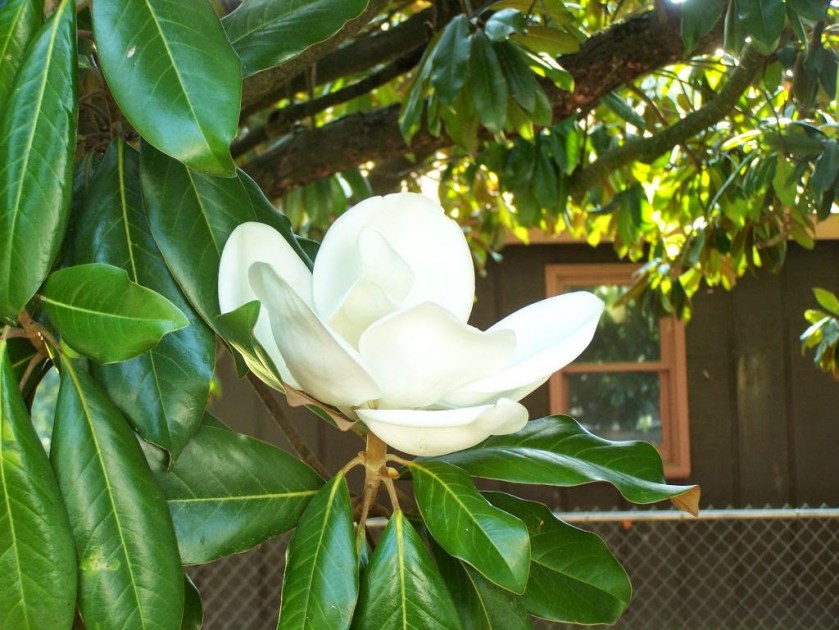
Magnolia blossoms are blooming now. The trees are so tall, and most of the blossoms are far above my head, making a close inspection difficult. However this year, there was one bloom that was at eye level. With the flowers being so large and beautiful and emblematic of an entire region of the south, and a blossom blooming literally before my eyes, I decided to photograph one blossom each day for its entire life cycle.
The blossom here as it appears initially is tightly wound, straight as an arrow, and contains no hints of the surprise inside.
EPrata photo
It popped open! Revealing more layers! How pretty!
EPrata photo
Each petal is larger than my entire hand. The color ranges from white to ivory and the entire blossom looks so stately.
EPrata photo
The petals are revealing a surprise inside!
EPrata photo
The petals are velvet-y.
EPrata photo
Now the petals are turning brown, barely hanging on to the stem, speckled on the edge with more brown. The leaves immediately under the blossom are dead. Bugs were crawling over the petals, looking for a good place to stake a claim to start munching.
Four days, that is all it took for the bloom to appear in its final form, open, live, and die. I was so surprised. There are many blooms on the tree, and I just assumed that they lasted a while. I’d never tracked just one. Its life is so short, a mere breath.
I was pondering that for a while today. What seemed so strong and beautiful was only a few days later fodder for death, decay, and insects. In addition, what was presented so starkly to me in the story of the magnolia is something that is repeated in our human body and our short lives. Most of us live more than 4 days, but to God, our life is a mere vapor, a mist.
“yet you do not know what tomorrow will bring. What is your life? For you are a mist that appears for a little time and then vanishes.” (James 4:14)
“You have made my days a mere handbreadth; the span of my years is as nothing before you. Everyone is but a breath, even those who seem secure.” (Psalm 39:5)
So what are we going to do with the time afforded us on our short time on earth?
“Therefore be careful how you walk, not as unwise men but as wise, making the most of your time, because the days are evil.” (Ephesians 5:15-16)
Once the petals fall away the seed inside is fully revealed. The magnolia fruit will continue to dry out, and eventually open, revealing tiny red seeds. These drop to the ground-
Mature Magnolia fruit just starting to open, with a few seeds visible. Wikimedia Commons
One botanist wrote that it hardly seems credible that such a large tree could come from such a small seed.
Paul wrote about how our body is a seed, a mere kernel.
The Resurrection Body
“35But someone will ask, “How are the dead raised? With what kind of body do they come?” 36You foolish person! What you sow does not come to life unless it dies. 37And what you sow is not the body that is to be, but a bare kernel, perhaps of wheat or of some other grain. 38But God gives it a body as he has chosen, and to each kind of seed its own body. 39For not all flesh is the same, but there is one kind for humans, another for animals, another for birds, and another for fish. 40There are heavenly bodies and earthly bodies, but the glory of the heavenly is of one kind, and the glory of the earthly is of another. 41There is one glory of the sun, and another glory of the moon, and another glory of the stars; for star differs from star in glory.”
“42So is it with the resurrection of the dead. What is sown is perishable; what is raised is imperishable. 43It is sown in dishonor; it is raised in glory. It is sown in weakness; it is raised in power. 44It is sown a natural body; it is raised a spiritual body. If there is a natural body, there is also a spiritual body. 45Thus it is written, “The first man Adam became a living being”; the last Adam became a life-giving spirit. 46But it is not the spiritual that is first but the natural, and then the spiritual. 47The first man was from the earth, a man of dust; the second man is from heaven. 48As was the man of dust, so also are those who are of the dust, and as is the man of heaven, so also are those who are of heaven. 49Just as we have borne the image of the man of dust, we shall also bear the image of the man of heaven.” (1 Corinthians 15:35-49)
Dried out and used up, the small seeds inside the husk have all spilled out and are doing their job in planting themselves into the ground for the next cycle.
When the magnolia seed drops to the ground it is a bare kernel, it looks nothing like what it will become. It is red, the flower is white. It is small, the flower is large. It has no smell, the magnolia scent is lovely. The mature blossom lives a short time, bearing witness to the Creator, who is pleased with its beauty and scent, and then it dies. It endures decay and becomes bug-eaten and eventually, dust. (Ecclesiastes 3:20).
The parallel to people is the same. Our lives are short and ends in decay. While we are living we have a job to do, glorify the Creator and testify to His works. Will we redeem the time? Is our Lord pleased with our aroma? When we awaken to receive our final bodies, will it be to shame and contempt or to everlasting life? (Daniel 12:2).
“Do not be amazed at this, for a time is coming when all who are in their graves will hear his voice.” (John 5:28)
I pray you are awakened to eternal life, saved by thegrace of our Lord, working to redeem the time on His behalf. Because, it bears repeating,
And walk in love, as Christ loved us and gave himself up for us, a fragrant offering and sacrifice to God.” (Ephesians 5:2)
SYNOPSIS: In this essay I explore Puritan migration, beliefs, and society, highlighting overlooked women whose literacy, labor, and faith sustained households, shaped children, and quietly influenced early American development despite historical invisibility and significant hardship.
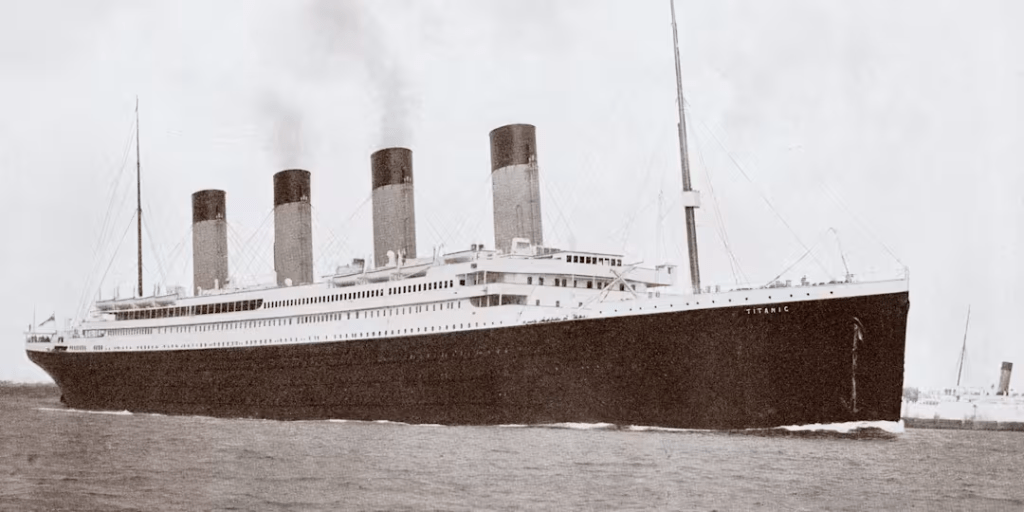
One hundred-and-fourteen years ago, the world awoke this day to the tragic and shocking news that the world’s most luxurious, biggest, and ‘unsinkable’ passenger ocean liner on its maiden voyage, had foundered, taking with it 1500 people down to the icy waters of the North Atlantic.
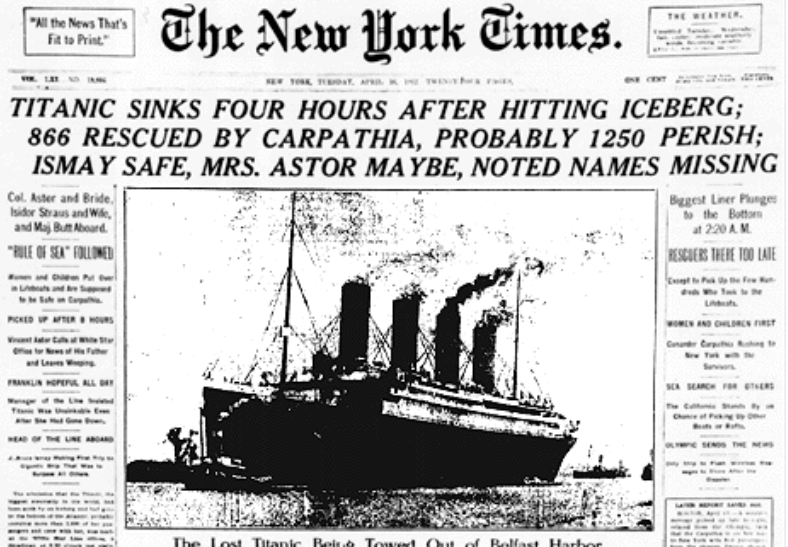
Initially, it was widely reported that all were safe. It was thought that the passengers and crew had been put off to other ships.
But that was soon to be corrected, with the enormity of the disaster soon impacting the world- and all the lives associated with the ship.
Here is the New York Times’ article:
The entire history surrounding Titanic is rich with lore, history, and melancholy, from its building, to the launch, to the rich appointments aboard, to its treatment of steerage passengers (good and bad), to its final plunge. The inquest itself was a massive part of its history, and also the results- changes in maritime safety which stand to this day.
There are many individual stories told which have been verified and remain carved into the memory of their families and Titanic-history- the Macy’s founders choosing to die together. Isidor refusing to get into a lifeboat and his wife Ida refusing to leave his side, saying, “Where you go, I go.” Benjamin Guggenheim famously chose to face the Titanic sinking with all the refinements of his class, in dignity, changing into evening wear and declaring, “We’ve dressed up in our best and are prepared to go down like gentlemen.” He was seen aiding women into the lifeboats, and in the end, drinking brandy with his valet in the first class smoking room.
Yet there is one man who stands out above the rest whose story is not as well known. He was a Scottish evangelist named John Harper. He ensured his daughter a spot on a lifeboat, then vigorously evangelized to those remaining on board as the ship went down. He is known to have said “Let the women, children, and the unsaved into the lifeboats!” Harper took seriously the verse that commanded our lives be dedicated to the Lord, putting others before self, and valuing souls above things. His life is recounted in the book “The Titanic’s Last Hero” which I own and plan to read this summer.
There have been many other maritime disasters, such as the famed ‘ship of gold’ USS Central America, sunk in a hurricane in 1857 taking with it 425 people and the loss of so much gold it sparked an economic panic in the US. The Lusitania, a British British luxury passenger liner torpedoed by a German U-boat in WWI taking with it nearly 1200 passengers, and more recently the Tall Ship HMS Bounty replica sinking off Cape Hatteras.
But the romanticism surrounding Titanic is still the number one capture for our attention and remembrance in maritime history. And for me, remembering John Harper. He was so famous as a speaker and evangelist he had been invited to preach at Moody Church in 1910. He was in fact, returning to Moody to peach again, this time with his sister and 6-year-old daughter. When knowledge of his last breath’s efforts became known, Moody Church memorialized him by naming one of the church rooms Harper Hall. Upon the occasion of the 100 year anniversary of Titanic’s sinking, in 2012 Erwin Lutzer wrote about “John Harper’s Last Convert“:
One report says Harper, knowing he could not survive long in the icy water, took off his life jacket and threw it to another person with the words, “You need this more than I do!” Moments later, Harper disappeared beneath the water. Four years later, when there was a reunion of the survivors of the Titanic, the man to whom Harper had witnessed told the story of his rescue and gave a testimony of his conversion recorded in a tract, I was John Harper’s Last Convert. …
This past April, Rebecca and I were invited to help commemorate the 100th anniversary of the sinking of the Titanic with the congregation at the Harper Memorial Baptist Church in Glasgow. To our delight we discovered that this church, founded by Harper, is still preaching the same Gospel that he preached on the Titanic a hundred years ago. We also learned that his daughter later married a pastor. She died in 1986, but her daughter and grandchildren were with us for the celebrations! A reminder that there is no substitute for the torch of faith being passed from one generation to another through the influence of godly families.
It is reported that only 6 people were rescued from the water alive, and one of those was George Henry Cavell, the last man to whom Harper spoke. God makes a way.
Perhaps I am captured by the Titanic because it took so long to sink, thus we have these testimonies from survivors that show us the tableau of responses to looming death. Some cried, some became paralyzed by fear, some became raving maniacs, some stood stoically…but John Harper was about his Father’s business, concerned for souls above his own life.
Only God knows how I would react if I was trapped in a situation where death is almost sure. I’d be praying, I know, but would I be praying for myself, or others? Let me pray now that the Lord would instill in me a concern for others that rises above my own doings.
Philippians 2:3-4, Do nothing from selfishness or empty conceit, but with humility consider one another as more important than yourselves; do not merely look out for your own personal interests, but also for the interests of others.
Romans 12:10, Be devoted to one another in brotherly love; give preference to one another in honor,
1 Corinthians 10:24, No one is to seek his own advantage, but rather that of his neighbor.
Galatians 5:26, Let’s not become boastful, challenging one another, envying one another.
I realize I am writing this on a digital platform to be published on digital media.
EPrata photo
However, I am 65 years old and I was a full adult nearing middle age before the internet came to my house. For most of my life, I had a heavy, black rotary phone, drove cars without a computer chip in them, and looked for books at the library through a card catalog. We sailed our boat over 22,000 nautical miles in the Atlantic Ocean without the help of a GPS. We always found our way to port.
When the internet came, and with it email, bulletin boards, Compuserv, streaming movies, I embraced the digital, it is an incredible invention. I do love it. But it is also fraught with potential for bad, even evil. Temptations and addictions abound. Distraction, FOMO, life comparison, phone addiction, and porn are just a few of those.
Children are entering school without knowing how to have a conversation, with limited vocabulary, and non-existent attention spans. Parents using the phone or tablet as a neglect-o-meter for their children, or on the phone so much themselves, their child wanders the house aimlessly not knowing what true loving engagement is.
We all embraced it when it came along. Schools scrambled to buy chrome books and desktop computers so their students would not be ‘left behind’. The dot.Com boom helped this attitude. The old humongous TV on a rolling cart used once in a while for a documentary program was replaced by ever larger screens used for just about everything. Apps were added to student computers to use at home and increasingly, in school. Even standardized testing went digital.
What I am seeing is a trend in the world back to digital. Being 65 and having seen trends come and go- and come again- is the way of the world. I’m glad there is a movement back to analog.
Many states in the US are banning student use of cell phones during school hours. Sweden was a country that initially wholeheartedly embraced it all. But over time, the glow dwindled. We read about Sweden–
“…by 2023, Sweden’s government and educators began to voice concerns. Studies raised red flags about declining reading comprehension and concentration among Swedish students. The Swedish government officially announced it would scale back the use of digital devices in early grades, with more focus on physical books and handwriting. According to an AP News report, Sweden’s Education Minister Lotta Edholm said students “need more textbooks” and emphasized that physical books are important for student learning as the country reconsiders screen-heavy instruction.”
There is a swing among Gen Z and millennials to ‘go analog’. I’ve read more than once lately that vinyl records are surging in popularity. Young adults scour the thrift stores for record players. Apparently there comes a time when a critical mass of concerns make using digital media just not fun anymore. Recent announcements by streaming music companies that you can pay to download songs but you don’t own them have dimmed the glow of the ease of using digital media for music. Major services who offer a service but decline to allow the consumer to own the music- meaning it can be removed at any time from their platforms, include Spotify, Apple Music, YouTube Music, and Amazon Music.
When older adults fondly recall sitting snuggled on the couch with their family and reminiscing over a photo album with 35 mm pictures in them, telling stories and knitting together in love, younger adults only have the cold phone swiping photo and feel they are missing out. And they are.
Photo albums are going extinct, but is that a good thing? Photo albums are the repository of nostalgia, family stories, personal history. Pixels don’t last. Photos do. A family narrative huddled around a smartphone, looking at pictures one by one does not have the same tender qualities as the former way of creating meaning among a family unit.
EPrata photo
There is a documentary that’s got people excited, it’s called “California Typewriter.” The documentary’s blurb goes,
CALIFORNIA TYPEWRITER is a documentary portrait of artists, writers, and collectors who remain steadfastly loyal to the typewriter as a tool and muse, featuring Tom Hanks, John Mayer, David McCullough, Sam Shepard, and others. It also movingly documents the struggles of California Typewriter, one of the last standing repair shops in America dedicated to keeping the aging machines clicking. In the process, the film delivers a thought-provoking meditation on the changing dynamic between humans and machines, and encourages us to consider our own relationship with technology, old and new, as the digital age’s emphasis on speed and convenience redefines who’s serving whom, human or machine?
DIgital media can display the best of humans, as in a GoFundMe to help a flooded out or burned out family. It can also illustrate our depravity, as some of those GoFundMe cases are revealed to be lies. People are turned off by constant AI fakery, lies, nastiness over even innocuous comments. It seems to be a quiet revolution as more people turn off their phones, swap for flip phones, retreat from social media, or just in general, quit.
“They are setting down their devices to paint, color, knit and play board games. Others carve out time to mail birthday cards and salutations written in their own hand. Some drive cars with manual transmissions while surrounded by automobiles increasingly able to drive themselves. And a widening audience is turning to vinyl albums, resuscitating an analog format that was on its deathbed 20 years ago.”
EPrata photo
I am not a prophet and I can’t say this trend will last. I hope so. I tell my students at school about ‘the old days of the 1900s’ when we played outside, rode our bikes all over, went to each other’s houses, had sleepovers, drank from the water hose, begged a dime for the ice cream truck, went to the movies on weekends for $1, and never saw a personal screen in all our lives. Their mouths drop open. They are amazed. My heart aches for them because I know what they are missing out on.
Of course in today’s world many of those activities are no longer safe or possible. But the ‘analog’ hobbies were fun. As I said, I hope this trend lasts a while, but in the end I think the world will be overrun with technology and with it, its worst qualities.
The Bible says that the future will be a one world economy, and it’s hard to see that happening without even further advancement of the digital world. The Antichrist who will seem to rise from the dead could easily be a faked AI video or a hologram. But for now, I salute those young adults who are searching for ‘analog’ connection, tactile hobbies, and a life not dominated by emotionless digital pressure but warmth of fellowship, swapped stories, and sunshine.
I’ve mentioned before that I lived on a yacht and sailed around for two years. We sailed north. We sailed south. We sailed coastal. We sailed offshore. We sailed fast and we sailed slow. We sailed during the day and we sailed at night.
I remember one night passage in particular. We had been anchored at Nassau’s Paradise Island and had upped anchor to scoot to nearby Rose Island. Rose Island is a long, skinny palm tree-lined island with no roads and no houses. A daily excursion boat playing a steel drum version of Yellow Bird arrived every day. We’d hear Yellow Bird coming, we’d hear Yellow Bird staying, we’d hear Yellow Bird going. I liked hearing the distant calypso steel drums, their notes winding around the palm tree leaves before bouncing off to arrive at our swaying boat to serenade us. In between it was quiet. Very quiet.
When we decided to leave, we wanted to head back north to Great Abaco Island. We plotted our trip on the chart. It necessitated scooting around the western tip of Rose island we were anchored behind, turning north, making a deep water passage, and then turning west to get inside the Abaco island chain. There were no navigational aids to mariners. We’d have to sail in between dodgy narrow cliffs with shallow waters dotted with deadly coral heads. Coral is sharp, it could rip a hole in the bottom of your boat faster than a blink.
It’s easy to see coral heads if the sun is behind your back, you’re wearing polarized sunglasses, and you stand far forward on the bow or even better, higher up if you have a wheelhouse. Unfortunately, this meant that to arrive in time for the sun to be behind our back in order to navigate the coral, we’d have to get there before noon. And that meant sailing overnight to arrive at sunrise.
Our Boat
We left Rose Island at dusk, and as the sun set, turned our vessel toward Great Abaco. Our heading was 0 degrees, due north.
Compass set for 0 degrees captain. Easy enough. The sky darkened, turned blue, then purple, then black. The stars came out. Absent any competing light, they were bright. However, one star stood out. It hung off our left spreader. The spreader is the cross-spar halfway up the mast. Our mast was unusual for a modern boat, it was wooden.
If I pointed the left spreader with the star just at the end of it, I could maintain my true north, 0 degree course. That is because the star was the North Star, and the north star never moves. All the other stars rotate around it, but Polaris never moves.
A long exposure photo of Polaris & neighbouring stars (exposure time 45 min),taken in Ehrenbürg (Walberla) in 2001. Source
The North Star is a pole star, and it’s called Polaris. There is only one, the North Star. Wiki says, “While other stars’ apparent positions in the sky change throughout the night, as they appear to rotate around the celestial poles, pole stars’ apparent positions remain virtually fixed. This makes them especially useful in celestial navigation: they are a dependable indicator of the direction toward the respective geographic pole although not exact; they are virtually fixed, and their angle of elevation can also be used to determine latitude. … The North Star has historically been used for navigation since Late Antiquity, both to find the direction of north and to determine latitude.“
We did not sail by celestial navigation, even though we had a sextant. We didn’t have a GPS either but we used the compass and the charts and eyeball and Loran. (Yes, that’s how old we are). We loved using the North Star as our navigational aid. It made us feel like sailors of antiquity, brave and adventurous, casting off to parts unknown and getting there using only what was set in the heavens.
Little did I know that in truth, that ten years later I’d come to know the real God who set the stars in the heavens. (Genesis 1:16). Now my adventures are more biblical, casting off for spiritual parts unknown, and following my North Star, who never moves from His position, and is always bright.
My New Year wish for you is that you follow the North Star. Always, always keep your heading to true north. Always check for drift and for undersea hazards that can rip your keel off and sink you in a blink. It is Jesus who never moves, never changes, and all other beings, planets, and stars rotate around HIM. You cannot go wrong with a compass heading as true as that. Follow Him, whether it is night or day, or whether there are rough or smooth waters. Navigate by His brightness, and the course that is set will see you there safely.
“I, Jesus, have sent my angel to testify to you about these things for the churches. I am the root and the descendant of David, the bright morning star.” (Revelation 22:16)
This beginning part of my Advent series is a presentation of 11 verses overlaid on photos depicting the life of Jesus from prophecy to birth and boyhood. There are additional links at the end of each day’s topic leading the reader to credible ministries to further explore the topic of the day.
The next section (#12-16) will feature verses about the Son as an adult God-Man.
From #17-26 we will survey the Preeminence of the Son, His attributes, and His ministry.
From #27-36 we’ll look at His Resurrection, Ascension, & Return. Yes we go over 30 days into a postlude that ends before the new year.
All photos are by EPrata unless otherwise noted.
There is no better refreshment for the soul than to meditate on Him. Enjoy!
I will meditate on your precepts and fix my eyes on your ways. (Psalm 119:15).
Today’s verse: now that Jesus has been born, and the angels had announced His arrival to the Shepherds, who went to see with all haste this thing the angels had spoken of, now Jesus must flee. So we see from the first moments of His life, hatred against Jesus for who He is and what He has come to do. And so it will be for anyone IN Christ, as well. But His flight to Egypt did not happen before others made great efforts to come and see the Babe- namely the Magi from the East. It was their gift of gold which enabled the poverty-stricken Joseph and Mary to fund their flight to Egypt. God’s providence is perfect, and so is His timing.
This picture—at once austere and tender—belongs to a series of seven showing the life of Christ. The masterly depiction of the stable, which is viewed from slightly below, and the columnar solidity of the figures are typical of Giotto, the founder of European painting. The impetuous action of the kneeling king, who picks up the Christ Child, and Mary’s expression of concern translate the biblical account into deeply human terms. Though we know from scripture that the Magi did not arrive the night Jesus was born in the stable, but saw ‘the child’ likely at a house, the act depicted of the King from the East kneeling is representative of Jesus’ stature as King of Kings, even as a baby.
GotQuestions: What Does the Bible say about the Three Wise Men (Magi)? It is a common misconception that the wise men visited Jesus at the stable on the night of His birth. In fact, the wise men came days, months, or possibly even years later. That is why Matthew 2:11 says the wise men visited and worshiped Jesus in a house, not at the stable.
Answers in Genesis: We Three Kings The original meaning of mάgoi is likely in view here—wise men who interpreted special signs. There are at least three reasons for this identification. First, they acknowledged that they were interested in signs in the heavens.
Grace To You: Who Were the Wise Men? Vincent, who has written some very helpful word studies, says in regard to this, “Many absurd traditions and guesses respecting these visitors to our Lord’s cradle have found their way into popular belief and into Christian art. They were said to be kings and three in number. They were said to be representatives of three families of Shem, Ham, and Japheth and, therefore, one of them is pictured as an Ethiopian. Their names are given as Caspar, Balthazar, and Melchior.”
I reminisce about vacations from Maine to Florida, exploring beaches from Labrador to the Bahamas. Each beach offers unique treasures—shells, sea glass, coral, and rocks—revealing the wonders of God’s creation. Blending natural history, personal reflection, and Scripture, my essay celebrates the beauty and mystery of the sea.
Even though it’s Fall and heading into Thanksgiving, Christmas, and deep winter, I never stop thinking about the ocean. During the Fourth of July long weekend, lots of families take vacations, and many choose to go to the beach. I used to as well.
Shells, sea glass, rocks, coral, barnacles, and pottery from the sea, collected from Labrador to the Bahamas. EPrata photo
I used to take a week off at Christmas and head to Florida, and the week of the 4th I’d go to my favorite spot in Maine, Lubec. If you see the map of Maine as a profile of a dog, Lubec is at the dog’s nose. It borders Canada separated only by a narrow inlet. The bridge from Lubec takes you to Campobello Island on the Canadian island of New Brunswick.
As you might guess, the beaches on the hardy, rockbound and foggy coast of Maine are wild. As a matter of fact, Dr Beach, AKA Stephen Leatherman, several years ago rated a beach near Lubec as the most wild in America.
In December, I took my vacation at Venice FL, where the sand beaches are white and the ocean is azure and gentle at the Gulf coast.
Beaches around the US and around the world all have their own personalities. Each one yields up its own treasures. At Jasper Beach in Machias Maine, the beach has no sand! There’s only smoothly polished rocks of rhyolite and jasper. I’ve taken home many smooth, glittering rocks from Jasper Beach. At Lubec’s Globe Cove, the sea yields sea glass, from the hundreds of years the fishing fleet used to throw over their glass bottles. At Venice FL, the sea yields up shark’s teeth in great numbers. At the deserted beaches in The Bahamas, you find coral washed up, bleached and in interesting twisted shapes. In Labrador, you find scallop shells bigger than your hand! All you need is one of these for dinner!
You rule over the surging sea; when its waves mount up, you still them. (Psalm 89:9)
And of course, there’s shells!
If you ever have headed to the beach, here are a few facts I find fascinating. As you amble along the borderline between ocean and ground, as you wade in the waters to cool your tired feet, as you shield your eyes and gaze out to the limitless blue expanse, praise God for making such a beautiful habitation, and its creatures so complex and wondrous.
My favorite shell is the moon snail. He has a lot of cousins. They all have that sweet spiral, so pleasing to the eye. Their hushed colors of slate grey or moon blue are also pleasing. In the US’s warmer waters and the tropics the shell colors are brighter. Some think this is because of the temperature of the ocean. Others think it’s because of the different food available that translates through digestion to the calcium the shells are made of. Scientists still aren’t sure what kinds of pigments the mollusks are using. The reasons for shell coloration and variation are a mystery to scientists, but God created them all. In one day! He knows why their colors and shaes are so varied. Perhaps to create a palette of beauty that glorifies Him.
Moon snails for all their delicate beauty are actually rapacious predators. The holes you see on other snail shells are made by the moon snail. He climbs on top of a shell, spits acid, uses his tongue lined with teeth to drill a hole, then spews acid onto the hapless mollusk inside. He waits for his prey to melt a little, then inserts his stomach into the hole and absorbs the prey. Ouch! Yuck!
This is what the LORD says, he who appoints the sun to shine by day, who decrees the moon and stars to shine by night, who stirs up the sea so that its waves roar— the LORD Almighty is his name: (Jeremiah 31:35)
Did you know that the moon snail is hatched with a little shell attached already? That’s the point at the start of the spiral. So cool.
Moon snail, collected Maine. Prata photo
Scallops can grow into the size of dinner plates, their age shown by lines on the shell – just like the rings of a tree. I found that one in the photo at the top, in Blanc Sablon at the border of Labrador/Newfoundland, Canada.
He is the Maker of heaven and earth, the sea, and everything in them— he remains faithful forever. (Psalm 146:6)
The Bahamas has been described as having the third most extensive coral reef system in the world. Did you know? Andros Island has a 140-mile Barrier Reef – and that is one of the longest coral reefs in the world.
Coral. The Bahamas. EPrata photo
Did you know?Corals are in fact animals, not plants. Coral reefs are the largest structures on earth of biological origin.
Sea glass is becoming rarer.
Did you know? Sea glass takes 20 to 40 years, and sometimes as much as 100 years, to acquire its characteristic texture and shape. Sea glass begins as normal shards of broken glass that are then persistently tumbled and ground until the sharp edges are smoothed and rounded. In this process, the glass loses its slick surface but gains a frosted appearance over many years. Naturally produced sea glass (“genuine sea glass”) originates as pieces of glass from broken bottles, broken tableware, or even shipwrecks, which are rolled and tumbled in the ocean for years until all of their edges are rounded off, and the slickness of the glass has been worn to a frosted appearance.
This article talks about the best places to find sea glass and mentions Jasper Beach in Machiasport, Maine among other beaches Downeast. That’s where you find the round and tumbled stones. Some glass can be found there, too. But if you’re going that far, drive just a bit further to Lubec, and walk the small beach at Globe Cove. That’s where even more sea glass treasure can be found.
If you spot some sea glass, salute our God who made the ocean and currents’ motion so strong that over time his waters will wear away hard glass.
See the barnacles on the scallop? Apparently in Labrador they grow ’em big! Barnacles are a sea creature that attaches to things, like they did to the underside of our sailboat. Enough of them get on there and it slows down the boat considerably, creating a lot of drag. Occasionally you have to pull the boat out of the water at a marina and scrape them off.
Barnacles on a scallop. They make it hard for the scallop to swim, too. Prata photo
Did you know that the cement barnacles use is stronger than anything man can make synthetically? How barnacles did it was a mystery from time immemorial until 2014. The US Navy has been intensely interested in barnacles, partly because of the issue of slowing the boats when barnacles grow on the hull, and also because the cement the creatures use is so sticky in salt water!!
When you’re walking on a pier and see the barnacles on the pilings, salute our God who made them so super strong.
Jasper Beach Machiasport ME. Prata photo
Whether it’s shark’s teeth, shells, rocks, sea glass, pottery, or any other treasure you find on vacation, praise God who made it all in 6 days by the power of His word and the creativity of His intellect.
Below you’ll find some resources I’ve enjoyed to help me learn more about the wonderful finds you find at the beach!
Conchologists of America, information about the shells and the animals that inhabit them. Conchologist is a shell collector.
Anne Morrow Lindbergh wrote a books of poems and thoughts called Gift from the Sea. Here is the link to the 70th anniversary edition
Boats are often mentioned in the Bible. Aside from the Ark that carried Noah and his family, a once in a history boat, there is a lot of shipping going on, much traveling on boats, shipwrecks, and references to boats. There is also the symbolism of boats. Let’s dig in.
The port city of Tyre was known for his boats, shipping, and valuable products. Ezekiel 27:3, and say to Tyre, who sits at the entrance to the sea, [ports, harbors] merchant of the peoples to many coastlands, ‘This is what the Lord GOD says: “Tyre, you have said, ‘I am perfect in beauty.‘
1 Kings 9:26-27 also mentions not only ships, but a navy. Solomon used these ships to bring in much gold and silver. King Solomon also built a fleet of ships in Ezion-geber, which is near Eloth on the shore of the Red Sea, in the land of Edom. And Hiram sent his servants with the fleet, sailors who knew the sea, along with the servants of Solomon.
Numbers 24:24 also mentions ships, “And ships shall come from the coast of Chittim, and shall afflict Asshur, and shall afflict Eber, and he also shall perish for ever.“
Grain boats of Egypt. Nile River. The boats used for carrying freight are built with a narrow keel, the stern and prow, as in ancient time, rising high above the water. They are usually managed by three or four men and carry what is known as the lateen sail. This is a large triangular sail. In Joseph’s day Egypt was the great granary of the world. Source: Earthly Footsteps of the Man of Galilee, p. 47
In the New Testament also there are mentions of shipping and passenger travel. Famously, Paul was shipwrecked. Acts 27:14-44 describes in some detail a difficult passage, and Paul’s ship eventually wrecked.
What kind of boats were these? Seagoing merchant ships, Galilean fishing boats, slave triremes, pirate ships, ferries (2 Samuel 19:18) …all types.
In 1986 in the Sea of Galilee a boat was discovered. The drought had caused waters on this freshwater large lake to recede and a 27′ long, flat bottomed boat was revealed. They call it the “Jesus boat” not because it has any connection to Jesus but the style of boat dates it to about Jesus’ time. It was about 7 feet wide and could hold 10 passengers if used as a ferry boat. If used as a fishing boat it could hold about five crew members and a catch of 600 pounds up to a ton of fish. It had 4 rowing stations and a mast for a sail.
remnants of ancient boat called Jesus boat.
We usually think of these kind of boats but the ancients were masters of shipbuilding. Aside from camel or donkey, ships were the only other mode of travel. They excelled at finding way to construct large vessels to get goods or people where they needed to go.
In the writings of Pliny the Elder (AD 23–79), I discovered the table (below) about ships of antiquity. This documents the rapid advances the ancients made in ship-building technology in just a few centuries. The time period in the table is from about the seventh century BC to the end of the third century BC.
Jonah’s ship was large enough so he could ‘go down to the lowest part of the ship’ and fall asleep. (Jonah 1:5).
Below is a modern reconstruction of a Roman War Ship docked near Ephesus from Holy Land Photos. It is called a penteconter. You see the box-like structure along the side, that is where the oars would poke out. The holes above are for light and ventilation for the oarsmen. These ships typically lacked a full deck. “They were versatile, long-range ships used for sea trade, piracy and warfare, capable of transporting freight or troops. A penteconter was rowed by fifty oarsmen, arranged in a row of twenty-five on each side of the ship” says Wikipedia. These ships evolved into the more famous triremes.
There is a ‘ram’ at the bow just under the surface of the water.
There were skiffs, highly maneuverable smaller boats used to transport goods, rowboats, smaller sailboats… In fact the Romans were so good at shipbuilding they became experts at building piers to dock the many ships. Some of their piers are stronger than ours built today. How?
How Roman concrete became strong: (AI overview) “Roman concrete was made from volcanic ash, lime, volcanic rock, and seawater. When seawater interacted with the concrete, it dissolved components of the volcanic ash. This allowed new minerals to grow, including aluminous tobermorite and phillipsite. These minerals reinforced the cementing matrix, making the concrete stronger. This process continues over thousands of years.”
Paul used some maritime references to the faith. Though the Hebrew people were pastoral and agricultural, showing no inclination to become seafaring, they did know what these terms meant. In 1 Timothy 1:19, Paul wrote that some have rejected the faith ‘keeping faith and a good conscience, which some have rejected and suffered shipwreck in regard to their faith‘.
Jude warns in Jude 1:12 that false teachers are like hidden reefs which would cause the ship to be torn apart from stem to stern and sink.
Newfoundland: the skiff rounds the point widely, avoiding the visible rocks and the further hidden reef under the surface. Art high tide the rocks would be covered. EPrata photo
Hebrews 2:1 reminds us that we must pay close attention lest we “drift away”. Isaiah 57:20 refers to the wicked being like the sea itself, But the wicked are like the tossing sea, For it cannot be quiet, And its waters toss up refuse and mud.
Larry Pierce said in his article at Answers in Genesis, Just because we cannot duplicate something that was done thousands of years ago, it does not mean the ancients could not do it either!
The biblical world was full of coming and going. The ancients were experts in many things, some of which we can’t even discern how they did it! Pyramids, anyone? The ancient world is fascinating, including maritime advances.