Posted in theology

Squirrel thoughts on a variety of topics

By Elizabeth Prata

I am reading several theologically rich books, my pastor is preaching wonderful sermons, I listen to terrific hymns, and the Bible is always deep with truths…and all this creates heavenly thoughts in my brain. Which is as it should be. This is how the Spirit transforms the mind.

Today I am sharing some of the rabbit trails my mind has been traveling this week as I ponder, mull, and meditate on the things of Christ.


“Dying Adam begat mortals.” From Thomas Boston, (1577-1635) Human Nature in its Fourfold State.

It’s an interesting way to phrase the concept of Adam becoming a sinner whose destiny is death, rather than the immortal person he was before he rebelled.

Think on this- Genesis 5:3 says, “When Adam had lived 130 years, he fathered a son in his own likeness, according to his image, and named him Seth.

‘His own likeness’ the verse is careful to remind us. Adam’s likeness is mortal, because after his fall, sin became our human nature, and sinners receive the due penalty of death. MacArthur says of Adam, “He was created in the image of God. Unfortunately, Seth was made in the image of man. While still bearing the imago Dei residually, still having something of the image of God in him, he is most dominated and marked by the image of man, which is the image of fallenness and sin. So he becomes, does Adam, the father of a son who bears his image. How sad.”


“Though the Flood could not carry off the corruption of human nature, yet it pointed at the way at how it is to be done; to wit, that men must be born of water and of the Spirit, raised from spiritual death in sin, by the grace of Jesus Christ, who came by water and blood, out of which a new world of saints arise in regeneration” ~Thomas Boston, Human Nature in its Fourfold State

Yes, the Flood did not solve man’s gravest problem, our sin nature inherited from Adam. A sinner cannot beget a saint. A sinner can only beget a sinner. If God took the same path with men, there would be deluge after deluge, because the corruption of man’s nature remains still. But God promised there would not be another flood, and sent the rainbow to seal this promise as a reminder to us when we see it. Instead, He sent something better, someONE better, Jesus, to live the holy life we need to live, to die in our stead, and to be raised again having conquered death by his perfect life.


Jen Hatmmaker made the rounds on social media this week. It was reported that Hatmaker has a new course which you can take for only $69 to learn how to be separate from religion and church but still love Jesus. It’s a course on how to ‘deconstruct’ which is a trendy word for the biblical term of apostatising.

I wrote about that here.

As a response to the outcry and outrage that Hatmaker would make filthy lucre off impugning Jesus’ name, toxic empaths insist on being nice and using gentle words with Hatmaker as we discuss this terrible state of affairs. “Be nice” they say. No. Whether wolves are baring their fangs or smiling through them, it behooves us to use strong language to warn about their deadly effects. Be gentle with her? No!

Megan Basham said on Twitter, @megbasham
For those telling me that we should approach Jen Hatmaker with gentleness – – be aware, she is a false teacher who has long peddled destructive doctrines, and now is making money selling a course to lead people out of the church. The ultimate wolf.

Fiercely protect the faith. We don’t have to sling mud, but we should be forthright, honest, and clear about those false teachers who seek to destroy us.

Michelle Lesley has some good thoughts about this topic.


I was browsing my bookshelves in my Library and came across a book I forgot I had. A commentary on Jonah & Nahum by John MacArthur. I love the book of Jonah. I live Nahum even more. I’d read my book Severe Compassion: The Gospel According to Nahum (The Gospel According to the Old Testament) by Gregory Cook. It is good and I recommend that one. So I began reading Jonah & Nahum by MacArthur. MacArthur has a way of writing that is concise, but deep. Easy to understand, but thought-provoking. Unsentimental, but so exalting it raises tears in my eyes.

In Chapter 2 of this commentary, we read: “From the outset of the story, God manifested His heart for the lost. Instead of executing immediate judgment on the Ninevites for their wickedness, the Lord graciously sent them a warning of their pending destruction if they did not repent (Jonah 1:2; 3:5-9). Yet, God showed compassion not only to Nineveh but also to His wayward prophet Jonah, sending a storm to discipline him (1:4) and a fish to deliver him from the sea (1:17; 2:10). Additionally, Yahweh spared the pagan sailors whom Jonah had hired to take him to Tarshish. Though they deserved death, being steeped in idolatry and self-dependence (1:5), God preserved their lives and drew them to Himself (1:16).

Jonah did not want to preach to the Gentiles, but he preached to them anyway- the sailors! Jonah is a good example of having head knowledge of God but it hadn’t reached his heart. He knew God was compassionate and likely to save the hated Ninevites. He knew God was Creator and King over the storms and waves. Jonah knew all this, but his heart for the lost was absent.

God was sovereign over the storm, the sailors, Jonah, the great fish, the Ninevites, the plant, the wind, and the worm. God’s sovereignty is so on display in this book, which you see as you read the commentary, it is breathtaking.


Charles Spurgeon was right in so many ways. In his Lectures to My Students, he spoke about the kind of men who apply to his seminary for training in ministry, but are rejected, and why.

Men who since conversion have betrayed great feebleness of mind and are readily led to embrace strange doctrines, or to fall into evil company and gross sin—I never can find it in my heart to encourage to enter the ministry, let their professions be what they may. Let them, if truly penitent, keep in the rear ranks. Unstable as water, they will not excel.

So, too, those who cannot endure hardness, but are of the kid-gloved order, I refer elsewhere. We want soldiers, not fops. We want earnest laborers, not genteel loiterers. Men who have done nothing up to their time of application to the college, are told to earn their spurs before they are publicly dubbed as knights. Fervent lovers of souls do not wait until they are trained—they serve their Lord at once.

I noticed that even back 150 years ago there were snowflakes, what Spurgeon called ‘those of the kid glove type.’ He didn’t hold back in this lecture, but at the outset he warned, “I am as much at home with my young brethren as in the bosom of my family, and therefore speak without restraint.” Yes, today in this era we have milquetoast men who are passive Adams, but for service in a pastorate we need hardy soldiers.

To this end we must give clear statements of gospel doctrine, of vital experience, and of Christian duty, and never shrink from declaring the whole counsel of God. In too many cases sublime truths are held in abeyance under the pretense that they are not practical; whereas the very fact that they are revealed proves that the Lord thinks them to be of value, and woe unto us if we pretend to be wiser than He. 

Well said, Mr Spurgeon.

Posted in theology

What is ‘Heresy’?

By Elizabeth Prata

We are warned, commanded, and urged in 26 of the 27 New Testament books to watch out for false teachers and false religious movements (example- Judaizers, Nicolaitans). Heresies have popped up like wildfires in every century since Jesus ascended to heaven. The church as diligently battled them when they arose.

But too often the word ‘heretic’ and ‘heresy’ are watered down from overuse. They have lost meaning from people who misunderstand its import. We cannot fling the word around and aim it at people when they are not in fact heretics. A heretic is bound for hell. It’s serious. So what does heresy actually mean?

Heresy

In a previous Word of the Week, I’d posted about Orthodoxy. In the religious context, Orthodoxy means conforming to correctly interpreted, established doctrine, especially in religion. Heresy is a teaching or belief that stands in opposition to the orthodox teaching, so much so that to believe it, one essentially declares himself not a Christian. Here is Matt Slick at Christian Apologetics and Research Ministry to explain.

Heresy, by Matt Slick

Heresy is a false teaching. It is a belief or idea that is in contradiction to orthodoxy. In the context of Christianity, heresy is that which deviates from standard biblical teaching. Examples of heresy would be polytheism [more than one god], a denial of the resurrection of Christ, salvation is obtained by works, etc. The Christian church has experienced many attacks by heretics throughout the centuries, but it has fought them successfully – even though many persist. There are modern-day heresies. For example, Mormonism which teaches God is an exalted man from another planet and that we can become gods. The Jehovah’s Witnesses deny the Trinity, deny the deity of Christ, and deny salvation by grace alone through faith alone. Roman Catholicism teaches this also, teaches works to salvation, and promotes Mary worship.

Thus, even though Mormons, Catholics, and Jehovah’s Witnesses claim a religion, and claim to know God, they are heretics because they deny the foundational aspects of Christianity. They do not know God.

Error, indeed, is never set forth in its naked deformity, lest, being thus exposed, it should at once be detected. But it is craftily decked out in on attractive dress, so as, by its outward form, to make it appear to the inexperienced (ridiculous as the expression may seem) more true than truth itself,” (Irenaeus Against Heresies 1.2).

The word “heresy” comes from the Greek ‘hairesis’ which means “choosing” or “faction.” At first, the term heresy did not carry the negative meaning it does now. But, as the early church grew in its scope and influence throughout the Mediterranean area, various teachers proposed controversial ideas about Christ, God, salvation, and other biblical themes.

It became necessary for the church to determine what was and was not true according to the Bible. For example, Arius of Alexander (A.D. 320) taught that Jesus was a creation. Was this true? Was this important? Other errors arose. The Docetists taught that Jesus wasn’t human. The Modalists denied the Trinity. The Gnostics denied the incarnation of Christ. Out of necessity, the church was forced to deal with these heresies by proclaiming orthodoxy; and in so doing, condemnation upon these heresies and the heretics became a reality.

Heretics after death will be cast into hell. Heresy is serious. So we do not cast around that word unless we have mindfully studied and are sure the person or movement we are commenting on is indeed meeting the qualifications of heretic or heresy.

“Hell at last, Yawning, received them whole”, Gustave Dore illustrator, Paradise Lost by Milton.

Posted in theology

The Mystery of the Trinity: Embracing God’s Fellowship

By Elizabeth Prata

I think most Christians probably have heard the hymn Holy, Holy, holy. The refrain is

Holy, holy, holy! Lord God Almighty!

Early in the morning our song shall rise to thee.

Holy, holy, holy, merciful and mighty!
God in three persons, blessed Trinity!

Your mind is humming it right now, isn’t it? 🙂

Our finite minds can’t grasp the notion of one person in three persons. So we don’t usually delve into the mystery of the Trinity. We don’t ponder it so much. It is a doctrine that just is.

“Theologian J.I. Packer noted that the Trinity is usually considered a little-thought-about piece of “theological lumber” that no one pays much attention to. But whatever your level of understanding of the doctrine of the Trinity, one thing you can know for sure: The Triune God is unchangeably committed to including you in the wonderful fellowship of the life of the Father, the Son and Holy Spirit.” (Source).

The concept of the Trinity is mentioned a lot in the New Testament. I was surprised when I started thinking about this and studied it, there are more verses that mention it than I thought.

Jesus is teaching. “If you had known Me, you would have known My Father also; from now on you know Him, and have seen Him.” (John 14:7).

Philip asks, “Lord, show us the Father, and it is enough for us.” Jesus replied, “Do you not believe that I am in the Father, and the Father is in Me? The words that I say to you I do not speak on My own, but the Father, as He remains in Me, does His works.” (John 14:10).

As our pastor taught, this is a concept called mutual indwelling. He explained in his sermon,

“He said something similar in chapter 10, verse 38; know and understand that the father is in me and I am in the father. That’s the language of mutual indwelling. What Jesus had been teaching them all along was his unity with the father. He is so united with the father, the best way to express it is mutual indwelling. The father dwells in him and he is in the father. Now that doesn’t mean that Jesus and the Father are identical in personhood. After all, according to verse 12 here, He was going to the Father, which indicates a distinction between them. And so their oneness doesn’t mean they’re identical in all respects, but to see Jesus is to see the Father in essence.

It is a mystery how all three Persons of the Trinity are one but separately they are three individual people, with their own wills, purposes, tasks. But God is one. I am glad He is a mystery. I would not respect a God I could understand. He has deigned to stoop to our level of understanding in magnificent ways. He gave us His word. He gave us His Son. He gave us the Holy Spirit to indwell us. He raised up the prophets. He have us this world in order to see his wonderful works. He gave us providence, where we can see in hindsight how He takes care of us.

Mutual indwelling as a term describing the relationship among the persons of the Trinity is an easy to understand term. Theologians also use a more technical term, perichoresis or circumincession.

Perichoresis is “the mutual intersecting or “interpenetration” of the three Persons of the Godhead and may help clarify the concept of the Trinity. It is a term that expresses intimacy and reciprocity among the Persons of the Godhead. Perichoresis is the fellowship of three co-equal Persons perfectly embraced in love and harmony and expressing an intimacy that no one can humanly comprehend. The Father sends the Son (John 3:16), and the Spirit proceeds from the Father and was sent by the Son (John 15:26)—another example of perichoresis, with the result that God’s people are blessed,” says GotQuestions.

Though one Person or another may be emphasized in a particular work, no one person does any work exclusive of the other two persons, for as the classic dictum states, “the external works of the Trinity are undivided.” ~John MacArthur, Biblical Doctrine.

Our comprehension of this doctrine will always be beyond our mind’s finite grasp. But by faith we know the unity of the Godhead is perfect, the works of the Trinity are ongoing, the Trinity’s essence is shared perfectly yet without blurring each person’s distinctions.

Hebrews 1:3 says- And He is the radiance of His glory and the exact representation of His nature, and upholds all things by the word of His power.

The God-head’s fellowship has opened up to include humans. Our fellowship with God becomes possible after we repent and by faith we are saved through grace. Then, as JI Packer says:

fellowship becomes a possibility; and it is only as the Holy Spirit enables us to speak to others, and others to us, in such a way that Christ and the Father are made known through what is said, that fellowship is made a reality. When we seek to enjoy fellowship together, we should do so in prayerful dependence on the Holy Spirit, the third Person of the Trinity, whose office it is to reveal Christ to us. ~Source, God’s words : studies of key Bible themes, JI Packer

Posted in theology

Elisabeth Elliot: Faith, Controversy, and Legacy

By Elizabeth Prata

A reader asked me about Elisabeth Elliot. This is the answer I gave.

Elliot was one of the five wives whose husbands were killed by the unreached Ecuadorean Auca Indians back in 1956. She decided to remain in the mission field and minister to the same natives who had speared her husband. Later, returning to the US, she remarried and began speaking on a circuit. Her second husband, Addison Leitch, died agonizingly of cancer 4 years later. Elliot wrote books and hosted a radio program for 13 years called Gateway to Joy. She married for a third time in 1977 to Lars Gren and remained so until her death caused by dementia in 2015. She had one daughter, Valerie. Elisabeth was seen as a graceful, valiant, strong woman, but she was also disillusioned at times, complex, and had bouts of depression.

The question I was asked about Elliot was, was her theology off? It seems a bit off to the reader. I answered, yes her theology IS off. Elisabeth seems to be something of a sacred cow in evangelical circles, and has escaped scrutiny or critique. She gets a pass.

Some years ago I read an interview a Catholic lady was involved in with Elisabeth Elliot. A remarkable exchange occurred which the interviewer put in her resulting article. Elisabeth’s evangelical brother Thomas converted to Catholicism. He became an apologist for Roman Catholicism and wrote many books on the religion.

She said of her brother, the Catholic, that she wished she was brave or she’d be a Catholic too. From Catholic Exchange, an interview:

Do you know my brother, Thomas Howard? He entered the Catholic Church some years ago. I only wish I had his courage. … “Cowardice, I suppose. My listeners and readers simply would not understand.” Source: Courage to be Catholic

No, we would not.

Though these things happen, it wasn’t solely wanting her child to go to American schools that made Elisabeth leave the mission field, it was constant interpersonal conflict with fellow widow Rachel Saint that was the final straw. They could not stand each other. Though Elisabeth apparently tried to heal the fracture, it never did heal. It’s really not here or there, but the press gives Elliott a winsome graciousness or a settled placidity which was not always true.

She also preached to men. Christianity Today wrote, “Elliot, like many prominent conservative women, also manifested certain contradictions amid her complementarian advocacy. Though she insisted that only qualified men could serve as pastors, she taught church audiences that typically included adult men. Along with her second husband, she joined the Episcopal Church, one of the denominations most adamant about ordaining female pastors.

In her early life and especially when courting Jim, she had weird ideas about personal will and divining the will of God, using almost mystical means such as circumstances and experience. Her Keswick Holiness upbringing instilled this in her. This led her to excessive self-introspection and sometimes paralysis in decision making.

Elliot biographer wrote in her essay Why Elisabeth Elliot Changed Her Beliefs about Finding God’s Will, “She saw God’s care as dependent on her perfect obedience, and obedience as including not only her actions and her will but every aspect of her life right down to her natural inclinations. Human free will involved only the choice to obey or disobey God’s direction, and God’s will was so minutely specific that even an earnest seeker could miss the narrow path of obedience.”

Elisabeth Elliot teaching men

The fear of missing God’s direction caused Elliot much grief. While it is admirable to want to lay down the whole body, mind, strength, and heart down for the Lord, it is a kind of personal sovereignty that thinks our own decisions can and do thwart God’s will.

Did not Mordecai say to Esther, “Then Mordecai told them to reply to Esther, “Do not imagine that you in the king’s palace can escape any more than all the other Jews. For if you keep silent at this time, liberation and rescue will arise for the Jews from another place, and you and your father’s house will perish. And who knows whether you have not attained royalty for such a time as this?” (Esther 4:13-14), making it clear that Esther could decide what she wanted to decide, but that God’s plan would proceed regardless of Esther’s decision.

Elisabeth developed a rubric for divining what God wanted her to do,

(1) the circumstances,
(2) the witness of the Word,
(3) peace of mind

It’s an unstable thing to depend on emotions to confirm a personal decision. Whether it’s fear or peace, emotions should not figure in. No doubt Paul did not ‘feel peace about it’ when he got up from the road from being beaten almost dead to confront the mobs again, or when he floated on a shipwreck plank for days. In Acts 9:16, Jesus tells Paul, “For I will show him how much he must suffer for the sake of my name.” Knowing the certainty of suffering was ahead, I am sure Paul didn’t feel a spiritual placidity all the time. Our emotions should not be a guide for obedience.

On the plus side, Elisabeth was staunchly against feminism, and spoke frequently about headship submission, roles in marriage, and resisting cultural norms. On the downside, she often said these things at predator Bill Gothard’s events. And she began this professional relationship with Gothard in the mid 1990s, AFTER accusations began to come out against Gothard, which were later confirmed by his Board.

She certainly endured horrific tragedies, martyrdom of her first husband, agonizing long death of 2nd from cancer, and a semi-abusive relationship with the 3rd, and a 10-year battle with dementia, which caused her death at age 88. Her work on the mission field is beyond admirable, and her writing no doubt has helped many, as well as her popular radio program.

However, her legacy is definitely complicated, wrapped in grace under suffering, obedience to the Lord even under the most difficult trials, and an advocate for gender roles- which are all good things. However her search for HOW to obey God, her yearning for Catholicism, and her evident hypocrisy in preaching to men, are sad complicating factors in her life’s story.

Posted in bible, hermeneutic, life verse, what this verse means to me

Avoiding Misinterpretation: A Guide to Biblical Hermeneutics

By Elizabeth Prata

Hermeneutics. It’s not a word you hear often inside of churches. In our watered down state of the church, preachers and pastors don’t often use the “big words” any more. If they do, they’re abashed and even apologize for saying theological words like ‘justification’ or ‘inerrancy.’ Hermeneutics is a battleground in our continued spiritual warfare against the schemes of the devil. You have to know what it is.

From the Compact Dictionary Doctrinal Words by Terry L. Mithe, hermeneutics is

From the Greek hermeneutikos, “interpretation.” Hermeneutics is the science of the study and interpretation of Scripture, the branch of theology that prescribes rules by which the Bible should be interpreted. Biblical hermeneutics strives to formulate guidelines for studying scripture that help recover the meaning a biblical text had for its original hearers.

Here are some thoughts regarding hermeneutics. Hermeneutics is the science of interpreting text, in this case, biblical text. The problem today isn’t so much Bible inerrancy, it’s Bible insufficiency- the Bible isn’t enough so we interpret it the way we want. The opposite of hermeneutics is casual interpretation and practices such as “life verses” and “what this verse means to me”.

In this essay you will find-

1. John MacArthur explains the fallacy of teaching ‘What does this verse mean “to me?”‘
2. A recommendation of Todd Friel’s teaching series “Herman Who? The art and science of interpreting Scripture“. (His ministry is now called Fortis Institute) is very helpful.
3. Matthew Henry’s quote

I think we’ve all seen either in real life or in videos, where a popular women’s ‘Bible teacher’ stands up to welcome her audience and to share with us her ‘life verse.’ Or as we hear the teacher ask the women, say, “Now, what does this verse means to you?…”

Biblical interpretation is not a Rorschach test “What do you see in the inkblot?”

What does John MacArthur say about this method of interpreting scripture, looking for what it means to the individual? What Does This Verse Mean “to Me”?

That’s a fashionable concern, judging from the trends in devotional booklets, home Bible study discussions, Sunday-school literature, and most popular preaching. The question of what Scripture means has taken a back seat to the issue of what it means “to me.” The difference may seem insignificant at first. Nevertheless, our obsession with the Scripture’s applicability reflects a fundamental weakness. We have adopted practicality as the ultimate judge of the worth of God’s Word.

In just one paragraph, MacArthur punctures the practice. We cannot adopt a scripture because it has personal applicability to us and dispense with other verses because they don’t. MacArthur continues,

No believer can apply truth he doesn’t know. Those who don’t understand what the Bible really says about marriage, divorce, family, child-rearing, discipline, money, debt, work, service to Christ, eternal rewards, helping the poor, caring for widows, respecting government, and other teachings won’t be able to apply it. Those who don’t know what the Bible teaches about salvation cannot be saved. Those who don’t know what the Bible teaches about holiness are incapable of dealing with sin. Thus they are unable to live fully to their own blessedness and God’s glory. True doctrine transforms behavior as it is woven into the fabric of everyday life. But it must be understood if it is to have its impact. The real challenge of the ministry is to dispense the truth clearly and accurately. Practical application comes easily by comparison.

Solid biblical hermeneutics searches for truth under the premise of “What did God intend for me to know about Himself in this passage?” versus today’s practice of me-centered interpretations asking “What does this verse mean to me?” The latter leads to a false kind of open-mindedness regarding interpretation. It’s also “me-centered” and not God centered.

In theology at some point you need firmness, it’s imperative to obtain a settled authoritative stance on at least the fundamentals of the faith.

When it comes to possessing a firm understanding of the foundations of the faith gained by a proper interpretive methid, it’s OK to be ‘dogmatic’.

Dogmatic theology gets its name from the Greek and Latin word dogma which, when referring to theology, simply means “a doctrine or body of doctrines formally and authoritatively affirmed.”

Biblical hermeneutics appropriately conducted leads to an illumination of the scriptures which leads to a Spirit-settled understanding which leads to an authoritative witness with conviction. S. Lewis Johnson this in his sermon “Paul’s Right to Compensation.” In highlighting the importance of dogmatism he compared the ridiculousness of open-minded non-dogmatism in the secular world:

Now, I’ve been talking like I’m dogmatic, haven’t I? I’ve been trying to inject a little bit of the apostolic dogmatism in it. The world has little use for people without convictions when — for example, when your child becomes very, very sick and you want to call a doctor, you don’t call a doctor who is open-minded about personal disease, do you? Or we don’t send our children to school if we know the teachers are open-minded about the multiplication tables and things like that. We don’t do that. We want someone that we have confidence in…

Does a pastor ascend the pulpit on a Sunday morning after a week of study, and say, “Open to John chapter 3, here is what the verse means to me. It may mean something different to you.” No. Not a good pastor.

In contrasting the “this verse means to me” approach with the biblical approach, we now turn to Acts 8:26:40. The Spirit directed Philip the evangelist to go up to the Ethiopian Eunuch, who was seated in his chariot reading scripture, Isaiah 53 as it turns out. How did Philip begin the teaching lesson? Did he say, “Oh, I see you are reading scripture. What does the verse ‘“Like a sheep he was led to the slaughter and like a lamb before its shearer is silent, so he opens not his mouth’ mean to you?”

Of course not. We read in Acts 8:30-31 that Philip asked, “Do you understand what you are reading?” This indicates there is one understanding, not many understandings dependent on personal applicability, whether the reader likes it, or how it fits into their culture or era.

In humility, the Eunuch said, “How can I, unless someone guides me?” indicating that interpreting a verse is not about a mutual exchange of different interpretations relative to an individual’s personal meaning, but a teacher-student relationship wherein one submits to the other’s greater knowledge and listens. (Always check for proper interpretations as a Berean afterward as per Acts 17:11). What happened next was,

Then Philip opened his mouth, and beginning with this Scripture he told him the good news about Jesus. (Acts 8:35)

Philip told him. Dogmatically, authoritatively. That’s what a teacher does, he studies, submits himself to the Spirit and seeks the interpretation. Then he tells the Good News. Do we say “I will share the Good News. It’s Good News to Me. Maybe it won’t be to you.” Heavens, no!

This is not to say that we aren’t humble when we’re dogmatic. Philip was humble when he submitted to the Spirit’s order to go where he didn’t know and approach the person he didn’t know and explain the scriptures to him. The Eunuch was also humble in his reply.

The difference between errant dogmatism and correct dogmatism in hermeneutical interpretation is the Holy Spirit. He will settle you, if you earnestly seek the Lord and submit to His teaching. Once a passage or doctrine is settled in your mind due to the Spirit’s illumination, then it’s the time to explain, exhort, and defend.

Observe, No scripture prophecy is of private interpretation (or a man’s own proper opinion, an explication of his own mind), but the revelation of the mind of God. … But though the scripture be not the effusion of man’s own private opinion or inclination, but the revelation of the mind and will of God, yet every private man ought to search it, and come to understand the sense and meaning thereof.

Henry, M. (1994). Matthew Henry’s commentary on the whole Bible: complete and unabridged in one volume (p. 2436). Peabody: Hendrickson.

Further Resources

Todd Friel’s teaching series “Herman Who? The art and science of interpreting Scripture“. (His ministry is now called Fortis Institute) is very helpful. Link brings you to a product.

What is dogmatic theology? GotQuestions essay

Posted in discernment, Uncategorized

How To Do Online Discernment Ministry, part 1

Part 2 here

There’s online discernment ministry, and there’s online “discernment ministry.” I hope I’m the former. The latter is often discussed negatively. When “scare quotes” are put around the name of discernment ministry, it’s a pejorative. Scare quotes in journalism are sometimes called sneer quotes, so you get the idea.

Though I post articles about a trio of topics, including encouragement and prophecy, I do post articles about discernment. I post articles naming names of false teachers. One-third of what I do online regarding my blog is online discernment. So, am I one of the good ones, or one of the bad ones doing “discernment ministry”? Let’s have a two-part lesson on how to do online discernment ministry, and through it I’ll reveal what I do and how I go about it, and I’ll challenge you to test the discerners you follow, (including me), by sharing how.

What Is Discernment and is it Biblical?

One of the gifts given to people by the Spirit is discernment. (1 Corinthians 12:10). This is one of the spiritual gifts given to me. I primarily serve in my local church, which I believe is extremely important because it’s a command (Ephesians 4:12, Romans 15:2 etc). Spiritual gifts are meant to be used in a local body of believers, for edification and for accountability purposes.

Biblically, discernment is important. It’s a skill all believers must hone, but some were given ‘an extra dose’ if you will, in the form of a specific gift. In the days when the canon was not set, prophecies and revelations and epistles were coming in to the believers. Some of the letters were false. Each local body needed to be able to determine which messages were truly from a designated apostle, and which were false. The church at Ephesus was praised for having developed worthy discernment, (Revelation 2:2) while the church at Thyatira was rebuked for their lack of it. (Revelation 2:20).

The gift is still in force today, much needed, as many false prophets have gone out into the world, and we must test the spirits now as then (1 John 4:1).

By 2003, user-friendly blog platforms had come along, and Blogger announced it had a million users. Christians rapidly gravitated to this new publishing method and pastors and theologians were setting up blogs to push the message. So were lay theologians, cranks, wingnuts, and anyone with a theory or opinion, including me. My first blog came along in 2006 but after two and a half years of writing increasingly Christian content, I separated the content and started a second blog, this one, in January 2009. It is solely focused on Christian content while my other one remains personal. I’ve blogged just about every day on The End Time blog ever since.

By now in the new millennium, many other means have been invented with which to share the message of the Gospel and to maintain its purity. Podcasts, websites, blogs, movies, texts, simulcasts, and more are blessedly available to get our message out. I believe those methods should be used. In Paul’s day there was no internet. But he wrote letters, the internet of his day. Whatever means that the Lord has allowed to be invented to share Christian doctrine, testimonies, missionary reports, and the like, is a good thing in my opinion.

A Little About Me

I’ve published 4,370 essays. That is a lot to say. Yet, who am I? Just some lady in a corner of the internet. I’m not a celebrity. I haven’t gone to seminary. I am just someone taking advantage of the platforms available to share my opinion and perspective. You need discernment to ensure that I am worthy of your time and attention.

I have been a writer all my life and before the internet was available, it was hard to get published. I had been published a few measly times, in a journal or magazine here or there. But it took enormous effort to send pieces for publication to Publishing Houses or Magazines and the monoliths would send rejection letters back after many weeks, if they sent anything at all. It was frustrating.

So when easy platforms like Blogger, LiveJournal (remember them?) and WordPress came along with the touch of a button, anyone could publish, including me! So I did.

An egalitarian publishing world has its downsides too. People can and do propagate error. Not just in theology but in politics, sociology, psychology; in any -ology there will be people who want to push their message. The internet is unregulated, (yay!) but it takes wisdom and discernment to sift through increasingly unhealthy, errant, or just plain rotten content to find the gold. Or just the good.

What are the Blogger’s Credentials? Track Record?

So when you look for a blog to follow, especially a discernment blog or an eschatology blog (those Christian subjects seem to draw the more wonky theorists and unstable theologians), look to see who is writing. Do they have a track record? Do they have credentials? Not that credentials are of sole importance, but sometimes it counts- and that can be for or against. A blogger might say in his ‘About,’ that “I have a Masters of Religious Education” but upon searching further you discover the MA is from Brigham Young University, the Mormon college.

As to the track record, look for their trajectory. Did they start off solid and weaken over time? Do they quote the Bible appropriately? Do they quote the Bible at all? Or are they drifting into theories and conspiracies? Are they focused on secular controversies or extra-biblical prophecies, personal revelations?

When I first started blogging I did newspaper eisegesis. I looked at the news and looked at the Bible and then made statements about it. Israel really is the center of it all! There’s a reason Israel is always in the news! The Middle East is volatile because of the Esau-Jacob struggle! People really are horrible, not basically good, and the news confirms it! I don’t think I ever crossed a line, but you can determine that. I didn’t focus solely on that, though, which is another important measure of a credible discernment ministry. If someone is always writing about and researching the bad, that colors one’s perspective. Soon one can lose perspective.

As for my early days, I don’t apologize for the interest in global affairs as they related to biblical prophecy. My eyes had been opened to another world, the Christian worldview through a biblical lens, and it was wonderful and amazing. I loved that time. I remember distinctly the amazement I felt when learning that the Christian world had been there all along. I was aroused with wonder to learn that God’s plan is orderly and may come to an end any day. That sense of wonder and imminence has never left me and I hope it never will.

But I grew out of the newspaper stuff by the Lord’s grace and went on to study deeper theology. That is what to look for. Is a discernment ministry writer growing up toward Christ, or growing away from Christ?

My credentials…I am loathe to share lest it seem like boasting, but the few times I’ve mentioned this in 9 years perhaps will be forgiven.

I am a writer & researcher, having been published in The Reading Teacher and The LAB at Brown University, in literary journal Brownstone Review and Glamour Magazine. I have helped edit Chicago’s National Association for the Study of Education 98th and 99th Annual Yearbook of Education Research. I was a newspaper publisher, editing a New England Press Association award-winning weekly newspaper. I’ve also been employed by the daily paper Athens Banner Herald as a features writer and have written for the Madison County Journal.

I was and am a educator. I worked as a short and long term substitute, a para-professional and as a certified elementary school teacher. I took some years off to attain a Masters Degree in Literacy Education, and to travel widely, before resuming work as a para-professional, of which I am employed to this day.

Is the Blogger a Lone Ranger, Not a Member of any Church?

I am a member of a local church, fully participating by steady attendance at Sunday worship service as well as weekly attendance in several small groups overseen by the church elders.

Those are my professional and personal credentials. I have no theological credentials. I have taken several for-credit classes through Ligonier. I listen to The Master’s University lecturers online. I applied to and was accepted at Reformed Theological Seminary but after the very first class taught a possible young earth and long years evolution, I quit. Other than daily study in diligence and submission, regular church attendance, and listening multiple times per week to credible pastors, I have no official theological credentials.

When you visit a discernment ministry online, assess who is in charge of it. Who is writing and sending out theological messages? I can’t tell you to do that without giving you some idea of who I am, and whether I should be read or followed. Transparency is important. Hence the above paragraph.

I do not agree with those writers who blog anonymously. I understand the issues around privacy and safety, especially for women, but if one is going to proclaim Christ, one does so openly. Jesus said He did nothing in secret (John 18:20). Paul said he works openly, nothing is done in secret (Acts 26:26).

That is the how and the why. Part 2 will discuss how to assess whether someone is a credible online discernment ministries such as discussing the importance of primary sources, and other tips such as separation issues and solidity and growth over time. I’ll look at how unscrupulous “discernment bloggers” use tenuous connections, weasel words, out-of-context material and quotes, and unrepresentative doctrine.

Till then, thank you and bless you for reading.

error and truth discernment

Part 2 here

Posted in discernment, Uncategorized

Why every woman should be a theologian: The Master’s University Table Talk

womenThe advent of the internet has afforded Christian men and women opportunity to learn from many credible teachers and pastors, and to access a variety of different theological resources.
For example, all of Charles Spurgeon’s sermons and writings are online. John Owen is online. Pilgrim’s Progress is online. John MacArthur’s sermons, over 3000 of them, are online. Martyn Lloyd Jones, S. Lewis Johnson, BB Warfield sermons and materials, online, Valley of Vision, online. Blogs, podcasts, courses both free and paid (i.e Mt Zion Chapel Library, free; Ligonier, affordable paid), books, pamphlets, art work, lexicons, concordances, and more are available tot he  believer as resources.

Wow.

In some ways, this period of time has given people, women in particular, opportunity to become deeply involved with the Word, especially if (other than her pastor) she has no males in her life, such as a Godly husband or brothers, father, etc. It is a rich time.

Alternately, the potential for deception among women has never been greater, either. Women are especially vulnerable to false teaching (2 Timothy 3:6, 1 Peter 3:7) and we must guard ourselves by all the means available to us. While many online ministries are solid, many other ministries online promote false teaching. Even church sermons posted on the internet can contain false teaching, as well as the false doctrine perpetuated by ministries that exist online only. So much falsity.

Now the Spirit expressly says that in later times some will depart from the faith by devoting themselves to deceitful spirits and teachings of demons, 2 through the insincerity of liars whose consciences are seared… (1 Timothy 4:1-2).

For certain people have crept in unnoticed who long ago were designated for this condemnation, ungodly people, who pervert the grace of our God into sensuality and deny our only Master and Lord, Jesus Christ. (Jude 1:4).

While it is true that the Bible prohibits women from operating in some roles (teaching men, pastoring), the Bible encourages all believers, women included, to be theologians. Being a theologian simply means you study God in His revealed self, via the Bible.

To that end, this Table Talk discussion from The Master’s University was helpful. The topic was Why Every Woman Should be A Theologian. Professor Abner Chou facilitated, and several other professors answered questions as the discussion went on.

The opening question was asked:

In light of complementarianism, we often emphasize things in light of what women cannot do; she cannot teach (men) she cannot preach or be a pastor. But let’s turn this around and ask what does the Bible encourage women to do? How can women can be active participants in the church?

One of the Professors answered (I’m sorry, his introduction was not contained in the tape):

Every believer is a theologian. Theology is simply asking and answering, ‘Who is God?’ Every time we ask ‘Who is Jesus’ we are engaging in theology. Believers should be about understanding who God is and how He has revealed Himself. Pursuing who He is is a key aspect that should fill the lives of every believer.

The talk went on from there. Betty Price, Associate Professor of Biblical Studies; Women’s Ministries, noted :

For too many years women’s Bible studies have been too light and fluffy, and not have been a serious study. It’s really hard to find something that gives much depth at all. They’re always quick little surface study guides that have a Bible clip and a few fill-in-the-blank questions in a workbook. Perhaps women have not been encouraged enough. … [Women’s studies] are geared around fellowship and social times, probably more than being a theologian. That’s not all bad, many of the women are stay-at-home moms and need the social times to come together with other adults. But I’d like to see deeper studies.

Here is the link. The talk is about an hour click here.

Mentioned in the Talk:

Book- To Preach or Not To Preach? By Professor William Varner

A study of the religious role of women in the Old Testament through the New Testament periods. Emphasis is placed on both the privilege and the limitations of women’s ministry in the early church.

Other resources:

Todd Friel’s Drive By series. He titled the series Drive By, and deliberately made the lectures short because the Internet was that student-theologians like you and me could listen to them in the car, even if the commute was short. However, these are also perfect for the stay-at-home mom who doesn’t often have a long, lingering hour to delve into a Bible study, but can find 8-15 minutes to listen to a lecture (and follow up in the Word later).

I’ve listened to the lectures in all three of these, they’re good. There are also other Drive By series, such as Drive By Biblical Counseling, etc.

Drive By Theology
35 Systematic Theology Lessons- Join Todd Friel and Dr. Steve Lawson (Dr. Metaphor) as they take you through 35 short lectures on every theology from bibliology to soteriology and every other “-ology” and you will see that the Bible is exactly what it says it is, “profitable for all of life and godliness.” $24.99

Drive By Pneumatology (Study of the Holy Spirit)
Drive By Pneumatology will provide a thorough, thoughtful and Biblical presentation on the doctrine of the Holy Spirit. $19.99

Drive By Discernment
Wolves are leaping over the fence. The sheep seem to be oblivious to their wiles. Drive By Discernment is designed to sharpen your skill to help you separate the true from the almost true. $19.99 – $24.99

Ladies, every woman should be a theologian. Priscilla was. Anna was. Mary was. The Bereans were. We can be too. Being a theologian simply means looking into His word to discover more each day who God is.

Posted in discernment, Uncategorized

Do we possess that much power?

Church signs. Most of them are cringeworthy. The messages on them try to be clever, punny, funny, or light-heartedly serious. The worst simply promote false doctrine or are erroneous in terrible unintended double entendre ways.

None really work, or at least not the way the sign-writer intended them. Why not just put a Bible verse on there? Or announce the times of worship and welcome one and all?

A few days ago, a friend sent me an email that contained a motto from a streetside Baptist Church sign. The sign read,

“No one can separate you from the love of God but you”.

This is not true. If we could separate from God’s love, we would be God, because we’d be stronger than Him. Let’s look a bit closer:

  • First, the saved. Can they be separated from God’s love?
    We are sealed with the Holy Spirit. (Ephesians 1:13). Can man UNseal what God has sealed? No. We do not have that much power
  • Next, the unsaved: can they separate themselves from God’s love?
    If they refuse to repent, they can. But all people are so drenched in their sin nature and blinded to God’s love no one would ever repent by themselves, unless God drew them first. (John 6:44).

So no matter who you’re talking about, we cannot separate ourselves from God’s love. I reject the statement on that church sign as false. Friends, don’t believe every sign.

Posted in encouragement, Uncategorized

Powers’ work in visual exegesis & Challies’ book “Visual Theology” come with study guides

Even at the beginning, when God ordered the Israelite craftsmen to build the tabernacle, He instructed the men to create objects that were not merely functional, but beautiful. Some of the items were not functional at all, but solely for beauty’s sake. Most people enjoy things that are more beautiful rather than less beautiful. Since then, people created beautiful things dedicated to God through paintings, drawings, or sculptures intended to honor Him by beautifying their church. The beautiful theological visual is not an oxymoron, nor it is unorthodox. Here is RC Sproul on beauty as one of the legs of the stool we include as foundational to faith, in his essay For Glory and Beauty

The Christian faith is like a stool with three legs, but we have a tendency to make our stools with only one or two legs. The three legs that properly belong to the Christian faith, the three elements of the faith, are the good, the true, and the beautiful. It is obvious that God is concerned about goodness, for He is the fountainhead of everything that is good (Gen. 1:31; James 1:17). As His people, we are called to mirror and reflect who He is, which means we are called to reflect the good. Likewise, God is deeply concerned about truth, for He is Himself the essence of truth (Isa. 65:16; John 14:6). Therefore, we are to be people who love and practice truth. Finally, as we have seen, God is highly concerned about that which is beautiful. As we read and study the Scriptures, we have to come to the conclusion that there is an ultimate source of beauty — the character of God. Just as the normative standard for goodness and truth is God, so the ultimate standard of beauty is God, and He is very interested in beauty in His creation.

John Bunyan is credited with making the first visual theological chart, his Ordo Salutis. In today’s time, there have recently been two books published which explore visual theology.

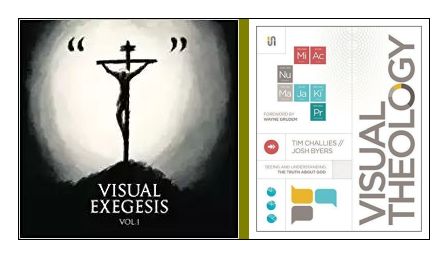
Chris Powers’ book Visual Exegesis, Vol. 1; and Tim Challies’/Josh Byers’ Visual Theology. As Justin Taylor said in his review of the Byers/Challies’ book,

Most theology books merely convey what we are to believe, but this one uses creative and beautiful design to capture and portray these crucial truths.

By themselves, both these books are worth your time. However what I wanted to point out also is that the Challies book comes with an 80-page study guide. And many of Powers’ animations as well as all his still pieces also come with written guides and explanations from scripture, which you can find at his site fullofeyes.com. The pictures plus the study guides, make these books valuable group teaching tools as well insightful as for individual learning.

As Chris Powers explains,

Imagery will always be secondary when it comes to declaring the glory of God in Christ, and so I want to make an explicit link between the imagery I am sharing and the words of scripture from which they spring

Westminster Books is offering until April 7, 2017, a free printed study guide with each purchased book Visual Theology ($11). If you miss the deal, or already own the book, you can download the Visual Theology Study Guide for free, here.

Posted in discernment, Uncategorized

The Power of Music- Baby Moved to Tears as Mom Sings Worship Song

In his book, Real Worship: Playground, Battleground, or Holy Ground? Warren Wiersbe wrote,

Music confronts the whole person, mind, heart, and will- and demands some kind of response. Music instructs the minds, inspires the emotions, and challenges the will. … It should not surprise us that great revival movements, evangelistic campaigns, and political and nationalistic crusades have all swept forward on the wings of song.Even Israel felt a new sense of unity and victory when they sang God’s praises at the Red Sea (Exodus 15), a scene that will be repeated in new dimensions when God’s people arrive in heaven. (Revelation 15:1-4).

I am convinced that congregations learn more theology (good and bad) from songs they sing than from the sermons they hear. Music reaches the mind and the heart at the same time. It has the power to touch and move the emotions…

RC Sproul said of music in his online class Recovering the Beauty of the Arts,

Just as conversion is an aesthetic experience in which the converted person is first awakened to the sweetness and excellence of God in Christ, so our musical expression of worship should continually direct our attention and stir us to adore His beauty and majesty.

But do not take my word for it. Watch what happens when a mom sings “Good Good Father” to her baby

Baby Moved to Tears as Mom Sings Worship Song to Him – “Good, Good Father”

Song Leaders, please be ever so mindful of the tremendous impact music has. Wiersbe said music

can be a wonderful tool in the hands of the Spirit or a terrible weapon in the hands of the Adversary. Naive congregations can sing their way into heresy before they even realize what is going on.