We tend to think of Revelation being the “hard” chapter. But Paul’s little missive to the Galatians has some tough language in it, and stern words for the Christians of his day and for Christians of all time. Paul sends curses out twice in this short passage. False doctrine is extremely important to tend to. A little leaven spoils the whole lump.
Paul wrote:
“I am astonished that you are so quickly deserting him who called you in the grace of Christ and are turning to a different gospel— not that there is another one, but there are some who trouble you and want to distort the gospel of Christ. But even if we or an angel from heaven should preach to you a gospel contrary to the one we preached to you, let him be accursed. As we have said before, so now I say again: If anyone is preaching to you a gospel contrary to the one you received, let him be accursed.” (Galatians 1:6-9).
Paul mentions here that:
–Christians desert solid doctrine –Christians accept a different gospel –Christians be warned that some come in who trouble us –Christians be warned that some who come in purposely distort the Gospel –Do not ‘dialog’ with the Gospel-perverters. Instead, let them be accursed!
“Have you ever noticed how difficult sometimes it is to reject a false system because the people in it are so nice? Paul says, “I don’t care if it’s me or if it’s a beautiful angel from heaven, let him be accursed.” So many buy false doctrine because the package is so nice. Don’t you know Satan knows that?” (source)
Far from being tolerant, having a ‘let them be mentality, or promoting inclusiveness; Christians should be exclusive to the Gospel only, intolerant of false doctrine, and vigorous in defending Christ.
The Bible offers a candid portrayal of human nature, showcasing both strengths and flaws. Acts 15 details a significant disagreement between Paul and Barnabas over John Mark, leading to their separation. This illustrates human conflict and the importance of reconciliation. Ultimately, believers are encouraged to learn from these examples while emulating Christ’s virtues.
Paul made three major missionary journeys. Acts 20 records the 3rd. He had spent 3 months in Greece, then planned to get on a boat in Corinth and set sail for Jerusalem via Syria, but he learned that some Jews were plotting to grab him for nefarious purposes on the voyage, so he decided to return to Macedonia by land. So Paul went from Corinth to Berea, Thessalonica, and Philippi, caught up with Luke again and observed Passover.
From Philippi, Paul and Luke set sail for Troas, arriving there five days later and meeting Paul’s traveling companions who had gone ahead of them: Timothy, Sopater, Aristarchus, Secundus, Gaius, Tychicus, and Trophimus. This is where we meet Trophimus.
And he was accompanied by Sopater of Berea, the son of Pyrrhus, and by Aristarchus and Secundus of the Thessalonians, and Gaius of Derbe, and Timothy, and Tychicus and Trophimus of Asia. (Acts 20:4).
Miletus was about 36 miles from Ephesus. Map source
Trophimus was mentioned three times in the Bible, in verse above in Acts 20:4, and also Acts 21:29, and 2 Timothy 4:20.
For they had previously seen Trophimus the Ephesian in the city with him, and they supposed that Paul had brought him into the temple. (Acts 21:29).
Erastus remained at Corinth, but Trophimus I left sick at Miletus. (2 Timothy 4:20).
Trophimus was from the Roman province of Asia and was living in or was from Ephesus. He was a Greek Christian. As we saw from the first mention of him in the verse, Trophimus was one of seven disciples mentioned by name who accompanied Paul on his return to Macedonia (Acts 20:3–4), meaning, the others to whom Paul was writing probably knew Trophimus personally, or knew OF him. These seven men formed an envoy from the various churches at Asia. They protected Paul, as it was better to travel in numbers. They also helped deliver the contributions from the churches of Asia to the saints in Jerusalem at the end of Paul’s third missionary journey (2 Corinthians 8:2–3). The delegation left Paul in Macedonia and traveled to Troas to wait for Paul and Luke to join them (Acts 20:4–6).
When they met up again, the men, including Trophimus, stayed together for a week. Imagine the theological conversations they must have held! The joy of being together!
Next time we read of Trophimus, it isn’t so joyous. We read of poor Trophimus being accused of having gone into the Temple with Paul, which uncircumcised Gentiles were not allowed to do. The Jews at that time were insisting that one had to become a Jew first in order to become a Christian. They leaped on the opportunity to accuse Paul of bringing Trophimus into the temple in order to get to Paul. And they did as much, dragging Paul out to be murdered. Of course, the accusation was false, but Trophimus’ name was used for evil purposes and he was innocently at the center of this controversy.
The modicum of fact lying at the root of this false accusation was that they had seen Paul and T. in each other’s company in the city. On this slender basis “they supposed” that Paul had brought T. past the barrier or middle wall of partition (Eph 2:14; see PARTITION), beyond which no Gentile was allowed to penetrate on pain of death. They supposed that T., who was neither a Jew nor a proselyte, but a gentile Christian, had been introduced into the temple itself by Paul—which would have been profanation. Hence their fury against the apostle. Source: The International Standard Bible Encyclopaedia (ISBE),. 1915.
Sometimes being Paul’s friend was dangerous!
The third time we read of Trophimus is when he had become too sick to travel. Paul had to leave him in Miletus.
As a side note: IF the miracle gifts had still been ongoing, why didn’t Paul just lay hands on his friend so he could continue the mission? Why doesn’t the verse say “Trophimus was sick in Miletus but I laid hands on him and by grace of God he used me to heal my friend.” Or something to that effect. 2 Timothy was written in 64/65 AD, and the sign gifts were well and truly dying out by then. The were for a sign to authenticate the Apostles and since it was nigh on 30 years since Jesus had departed and at least 20 years since the first NT book was written, the need to authenticate the ministers of God was lessening by the day.
In the previous book, 1 Timothy 5:23 written a few years before, Paul had advised Timothy to take wine for his stomach ailments.
Anyway, Trophimus was sick a few years after we last read of him, we know not with what, but was serious enough to cause Paul to have to leave T. behind. But not alone. We read in Acts 20:17 Paul had previously sent for some elders to come from Ephesus, which they did. It was an easy travel jaunt. Therefore, Paul was not abandoning his trusted friend and traveling companion to the wilds,
“Trophimus, therefore, in his sickness, could easily reach Ephesus, or his friends from that city could quickly come to him at Miletus, and give him whatever attention and nursing he might require.” ISBE
Keep in mind that these people we read about in the Bible are real people. They are alive now. We will meet them in heaven and commune with them. We can sit with Trophimus and talk with him about his sickness, his association with Paul at the temple, his missionary journeys. That’s why I write about the ‘little known’ Bible characters. Someday we will fully know them, and they will fully know us. What a day that will be.
If you have ever been in the midst of a controversy, you soon begin to see who your real friends are. As the controversy heats up, your friends edge away. They stop calling. They make excuses. They don’t sit with you in the workplace cafeteria. It becomes obvious they don’t want whatever ‘taint’ from your controversy to singe them, and they stay out of the circle of scorched earth you’re in.
Peter was one of those, after Jesus had been arrested, in attempt to separate himself from the stink of disgrace, Peter denied Jesus three times. Paul was deserted several times- John Mark left, Demas departed because he loved the world, and in 2 Timothy 4:16 Paul said ‘all’ had abandoned him at his first trial.
Of course we know that in the end, out of thousands who had followed Jesus in his heyday, only 4 women and John stayed with Jesus at the cross.
Self-preservation is strong in the human soul. It takes a strong person to stick with you when the chips are down. In 2 Timothy 1:15-18 we read Paul’s statement that ‘all who are in Asia turned away from me’. No matter how strong in the Lord a person is, it is still heartbreaking to be abandoned. Here, Paul mentions two specific men who left him: Phygelus and Hermogenes.
You are aware of the fact that all who are in Asia turned away from me, among whom are Phygelus and Hermogenes. (2 Timothy 1:15)
That hurts. For Paul to specifically name these guys must have meant that the letter recipients knew the two men. No doubt it brought uncertainty to the heart of some, who may have wondered, ‘should I leave? Why did they leave? Should I stay associated with Paul, or distance myself?’ Abandonment is disheartening. How do we know? Because Paul uses the opposite to describe one who stayed.
The Lord grant mercy to the household of Onesiphorus, for he often refreshed me and was not ashamed of my chains; but when he was in Rome, he eagerly searched for me and found me— the Lord grant to him to find mercy from the Lord on that day—and you know very well what services he rendered at Ephesus. (2 Timothy 1:16-18).
We learn much just from those 3 verses. (By the way, Onesiphorus is not Onesimus, the fugitive slave of Philemon).
1.He refreshed me- often! Visiting a dear friend who’s down is refreshing- to both of you. Sharing your joy in the Lord is refreshing. Singing together is refreshing. Just being there physically is refreshing. We don’t know for sure exactly what Onesiphorus did for Paul that was so refreshing but no doubt it included some of those things. And Onesiphorus did it often. Not a perfunctory visit. Not a putting in the time looking at the watch kind of visit, but many deep, refreshing sojourns.
2.’Not ashamed of Paul’s chains’- Onesiphorus’ identity was so strongly in the Lord he was not afraid to have his own reputation damaged by being seen at the disgraceful jail with this questionable character of Paul. This is a true friend. Self-preservation was not on his plate, selflessness was.
3.’Eagerly sought Paul’. It is refreshing just to know that someone is searching for you, eager to visit, and not grudgingly. It makes you feel loved! That’s refreshing!
4.’Service rendered at Ephesus.’ This is a man who loves the Lord and serves in many ways. Paul ended his letter with greetings to Onesiphorus’ household (2 Timothy 4:19). Onesiphorus’ service to Paul was really unto the Lord. Paul was blessed by it, no doubt Onesiphorus was blessed (Mark 9:41), and importantly, the Lord was blessed.
Choose your friends wisely. (Proverbs 12:26). Some may want to be your friend because of something they can get from you:
Many will seek the favor of a generous man, And every man is a friend to him who gives gifts. All the brothers of a poor man hate him; How much more do his friends abandon him! He pursues them with words, but they are gone. Proverbs 19:6-7
Maybe Phygelus and Hermogenes felt that way.
The Apostles and Disciples weren’t infallible. Sometimes they made mistakes. Philip baptized Simon the Magician. Demas was revealed to be a non-believer. John Mark failed for a while and bounced back, but not without fracturing a relationship and some heartache in between. But a true friend is good as gold.
A true friend shows love, no matter what (Proverbs 17:17). A true friend gives heartfelt advice, bringing joy to the heart (Proverbs 27:9). A true friend rebukes when necessary, but the correction is done in love (Proverbs 27:5–6). A true friend influences, enlivens, and sharpens (Proverbs 27:17). A true friend avoid gossip (Proverbs 16:28). A true friend forgives and does not hold grudges (Proverbs 17:9). A true friend is loyal (Proverbs 18:24). A true friend helps in time of need (Ecclesiastes 4:9–12).
The time may well come when a friend of yours enters into difficulty because of the faith. What kind of friend will you be? Stalwart, loyal, selfless? One who refreshes?
Or craven, undependable, selfish? One who abandons? Gear up now. These decisions will be happening.
I was reading Acts 27 and the seafaring language was a wonderful reminder of days when I lived on a sailboat. Some days were lazy, drifting along in puffs of wind on a glassy sea. Other days were tempestuous, the sea raging and the boat beating into waves that seemed to grow ever higher. There was one rough overnight passage we made along the coast of New Jersey. When daylight came we saw that the dinghy we’d trailed behind our yacht was missing. The rope had snapped.
It was a disconcerting feeling to be separated from what would need to be our lifeboat if it ever came to that.
“It is, in a great measure, by raising up and endowing great minds that God secures the advance of human affairs, and the accomplishment of His own plans on earth. All minds have their origin in God; and great minds seem to be created by Him as “He creates great oceans, great mountains, great worlds,” as proofs of His own greatness, … by bringing upon the stage from time to time some mind qualified by high original endowment to give a new impulse to human affairs; to lift up the race to a higher level; and to perform, in a single generation, what might have been otherwise the slow work of centuries, or what might not have been done at all.”
Paul opens his massive and majestic letter to the Romans with effusive rhapsodies of his love for the Roman believers and his gratitude for their faith- which he said is known the world over. He speaks of his intense desire to come to them so that he can be encouraged by their faith. Paul mentions them all the time to everyone. And so on.
First, we note Paul’s ministerial desire for his flocks and his obedient submission to his ordained role as Christian, pastor, sufferer. He is surely a super-Christian, if one such designation existed.
In the iconic movie The Princess Bride, Inigo is sailing a boat with all due speed in attempt to get away with a kidnapping. He looks back at one point and sees a distant boat on the horizon. The breeze is gentle and the night is long, so he has no worries. When he looks up again, he sees the boat is now close. And after a while, closer, then closer… This perplexing phenomenon causes him to utter the well-known line,
It’s like that with Paul. We might say, “I wonder if he is using the same Spirit we are using?” and the answer would be “Yes”. I am awed by Paul’s fervor, dedication, diligence and deep obedience never having wavered. He died poured out as a drink offering, a rushing torrent of obedience and love spilling across the altar of his beloved Savior.
Then in verse 15 of chapter 1, Paul says this-
So I am eager to preach the gospel to you also who are in Rome. (Romans 1:15).
Wait, what?
Hadn’t Paul confirmed the Roman believers’ solid faith, their well-known faith, their doctrinal and loving faith? Yes.
Some could interpret the verse as Paul being anxious to come minister to them, which is definitely true. But he didn’t say only that. He said he is eager to come preach the Gospel at Rome to Greeks and barbarians, to the wise and the foolish, “and also to you.” The Greek word for Gospel in this verse is euaggelizó which means bringing or preaching the full Gospel of Christ.
Some could interpret this as Paul’s eagerness to preach the Gospel indiscriminately to all, and that would also be true.
But do believers need the Gospel?
The answer would be “Yes.”
The Gospel is not a once-for-all mechanism that saves a person from the wrath of God and installs him into the kingdom as a child of God. Not only. It is the launching pad, and the eternal linchpin. It is the indispensable necessity for life eternal in the believer on earth and forever. The Good News is always Good News, and it continues being so, even for believers. Especially for believers.
The Good News is the fullness of Jesus, the encompassing message, the total plan of God, the victory of Jesus over sin, death, and hell. It is a message of resurrection, triumph, power, and abundant life. We all need this message, every day! Paul knew this. The Gospel is the mighty rushing wind of power and sustenance for every believer on earth who lives by the Spirit. We are reminded of the verse from 1 Thessalonians 1:5a
because our gospel came to you not only in word, but also in power and in the Holy Spirit and with full conviction.
Paul said in the very next verse, Romans 1:16 these famous and everlastingly glorious words:
For I am not ashamed of the gospel, for it is the power of God for salvation to everyone who believes, to the Jew first and also to the Greek. 17For in it the righteousness of God is revealed from faith for faith,e as it is written, “The righteous shall live by faith.”
The faith we live by is that Gospel, Good News of the savior Jesus Christ. We needed it when we were foolish, wise, Greeks, and barbarians. Now that we are saved, it’s a message “And also to you.” The gospel necessity never ends.
Kay Cude poetry. Used with permission. Artist’s Statement:
There is not one of the Apostles of Christ whom I do not love, and I am so grateful for their love and dedication to Christ, as well as to us the redeemed who have loved the truth of their teachings about our Lord and Saviour.
New York City. The Empire State Building as seen from the East River. Note its lightning rod. EPrata photo
Our teaching pastor is going through Acts. We got to a part where the scriptures introduced Barnabas. My teaching pastor spent some time relating to us the scriptures that demonstrated Barnabas’ character. Anyone who has spent any amount of time in the New Testament is familiar with Barnabas.
Barnabas was nicknamed “Son of Encouragement.” It’s a great nickname. Son of Encouragement is way better than the nickname given to James and John- “Sons of Thunder” AKA Boanerges. Barnabas and Paul were together for many years, a pair that encouraged each other, supported each other, and went about on mission teaching and preaching having each other’s backs. Barnabas even affirmed Saul before he was widely known as a convert and still seen as a persecutor. (Acts 15:2, Acts 9:27). Look for how many times in the New Testament we read, “Paul and Barnabas.” As Kevin DeYoung said in his sermon Christians in Conflict, these two were like Batman and Robin.
So the other day I watched a clip of a storm hovering over a driving range. The range had been cleared, but one teenager wanted to get in one last swing. He drove his golf ball off the driving tee, and hurtling 88 miles per hour, in mid-air a lighting bolt came out of nowhere and incinerated it. The youth was amazed and scurried further into the safety of the covered roof. The video made the news.
The National Weather Service has a few things to say about lightning and thunder. “Lightning is an underrated killer, responsible for an average of 26 deaths per year across the country (10 year average).” The NWS motto is, “When Thunder Roars, Go Indoors!” because “if you can hear thunder, you are close enough to be struck by lightning, … No place outside is safe during a thunderstorm.”
Paul was a lightning rod. We know that the Lord told Ananias in Acts 9:16 that Paul must suffer for His name. In 2 Corinthians 11:23b-27 Paul recounted some of these sufferings-
I more so; in far more labors, in far more imprisonments, beaten times without number, often in danger of death. Five times I received from the Jews thirty-nine lashes. Three times I was beaten with rods, once I was stoned, three times I was shipwrecked, a night and a day I have spent adrift at sea. I have been on frequent journeys, in dangers from rivers, dangers from robbers, dangers from my countrymen, dangers from the Gentiles, dangers in the city, dangers in the wilderness, dangers at sea, dangers among false brothers; I have been in labor and hardship, through many sleepless nights, in hunger and thirst, often without food, in cold and exposure.
Barnabas suffered also. Barnabas was with Paul at Lystra when the Jews stoned Paul. Acts 14:19-20
But Jews came from Antioch and Iconium, and having persuaded the crowds, they stoned Paul and dragged him out of the city, supposing that he was dead. But when the disciples gathered about him, he rose up and entered the city, and on the next day he went on with Barnabas to Derbe.
Even if the people with Paul didn’t directly experience the stoning, they experienced trauma. Even if one stone had not landed on Barnabas, Barnabas had the agony of witnessing his friend being injured, watched him dragged bloody and unconscious out of the city, and thought his friend was dead! It must have been emotionally wrenching for Barnabas.
What if you’re a bit shy, and friends with someone who stands firmly on biblical doctrine? What if you’re friends with a podcaster who receives push-back for their stances? What if you are friends with someone who preaches or teaches or proclaims in the streets the ordinances of God? Will you stand with him or her? Or will you back away?
Counting the cost not only has application for the ones proclaiming, but for the friends within that person’s sphere, too. Will you stand with your friend and ignore your crumbling reputation because of his or her strong stances? Will you support by your friend, defending him even when others back away? Will you keep holding the lightning rod?
In 1752, when Ben Franklin was mulling over the issue of lightning and electricity, even before he did his kite experiment, Franklin proposed a lighting rod would be a safe way to attract the lightning and deliver it safely to the ground before it could harm anything or anyone. He called it the lightning attractor. These days, anyone who stands on biblical doctrine is a lightning attractor. We never know when or from what direction the strike will come from, but it will come.
Indeed, all who desire to live a godly life in Christ Jesus will be persecuted, 2 Timothy 3:12
The days are evil and getting more evil by the day. Here in the United States, there is an overt and aggressive push against anything Christian. It’s worse elsewhere in the world. Just saying a Bible verse out loud in public is often enough to draw the lightning! Counting the cost will come to mean counting whether or not to be a Robin to your Batman.
Well, when he arrived at the synagogue, he was invited to preach; and Barnabas and he sitting in the congregation were noticed by the leaders. Paul was invited to preach, and he did. His sermon blew the city wide open. It was the most devastating, shattering thing that perhaps had ever happened in the city of Antioch. The city had, like most cities, endeavored under its leadership to maintain some kind of a placid equilibrium and some kind of a balance, and that was absolutely shattered by the preaching of Paul. But before we would be too surprised, we would call to mind the fact that the gospel, whenever it is purely proclaimed in the midst of sin and wherever there are unsaved people, is bound to have results that are going to be shattering. (Source: The Troubling Gospel)
Bearing the above in mind, here’s an imaginary conversation between Paul and Barnabas.
Barn, let’s sail to Cyprus. Hey, haven’t you been shipwrecked three times? Yup. OK, let’s go! And Barnabas gets on the ship.
Would you get on a ship with Paul? Will you hold the lightning rod? It’s one thing to hang onto it when skies are clear. Now that it’s stormy, will you not only stand next to it, but hold it? These are decisions you will no doubt need to make as time goes on. We bless Barnabas for being a faithful friend to Paul even though Paul’s sufferings often included his friend either witnessing dire events, or participating in them. Silas was jailed WITH Paul-
The crowd joined in an attack against them, and the chief magistrates tore their robes off them and proceeded to order them to be beaten with rods. When they had struck them with many blows, they threw them into prison, (Acts 16:22-23a).
If you’re a Robin because you like to be in the background, you might sorrowfully find yourself stepping away from your friend. If you’re a Robin because you’re a Son or Daughter of Encouragement and enjoy being a support to someone else for the name of Christ, then you might find yourself on a wild ride like that golf ball hurled into the skies only to be struck by a bolt out of the blue. Will you get on the ship with Paul or wave goodbye from the shore?
Time will tell. But think on these things, and prepare ahead for the inevitable time of deciding.
Thank goodness for historians. In ancient Rome during the last days of the Apostle Paul, Sallust and Livy, for example, wrote of the notorious jail in Rome known as the Mamertine, dubbed so in the medieval period. It’s originally known in history as the Carcer, or the Tullianum, or at least, the lower half of the underground dungeon was. History does not record for a definite fact that Peter and Paul were at different times held there, but tradition and Roman practice indicate it was a strong possibility.
This essay is constructed in three sections:
Section 1: The prison itself. What was it like? Section 2: Paul in Prison Section 3: Facing Death
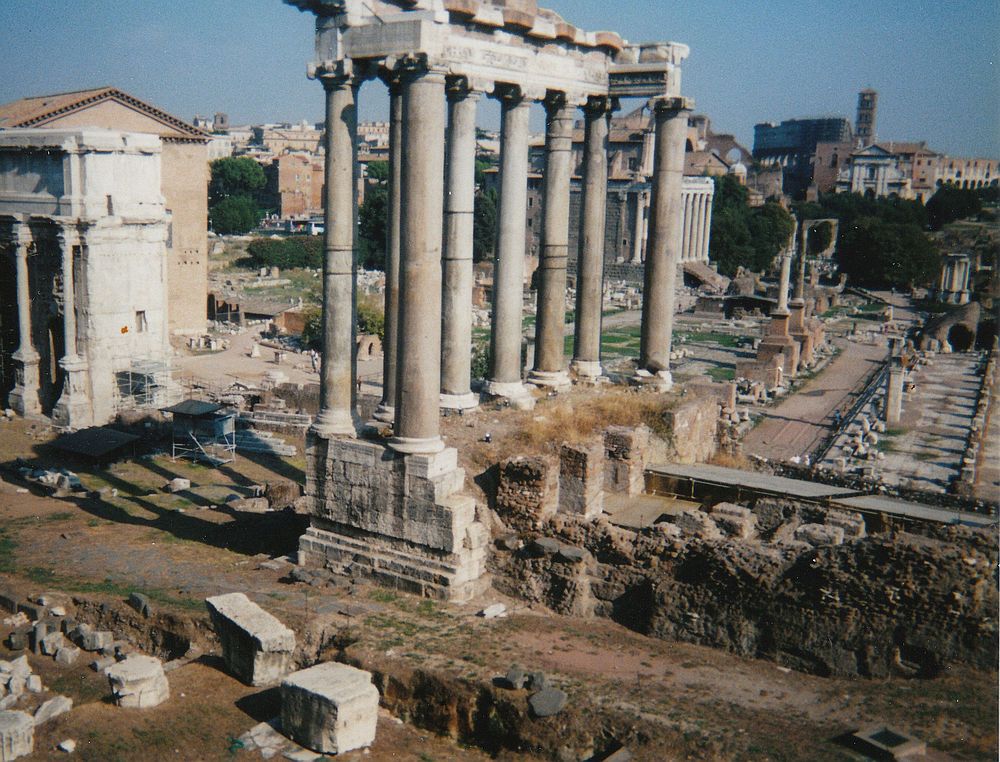
Roman Forum. Mamertine Prison was up behind the building with the dentil cornice. EPrata photo
What was the Mamertine Prison like?
The Mamertine prison was a prison in the Roman Forum where high-profile prisoners were kept, usually so they could be marched through the Roman streets during a triumph parade. High ranking commanders captured during war and other famous prisoners’ names are recorded on a plaque at the entrance. Since Paul was a significantly known public figure, it’s likely when he was imprisoned in Rome, this was the place he was kept.
The prison was deliberately constructed in the middle of the city and placed in the middle of that, into the Roman Forum, as a symbol of Rome’s power, authority, and as a warning. Crime had begun to rise as the city grew, and the Emperors wanted its citizenry to heed the consequence of crime. Hence the jail was visible and constructed so as to be fearsome.
Interestingly, Roman law did not consider the imprisonment itself as a punishment. Jails were simply a place to hold the captured or the criminals until execution, which was the punishment. Mamertine was a place of detention until execution. Barbarian Commanders captured in war were paraded and then strangled publicly, for example. Roman citizens, if unfortunate enough to have been detained for a crime, were taken outside the city on the Ostian Way and beheaded there, usually in private. Privacy in execution was a way to give a Roman Citizen his last dignity. Non-Romans were killed by any method; for example, sent to the beasts, used to the death in gladitorial games, or crucified as Peter was (tradition says, upside down). These executions were public for the spectacle of Roman power and for the amusement of its citizens.
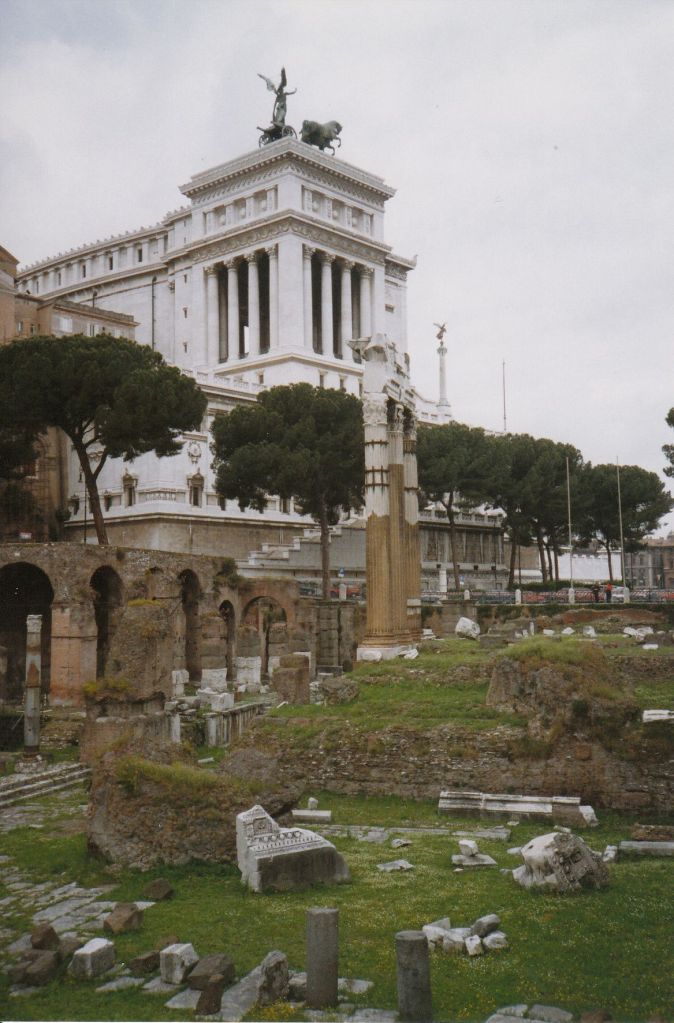
Roman Forum. EPrata photo
The Mamertine, or Tullianum prison was a two-story underground prison. The upper chambers had light and air and was drier. The lower, which prisoners were let down through a hole for their fate, was dank. Historians say the word tullius meant a jet of water and since the prison was originally built as a cistern, this signifies the origin of the name. When the 6th emperor of Rome Servius Tullius arose, the origin story shifted to claim his name as the name of the jail. Below the well or cistern ran the sewer known as the Cloaca Maxima. Seepage from the sewer into the cells just above was common. In fact, they used to flush out the corpses of the incarcerated dead to the Tiber River in this way.
Once the door was shut there was little air, no light, and the cell was steaming hot. Just the name of the Mamertine drew shudders, as in this account from historian Sallust-
“There is a part of the prison which is called the Tullianum, where you ascend a short way on the left. The Tullianum is sunk into the earth about 12 feet and is constructed of stone walls on all sides; above this is a room with a ceiling of vaulted stone. Foul from neglect, darkness, and stench, it is an altogether terrifying sight. … Sallust described “Its appearance is disgusting and vile by reason of the filth, the darkness and the stench.” Sallust, War against Catiline 55. “Execution of Prisoners.”
Prisoners who were held for trial were called in carcer from which we get the word incarcerated. If you were in the Mamertine prison, you were considered as dead. Sometimes, in fact, they threw you down to the lower cell and starved you to death. What a way to go, in the dark, forgotten, hungry, alone, and then you die the painful slow death of starvation, knowing your ignoble corpse will be flushed into the sewer as waste.
Paul in prison- what do the scriptures say?
Paul was jailed numerous times and in a variety of conditions. His first was at Philippi, where he’d delivered a slave girl of her demon of divination and the owner was upset his method of income was gone. This was around 51AD. Paul (and Silas’) release was a supernatural event accompanied by an earthquake and an instant loosening of all the bonds and chains. The jailer was converted, and the next day the magistrates came and let Paul and Silas go (but asked them to leave the city). Paul went to Lydia’s house. (Acts 16:22-40).
Paul’s second jailing that we know of occurred in Jerusalem. It was prophesied beforehand that he would be jailed, (Acts 21:11) but Paul pressed on, knowing at the outset that Jesus had said Paul was to suffer mightily for the Name. (Acts 9:16). Jews, jealous of Paul, claimed (wrongly) that Paul was allowing Gentiles into the Jews-only part of the Temple, and stirred up a riot. (Acts 21:28). This was AD 57. Paul was removed to Caesarea for his safety, kept another two years, sent to Rome under house arrest around AD60. He was released in 62AD.
Paul’s last jailing was likely at the infamous Mamertine prison. He had been deserted. He knew this was the end. He had written before that he had learned to be content in whatever circumstances he found himself in by God’s providence. He had learned he could do all things through Christ. (Philippians 4:11-13). Whether enjoying a comfortable house imprisonment attended to by family, whether free and dining at Lydia’s in fellowship with the saints, or hunkered down in the sewage at Mamertine, hungry and alone. We do not know if the Lord visited Paul at the end, but we do know the Lord visited Paul at other times in his jailings, like in Acts 23:11. Bible Knowledge Commentary says,
23:11. The importance of this vision was not only in its comfort and encouragement (cf. 18:9–10) but also in the confirmation it gave of Paul’s plans to go to Rome. The gospel of Christ would literally go from Jerusalem to Rome by means of the Apostle Paul. This was the fourth vision the Lord gave Paul (cf. 9:4–6; 16:9; 18:9–10).Toussaint, S. D. (1985). Acts. In J. F. Walvoord & R. B. Zuck (Eds.), The Bible Knowledge Commentary: An Exposition of the Scriptures (Vol. 2, p. 420). Wheaton, IL: Victor Books.
Facing Death
But in reality, I think it must have been hard to maintain a positive attitude in that place. Only Luke was with him, which must have been a comfort. (2 Timothy 4:11). Paul hopes to see Timothy and also Mark. Paul was a super-Christian, but still a man. He had been buoyed personally by Jesus many times, supported by family at times, and enjoyed within his circle of beloved friends. But what thoughts go through a man’s mind when sitting in a jail cell knowing the end has come? He longed to be with Jesus, that is certain. But he just have wondered if his actual death would be prolonged or painful. He must have wondered how long he would languish in that dank place. He had been blessed with glimpses of ‘the other side,’ but must have wondered what would it really be like to be with Jesus eternally. Here is A.T. Robertson’s The International Standard Bible Encyclopaedia entry of the end.
"When Paul writes again to Timothy he has had a winter in prison, and has suffered greatly from the cold and does not wish to spend another winter in the Mamertine (probably) prison (2 Tim 4:13, 21). We do not know what the charges now are. They may have been connected with the burning of Rome. There were plenty of informers eager to win favor with Nero. Proof was not now necessary. Christianity is no longer a religio licita under the shelter of Judaism. It is now a crime to be a Christian. It is dangerous to be seen with Paul now, and he feels the desertion keenly (2 Tim 1:15 ff; 4:10). Only Luke, the beloved physician, is with Paul (4:11), and such faithful ones as live in Rome still in hiding (4:21)." [Robertson's The International Standard Bible Encyclopaedia entry continues->]
"Paul hopes that Timothy may come and bring Mark also (4:11). Apparently Timothy did come and was put into prison (He 13:23). Paul is not afraid. He knows that he will die. He has escaped the mouth of the lion (2 Tim 4:17), but he will die (4:18). The Lord Jesus stood by him, perhaps in visible presence (4:17). The tradition is, for now Paul fails us, that Paul, as a Rom citizen, was beheaded on the Ostian Road just outside of Rome. Nero died June, 68 AD, so that Paul was executed before that date, perhaps in the late spring of that year (or 67). Perhaps Luke and Timothy were with him. It is fitting, as Findlay suggests, to let Paul’s words in 2 Tim 4:6–8 serve for his own epitaph. He was ready to go to be with Jesus, as he had long wished to be (Phil 1:23)."

Source-  Robertson, A. T. (1915). Paul, the Apostle. In J. Orr, J. L. Nuelsen, E. Y. Mullins, & M. O. Evans (Eds.), The International Standard Bible Encyclopaedia (Vol. 1–5, p. 2287). Chicago: The Howard-Severance Company.

And so, Jesus gathered Paul to Himself to enjoy eternal peace and rest after so much suffering for the cause. Of all people, we can say of Paul, "Rest in Peace, brother".












 the-end-time.org