Posted in theology

Kay Cude Poetry: Hymn and food for thought

By Elizabeth Prata

Today’s piece from Kay Cude is inspired by the hymn And Can it Be? by Charles Wesley, (his lyrics appear on the art and also below), and the sermon The Divine Summons by John MacArthur. Kay Cude is a Texas poet. Used with permission. Here is Kay Cude’s Artist’s Statement:

“Sometimes in the midst of our sanctification as we face some very inflexible, but necessary trials, we may find that we need the comfort of the deep sustenance that comes through feeding upon sound, Biblical truths that are richly expressed in many of the “old” hymns.  I know that I do.”

“I am still moved by “And Can It Be?” by Charles Wesley and find that Pastor MacArthur’s “The Divine Summons” goes hand-in-hand with it as instruction and edification for we whose circumstances compel us to return to the study of God’s sovereign act of salvation and the reassurance that it is God’s work in us and none of our own.”
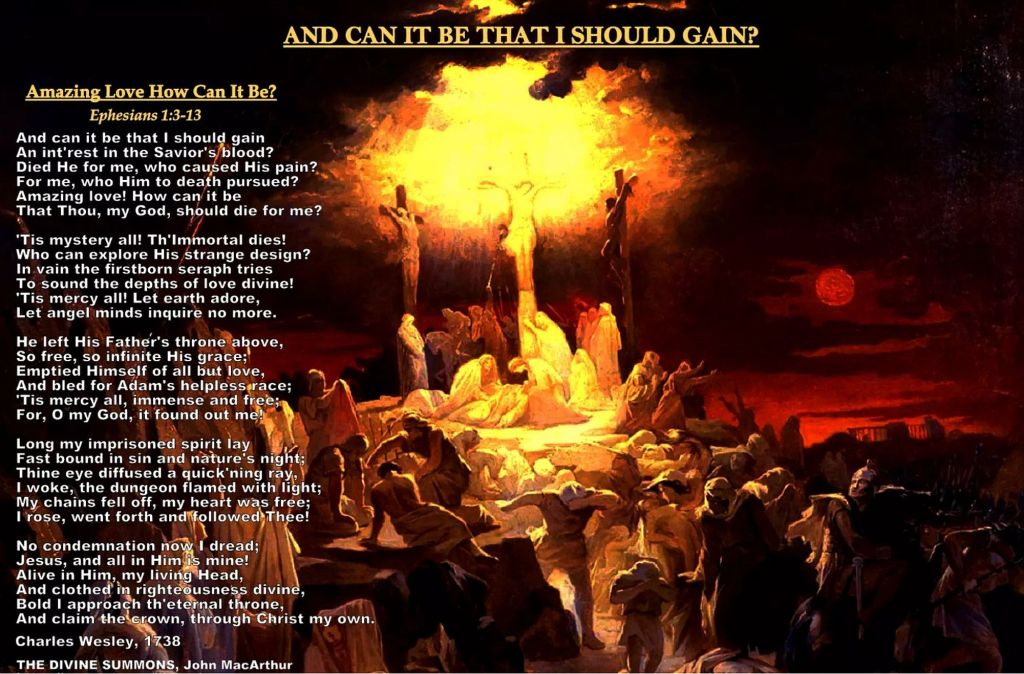
Painting by Vasily Golinsky, “The Crucifixion of Christ” (1890-1900)

And Can it Be? Charles Wesley, 1738

And can it be that I should gain
An int’rest in the Savior’s blood?
Died He for me, who caused His pain?
For me, who Him to death pursued?
Amazing love! how can it be
That Thou, my God, shouldst die for me?
Amazing love! how can it be
That Thou, my God, shouldst die for me?

’Tis mystery all! The Immortal dies!
Who can explore His strange design?
In vain the firstborn seraph tries
To sound the depths of love Divine!
’Tis mercy all! let earth adore,
Let angel minds inquire no more.
’Tis mercy all! let earth adore,
Let angel minds inquire no more.

He left His Father’s throne above,
So free, so infinite His grace;
Emptied Himself of all but love,
And bled for Adam’s helpless race:
’Tis mercy all, immense and free;
For, O my God, it found out me.
’Tis mercy all, immense and free;
For, O my God, it found out me.

Long my imprisoned spirit lay
Fast bound in sin and nature’s night;
Thine eye diffused a quickening ray,
I woke, the dungeon flamed with light;
My chains fell off, my heart was free,
I rose, went forth, and followed Thee.
My chains fell off, my heart was free,
I rose, went forth, and followed Thee.

No condemnation now I dread;
Jesus, and all in Him, is mine!
Alive in Him, my living Head,
And clothed in righteousness Divine,
Bold I approach the eternal throne,
And claim the crown, through Christ my own.
Bold I approach the eternal throne,
And claim the crown, through Christ my own.

Posted in encouragement, Uncategorized

Kay Cude Poetry: The Light of Our Salvation

Artist’s statement:

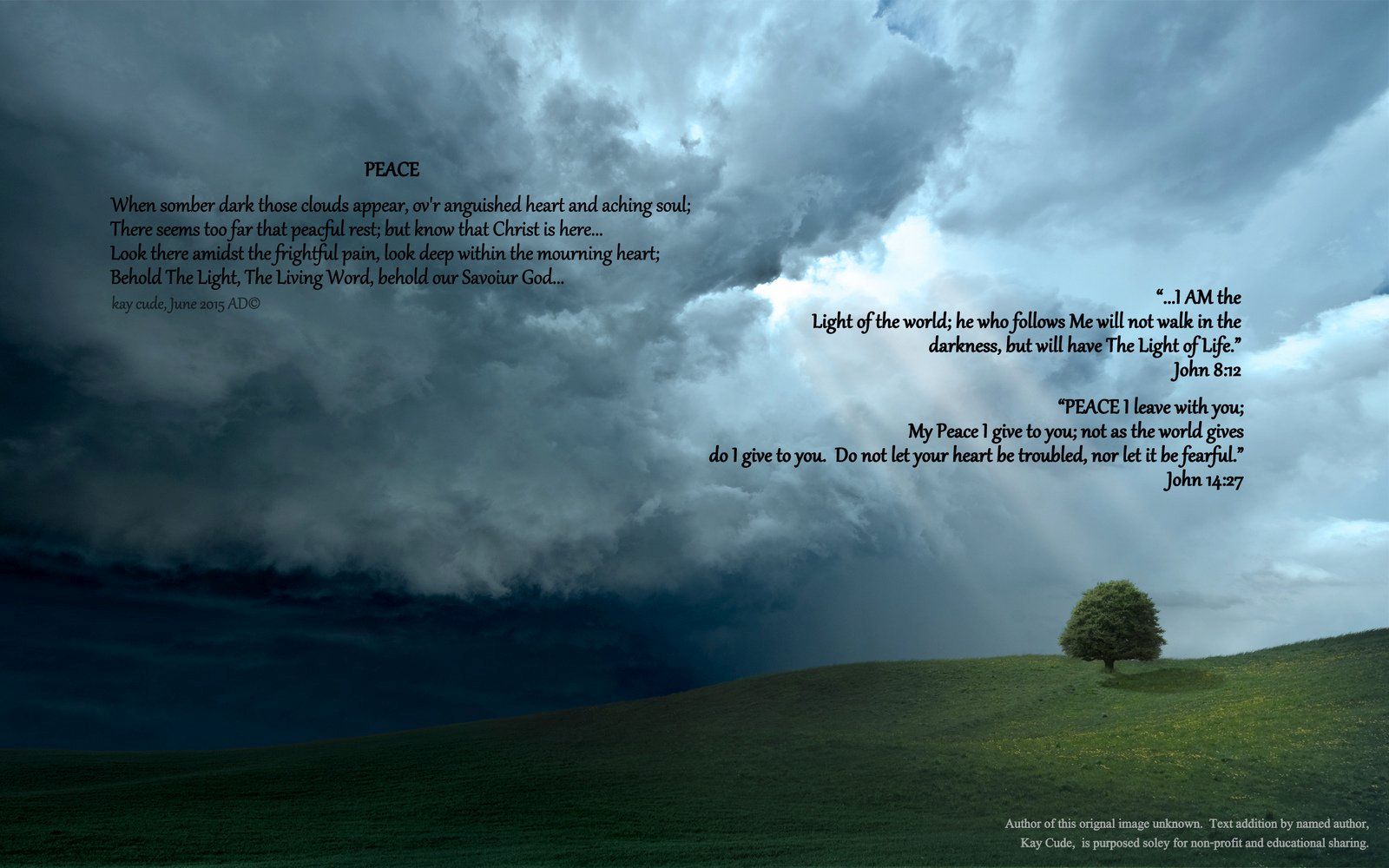
For me, the lone tree speaks of God’s wonderful handiwork, not only representing His gift of nature, but brings to mind that His redeemed are not alone, but safely tucked within His Might eternally. And as the brilliance of the sun pierces boldly through the dark-ending of the storm, one thought leads me to another — remembrance of Christ’s death and resurrection. Then speaks to His beloved redeemed: the “things” of this world are now more clearly seen through the light of His Salvation! We must daily pause to remember…

REMEMBRANCE
Posted in theology

Kay Cude Poetry: The Trinity

Right click the picture to see larger in new tab. Used with permission of author.

Kay Cude Author Statement:

“I [Kay Cude] was reading the July 2022-Volume 706 Banner of Truth Magazine when I came upon an article by Nick Needham, “Shapers of Christianity-Gregory of Nazianzus (AD 330-390).”

Mr. Needham begins, “The fourth century is often considered the Golden Age of the Early Church Fathers, owing to the sheer intellectual and spiritual brilliance of that century’s Christian thinkers in expounding the faith doctrinally and practically.  Among its most influential figures were the Cappadocian Fathers.”

‘”This was a group of three theologians from the Roman province of Cappadocia in Asia Minor –Basil of Caesarea, his brother Gregory of Nyssa, and his friend Gregory of Nazianzus.  Of the three Cappadocians, Gregory of Nazianzus came to be the most treasured by following generations.  Greek speaking Christians reverentially called him “Gregory the Theologian,” as if he were the first true theologian after the apostle John.  In the Greek East, the term “theologian” had special reference to the Doctrine of the Trinity.  The apostle John was held to be the first great theologian in that sense, and Gregory the second.”

As a Southern Baptist, I [Kay Cude] am insufficiently read of the early Church Fathers, but that four page article drew me into a “beginning understanding” that their unwavering dedication to stand in and teach the Doctrine of the Trinity and lead the church in rejecting and vanquishing the Arian heresy, should also be the understanding and dedication of the 21st Century’s true Body of Christ.  We also are to understand that the fullness of the Trinity is wholly divine.  And that should also compel us to stand unwaveringly against Arianism and any other demonically inspired weaponry raised against the Doctrine of Trinitarianism.

This dedication is perhaps more important than too many of the redeemed of the invisible church realize; for the bewitchment that is Arianism is once again an acceptable theology of a greater portion of the visible church.  Far too many do not believe in the Holy Trinity; and most assuredly far too many reject the second person of the Trinity, our Lord and Saviour Christ Jesus as divine and of the same full essence and nature with God the Father.

In summary, I find that the more I seek to learn and understand, the more I realize how very little I know and how very faint is my understanding of the Holy Trinity; and yet I am compelled to want to know.  And that is the excellency of the mystery of the sovereign and providential work and will in our spirits by our Father the Lord God I AM WHO I AM; that our hearts are compelled by the Holy Spirit to seek to know the Lord God I AM as He really is; and in that, to know and honor and worship the divine fullness of the Trinity and the three distinct persons, God the Father, God the Son, and God the Holy Spirit.  We must desire to have a right understanding of what is the true honoring in the true worship of the “One Deity and Power, found in the Three-in Unity.”

ORATION 40, CHAPTER 41 – GREGORY OF NAZIANZUS

I set before you the One Deity and Power, found in the Three-in-Unity,
Embracing the Three One by One, equal in essence and nature,
Neither increased nor decreased by ideas of greater or less;
In every way equal, in every way the same,
Just as the loveliness and hugeness of the heavens are one:
The infinite oneness of Three Infinite Ones,
Each of whom is God when seen individually in Himself.
As the Father is God, so is the Son,
And as the Son is God, so is the Holy Spirit;
And the Three are likewise One God when seen together.
Each is God because they are of the same essence,
And they are One God because of the single principle of Deity.
The very instant I conceive of the One,
I am enlightened by the brightness of the Three;
The very instant is differentiate them,
I am carried straight back to the One.
When I regard any One of the Three, I think of Him as the Whole;
My sight is filled to the brim,
And the greater part of what I am thinking of eludes me!
I cannot grasp the greatness of One of the Three
So as to reckon a greater greatness to the Others.
And when I see the Three together, I see only one torch,
And I cannot divide or share out the Undivided Light.

right click to open larger in new tab. Poetry by Kay Cude