An essay critiques feminism within conservative Christianity, arguing it disguises itself as ministry. Tracing roots from temperance to suffrage, it defines feminism, challenges female celebrity teachers, and claims biblical hierarchy is violated when women pursue public platforms, careers, and influence while neglecting home-centered roles scripturally.
I critique an older essay of Jen Wilkin’s, labeling her a false teacher whose trajectory since 2014 has been downward. I translate her false teacher-speech into what she is really saying, in order to demonstrate that even seemingly soft words and faux-kindness have hidden barbs that destroy. I warn that false teachers use persuasive language, urging discernment when evaluating their messages.
I was disappointed to see Midwestern Baptist Theological Seminary’s social media outreach @forthechurch feature Jen Wilkin at their upcoming Women’s pre-conference in September. Sadly, Jen is not solid. Her egalitarian, gyno-centric, angry, usurping preaching should be a no-go for women, and the men at that seminary should evidence better discernment.
It is QUITE ironic to me that the topic of her speech will be ‘faithful to the family’, when Jen has not been faithful to GOD! She preaches to men, violating the very word she promises to strengthen you by. (1 Timothy 2:12)
Jen has spent the last decade or more urging pastors and leaders to put women in “visible leadership positions” and even preach, when the Bible says for wives to do good at home. (Titus 2:3-5).
But that has not been Jen’s MO for years. She has a heavy speaking schedule and up until last September for the 12 years previous to that had been on staff at The Village Church. Jen has children, is married, and totally violates the topic of her own upcoming speech. Can a student go higher than his teacher? Can one learn how to strengthen one’s walk by listening to a usurper? No. Avoid Jen Wilkin.
About the series: I have written discernment essays critiquing various teachers. In articles like that, I include sources, explain the teacher’s errors thoroughly, and provide examples. All this make the essays longer. Nowadays however, people like to read less lengthy material. So I cut to the chase and made shorter essays showing why these folks are false. In the Cut to the Chase I include links at the end if you care to go to my longer essays and/or other resources.
Why should we avoid Jen Wilkin?
1. Poor hermeneutic. Wilkin’s emphasis on gender and pushing for opportunities for women to teach (no focus on exercising the other gifts, solely teach, preach, or be hired leader-staff) is starting to twist her hermeneutics. I saw this in each of the messages I watched, including a Bible teaching from 2014 supposedly expositing Joshua, the Rahab segment of that speech. Her teaching is off. I would not trust it and sadly do not recommend Jen Wilkin’s Bible studies. Some have called her recent teachings ‘gynocentric’ which I think is apt.
2. Discernment. Jen is partnering with and promoting questionable/false teachers. She is increasingly speaking with Kelly Minter, Christine Caine, Priscilla Shirer, and Beth Moore. Also Jackie Hill Perry. See one example here. Another is the Lifeway Women’s Leadership conference in February 2020. More recently Jen spoke at an Oklahoma Women’s Retreat alongside Whitney Capps, who is part of false teacher Lysa TerKeurst’s Proverbs 31 Ministries and Lifeway Women…and The Gospel Coalition Women with Muslim Isa-dreams believer David Platt.
3. Egalitarian. In one famous example, Wilkin based her entire talk on the biology of men and women, avoiding the biblical/spiritual foundation. When she does refer to the Bible it was to present a different interpretation of the creation of humans in Genesis 2.
In that speech, Wilkin explained to the attending male pastors and church planters, that it’s important to understand the biology of men and women when you’re planting a church, and so you can use women in “visible leadership”. You hear this phrase from Wilkin a lot … “visible leadership”. She is big on women in visible leadership. As opposed to “hidden leadership”? Wilkin tries to make the case that men and women are interchangeable and therefore their roles are too. She does not preach the beauty of an Abigail, Anna, Lydia, Mary, Dorcas. Her sole focus of late is women who leading, and often mentions Deborah and Huldah. She is against the concept of complementarian helpmeet, which is why she needs to reinterpret Genesis 2.
3. Attitude. Titus 2:3a says, Older women likewise are to be reverent in behavior Wilkin is on record as being angry and being snarky. Greear said in his introduction about her that he’d first heard of her as ‘The Bible Girl’ and talked with her, testing her for her biblical knowledge, and “she’d always give back a snarky answer, to let me know that she knew a whole lot more than I did about whatever I was asking about, so I learned to be very respectful around her…”
Unknowingly Greear made Proverbs 27:15-16 come to life-
A constant dripping on a day of steady rain And a contentious woman are alike; He who would restrain her restrains the wind, And grasps oil with his right hand.
Wilkin sometimes demonstrates a barely suppressed anger, a vitriol that in one case clearly came through. She actually called one noted and credible theologian “a pervert”. It was uncharitable in the extreme. In another case of an author of a commentary writing that Rahab was a prostitute, she said to her audience, “If I ever meet him I’ll probably sock him in the face.” Maybe her anger is not so suppressed after all.
Show yourself in all respects to be a model of good works, and in your teaching show integrity, dignity, 8and sound speech that cannot be condemned, so that an opponent may be put to shame, having nothing evil to say about us. (Titus 2:7-8).
4. Omissions. Wilkin does not teach the role of women as submissive learners, content in her God-designed role to serve at home and humbly in the church. She does not teach women mentoring other women. She does not teach positively about the women who submitted to their biblical roles, like Lydia, Eunice and Lois, Anna. Jen speaks of “the gifts” but restricts ‘the gifts’ to teaching and not the other gifts such as administration, hospitality, support, etc. She focuses on the teaching and positions of women in “visible leadership.” Omissions are harder to detect but once you realize Jen gives only part of the story of our roles and joys, you can’t forget it. She is unduly entranced with gender politics and it’s affected her teaching and her own walk.
Further discernment essays from The End Time critiquing Jen Wilkin-
I went back and re-edited the following two series. They are slightly shorter now.
This 3-part series looks at Jen Wilkin’s “Redefining Rahab” lessons from 2014 and 2018. We have abackground & intro part 1, a look at her gender emphasis in the Rahab lesson part 2, and finally this essay, part 3, a look at her academic ethics & her situational ethics from that Rahab lesson.
I wrote a 3-part series on Mrs Wilkin, looking at her overall ministry here,here, here. It got long, so I promised to follow up with some specifics from her Rahab teaching lesson. This is that series.
Mrs Wilkin teaches expositionally through books. This is good. She has taught through Joshua recently and also in 2014. In the section concerning Rahab, Wilkin preached a gender message. I am sad to report this. I was fairly shocked with Wilkin’s attitude through this lesson, which was angry, unethical, and improper for a woman of her maturity and standing. Let’s take a closer look.
Full lesson from 2014 sorry this full episode has been deleted and I can’t find it anywhere on the internet
A pertinent part of the 2018 talk is transcribed for you here. Wilkin said much the same things in her 2014 podbay lesson and the June 2018 Lifeway talk. One difference is that in the 2014 talk Wilkin said the names of the commenters with whom she disagreed.
But in both talks Wilkin twisted the exposition to meet her own agenda, which was to elevate and redefine Rahab’s reputation away from the biblical characterization, downplay her prostitution as a sin, add a mythical backstory, and tarnish the men who dared to speak of her in a way Wilkin didn’t like.
Jen opens her lesson this way-
Quote: Rahab has been handed down to us thru the centuries characterized with 2 words- she is liar and a whore. That is the way she has come to us through the centuries. Even to today I was hard pressed to find commentaries that did not view her in that light. Listen to some of the things I read as I prepared to teach. (from 2014 podbay lesson).
The reason Rahab ‘has come down to us’ as a liar and a whore is becuase the Bible says that is what she was.
Quote: How has [Rahab] come down to us through history? She’s a woman and a Canaanite and a prostitute. She would have been a social outcast even among her own people. Here’s the way she is often referred to in commentaries. I’m not going to name the names of the commentators. … You know why she was a prostitute? Because she wanted to be one.(from 2018 Lifeway lesson)
Wilkin refers to Rahab several time as a ‘whore’: History has judged Rahab as a liar and a whore. Is that how we should read her?
In the 30 or so Bible translations I looked at, the word prostitute or harlot was used almost equally. Not one used the word whore. Only Jen Wilkin called Rahab a whore. That was Wilkin’s choice, and of course, we know that it is a worse word, an inflammatory word.
The reason Rahab has ‘come down to us in history’ as a prostitute is because God in His wisdom inspired the writer to write it that way. It is a fact. She was a prostitute. That was her profession. Lydia was a dyer of purple, Moses was a shepherd. Rahab was a prostitute. It’s a plain fact, but Wilkin spends a good deal of time in her lesson on this topic, as we will see.
Quote: Here’s the way that she’s often referred to in commentaries. I’m not going to name the names of the commentators, but can I just be honest with you? Male commentators can be super hard on female Bible characters. Abraham can take his wife over to Pharaoh’s house and leave her there for several weeks twice basically. Abimelech and Pharaoh. And we’re like, “But you know what? It’s cool.” And then the women, it’s like, “Mmm. No. You know why she’s a prostitute? Because she wanted to be one.”
It is a massive generalization to claim that ‘male commentators’ are ‘super hard’ on female characters. Her gender bias is showing here. In addition, Wilkin is claiming that the male commentators are biased in how they write their commentaries, that they see male vs. female and write about the females in a less than honest way. It may or may not be so. If one finds bias in a commentary then a teacher should just move on and not disdain their work by publicly mocking it, which was the tone of Wilkin’s voice as she made the statements. So far she hasn’t taught the text yet.
Matthew Henry, we can give his name out cause he’s long dead. And this does not mean these men are terrible commentators, it’s just a sampling for you. I said I wasn’t gonna say their names, I lied. He’s describing her taking them up on the roof and hiding them under the stocks of flax and he says, “By these stocks of flax it appears that she had at least one of the good characters of the virtuous woman. However, in others of them, she might be deficient. That she sought wool and flax and wrought willingly with her hands. From this instance of her honest industry, one would hope that whatever she had been formally, she was not now a harlot.”
What on earth is the matter with that assessment? One would hope the woman was not still a harlot. And the flax on the roof is mentioned in Proverbs constantly as a worthy industry for a woman.
Another well-known commentator, I will not say his name, he says, “We may be appalled at the fact that Rahab was a prostitute or that she was a liar, but the fact is that she was not saved by her works, but by her faith.” Now, don’t miss that we’re supposed to be appalled by the fact that she was a prostitute and a “liar” (air quotes).
Of course we’re appalled at the thought of a woman selling her body for money. Who wouldn’t be! It’s a degrading and awful profession. It’s also a sin. Sexual sins are worse than other sins, according to 1 Corinthians 6:18.
And then this is from a book called All The Women of the Bible by a man whose name I very much want to tell you, because I’ve since read other things he said about other women of the Bible. He says this about Rahab: “Like many a young girl today, perhaps she found the restrictions of her respectable home too irksome. She wanted a freer life, a life of thrill and excitement away from the drab monotony of the home giving her birth and protection. So high-spirited and independent, she left her parents, set up her own apartment with dire consequences.” Yeah, right, Herbert. (audience laughs). … History has judged Rahab as a liar and a whore. (from 2018 Lifeway video).
Jen’s voice deepened when she read ‘dire consequences’. It is dire when a woman finds she must turn to selling her body to survive. Is Jen saying it isn’t dire? Here her mocking became hardened. That was sad, not only because one should simply teach the text, not attempt to educate the audience on gender politics suspected or imagined from other commenters, but because that is what the text says.
History hands Rahab the moniker liar and prostitute because that is what the eternal word has named her. Is Jen Wilkin disagreeing with the inspiration of scripture and the characterization of Rahab this way? She spends time mocking commenters who relate Rahab’s profession as it was stated in the Bible, as if the mean and misogynistic men had made it up. She chided the commenter for speculating on how Rahab might have became a prostitute, but Wilkin does the exact same thing in both her lessons, speculating on Rahab’s backstory.
I think we’ve grown in our understanding of things. If you were to google the name Rahab right now, do you know what would come up for you? A list of non-profit organizations. And what do you think that they’re involved in? Freeing women from human trafficking.
Wilkin choked up and held back tears at this point. We’ve ‘grown’ in our understanding of things? What things? That we should no longer believe that prostitution is bad? That lying is OK? Here Wilkin goes off on a second tangent (the first was mocking commenters who identify Rahab as a prostitute) and here she spends time explaining about the backstory of Rahab as an unwillingly trafficked youth, which isn’t in the Bible, and tying it to today’s Googling of her name as the inspiration for social justice causes. Is that what you want from a credible Bible teacher?
How do you think a woman gets to be a prostitute in ancient Canaan? I mean, it could be that she chose the profession, but I’ve heard precious few stories in my entire life that would indicate that a woman chooses that, free of any power dynamic, free of anything societal that’s going on. And in fact, we even know from history that it was a common practice in Canaan and other ancient cultures, that when a family could not pay a debt they often had to sell a daughter. It seem far more likely to me that find Rahab in the state that we find her in, not because she wanted to be a prostitute, but because that is where life forced her to be.
In neither of her lessons, the 2014 or the 2018 that I listened to, I never quite understood Wilkin’s emphasis on softening Rahab’s profession with a mythical backstory and including societal pressures and human trafficking into the lesson as potential motivators for Rahab’s profession, and what that had to do with what she had said would be the point of her lesson: looking at why Joshua sent the spies in the first place.
Others who commented under the 2018 Youtube Lifeway video were similarly confused at Wilkin’s emphasis. You can see I’m not the only one who saw Wilkin’s obvious anger.
La Di commented: So why concentrate on commentators when we can read it for ourselves? I don’t understand the anger at flawed men with flawed opinions. It’s not really relevant to the story.
Shelie Martin commented: Jen Wilkins cannot redefine Rahab. She is not God and she should not be redefining anything in God’s Word.
In part 3 we will look at Jen Wilkin’s academic ethics and her situational ethics. It’s not dry, I promise. Stay tuned.
Falsity spreads its tentacles no matter how it comes, secretly, openly, or when it is known but not opposed. It upsets the faith of some, destroys whole families, and pollutes the church, drawing away its disciples into darkness.
Though it is a heavy responsibility and a constant challenge, incorrect or false teaching must be identified and rejected. It does get wearisome for people to constantly see this one or that one called out as drifting, false, or a heretic. It’s disappointing too. But we must persist. Keep Christ’s name spotless and His faith pure.
Incorrect or false teaching sometimes doesn’t start out as false. It sometimes starts off as good. But without course corrections, satan can take something good and twist it. (2 Peter 3:16). That may be happening with Jen Wilkin.
She admitted in an interview that her foremost motivation is not to teach the Bible to women, it is that she wants women to see a woman teaching the Bible. It’s gender, not Christ. She said, “One of the most important things that I do when I travel around the country and teach the Bible is actually not that I teach the Bible. It’s that I show up looking like a woman and teach the Bible. Because a lot of women see only men do that.” Underline mine. There is nothing more important than teaching the Bible, for a man or a woman. (2 Timothy 3:16-17)
This 3-part series looks at Jen Wilkin’s “Redefining Rahab” lessons from 2014 and 2018. Part 1 is background & intro, part 2 is a look at her emphasis in the Rahab lesson, and part 3 is a look at her academic ethics & her situational ethics.
Jen Wilkin bio
Jen Wilkin hit the public scene with her freshman 2014 book, Women of the Word. She is a member of Matt Chandler’s Village Church, and is an Executive Director of Bible Studies at The Village Church Institute, a discipling/teaching arm of the church. Jen writes Bible studies and teaches. She is a nationally known author, and is a sought-after speaker for conferences, podcasts, and other settings. Jen is a wife and mother of 4 adult children.
Jen has stated often that she is a complementarian, and wishes to teach women only, strengthening them in their theological understanding. She decries books “that look like their covers were painted with estrogen”, lol, and pushes for a strong foundation for women in their beliefs. To that end, Jen has made her career and ministry focus by writing books and touring the conference circuit with that message.
However in the past series I wrote, I demonstrated that Wilkin’s complementarianism is in word only. Functionally, she teaches the Bible to men, she trains male pastoral staff, male missionaries and male church planters, (frequently on gender issues), and she speaks before mixed audiences even on a Sunday pulpit.
As we see with ministries with a singular focus, such as end time ministries, ‘deliverance’ ministries, or discernment ministries, the more singular and narrow focus the ministry’s theme is, the more easily it can be twisted away from its center and into something that over time goes far afield from orthodoxy. With Wilkin’s ever more narrowing focus on women and gender, I believe that is what might be happening with Wilkin.
I wrote a 3-part series on Mrs Wilkin, looking at her overall ministry here, here, here. It got long, so I promised to follow up with some specifics from her Rahab teaching lesson. This is that series.
In Part 1 I introduced this three-part series with some of the things I enjoy about Jen Wilkin, the pros, so to speak, her bio, and raised some concerns. In this part I’ll take a closer look at the concerns. I look at Mrs Wilkin’s now-infamous menstruation eisegesis lesson. In part 3 I discuss whether she actually lives out her stance that she is a complementarian woman.
Discernment is a moving target. It’s never settled. Different teachers and pastors move behind different biblical boundaries, they change. Just because someone used to be good doesn’t mean we never take another look as time goes by.
For example, Jen Wilkin used to be solid. Now she’s not.
Recently a video clip surfaced of author, Bible teacher, and Executive Director of The Village Institute, Jen Wilkin. Wilkin is considered solid. Her 2014 freshman book, Women of the Word is used widely. She is a vocal proponent of complementarianism, the biblical concept of the living out the different but complementary roles God has set for women and men. She is a staff member andacongregant at one of the campuses of Matt Chandler’s Village Church. Mrs Wilkin is also a sought-after speaker at national conferences and podcasts.
However, in this clip of which I’ll speak, Wilkin was educating a gathering of male pastors and church planters on the topic of “Women in Church Planting: Understanding women as central to the mission.” Teaching a male audience violates 1 Timothy 2:12. Further, as part of her lesson, she eisegeted a woman’s menstrual period. She said that women “understand the Gospel” differently because of it, and intimated that because women ‘are wrapped in female flesh’ we have special insight into Jesus because of this fleshly parable of the monthly “shedding of blood for the renewal of life”. Transcript and video clip will be in part 2. Thus, her gender politics were evident, another shock. What is going on? That is what this and the next essay is about.
Eisegesis is when you apply a topic, thought, or narrative INTO the text and shape your talk according to your presupposed concepts, manipulating the Bible to fit it. The proper way to handle God’s word is to exegete it, or draw out of the text (ex-) its intended meaning.
Needless to say, the earthquake the video caused was thunderous. Social media was abuzz, stunned at what had previously been seen as a solid teacher speaking of such things casually, unbiblically, eisegetically, and to a room full of men, no less.
Is it time to look into the teachings of Mrs Jen Wilkin? It seems so. Subsequently I was asked to look into her biblical positions and her activities, in a discernment review.
Jen Wilkin: Pros
As for Jen Wilkin, I admire her emphasis that we should teach through books of the Bible, not relying on canned curricula. I also admire her desire to bring to women a cohesive understanding of the Bible and its overarching message. Mrs Wilkin proclaims a strong complementarian stance. She is passionate about women receiving a proper theological education. There is no doubt that Mrs Wilkin is intelligent and well spoken.
We should compare what people say with what they do. Talking is easy. Does the person follow through with a lifestyle that demonstrates her proclaimed stances? For example, many complementarian women say they “don’t want to be pastors,” including Mrs Wilkin. This is good, it’s not biblical for women to lead a church. But they stop short of true complementarian doctrine when they go on to teaching men anyway. 1 Timothy 2:12 says “I do not allow a woman to teach or assume authority over a man, she is to be quiet.” (NIV). Teaching men or a co-ed audience in church or at conferences violates this verse.
In the next part I will examine the now-infamous menstruation clip. In part 3 I will look at Jen Wilkin’s recent activities to see whether they line up with her proclaimed complementarian stance. I’ll also look at Jen’s continual insistence that adding women to the teaching staff “is not a slippery slope”. (Hint: It is).
In a follow up to these three parts of my discernment review, I discovered her lessons on “Redefining the Story of Rahab.” Ladies, any time you see someone, man or women, redefining anything from orthodoxy, be wary. Her Rahab lesson includes promotion of situational ethics but it gives me a chance to write about proper treatment of handling material. I’ll write that follow up soon.
So, is Jen Wilkin moving behind the boundary stones and sliding down a slippery slope? We will see.
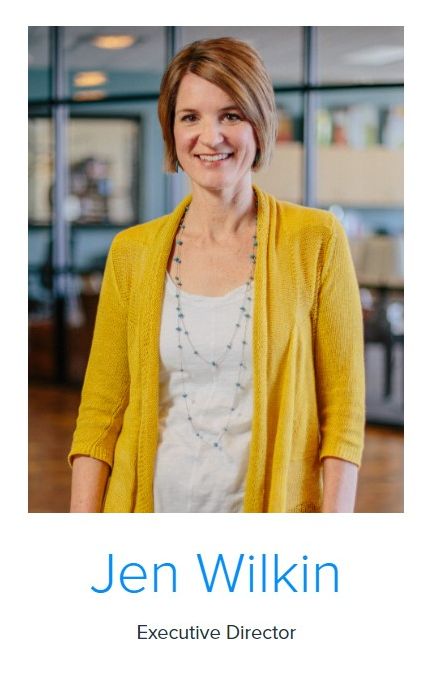
The Village Church Institute is the teaching and discipling arm of the Village Church, to which Jen Wilkin belongs. Matt Chandler is currently the main pastor of the church, over all the campuses. Jen is on staff there. Jen had been ‘Classes and Curriculum Director’ (above) and then was Executive Director (below). Jen writes Bible studies for the Institute.





 the-end-time.org