Posted in encouragement

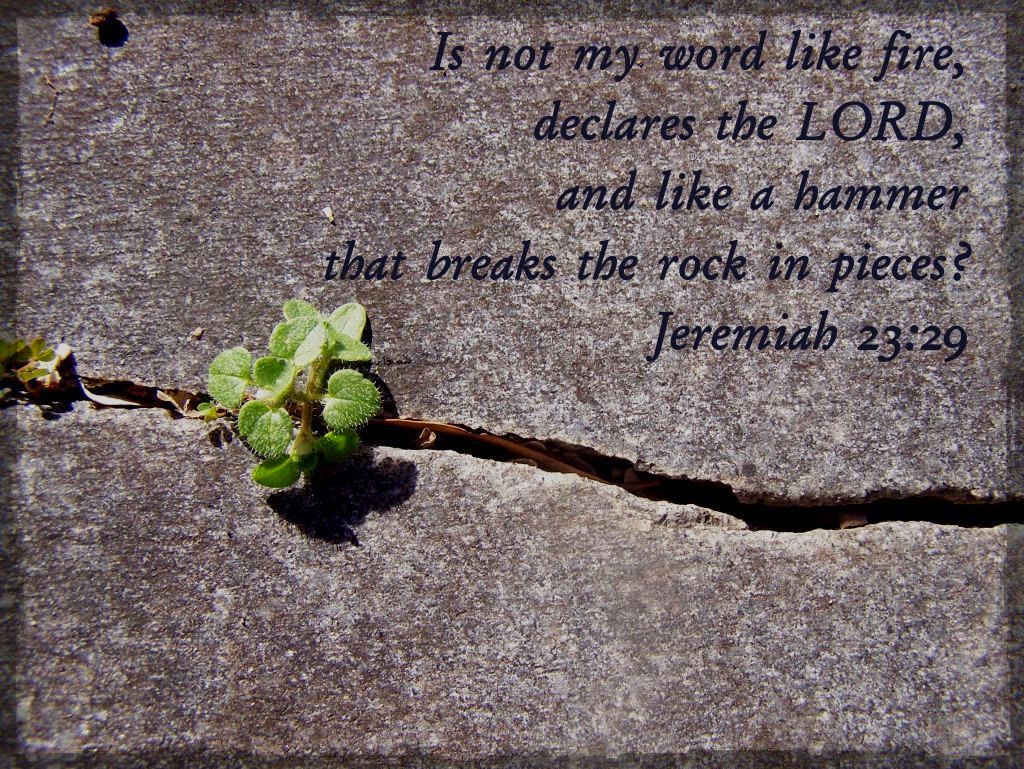
Be encouraged: the Lord’s word can break the stoniest of hearts!

By Elizabeth Prata

Keep praying for your friends and family. The LORD and His Word is stronger than all circumstances, bigger than any sin, the healer of hearts, and the slayer of fortresses.

I traveled to Italy a few times back in the 1990s. I visited a lot of ancient stone and granite buildings, cathedrals, and monuments. It always amazed me to see the sunken middle step. Where millions of footsteps had trod over millennia, the stone had work away! Stone seems so strong, like it will never be worn out or dented. But with enough persistent pressure and use, the stoniest of stones will wear down.

inside steps of the Tower of Pisa

Whether God works slowly in a person’s life or quickly, His word will wear away the seemingly strongest of guards around the heart. If your family, work acquaintance, or friend isn’t saved, God’s word IS like fire, a hammer, and a sword. It will pierce the strongest of stoutly sinning hearts. Don’t give up speaking truth and praying.

Posted in circumcision, heart

Don’t follow your heart

By Elizabeth Prata

We’re sinners, you know.

The Bible explains in constant and plain terms what is in our heart. You know the heart is not to be trusted. Yet, so often we hear idioms about the heart, and believe them as if they were true.

Heart-to-heart means a serious conversation between two people in which they talk honestly about their feelings
Best interests at heart means to make decisions based on someone’s best interests
Heart of gold means a person is truly nice, deep down
One can set one’s heart upon something, meaning, one desires and expects something
Out of the goodness of one’s heart means doing something simply because one is kind

All lies. “The heart is deceitful above all things, and desperately sick; who can understand it?” (Jeremiah 17:9)

The Lord saw that the wickedness of man was great in the earth, and that every intention of the thoughts of his heart was only evil continually.” (Genesis 6:5)

And when the Lord smelled the pleasing aroma, the Lord said in his heart, “I will never again curse the ground because of man, for the intention of man’s heart is evil from his youth. Neither will I ever again strike down every living creature as I have done.” (Genesis 8:21)

“Keep your heart with all vigilance, for from it flow the springs of life.” (Proverbs 4:23)

Create in me a clean heart, O God, and renew a right spirit within me.” (Psalm 51:10)

The Lord our God is merciful. He knows what is in our heart, and He made a way. In the Old Testament, circumcision was a picture of how the heart is covered but the Lord cuts away its foreskin.

Circumcise therefore the foreskin of your heart, and be no longer stubborn.” (Deuteronomy 10:16)

And the LORD your God will circumcise your heart and the heart of your offspring, so that you will love the LORD your God with all your heart and with all your soul, that you may live.” (Deuteronomy 30:6)

Pulpit Commentary explains, “As circumcision was the symbol of purification and sign of consecration to God, so the Israelites are enjoined to realize in fact what that rite symbolized, viz. purity of heart and receptivity for the things of God.”

In the New Testament, Paul spoke about the circumcision of the heart,

But a Jew is one inwardly, and circumcision is a matter of the heart, by the Spirit, not by the letter. His praise is not from man but from God.” (Romans 2:29)

Our hearts are desperately wicked from birth and the inclinations of our heart are only evil continually. Only the Holy Spirit can purify the heart. Only Him. Paul is arguing that true circumcision is a matter of the heart, an operation only the Spirit can perform.

Left, Salvador Dali, The Veiled Heart

The beauty and grace of our merciful God is that He does clean us. If we repent, He will purify us and establish us as His adopted heirs, His very children. What Good News!!

Don’t believe your heart, but believe Jesus. The Book of Revelation calls for repentance 10 times. The entire New Testament in the ESV calls for repentance 53 times. The entire Bible calls for repentance 75 times. The first word John the Baptist uttered in his public ministry was repent. (Matthew 3:2). The first word Jesus uttered in His public ministry was repent. (Matthew 4:17).

We are NOT “basically good.” Our heart is not something to depend on but contains the things that are evil, things He hates. Sin. Only Jesus can clean our heart, cleaning us from the inside out. He is the Resurrected Savior who shed His blood, died, and rose from the dead to perform this very act: forgiveness.

Posted in theology

The very small!

By Elizabeth Prata

Yesterday I wrote about very large things in the Bible. The Anakim, large giants of the antediluvian Flood, (and afterwards too), The Ark, large armies killed in a single night. The observable universe is said to be 95 billion light years across. So just imagine how big God is to be transcendent from that.

And in typical squirrel fashion, I then thought about the opposite of Very Large Things, what’s in the Bible that is very small? Of course, the mustard seed was the first small thing I thought of. Let’s take a look at the verses and the facts about this very small seed.

He presented another parable to them, saying, “The kingdom of heaven is like a mustard seed, which a man took and sowed in his field; and this is the smallest of all seeds, but when it is fully grown, it is the largest of the garden plants and becomes a tree, so that the birds of the air come and nest in its branches.” (Matthew 13:31-32).

[Mt 13:31Mk 4:31Lk 13:19Mt 17:20Lk 17:6]): The minuteness of the seed is referred to in all these passages, while in the first three the large size of the herb growing from it is mentioned. In Mt 13:32 it is described as “greater than the herbs, and becometh a tree” (cf Lk 13:19); in Mk 4:32 it “becometh greater than all the herbs, and putteth out great branches.” Several varieties of mustard (Arab. khardal) have notably small seed, and under favorable conditions grow in a few months into very tall herbs—10 to 12 ft.

From The Plants of the Bible by JH Balfour:

Professor Hackett tells us that when crossing the plain of Akka, in Palestine, he saw before him a little grove of trees. On coming nearer they proved to be a grove of mustard-plants. Some of the trees were full nine feet high, with a trunk two or three inches in circumference, throwing out branches on every side. He wondered whether they were strong enough for the birds to “lodge in the branches thereof.” Just then a bird stopped in its flight through the air, alighted on one of the limbs, which hardly moved beneath the weight, and began to warble forth a strain of sweetest music. The professor was delighted with the incident. His “doubts were charmed away;” the “least of all seeds” had actually grown into a substantial tree.

Balfour, J. H. (1885). The Plants of the Bible (p. 61). T. Nelson and Sons.


Four things are small on the earth, But they are exceedingly wise: 25The ants are not a strong people, But they prepare their food in the summer; The shephanim [shy, furry mammals, field mice, some think] are not a mighty people, Yet they make their houses in the cliff; The locusts have no king, Yet all of them go out in rank; The lizard you may grasp with the hands, Yet it is in kings’ palaces.

Who would admire an ant? it’s an insect, of no account, small but as Matthew Henry says, “yet they are very industrious in gathering proper food, and have a strange sagacity to do it in the summer, the proper time. This is so great a piece of wisdom that we may learn of them to be wise for futurity, ch. 6:6. When the ravening lions lack, and suffer hunger, the laborious ants have plenty, and know no want. [Henry, M. (1994). Matthew Henry’s commentary on the whole Bible: complete and unabridged in one volume (p. 1024). Hendrickson.]

The same admiration in different ways for the field mice, locusts, and lizards. Thus, these small things are not of no account, but the writer was inspired by the Holy Spirit to include these for meditation on their admirable aspects.


A small boy. Matthew, Mark, and Luke all record this miracle but only John mentioned its catalyst was a small boy. (a lad, a young child; Greek paidarion)

“There is a boy here who has five barley loaves and two fish, but what are these for so many people?” (John 6:9).

The loaves were barley loaves, a lesser grain than the fine wheat grown in Palestine. He had only 2 loaves, and likely they were the usual ‘cakes’ and likely they were small enough for the lad to be able to carry them. Same with the fishes- small so he could carry them. But from the small boy carrying small loaves and smaller fish, Jesus multiplied it to a largesse unknown before that moment- feeding 5000 men, who were probably married, so that’s 10000, who probably had kids, so maybe as many as 15,000 people there received the blessing from the ‘small’ boy and his ‘small’ meal.


Conclusion

For who has despised the day of small things? But these seven will be glad when they see the plumb line in the hand of Zerubbabel—these are the eyes of Yahweh which roam to and fro throughout the earth. (Zechariah 4:10).

God sees the heart, not the externals. Saul was seen to be head and shoulders above the rest, but God knew Saul’s heart. It didn’t matter that Saul was impressively large. It didn’t matter that David was small and young. David was to be king, not Saul.

It didn’t matter that the widow was an at-risk person in that culture, often overlooked and/or poor. The Persistent widow was lauded, so was Anna. Dorcas’ sewing needle mattered to God as much as Paul’s pronouncements in amphitheaters to Kings and leaders. In fact, God allowed Dorcas to be raised from the dead.

Hagar was a cast-off slave girl, but God saw her pain in the wilderness and personally ministered to her.

The walls of Jericho were large and impressive, but they fell flat when God moved His hand. Nothing is hidden from Him.

Large or small, impressive or seemingly overlooked, God sees all. It’s the heart that matters. He counts every hair on our heads, He knows every dust mote that wafts in the wind, he is intimately involved with every soul whether they are reserved for wrath or for blessing.

God is amazing!

Further resources

No wonder they were grasshoppers in their sight: The Very Large

What does it mean when it says God looks at the heart?
Posted in theology

God laid it on my heart?

By Elizabeth Prata

I’ve been writing lately about how the constant barrage from female so-called Bible teachers claiming “God told me,” known as direct revelation, is building a foundation of sand rather than on the rock of biblical sufficiency. I’ve said many times not to accept someone’s claim of direct revelation. If they teach that, avoid the teacher.

But it does beg the question- HOW does God lead? We know He does. We know the indwelling Spirit in believers illuminates the scriptures, leads us in the path of holiness, and convicts us of sin. He is involved. But how?

I was asked this good question: “How do I respond when someone says ‘God laid it on my heart?’ “

First, understand that God, rather, the Holy Spirit, has a ministry of illumination. He brings light to your mind when you study the scriptures. He reveals wisdom and understanding to your mind, transforming it to a likeness of Jesus’ mind. When you read the Bible, then meditate on the scriptures, then apply them to your life, it is the Spirit sustaining you in this process. When you are reading the Bible another day and bazinga! something suddenly makes sense from something you read before, that is the Spirit’s illumination. When you are in a situation and bazinga! You suddenly know what to do based on a biblical principle, that is the Spirit illuminating the word to your mind.

When you feel something laid on your heart that convicts you, something you feel bad about, like harsh words, or a sin, or wounding another person, or even a secret sin- that is the Spirit ‘laying on your heart’ a conviction to repent.

The Spirit DOES ‘lay on our heart’ illumination and conviction. That is His ministry to our conscience and our mind.

If you feel ‘God laid it on my heart’ to tell someone a foretelling prophecy, or to move the family to another city, or to change jobs, or to drop out of college, or to take a trip, etc, well, that’s just your own decision making. You’re attributing your own personal decision to the Spirit, which is dangerous to do. We can’t put words in His mouth He didn’t say.

Here is an article excerpt explaining-

How can I know the will of God? First, I need to realize that God’s revelation has been “once for all delivered” (Jude 3), which means no further revelation will be made. Second, I need to accept that God’s revealed will in His Word is complete and all-sufficient (2 Tim. 3:16-17), supplying me with everything I need to live and to serve God (2 Pet. 1:3). Third, I need to admit that if I believe God laid something on my heart, then someone else has an equal right to claim that God has laid the complete opposite on his heart, and who is to say who is “right” and who is “wrong”? That’s why God’s Word is the perfect, complete and final standard in all things (John 12:48). ~Source

We might feel an impression to do something, or have a feeling, or follow a leading, but we cannot know specifically that it is the Spirit impressing or leading in that particular instance. Here is Phil Johnson of Grace Community Church, speaking to that issue after the Strange Fire Conference held some years ago:

“The Bible is perfectly sufficient, and that means someone’s personal impression based on a dream or a vision or a voice in the head has no place in the church’s teaching ministry. Those things have no legitimate authority over the conscience of any believer. We are to order our lives by a more sure word of prophecy, namely Scripture.” ~Phil Johnson

So to the question at hand: The following was asked at The Strange Fire Conference, answered by Phil Johnson:

Q. How do we distinguish between the legitimate prompting of the Holy Spirit and our own thoughts or will?

A. While God can prompt us to think or do something, He has not given a clear and objective mechanism to identify when He is doing that. Since no one can identify with absolute certainty the source of the impressions he experiences, he must not ascribe authority to them or rely upon them as direction from God. John MacArthur gives good advice on that point in this downloadable audio. Mistaking a personal impression for divine guidance can lead us far astray from God’s will and may cause serious problems in our lives. ~Phil Johnson

Q. How should a Christian respond to what he thinks might be a leading of the Holy Spirit?

By comparing the impression with the objective, authoritative revelation God gave us—the Scripture. So, does the thought you are having agree with biblical theology? Is the action condemned or condoned in God’s Word? Will that choice ultimately bring glory to God? As you answer these questions in light of biblical teaching, you can know whether you are walking in the will of God.

Look for the word “decided” in the New Testament. Paul decided to do this or that, decided to go here or there. He legitimately received direct instruction from the Holy Spirit, the canon was not written yet. But Paul also decided to do things. We do not leave our decision making faculties behind when we become a Christian.

Acts 16:4, Acts 20:3, Acts 20:16, Acts 27:1, Titus 3:12

So, ladies, if it is something you want to do and it’s aligned with the scriptures in principle, you do not have to say “God laid it on my heart.” That’s unnecessary. Just say, “I decided…” God’s will for your life is to obey Him where there are explicit commands and to obey Him to the best of your interprtation where there are implicit concepts. In between, just decide.

Further Resources

Ligonier: The Holy Spirit’s Ministry

Grace To You: Does God Give Personal Direction through a Still Small Voice?

Posted in theology

What is the conscience? Can we be led astray by it?

By Elizabeth Prata

My friend Pastor Phil wrote this on Facebook. It got me thinking about the conscience. What is conscience? Dare we obey it when it is scarred by sin? Does the person know when their conscience has become seared? First, Pastor Phil’s thoughts, then some scriptures and thoughts musing on my questions and Phil’s.

Phil Andrukaitis:
Proverb for Today

“He who walks with integrity walks securely, but he who perverts his ways will become known” (Proverbs 10:9).

The lesson: A person whose reputation, career, and/or character are based on deception will be humiliated and brought to ruin.

Therefore, here are four actions to help each of us to walk with integrity: First, listen to your conscience; obeying the Scripture will never lead a person astray. Second, cultivate your relationship with your family because your example will impact their lives forever. Third, respect and obey governing authorities as they are commissioned by God for our good. Fourth, become intimately involved with a local church that honors Jesus Christ. After all, every Christian needs other believers to mature in Christ.

Amen.

Pastor Phil answered a question from a friend who had posted a reply, this way:

Conscience is that “device” God has given to each of us because each person is made in the image of God. Having a conscience is one of the distinguishing ways separates a person from the animal world. Conscience is a personal authority to which each of us either listen to or ignore.

Second, beginning with Adam and Eve, I believe God created us and fashioned our hearts to know the difference between right and wrong (Romans 1:18-19). But when they sinned, their sinfully marred spiritual DNA was passed down to each of us. Yes, we still have a conscience and it is scarred by sin, but it still is the first means by which God speaks to us. Even without the knowledge of the Scripture in our minds, even before sinners are regenerated by the Holy Spirit and Holy Scripture, we know the difference between right and wrong. Therefore, conscience will scream at us saying, “STOP!”

Third, I see your point in that we can be led astray with our conscience. I believe this occurs when a person continually ignores his conscience and the Scripture. When we ignore our conscience, though it has been impacted by sin, and experience the painful consequences of our actions, remember, it was our conscience – a gift from God – that warned us to stop. Sadly, when we ignore our conscience, we also tend to ignore, distort, and eventually reject the Scripture. And the consequences are far more painful as our hearts become hardened; God withdraws His hand [influence] from our lives.

————————end Phil’s Facebook comment and reply————————

The heart/conscience is mentioned in the Bible explicitly over 1000 times. For example, in Romans 2:15,

They show that the work of the law is written on their hearts, while their conscience also bears witness, and their conflicting thoughts accuse or even excuse them

And in Hebrews 10:22,

let us draw near with a true heart in full assurance of faith, with our hearts sprinkled clean from an evil conscience and our bodies washed with pure water.

and in 1 Peter 3:15-16,

But in your hearts sanctify Christ as Lord. Always be prepared to give a defense to everyone who asks you the reason for the hope that you have. But respond with gentleness and respect, 16keeping a clear conscience, so that those who slander you will be put to shame by your good behavior in Christ

and Titus 1:15,

To the pure, all things are pure, but to the defiled and unbelieving, nothing is pure; but both their minds and their consciences are defiled.

And so on. So, conscience IS a thing.

J. I. Packer wrote in Rediscovering Holiness,

An educated, sensitive conscience is God’s monitor. It alerts us to the moral quality of what we do or plan to do, forbids lawlessness and irresponsibility, and makes us feel guilt, shame, and fear of the future retribution that it tells us we deserve, when we have allowed ourselves to defy its restraints. Satan’s strategy is to corrupt, desensitize, and if possible kill our consciences. The relativism, materialism, narcissism, secularism, and hedonism of today’s western world help him mightily toward his goal. His task is made yet simpler by the way in which the world’s moral weaknesses have been taken into the contemporary church.

Is the conscience different from “the heart”? In my opinion, yes. Bruce Waltke wrote in Baker’s Evangelical Dictionary,

The heart functions as the conscience. After David showed insubordination against the anointed king by cutting off the corner of his robe, his heart smote him (1 Sam 24:5 ), and after Peter’s sermon the audience was “cut to the heart” (Acts 2:37 ). The heart may condemn us, but God is greater than our hearts (1 John 3:20 ). David prays that God would create for him a pure heart to replace his defiled conscience (Psalm 51:10 ).

John MacArthur wrote in The Vanishing Conscience Revisited,

The Hebrew word for conscience is leb, usually translated “heart” in the Old Testament. The conscience is so much at the core of the human soul that the Hebrew mind did not draw a distinction between conscience and the rest of the inner person. Thus when Moses recorded that Pharaoh “hardened his heart” (Exodus 8:15), he was saying that Pharaoh had steeled his conscience against God’s will.

What is the seared conscience? 1 Timothy 4:1-2 mentions it,

Now the Spirit expressly says that in later times some will depart from the faith by devoting themselves to deceitful spirits and teachings of demons, 2 through the insincerity of liars whose consciences are seared

JI Packer wrote, “when moral and spiritual light has been resisted it may become ‘seared’ (i.e. cauterized, rendered insensitive) (1 Timothy 4:2; cf. Ephesians 4:18).”

mind of christ orig

Posted in bible reading plan, Uncategorized

Bible Reading Plan thoughts: Sins in the heart

In our Bible Reading Plan today we read Matthew 5-7.

But I say unto you, That whosoever looketh on a woman to lust after her hath committed adultery with her already in his heart. (Matthew 5:28)

Here’s a bit of history for you. President Jimmy Carter was the 39th President of the United States. He was elected in November 1976 when I was almost 16. He served one term until I was 20 years old.

He was an active Christian, the first one I’d had any ‘contact’ with. In my personal life growing up, religion didn’t play a role at all. I knew no Christians. Because Carter was a public figure, President, his beliefs were public and often passed before my eyes in TV interviews and newscasts as he was interviewed about them.

During Carter’s campaign he was interviewed by a freelance writer for an article to be published in Playboy Magazine. Carter offered unprompted,

“I’ve looked on a lot of women with lust. I’ve committed adultery in my heart many times.”

Time Magazine’s opinion of the incident was put this way:

The decision to do an interview with Playboy magazine was possibly not the best call of President Carter’s tenure. Yet, it was all going pretty well until he started talking about the Bible and adultery. Now, Carter’s not actually admitting anything shocking. Most men would probably say, “Yep, been there.” But presidents rarely (and for good reason) venture into the land of “too much information”: Ideally, they should exist on a higher plane than the rest of us. It was an uncomfortable moment for America.

I agree with the secular view of offering too much unprompted information. We all want to dwell in a fiction of our leaders being above reproach. But since Carter said it, and I heard it, I was left with the problem of trying to figure out what it meant. Having no knowledge of the Bible, I was strenuously trying to reconcile my own knowledge of sin, which I called immorality. I didn’t understand that sin came from a completely depraved heart. Being unsaved, I thought sin was a private matter, nobody’s business. Adultery I well understood, having two parents who both indulged in it. It seemed wrong to me but I was too young to have any firm basis for saying so. However I believed that thoughts about adultery were one’s own and thus a private matter.

I learned after salvation that God reads the heart and knows the intentions of man. Sin actually springs from the heart and mind. All sins, even the unacted-upon sins, even thoughts only, are just as damaging. But back then, it was perplexing to me that a man should feel ashamed of his ‘normal’ thoughts. As long as he didn’t act on it, I thought he should be termed “a good man.” I thought Carter was silly for saying anything about it.

The Matthew verse today shows me that I was the silly one. Carter might have made a political faux pas, but he was biblically correct. It’s wrong to commit adultery in your thoughts. What a radical thought. It was to me then, and the reactions of the listeners of the sermon on the mount and others later thought so too. (Matthew 7:28-29; John 6:60). Guard your thought life.

sat heart

Posted in discernment, Uncategorized

Jonah and his leaf: a Lesson in Priorities

God relented from the disaster He’d promised upon the Ninevites.

But it displeased Jonah exceedingly, and he was angry. (Jonah 4:1).

Then God gave Jonah some shade.

Now the LORD God appointed a plant and made it come up over Jonah, that it might be a shade over his head, to save him from his discomfort. So Jonah was exceedingly glad because of the plant. (Jonah 4:6)

As our pastor preached on Sunday, “This seems kind of backward!” What are your priorities? What are mine?

Sometimes we can detect our own heart condition by what makes us exceedingly glad and what makes us exceedingly angry.

leaf1
EPrata photo