And Isaac said to his father Abraham, “My father!” And he said, “Here I am, my son.” He said, “Behold, the fire and the wood, but where is the lamb for a burnt offering?” Abraham said, “God will provide for himself the lamb for a burnt offering, my son.” So they went both of them together. (Genesis 22:7-8)
The Sacrifice of Isaac is a familiar chapter to most Christians. We study it in Sunday School, it’s taught in VBS, we read it familiarly as mature Christians, our eyes having passed over the verses many times.
But sometimes the gravity of the moment just grabs you and won’t let go. The Father DID provide the Lamb for the sacrifice. The grandest, most beautiful, most terrible moment in all of history or ever shall be, was the death of Jesus on the Cross at Calvary.
Therefore, we are ambassadors for Christ, God making his appeal through us. We implore you on behalf of Christ, be reconciled to God. He made Him who knew no sin to be sin on our behalf, so that we might become the righteousness of God in Him. (2 Corinthians 5:20-21)
Ambassadors have all the authority of the sending nation behind them. As Christ’s ambassadors, we have all the authority of heaven behind us!
Sometimes just thinking about how Jesus died for us and absorbed the wrath that was rightfully due me, is overwhelming. Sometimes thinking of how despite my craven sinful nature, God cleaned me and forgave me. Sometimes thinking of the fact that God uses me, a poor clay vessel, for His glory, is just too immense for my mind to absorb.
The Christian journey is sometimes not easy, and it is always demanding, but it is also the most joyous and entrancing life a person could ever imagine. If you have not turned to Jesus for forgiveness of your sins, sins that incur the wrath of a Holy God against you every minute of every day, please do it. The life, death, and resurrection of Jesus of Nazareth split history. The event divided the world into two paths. One is narrow and leads to everlasting life. The other path is broad and many find it, and will descend to hell for everlasting wrath.
The Father did provide the Lamb. And He is exalted.
The Lamb Exalted Then I looked, and I heard the voice of many angels around the throne and the living creatures and the elders; and the number of them was myriads of myriads, and thousands of thousands, saying with a loud voice, “Worthy is the Lamb that was slain to receive power and riches and wisdom and might and honor and glory and blessing.” And every created thing which is in heaven and on the earth and under the earth and on the sea, and all things in them, I heard saying, “To Him who sits on the throne, and to the Lamb, be blessing and honor and glory and dominion forever and ever.” (Revelation 5:11-13)
This is not a one-thought essay on one topic. These are just some tidbits that moved me or stayed in my mind as I’ve studied this past month.
The Apostle Paul’s self-description progressed toward greater humility as he aged, moving from “least of the apostles” (1 Cor 15:9, c. AD 55) to “very least of all the saints” (Eph 3:8, c. AD 60), and finally to “foremost/chief of sinners” (1 Tim 1:15, c. AD 62-64), reflecting deep gratitude for grace. Source Jerry Bridges Blessing of Humility
Spurgeon on Humility “Micah’s Message for Today”, “I believe that when a man goes back he gets proud, and I am persuaded that when a man advances he gets humbler, and that it is a part of the advance to walk more and more and more humbly.”
Spurgeon ibid, on our progress toward humility: “Remember how Abraham, when he communed with God, and pleaded with him for Sodom, said, “I have taken upon me to speak unto the Lord, which am but dust and ashes;” “dust” — that set forth the frailty of his nature, “ashes” — as if he was like the refuse of the altar, which could not be burnt up, which God would not have. He felt himself to be, by sin, like the sweeping of a furnace, the ashes, refuse of no value whatsoever; and that was not because he was away from God, but because he was near to God. You can get to be as big as you like if you get away from God; but coming near to the Lord you rightly sing,” —
“The more thy glories strike mine eyes, The humbler I shall lie.” Isaac Watts.
The “Son of man” was Jesus’ favorite term for Himself. It is used 14X in the New Testament. We first read it in Daniel 7,
The Son of Man Presented
“I kept looking in the night visions, And behold, with the clouds of heaven One like a son of man was coming, And He came up to the Ancient of Days And was presented before Him.”
The request of James and John to sit at Jesus’ right and left in the kingdom, is astounding. What they were really saying is that they should be exalted even higher than Elijah, Moses, or Joseph, for example. Even in their own thinking that they had ‘earned’ a spot of exaltation, even at that, James and John had only been serving and following Jesus for three years, whereas Moses dedicated his life to God. Joseph had been through something horrific, and Elijah was a diligent prophet all his life. Their request reminds me of the Pharisees who ‘loved the chief seats’. Obviously, the pride in their hearts nor the thinking in their heads had been smoothed out yet.
We first meet Barnabas in Acts 4, just before the dramatic slaying of Ananias and Sapphira. The verse gives us a succinct bio of the man: “Thus Joseph, who was also called by the apostles Barnabas (which means son of encouragement), a Levite, a native of Cyprus”... Did you remember that Barnabas was a nickname and not his actual name? The Bible shows us this quite often, people’s names are changed by God, or they have nicknames they are better known by.
Saul/Paul, Simon/Peter/nickname Cephas, Levi/Matthew, Priscilla/Prisca, Silvanus/Silas, Naomi/Mara, Jacob/Israel plus there are many more in the Bible I didn’t mention.
We will be receiving a new name when we get to heaven!
The one who has an ear, let him hear what the Spirit says to the churches. To the one who overcomes, I will give some of the hidden manna, and I will give him a white stone, and a new name written on the stone which no one knows except the one who receives it. (Revelation 2:17).
Your clothing did not wear out on you, nor did your foot swell these forty years. (Deuteronomy 8:4).
Did you ever think through the details of that little nugget of a scene? With all the wandering they did day after day for an entire generation, ‘their foot did not swell’. In other words, they did not have foot trouble. No blisters. No turned ankles. He made it so they could walk. This underscores His minute attention to their individual and personal care, which is a glorious aspect of the Lord’s miraculous preservation of His people.
Biblehub topical lexicon: “Swelling of tissue results from fluid imbalance and venous stress—an inevitable reality in a grueling march. By preventing it, the Lord demonstrated authority over ordinary biological functions, reinforcing His supremacy over creation (Psalm 103:19)”.
As for their clothes… as we read the we picture the people in linen type togas. Adults. But…children grow! When the Wandering began a child might have been 1 year old but when about when they were 6 or 9 or 12? How did God make it so “their clothes did not wear out”?
BibleHub Topical Lexicon:
By contrast, three wilderness texts celebrate a divine suspension of the normal process:
“Your clothing did not wear out and your feet did not swell during these forty years” (Deuteronomy 8:4; cf. 29:5).
“For forty years You sustained them in the desert; … their clothes did not wear out” (Nehemiah 9:21).
Israel’s garments should have fallen apart, yet the Lord sovereignly checked. The same Lord who ordains natural decay can overrule it to keep covenant promises.
Matthew Henry has some ideas. In one potential answer, he said the people could have traded clothes. As one person outgrew clothes, they gave them to another who would fit them. Makes sense. We donate and swap clothes today. But that doesn’t answer how God made it so that no matter which boy wore it, a boys’ size 4 stayed in good enough condition to wear for 40 years?!
Here is Matthew Henry’s Commentary on it:
By the method God took of providing food and raiment for them [1.] He humbled them. It was a mortification to them to be tied for forty years together to the same meat, without any varieties, and to the same clothes, in the same fashion. Thus he taught them that the good things he designed for them were figures of better things, and that the happiness of man consists not in being clothed in purple or fine linen, and in faring sumptuously every day, but in being taken into covenant and communion with God, and in learning his righteous judgements. God’s law, which was given to Israel in the wilderness, must be to them instead of food and raiment.
[2.] He proved them, whether they could trust him to provide for them when means and second causes failed. Thus he taught them to live in a dependence upon Providence, and not to perplex themselves with care what they should eat and drink, and wherewithal they should be clothed. Christ would have his disciples learn the same lesson (Mt. 6:25),
Henry, M. (1994). Matthew Henry’s commentary on the whole Bible: complete and unabridged in one volume (p. 247). Hendrickson.
You trust God with your soul, which is eternal, so do trust Him to provide the temporary things, like clothes. He is faithful!
“For this reason I say to you, do not be worried about your life, as to what you will eat or what you will drink; nor for your body, as to what you will put on. Is life not more than food, and the body more than clothing? (Matthew 6:25)
We are told to love the Lord with all our heart, mind, strength and soul. We are told to serve with gusto, and not just when the boss is around, but all the time. We are told to die to self.
EPrata photo
But how do we balance serving and dying to self, and avoiding burnout so we can keep serving? I mean, should we even avoid burnout? We must serve with excellence, but does that mean serve to the point of exhaustion, even death? Paul did. Charles Spurgeon did. Paul even said he is poured out like a drink offering, signaling his willingness to serve to the death of a martyr, Philippians 2:17, 2 Timothy 4:6.
Christian self-sacrifice does not mean burnout, nor does it require a continuous state of emotional, physical, or spiritual depletion. At most times, busy-ness does not even mean efficiency, productivity, or effectiveness. Exhaustion is NOT next to godliness.
It’s true that Christian love is sacrificial and modeled on Christ’s self-giving, but the Bible does not equate self-sacrifice with self-obliteration or a state of exhaustion that makes you unable to continue serving. Your energy levels are finite. Even Jesus’s was, He removed Himself frequently to pray or rest. He was tired in Samaria and sat down by the well to rest. (John 4:6). He enjoyed fellowship and dinners with Mary/Martha/Lazarus, or Zacchaeus, or Matthew (Levi), or the wedding at Cana. Everything He did was intentional but some of those times it was for fellowship or to simply celebrate (like Levi’s banquet to celebrate his conversion).
We need to find that sweet spot of serving sacrificially yet preserving enough energy so we can continue ministering. We need not obliterate ourselves. The key is to develop sustainable sacrifice, with boundaries. But HOW?
Saying ‘no’ is hard to do…
1.Learn to say ‘no’. For example, if you’ve agreed to serve at Sunday School, it is OK to preserve some time during the week set apart for study, preparation, and prayer, even it it means saying no to something good that would intrude on that time. You serve at work, plus you have responsibilities to an employer there, so it is OK to say no and guard some time to faithfully complete work tasks. Saying no to something, or deciding not to go somewhere or help someone during the times you’ve set apart, isn’t selfish. It just means you are striving for excellence in the ministrations where you ARE serving already.
Christopher Ash wrote a short book called Zeal without Burnout. Here is Ash with a short article at Challies’ site with some background and introductory explanations about how to be zealous for God without burning out-
Ash explains ‘sustainable sacrifice’, and what a ‘living sacrifice’ means. Here he is expounding in a video at his former church as a guest lecturing from his book if you don’t want to get the book.
His speech covers the following themes:
17:19, God Never Goes to Sleep 19:14, Allow Yourself Time for Sleep 20:01, How To Wind Down before Going to Sleep 25:43, The Sabbath Principle 26:49, We Need Friends
People-pleasing is easy to do
2.Are you a ‘people pleaser’? To some extent, we all are. We are told to love our neighbor as ourselves. However, if the motivation for our constant movement in serving is that you are aiming to please a person but Jesus doesn’t figure into your decision making, it’s the wrong motivation. There is a difference between mindful self-sacrifice as a duty to Jesus, and people-pleasing.
Here is an article from TGC on people-pleasing, which sometimes is the background of someone’s people-pleasing service if that applies to you.
Freedom from the Burden of People Pleasing– Jesus came to give us life and life to the full (John 10:10). When we carry the burden of trying to keep everyone happy, that fullness starts to dissipate. We end up carrying a cross that is not ours to carry. We become embittered because, instead of glorifying God, we seek the world’s acceptance—a fickle and transient way to find significance.
EPrata photo
As this Facebook random lady said, “You don’t have to set yourself on fire to keep everyone else warm.” Boundaries are not selfish, they are necessary tools for stewardship. Here is an article from Desiring God, “Die to Yourself Without Losing Yourself“-
Self-sacrifice can be exhausting. It can be painful, arduous, and largely thankless. Moreover, no shortage of people stand ready to take advantage of our willingness to serve. Nonetheless, few messages are more consistent in the New Testament than Christians being known for our sacrificial spirit (Romans 12:10).
A lot of ‘dying to self’ doesn’t mean DOING in the dying. It means mortifying ego, selfish ambition, wayward guilt, pride, and more. It’s working to choose forgiveness over a grudge, serving others without recognition and foregoing ego, managing anger, yielding our will to God’s purpose…etc. A lot of dying to self isn’t in visible external service to others, it is personal work on one’s own sin nature; it’s personal and internal. We are dying to our sin nature.
The gift of sleep
3. Spurgeon said, “Sleep is the gift of God, and not a man would close his eyes, did not God put his fingers on his eyelids”
I lay down and slept; I awoke, for the Lord sustains me.(Proverbs 3:5)
When you lie down, you will not be afraid; When you lie down, your sleep will be sweet. (Proverbs 3:24)
I know, I know, moms especially have a very hard time finding enough time to sleep. Little ones wake up in the night and what can you do? Except get up and tend to them. But if you can sleep when you can, without guilt, then prayerful, refreshing sleep prayed for and graciously given, we know it IS a gift.
Sleep and rest is God’s reminder to be humble.
There is no hard and fast ‘how-to’ in finding that balance. It’s personal and unique to every individual. As we grow, we tread a path of finding the sweet spot. It’s like any principle in life we discern from the Bible and apply to our lives as we go. As you learn to set boundaries, keep praying for the Spirit to help you realize if laziness or sloth is setting in, or alternately if you are still on a path to burnout. But remember, dying to self means our own work on sanctifying our holy nature and obliterating our sin nature.
THIS is dying to self- Galatians 5:24, Now those who belong to Christ Jesus crucified the flesh with its passions and desires.
This was a bumper sticker adorning the car ahead of me at a red light. A long light. I had time to read it and think about it and then get steamed about it. Of course next to that bumper sticker there was a ‘coexist’ bumper sticker. How can those two be reconciled? If a women isn’t being well-behaved, she is being rebellious. And if she is being rebellious, she is not co-existing peacefully with those around her, is she? Illogical.
In any case, I thought that the bumper sticker’s premise was that for women to be recorded in history, they must have had to do something daring or against societal expectations, or had done something ‘out there’ in some way. This, I had mused, is illogical too, because there are plenty of women in history who were simply good at what they did, and that was why they got into the history books. Louisa May Alcott, Laura Ingalls Wilder, Marie Curie, Queen Elizabeth II, Sally Ride… Would NASA have chosen a rebellious upstart to be part of their space program? Of course not.
Curious now, I looked into the origins behind the bumper sticker and I was surprised by what I found.
The phrase comes from Harvard Professor Laurel Thatcher Ulrich. Ulrich identifies herself both as a feminist and a Mormon. It was her 1976 little-known academic paper published in American Quarterly called “Vertuous Women Found: New England Ministerial Literature, 1668-1735” where the now famous bumper sticker phrase was first seen.
Massachusetts, where Harvard is located, was populated in the 1600s by deeply religions Puritans who had emigrated from England and the Netherlands to worship God freely, something they could not do on the Continent.
Ulrich looked into the lives of ‘ordinary’ Puritan women, especially midwives, through their own diaries. The ordinary, the mundane, the repetitive nature of the life, consisting of hard work mainly at home, drew Ulrich’s attention. She expanded her paper into into a 1990 book called, “A Midwife’s Tale: The Life of Martha Ballard, Based on Her Diary, 1785-1812.” The staying power and viral nature of the adage she had coined back in 1976 led to Ulrich eventually write a book in 2007 called by the very phrase she had coined: “Well-Behaved Women Seldom Make History.” Here is an excerpt from the 1976 paper:
Cotton Mather called them “The Hidden Ones.” They never preached or sat in a deacon’s bench. Nor did they vote or attend Harvard. Neither, because they were virtuous women, did they question God or the magistrates. They prayed secretly, read the Bible through at least once a year, and went to hear the minister preach even when it snowed. Hoping for an eternal crown, they never asked to be remembered on earth. And they haven’t been. Well-behaved women seldom make history; against Antinomians and witches, these pious matrons have had little chance at all.
It turns out, that Ulrich wanted to simply promote the lives of the Puritan and the 1800s women which history had forgot.
Ulrich noted that though women were nearly invisible in society, only recording when they were born, married, or died, their standing in spiritual realms was highly elevated.
…this circumscribed social position was not reflected in the spiritual sphere, that New England’s ministers continued to uphold the oneness of men and women before God, that in their understanding of the marriage relationship they moved far toward equality, that in all their writings they stressed the dignity, intelligence, strength, and rationality of women even as they acknowledged the physical limitations imposed by their reproductive role. … Source 1976 paper, “Vertuous Women Found”
Huh. Go figure. A Mormon Harvard feminist professor who got it right. As for the popularity of the phrase I’d seen on the bumper sticker, Ulrich said that its ambiguity (when taken out of its context) accounts for its appeal. In other words, you can interpret it any way you want. Which is exactly what I had done at the red light when I first read it.
My objective when I wrote those words was not to lament their oppression but to give them a history. … [T]he ambiguity of the slogan surely accounts for its appeal. To the public-spirited, it is a provocation to action, a less pedantic way of saying that if you want to make a difference in the world, you can’t worry too much about what people think. To a few it might say “Good girls get no credit.” To a lot more, “Bad girls have more fun.” … Source: “Well-Behaved Women Seldom Make History” (Knopf, September 2007)
Well there you go.
There’s one more thing. The premise that ‘well behaved women seldom make history’ is supposed to spark a knee-jerk reaction that it’s a bad thing not to make history. Like, “Hey! I wanna get into history! Why can’t I be in the history books?! The biblical worldview would have a response to this in several respects. First, woman already are in the only history book that matters, the Bible. Well-behaved and rebellious women are both recorded throughout the pages of that holy Book. From Jezebel to Esther, from Mary to the Woman at the Well, women are recorded in biblical history doing what they do as humans.
Secondly, women already are recorded…in the Lamb’s Book of Life. There is NO OTHER book than that precious book one should aspire to have our names written.
And I saw the dead, great and small, standing before the throne, and books were opened. Then another book was opened, which is the book of life. And the dead were judged by what was written in the books, according to what they had done. (Revelation 20:12).
Nothing impure will ever enter it, nor will anyone who does what is shameful or deceitful, but only those whose names are written in the Lamb’s book of life. (Revelation 21:27).
If you have repented and believed in the risen Christ, then us well behaved women are all set with names written in the Lamb’s book. All other books will fade away. But not Jesus’ words, those are the only words and the only history that matters.
Heaven and earth will pass away, but my words will not pass away. (Matthew 24:35).
In biblical times, a shepherd’s main concern was the welfare of the flock. Providing the sheep with food and waters as well as guarding them from predators and thieves were primary responsibilities. Highlighting this relationship, Jesus says in the scripture, “I am the good shepherd. The good shepherd lays down his life for the sheep.” (John 10:11). [from Logos Bible Software]
But he brought his people out like a flock; he led them like sheep through the wilderness. (Psalm 78:52).
Since moving to this county twenty years ago, I have never ceased to enjoy the sight of numerous animals dotting the landscape. We are a high-producing agriculture county. Lots of animals around, domestic and otherwise.
There are many pastures. I regularly see cows, horses, donkeys, sheep, chickens, and sometimes emus, buffalo, hawks, foxes, and even coyotes.
Reading about the animals in the Bible is wonderful and interesting. However, being among the animals mentioned in the Bible and observing them is another layer of understanding entirely. WHee I lived for 13 years, for a period of time the neighbor on the other side of the duplex was a shepherdess. I love watching the pastured sheep next door. Their life cycle, cavorting lambs, the nursing, the hay, grass, and stubble that they eat, the wool, their grazing, their recent escapes from the field lol, all interesting.
The Bible refers to the body of Christ as sheep. Am I a sheep? Yes, says Jesus, metaphorically. He is my Shepherd. What a glorious metaphor. I love to think of The Perfect herding me, caring for me, leading me, protecting me. Everything He does is perfect so His care of the sheep will also be perfect, and I can and do rest in that knowledge.
It’s a good metaphor. He could have likened us to badgers, angry and contentious. He could have called us after the evil one who is god of the earth- a lion, a prowling predator seeking after sin and devouring others. He could have called us a spider, an insect nobody likes. I mean, really. A sheep is good.
In my Logos 6 software one can research by topic. I found these biblical facts about sheep:
The sheep is the first animal specified by name in the sacred writings. Abel, himself a shepherd, offered the firstlings of his flock to the Lord (Gen. 4:4). Abraham was very rich in sheep, and Job at one time had 14,000 amongst his herds. In 2 Kings 3:4 we read of a Moabitish shepherd-king who gave a tribute of a hundred thousand lambs and a hundred thousand rams; and this country is still inhabited by owners of vast herds of sheep, the Beni Sakkr sheikhs. Solomon celebrated the dedication of the temple by the sacrifice of 120,000 sheep.
The Sheep is perhaps the most important of all the animals in the Scriptures. It formed the chief portion of the wealth of the patriarchs, and it is not merely as an article of food that its value is to be estimated. The clothing of those days was almost entirely made of wool; cotton, silk and flax being hardly known or quite out of reach until a later period. The number of flocks was the chief measure of property. Tillage was, comparatively speaking, but little resorted to in Palestine, and there was only very local or in most places no possession in land. Hence sheep were of primary value; and from its nature the country was, and is still, better adapted to the rearing and feeding of sheep than other domestic animals.
Source- Hart, H. C. (1888). The Animals Mentioned in the Bible (pp. 193–194). London: The Religious Tract Society.
Interesting! How about the beloved 23rd Psalm-
The LORD is my shepherd; I shall not want. 2 He makes me lie down in green pastures. He leads me beside still waters. 3 He restores my soul. He leads me in paths of righteousness for his name’s sake.
4Even though I walk through the valley of the shadow of death, I will fear no evil, for you are with me; your rod and your staff, they comfort me.
5You prepare a table before me in the presence of my enemies; you anoint my head with oil; my cup overflows.
6Surely goodness and mercy shall follow me all the days of my life, and I shall dwell in the house of the LORD forever.
Here is Matthew Henry Commentary on the famous first line of the Psalm, ‘The Lord is my Shepherd, I shall not want.’
Confidence in God’s grace and care. – “The Lord is my shepherd.” In these words, the believer is taught to express his satisfaction in the care of the great Pastor of the universe, the Redeemer and Preserver of men. With joy he reflects that he has a shepherd, and that shepherd is Jehovah.
A flock of sheep, gentle and harmless, feeding in verdant pastures, under the care of a skilful, watchful, and tender shepherd, forms an emblem of believers brought back to the Shepherd of their souls. The greatest abundance is but a dry pasture to a wicked man, who relishes in it only what pleases the senses; but to a godly man, who by faith tastes the goodness of God in all his enjoyments, though he has but little of the world, it is a green pasture.
The Lord gives quiet and contentment in the mind, whatever the lot is. Are we blessed with the green pastures of the ordinances, let us not think it enough to pass through them, but let us abide in them. The consolations of the Holy Spirit are the still waters by which the saints are led; the streams which flow from the Fountain of living waters. Those only are led by the still waters of comfort, who walk in the paths of righteousness.
Do you have confidence in God’s grace and care? Do you have quiet contentment of the mind, knowing the Great Shepherd would not only lay down His life for the sheep, but He has done it? Are you consoled by the knowledge that His protection is mighty and everlasting? That His pastures remain green? That the waters are always living and fresh?
We are blessed with good care. Though we stray, the Good Shepherd brings the lost sheep home. This is the ultimate blessing, forgiveness of our many sins, and promise of eternal joy.
All we like sheep have gone astray; we have turned—every one—to his own way; and the LORD has laid on him the iniquity of us all. (Isaiah 53:6)
To him the gatekeeper opens. The sheep hear his voice, and he calls his own sheep by name and leads them out. (John 10:3)
Whoever may hereafter stand related to you as your spiritual guide, my desire and prayer is that the great Shepherd of the sheep would have a special respect to you, and be your guide (for there is none teacheth like him), and that he who is the infinite fountain of light, would “open your eyes, and turn you from darkness unto light, and from the power of Satan unto God; that you may receive forgiveness of sins, and inheritance among them that are sanctified, through faith that is in Christ;” that so in that great day, when I shall meet you again before your Judge and mine, we may meet in joyful and glorious circumstances, never to be separated any more.
SYNOPSIS: In this discernment essay I critique Beth Moore as an example, arguing false teachers persist by God’s design to test, refine, and reveal believers, warning that longevity, sincerity, zeal, and eloquence do not confirm theological truth.
Resurrection Sunday has just passed. I celebrated the monumental work of our Lord in His redemption of us to the Father. He will present a spotless bride thanks to Him living a sinless life, becoming sin for us, dying on the cross after exhausting God’s wrath for those sins. He paid the penalty we were due.
that He might present to Himself the church in all her glory, having no spot or wrinkle or any such thing; but that she would be holy and blameless.(Ephesians 5:27).
But now He has reconciled you by Christ’s physical body through death to present you holy, unblemished, and blameless in His presence— (Colossians 1:22).
The resurrection is a gateway to eternal life! And now our sins are as far away as the east is from the west!
As far as the east is from the west, So far has He removed our wrongdoings from us. (Psalm 103:2).
The Bible is so perfect in every way, so detailed and complex, but so clear a child could understand it, that there is a reason it is written ‘east from the west’ and not as far as the north is from the south. There is a difference between those cardinal directions.
You can travel north to the Pole. But once passing the North Pole you are now traveling south. However, if you travel east, there is never a time when you are now traveling west. It is endless. You always travel east and never get to the west. It is a measureless distance. It is an infinite distance.
Because the earth is a globe, a sphere, the lines of latitude circle endlessly. North and south lead to specific, finite points—the North and South Poles and you can’t go any further in that direction before it stops and becomes another direction.
Jesus’s love for us is such that He not only bore the wrath for our sins but He removed them from us to an immeasurable infinity. When we repent, our sins are gone, boundlessly extinct. God’s immeasurable love is never distant from us though. Our sins are thrown to a point as far as the east is from the west, but God is Immanuel: God with us!
“Therefore the Lord himself will give you a sign: The virgin will conceive and give birth to a son, and will call him Immanuel.” Isaiah 7:14.
Praise the Lord who was born, lived sinlessly taught, died, and rose again! Our sins are now taken care of, if we repent and believe.
Have you heard of the new trend sweeping through our society from Gen Z-ers to Boomers? It’s analog. Yes, the new fashioned word for an old fashioned life- one filled with tactile hobbies like knitting and crosswords in real books and newspapers. Design trends where prospective house buyers seek a home like grandma had- with real rooms, not open concept, afghans, wallpaper, hardwood floors, sunrooms, even sewing rooms. They call it ‘a grandma house.’
The last 30 years has seen a rise of the digital, and a resulting loss of the tactile. People are tired of the constant notifications, intrusive surveillance, annoying advertisements/pop-ups, and anxiety known as FOMO (Fear Of Missing Out). When we’re always ‘connected’, we tend to compare our lives to others and covetousness, jealousy, and unease rises. Frankly, we’re tired.
The Book
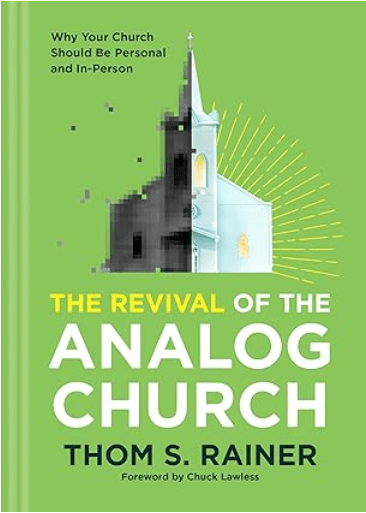
The church has not escaped the impact of the rise of digital lifestyles. Into this rising trend of concern and yearning for simpler times is Thom Rainer’s forthcoming book, “The Revival of the Analog Church: Why Your Church Should Be Personal and In-Person (Church Answers Resources)”. It is due out in October 2026, and it is being published by Tyndale Momentum.
The Problem
The church never escapes being influenced by the world around us. Even diligent churches that resist worldly trends have to fight hard to push back. Church is composed of people, and people for the last 30 years have grabbed onto all things digital. Many churches have suffered for it.
Rainer wrote, “Have we digitized what was meant to be deeply personal? The digital world gave us tools. Helpful ones. We could reach farther and faster. Sermons went online. Groups went virtual. Resources were available with a click.”
But all these tools come with a cost. We are suffering from ‘digital fatigue’ and this includes churches. It’s no so much the tools that churches use, such as streaming the sermon or digital Bibles, it is the pace at which the digital world has taught us to run. It is the brain, always pumping for more, the new, the next. Digital is a tool, but it has overpowered us and taught us that we need to always be moving. This constant movement includes a hurry-up pace in church. Yet, Rainer writes, church is exactly the place where we need to slow down, pray pensively, linger in relationship, be present emotionally, mentally, physically. He advocates for “the sacred simplicity of a Sabbath-like presence.”
Rainer’s point is synopsized with this- we are digitally numb, and ‘Digital numbness leads to spiritual numbness.’
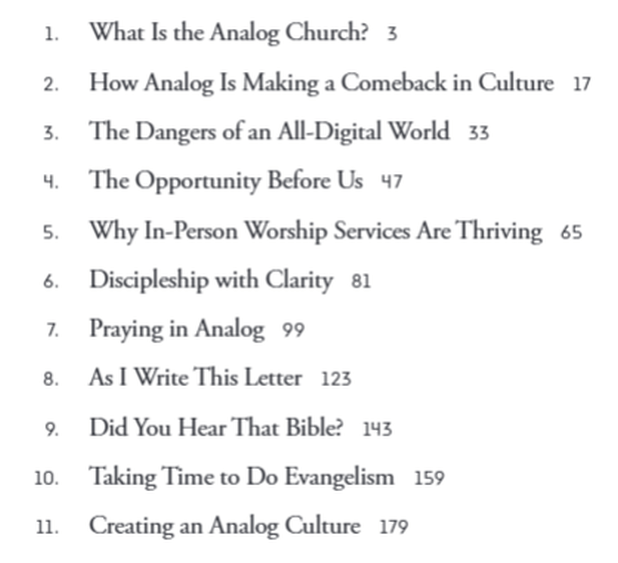
The chapters, 11 of them, describe the problem and offer solutions. Rainer includes reflection questions at the end of each chapter.
My Review
Rainer begins with a solid explanation of the difference between analog and digital, and how this is impacting the church. He humbly relates that he himself had fallen into the fast-paced digital world, at one point, to the detriment of his family. He loves the digital and assures the reader he is no naysayer, writing, “We have not sinned by embracing digital tools.”
However, Rainer makes the case that we must mindfully slow our pace, be present at church, and restore an unhurried worship.
This book is positioned well to capture this wave of analog yearning to return to an unhurried pace with real relationships. The realization that digital has its limits is fueling the desire to return to unhurried worship and discipleship in its fullest sense. In his book, Rainer describes how.
There is no doubt that digital media has drastically changed how people communicate and how people commune with each other, and the change has impacted not only worship but witnessing and evangelism. This must be a concern for us all.
His point is that “People are weary of a life that feels like it’s always in motion but never truly grounded.” It’s true that the digital world has taught us to live in fragments, when Jesus actually taught to live by thinking deeply, slowly, and intentionally in worship.
Positives:
–The author captures and crystallizes and amorphous unease many people seem to be dealing with regarding the digital lifestyle,
–His end-of-chapter questions are thought provoking,
–Rainer provides solutions, not just identifying the problem,
–He Humbly includes himself in the digital problem.
Negatives:
–I saw a few scriptures, maybe 3 or 4. I’d like to see more scripture use in a book about the importance of relational worship,
–His likening of listening to vinyl records or playing board games to church life as examples of analog were a bit of a stretch. In my opinion, he could have written more deeply about analog church life. I felt the book was more overview than deep theology. Of course, this is fine for someone new to the concept of the problem of digital vs. analog.
–The writing style was very much digital. Too many sentences beginning with ‘And’, staccato short bulleted sentences, and lots of “it’s not this, it’s that.” Rainer mentioned several times how he has absorbed and enjoyed the digital life and pace, and this absorption shows through in his writing, which definitely mimics the digital.
Conclusion
If you are new to the idea that digital fatigue is rising and beginning to permeate our society -and the church- from the oldest adult generation to the youngest, then this would be 4-stars for you. If you are already familiar with the concept and want a more deeply theological examination of the issue, then this book is a 3-star for you, with other suggestions below.
Further Resources:
Out-Of-Doors in the Holy Land by Henry van Dyke. Published 1908 and considered a classic of Holy Land travelogues. Blurb: “Van Dyke’s beautiful descriptions and thoughtful reflections on the landscape, the people, and the spiritual significance of the places he visits make this a must-read for anyone interested in travel, religion, or culture. This work has been selected by scholars as being culturally important”. The premise is that Christianity was an out of doors religion, where walking, pondering, contemplating and considering were all slow processes.
Digital Minimalism by Cal Newport. (2019). Blurb: “a book that proposes a philosophy for using technology intentionally to support your values, rather than letting it control you, advocating for a focused life by drastically reducing low-value digital activities”.
Twelve Ways Your Phone is Changing You, by Tony Reinke. (2017). Blurb- “Drawing from the insights of numerous thinkers, published studies, and his own research, writer Tony Reinke identifies twelve potent ways our smartphones have changed us—for good and bad. Reinke calls us to cultivate wise thinking and healthy habits in the digital age.”
Competing Spectacles by Tony Reinke. (2019). Blurb- “We live in a world full of shiny distractions, faced with an onslaught of viral media constantly competing for our attention and demanding our affections. These ever-present visual “spectacles” can quickly erode our hearts, making it more difficult than ever to walk through life actively treasuring that which is most important and yet invisible: Jesus Christ.”
God, Technology, and the Christian Life by Tony Reinke (2022). “Highlights: Biblical, Informed Look at Technology; Gathers Ideas from Industry Experts and Theologians by Interacting with Christian and non-Christian sources on technology and theology including John Calvin, Herman Bavinck, Wendell Berry, and Elon Musk, and is Educational: Discusses the history and philosophy behind major technological innovations.”
Amazon Bio: Thom S. Rainer is the founder and CEO of Church Answers. Prior to Church Answers, he served as president and CEO of LifeWay Christian Resources. He also served at The Southern Baptist Theological Seminary for twelve years where he was the founding dean of the Billy Graham School of Missions and Evangelism. He has been a pastor of four churches and interim pastor of ten churches. He has written several books, including “I am a Church Member” and “Simple Church”.
DISCLAIMER- My Advanced Reader Copy was provided via NetGalley. I received a free digital copy of this book from Tyndale, the publisher, in exchange for an honest review.
Can you imagine the pit of despair the Disciples felt on Good Friday? To them it was a hellish and confusing Friday. They were confused, they scattered, Peter even denied Jesus.
Jesus’ separation from the Father while on the cross (Matthew 27:46) is the loneliest and most poignant moment any person ever felt in the history of the universe, bar none.
But the disciples’ sudden and unexpected separation on Friday from their spiritual Father they’d been following so hopefully for three years came upon them cruelly and brutally, throwing them all into states of panic, despair, and spiritual depression. Even though Jesus had told them ahead of time, and even though they had studied the scriptures, they didn’t understand. To them, it wasn’t Good Friday. It was just bad Friday and the seeming end of the long trail of hopes and highs they’d been experiencing for three years with Jesus in discipleship to Him. They did not know as we do, Friday’s here, but Sunday’s coming!
We worship Jesus every day. We worship and praise Jesus collectively in services on Sunday. We exalt Him each year on Resurrection Sunday. We know Him as Resurrected King triumphant over sin and death!
His ultimate moment will be His return, when every knee shall bow and every tongue will confess (Romans 14:11, Philippians 2:10, Isaiah 45:23).
“The LORD will be king over the whole earth. On that day there will be one LORD, and his name the only name.” (Zechariah 14:9)
Everyone will know that Jesus is MESSIAH! They will finally know the Resurrected Jesus is the only name. He is all names. He is the beginning and the end!
And it started with the cross on Friday, when it was finished.