Posted in theology

Squirrel thoughts on a variety of topics

By Elizabeth Prata

I am reading several theologically rich books, my pastor is preaching wonderful sermons, I listen to terrific hymns, and the Bible is always deep with truths…and all this creates heavenly thoughts in my brain. Which is as it should be. This is how the Spirit transforms the mind.

Today I am sharing some of the rabbit trails my mind has been traveling this week as I ponder, mull, and meditate on the things of Christ.


“Dying Adam begat mortals.” From Thomas Boston, (1577-1635) Human Nature in its Fourfold State.

It’s an interesting way to phrase the concept of Adam becoming a sinner whose destiny is death, rather than the immortal person he was before he rebelled.

Think on this- Genesis 5:3 says, “When Adam had lived 130 years, he fathered a son in his own likeness, according to his image, and named him Seth.

‘His own likeness’ the verse is careful to remind us. Adam’s likeness is mortal, because after his fall, sin became our human nature, and sinners receive the due penalty of death. MacArthur says of Adam, “He was created in the image of God. Unfortunately, Seth was made in the image of man. While still bearing the imago Dei residually, still having something of the image of God in him, he is most dominated and marked by the image of man, which is the image of fallenness and sin. So he becomes, does Adam, the father of a son who bears his image. How sad.”


“Though the Flood could not carry off the corruption of human nature, yet it pointed at the way at how it is to be done; to wit, that men must be born of water and of the Spirit, raised from spiritual death in sin, by the grace of Jesus Christ, who came by water and blood, out of which a new world of saints arise in regeneration” ~Thomas Boston, Human Nature in its Fourfold State

Yes, the Flood did not solve man’s gravest problem, our sin nature inherited from Adam. A sinner cannot beget a saint. A sinner can only beget a sinner. If God took the same path with men, there would be deluge after deluge, because the corruption of man’s nature remains still. But God promised there would not be another flood, and sent the rainbow to seal this promise as a reminder to us when we see it. Instead, He sent something better, someONE better, Jesus, to live the holy life we need to live, to die in our stead, and to be raised again having conquered death by his perfect life.


Jen Hatmmaker made the rounds on social media this week. It was reported that Hatmaker has a new course which you can take for only $69 to learn how to be separate from religion and church but still love Jesus. It’s a course on how to ‘deconstruct’ which is a trendy word for the biblical term of apostatising.

I wrote about that here.

As a response to the outcry and outrage that Hatmaker would make filthy lucre off impugning Jesus’ name, toxic empaths insist on being nice and using gentle words with Hatmaker as we discuss this terrible state of affairs. “Be nice” they say. No. Whether wolves are baring their fangs or smiling through them, it behooves us to use strong language to warn about their deadly effects. Be gentle with her? No!

Megan Basham said on Twitter, @megbasham
For those telling me that we should approach Jen Hatmaker with gentleness – – be aware, she is a false teacher who has long peddled destructive doctrines, and now is making money selling a course to lead people out of the church. The ultimate wolf.

Fiercely protect the faith. We don’t have to sling mud, but we should be forthright, honest, and clear about those false teachers who seek to destroy us.

Michelle Lesley has some good thoughts about this topic.


I was browsing my bookshelves in my Library and came across a book I forgot I had. A commentary on Jonah & Nahum by John MacArthur. I love the book of Jonah. I live Nahum even more. I’d read my book Severe Compassion: The Gospel According to Nahum (The Gospel According to the Old Testament) by Gregory Cook. It is good and I recommend that one. So I began reading Jonah & Nahum by MacArthur. MacArthur has a way of writing that is concise, but deep. Easy to understand, but thought-provoking. Unsentimental, but so exalting it raises tears in my eyes.

In Chapter 2 of this commentary, we read: “From the outset of the story, God manifested His heart for the lost. Instead of executing immediate judgment on the Ninevites for their wickedness, the Lord graciously sent them a warning of their pending destruction if they did not repent (Jonah 1:2; 3:5-9). Yet, God showed compassion not only to Nineveh but also to His wayward prophet Jonah, sending a storm to discipline him (1:4) and a fish to deliver him from the sea (1:17; 2:10). Additionally, Yahweh spared the pagan sailors whom Jonah had hired to take him to Tarshish. Though they deserved death, being steeped in idolatry and self-dependence (1:5), God preserved their lives and drew them to Himself (1:16).

Jonah did not want to preach to the Gentiles, but he preached to them anyway- the sailors! Jonah is a good example of having head knowledge of God but it hadn’t reached his heart. He knew God was compassionate and likely to save the hated Ninevites. He knew God was Creator and King over the storms and waves. Jonah knew all this, but his heart for the lost was absent.

God was sovereign over the storm, the sailors, Jonah, the great fish, the Ninevites, the plant, the wind, and the worm. God’s sovereignty is so on display in this book, which you see as you read the commentary, it is breathtaking.


Charles Spurgeon was right in so many ways. In his Lectures to My Students, he spoke about the kind of men who apply to his seminary for training in ministry, but are rejected, and why.

Men who since conversion have betrayed great feebleness of mind and are readily led to embrace strange doctrines, or to fall into evil company and gross sin—I never can find it in my heart to encourage to enter the ministry, let their professions be what they may. Let them, if truly penitent, keep in the rear ranks. Unstable as water, they will not excel.

So, too, those who cannot endure hardness, but are of the kid-gloved order, I refer elsewhere. We want soldiers, not fops. We want earnest laborers, not genteel loiterers. Men who have done nothing up to their time of application to the college, are told to earn their spurs before they are publicly dubbed as knights. Fervent lovers of souls do not wait until they are trained—they serve their Lord at once.

I noticed that even back 150 years ago there were snowflakes, what Spurgeon called ‘those of the kid glove type.’ He didn’t hold back in this lecture, but at the outset he warned, “I am as much at home with my young brethren as in the bosom of my family, and therefore speak without restraint.” Yes, today in this era we have milquetoast men who are passive Adams, but for service in a pastorate we need hardy soldiers.

To this end we must give clear statements of gospel doctrine, of vital experience, and of Christian duty, and never shrink from declaring the whole counsel of God. In too many cases sublime truths are held in abeyance under the pretense that they are not practical; whereas the very fact that they are revealed proves that the Lord thinks them to be of value, and woe unto us if we pretend to be wiser than He. 

Well said, Mr Spurgeon.

Posted in theology

You never know which words

By Elizabeth Prata

The other day I was scrolling around online, and I passingly saw a quote from John MacArthur. “God is holy. We are not.” It was a simple phrase, common, a regularly spoken thing. I see that kind of sentiment frequently and it never affected me like it did at that moment. It wasn’t even scripture, just a spiritual/doctrinal concept.

But my spirit was immediately overcome. I teared up, I bent over in my chair, I whispered aloud, “Praise the Lord”. I kept praying for a while, tearing up at the sweetness of such a simple but true concept.

Where’d THAT come from? I wondered…

It had to have been the Holy Spirit in me knitting Himself to the Lord of Lords in truth. It was a mini-event. To use a trite phrase, “a God thing”. But it was a potent reminder. When we go about our daily lives in public, whether online or in real life, we never know which scriptures or which scriptural concepts will be flung into a heart and pierced with eternal truth. Especially to the lost.

If you don’t know how Spurgeon was saved…he had been wrestling with the issue of his sin and longing for redemption for a few years. But to no avail. It wasn’t until he stumbled into a small church during a snowstorm, knowing he would not make it to his intended church destination. The pastor of that church couldn’t make it either so a layman took the pulpit. Hardly knowing what to say, he simply repeated the verse several times, mispronouncing along the way, and added a bit of his own commentary in his own halting, simple manner. But the words grabbed Spurgeon with a vise-like grip and would not let go. Here was the verse-

Look unto me, and be ye saved, all the ends of the earth: for I am God, and there is none else. (Isaiah 45:22 KJV).

After that, the layman substituting for the regular pastor just kept saying, Look! Look! A simple verse, a simple man, but it did the work and the heart of the soon to be Prince of Preachers was pierced.

The Conversion of Charles Haddon Spurgeon: January 6 1850


If you don’t know of the conversion of John Bunyan…

John Bunyan…”The thing that gave Bunyan any notoriety in the days of his ungodliness,” writes his biographer, Dr. Hamilton, “and which made him afterwards to appear to himself such a monster of iniquity, was the energy which he put into all his doings. He had a zeal for idle play and an enthusiasm in mischief which were the perverse manifestations of a forceful character.” (source)

Bunyan was notorious in his raucous doings among the town. He was well known for being a rake. In fact, he was a hardened sinner – yet deeply disturbed by his own sin. He experienced a prolonged conviction of sin and tried in his own strength at various times to remove this burden from himself by reforming his character. Of course, this did not work. His sinful nature always re-emerged, to Bunyan’s despair.

One day Bunyan passed some women sitting in the doorway in the sun, talking of Godly things, the graces the Lord had afforded them, satan’s wiles and resisting temptation. Bunyan later wrote,

And methought they spake as if joy did make them speak; they spake with such pleasantness of Scripture language, and with such appearance of grace in all they said, that they were to me as if they had found a new world, as if they were people that dwelt alone, and were not to be reckoned among their neighbours (Num. 23.9). (Source)

There were actually about ten things over time that entered Bunyan’s bosom and rested there, until the appointed day they should come together and knit a glorious salvation into his soul, but the women’s plain talk was one of them, a significant point of entry on his path toward eternal glory. Regular women, salted conversation.

The conversion of John Bunyan


Augustine: a rotting, foul, fetid sinner, by his own characterization, Augustine was definitely one who by man’s eyes would seem beyond redemption. But his mother Monica prayed. And prayed. And prayed.

Augustine was tormented by his sin and inability to change the direction of his life. He had gotten to a point in his depravity it bothered even him, but more so, how he constantly lied to his mother. One day he heard a child in a garden singing simple words- Augustine later wrote,

I was saying these things and weeping in the most bitter contrition of my heart, when, lo, I heard the voice as of a boy or girl, I know not which, coming from a neighbouring house, chanting, and oft repeating, Take up and read; take up and read. Immediately my countenance was changed, and I began most earnestly to consider whether it was usual for children in any kind of game to sing such words; nor could I remember ever to have heard the like. So, restraining the torrent of my tears, I rose up, interpreting it no other way than as a command to me from Heaven to open the book, and to read the first chapter I should light upon —

Romans 13:13-14, Not in rioting and drunkenness, not in chambering and wantonness, not in strife and envying; but put on the Lord Jesus Christ, and make not provision for the flesh, to fulfil the lusts thereof

Gulp. The exact verse he needed to see himself reflected in scripture describing his flavor of sin in which he was drowning. Augustine was pierced through. He later wrote of his mother’s prayers, “whereby when I was cleansed, the streams of my mother’s eyes should be dried, with which for me she daily watered the ground under her face.”

The conversion of Augustine


Simple words, some, from a child. Scriptures, plainly stated. Godly conversation seasoned with salt and grace. We don’t have to be experts in nuance and knowledgeable of the Greek and Hebrew. Simple words carried by the winds of the Holy Spirit to minds and hearts will cause change in perspective unto conversion as much as a complex sermon from a seminary professor. The point is, do not be afraid to speak Godly verses, concepts, conversations. The hearers will be blessed.

Let no unwholesome word proceed from your mouth, but only such a word as is good for building up what is needed, so that it will give grace to those who hear. Ephesians 4:29

Any of God’s words or concepts can pierce a heart

Posted in theology

Christian Conversation, Part 3

By Elizabeth Prata

We are inundated with hate language all day long from rebellious pagans, and many of us are also treated to the snark, anger, or hateful speech of people claiming to be fellow Christians, too (surely blotting their witness.) I don’t want to fall into the same trap. The Bible says “Your speech must always be with grace, as though seasoned with salt, so that you will know how you should respond to each person.” (Colossians 4:6).

How do I do that? How do I develop the habit of speaking of the glories of Jesus and have edifying conversations?

I found a Spurgeon sermon that fills the bill.

Part 1 here
Part 2 here
Part 3 here
Part 4 here
Part 5 here
Part 6 here
Part 7 here

Continue reading “Christian Conversation, Part 3”
Posted in theology

Christian Conversation, part 1

By Elizabeth Prata

Part 1 here
Part 2 here
Part 3 here
Part 4 here
Part 5 here
Part 6 here
Part 7 here

We talk all day long. We speak of husbands, plans for the weekend, our physical state, our kids. But do we talk of Jesus? If we do, do we speak of Him often enough?

I am online a lot. I also spend time at work during lunch with colleagues, who are also Christians. I have opportunity to speak of Jesus all day long. But do I? And if I do, is it often enough?

EPrata photo

But of what exactly do I speak? I may ask. How do I bring up the topic? I wondered. So I had gone searching for tips on how to better have a Christian conversation. Lo and behold, Charles Haddon Spurgeon had preached on this very topic in 1858. I read the sermon and it simply brought tears to my eyes. They were both tears of conviction for my poor conversation, and tears of joy reading of His excellencies.

Continue reading “Christian Conversation, part 1”
Posted in theology

“Why is this happening?”

By Elizabeth Prata

Charles Spurgeon was a great preacher. In his sermon What are the Clouds? He asks timeless questions. He asks the questions we ask today, when there are disasters, wars, tragedies. Why did my baby die? What did that war accomplish? Why was there a terrible hurricane?

Here Spurgeon speaks of mysterious Providence as he did so often. Providence is the outworking of the plan God has in His mind that He causes to happen and all things that He prevents from happening. It’s the working out of His will in the world. We might be but a microbe in the grand plan and cannot see all that He is doing nor know why. But we still ask, Why? Where is the good in this?

Continue reading ““Why is this happening?””
Posted in devotionals, theology

Are you done with butterfly hunting?

By Elizabeth Prata

Charles Spurgeon stumbled across Puritan Thomas Manton’s works and was immediately captivated by them. Enchanted, he reformatted some of Manton’s sermons into a devotional form. The result was a book called Flowers from a Puritan’s Garden, by Charles Spurgeon, 1883. Here is one of them.

——————————–

It is time that I am done with all butterfly-hunting!

“As children catch at butterflies—the gaudy wings melt away in their fingers, and there remains nothing but an ugly worm!”

Such is the end of all earthly ambitions! They cost us a weary pursuit, and if we gain our desire—it is destroyed in the grasping of it!

Alas, poor rich man, who has wealth—but has lost the power to enjoy it!

Alas, poor famous man, who in hunting for honor, has learned its emptiness!

Alas, poor beautiful woman, who in making a conquest of a false heart, has pierced her own with undying sorrow!

A butterfly-hunt takes a child into danger, wearies him, trips him down, and often ends in his missing the pretty insect. If, however, the boy is able to knock down his victim with his hat—he has crushed the beauty for which he undertook the chase, and his victory defeats him!

The parallel is clear to every eye. For my part, let me sooner be the schoolboy, dashing after the painted insect—than his father worrying and wearying to snatch at something more deceptive still.

It is time that I am done with all butterfly-hunting! My years are warning me that I may hope soon to be with Christ Himself, and see greater beauties than this whole creation can set before me. I am now bent on pursuing nothing but that which is eternal and infinite. Keep me to this resolve, I beseech you Lord.

—————————————————

Toshiba Exif JPEG
EPrata photo

Posted in encouragement, Uncategorized

Our Daily Bread

I really liked this morning’s devotional from Spurgeon. Spurgeon wrote in the last paragraph. “in matters of grace you need a daily supply. You have no store of strength. Day by day must you seek help from above”.

The Lord’s Prayer in Matthew 6 reminds us of this. In verse 6:11 we read that we are to pray: “Give us this day, our daily bread”. The word in the Greek for ‘our daily’ means “for the coming day, for subsistence”, bringing emphasis to Spurgeon’s note that we have no store of strength.

Blessedly, the table of bread is eternal, ever flowing to sustain His people. Spurgeon notes that we will “never go hungry while the daily bread of grace is on the table of mercy.” Like the manna in the desert, sustenance will ever appear, daily.

This Morning’s Meditation

C. H. Spurgeon

And his allowance was a continual allowance given him of the king, a daily rate for every day, all the days of his life.“—2 Kings 25:30.

JEHOIACHIN was not sent away from the king’s palace with a store to last him for months, but his provision was given him as a daily pension. Herein he well pictures the happy position of all the Lord’s people. A daily portion is all that a man really wants.

We do not need tomorrow’s supplies; that day has not yet dawned, and its wants are as yet unborn. The thirst which we may suffer in the month of June does not need to be quenched in February, for we do not feel it yet; if we have enough for each day as the days arrive we shall never know want. Sufficient for the day is all that we can enjoy.

We cannot eat or drink or wear more than the day’s supply of food and raiment; the surplus gives us the care of storing it, and the anxiety of watching against a thief. One staff aids a traveller, but a bundle of staves is a heavy burden. Enough is not only as good as a feast, but is all that the veriest glutton can truly enjoy. This is all that we should expect; a craving for more than this is ungrateful. When our Father does not give us more, we should be content with his daily allowance. Jehoiachin’s case is ours, we have a sure portion, a portion given us of the king, a gracious portion, and a perpetual portion. Here is surely ground for thankfulness.

Beloved Christian reader, in matters of grace you need a daily supply. You have no store of strength. Day by day must you seek help from above. It is a very sweet assurance that a daily portion is provided for you. In the word, through the ministry, by meditation, in prayer, and waiting upon God you shall receive renewed strength. In Jesus all needful things are laid up for you. Then enjoy your continual allowance. Never go hungry while the daily bread of grace is on the table of mercy.

bread verse.jpg
EPrata photo

Posted in discernment, Uncategorized

What is ‘Bridal Mysticism’? And why is it so prevalent?

In 2005, Beth Moore was interviewed by Today’s Christian Woman magazine. They asked Moore:

Q. What led you to Jesus?

A. Beth Moore’s [2005] answer:

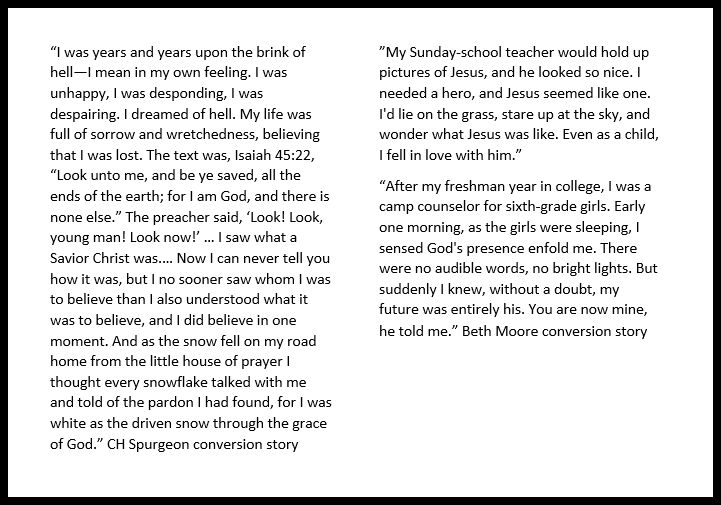
My Sunday-school teacher would hold up pictures of Jesus, and he looked so nice. I needed a hero, and Jesus seemed like one. I’d lie on the grass, stare up at the sky, and wonder what Jesus was like. Even as a child, I fell in love with him. After my freshman year in college, I was a camp counselor for sixth-grade girls. Early one morning, as the girls were sleeping, I sensed God’s presence enfold me. There were no audible words, no bright lights. But suddenly I knew, without a doubt, my future was entirely his. You are now mine, he told me. (source)

If that sounds familiar, it’s because it is very much like many other false teachers’ conversion stories.

It’s a testimony devoid of essential Gospel elements such as sin or repentance, but rife with romantic eroticism. Sarah Young describes her experience this way:

Suddenly I felt as if a warm mist enveloped me. I became aware of a lovely Presence, and my involuntary response was to whisper, ‘Sweet Jesus.’ This utterance was totally uncharacteristic of me, and I was shocked to hear myself speaking so tenderly to Jesus. As I pondered this brief communication, I realized it was the response of a converted heart; at that moment I knew I belonged to Him. (source)

Bob Dewaay explains the problems with such erotic romanticism.

The Bible speaks of the church as the Bride of Christ but does not describe the universal call of the gospel in sensual terms of a lover pursuing His love interest (who may have no interest in return). God is commanding sinners to repent. The gospel calls for repentance and faith, not romantic feelings looking for satisfaction. Voskamp’s romanticism is enhanced by her skill at describing things in a most sensual manner. The sensual terminology is designed to create a mood, a feeling, a sense of romantic mystery that longs for discovery and fulfillment. Those like me who relish clear description of theological concepts meant to be understood and discerned, will be horribly frustrated by the book. Her book is not meant to be a theological text filled with ideas to be judged true or false, but is instead a literary piece filled with feelings to be relished.

Conversion and life in Christ is not the fulfillment from a young girl’s romantic heart, yearning for a boyfriend. It’s the majestic gift of grace from a powerful but merciful God who draws people to Himself and forgives of sin, making them a new creation. Moore’s yearning for a heroic boyfriend is not the same as Godly reconciliation and peace from the spiritual battle in which all are engaged. Sadly, Moore has built a career on the false premise, and many millions have followed her down that path.

Such romanticism is not new nor did it originate with Protestants. Some Catholic mystics were adept at seeking and enjoying such unions. These women were popular in the Middle Ages. Here is an explanation of this kind of conversion story related to a famous Catholic mystic, Teresa of Avila:

Teresa described the soul’s intense desire for God in the language of erotic passion. In this, she belongs to a long tradition of mystical experience that is known as bridal mysticism. … 

The symbolism of bridal mysticism is found already in early gnostic forms of Christianity, where the central sacrament is called the Bridal Chamber. There the feminine soul of the gnostic unites with the masculine spirit and is in this way spiritualized, that is, liberated from the limitations of mundane existence.

The Catholic Encyclopedia explains mystical marriage:

In a more restricted sense, the term mystical marriage is employed by St. Teresa and St. John of the Cross to designate that mystical union with God which is the most exalted condition attainable by the soul in this life. … This state consists of three elements:
1. The first is an almost continual sense of the presence of God, even in the midst of external occupations.
2. The second element is a transformation of the higher faculties in respect to their mode of operation: hence the name “transforming union”;
3. The third element consists in an habitual vision of the Blessed Trinity or of some Divine attribute.

You notice in the writings of these women, especially Voskamp and Young, they mention “Presence”. That’s mystical bridal union state .  For example, Voskamp wrote,

The practice of giving thanks . . . eucharisteo . . . this is the way we practice the presence of God, stay present to His presence, and it is always a practice of the eyes.

This notion of continual presence and feeling it tangibly comes from a book written by Brother Lawrence, called Practicing the Presence, who was, you guessed it, a 17th century Catholic mystic.

These “mysti-chicks” such as Voskamp, Moore, Kim Walker Smith and Young, also mention that they have experienced bridal mysticism’s heightened senses and a clarity of thought, and third, they say they continually hear God or see angels or have habitual visions. Just as the Catholic encyclopedia says occurs in their descriptions of what they claim is the state of bridal mysticism.

Compare those flimsy, feelings & emotion saturated female ecstasy conversion stories with a real conversion story. This one is drenched in the scriptures.

Beth Moore’s conversion answer to the Christian reporter was terribly sad in its absence of anything remotely Gospel. A mysti-chick seeking a handsome hero to enfold her and keep her forever is a conversion story more attuned to bridal mysticism than the gritty realty of a repentant sinner saved by grace through faith.

And that’s bridal mysticism. As for the second part of my original question, why is it so prevalent? It is because apostasy is always present. As long as Christianity exists in this age, there will be those who claim to possess a transformed heart but do not possess one.

Now the Spirit expressly says that in later times some will depart from the faith by devoting themselves to deceitful spirits and teachings of demons, (1 Timothy 4:1)

Some of these people making the claim will be teachers, pastors, leaders. If you believe that false converts should be easy to spot, you’re wrong. Judas lived intimately with the disciples and Jesus for three and a half years and none of the disciples even suggested Judas as the false one when Jesus said there is one among them. Philip baptized Simon the Sorcerer, who later was cursed because he thought he could obtain the Spirit by money. Demas walked with Paul, the greatest evangelist on earth, but he showed his true colors when he left Paul because he loved the world more.

If the Disciples, Philip, and Paul could not initially spot a false convert under their nose, neither can we. However, false converts always do or say something eventually to reveal who they really are.

So, mysti-chicks did not originate with post-modern Christianity, nor did they originate in the Middle Ages’ Catholic bridal mysticism. They’ve been around as long as metaphorical Jezebel, whom Jesus threatened to strike dead. (Revelation 2:20-23). Be wary of teachers who have a conversion story absent of the necessary elements, who have added elements, or who have relied on some sort of temporal experience as the basis for their conversion. They must have a clear view of who Jesus is, (Savior) and who they are, (sinner) from the start. Not a mature perspective, because converts are babes in Christ, but a correct one. A house built on sand will not last.

For the ladies who wonder if it is OK to read or study under these false female teachers’ earlier works, ‘when they still seemed solid,’ just remember their conversion was based on sand. They were never solid.

Build Your House on the Rock
Everyone then who hears these words of mine and does them will be like a wise man who built his house on the rock. And the rain fell, and the floods came, and the winds blew and beat on that house, but it did not fall, because it had been founded on the rock. And everyone who hears these words of mine and does not do them will be like a foolish man who built his house on the sand. And the rain fell, and the floods came, and the winds blew and beat against that house, and it fell, and great was the fall of it.” (Matthew 7:24-27).

See below the conversion story of a 16 year old Charles Spurgeon, compared to the 18 year old Beth Moore conversion story. House of sand indeed.