Posted in book review, Uncategorized

Book Review: Above All Things

My summer began at Memorial Day. My summer break from school ended a month ago, when I returned to work on July 31. I’d been making the most of the time off, after spiritual duties and pleasures, to engage in some of my favorite past-times: reading and movie watching. Here is a review of one of the books I read this summer, Above All Things.

I reviewed Randy Alcorn’s Deadline previously

Amazon’s Above All Things synopsis:

Expecting their first baby, Judd and Evette McGlin are thrilled at the prospect of becoming parents. But their marriage faces the ultimate test when Judd learns he already has a child: a six-year-old bi-racial daughter, born amid secrets and lies. Now, Evette must decide if she can accept the child—and forgive Judd. She thought she was open-minded—until hidden prejudices threaten the future of an innocent little girl, Evette’s marriage, and the very notion of the woman she’s believed herself to be. Above all things, this child needs acceptance and love. Needs Evette to discover what being a mother truly means. Needs Judd to face his past. And needs them both to discover what it truly means to be a family.

above all things
Review:

I’ve never read any of Deborah Raney’s books. I bought Above All Things for the Kindle because it was free. I haven’t had the best of luck with the freebie notices that BookBub sends me. When a Kindle book is free there’s usually a reason. But sometimes a good one is stuck in there so I keep trying. This was one of the good ones.

BookBub “is a free daily email that notifies you about deep discounts on acclaimed ebooks. You choose the types you’d like to get notified about — with categories ranging from mysteries to cookbooks — and we send great deals in those genres to your inbox.” BookBub is like Honey or Camel Camel Camel but strictly for books.

My favorite genres tend toward the more manly fast paced thrillers, detective, or legal genres than the Christian ChickLit, which Above All Things definitely is.

I enjoyed how the author set the foundation at first and introduced her Christian characters by showing, not telling. I enjoyed how she brought us through their issue, the unknown daughter Judd had 6 years ago and the other issues of pre-marital sex, betrayal, and blended family that come with it. Included in their issues to work through was also the biracial aspect. The characters were well-drawn, including the daughter, grandmother and in-laws. Raney’s depiction of the change of heart and Christian growth were realistic. I especially enjoyed the scene where the couple is counseled by their pastor.

All in all, I was tremendously surprised when I looked up the length for the print version and saw it was 308 pages. It felt shorter.

Raney has been a Christy Award finalist and her first book, A Vow To Cherish earned a Silver Angel from Excellence in Media and was made into a movie of the same name. The print version of Above All Things was self-published. The writing wasn’t nuanced or tremendously complex. It is a good, free book. All in all, a good vacation read.

Posted in discernment, Uncategorized

The worst example of fake news

There is a concern with #fakenews these days. It’s news that is written to be deliberately misleading, biased, or circulated knowingly with purposes to outrage or confuse. This isn’t new. The old Soviet Union Communists of the 1950s were great at propaganda, which is what fake news used to be called. They were masters at spreading disinformation.

The Yellow Journalism age of the US in the late 1800s was another era of patently fake news, sensationalized simply to sell more papers, protect reputations, or to build reputations. (“Puff Graham“)

Fake news has been with us a long time. I can point to a very early example. Certainly the worst:

While they were going, behold, some of the guard went into the city and told the chief priests all that had taken place. And when they had assembled with the elders and taken counsel, they gave a sufficient sum of money to the soldiers and said, “Tell people, ‘His disciples came by night and stole him away while we were asleep.’ And if this comes to the governor’s ears, we will satisfy him and keep you out of trouble.” So they took the money and did as they were directed. And this story has been spread among the Jews to this day. (Matthew 28:11-15).

Fake news has been with us since forever. It has certainly been useful to the lost, greedy, and craven. Isn’t it wonderful to know that there is one source to which you can go that will always be reporting the truth?

bible with glasses 2

Posted in encouragement, Uncategorized

Seeking Jesus: My experience with ‘life between lives’ hypnotherapy

Popular Christianity makes it seem like entering the Kingdom of God is easy. You float airy-fairy into it, light and happy and joyful and basking in love. The narrow road is lined with posies and helpful angels applaud your way in. Or, you raise your hand in the congregation, walk peacefully down the aisle, appear in front to sign a card, and you’re in.

That’s not how it was for me. And it’s not how it is for most, I don’t think. My entrance was full of anger, doubt, confusion, anxiety, fervency, seeking, and striving. I was dragged into it, a pawn in a spiritual battle with one side’s bony claw clutching at my clothes, doing anything and everything to keep me in darkness. The other side full of power and light and irresistible grace, which I tried to resist, but at the same time tried to understand and desired with all my being. Agony.

Here is John MacArthur on a seeker’s journey in Which Way to Heaven?

You must enter, you must enter the narrow gate, you must enter alone. Listen to this one: you must enter with great difficulty – with great difficulty. Now, I know that shocks some people, because we hear all the time that getting saved is easy. All you have to do is just believe, sign on the dotted line, walk the aisle, raise your hand, go to the prayer room, whatever. And we’ve made it easy.

In Luke 16:16, the Lord said, “Every man who comes into the Kingdom presses his way into the Kingdom.” Now, this is not what you hear, but this is what Jesus said. The Kingdom is to those who seek it with all their hearts. The Kingdom is to those who strive, who agonize to enter it, whose hearts are shattered over their sinfulness. Who mourn in meekness, who hunger and thirst, and unquenchably satisfied, long for God to change their life. It’s not for the people who come along in a cheap way and want Jesus without any alteration of their living. When Jesus emphasized that one cannot sleep his way into the kingdom, Jesus was saying, “In order to be in My Kingdom you must have earnest endeavor, untiring energy, utmost exertion.”

I knew there was a heaven. Too many cultures spoke of an afterlife to deny the internal, global human urge to accept that there’s an afterlife. So many people had reported after-death or near- death experiences with a white light, experiences that seemed likely to validate a continuation of life after death. I mean, if there wasn’t life after death, what was the point of life? Did we evolve only to live a mere 50 or 60 or 70 years then turn to dust for all eternity? It seemed incredibly inefficient.

God’s existence seemed obvious- the earth in its beauty and complexity didn’t form from a Big Bang and a void and tumble together perfectly so as to give life to forms in a delicate balance of perfect biology. It seemed like a pretty sure bet we possessed a soul. No, God existed.

But who was He? Where was His heaven? How do we get there? And my most burning question, what was the entry requirement? It’s also obvious that humanity is evil. We’re terrible. I never believed the cultural mantra that “we’re all basically good.” There is an entire human history showing that we’re not. Stalin, pogroms, Jew-hatred (which always perplexed me), tyrants, dictators, wars, genocide. And even close to home, thievery, adultery, lying, cheating, killing. No, people are bad. So if we go to heaven, what made it heaven? If we all just transfer to heaven, it’d be just like earth. That seemed inefficient, too.

Before salvation, we are all sinners, (Romans 3:23 Ecclesiastes 7:20) in bondage to our sin nature (2 Timothy 2:26, 2 Peter 2:19, Acts 8:23 (and loving the darkness because we love our sin. (John 3:19).

I had tried Wicca, other earth pagan religions, New Age, (I had my aura photographed Kirlian photography), Buddhism, and self-righteous attempts at goodness. Nothing worked. I felt trapped in what I called “my badness.” I did not grow up Christian, never had attended church, nor was I familiar with any of the Christian terms, like sin or repent. I just knew people were bad, I was bad, and I wanted to be good. Frustratingly, nothing I tried swung me to the good side, or if it did, I never seemed to be able to maintain it.

I had read a book called Journey of Souls by Dr Michael Newton. The book deals with the eternal questions, why are we here on Earth? Where we go after death? What will happen to me when I get there? The book presupposes that we have a soul and that it goes somewhere after death. It also presupposes that our soul comes back to earth in a reincarnation. But what about in between? Dr Newton seemed to have the answers.

Dr Newton realized through his research that people (under hypnosis) could recall what they were doing between lives, and decided to create a cottage industry of trained hypnotherapists to help people unearth their between states. I thought that submitting to such hypno-therapy would help me see what was what, celestial-soul wise. I made an appointment with a Newton-trained hypnotherapist in San Mateo, CA,and off I went. I’m from Maine, so this was quite a jaunt. Talk about placing all my marbles in one basket.

His office was normal, no crystals in sight or anything like that. I sat in a large recliner, and he gave me a type of intake interview. I’d wanted to find out what happened to our souls after death and before the next life. (I wasn’t sure I subscribed to the reincarnation theory, but I went with it for now). I forget exactly what he did to “put me under”, but under I went, deeply. I could sense the physical environment around me, and hear him asking questions and prodding, but my mind also enlivened itself with vivid visions and details of past lives.

Later, I realized that under hypnosis I was recalling details of past “lives” but none were “between lives” For example, in the 1800s I was a captain’s wife aboard a sailing ship, and I fell off and drowned. In another I was a farmer’s daughter in the Netherlands grinding wheat at a mill. Where was the insight into what happened BETWEEN lives? The soul journeys? As advertised?

life between lives

I have no idea where the details about past lives came from, as we all know we only live one, long, eternal life. I was never a medieval Netherlands farmer nor a whaling wife. No such thing, but my mind presented these lives (and others, I forget now) quite vividly. I was simply a sinner seeking eternal answers in all the wrong places.

I came out from under hypnosis in what felt like 5 minutes, but it had been five hours. He made a CD of all that was said and gave it to me to take home. I never listened to it.

The weekend wasn’t a washout, I visited San Francisco and enjoyed that. I saw the Golden Gate Bridge, ate at a great Asian restaurant, etc. But my seeking was not satisfied and my questions remained. I was in slavery to my sin and the only answer was casting myself upon Jesus, our Savior, who died for our sins and took my wrath unto Himself. I didn’t know that yet. I still thought I could “figure it out.” Entering the door through Him is the only way, and it’s narrow. Rattling my cage for answers only got me more questions.

No, it’s when you come to the brokenness, and the recognition that you of yourself cannot do it, then Christ pours into you grace upon grace to strengthen you for that necessary agonizing to enter it. In your brokenness, His power becomes your resource. You must enter, you must enter the narrow gate, you must enter alone, you must enter with difficulty, and next, you must enter naked. You can’t go through a turnstile with luggage. Have you ever noticed that?  It’s a mess; can’t do it.  It is the gate – watch it – of self-denial. It is not the gate that admits the superstars, who want to carry all their garbage in. It is a gate where you strip off all of self, and self-righteousness, and sin, and immorality, and everything. You unload it, or you don’t come through it. JMacArthur
Posted in discernment, Uncategorized

How does satan snatch away the seed from the hard ground?

In one of Jesus’ parables, we read,

When anyone hears the word of the kingdom and does not understand it, the evil one comes and snatches away what has been sown in his heart. This is what was sown along the path. (Matthew 13:19).

In the beginning parts of the parable, Jesus had given the vivid picture of the sower scattering seeds along the ground. The seeds fell on different types of ground, hard, rocky, thorny, and good. Later, the disciples asked Jesus to explain the meaning of the parable. He did, and His explanation of the different types of ground and the destinies of each seed is above.

The “path” mentioned is the path that the farmers and other people would walk in between fields. It was so heavily trod that they became hard packed, almost like cement. In Leviticus 23:22 it’s mentioned as a rule that the farmers were not to harvest to the very edges of the field, so that those who are traveling or poor could glean from the stalks that were alongside the path. You might remember Ruth gleaning Boaz’s field. (Ruth 2:2-3). As Jesus and His disciples walked along the fields, they plucked some grain to eat as they passed. (Matthew 12:1). These paths were very hard and well-traveled.

In Barnes’ Notes it’s explained about the paths. As expected, the vivid picture of the hardened path, the seed, and the birds scooping away the exposed seeds is visually understandable.

He is represented by the fowls that came and picked up the seed by the way-side. The gospel is preached to people hardened in sin. It makes no impression. It lies like seed on the “hard path;” it is easily taken away, and never suffered to take root.

But I’d like to focus on the part of the parable verse that mentions that the evil one comes along and snatches the seed away. I ask myself, how does the evil one do this? In what manner? Thanks to the visual nature of the parable we can readily understand that he does, but how?

Someone asked me recently how does the devil do his work, how does spiritual warfare operate. It’s a good question and it is something that though the parable’s images are understood, it what is meant by ‘digging deeper.’ Ask yourself questions as you read. Listen to others ask questions. Pray and ponder a while. Do a parallel verse search. Look up the important words in the verse in Greek or Hebrew. Consult commentaries.

In the Greek, the word for hearing is in the continuous present tense, setting an immediacy to the situation. As stated here in Vincent’s Word studies in the New Testament, “the action is exhibiting action in progress, and the simultaneousness of Satan’s work with that of the gospel instructor. ‘While any one is hearing, the evil one is coming and snatching away, just as the birds do not wait for the sower to be out of the way, but are at work while he is sowing.'”

I am reminded of fishing boats and shrimp boats pulling up a catch, and the cloud of seagulls and other scavenging birds are plucking the fish from the nets even as they are pulled to the boat’s deck. The ground is so hard the seed of the Word never makes any impression in it, and the birds come snatch it almost immediately.

Here is Gill’s Commentary on the subject of how the devil snatches away the seed. This is aimed at the unsaved, but the point has lessons for the saved, which I’ll explore below.

Then cometh the wicked one, Satan, the devil, Mark 4:15 who is, by way of eminency, so called, being the first creature that became wicked, and the worst that is so; who is entirely and immutably wicked; whose whole work and employment lies in wickedness; and who, was the original cause of the wickedness that is among men, and which he is continually instigating and promoting: … This evil spirit, as soon as ever he observes one hearing the word, especially that has not been used to attend, comes immediately, and, as he is hearing,

catcheth away that which is sown in his heart: not the grace of God, which being once implanted in the heart, can never be taken away by Satan; but the word which was sown, not in his understanding, in a spiritual sense, nor even in his affections, so as to love it, delight, and take pleasure in it; much less in his heart, so as to become the engrafted word able to save, or so as to believe in it, and in Christ revealed by it; but in his memory, and that but very slightly neither; for the heart sometimes means the memory; see Luke 2:51.

Besides, the word only fell “upon”, not “into” his heart, as into the good ground, as the metaphor in the parable shows; and it made no impression, nor was it inwardly received, but as soon as ever dropped, was “catched” away by the enemy; not by frightening him out of it, by persecution, as the stony ground hearer; nor by filling the mind with worldly cares, as the thorny ground hearer; but by various suggestions and temptations, darting in thoughts, presenting objects, and so diverted his mind from the word, and fixed his attention elsewhere; which is done at once, at an unawares, secretly, and without any notice of the person himself; so that the word is entirely lost to him, and he does not so much as remember the least thing he has been hearing:

this is he which receiveth the seed by the way side; such an hearer is comparable to such ground, on whom the word has no more effect, than seed sown upon a common beaten path.

The saved can never have the Gospel seed snatched away from Jesus’ hand. John 10:28 explicitly says so. But even though satan cannot destroy the salvation of the saved by snatching the gospel seed from the ground into which it is sown, he can diminish our effectiveness. We, too, can be tempted as the unsaved Gospel-hearers can be tempted. The word will never be “entirely lost” to us, as Gill said it will be of the hard ground unsaved, but we can be tempted by–

–various suggestions and temptations,
–darting in thoughts,
–presenting objects,
–and so diverted his mind from the word, and fixed his attention elsewhere
–which is done at once, at an unawares, secretly, and without any notice of the person himself;

Here is John MacArthur on his version of how the devil snatches the seed away from the unsaved, but has application for us in satan’s ever-present attempt to divert us from our effectiveness:

In other words, when someone does not respond to the gospel initially, when they’re hardhearted and stiff necked, Satan just snatches it away. He just blinds them to its true value. How does he do that? Well, there are a lot of ways. One way he does that is send false teachers along to say all of that stuff was lies. Don’t believe that stuff. Another way he snatches the seed is by the fear of man. People don’t respond to it because they’re afraid they might lose their reputation or they might be kicked out of their little group or somebody might think they’re a religious fanatic.

Sometimes Satan uses pride. People are just know-it-alls. They just don’t want to admit that they need some help, that they need some information, that there’s some things they don’t know. Sometimes Satan snatches it away through doubt. Sometimes he snatches it away through prejudice, sometimes through stubbornness. Sometimes through the love of sin the person doesn’t want to give up. Sometimes through procrastination. But one way or another or a combination of ways, when it hits that hard stuff, Satan snatches it away and the person so easily forgets that it ever came.

When we procrastinate, become stubborn, prideful, doubtful, follow false teachers, or fear man, satan is snatching away our effectiveness of His word and our growth.

I told the person asking how spiritual warfare works that it isn’t done by being against people. No, our battle is against the evil one who is prince of the power of the air. Also, it is a battle of the mind. Spiritual transformation happens in the mind, and what we think becomes what we say and then what we do. Don’t let satan steal your effectiveness. If we’re saved then that means the word was sown on good soil. Keep aerating the soil of our heart by turning over His word constantly in our minds. Unearth sin and reject it, confessing and repenting. Let the roots of His truths grow deep into our heart and then we will stand like trees beside the waters, and cannot be moved. (Jeremiah 17:8, Psalm 1:3).

Maranatha!

crackSatan snatches away the seed that falls on the hard ground almost immediately as it it sown.
——————————————–
Further Reading

Truth Or Territory: A Biblical Approach to Spiritual Warfare

Posted in encouragement, Uncategorized

The Plain of the Jordan, then and now

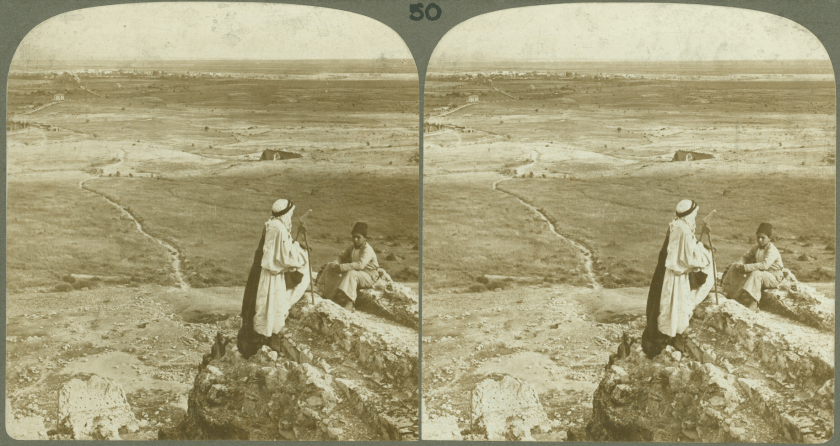
I love the old photos of the Holy Lands. Here we have a approximately 117 year old stereoscopic photo of a shepherd and a boy overlooking the plain of the Jordan. (Stereoscopic Images of the Middle East).

plain of the jordan

The caption from the book says,

‎We are looking southeast, across the northern end of the Dead Sea, six miles to the south, over the mountains east of the Jordan.

‎Yonder on the right we can see the head of the Dead Sea, and beyond it the long line of the hills of Moab. There is the Jordan, after its long wandering, finding rest in the sea. See the once fruitful plain of the Jordan with only stunted trees and bushes growing upon it. Do you notice where the plain rises, nearer us, into a higher plateau, over which a path runs? There stood the Old Testament city of Jericho. All that is left of it now are those ruined heaps, and those are later than the Jericho of the Old Testament. This part of an old aqueduct on which these men are resting was probably here in Christ’s time, as its foundation can be traced out over the plain to the site of the New Testament Jericho, on the extreme right of our view. To the left in the distance are the few buildings that make up modern Jericho.*

‎Vivid pictures of the past surge before our mental vision as we look out over this site of once proud cities. We see Old Jericho defying the attack of Joshua (Joshua 6:1); we see the collapse of those sturdy walls under the strongest assault history records (Joshua 6:3–20). We see Elijah and Elisha walking down yonder path toward the river, while by the banks of Jordan waits the fiery chariot that shall part them. Centuries later we see Jesus coming up to the gate of another Jericho, while blind Bartimeus cries out to him from the wayside, and eager Zaccheus looks down upon him from the sycamore tree.

‎*See “Traveling in the Holy Land through the Stereoscope,” by J.L. Hurlbut, D.D.

The plain of the Jordan figures is in several passages. Here is one,

Lot looked around and saw that the whole plain of the Jordan toward Zoar was well watered, like the garden of the Lord, like the land of Egypt. (This was before the Lord destroyed Sodom and Gomorrah.)So Lot chose for himself the whole plain of the Jordan and set out toward the east. The two men parted company: (Genesis 13:10-11 NIV).

That area was home to five cities of the plain, not just Sodom and Gomorrah. Admah and Zeboiim, and also of course Zoar (AKA Bela) to which Lot and his daughters fled when the brimstone came down on Sodom.

Though the plain is a sulfurous wasteland now, once it was grassy and watered like Eden’s garden. And once again it will be!

And wherever the river goes, every living creature that swarms will live, and there will be very many fish. For this water goes there, that the waters of the sea may become fresh; so everything will live where the river goes. Fishermen will stand beside the sea. From Engedi to Eneglaim it will be a place for the spreading of nets. Its fish will be of very many kinds, like the fish of the Great Sea. (Ezekiel 47:9-10).

Praise the Lord that what was once fresh and vibrant and living and beautiful, that now has become salty, dead, and barren, will once again be renewed. It will become “very good” again. (Genesis 1:31; 2:10-14)

Posted in movie review, Uncategorized

Movie Review: The Great Gilly Hopkins

Summer time means movie time, but for the discerning Christian that often means spending more time looking for a suitable movie to view than actually getting to settle down and watch one. In my opinion, The Great Gilly Hopkins is an excellent movie for the entire family.

The IMDB synopsis of the movie:

A feisty foster kid’s outrageous scheme to be reunited with her birth mother has unintended consequences in The Great Gilly Hopkins, an entertaining film for the entire family. Gilly Hopkins (Sophie Nélisse) has seen more than her share of foster homes and has outwitted every family she has lived with. In an effort to escape her new foster mother Maime Trotter’s (Kathy Bates) endless loving care, Gilly concocts a plan that she believes will bring her mother running to her rescue. But when the ploy blows up in Gilly’s face it threatens to ruin the only chance she’s ever had to be part of a real family. Based on the award-winning young-adult novel by Katherine Paterson (Bridge to Terabithia)

The cast includes Sophie Nélisse as Gilly, in an excellent performance. Her face can carry a series of nuanced emotions that many actors of her age only dream of being able to convey. Also starring are Kathy Bates, Glenn Close, Bill Cobbs, Octavia Spencer, and others you’ll recognize.

I have a huge bias toward kid movies, not just movies for kids like Minions, ToyStory or Monsters Inc, but movies starring kids or about kids. Previously on my link to family-friendly movie reviews I’d reviewed Camp, Raising Izzie, The Blind Side, Walking Across Egypt, The Queen of Katwe, On The Way to School, and others, featuring various childrens’ plights.

Gilly Hopkins is one of the very best of this genre, and with a stellar cast and good production values it lived up to its potential. Gilly has been rejected, marginalized, and shuttled from foster home to foster home, though she has a distant living mother who simply doesn’t want her. This is a fact that Gilly understands deep down but refuses to accept, thus, her repeated attempts to contact and reunite with her mother are sprinkled throughout the film as its thread. In the meantime, Gilly’s barely submerged anger over her maternal rejection rebuffs all who try to get close to her, and Maime’s foster home is threatened to be the last stop before juvie.

Foster mother Bates has one other charge under her care and with the addition of Gilly their placid and loving home life is disrupted immediately. Gilly sneaks, provokes, steals, and eventually lashes out as Bates’ character Maime prays, loves, patiently and tirelessly attempts to show Gilly she has nothing to fear by accepting love.

Glenn Close makes her entrance as Gilly’s Grandmother after recently learning of Gilly’s existence. A custody tussle emerges and presents the vehicle for the climax of the movie.

Other reviewers say that the movie closely follows the book. In order to demonstrate Gilly’s character there are a couple of swear words, rebellion, and some theft, but there is no violence, immodesty, sex, or nudity in this movie. Though Christianity is mentioned, and Maime is seen praying, religion is not a major part of the overt script but patient love as an underlying aspect comes through clearly. It is a good movie for the entire family.

Posted in discernment, Uncategorized

You (I) don’t have to say everything

There’s always controversy in the world. We live in a contentious world, led by a liar who is also a thief and a destroyer. Ergo…contention.

Contention is not restricted to the secular world. Watching the news has become a chore for those who still persist in viewing it is often seen as simply sandbox yelling and fisticuffs at a juvenile level. The news itself, when the ‘journalists’ get around to reporting it, is evil, heartbreaking, and soul denting.

Controversy also occurs in the Christian world. It has since the beginning, the very beginning. They killed Jesus, the only perfect, sinless, and loving human being ever to walk the earth. People who long for the early days of the first century church need to remember that false doctrines, false prophets, and false teachers crawled in like a tsunami of cockroaches and permeated the faith right away. The Apostles had to spend a lot of time stamping them out. It even affected Peter and Barnabas, who had to be corrected publicly by Paul. There were Nicolatians, the Judaizers, the Gnostics,  those who went the way of Balaam, individual false teachers going from town to town, the Pharisees, and many others who had to be opposed with a voice from the pastor or leader. Vigilance was necessary.

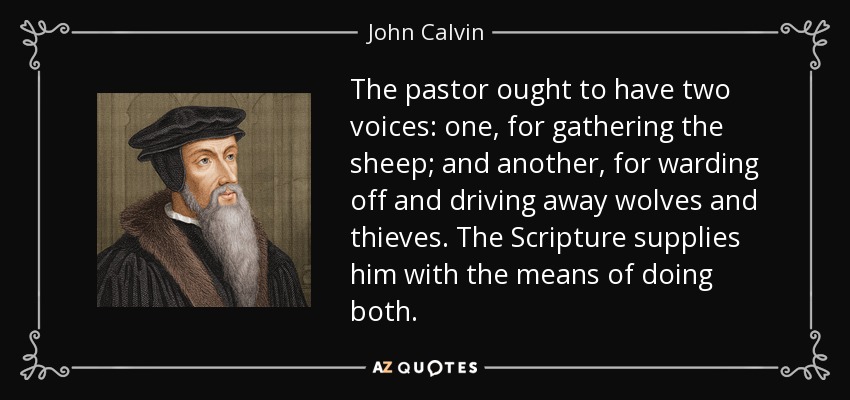
John Calvin said that a pastor must have two voices. One, for gathering the sheep; and another, for warding off and driving away wolves and thieves. The Scripture supplies him with the means of doing both.

However, you notice that the Bible’s writers did not spend a lot of time opining about the culture. They did not opine about every emperor transition, every tragedy, every riot or mob incident or organization or guild. There was one mention by Jesus of the Tower of Siloam incident which seemed to have happened “off stage” and was only spoken of as an object lesson for death.

Our hurry-up, social media, 24-hour news culture seems to demand from us an opinion on just about everything. These days, it demands that the opinion has to come with some form of outrage or offendedness.

I was a journalist for almost 8 years. I worked for weeklies, dailies, and contributed to a monthly. I was a news reporter so I had to be in tune with the culture and fresh news. I was an editor so I had to have an opinion about it, and write it in such a way so as to help people make sense in their daily lives of what they read. I won awards for news editorials. I was good at it and news opinion was a constant thread in my work no matter what other kind of journalism I was working at.

However all those habits and works were a detriment to me when it came time to be saved and begin a writing ministry. I had to go slower. I had to step out of the cycle. Most painfully, I had to learn that I didn’t have to have an opinion.

People smarter than me have opinions on the culture, on today’s news, on the secular and religious controversies. People who have more information have opinions. People with more talent have opinions. People who are men, the leaders and pastors have opinions.

I’ve mentioned that I really enjoy Samuel D. James’ writing. He published an essay recently called The Bible is Not a Slideshow for Your Hot Take

Mr James wrote about the aftermath of the news that comedian Robin Williams had taken his own life. It’s a good moment and a good impulse when the Chrisitan wants to capture the moment and impart some Christian worldview truths. “This is good, and normal,” he wrote. However, too often we do not have all the information necessary to do so in a God-honoring way. As time went on, more information came out that added dimension and nuance to the Robin Williams tragedy. If the Christian who had written superficially in the immediate aftermath did so in a less than God-honoring way (“Click to like!”) then it’s a tragedy for us too.

What I am saying is that cheaply thought, cheaply written responses to these events by definition betray the Christian commitment to the centrality of truth.

Aaron Armstrong wrote a similar essay with an ever more pointed headline: No You Don’t Have to Comment On Everything

I have opinions about politics, including American politics. I occasionally share those opinions. But usually, I prefer to keep my mouth shut. Why? It generally comes down to one thing. A proverb, in fact. “A fool does not delight in understanding, but only wants to show off his opinions” (Proverbs 18:2, CSB).

When the James White-Brannon Howse issue came to the fore, I had an opinion. When it continued, I had an opinion. As it subsided, I had an opinion. I didn’t share my opinion, except for one private query with my very short answer. Why? The men were handling it. Phil Johnson was on it. The men of GTY were on it. Others behind the scenes were on it. In the end Justin Peters and his church elders from Kootenai Church were on it. They knew more. They had a bigger platform. They were more humble. They had more spiritual insight. They possessed more experience.

I feel that the above mentioned controversy was a good test for me. It took a long time for me to subside the drive to be first, get a word in, have a published opinion. This was difficult for a hard-boiled journalist taught to be first, get a word in, have a published opinion. It’s even harder when the Lord has given the spiritual gift of exhortation. I always want to speak, but I don’t always have to speak. There is a time to speak and a time to be silent. (Ecclesiastes 3:7).

Sometimes I’ll feel led to have a public opinion. That’s OK. But not every time. Not all the time.

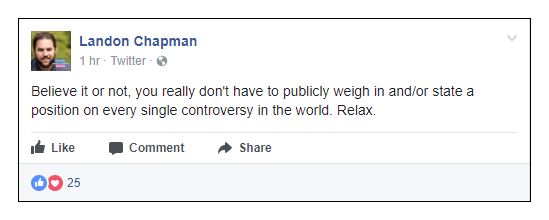
It IS more relaxing to not feel like I have to publicly weigh in or have a public position on every single controversy in the world. Sometimes in my news days I felt like a minnow in a washing machine. I don’t want to feel that way as a Christian. I want to exude a steadiness, a patience, a reserve, a solidity.

I’ll let my favorite pastor and one of Christendom’s most respected living teachers have the last word. Whether you feel led most times or only sometimes to state your position on social media or other forms of wide communication…

Posted in encouragement, Uncategorized

Who else longed to look into the Gospel besides angels?

We’re familiar with the part of the verse that tells us that angels long to look into these things. The full context of that verse is pasted below, it’s from 1 Peter.

Apostle Peter, formerly Simon, formerly a fisherman, is nearing the end of his life. It’s about the early 60s and Peter had been a leader of the church. The elect to whom Peter addressed his letter were beginning to suffer persecution, and his letter, which was to be circulated, was aimed at encouraging them. Peter strongly urges them to link doctrine and practice, a point he makes in chapter 1:12, 15, and he begins in the first chapter with elevating the glory of the Gospel. Here is where we remember that the Gospel is so great, so mysterious, that angels long to look into it.

Concerning this salvation, the prophets who prophesied about the grace that was to be yours searched and inquired carefully, 11inquiring what person or time the Spirit of Christ in them was indicating when he predicted the sufferings of Christ and the subsequent glories. 12It was revealed to them that they were serving not themselves but you, in the things that have now been announced to you through those who preached the good news to you by the Holy Spirit sent from heaven, things into which angels long to look.
(1 Peter 1:10-12).

In reading the passage I realized that not only angels longed to look into the mystery of the Gospel, its wonder, atonement, wrath, crucified and sinless God-Man. The Prophets also wanted to know about it. They, who had the Spirit in them, inquired of the LORD as to the aspects of this religion they were required to speak. Here is the wonderful Barnes with his Notes:

Of which salvation – Of the certainty that this system of religion, securing the salvation of the soul, would be revealed. The object of this reference to the prophets seems to be to lead them to value the religion which they professed more highly, and to encourage them to bear their trials with patience. They were in a condition, in many respects, far superior to that of the prophets. They had the full light of the gospel. The prophets saw it only at a distance and but dimly, and were obliged to search anxiously that they might understand the nature of that system of which they were appointed to furnish the comparatively obscure prophetic intimations.

They were writing to us and for us. It was revealed to them that they were serving not themselves but you, Peter wrote. Us. The elect saints in the church age would be the recipients of the further information than myriads of angels- who live with God- . and prophets – who personally spoke with God – longed to look.

Next time someone says they “want a fresh experience” or desire the Spirit to fall down and manifest some kind of event, or that they wish to hear Jesus personally calling, or that they feel stale and covet a miracle, please remind them of this glorious truth. We already have the benefit of the most glorious experience of all, the understanding of the plan of God with regard to His Son. The angels and the Prophets wanted to know about Him, who He would be, what would be his life and doctrine and character, and what would be the nature of the work which He would perform on behalf of the people. They didn’t know. They wished to know. They asked to know. They did not know. We do.

As Barnes says of verse 12,

By them that have preached the gospel unto you – The apostles, who have made known unto you, in their true sense, the things which the prophets predicted, the import of which they themselves were so desirous of understanding.

knowing that you were ransomed from the futile ways inherited from your forefathers, not with perishable things such as silver or gold, 19 but with the precious blood of Christ, like that of a lamb without blemish or spot. 20 He was foreknown before the foundation of the world but was made manifest in the last times for the sake of you 21 who through him are believers in God, who raised him from the dead and gave him glory, so that your faith and hope are in God. (1 Peter 1:18-21)
Have a blessed day, pondering these truths into which angels and Prophets inquired and longed to look.

Posted in encouragement, Uncategorized

Of Jesus’ love: My Value’s Fixed

Keith Getty’s song “My Worth Is Not In What I Own” is a lovely song. As Mr Getty describes the song at The Gospel Coalition, it

is a song that speaks to the subject of worth by reminding us that true significance is found in our identity in Christ. Kristyn and I recently wrote it with our good friend, Graham Kendrick, in an attempt to reclaim two glorious truths. The first is that we, as men and women created in the image and likeness of the Creator, are created with intrinsic worth.

But there’s another truth we want to convey: given our pervasive rebellion—what R. C. Sproul calls “cosmic treason”—against the king, we are all unworthy of the value with which he crowns us. Yet God sent his Son so our worth might be found in something far grander than ourselves. In Christ, no longer do we look to our own accomplishments and achievements to find significance. We look instead to his perfect work on our behalf, and there our souls find the true sense of identity we so crave. The chorus of our song draws from the rich imagery of 1 Peter, which depicts Jesus as an inheritance and treasure far greater than anything this world has to offer.

Getty goes on to describe some of the many themes within the song, but notes that the original thought was the phrase “my worth is not in what I own.”

However, another idea came to me that focuses on another part of the lyric. The value of the Gospel is inestimable. In 1 Peter, the passages from which Getty took the thoughts and doctrines for his song, angels and the Prophets longed to look into the glorious coming of the Savior. They were told they were serving not themselves but us. (1 Peter 1:12). They were extremely humbled and intrigued by the notion of the Savior and His coming in Gospel times.

In that sense, we who dwell in the Church Age, AKA the Age of Grace, AKA Gospel Times, have an inexpressible value, because we are saved by grace through faith in the Gospel. Since the Gospel is inestimably precious, we are inestimably precious. As the song says, “my value’s fixed.”

For those who struggle with low self-esteem, let this song and its lyrics and the verses behind it comfort you. Your value is fixed. Your identity is sure. After salvation, our value is linked to the Gospel which saved us by faith through the work of Jesus. Jesus cannot love us any less or any more than He does at this moment or since before the foundation of the world when He chose you. (Ephesians 1:4). His love for you is fixed and perfect.

If you struggle with a high self-esteem, then the same is true again. His cannot love you any less or any more than He does now. Your value is fixed. Nothing you say or do or work at or accomplish or are noted for will cause in Him an atom’s worth of further love, deeper love, or less love than expressed through His lovely Gospel and His saving. His love for you is not based on your worth, but His worth.

Be comforted by this. Be released from worry that anything you might say or do will cause a decrease in His love for you. Be released from the notion that anything you say or do will help yourself to greater love by Him. Your value is fixed in the palm of the One who already loves perfectly and completely.

14For this reason I bow my knees before the Father, 15from whom every familyc in heaven and on earth is named, 16that according to the riches of his glory he may grant you to be strengthened with power through his Spirit in your inner being, 17so that Christ may dwell in your hearts through faith—that you, being rooted and grounded in love, 18may have strength to comprehend with all the saints what is the breadth and length and height and depth, 19and to know the love of Christ that surpasses knowledge, that you may be filled with all the fullness of God. (Ephesians 3:14-18).


My Worth Is Not In What I Own

Keith Getty

My worth is not in what I own
Not in the strength of flesh and bone
But in the costly wounds of love
At the cross

My worth is not in skill or name
In win or lose, in pride or shame
But in the blood of Christ that flowed
At the cross

Refrain:
I rejoice in my Redeemer
Greatest Treasure,
Wellspring of my soul
I will trust in Him, no other.
My soul is satisfied in Him alone.

As summer flowers we fade and die
Fame, youth and beauty hurry by
But life eternal calls to us
At the cross

I will not boast in wealth or might
Or human wisdom’s fleeting light
But I will boast in knowing Christ
At the cross

Refrain

Two wonders here that I confess
My worth and my unworthiness
My value fixed – my ransom paid
At the cross

Refrain

Posted in encouragement, Uncategorized

Think about what Paul said- “We always thank God, the Father of our Lord Jesus Christ, when we pray for you…”

We always thank God, the Father of our Lord Jesus Christ, when we pray for you, 4since we heard of your faith in Christ Jesus and of the love that you have for all the saints, 5because of the hope laid up for you in heaven. (Colossians 1:3-5).

One of our pastors preached on Colossians last Sunday. He noted the above introduction in Paul’s letter. Paul prayed to Jesus in thanks for the saints.

Our pastor said, ‘What if we prayed like that? Instead of when we pray and getting straight to our petitions, or even instead of getting straight to thanking Jesus for what He’s given ourselves or done for us, we thank Him for our brethren?’

When was the last time I prayed in thanks for the saints around me, the saints around the world, the saints that have come before on whose works I rely? Hmmm, it’s been a while I think.

I am thankful for our elders. We have a Teaching Pastor, an Associate Pastor and two elders who lead us in preaching, confession time, prayers, and devotionals. They are Godly men, humble, and filled with a heart of love for Jesus and service to Him. I know I am blessed to be growing under such men, and I do thank Jesus for them. Therefore I say,

We always thank God, the Father of our Lord Jesus Christ, when we pray for you, 4since we heard of your faith in Christ Jesus and of the love that you have for all the saints, 5because of the hope laid up for you in heaven.

We have a cadre of elder folks who are seasoned, mature, kind, doctrinally solid, and constant in their attendance, devotions, and service. They aren’t coasting, they take nothing for granted, and they are always willing to lead, teach, encourage, or just silently be present. Therefore I say,

We always thank God, the Father of our Lord Jesus Christ, when we pray for you, 4since we heard of your faith in Christ Jesus and of the love that you have for all the saints, 5because of the hope laid up for you in heaven.

youths
Some of our members on a retreat. http://www.nacathens.org

In a most remarkable blessing, the largest demographic of members and attendees in our church are youngsters. These are youths aged from upper teens to mid twenties. The college crowd. Many are in undergraduate or graduate school in the area. Their eagerness and fervor is a boon to us elder folks. Their zeal to serve is refreshing. Most of all, they love Jesus and devour His word. Despite a heavy class load or demanding work schedule, they arise before dawn or stay well after dark to attend Bible groups. They faithfully attend church services. They drive 40 minutes and stay two hours just to seek advice from an older member. They happily jump in to serve by setting up or taking down, the drudge jobs. They love each other and they joyously submit to leadership. They are amazing. Therefore I say,

We always thank God, the Father of our Lord Jesus Christ, when we pray for you, 4since we heard of your faith in Christ Jesus and of the love that you have for all the saints, 5because of the hope laid up for you in heaven.

Next time, I won’t lightly skim the intro to a letter, but as our elder preached, I’ll stop and truly ponder what the writer is saying. Paul dwelled on praise to Jesus for the brethren, and I want to adopt that same mindset in prayer by thanking Jesus for them both in my sphere and across the world.