Posted in encouragement, Uncategorized

The ‘Wondrous Strange’ Gospel

Back in 1998 I drove a few hours from my home in Gray, Maine to Rockland, Maine. The destination was the Farnsworth Library & Art Museum. The Farnsworth is a gorgeous museum tucked away on the rockbound coast. The New York Times wrote of the opening of the Farnsworth and the Wyeth collection this way,

Ever since N. C. Wyeth bought a place in Port Clyde, south of Rockland, in the early 1930’s, the family has summered here, and Andrew Wyeth’s painting ”Christina’s World” is, for many people, synonymous with Maine. The Wyeth center is attached to the Farnsworth Art Museum, a respected 50-year-old institution that focuses on artists connected with Maine and that has built one of the best small, specialized collections in the country.

They had advertised a collection I was dying to see. It was called, “Wondrous Strange: the Wyeth Tradition: Howard Pyle, N.C. Wyeth, Andrew Wyeth, James Wyeth.” You might or might not know that the three generations of Wyeths have a deep connection to Maine, and all three generations owe inspiration to Pyle. The generations went like this- Turn-of-the-last-century illustrator Howard Pyle; His student was N. C. Wyeth; N. C.’s student and son was Andrew Wyeth (wife Betsy); Andrew’s student and son was Jamie Wyeth. Betsy Wyeth chose the paintings and illustrations for the show I was driving to see, and named it Wondrous Strange.

The theme of the show is described from the catalog as, “an imaginative, often disquieting, dreamlike imagery.” The catalog/book describes the paintings- “Demonic eyes shining out of a shadowy tree. A blind man staggering through a moonlit landscape. Disembodied, dark hands rising out of snow. A feral dog with one blue eye. Ambiguous shadows harboring human shapes.”

The NY Times described it this way:
While Andrew and Jamie work in cooler times, there is no question that some of the images in ”Wondrous Strange” are really weird. Andrew paints a corpse emerging from a block of melting ice and severed hands perched on ice floes; Jamie portrays himself with a pumpkin head and as a clownish scarecrow. He depicts lighthouses with the same fierce perspective that his grandfather used for Peg Leg Pete.

One of the paintings’ raison d’etre is described by the artist Andrew Wyeth himself as ”to memorialize the emotions he felt upon viewing his father, N. C. Wyeth, in his casket.” Yes. Weird indeed.

Here are a few of the paintings that were mounted in that long-ago show.

“Mischief Night,” by Jamie Wyeth.
“Pumpkinhead Visits the Lighthouse,” by Jamie Wyeth

Treasure Island illustration, NC Wyeth, 1911

One painting that was included in the show was this one, called simply, “Lighthouse”, by Jamie Wyeth. This painting adorns the cover of the catalog/book.

It’s eerie. There’s nothing particularly ghoulish about the scene. In fact, many other paintings were more weird and fiendish. But there is something maniacal and out of control in this painting. The scudding clouds evoke thoughts of monstrous hands strangling the world, the fortress-like lighthouse, the wild hair, the jarring vestment of a wrinkled military uniform worn on a wild hill… the painting is a perspective of the world that’s cracked, tilted, and agitated.

Perhaps that was the appeal- weirdness, agitation, and ghoulish specter of the disquieting. As I said, I’d driven a few hours and it was going to be a day trip, no less. After seeing the exhibition and having lunch with the friend accompanying me, we’d turn around and drive home. The attraction of the wondrous strange to the pagan heart is strong.

The title of the show comes from Shakespeare’s Hamlet Act I Scene V-

HORATIO
O day and night, but this is wondrous strange!
HAMLET
And therefore as a stranger give it welcome.
There are more things in heaven and earth, Horatio,
Than are dreamt of in your philosophy.

Returning from nostalgia, on Saturday I was listening to John Gerstner’s Handout Apologetics this morning. The lesson was on The Gospel of God, lesson 10. Gerstner said of the Gospel,

The question remains, how do I know that this Jesus of Nazareth, a man among men, was more than a man among men? You ask me to believe He was actually God incarnate? When did anybody ever stretch the credulity of the human mind more than when it is asked to believe that that simple peasant of Galilee was God dwelling in human flesh?!

The mind of man couldn’t think it up. To think a Person in the Godhead, would unite humanity with deity, and suffer in that humanity and yet as deity, survive the wrath of the Godhead, that is something that when you read about it in the Bible you know it has to be true, it couldn’t be fictional. It is so strange, so wonderful so beyond human anticipation that it has to be a God-given reality.

Well, you know of course why I spent time writing about the Wyeth wondrous strange exhibition. The mind of man I’d thought was so imaginative in painting and illustrating eerie and strange scenes, is not so wondrous strange after all. The REAL wondrous strange is the reality of the Gospel, of a God whose act of sacrificial incarnation, suffering, and death is SO strange that man had never ever thought it up in any religion, before or since. The wondrous strange mind of God, who had planned this devastatingly necessary separation of His Son from the Godhead since before the foundation of the world, in merciful love and grace, is the strangest wonder of all. As Halloween proceeds through this day, please ponder the most strange philosophy, Horatio, ever not dreamt of in earth, but is real and true from heaven.

Posted in prophecy, Uncategorized

Did you know…about ‘The Nazarene’? Bible fact

We know that Jesus was from Galilee in a region called Nazareth. The region’s largest city is Nazareth. People from that region were often dubbed Nazarenes. Geographic identifiers in the Bible are pretty common. Saul of Tarsus is one. Mary Magdalene might have been so named because she was likely from the town of Magdala. But did you know there might also be a prophecy associated with the name Nazarene? Faithlife Study Bible has more.

Within the four gospels and the book of Acts, the term “Nazarene” (translated from the Greek nazōraiōn or nazōraios) appears about 19 times. It occurs once in an allusion to a prophecy (Matt 2:23) and is applied once to the newly formed group of Christians (Acts 24: 5). All 17 remaining instances of “Nazarene” apply directly to Jesus (Matt 26:71; Mark 1:24; 10:47; 14:67; 16:6; Luke 4:34; 18:37; 24:19; John 18:5, 7; 19:19; Acts 2:22; 3:6; 4:10; 6:14; 22:8; 26:9).

The prophecy quotation from Matthew 2:23 comes in the context of Joseph receiving a dream which tells him to leave Egypt and go to Israel. The passage recounts that in response to the dream, Joseph settles his family in a town called Nazareth (Matt 2:19–23). The Gospel of Matthew connects this geographical movement fulfilled what was spoken by the prophets: “He will be called a Nazarene.” However, an Old Testament text making any statement similar to this does not exist—meaning that another explanation is required.

A few plausible options are available to resolve this issue. The author of the Gospel of Matthew may have been employing a pun or wordplay by associating the Hebrew word for “branch” (netser) in Isaiah 11:1 with the word designating a person as a resident of Nazareth (a “Nazarene”; nazōraios in Greek). The reference to “branch” would have been significant because it symbolized Jesus as a king from the lineage of David.

A second more plausible explanation is that the author may have been alluding to several statements made by a variety of Old Testament texts that focus on the obscurity and humility of the Messiah (e.g., Psa 22:6–8; 69:8, 20–21; Isa 49:7; 53:2–3; 7–8). The term Nazarene had a derogatory connotation, referring to someone from an obscure or insignificant town (John 1:45–47). During Jesus’ day, the town of Nazareth was insignificant from the perspective of Jerusalem (John 7:41–42, 52).

Much later, the term Nazarene appears in the account of the charges leveled against the Apostle Paul. He was facing trial for stirring up dissension, supposedly desecrating the temple, and serving as the ringleader of the “sect of the Nazarenes” (Acts 24:1–5). Jewish Christians were probably given the label because of their connection with Jesus of Nazareth. It likely served as a pejorative term when applied to the Christian community.

DAVID SEAL, Barry, J. D., Mangum, D., Brown, D. R., Heiser, M. S., Custis, M., Ritzema, E., … Bomar, D. (2012, 2016). Faithlife Study Bible. Bellingham, WA: Lexham Press.

There is always more to study with the Bible. We know what we know until there is more to know!

Posted in potpourri, Uncategorized

Prata Potpourri: Secret Nazi Base, Gay man dislikes Church Discipline action, Star Trek Uniforms, Luther & Reformation Day- more

Our school closes for a few days at the end of October for a mini-Fall Break. We all look forward to this, both the staff and the students. Lots of people take trips. The mountains aren’t far and Fall is a great time of year in Georgia to go tuck away in a cabin somewhere. Others go to Disney because it isn’t so hot, or the beach, for the same reason. I love Fall in Georgia, it’s my favorite time of year. It lasts longer than Fall lasts up north. Its gradual slope into winter leads us to toward holiday season in a gentle way. We can finally turn off the loud air conditioner and start using the oven to bake wonderful things without making the house too hot.

The progression of the seasons is orderly and beautiful. Each season with its distinct colors and meaning is due to the creative mind and power of Christ.

For in Him all things were created, things in heaven and on earth, visible and invisible, whether thrones or dominions or rulers or authorities. All things were created through Him and for Him. He is before all things, and in Him all things hold together. (Colossians 1:16-17)

Here are a few items I believe may be of interest. Enjoy the day, the season, the Savior 🙂

This is interesting. Man starts social media campaign over his church dismissal for unrepentant homosexuality. The next big thing I see coming are lawsuits emerging from church discipline. As a side note, please notice in the article where it says the man had repented and lapsed several times prior to his final repudiation of God’s standards. Remember, repentance should be viewed as something that happens over time. Fruit takes time to grow. Be patient, either way, to see if what is growing in the heart is an apple or a thorn.

Oh the agonizing pull to check notifications or respond to texts…the overarching need for new stimulation even after a few minutes…Samuel D. James has more in his essay The Phone and His Boy.


A Secret Nazi Base in the Arctic has been discovered? And it’s not a wartime myth or clickbait? No, it turns out to be true. Russian researches stumbled onto it and found within over 500 relics, including well-preserved papers. /shudder/ Nazis are still extending their shadowy reach into even this millennium. We will only be removed from the presence and memory of that terrible history when we are resurrected into glory. The UK Independent also has the article and photos.

Death has always troubled the pagan man. Cemeteries have always troubled the aggressive realtor. Decaying biomass has always troubled the zealous environmentalist. Now, these concerns are combined in an unusual proposal for where or how to bury the dead. Is this the future of death?

With Halloween coming, with the inevitable Star Trek costumes abounding, which is as it should be, here is how to read the secret language of the Star Trek uniforms of that most unabating TV show. Which is 50 years old this year by the way. Oy, I suddenly feel old…

The Narrow Minded Woman has a great essay on Luther and Reformation Day.

Ignore the one reference to Rick Warren and enjoy the author’s case for quantifying discernment/judgment of each other. The 10 Percent Grace Rule: Judging Without Being Judgmental

I really like this man’s writing. He muses on You Get What You Pay For, an essay on shepherding financial resources wisely, Philippians 4:8, the election, and Netflix which is cohesive and concise. Really, the guy has mad writing skills.

Julia at Steak & a Bible said, “Hillsong Music: Popular Yes, but Is it Biblical?

Hillsong is an enormous church network and through its music, the church reaches far outside of that network. Many churches use Hillsong songs on Sunday mornings. But I wonder how many of them ever stopped to examine the songs for doctrine. That’s precisely what Chris Rosebrough, Steve Kozar and Amy Spreeman did on a recent episode of Fighting for the Faith. Given the popularity of the music I highly recommend listening to it.

I recommend it too!

Dr. Michael J. Kruger, President and Samuel C. Patterson Professor of New Testament and Early Christianity, RTS Charlotte answers the question of does the Bible have mistakes? Length, 2:40.

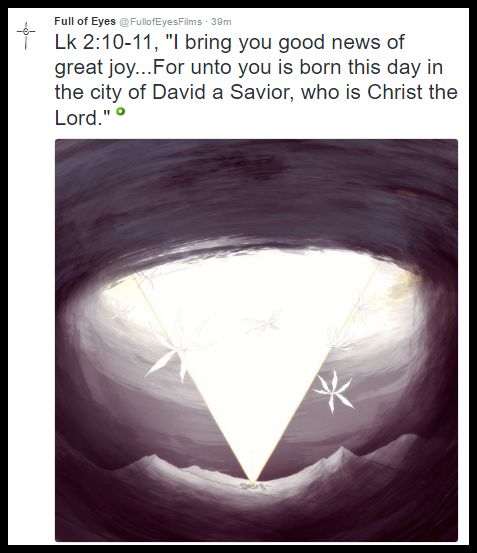
Chris Powers has illustrated another Bible verse with his usual skill, insight, and sensitivity. Take a look,and please take a look at his overall ministry at Full of Eyes. Everything he makes he gives for free for the edification of the body and evangelization of the lost.

Posted in encouragement, Uncategorized

What does it mean to “reason together”?

People are surprised when they learn that the following verse is not in the New Testament. It sounds New Testament-ish. But it’s not in that book.

Come now, let us reason together, says the LORD: though your sins are like scarlet, they shall be as white as snow; though they are red like crimson, they shall become like wool. (Isaiah 1:18).

It’s from Isaiah.

Things get even more interesting. It is the LORD God telling His people to approach Him to reason with Him, and to do it in confidence and not in fear. In the verse, God is speaking to His chosen people Israel.

Gill’s Exposition explains:

Come now, and let us reason, together, saith the Lord,…. These words stand not in connection either with the preceding or following, but are to be read in a parenthesis, and are thrown in for the sake of the small remnant God had left among this wicked people, in order to comfort them, being distressed with sin.

These, seeing their sins in their dreadful colours, and with all their aggravating circumstances, were ready to conclude that they were unpardonable; and, seeing God as an angry Judge, dared not come nigh him, but stood at a distance, fearing and expecting his vengeance to fall upon them, and therefore put away the promises, and refused to be comforted;

when the Lord was pleased to encourage them to draw near to him, and come and reason with him: not at the bar of his justice; there is no reasoning with him there; none can contend with him, or answer him, one of a thousand; if he marks iniquity in strict justice, none can stand before him; there is no entering the lists with him upon the foot of justice, or at its bar:

but at the bar of mercy, at the throne of grace; there the righteous may dispute with him from his declarations and promises, as well as come with boldness to him; and at the altar and sacrifice of Christ, and at the fountain of his blood:

here sinners may reason with him from the virtue and efficacy of his blood and sacrifice; and from the Lord’s proclamation of grace and mercy through him; and from his promises to forgive repenting and confessing sinners: and here God reasons with sensible souls from his own covenant promises and proclamations to forgive sin; from the aboundings of his grace over abounding sin; from the righteousness of Christ to justify, his blood to cleanse from sin, and his sacrifice to atone for it.

We have a good God, abounding in mercy and patience. His grace is eternal. His Son’s atoning sacrifice is eternal. Our communion and reasoning with Him is eternal.

Posted in discernment, Uncategorized

Ted Dekker’s The Forgotten Way: Book Review and a Discernment Lesson

Ted Dekker is a Christian novelist who writes Christian thrillers. He has also written several book series of historical nature, several fantasy books, and Christian fiction. Dekker’s interests and range are diverse. He has won the Christy Award for best fiction book, ECPA Gold Medallion Award, INSPY Award, among other awards and recognition.

This month, Dekker has published a book which diverges from his usual genre of fiction. His new book is a study/devotional. It’s called The Forgotten Way of Yeshua for Power and Peace in This Life. I’ve been asked to look into the book and give an opinion as to its doctrinal solidity.

This article will serve a two-fold purpose. The first part will be to explain and teach how I approach the decision-making process on whether to read a Christian book or engage in a published study. Time is short in our lives and we do not have it to waste on absorbing poor or unhelpful material. Secondly and more importantly, the name of Jesus is tantamount. The material must reflect Him, His word, and His precepts correctly so His name is glorified. Thirdly, as women, we are more prone to error and tend to be unduly influenced by unbiblical things so we must be sure that what we take into our brain doesn’t pollute our brain. (1 Timothy 2:14, 2 Timothy 3:6). Be discerning, wise, and careful.

The second part of this article, as you scroll further down, will be a book review by a man who is familiar with Dekker’s works and who has read The Forgotten Way. So, a lesson, and a review.

How to Approach Whether to Read a Book or Study

I looked at Dekker’s website, and I read the sample lessons in his study and I downloaded the free sample devotionals. I read 30 pages of the devotional.

1. What I do first is, I look for contemporary buzzwords that indicate where a person’s heart or mind lay. If they use standard, biblical words to describe the standard biblical concepts such as justification, sin, repentance, etc, then all well and good. The first red flag I noticed is calling Jesus “Yeshua”. I’ve observed that many mystics seem to think this gives them more piety when they use the Hebrew name. Also people in the Hebrew roots movement call Jesus ‘Yeshua’. It’s an affectation. More buzzwords below.

2. The second big red flag is any leader who says he has discovered a new way, or a forgotten method, or an overlooked verse, or claims new meaning, it’s a problem. The point of Christianity is its unchanging nature because it’s founded on God and He does not change. It also indicates a mountainous pride. “Everyone else has forgotten this, no one else has noticed this, but I am here to rectify that.” Dekker’s promotional material is rife with promises that this ‘new way’ will revolutionize your faith, which leads to the third red flag-

3. Any promotional material that says it will change your life is of concern. The Holy Spirit changes your life, not a method. The point is to get to know Jesus better, not to change our temporal lives. Any time we are with Him in the word or worship or hymns or prayers, we become transformed and our transformation through ongoing sanctification changes our life. But short cuts like a 21 day devotional with a newly rediscovered method such as Dekker’s? I’m always suspicious of claims that promise an immediate jump in sanctification.

4. Fourth, notice if the author uses trendy buzzwords or buzzwords that are from another religion. In Dekker’s case, the promo material as well as the actual study contain many terms associated with New Age. Words such as “alignment, resonating, tuning fork, vibrate, same frequency” abound. These are not biblical words. There are biblical words that describe the concepts Dekker is attempting to get across. Other words that he uses have no biblical grounding. Either way, use the biblical word and not the words that are widely associated with a different religion. Never mind the obvious, that with the Holy Spirit IN us, we are already ‘aligned’ with Him and always on His ‘frequency.’

In considering whether to take up a study or read a Christian book, I ask myself if the writer seems to have a grounded, balanced view of Jesus. It seems that in this new study, Dekker’s entire emphasis is solely on the love of Jesus and not His wrath, justice, holiness etc. In fact, it seems he focuses on what WE can get out of Jesus rather than focusing on His attributes for His own glory’s sake. The constant references to “who we are” and being “able to love ourselves”(I got those from his promo video) are concerning.

There are sweeping claims in the promo material and in the part of the study I’d read. I read such outlandish things as “The whole world longs for the Way of Yeshua” and “An awakening is sweeping the world.” I do not like it when authors make sweeping statements about God as if they know things. Dekker does not know that all 8 billion people of the world long for the way of Yeshua. As a matter or fact, the world rejected and still rejects Jesus and He said they always will. (John 15:18). No one seeks after God. They all go their own way, (Isaiah 53:6), which is not the way of “Yeshua”. So Dekker’s sweeping statements are a problem.

Last, I look at who has supported the book or Bible study, or who promotes it. Dekker has blurb support and recommendations from Elevation Church, which is bad. Other readers liken Dekker’s book to Henri Nouwen, who in fact is a Catholic mystic.

From these flags, I’d say that the book seems to be a misstep for Dekker. It’s sad, because in his video he said he’d been working on it for years. As a woman, I would choose not to read the book/take the study because these red flags are enough to show me there are problems. I don’t want to use the bulk of my brain power while in a study busily warding off potential doctrinal issues. I want to be able to fairly safely engage in the study so as to learn from it and enjoy biblical truths. With so many better studies out there, I’d say give this one a pass.

The Book Review

Here is a review from a friend, Bryn Jones, who has read Ted Dekker’s The Forgotten Way.

I did read his e-book Waking Up, which is essentially a promo for the 21 Day “cleanse,” as he puts it. I wrote a review (2 stars). He gets a couple things very right. For instance, he stresses that we need to find our identity in Christ, not in our own efforts to measure up or prove ourselves. But there’s some wrong in there, too. Like you pointed out, he loves the “love” of God, and he comments on the omnipotence of God, but then fails when defining love. To him, love means never being offended and just showing kindness to everyone, never pointing out wrong, just accepting… etc. 

Oddly, John defines love as obedience to Christ (1 John 5:3). Also, if we’re never to correct anyone, or never to be offended, then there would be no content to the epistles (which were often corrective) and there’d be no reason for Jesus to outline how we are to address issues where a brother sins against us. What I heard is “planks of offense” in Dekker’s promo, which is a phrase I’ve heard from a charismatic friend who regularly quotes from the Word-Faith movement. In that version, they change Jesus’ teaching to say people have “planks of offense” in their eye, rather than the meaning of being guilty of the same issue they intend to correct in other people. I imagine the subtle change is so that these domineering pastors can chastise anyone who tries to correct them by claiming they have “planks of offense.” 

So, Dekker has some good in regard to the identification with Christ, that our position is secured and not in need of our efforts … but then he ignores the actual “elephant in the room” that many who “got saved” but are living lives that are so sinful they’ve “forgotten who they are” might actually not be saved. So, his advice that they need to just “awaken” to the “reality” of their position in Christ sounds rather … universalist.

The other thing that got me about the book was how the author claimed that the Ted Dekker he sees in the mirror, the novelist, is not the real person. It’s like a role he’d play on TV … it’s passing away … the true Ted is this spiritual one in Christ. He assures the readers that he’s not a Gnostic, but it sure sounds like it. I don’t think the “putting off of the flesh” meant that our personalities and occupations and interests are all worldly. God made us who we are and we will be perfected. Maybe I’m being picky. But it sure read very mystic/gnostic to me.

Bryn Jones is the author of the apocalyptic novella RESISTANCE, the thriller, The Next Chapter,the supernatural suspense novella, The Fold, & The End Times Christmas novella, The Last Christmas

~~~~~~~~~~~~~~~~~~~~~~~~~~~~~~~~~~~~~~

I hope this helps. As always, search out these things for yourself, and remember that prayer is the best vanguard. Pray to the Holy Spirit to give wisdom and discernment. (James 1:5). Read your Bible to grow, and be careful of what you choose to study, even from formerly solid teachers.

Be sober-minded; be watchful. Your adversary the devil prowls around like a roaring lion, seeking someone to devour. (1 Peter 5:8)

Posted in encouragement, Uncategorized

Footsteps of the Man of Galilee: Jenin by Early Morning Light

I like the book Earthly Footsteps of the Man of Galilee due to the wonderful, sepia photos of places where Jesus walked. Taken in the late 1800s, the photos record a mostly unchanged region, where it is inspiring to peer into the picture and imagine the days of Jesus’ incarnation. Here is the synopsis of the book:

‎Earthly Footsteps of The Man of Galilee and the Journeys of His Apostles contains 400 original photographs by Robert E.M. Bain, taken in Egypt, Israel, Syria, Lebanon, Turkey, Greece, and Italy. Descriptions for each photograph are written by James Lee. These photographs depict the life of Christ and the influence of his ministry—the locations where Christ was born, baptized, crucified, as well as scenes from his prayers, miracles, and sermons. This resource also contains photography of sacred sites between Jerusalem and Rome. Vincent, J., Lee, J., & Bain, R. E. M. (1894). Earthly Footsteps of The Man of Galilee and the Journeys of His Apostles. New York, NY;St. Louis, MO: N. D. Thompson Publishing Co.

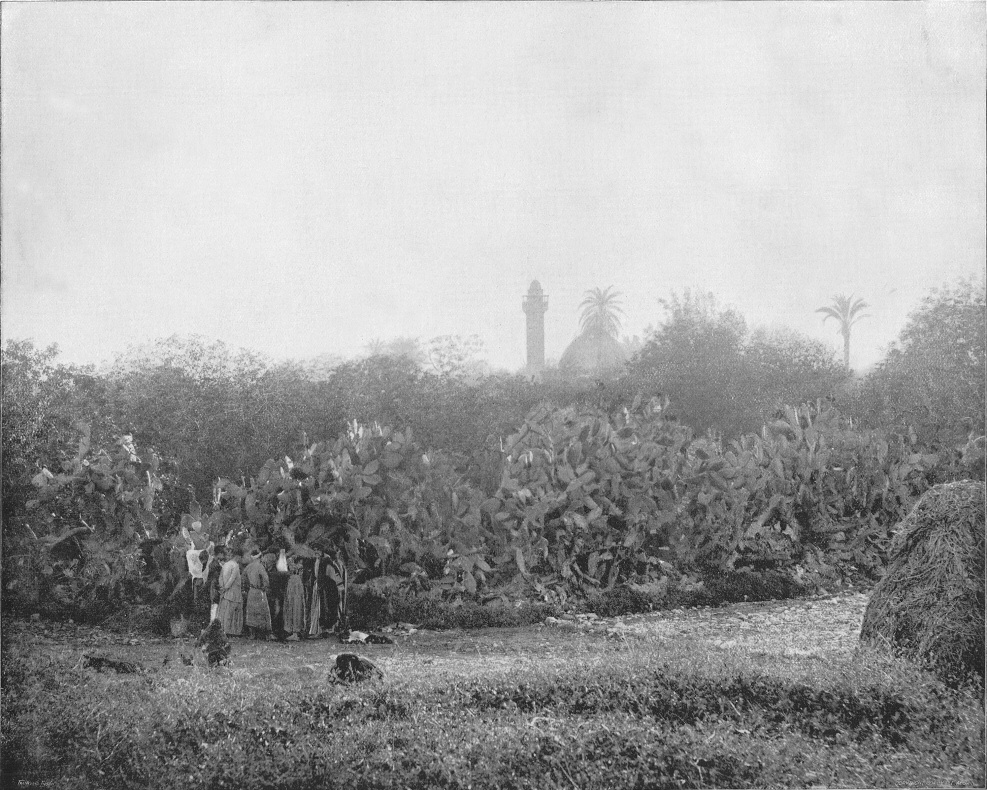
Jenin by early morning light.

Jenin is perhaps ten miles to the right of the route Joseph and Mary are supposed to have followed on their return from the sojourn in Egypt. It is one of the places, however, our Lord often passed during the years of His active ministry. Jenin is supposed to be the Ginea of Josephus, which again answers to the ancient En-gannin or “Garden Spring” (Joshua 19:21) with the territory of Issachar. The road from Nazareth to Jerusalem always passed this way, therefore, we are on sure ground again as we think of Mary on her way to Jerusalem with Joseph; on her way from Egypt; on her way from Nazareth to Jerusalem again when the lad Jesus was twelve years of age.

Jenin is a well-built town of some importance. It was never a fortress, but its soil is fertile and its verdure uncommonly beautiful. It is situated on the boundary between the mountains of Samaria and the plains Esdrælon. An excellent spring, rising to the east, is conducted through the village which abounds with fruit orchards and large gardens. Jenin is now the chief town between Nablous and Nazareth. Its people are Moslems, fanatical, rude and rebellious. There are a few families of the Greek faith. The inhabitants deal in all the products of the country, and their best customers are the Bedouin Arabs on the east of Jordan. Their dress is peculiar. H. B. Tristram describes it thus: “They wear no trousers, but a long blue and white striped cassock reaching to the ankles and bound around the waist by a broad leather girdle.”

Posted in encouragement, Uncategorized

Asking the LORD for help sometimes has unexpected results

Now when Daniel learned that the decree had been published, he went home to his upstairs room where the windows opened toward Jerusalem. Three times a day he got down on his knees and prayed, giving thanks to his God, just as he had done before. Then these men went as a group and found Daniel praying and asking God for help. (Daniel 6:10-11 NIV)

Daniel, the Godly youth, was in a bad way. He had been carried off to Babylon and separated from all he had known. He was under the earthly sovereignty of King Darius, while Babylon the city and the Kingdom of Persia was at its peak. Darius was pleased with Daniel and had planned to set him high in his court as a second-in-command administrator. The other administrators were jealous and plotted ways to defeat Daniel by stealth. They tried to find something with which to charge Daniel, but could not. They said if we find something it will be having to do with His God. So the jealous administrators went o King Darius and urged him to make a decree that anyone who prayed to another god except to Darius for the next thirty days should be thrown into the lion’s den. Darius liked the idea, and made the decree. That’s where we pick up the above verse. Daniel heard the decree had been set, and according to Persian law kingly decrees cannot be repealed.

First it should be mentioned that Daniel did not compromise. Likely he had men telling him that “it’s only 30 days, just ride it out. Just don’t pray to Yahweh this month’. Daniel did not compromise. As a matter of fact, he went immediately to his room and prayed. The jealous administrators knew Daniel would, and they spied on him just as immediately.

We know the story. Daniel was ‘caught’ by the jealous administrators, and Darius reluctantly sentenced him to the lion’s den. God showed His majesty and power by shutting the lion’s mouths and Daniel was unharmed and released.

Note the verse though. The NIV has it most clearly but all verses say the same. Daniel was making supplication to the LORD. Daniel prayed- to ask for help.

Daniel knew he’d been painted into a corner. Instead of looking around at his shrinking options, he looked up. He asked the Lord for help.

The help came. It was to sentence Daniel and throw him into the lion’s den!!

Daniel knew His God had the power to save him or the power to allow him to die. Daniel was a Godly man. However, Daniel was a man, and no doubt he was scared to face lions and wondering about this version of the help he had prayed for! Nevertheless, Daniel trusted God.

When we pray to God for help, He hears our prayer. He is a good, good Father who knows the number of hairs on our heads. If He cares for the sparrow which is a small insignificant bird, will He not care for us, His children? He will!

However we never know in what form the help will come. God will always shine His glory, and in so doing He might make circumstances that we can see with our fleshly eyes seem dire. Our eyes can only see so much less, like, 10% of what is going on at any given time. We can’t see the invisibles, the heavenlies, and the circumstances beyond our eye and ear range but they are all working God’s will to His glory and our good. (Romans 8:28).

The key is to pray, ask for help, and then to trust the outcome. Even if it is our moment to part the veil and go to the other side, God will hear our prayer, and He will use our situations to show His glory. Trust and obey, as Daniel did, even if we are thrown into a metaphorical lion’s den!

Look at the lasting glory that occurred through the help that came to Daniel:

Then King Darius wrote to all the peoples, nations, and languages that dwell in all the earth: “Peace be multiplied to you. 26I make a decree, that in all my royal dominion people are to tremble and fear before the God of Daniel,

for he is the living God,

enduring forever;

his kingdom shall never be destroyed,

and his dominion shall be to the end.

27He delivers and rescues;

he works signs and wonders

in heaven and on earth,

he who has saved Daniel

from the power of the lions.”

(Daniel 8:25-27)

Amen!

Posted in encouragement, Uncategorized

Ack, Millennials these days

Millennial Generation comedy #1, by John Crist.

“Millennial International is a sponsor based program designed to help Millennials live the lives they portray on Instagram.” HT Challies

Millennial Generation comedy #2, by Micah Tyler

We love to poke fun at younger generations. We read this famous quote from one elder statesman regarding the younger generation.

“The children now love luxury. They have bad manners, contempt for authority; they show disrespect for elders and love chatter in place of exercise.”

This is a quote anyone from any generation could have uttered. It was actually Socrates, who lived from 469-399 B.C.

Many times we perpetuate stereotypes of preceding or upcoming generations. However, it happens that oftentimes the parodies and pokings are based on germs of truth. We shouldn’t succumb to stereotypes but we shouldn’t ignore the truths, either. Those in older generations do have concerns whether the ones coming up will handle with care and thoughtfulness the gains made and achievements won by the elders in previous generations. When we pass the baton, will it be to hands that care for it well? Or will they be casual about receiving the baton, or worse, even drop it?

We read about the ‘generation gap.’ We hear that this generation is the first that will not have a better life or opportunities than their parents. The skepticism about generations is not only one way, from elder to younger. Younger people often worry about their future because of long-lived elder generations like us soaking up resources in health care and social security.

I agree with the following author’s quote about generations:

Every generation wants to be the last. Every generation hates the next trend in music they can’t understand. We hate to give up those reins of our culture. To find our own music playing in elevators. The ballad for our revolution, turned into background music for a television commercial. To find our generation’s clothes and hair suddenly retro. Chuck Palahniuk, author of Lullaby.

Though we may poke fun of the other generations, (either elder to younger or younger to elder) and even though there are grains of truth in all of it, what does the Bible say about generations?

“O my God,” I say, “take me not away in the midst of my days— you whose years endure throughout all generations!” (Psalm 102:24)

The writer finds encouragement in the midst of all his distresses. God’s eternal existence is a pledge of faithfulness to His promises, says Jamieson-Fausset-Brown Bible Commentary.

Or this verse,

Your faithfulness is to all generations: you have established the earth, and it stays. (Psalm 119:90). Gill’s Exposition says,

Thy faithfulness is unto all generations,…. Or “to generation and generation” (y); to his people in every age, fulfilling his word, supplying their wants, giving them new mercies every morning and every day; never leaving and forsaking them, according to his promise: his faithfulness never fails, it endures for ever, and is exceeding great and large indeed

We can poke fun of generations or even grouse about them. We can worry, look askance, and hope and encourage. But one thing is clear, Jesus is faithful to all generations. His promises touch all generations, sustain all generations, and ultimately will bring home all generations.

What age will we appear in heaven? Will we be looking the age when we died or were raptured? Will we be the age of Jesus when He died? God created Adam and Eve at a certain age, which was adult+. Our bodies do have a peak at which our deterioration is not yet exceeded by our growth. We do hit peak before going downhill, perhaps we will be resurrected at that peak age. Whatever the actual age-look we will be, won’t it be funny if we are all the same age-look, and there are no more generations? Where would we be if the elder ones could not grouse “Ack, kids these days”, or if the younger ones can’t say “Get out of the way, Grandpa!” Lol.

For now in earth, Brett Harris, author of Do Hard Things: A Teenage Rebellion Against Low Expectations, said,

The beauty of collaboration between older and younger generations is that we combine strength with wisdom—a surefire way to accomplish more for the glory of God.


Posted in discernment, Uncategorized

The Power of Music- Baby Moved to Tears as Mom Sings Worship Song

In his book, Real Worship: Playground, Battleground, or Holy Ground? Warren Wiersbe wrote,

Music confronts the whole person, mind, heart, and will- and demands some kind of response. Music instructs the minds, inspires the emotions, and challenges the will. … It should not surprise us that great revival movements, evangelistic campaigns, and political and nationalistic crusades have all swept forward on the wings of song.Even Israel felt a new sense of unity and victory when they sang God’s praises at the Red Sea (Exodus 15), a scene that will be repeated in new dimensions when God’s people arrive in heaven. (Revelation 15:1-4).

I am convinced that congregations learn more theology (good and bad) from songs they sing than from the sermons they hear. Music reaches the mind and the heart at the same time. It has the power to touch and move the emotions…

RC Sproul said of music in his online class Recovering the Beauty of the Arts,

Just as conversion is an aesthetic experience in which the converted person is first awakened to the sweetness and excellence of God in Christ, so our musical expression of worship should continually direct our attention and stir us to adore His beauty and majesty.

But do not take my word for it. Watch what happens when a mom sings “Good Good Father” to her baby

Baby Moved to Tears as Mom Sings Worship Song to Him – “Good, Good Father”

Song Leaders, please be ever so mindful of the tremendous impact music has. Wiersbe said music

can be a wonderful tool in the hands of the Spirit or a terrible weapon in the hands of the Adversary. Naive congregations can sing their way into heresy before they even realize what is going on.

Posted in discernment, Uncategorized

Nebuchadnezzar knew it was best to take the youth

James Montgomery Boice preached through Daniel. In his initial sermon of the series, Daniel 1: A Young Man Decides, he expounded on how liberals use language to change the meaning of words, and to inculcate a loyalty to the new definition by showing how Nebuchadnezzar did the same. (Daniel 1:1-7).

How does one change the loyalty of people who adhere to a different God, and make them loyal to him and the Empire? And as much as possible make them forget their loyalty to their homeland and all that was within it (including their God)? In the sermon, Boice noted that the originator of the word changes was Nebuchadnezzar.

We see of course that Nebuchadnezzar took young men, who at that age are more impressionable and perhaps have not come to a settled loyalty yet. Or who at least could moldable and be made to forget.

Next, you entice them. That was why the King offered the young men choice delicacies from his own table. Nebuchadnezzar was making the world attractive.

Third and chiefly, Nebuchadnezzar did it through changing their names. Their names had God within them. According to Daniel 1:6, the young men’s original Hebrew names were

Dani-El
Hananiah
Misha-El
Azariah

Daniel and Michael have the name for God (El) in them, the plural name of El is Elohim which we may be more familiar with. In Hebrew, Daniel means “God is my judge”, Mishael means “Who is like God?”. The names were great reminders of their racial and Godly heritage. Hananiah and Azariah contain a shortened form of the name Jehovah. Hananiah’s meant “Jehovah is gracious”, Azariah’s meant “Jehovah is my helper.”

Nebuchadnezzar was intending to mold them by giving them names of local Babylonian deities in order to distance the men from their own God and inculcate a local loyalty.

We can apply Nebuchadnezzar’s tactic to our own day. Nebuchadnezzar did it then, and the world still does it. Changing words and meanings of words is a scheme that molds followers to a new concept or idea. Liberals change words within the Christian vocabulary. They don’t abandon the great concepts outright, they simply change the meanings of the words.

A word like sin is changed to mean: not any want of conformity unto or lack of obedience to the Law of God, which is the word as true Christians know it. Sin is changed to oppression that resides in the social structure to a word so that it’s not a personal thing, where you and I individually have rebelled against God, but is instead something ‘out there’ in the system that can be overcome by revolution.

The name Jesus according to traditional understanding is the second person of the Godhead, God the Son who became a man-God who died on the cross for our sins and rose from the dead to be seated at the right hand of the Father.

The word ‘Jesus’ has come to be redefined in some liberal quarters, not the second Person of the Trinity, but is changed to mean simply a Person who is an example to us, not someone who achieved anything for us.

Salvation comes not as a word meaning not God’s deliverance to us by His grace instead of the penalty due us for our sins, but a word meaning we are freed from the world’s socially oppressive structures.

The word faith has been changed to mean not that obedient response of the heart to God’s declaration of what He’s done, but instead becomes something like “commitment”.

Change the word meaning, and you can change the mind. What’s important though, its that external pressures, liberals, or the world, cannot change the heart. What keeps the heart warm and moldable to God is reading His word and prayer. Daniel, Hananiah, Mishael, and Azariah could not be swayed from their faith to God and in God. They remained actively attuned to Him and steadfast in their faith in both heart and mind and so were true to the end.

When you speak to people and they say words like faith, salvation, Jesus, sin, or any other common word, they might mean something totally different to that person from what your understanding of these words are. It’s always important to first, know what you believe and can define it. Second, when discussing Christian concepts, don’t take for granted that both you and the other person have the same understanding of the words you are using. Third, recognize that there is nothing new under the sun, and people opposed to the truth use and re-use the same tactics that are intended to incrementally sway you away from the truth.

One wonders what tactics were being used against the truth to draw the Galatians away from the Gospel. Paul was amazed it had happened so fast.

I am astonished that you are so quickly deserting him who called you in the grace of Christ and are turning to a different gospel (Galatians 1:6).

The word ‘quickly’ is tachus which means quick, fleet, speedy. We get the word tachometer from tachus. Tachometer is a measure of velocity of machines. I know right now you’re picturing a tachometer needle speeding up form first gear to top gear. Sometimes desertion of the truth can happen that fast.

Make sure your loyalty is founded on a solid rock and that you (and I) have a solid understanding of what word means what in the faith. Especially the moldable youth. I do not think it is an accident that over this last generation we have herded the youth away from the main church service and sequestered them all in one room or building. Nebuchadnezzar knew that the impressionable teenagers were best to remove from their traditional place and mold to a new thought by sequestering them, enticing them, and redefining what they used to know into new concepts.

Stay strong, Ladies, oppose redefinition of our words, which are precious to the faith and important to the mind and heart. Watch your teenage children. Don’t be satisfied when you superficially hear the Youth Pastor teaching them of Jesus, sin, faith and the like. Make sure you know that he knows what they really mean, and that your children do too.

And, Do your best to present yourself to God as one approved, a worker who has no need to be ashamed, rightly handling the word of truth. (2 Timothy 2:15).