Posted in prophecy, Uncategorized

Oliver B. Greene on the pre-tribulation rapture

 
(This essay first appeared on The End Time on July 10, 2014.)

Oliver B. Greene published a wonderful verse-by-verse exposition of Daniel in 1964. I’ve enjoyed reading it, because the book of Daniel is so hard for me to interpret. I was struck by Mr Green’s certainty and fervency regarding the pre-tribulation rapture.

A Pre-Trib rapture is biblically correct. The rapture itself has been in the bible all along, notwithstanding assertions that it was a made-up doctrine from the 1800s. And the rapture’s timing happening prior to the Tribulation has always been biblically evident too. It was only lately that man began to shy away from the clear teaching of this and muddy the waters to the extent that people now are hesitant to be dogmatic about it- so much so that they think they are being pious to show uncertainty. Look at Mr Greene’s statement on the subject (I kept his exact emphases):

The Great Tribulation has nothing to do with the church; the Church will not enter or go through any part of that terrible time. Any preacher or teacher who suggests that the bride of Christ will be subjected to any part of the reign of the Antichrist is definitely wrongly dividing the Word of Truth. God pity the preacher who will accuse Jesus of allowing the Antichrist to reign over His bride-and the Church IS the bride of Christ!

We have the blessed promise, “Because thou hast kept the word of my patience, I will also keep thee from the hour of temptation, which shall come upon all the world, to try them that dwell on the earth.” (Revelation 3:10).

In the writings of Paul we are promised. “For God hath not appointed us to WRATH, but to obtain salvation by our Lord Jesus Christ.” (1 Thess. 5:9). The Great Tribulation has to do with the nation of Israel, not with the Church.

If the Church were to enter or go through any part of the tribulation, believers would be commanded to watch for Antichrist, not for THE CHRIST. We would be commanded to watch for the great tribulation, not to wait for God’s Son from heaven. (1 Thess. 1:10).

Posted in book review, Uncategorized

Book review: Randy Alcorn’s Deadline

My summer began at Memorial Day and for most people the summer still has 5 weeks to go until Labor Day, the traditional ending of the travel and stay-cation season. My summer break from school ends on Monday, when I return to work on July 31. I’ve been making the most of the time off, after spiritual duties and pleasures, to engage in some of my favorite past-times: reading and movie watching. Here is a review of one of the books I’ve read this summer.

deadlineRandy Alcorn’s Deadline

First published in 1994 and re-released in 2009, I’d bought this book on sale for my Kindle.

Alcorn has written The Treasure Principle, a small book of his that I have and We Shall See God: Charles Spurgeon’s Classic Devotional Thoughts on Heaven which I have read. Alcorn is most well-known for his book Heaven, which explores in detail descriptions of heaven gleaned from all over the Bible, along with quotes and commentary from famous preachers and authors. Coming in at 560 print pages, Heaven is a hefty book, one which I’ve also read. Deadline was the first piece of Alcorn’s fiction I’ve read.

Deadline starts well with a fast-paced scenes setting the foundation of three men’s life-long friendship, all of whom figure prominently in the book, though reporter Jake Woods is the central character. The other two characters are Doc (Gregory) and Finney. As we learn of each man’s background, Alcorn also does well describing the scenes where Woods served in Viet Nam, getting inside the head of a soldier and a man. All three characters have been friends since grade school, and now all of them are near 50, established in their careers, married (or in Jake’s case, divorced) and have children. Along the way Finney has become a born-again Christian, while Doc (Gregory) has evolved into an atheist. Jake is on the fence. Alcorn does well showing the difficulty in maintaining friendships with people who do not share Christ as a unifying thread.

Early in the book, there is an car accident with the three men in the car. The rest of the book is consumed with unraveling the mystery surrounding the car accident, which Jake learns was no accident.

Finney and Doc eventually die. The rest of the book shows scenes in heaven where Finney is, and one short scene where Doc is shown in his place of torment. Meanwhile on earth, Jake and his police friend Ollie Chandler work to solve the car accident mystery that killed his two friends.

Review:

On a Kindle you don’t know how many pages you’ve read, only percents. I’d noticed that the first 1/8 of the book moved fast, the opening scenes among the men, jungle in Viet Nam, and the accident itself were very interesting and gripping. And then it bogged down. I read and slogged and read and noticed that I was only 17% through. I looked up the page length online and the print version is 448 pages.

Using Jake’s interview and columnist skills as a pulpit, Alcorn exposits and expounds and preaches endlessly. As Jake the reporter gathers information for his column and interviews Planned Parenthood abortionists or NOW women, his interviews go on for pages and pages, exposition that exists only to preach at the choir and do not push the story forward, are laden throughout the book. These lengthy scenes explore journalistic bias against conservatives, abortion, AIDS (it was 1994), homosexuality, and teen sex.

The book could have been cut by 200 pages and been fine. I noticed that Publisher’s Weekly gave the book a good review in its original version but mentioned that Alcorn “is long-winded”. I agreed with Amazon readers’ few one and two-star reviews all mentioning the same thing- long winded preachy narrative bogs the book down.

  • “The book is more about “preaching” than it is about a story. I wholeheartedly agree with his stances, but way too much of it for my literary taste.”
  • “Can you say…Get to the point…”
  • “I found this book to be boring and “preachy”. The author goes on and on about abortion, teen sex, and the consequences of each. I am a Christian and I don’t need a 300+ page book to tell me of all the arguments against abortion and pre-marital sex. This is like preaching to the choir, if I wanted to read on the subject I would buy a NONFICTION book on those subjects.”

Since this was his first fiction book I thought maybe a good editor would help Alcorn with his next book in the trilogy, Dominion. Nope, Dominion is longer, coming in at 626 pages. The third book in his series, Deception, is 490. Really, no one needs to write a fiction book at 600 pages except maybe Stephen King.

I really enjoy a good Christian yarn but haven’t read a good one since (and don’t flog me for this) Frank Peretti’s This Present Darkness. Alcorn can write well, as mentioned, the scenes in Nam and of the accident were great. The scenes at the end where the killers are hunting Jake are excellent, and several the scenes in heaven were breathtaking. But man, Alcorn needs a really good editor.

Not recommended.

Posted in discernment, Uncategorized

Let’s stop supersizing “our dreams”

Megan Miller assures us that “God desires to fill our hearts with big dreams.”

In my opinion I believe He desires to fill our heart with holiness and righteousness of His Son.

Certified life coach Holley Gerth assures us that “there’s a God-sized dream knocking on the door of your heart”. Plus, she “shows you how to forget the lies and expectations the world feeds you and instead believe that God loves you and has even bigger plans for your life than you’ve even imagined.”

Before I was saved, I had not just big plans, I had huge plans for my life. After salvation, God showed me how puffed up those dreams were. Thank you, God.

Michelle Cox prays for us that that He might “Open God-sized doors so that I can accomplish those big things You want me to do…”

Now in addition to God-sized dreams we have God-sized doors? Why all this supersizing?

Paula Casill asks us “Did you know that your dreams and goals are important to God?”

Maybe so. Personally I can’t say with the same conviction as Paula does of what God considers important because I can’t read His mind, only see what He has declared important on His pages of Holy Writ. I do know He considers important being a follower of His plan and will, which is to pursue holiness and be an obedient participant in His sovereign global and eternal plan for His Son.

I don’t know about the motivations of all these people who write book after book about having God-sized dreams. In fairness, some of them write about being obedient to God when the ‘dream’ (I wish they’d just call it a plan or a decision) means they want to do a big scary thing, like start an orphanage or to rescue sex-trafficked girls, or do missionary work in the 10/40 belt, etc.

But for many of them what they mean when they say we have a God-sized dream, is that we have a big, personal dream we want our Big God to fulfill.

Supersizing our dreams is not a good idea. Nowhere do I read in scripture that God has big plans for my life other than the already big adoption into the most perfect family ever, inheriting all things in the universe, and having the Perfect Father, Friend, Brother, Priest, and King who saved us from the wrath that we deserve. I think that is pretty big.

But it goes on. He makes a place for us, will give us perfect work to do that will not be toil, changes our desires from our own dreams to His (hint, hint, you God-sized dream people :)! And much more. He gives us His Spirit, His love, and grows us in holiness. That’s pretty big. Why isn’t that enough for people? Must we have huge dreams too? Must we encourage each other by saying God has huge plans for our lives? Because sometimes His plan for our life is not a fantastic rollercoaster of supersized dreams, but difficulty, humiliation, rejection, and heartache.

I think of the Prophet Ezekiel. “Ezekiel, God desires to fill your heart with big dreams!” He was living a nice life with his wife whom he dearly loved, and who was the “delight of his eyes”. Yet one day God’s word came to Ezekiel and God said in Ezekiel 24:15-18,

The word of the Lord came to me: 16 “Son of man, behold, I am about to take the delight of your eyes away from you at a stroke; yet you shall not mourn or weep, nor shall your tears run down. 17 Sigh, but not aloud; make no mourning for the dead. Bind on your turban, and put your shoes on your feet; do not cover your lips, nor eat the bread of men.” 18 So I spoke to the people in the morning, and at evening my wife died. And on the next morning I did as I was commanded.

Would today’s kind of evangelism-slash-encouragement about how God is going to fulfill your God-sized dreams given Ezekiel any help?

Isaiah was having a nice life. Did someone come along and tell Isaiah that “there’s a God-sized dream knocking on the door of your heart” that God wants to fulfill? No, in fact he was called to preach for many decades and told that no one would believe him ever- Isaiah’s ministry would seem to be a failure. Worse, he had to go naked in public for three years as a sign (Isaiah 20:3-4) and many other less-than-dreamy sized things happened to Isaiah.

I think of the Prophet Jeremiah. Did someone come along and tell him that his “dreams and goals are important to God?” After his call to the office of prophet, things got very difficult for him. Same with Joseph, Moses, Abram, Hannah, Job…

In the NT, young Mary had God-sized dreams, the upcoming marriage to her betrothed and a nice life with children. However soon enough she was nearly divorced and disgraced, then had to flee her country for her life, live in exile, return and then as an old woman, see her Son crucified in a horrific manner. Saul/Paul had dreams, and he fulfilled them. He was at the top of his profession as a lawyer-theologian in the Sanhedrin, a Pharisee’s Pharisee. Then one day he was struck blind, rebuked by the Living Jesus, and told he will be beaten and jailed in almost every city he comes to for the rest of his life. His life would be one of pain and suffering for the sake of the Name.

I think the biblical record and my own experience give me the confidence to say that after salvation, our personal dreams are either shown to be puffed conceit or are taken away and substituted with ‘dreams’ that are from God and in fact are personally difficult to follow. In many cases, the person’s life got worse after their call or after salvation. Why tempt people in evangelism or encouragement with something that isn’t really borne out in the biblical record?

My dreams are not God-sized. I don’t know what size they are. I pray that the Lord removes the fruit flies from my kitchen. I pray He will resolve my headache. I pray He will provide enough money for me to get to the end of the month. But are those puny dreams and wants? He said He will provide. (Matthew 6:33). He said to cast ALL our cares upon Him. (1 Peter 5:7). Trusting Him and obeying Him is huge.

When I pray for others, those dreams are puny also. I dream that the heart of my family be converted to Christianity. The heart, how big is it? Small. 9 ounces? 5 inches? It’s a small thing, the heart. But a very big God can convert that heart from one of stone to one of malleable, forgiven clay. Conversion is a God-sized dream. I pray He will use me as salt and light to show Himself to others. Salt is small, but God makes it big when He uses it. Puny sized dreams aren’t they? But they are God-sized because only God can do those things.

Are founding orphanages and witnessing with a scimitar aimed at your head the only kind of “big dreams” one can have? Isn’t salvation a God-sized dream? We should hear more about those kind of dreams.

Are my dreams lesser, smaller, just because I dream of having a quiet and modest life, persevering in faith in the day-to-day mundane? 1 Thessalonians 4:11, 2 Thessalonians 3:12, 1 Timothy 2:2 say otherwise. Tell a homeschooling mom of four that God has God-sized dreams for her and she’ll likely say that a shower, or a nap, or putting on clean clothes at some point during the day or eating a meal all by herself from start to finish is good enough dream.

So let’s stop rambling on about the size of our dreams. Let’s dispense with personal dreams and focus on Jesus and His commands. If we intuit that the “dream” in our mind is one that Jesus put there, whether it is to stay behind and live a quiet, comfortable life within our sphere that has little regional influence, or is one that makes a huge splash in the difficult areas of the world, so be it.

As for dreams themselves, the Bible says,

Commit your work to the Lord, and your plans will be established. (Proverbs 16:3).

dreams

Posted in discernment, Uncategorized

How did they ever hear God’s voice without a how-to manual?

old phone
There are so many pamphlets, teachings, sermons, and books out there today “educating” the Christian on “How to Hear God’s Voice.” None of these teachers seem to realize that God doesn’t need our help hearing His voice. None of these teachers seem to realize that much of what they write conflicts with each other. The different “ways”, “tips”, “methods” are piling up. Soon we will have a hundred ways to hear God’s voice. Sadly, all of them will be wrong.

Worst of all, many of these teachers claim that if you do NOT hear God’s voice, either it is because your faith is weak, or you can never enjoy intimacy with God if this “critical” element is missing. They make absolute statements that have no basis in reality, but harm the hapless who believe them. It’s heartbreaking, what these false teachers teach. Here are a few examples:

Andrew Wommack writes:

One of the greatest benefits of our salvation has to be that of hearing God speak to us personally. There can be no intimate relationship with our heavenly Father without it. But, as easy as it is for us to speak to Him, the average Christian has a hard time hearing His voice. This is not the way the Lord intended it to be.

Dallas Willard wrote

God is constantly speaking to people. But too often, they miss out on hearing God’s messages because they seek His guidance only occasionally – usually when they’re going through a crisis or facing a major decision. Then, with a dire need to hear from God, people become confused and frustrated when they don’t clearly hear what they should do. Here are 10 ways how you can hear from God and recognize his voice regularly:

Adam Wittenberg from IHOP Kansas City writes:

Maybe you’re someone who wants to hear God’s voice, but you don’t know how. Perhaps you’ve even tried, and feel like He didn’t answer you. Maybe you want to listen but can’t focus long enough to hear. Or maybe you’re frustrated, because it seems like God is talking to everyone else but you. If you think God doesn’t want to speak to you, be encouraged: Jesus says in John 10:27 that “My sheep hear My voice and I know them, and they follow me.”

That John 10:27 verse the ‘how to hear God’ teachers use often as a (false) basis that God is speaking audibly today- my sheep hear my voice. Well, are you a sheep? If so then I guess Jesus is actually a vine, or He is actually living water.

Lynette Hagin at Kenneth Hagin Ministries wrote:

In these last days it’s more important than ever for us to fine-tune our spiritual ears to hear the Lord’s voice. God is constantly speaking to us. He’s trying to warn us of things to come. So many times we simply shrug it off. We think, “That’s just me.” But it’s not. It’s the Holy Spirit’s voice. To be able to hear God’s voice, we must set aside time to wait in His presence and allow Him to talk to us. It’s when we are quiet before the Lord that we can hear from Him most clearly.

He is trying to warn us? Trying?! Is there anything God cannot do? (Genesis 18:14).

Joyce Meyer has this to say about how to hear from God, delicately disdaining to her readers with this article about hearing from God, It’s Not that Complicated:

Even though I sincerely loved Jesus, I went to church for years without knowing that God talks to people. I observed all the religious rules and holidays…I went to church every Sunday. I was really doing all that I knew to do at that time. But it wasn’t enough to satisfy my longing for God. I could’ve spent every moment in church or in Bible study, but it wouldn’t have quenched the thirst I had for a deeper fellowship with the Lord. I needed to talk to Him about my past and hear Him talk to me about my future. But nobody taught me that God wants to talk directly to me. No one offered a solution for the dissatisfied feelings I endured.

Meyer says this in other places:

–Recently God told me that … Meyer
–Hearing God’s voice throughout the day has become a natural way of life for me …Meyer

I suppose once you start to be known for being a special recipient of God’s words, you have to maintain the pretense.

You’ll notice that Meyer’s is a familiar theme with the false teachers educating people on how to hear from God: unfulfilled longing. Church isn’t enough. The Word isn’t enough. Prayer isn’t enough. Redemption isn’t enough. Sarah Young who wrote Jesus Calling, a book all about her conversations with God, who allegedly spoke audibly to her and she recorded ‘His’ words, said she had a yearning for “more.” If Jesus isn’t your all in all, if you aren’t thrilled with the Word, if you aren’t sated by church worship and fellowship with the saints, then a disembodied voice from the ether isn’t going to fulfill you. The adulation you receive from ignorant followers might fulfill you for a while. The royalties from the books you write about hearing from God might fulfill you for a while. The applause on interview shows might fulfill you for a while, but it is all vapor. Only Jesus can fulfill you, and He is not speaking now.

He spoke. In His word.

Long ago, at many times and in many ways, God spoke to our fathers by the prophets, 2but in these last days he has spoken to us by his Son, whom he appointed the heir of all things, through whom also he created the world. (Hebrews 1:1-2).

I was pondering that verse the other day and thinking about all the ways God had spoken in previous times. Through a burning bush. Through a donkey. Through an angel. Through His prophets. Through a fleece. Through dreams (‘Joseph, flee to Egypt’).

Then I began thinking about ALL the many folks in times past who heard God speak without the help of Andrew Wommack or Joyce Meyer or Lynette Hagin. God had no trouble speaking clearly to those whom He desired, without the aid of lessons and books and how-tos.

Then I began thinking of a silly scenario using the false teachers’ own words. Like this in Joel 1:1-2, as Joel was going around doing his daily tasks, he hears,

The word of the LORD that came to Joel, the son of Pethuel: 2Hear this, you elders;

And Joel says to himself, “Shoot! I can’t hear God clearly! I KNEW I should have bought that Joyce Meyer pamphlet at the market when I saw it! Now I’ll never have intimacy with God!”

Or this from Haggai 1:1,

In the second year of Darius the king, in the sixth month, on the first day of the month, the word of the LORD came by the hand of Haggai the prophet to Zerubbabel the son of Shealtiel, governor of Judah,

“Stop! I haven’t even built my prayer closet yet! I haven’t done what Lynette Hagin said, to set aside time to wait in Your presence and allow You to talk to me!”

Or this from Jeremiah 1:4,

Now the word of the LORD came to me, saying,

Wait! this doesn’t coincide with Dallas Willard’s point #3, that I should “make your main goal to become a spiritually mature person in a close relationship with God. That’s the only way I’ll clearly and correctly hear what God has to say to me.” Since I haven’t made my goal yet and since I am not a spiritually mature person, and since according to Mr Willard, that is the ONLY way I’ll correctly and clearly hear what God is saying to me, then it must not be God. Phew, I’ll just go to the store and get another Willard book just to be sure I am on the right track.

Isn’t it silly to think that multitudes of people heard God clearly before all these false teachers started writing manuals for hearing from God? Doesn’t it diminish God’s glory to intimate, or even say out flatly as so many of these teachers have, that God can’t get to you unless you do certain things? He hung the moon by His word. He also made the stars, knows them and named all of them. He upholds the universe by the power of His will. He ordains every single event on earth every second of every day for 8 billion people. But He can’t make Himself heard unless you do what Andrew Wommack says?

I hope I’ve shown through this reverse method how silly it is that the God of the Universe needs any help from any of these teachers explaining methods for “How to Hear God.” He’s God. He never needed any help making Himself heard before and He never will.

Stick with the word, it’s glorious and clear. It is currently the method we are told that He uses to make Himself known. It should hopefully excite you and fulfill you. If that isn’t enough and you seek tips and how-tos for “more”, sadly, you’ll get less.

Long ago, at many times and in many ways, God spoke to our fathers by the prophets, 2but in these last days he has spoken to us by his Son, whom he appointed the heir of all things, through whom also he created the world. (Hebrews 1:1-2).

~~~~~~~~~~~~~~~~~~~~~~~~~~~~~~~~~~~~~~~

Further Reading

The Myth of God’s Silence

Posted in encouragement, Uncategorized

The First Exile & Faithful Remnant

We often read about the Remnant in scripture. As GotQuestions explains in the opening to their question about remnant,

Question: “What does the Bible mean when it refers to a remnant?”

Answer: A remnant is a left-over amount from a larger portion or piece, whether it is food, material from which a garment is fashioned, or even a group of people. Although remnants could be looked upon as worthless scraps, and many times are, God assigned high value to those of His people whom He had set aside for holy purposes, those He labels as “remnants” in several places in the Bible.

We also read about Exiles. Adam and Eve were exiled from the Garden. Cain was exiled from God’s presence. We know the Israelites were often exiled from the land as they were punished for their spiritual adultery against God by worshiping other gods. The People were exiled to Egypt, carried to Babylon and lived as strangers in a strange land. Exile will be the final and unalterable state of anyone who has not repented to Jesus, living bodily in an eternity in hell away from God’s grace and instead a life of exile in torment.

Exiled means to rejected and be apart from, denied entrance to. The same with remnant, a tattered thing that oftentimes, no one wants. A small quantity of something left over.

So Jesus also suffered outside the gate in order to sanctify the people through his own blood. Therefore let us go to him outside the camp and bear the reproach he endured. For here we have no lasting city, but we seek the city that is to come. (Hebrews 13:12-14).

In the Old Testament, God’s main threat for sin was a judgment of exile away from the presence of God. Remember, God’s glory inhabited the Temple, the one place where heaven met earth at the Ark of the Covenant. The notion of exile develops further in the New Testament and becomes clearer that judgment is to be eternally exiled from God’s presence…eternal abandonment by God.

As my pastor preached on Sunday,

Because God loves us, as sinful people, He did not want us to experience eternal judgment of the exile that we all deserve. So He sent Jesus. Jesus is the faithful remnant of One. The only truly faithful Israelite in history, who actually kept the Law of Moses. Jesus actually became, when He was crucified outside the city at Golgotha, the salt of the earth, the light of the world, the city on the hill, in His one person representing His people. He was abandoned, in exile, alone, crucified apart from the city outside. Abandoned by the people, the religious people, His disciples, His friends, and even by His Father.

The Bible is about Jesus.
His story
His work
His Person
His glory
His desire to gather a people to Himself
His kingdom
His priesthood
His judgment

Sometimes it’s good to cut through the Christian brouhaha, the nasty arguments, the forced intellectualizing of the faith, the confusing evangelism techniques, the added layers,…and remember the simple. It is about Jesus. Everything and all of history points to one person, Jesus Christ, God’s son, God Himself.

If you are reading this as a non-believer, a seeker, a doubter, then pray in repentance to Jesus who is in heaven but is soon to come. He will forgive your sins. If not, then unfortunately when you die you will discover that death is only a gateway to another life, one that you will live as an exile, not even enjoying His common grace as you enjoy now, the beauty of the world, the food you eat, the refreshing rain, the sunlight. There will be no hope.

If you’re reading this as a believer take time today to thank Him for writing your name in the Lamb’s Book of Life, setting you apart for His kingdom before the foundation of the world. Believers, take time today to cut through what you’re doing either secular work or spiritual and thank Him for the hope we have within us, that we are a remnant on earth but not a remnant, that we are aliens in a strange land but not exiled, but are and will be firmly and eternally ensconced into a loving family of every tribe, nation, and tongue. And why? Because of Jesus, it is only and ever about Him.
road

Posted in christian living, Uncategorized

Being busy is not the problem

I understand how life can get busy as different obligations creep in. I know there are seasons of busy-ness and that’s OK. But here is something to think about.

People who say they are busy say sometimes that if they were less busy, they would have time to read the Bible. If they just weren’t so busy, they’d have time for serving. If they didn’t have such a crowded day, they’d have time for ministry. Being busy is sometimes the reason they do not meet with God or serve the kingdom.

I’ll look at the issue in two ways, first, here is John MacArthur talking about giving. He isn’t talking about being busy, but the concept is the same. If you had more money, you’d give more. If you had more time, you’re do more. Here is JMac:

Some people say, “Well, if I just had more I’d give more.” No, I’ve heard that. You always hear them say, “If I had $1 million I’d give it over here and I’d give…if I could just win the lottery. Oh man, if I could just win the lottery.” The question is not what would you do with $1 million. The question is what are you doing with this $4.00 you’ve got in your pocket. What are you doing with the $10.00?  What are you doing with the $20.00 or the $60.00? That’s the issue, because Ecclesiastes 5:10-11 says, “He who loves money will not be satisfied with money. When good things increase, those who consume them increase.”

Another way to say that is, the only advantage to money is to watch it slip through your fingers. The more you get, the more that goes. So it isn’t a question of if you had more you’d give more. No, that’s not the issue. Jesus said it this way, “He who is faithful in a very little thing is faithful also in much, and he who is unrighteous in a very little thing is unrighteous also in much.” Sermon, The Biblical View of Money

It isn’t a question of if you had more you’d give more. I can attest to that. Confession time: sometimes I’m not busy at all and that’s when I do the least for Jesus.

I work in education, which means I have extended time off during the summer break. This year our break is about 8 1/2 weeks. I work hard during the school year. Most school years I also work a second job in the After School Program, as I will be doing this year again. When I arrive home between 5:30-6:00pm, I begin my second shift of reading the Bible, writing, praying etc. Thursday nights are devoted to Bible Discussion Group, and of course, Sundays are for worship service with either Bible group or fellowship time afterward. Add the occasional social time with friends, school meetings, and must-do tasks (car oil change, doctor appointment,) and you have a pretty full schedule. I’m not crazy busy, but the school year has structured time that mostly fills my day from bedtime-to-bedtime.

All I can think about during the school year is how happy I will be during Summer when I have all this time to myself. “I’ll read the Bible more…write more…research different topics…read theological books…” And I do. At the beginning. I get up early, do my spiritual tasks, spend the rest of the day productively for the Kingdom.

As summertime slides on, though, so does my schedule. I get up later, watch more movies, snuggle with the cats longer, take more naps. I spend less time doing things for the kingdom and more time just being comfortable for myself. There have been a few days when I sit here, the Bible within reach, and never have opened it once during the day once.

If I had more time I’d do more? Not hardly. Sloth and laziness are built into us I think, and I soon fall victim to it. I have to work diligently during summer to ensure that I maintain my prayers, do my Bible readings, and complete my spiritual kingdom work when what I really want to do is watch Youtube videos of Kids Escaping Cribs or Funny Cats.

So I can attest that having more time does not mean that I’d do more. In fact, for me it’s the opposite. When school starts in ten days I’ll be grateful for the structure again. My work schedule really helps me keep track of my spiritual self.

Don’t delude yourself into thinking it is because you’re so crazy busy you have no time to read your Bible, pray, or serve. As John MacArthur said on the subject of giving, it’s not about not having millions of dollars, it is about what are you doing with $4 in your pocket. Whether you have 24 hours to yourself or 20 minutes to spare, what are you doing with the time? If the issue regarding money isn’t “Oh man, if I could just win the lottery”, it’s the same for time. It isn’t about “Oh man, if I could just have all day to myself.”

Here are a few resources on balancing work-busy with (summer)-lazy.

What does the Bible say about being too busy?

In our supersonic postmodern society, known for its busyness and its increasing ability to deliver instantaneously, we find ourselves hurried more than our ancestors ever could have imagined. We have come a long way from the horse-and-buggy days, and because of that, our twenty-four hours a day seem more and more restrictive. We never feel like we have enough time to accomplish everything we want or need to do, and the clock keeps ticking

Parents, don’t waste your lazy summer days

But is it really such a bad thing to have wide open spaces in our planners? Might this be the very thing we need in order to refocus our priorities and make the most of the short season of time we’re given with our children?

Tim Challies’ book and course with a practical guide to productivity
Do More Better

I wrote this short, fast-paced, practical guide to productivity to share what I have learned about getting things done in today’s digital world. It will help you learn to structure your life to do the most good to the glory of God.

Challies’ book is also a course with the same title at Ligonier Connect.

Posted in encouragement, Uncategorized

The Approachableness of Jesus (reprise)

There are so many attributes of Jesus Christ than we can praise and ponder. One of them is His kingliness.

He is King of Kings and Lord of Lords. (Revelation 19:16). God has given Jesus all authority in heaven and in earth (Matthew 28:18), therefore He is above all authorities anywhere that can possibly be imagined. He is High and exalted on His throne and He is KING.

On earth few of us have actually been in the presence of a King or Queen. There are relatively few royals on earth, compared to number of the population of the plebeians like us.

If one is favored enough to visit a royal, there is strict protocol. ABC News reminds us, regarding a visit with Queen Elizabeth II-

There is a long list of protocols that guides one’s behavior in the presence of Her Majesty and even though the president and the first lady are not required to abide by all of them, there are certain formalities they do have to follow.

There is the “no-touch” rule…
Wait until the Queen extends her hand to shake it
No gripping her hand or tightly pumping it
No hugs, no kiss on the cheek, no touching the shoulder

Refer to the Queen as “Your Majesty” initially then “ma’am” subsequently
Bow upon being introduced
Do not turn your back to the Queen
Wear conservative clothing with not much flesh showing

And so much more.

I remember the HBO mini-series John Adams. It was an excellent series, showing the life of our second President from a fiery attorney in his youth through to old age, in other words, most of his political life.

There came the moment when the Americans had won the Revolutionary war. Adams had been given the privilege and responsibility as diplomat to begin relations with The United Kingdom as national co-equals. He was to meet with the King. The moment was fraught with tension for two reasons. He had all of the future of America resting on his shoulders in how he approached the Monarch these next few moments. Would the United Kingdom be an enemy or an ally?

The second reason was protocol. Here was a scrappy lawyer born in 1735 in British America, (Quincy MA), and was American through and through, about to meet the most powerful man in the world, King George III. Americans had not been known to stand on formality and protocol, and Adams had been strongly tutored for this meeting. Bow three times, once upon entering, once when halfway to the ‘Royal Presence’ and a third time as you enter the ‘Royal Presence’. Avert your eyes until standing before the ‘Royal Presence’. Wear suitable clothing, “something more British.” Unsuitable clothing has been the undoing of many an Ambassador, we learn.

See how it went, at the link. It’s an extremely memorable cinematic moment and an incredible piece of acting, as well as a visible punctuation for my point. I can’t embed, HBO has disabled it.

There have always been strict protocols when meeting royalty. In Esther 4:11 we read,

All the king’s servants and the people of the king’s provinces know that if any man or woman goes to the king inside the inner court without being called, there is but one law—to be put to death, except the one to whom the king holds out the golden scepter so that he may live. But as for me, I have not been called to come in to the king these thirty days.

This scene is described in Esther 5:1. The King is holding his scepter.

On the third day Esther put on her royal robes and stood in the inner court of the king’s palace, in front of the king’s quarters, while the king was sitting on his royal throne inside the throne room opposite the entrance to the palace.

Wikipedia

Thrones were always higher, set upon a dais in order to visibly indicate the lower position of the person approaching the Royal Presence. This is a photo of Napoleon’s throne. Pharaoh is described as sitting on a throne in Exodus 11:5; Exodus 12:29.

Solomon wrote,

Do not claim honor in the presence of the king, And do not stand in the place of great men; 7For it is better that it be said to you, “Come up here,” Than for you to be placed lower in the presence of the prince, Whom your eyes have seen.

And yet, another aspect of the uniqueness of Jesus continues. He sits upon His throne, the highest of the high and lifted up (Isaiah 6:1) and yet we may approach!

Let us then with confidence draw near to the throne of grace, that we may receive mercy and find grace to help in time of need. (Hebrews 4:16)

In him and through faith in him we may approach God with freedom and confidence. (Ephesians 3:12).

Must we dress in a certain way? Must we wait to be introduced or summoned? Must we bow in sequential order as we reach certain spots in the throne room? Must we avert our eyes until He speaks? No! No! No! No!

Our Lord Jesus is said to be the Mediator between God and man. Now, observe, that the office of mediator implies at once that he should be approachable. ~Spurgeon
He is Lord of Lords and King of Kings and yet He has told us we may approach Him with petitions large and small! He is tremendous. Every time we pray we approach Him. He is a God who sees (El Roi Genesis 16:14) and a God who hears!

In 1920 Frank Boreham wrote a book titled “A bunch of everlasting; or, Texts that made history“. His book contains biographies of famous Christians who came to the saving grace of salvation as the light of one particular verse broke upon their hearts. John Bunyan met Jesus through this verse in John 6:37,

All that the Father giveth me shall come to me; and him that cometh to me I will in no wise cast out.

From Boreham’s text we read,

In his pitiful distress, there broke upon the soul of John Bunyan a vision of the infinite approach-ability of Jesus. John Bunyan’s text-verse was a revelation to him of this approach-ability.

‘This scripture did most sweetly visit my soul; and him that Cometh to me, I will in no wise cast out.” Oh ! the comfort that I had from his word, in no wise! As who should say, “By no means, for nothing whatever he hath done. ‘Him that cometh I will in no wise cast out!’ Like the gate that swings open on hearing the magic ‘sesame’; Like the walls that fell at Jericho when the blast of the trumpets arose; the wall round Bunyan’s mountain fell with a crash before that great and golden word. ‘Him that cometh to Me I will in no wise cast out!’ The barriers had vanished! The way was open!

Christ is approachable. Praise Him! Approach today, with no worries of what you must say or how you must look. He will in no wise cast you out. How sweet is this knowledge.

————————–

Further Reading

Spurgeon sermon- The Approachableness of Jesus

Frank Boreham, A Bunch of Everlastings, online text

Wikipedia entry about John Bunyan

Etiquette: How to Address a King or Queen

Posted in prophecy, Uncategorized

Preaching in Jesus’ name

Therefore thus says the Lord concerning the men of Anathoth, who seek your life, and say, “Do not prophesy in the name of the Lord, or you will die by our hand” (Jeremiah 11:21).

and when they had called in the apostles, they beat them and charged them not to speak in the name of Jesus, and let them go. (Acts 5:40).

The name of Jesus Christ is extremely powerful. I’m not talking that it’s powerful like a magic charm, or a mantra, or a mystical incantation. His name is powerful because Jesus is the most powerful person in the Universe, because He sustains the world with His will, because He became the unique, one and only sacrifice for sin, died, and rose again defeating death.  He is the I AM. He is the Authority. It’s that simple.

And Jesus came and said to them, “All authority in heaven and on earth has been given to me.” (Matthew 28:18)

You can preach in any other name and the heart of the listener might or might not be emotionally or mentally affected. He might become emotional at a good speech delivery. She might feel temporarily joyful or sad but that burns off because an emotional reaction it doesn’t reach the soul. Only the word of God can affect the soul, and the only name in which we preach the true word is Jesus.

When the words affect the soul, the reaction has staying power, whether it’s to cause the person to retreat further into sin, or to convert under grace.

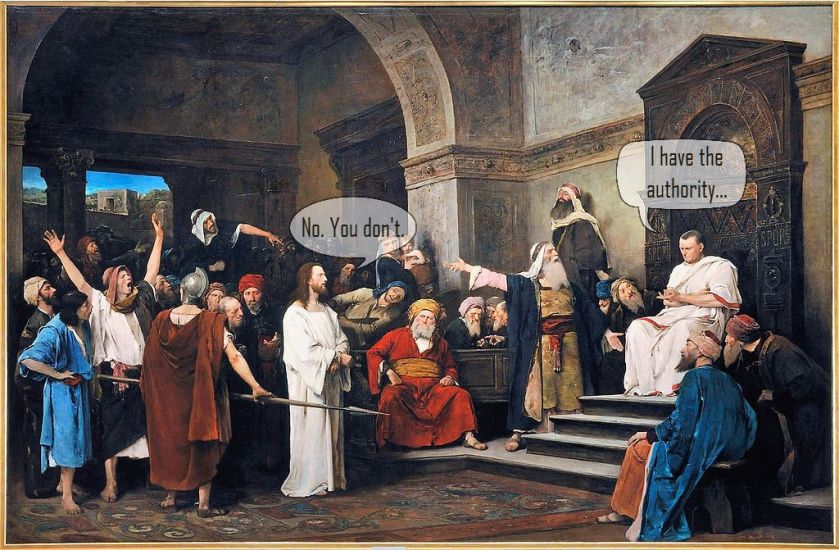
In the New Testament we know that the party opposing Jesus (Scribes, Pharisees, Sadducees) hated the name of Jesus. They hated His teachings, His disciples, His power, His authority, His resurrection. They thought they had authority, but they did not.

Pilate thought he had power and authority. He did not know that his authority was not his own, but was from above.

So Pilate said to Him, “Do You refuse to speak to me? Do You not know that I have authority to release You and authority to crucify You?” Jesus answered him, “You would have no authority over me at all unless it had been given you from above.” (John 19:10-11)

Jesus’ name has power. Not because it’s a magic mantra. But because all authority in heaven and on earth has been given to Jesus. He is the ultimate authority over men. And men’s souls sense this. We rebel against authority. We fight authority but authority always wins, sang John Cougar Mellencamp in his “The Authority Song”. We been doin’ it since we were young mean and we come out grinnin’.

We think it’s funny to rebel against parents, teachers, employers, police, the law, the government. But who we’re really rebelling against is God and God alone. He is the authority and He gives His authority to parents, teachers, employers, police, the law, the government. However, He retains sole claim to all authority and dispenses it to whom He desires. That is why when we rebel it is against Him and Him alone. (Psalm 51:4).

The authority of the name of Jesus calls for men’s submission to that name, but in our sinful state we protect our rebellion instead of submit to authority. We are rebels, sinning at every turn and hating those who tell us to stop.

Fortunately, Jesus’ name does have power. Without His power, we would never be saved. Jesus lived a perfect and holy life under the Law. He fulfilled every bit of it, and was crucified unjustly. He took on all man’s sins and endured God’s wrath for that sin. He died and was buried.

Three days later He rose again victorious over death!

“O death, where is your victory? O death, where is your sting?” The sting of death is sin, and the power of sin is the law. But thanks be to God, who gives us the victory through our Lord Jesus Christ. (1 Corinthians 15:55-57)

Vainly attempting to grasp our rebellion against authority, or foolishly trying to keep whatever scraps of authority we think we have, will always end in one moment, one act: bowing before Jesus and confessing Him as Lord. It’s better to submit to His authority now and be adopted as son and friend, than to have confess to Him as a rebel.

Munkacsy_-_Christ_in_front_of_Pilate
With apologies to artist Mihály Munkácsy, “Christ before Pilate, 1881

Posted in encouragement, Uncategorized

War no more

Sin is the oldest negative thing on earth. After God created the world and the two people and called it all “very good”, sin came. Shortly after that came murder, lying, anger, jealousy, polygamy, and war.

War has been with us for so long.

I remember growing up, the Viet Nam War. It was the first war to be broadcast on television, and in living color, too. There were reports every single night. We’d hear the tally of dead and wounded. Scenes to my young eyes of limbless men hanging off gurneys in the jungle, helicopters, camouflaged men skulking with rifles pointed through the leafy undergrowth were plenty scary. They were scenes of chaos and blood.

That’s war.

I saw a news article from the Canadian Broadcasting Company.

A cannonball fired by the British during the Battle of the Plains of Abraham in 1759 has been unearthed at a building site in Old Quebec. The rusted, 90-kilogram projectile was unearthed during excavation work last week at the corner of Hamel and Couillard streets and still contained a charge and gunpowder. The work crew that found the ball picked it up and gathered around it for photographs, unaware that it was still potentially explosive.

The cannonball is from Britain and was fired at Quebec City from Lévis,
across the St. Lawrence River. (Facebook/Lafontaine Inc)

In Genesis 4 we have the first murder. The Bible isn’t specific on how Cain killed Abel. Later in Genesis 4:22 we read, Zillah also bore Tubal-cain; he was the forger of all instruments of bronze and iron

Knowing that Tubal-can was in the line of ungodly descendants of Cain, and knowing the evil heart of man, I’d say with near certainty that some or all of those instruments were instruments of war. Many of those implements were likely arrows, shafts, spikes, and the sort.

Then by Genesis 6:11 we read Now the earth was corrupt in God’s sight, and the earth was filled with violence.

Violence that included war, with implements, I’m sure.

We all know about Galileo. He was famous for looking through his telescope and making

“observations that strengthened his belief in Copernicus’ theory that Earth and all other planets revolve around the Sun. Most people in Galileo’s time believed that the Earth was the center of the universe and that the Sun and planets revolved around it.” (Source: NASA).

But 20 years before that, Galileo experimented with, produced, and wrote about military technological advances, in a treatise called The Operations of the Geometrical and Military Compass. Galileo’s invention of the military compass was used to calculate precise trajectories of cannonballs and other military killing projectiles.

Throughout the Renaissance many attempts were made to develop a universal instrument  that could be used to perform arithmetical calculation and geometric operations easily. This need was felt especially in the military field, where the technology of firearms called for increasingly precise mathematical knowledge. … The geometric and military compass of Galileo belonged to this class of instruments. [T]he Accademia Delia was founded in Padua to provide mathematical instruction for young noblemen training for a military career.

Imagine how much of our mind will be released when we don’t have to devote so much of it to devising evil. Imagine when we are freed to think up ways to worship Jesus, or ways to praise Him, or anything else, than to creating military items that maim and kill and destroy.

He shall judge between the nations, and shall decide disputes for many peoples; and they shall beat their swords into plowshares, and their spears into pruning hooks; nation shall not lift up sword against nation, neither shall they learn war anymore. (Isaiah 2:4)

Jesus will dissolve the earth in a fervent heat. When He creates a new earth, there will never be a cannonball to dig up. There will never be any implements of war found anywhere, like arrowheads or bullet casings or swords. Forgers of instruments of bronze and iron will be making plowshares and pruning hooks.

Won’t it be great when we will study war no more? Peace. Peace will reign in men’s hearts, between men and Jesus, and between men and men (and animals). Peace, shalom, war no more.

Posted in discernment, Uncategorized

Lucky Dipping

In RC Sproul’s class called Knowing Scripture, in lesson 4, “Literal Interpretation,” Sproul taught against a certain popular method of decision making he calls “lucky dipping.”

In this method, when the believer wants to hear from God or wants to make a decision, they ask God to lead and guide them, and then they open the book and let their finger or their eye fall on a particular passage. They read the passage and then rest on it as their “answer” to their problem. Sproul said that this is a spiritualistic method of interpretation that rips verses from the Bible’s context. He said,

“God did not inspire passages of Scripture many years ago to tell us answers totally unrelated to the literal meaning originally intended. God does use Scripture to speak to us, but the message is always consistent with the literal interpretation.” Sproul, Knowing God

He gave an example of a hypothetical believer who asked God to lead him. He opened his Bible and read Matthew 27:5, ‘And throwing down the pieces of silver into the temple, he departed, and he went and hanged himself.’

The audience laughed. Sproul went on. He said that the person didn’t like the ‘answer’ at all, muttering ‘That can’t be right’. He repeated, ‘Lord, lead me’, and opened the Bible and dipped again, landing on Luke 10:37. “You go and do likewise.”

Sproul’s exaggerated example reveals the ridiculousness of using the Bible like a Magic 8 Ball.

I think we can all agree that dipping is unwise and we should avoid it. Sometimes when pastors preach exclusively in the topical method, they can tend to ‘lucky dip’, too. Not that they use it as a method for finding personally tailored advice, but as a method for coming at the scriptures with a topical agenda in mind.

But if topical preaching is the main method of preaching and teaching, rather than expositional verse-by-verse, then a lazy tendency can creep in. Sometimes the leader can handle the scriptures carelessly, selecting different verses from different Testaments or different literary genres to support their point. With a careful pastor who normally exposits, occasional topical preaching can be fine or even necessary. Sometimes the congregation needs clarity on an issue, especially if there has been a national or local tragedy, or if there has been a particular problem in the membership that is causing confusion or division.

But if a teacher or pastor continually preaches topically, then lucky dipping could become a problem. If the pastor doesn’t take the care that’s necessary, the sermon could simply become a mere listing of of verses disconnected from the overall argument.

And back to the original statement about laymen doing the lucky dip. If a pastor or teacher teaches topically all the time, taking verses from here, there, and everywhere, or worse, from all different translations in order to support the topic, he or she is actually teaching his congregants to lucky dip. With less training than the teacher, the church member might say, ‘Well, he/she goes all over the place with the verses, it must be OK if I do too’. And then you wind up with people who might eventually use the scriptures as a Magic 8 Ball, divining God’s will or manipulating His word to make it say what it doesn’t say.

It’s admittedly easier to open the Bible and find the one verse that will seem to help for the moment, rather than setting down to carefully study a passage in context. That is why a lazy tendency can creep in. Resist that. And resist following teachers who do that all the time. The Bible is God’s own word to humankind, the only supernatural message we have ever received with purity and unimpeachable truth. Handle with care.

I argue that the primary reason we misinterpret the Bible is not because the Holy Spirit has failed to do His work, but because we have failed to do ours. Essential Truths of the Christian Faith by R. C. Sproul

Clipboard
Sing to tune of Pink Floyd’s The Wall, “We don’t need no divination…”
EPrata photo