I like the Appalachian fiddle instrumental version of the old song Just a Closer Walk With Thee. Here are the lyrics, written by an anonymous or unknown author
I am weak, but Thou art strong; Jesus, keep me from all wrong; I’ll be satisfied as long As I walk, let me walk close to Thee.
Refrain: Just a closer walk with Thee, Grant it, Jesus, is my plea, Daily walking close to Thee, Let it be, dear Lord, let it be.
Through this world of toil and snares, If I falter, Lord, who cares? Who with me my burden shares? None but Thee, dear Lord, none but Thee.
When my feeble life is o’er, Time for me will be no more; Guide me gently, safely o’er To Thy kingdom shore, to Thy shore.
The only mention of anything sovereign is the word ‘kingdom’ in the last line.
I watched the TV series of Queen Elizabeth II, called The Crown. It’s an excellent series, well written, well acted, with sumptuous production values. It is Netflix’s most expensive series to date. They spent a lot of money replicating the surroundings of the kings and queens depicted, and nearly exactly replicated the events they lived through.
One thing that the first season’s series has firmly shown, is that while the crown is a successive institution, the people inhabiting it alternate. Yet the people inhabiting it are still distinct from the commoners. The Queen, her mother, her sister, her father, any of the sovereigns, are isolated. They live behind fences and high walls. When they appear in public they are again shielded. If they are walking, there is always a large distance between the rows of people and the Queen (or the King as it is now). They might walk past the people, but they do not walk with the people.
Jesus is our King. He is King of KINGS and Lord of LORDS! He is the highest of the high. Has any King ever invited the commoners to walk with Him? No! Did King Ahasuerus (Esther’s husband) invite people to walk with Him? No! He decreed that anyone entering his throne room without him having called them there would be put to death! Did King Herod go out and stroll around with Lydia and Timothy and James? No!
Jesus invites us to be His friend, He is our Father, our Brother, our Intercessor, our Priest, our Redeemer, and our Savior. Yet…walking with the King is unheard of!
We sing that song in a lively fashion when we hear it on the radio, because it’s familiar to us and it’s sweet. But think about the words, really think about them. We ask Jesus to walk closer to us And He will!
None of this is news to any of you. But it does us good to think about Him once in a while as the amazing Person He is, King, who does not isolate Himself behind fences and walls. In what other kingdom at any time or anywhere, does the King invite His people to walk with Him? The King who does not dismiss the commoners, but invites them to participate with Him in his sovereignty is to be praised in wonder and awe.
Our pastor preached a parable from Matthew the other day. He explained an anecdote from the biography of Adoniram Judson. Judson was raised Christian. He went to college. He roomed with a magnetic, charming non-believer named Jacob Eames who slowly drew Judson away from the faith. Judson did not share this with his parents, but after a while, Judson apostatized. After Judson graduated he finally told his parents he wasn’t a Christian any more.
He asked for his inheritance like the Prodigal, which was a horse and some money. His mom sank to her knees and started praying right then. Judson left anyway. He desired to write plays in New York City. Later, Judson found his life of sin was not as fulfilling as he thought it’d be. This perplexed Judson.
One day he was riding thru a small town he never went to before and lodged at an inn he was unfamiliar with. Innkeeper said there was only 1 room but in the next door room a man lay dying, probably not make it thru the night. Do you want the room? Judson said fine, ‘OK, I’ll take the room, I’m not afraid of death’.
All night people whispered coming and going, taking care of the unwell man. Judson heard moanings and groanings from the man. Finally the man was quiet. Judson was disturbed about the proximity of eternity for the man, thoughts which soon turned to himself. Am I ready for eternity? Judson thought. He became troubled.
Judson fell asleep, awakening the next day feeling good and bounded downstairs for breakfast. He inquired of the man. The Innkeeper said the man did indeed die. Judson was sad, and began to think about the man’s eternity. He asked if the Innkeeper knew the man’s name. “Oh yes, It was Jacob Eames.”
Just 21 years old, charming magnetic vibrant Eames was dead and facing hell forever. Judson was so shocked, because he knew this was from God; the happenstance of finding this little village, this inn, the last room, the dying man he used to room with in college just a year ago, heard his groanings of his last night on earth…now dead. Judson stayed stock still in shock for three hours.
He didn’t convert right then but this was a key moment. Adoniram WAS in fact, scared to death of death. He enrolled in seminary that year and soon after, became one of the very first missionaries to leave America for other tribes far away, dedicating his life to Christ.
The Lord does pursue His people.
I think of that heartbroken mother on her knees praying Adoniram as he left the house. I am sure she continued praying. If you have a prodigal child, don’t stop praying. If the child is one of His, Jesus will seek that lost sheep and bring him home. if he is not one of His, your prayers glorify Jesus in any case. And our chief end is to give Him glory no matter our own desires, circumstances, or feelings.
Further Resources:
Ligonier: 5 Minutes in Church History (audio with transcript): Adoniram Judson
I don’t get a whole lot of comments on the blog. That is OK. People read it, all right, but I don’t think I could keep up with hundreds of comments if they came in. It’s just me here. No staff, nothing fancy.
I approve critical comments as well as positive ones. Some comments are worthy if an instant deletion. The comments I delete are for several reasons.
-comments containing links to false teachers or false doctrines. I do my best to protect my readers from falsity.
-comments with links to hours-long videos and the commenter gave no synopsis of what it’s about. I am not going to spend hours vetting a link if you didn’t spend minutes giving me a summary.
-comments opposing the point of the article with no example, proof, or even a reasoned argument. ESPECIALLY when the person is a coward and doesn’t even use their name to oppose it. Like this one I deleted today, and from a years-old article no less:
Whoever wrote this on this blog is such a spiritual babe with no even discernment. Your whole analysis do not add up
OK, fine to have a negative view of a piece I’ve written. But resorting to ad hominem accusations about my character (“spiritual babe” “no discernment”) without even bothering to explain his or her stance, when the article they’re rebutting is full of links, analysis, and a thorough argument, gets a swift “DELETE” from me.
I’m on Twitter/X, Instagram, Facebook, and WordPress. I’ve had a blog since 2006. That’s 18 years. For 6 years prior to that I ran a hard copy newspaper with an online version, which accepted comments and Letters to the Editor. So, I’ve had 24 years of dealing with the public’s reactions to things I’ve written.
I’m well versed in how to detect the difference between bull hockey, cowardice, and sincere dialog even if it’s clumsy. I have no problem deleting comments. Just because I operate in the public doesn’t mean I have to accept what I consider comments to derail the dialog, or attempts to incite a confrontation, or just an angry person using the shield of anonymous public discourse to bleed anger all over the place.
I have enjoyed the edifying benefit of some commenters opposing something I’ve stated where I found they had a point. Once in a while someone changed my view. They didn’t accomplish that by accusations and name calling. They did it by a kind and reasoned argument. You know, like the kind the Bible tells us to have:
The tongue of the wise makes knowledge look good, But the mouth of fools pours forth folly. (Proverbs 15:2, LSB).
The heart of the wise gives insight to his mouth And increases learning to his lips. (Proverbs 16:23 LSB)
The heart of the righteous ponders how to answer, but the mouth of the wicked blurts out evil. (Proverbs 15:28 LSB)
And especially:
Let your words always be with grace, seasoned with salt, so that you will know how you should answer each person. (Colossians 4:6 LSB)
Mean spirited, thoughtless, unreasoned ad hominem comments only do two things: reveal what is in one’s heart, and tempts the receiver to sinning by rejoining in similar responses.
If you are a person who comments online, please remember the Bible’s standards on the power of our words. Build one another up, even if you have a criticism:
but sanctify Christ as Lord in your hearts, always being ready to make a defense to everyone who asks you to give an account for the hope that is in you, yet with gentleness and fear, (1 Peter 3:15 LSB)
Our church has a healthy demographic of college kids and young marrieds. Some time ago I was watching an Instagram video story a young friend posted of a bunch of the youths in high spirits romping around the college campus at midnight, then heading to a local store for sodas, laughing and pushing and giggling.
I smiled, remembering my own hi-jinks and clean fun- road trips and loud laughter and silly fun. Ahhh, youth.
Those kind of memories are satisfying because that is how youths act, college or no. They’re boisterous, they’re lively, they’re carefree, they’re happy.
Kim Shay at The Upward Call blog published a good essay about older women not being a trope. (In TV or Movies a trope is a common overused theme or device). In many TV shows, the older women is depicted as silly, or a gossip, or a busybody. Think Hyacinth Bucket (Bou-quet) or the sanctimonious Church Lady of Saturday Night Live by Dana Carvey. Or Mrs Bridgette McCarthy on Father Brown, a church secretary, gossip, and often at odds with and acerbic toward other characters.
Shay’s essay was a look at how older women should act according to Bible verses that command reverence and sober-mindedness.
I’m an older woman now. I’m almost 64 years of age. I have completely white hair, overweight, a lumbering stiff walk, and oh my achin’ back. All the things that come with old age, including sagging skin, age spots, and general droopiness.
Not me. But sort of me.
I remember being a teen at a friends’ house listening to the latest music laying upside down, college road trips, my car stuffed with gangly youths, a young adult with my posse playing bar trivia…it was yesterday. Ladies, age creeps up on silent cat feet (with apologies to Carl Sandburg). The boisterous hi-jinks no longer suit. If I were to gadabout at midnight with pals, they’d lock me up for being crazy. Why? That’s not how older women act.
We line the wall at dances sitting in folding chairs, purses firmly atop lap. We tut-tut at the beauty and litheness of the young ones sailing by. We cook and serve the meals with a knowing nod and quiet hospitable satisfaction. We accept collect calls from grandkids at midnight when the car breaks down on the way home from hi-jinks. We rearrange the potlucks on the sagging table, they form the cleanup swat team afterwards. I say, we. I’m a we now.
I know some of these are a writing trope in themselves, but they are tropes because they are true.
Kim Shay wrote: “My husband once asked me with regard to the women who have spoken at my church’s women’s conferences: “Why is the speaker always young and beautiful instead of old and plain?”
I was noticing that, too. So many of the speakers at conferences now are younger women. Do younger women have something to say? Yes, but so do older women. And the elder females have been at it longer.
So since we have been at it longer what do we say about how to conduct ourselves? Well, whatever the Bible says we are to act.
Before I get into the nuts and bolts of biblical behavioral standards, I’ll mention that whenever I discuss behavioral standards, particularly applied to false teachers, these comments receive the most negative feedback of all the kinds of comments I make online. People hate to be reminded that the Bible endlessly outlines behavioral standards of any kind. There are general calls for certain kinds of good behavior, there are specific calls for individual demographics, and there is a reminder that we will be judged on how we behaved as well as what we believed.
In one set of verses we read about how we are to act, and the reason for it-
as servants of God we commend ourselves in every way: by great endurance, in afflictions, hardships, calamities, 5 beatings, imprisonments, riots, labors, sleepless nights, hunger; 6 by purity, knowledge, patience, kindness, the Holy Spirit, genuine love; 7 by truthful speech, (2 Corinthians 6:4-7a)
Why?
“so that no fault may be found with our ministry” (2 Corinthians 6:3b).
But what specifically of elder women? If we are married to a overseer, act in ways that aid him in keeping order in the household. (1 Timothy 3:4). If married to a deacon, the same, (1 Timothy 3:12. Additionally, deacon’s wives must be dignified, not slanderers, but sober-minded, faithful in all things. (1 Timothy 3:11). I am assuming that wives of pastors and deacons aren’t entirely youthful because the qualifications for pastors are not to be recent converts (1 Timothy 3:6) and to have built up a good reputation- which takes time. (1 Timothy 3:7).
If we are a widow, Paul in 1 Timothy 5 described real widows as: “Now she who is a widow indeed and who has been left alone, has fixed her hope on God and continues in entreaties and prayers night and day.” Which reminds me of Anna at the temple in Luke 2.
A widow could be put on the list for church aid if she had behaved in the following way-
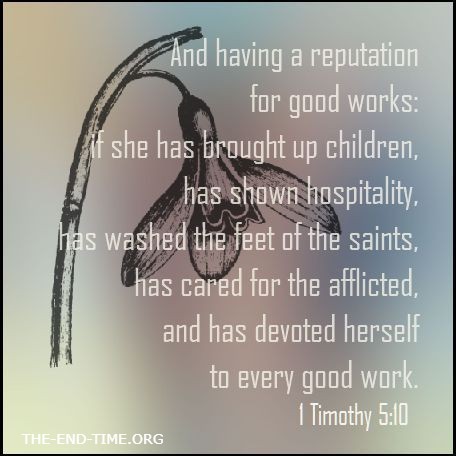
A widow is to be put on the list only if she is not less than sixty years old, having been the wife of one man, 10having a reputation for good works; and if she has brought up children, if she has shown hospitality to strangers, if she has washed the saints’ feet, if she has assisted those in distress, and if she has devoted herself to every good work.
An elder married woman is not to be contentious, as Syntyche and Euodia were. (Philippians 4:2). Titus 2 is the famous verse that outlines how older women are to act-
Older women likewise are to be reverent in behavior, not slanderers or slaves to much wine. They are to teach what is good, and so train the young women to love their husbands and children, to be self-controlled, pure, working at home, kind, and submissive to their own husbands, that the word of God may not be reviled.
Reverent in behavior. Self-controlled. Kind. These are not hard to understand and not unreasonable to ask. When I write about behavioral standards other women rush to scream and rant, but really, what is there to rant against? They want to lose control? Be irreverent? Unkind?
Anyway, the Bible outlines behavioral standards for all ages. As I pass through the aging eras and enter the golden gate of elder womanhood, I’ll try to be mindful of how the Bible expects me to behave, so as not to discredit the ministry. Plus, in the Lord’s grace, I’ll try not to be a trope!
Further Reading
This makes a nice companion piece. Jared Wilson, that whippersnapper at age 49, not only muses on growing old, but provides some helpful tips to grow old gracefully.
I always thought the Sunday nap was because I was tired. During quarantine 4 years ago, I began to think otherwise.
And on the seventh day God finished his work that he had done, and he rested on the seventh day from all his work that he had done. 3So God blessed the seventh day and made it holy, because on it God rested from all his work that he had done in creation. (Genesis 2:2-3).
I’m blessed to have a regular Monday-through-Friday work week, daytime hours. On Saturday I run around and do errands and cleaning and stuff that I’ve put off during the work week. So it’s like a 6th work day. Thus, when I get to Sunday, I’m tired. I go to church and I take a nap, and that is about all I do.
But during that time of “pandemic” where we are told to remain socially distant from others, work had stopped, I was quarantined inside my home. I was not tired on most days anymore. Oh, sure, when the work-stoppage first occurred, I napped to burn off the sleep debt and stress that had accumulated. But after the first week of the 2020-quarantine, the need for naps stopped.
I have sympathy for all those daughters and wives and women and sons who did not have a father. Either because their dad died early, or abandoned them, or divorce, or abuse. In a One Minute Apologist session, the impact of an absent father is discussed.
In addition to earthly issues, fatherlessness has serious spiritual implications for the child and adult. I distinctly remember the transition from the acceptance-as-normal of a two-parent home these days you have to further define, as women and man, married, mom and dad of opposite genders, to a home that ‘didn’t need’ a father. Where divorce was accepted as a something as simple as checking off items in a grocery list, and how women can ‘do anything’ including work AND raise the kids by herself. Fathers became bumbling fools on television and unnecessary in the public domain.
Throughout the ages, it was always understood that fatherlessness is a tragedy and deprivation, even when others needed to step in to take these roles through tragedy or the sinful choices of parents. Indeed, it is a tragedy that needs special attention. Orphans (James 1:27) and the fatherless (Ex. 20:22; Dt. 24:17, 19-21; Dt. 26:12-13; Job 31 17, 21) receive special notice and protection throughout Scripture. One characteristic of God is that God, as the Psalmist declares, “is a Father to the fatherless” (Ps. 68:5; see also Ps. 10:14, 18; 146:9; Hosea 14:3). Churches, as God’s representative on earth, should be a strong support to fatherless children and single parents.
It is a praise to the Holy Spirit when He saves a daughter or a son out of unbelief even though the earthly model for the Father was absent in their lives!
If you are in Christ, rest in the eternal fact that a loving Father has always loved you, even before you knew Him, and who will never abandon you again. Ever.
In tweeting about transgenderism, an angry person – obviously not a believer – challenged me with this-
you’re the reason baptists churchs are removing “baptist” from their names. How many divorced adulterers u take money from #hypocrite
He has a partial point. We make much of the homosexual and the transsexual, rightly holding up the doctrines of the Bible that speak to sexual sin, but often overlook the same doctrines that speak of divorce and unrighteous re-marriage. In those cases the remarried Christian is seen by God as an adulterer. Isn’t unbiblical divorce and adultery sin, too? Of course it is.
We all know the famous “God hates divorce” from Malachi 2:1. His command regarding divorce is reiterated in 1 Corinthians 7:10–11:
But to the married I give instructions, not I, but the Lord, that the wife is not to leave her husband. (but if she does leave, she must remain unmarried, or else be reconciled to her husband), and that the husband is not to divorce his wife.
He still hates divorce. But God did give some wiggle room for an allowable divorce. Not a desirable divorce, but an allowable one: if the spouse is unfaithful (Matthew 5:32), and if the spouse abandons the other spouse. (1 Corinthians 7:15).
Speaking of persistent sin, if there is someone getting a divorce on unbiblical grounds, for example, this is how MacArthur handles divorce as written in Grace Community Church’s Distinctives this way. His church’s distinctive is based on the Bible verses about divorce:
“Believers who pursue divorce on unbiblical grounds are subject to church discipline because they openly reject the Word of God. The one who obtains an unbiblical divorce and remarries is guilty of adultery since God did not permit the original divorce (Matt. 5:32; Mark 10:11-12). That person is subject to the steps of church discipline as outlined in Matthew 18:15-17. If a professing Christian violates the marriage covenant and refuses to repent during the process of church discipline, Scripture instructs that he or she should be put out of the church and treated as an unbeliever (v. 17). When the discipline results in such a reclassification of the disobedient spouse as an “outcast” or unbeliever, the faithful partner would be free to divorce according to the provision for divorce as in the case of an unbeliever departing, as stated in 1 Corinthians 7:15. Before such a divorce, however, reasonable time should be allowed for the possibility of the unfaithful spouse returning because of the discipline.”
But how often does a local church practice discipline like that? Discipline grows a church, doesn’t shrink it. (Acts 5:11-14). I think many churches have become somewhat like the world in that regard. They pull out the stops to prevent homosexuality from entering but have allowed other sins like divorce to become commonplace.
God’s people are united to their husband, Christ, by faith. This indissoluble union begins when we place our faith in the one who is “chief among ten thousand.” A significant implication emerges from this truth: Heaven is eternal because we are married to Christ, and God hates divorce. God would first have to sin by dissolving our union with Christ before Heaven could end. When God sins in this manner then Heaven will end.
The problem of the evil that is in each and every person on earth is troublesome. For many reasons, of course, but for this reason today: we can’t see it all. We don’t see it all.
We point to Hitler as if he was an anomaly. ‘He’s really evil, unlike us’, we think. Wrong. The LORD simply allowed the evil that was in him to emerge into action. The potential for actions like Hitler’s or any other serial killer, child molester, or tyrant like Nero, is there. We are all not as bad as we could be, mercifully. God puts the restraints on us, but evil is there. Often in thought if not deed. And more than we think.
The actual wickedness of men’s lives bears a very small proportion to what is in their hearts. But when lust is inwardly cherished, it will break forth into outward sin. Those who tempt others to drunkenness never can be their real friends, and often design their ruin. Thus men execute the Divine vengeance on each other. Those are not only heated with sin, but hardened in sin, who continue to live without prayer, even when in trouble and distress.
Did you see that first sentence? The actual wickedness of what is in men’s lives bears a very small proportion to what is in their hearts. It’s the old iceberg analogy again. What we see bobbin on the surface is minuscule compared to what is under the surface, hidden from view.
A practical disbelief of God’s government was at the bottom of all Israel’s wickedness; as if God could not see it or did not heed it. Their sins appear on every side of them. Their hearts were inflamed by evil desires, like a heated oven. In the midst of their troubles as a nation, the people never thought of seeking help from God.
God does see it all in us. He knows what is in a man’s heart. God is our very great helper to resist sin and live a holy life. Not just the Israelites, bow often do we in our day forget to turn to God?
We cannot be ‘a good person’ without His help.
Therefore let’s approach the throne of grace with confidence, so that we may receive mercy and find grace for help at the time of our need. (Hebrews 4:16)
And all who were sitting in the Council stared at him, and they saw his face, which was like the face of an angel. (Acts 6:15)
But if the ministry of death, in letters engraved on stones, came with glory, so that the sons of Israel could not look intently at the face of Moses because of the glory of his face, fading as it was, how will the ministry of the Spirit fail to be even more with glory? (2 Corinthians 3:7-8)
And we all, with unveiled face, beholding the glory of the Lord, are being transformed into the same image from one degree of glory to another. For this comes from the Lord who is the Spirit. (2 Corinthians 3:18)
For God, who said, “Let light shine out of darkness,” has shone in our hearts to give the light of the knowledge of the glory of God in the face of Jesus Christ. (2 Corinthians 4:6)
The more we look at Jesus, the more we behold His glory. Then the more His glory changes us into His likeness.
How do we look at Jesus? In prayer, through His word, by resisting sin, by repenting of sin, by obedience to His word in our daily, practical lives.
The first human blood shed in the Bible was a shepherd’s blood, shed by one who rejected God in jealousy and anger.
Now Abel was a keeper of sheep, and Cain a worker of the ground. (Genesis 4:2b) And the Lord said, “What have you done? The voice of your brother’s blood is crying to me from the ground. (Genesis 4:10)
The Death of Abel, by Gustave Dore
The last blood needed for sin’s atonement was the blood of Jesus, The Great Shepherd.
and not through the blood of goats and calves, but through His own blood, He entered the holy place once for all, having obtained eternal redemption. For if the blood of goats and bulls and the ashes of a heifer sprinkling those who have been defiled sanctify for the cleansing of the flesh, how much more will the blood of Christ, who through the eternal Spirit offered Himself without blemish to God, cleanse your conscience from dead works to serve the living God? (Hebrews 9:12-14)
But now in Christ Jesus, you who once were far off have been brought near by the blood of Christ. (Ephesians 2:13)
Chris Powers, fullofeyes.com
Here is a song called The Last Blood. Listen to it entirely. It builds to a devastating climax.