Posted in poetry

Kay Cude Poetry: Fear Not!

Poetry by Kay Cude. Used with permission. Kay Cude is a Texas poet.

Surely the mouth of the Lord has spoken: FEAR NOT
“Fear not, for I am with you;
Be not dismayed, for I am your God. I will strengthen you, Yes, I will help you,
I will uphold you with My righteous Right Hand.
Behold, all those who were incensed against you Shall be ashamed and disgraced; They shall be as nothing,
And those who strive with you shall perish.
You shall seek them and not find them- Those who contended with you. Those who war against you
Shall be as nothing,
As a nonexistent thing.” Isaiah 41: 10-12

OBSERVE
Though deadly times seem far away, they are around life’s curve; their winding path continues on–take note that you observe–

Though fear assails your very heart, let not your faith succumb; the adversary’s reign soon ends, his power now’s undone. A chasm deep may lie ahead, so vast and wide its beams;

fear not beloved, you will not fall, you are Christ’s own redeemed. God’s promises to Israel, a hope that we embrace; we are the branch He’s grafted in, adoption through His Grace. by kay cude, Janaury 2016©

…for He Himself has said, I will never desert you, nor will I ever forsake you,’ so that we may confidently say, The Lord is my helper, I will not be afraid. What will man do to me?” Hebrews 13:5c-6

Text by author, Kay Cude, purposed solely for non-profit, non-commercial sharing.

Posted in theology

A Day in the Life of A: Concubine

By Elizabeth Prata

When we think of a harem, artistic rendering like this may come to mind, beautifully adorned young women lounging languidly. And that may indeed been part of the harem girl’s day. But that’s not all it was.

“Girls of the Harem” (Italian artist Fabio Fabbi 1861-1946)

12Now when the turn came for each young woman to go in to King Ahasuerus, after the end of her twelve months under the regulations for the women—for the days of their beauty treatment were completed as follows: six months with oil of myrrh and six months with balsam oil and the cosmetics for women— 13the young woman would go in to the king in this way: anything that she desired was given her to take with her from the harem to the king’s palace. 14In the evening she would enter and in the morning she would return to the second harem, to the custody of Shaashgaz, the king’s eunuch who was in charge of the concubines. She would not go in to the king again, unless the king delighted in her and she was summoned by name. (Esther 2:12-14).

Xerxes

Xerxes was not a talented king. We read from the book From Cyrus to Alexander: A History of the Persian Empire by Pierre Briant:

The Year 479 and Xerxes’ Reputation: Traditionally, modern historiography has presented a terrible image of Xerxes’ personality and reign. This image was already fully fashioned in Rawlinson’s Five Great Monarchies, a work published in 1867: with Xerxes began the disorders of the harem, assassinations, and conspiracies; around him were unleashed the passions of the court princesses and the growing influence of the eunuchs, with the result that “the character of Xerxes sank below that of any of his predecessors.” The king was weak, easily influenced, immature in his appetites, egotistical, cruel, superstitious, licentious.

What is a Concubine?

Concubines are a term used to describe a King’s woman used for sexual intimacy, without being a lawful wife. Lexham Bible Dictionary defines concubine as “A woman who is conjugally related to man but holds a secondary or inferior status to his primary wife.” For many women throughout history, the position served as one of the highest she could achieve in terms of power and safety. Hagar and Keturah were concubines of Abraham. Romans also had concubines.

The Old Testament contains 37 occurrences of the word “concubine” (pilegesh).

Belshazzar had concubines, see Daniel 5:1-3. They were present at the great feast when the Hand appeared and wrote on the wall.

Saul had a concubine named Rizpah. (2 Samuel 21:11).

King Solomon had 300 concubines.

So did David. (2 Samuel 5:13)

Pharaoh took Abram’s wife Sarai into his palace as an intended concubine. (Genesis 12:15).

Judges chapter 19 describes a concubine degraded. In Patriarchal times a concubine had no authority in the family, and they could not share in the household government. Since they were not a legal wife, they could be sent away (example: Abraham and Hagar.)

Many kings in the Bible had concubines but Xerxes’ harem was the only one described with any detail, so we will focus on his harem for this essay. And Xerxes’ harem apartments have been excavated!

Harem excavation photos: Harem of Xerxes from the University of Chicago, Institute for the Study of Ancient Cultures. Caption is already contained in the photo. The ruins were excavated when the Oriental Institute of the University of Chicago sponsored an archaeological expedition to Persepolis and its environs under the supervision of Professor Ernst Herzfeld from 1931 to 1934, and Erich F. Schmidt from 1934 to 1939.

What was it like in a harem?

Harem might be a familiar word to us but since harems existed in ancient times in China, Japan, India, Assyria, Persian, and Egypt, their practices and characteristics differed from one culture to another.

A harem is a place where women are sequestered in order to separate them from the world. Once in the harem they had very little interaction with the outside world, unless they were dismissed or in some lucky cases, retired. The women in a harem could not see the outside world and the outside world, including family (if they lived nearby) could not interact with them.

Where did all these women come from? They got there in different ways. Mostly coerced. Normally in a harem there were different classes of women, different groups, living in separate quarters and heavily guarded for their safety and privacy. In Xerxes’ case they were separated by virgin vs. concubine.

The third group of harem women were concubines, beautiful girls (Plutarch, Artoxerxes, 27; Diodorus, 17.77.6; Esther 2.3) bought in slave markets (Herodotus 8.105; Plutarch, Themistocles, 26.4), or received as a gift (Xenophon, Cyropaedia, 4.6, 11; 5.1, 1; 5, 2, 9, 39) and tribute (Herodotus 3. 97), or collected from different parts of the empire (Esther 2.2-3;), and even captured from rebellious subjects (Herodotus 4.19, 32; Cf. Grayson, 1975, p. 114). (Source Iranicaonline.)

Harems were highly regulated

System and Restrictions: Harems typically operated as a system of segregated living quarters for women, often within a palace or residence. They were usually guarded by eunuchs or trusted servants to maintain the privacy and security of the women inside. Women in harems often had limited freedom and were subject to strict rules and protocols. (Source).

The throne hall in the background…you can imagine Esther walking from this large harem complex tot he throne room, not knowing if she was going to be executed. “And then I will go in to the king, which is not in accordance with the law; and if I perish, I perish.” Esther 4:16.

What did they do all day? Greek Philosopher Aelian in his Varia Historia, 12.1 wrote- “While still virgins, they were kept and groomed in the harem’s “first house of women” (Esther 2.9), and trained as musicians, dancers and singers in order that they might entertain their king or the magnate lord at banquets or throughout the night.”

Their education was much better than women usually receive outside the harem. They were instructed in all the arts but also reading and math. They were also taught manners and traditions. It was the ultimate charm school. If the concubine did not excel at her education she would likely have been assigned tasks such as cooking or laundry in the harem. Of course also we see in the Esther verses there was a strict beauty regimen. All this would have taken up her time during the day.

As we see in the Esther verses above, once the woman has ‘gone into the King’ she was moved to a different harem than the one she occupied with the other virgins. In the second house she probably would have been helping to raise any children running around from the union of the concubine and the king. And as in any large system of operations, the women would have been accomplishing tasks such as continuing their education, practicing their musical instruments, or serving others. We know that Esther was given 7 maidservants. (Esther 2:9).

Josephus said in his Antiquities, 6.200 that Xerxes had 400 concubines.

In order to house 400 women, their guards, eunuchs, and servants, the complex would have had to be large!

What happened to Concubines?

Aging and Weakness: The fate of women in a harem as they aged or became weaker depended on the specific circumstances and the attitudes of those in power. In some cases, older or weaker women in a harem may have been assigned roles as caretakers or advisors to the younger members. Others might have been granted some level of freedom or retirement within the palace. However, there are also instances where elderly or weak women were marginalized or had diminished status within the harem. (Source).

A large and ornate harem was often constructed to display the king or sultan or pharaoh’s wealth and power. It would have been highly decocrated

Some were executed. The wife/queen of the king or sultan often wielded much power, and any concubine caught in an intrigue that displeased the queen or the king could be executed. In the 1640s Ibrahim the Mad, an Ottoman king, was told by one of his favored concubines that one of the others had slept with an outsider. Ibrahim was furious. He had his eunuchs investigate, then torture his 200+ concubines in the harem but either the tale was false and it didn’t happen, or they refused to give up one of their own. So Ibrahim had all 280 women sewn into weighted sacks and drowned in the Bosporus Strait. That was definitely a case where an intrigue blew back into unfortunate heights.

In a harem full of women, whether the virgin harem or the concubine harem, rumors and jockeying for position was rife. We see from the verses below that virgins could be favored, and since that is true, there must have been intrigue to catch the attention of the eunuch in charge of them to gain even more favor. But Esther didn’t do that. She trusted God and in HIS favor, Esther rose to the top without her having to curry attention or otherwise plan intrigues.

Esther Finds Favor: So it came about, when the command and decree of the king were heard and many young ladies were gathered to the citadel of Susa into the custody of Hegai, that Esther was taken to the king’s palace into the custody of Hegai, who was in charge of the women. Now the young lady pleased him and found favor with him. So he quickly provided her with her cosmetics and food, gave her seven choice female attendants from the king’s palace, and transferred her and her attendants to the best place in the harem.

Conclusion

A harem was a busy place. The women were physically prepared, intellectually prepared, and prepared in the arts, charms, and traditions of their culture. They worked raising the children, teaching others, or serving others. Of course if they were chosen, they worked at night, too. Though they had access to better food, education, clothing and even oils, perfumes, and jewels they might not have had access to ‘on the outside’, life in a harem was not always easy. They existed at the whims of the king, and walked a tightrope of luxury vs. execution or abandonment. We know that Esther took her life in her hands by approaching the unstable king Xerxes without his calling for her. It was only by the providence of God she was not executed, as was the rule.

Though the story of Esther is mainly taught to show us the providence of God, it also shows me personally how a life of jockeying and intrigue, gilded cages and sinful jealousies can ruin a life, where even in that environment trusting God for His provision and His life plan for us is always best. Doing so doesn’t always give rise to queenly proportions as it did for Esther, but her demeanor was queenly even before Xerxes took her into his heart, because she is the daughter of THE KING of KINGS. Her reliance on God, peaceful attitude, and kindness shone out among the hundreds of other women in those harem apartments in ancient Persia.

Further Resources

Little Known Bible Characters: Harbonah the Eunuch

Posted in christian life, theology

A Day in the Life of: Introduction

By Elizabeth Prata

Do you enjoy reading the Bible? I do. Too often though, I allow my mind to drift to the novelization of it, laying aside that this book recounts real, literal events with real, literal people. It’s easy to start thinking of the people we read about as either superheroes, or characters in a novel.

To combat the creep of fictionalization of the pages, or alternately, to make them more real to me, I often think about the people in the Bible going about their day. Our teaching elder recently preached through John 4, the Woman at the Well. This scene of this illegitimate housewife is easier to imagine as she goes about her day, because the time of day and her wifely task is often preached as an important part of the scene. How the housewives gathered in the early morning or later afternoon to draw water from the community well because it was cooler. How that was all the water they had to use during the day, unless they wanted to walk the whatever miles to get more from the well. And so on. A housewife’s day is also recounted in Proverbs 31.

But there are a lot of other professions mentioned in the Bible besides housewife. Shepherds are rife throughout the pages. King, scribe, farmer, fisherman. Tanner, tent-maker, baker, fig picker, seller of purple, cupbearer, cook, hunter, and so many other professions mentioned. What was a fisherman’s day like? What did a seller of purple do? What is a tanner, anyway? Is there still a job of cupbearer?

I decided to do a series on people in the Bible going about their day doing their job. For example, A Day in the Life of: A Tanner, A Day in the Life of: A Merchant. A Day in the Life of: A Cupbearer, and so on. I’ll select professions to write about based on the amount of reliable information I can find (and understand, lol). If there is a profession mentioned in the Bible you’re interested in learning about, what a day in that Bible person’s life would have been like, let me know. I’ll do my best to research it out.

collage 1
Baker, fig picker, fisherman, scribe… What was the first century Palestinians’ job like?
Posted in theology

At the gates

By Elizabeth Prata

The Proverbs 31 wife has a husband at the gates, Her husband is known in the gates, When he sits among the elders of the land. (Proverbs 31:23).

The famous Ishtar Gate, before 4BC. now in Pergamon Berlin Museum. Note the scale, compare the people to the gate. Photo By Rictor NortonCC BY 2.0. Nebuchadnezzar II inscribed the gate and gave credit to ‘Marduk, lord of the gods’. He will learn later Marduk does not exist.

Gates. I never thought much about ’em until I moved to rural Georgia. My first apartment here in the south had a horse gate. I had to stop my car and get out, unlock and push open the gate, drive through, then repeat the procedure in reverse. Many farm driveways have a cattle gate. Same with a lot of homes that have animals of one kind of another. Big gates, small gates. Gates.

EPrata photo

What does this mean, ‘sitting at the gates’?

In Bible times the cities were walled and you could only enter by a gate. The bigger the city, the bigger the wall. Nineveh with a population of 120,000 and three days’ walking breadth had walls so wide a chariot could run along the top.

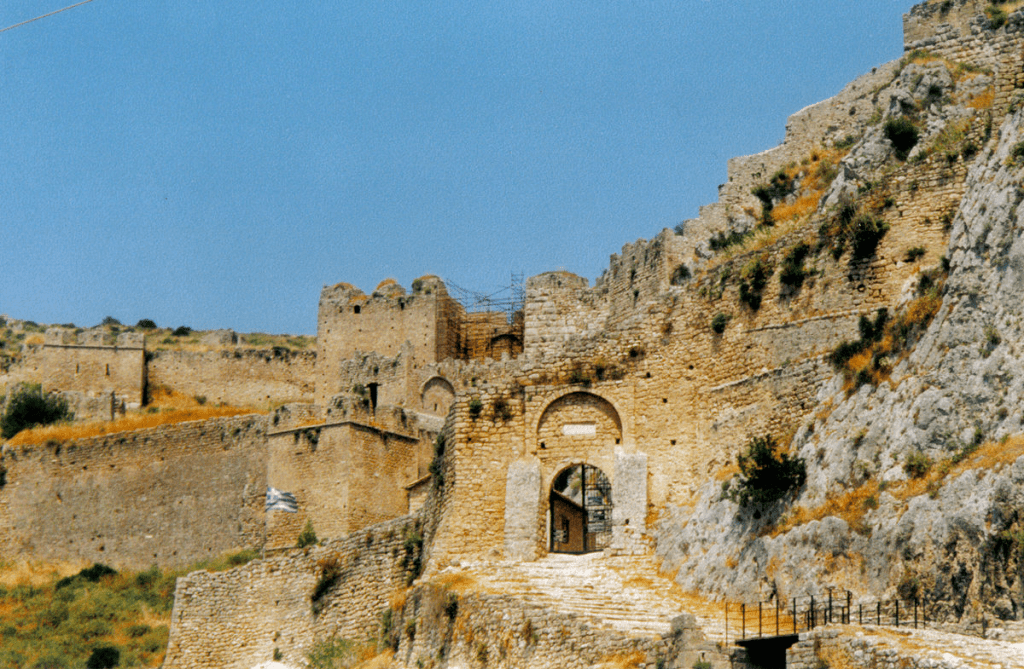
The system of gates at the fortress Acrocorinth near Corinth, Greece. Nicolas von Kospoth. https://commons.wikimedia.org/wiki/File:Acrocorinth_Gateway.jpg. CC

At the gates of cities courts of justice were frequently held, and hence “judges of the gate” are spoken of (Deut. 16:18; 17:8; 21:19; 25:6, 7, etc.). At the gates prophets also frequently delivered their messages (Prov. 1:21; 8:3; Isa. 29:21; Jer. 17:19, 20; 26:10). Criminals were punished without the gates (1 Kings 21:13; Acts 7:59). Source, Illustrated Bible Dictionary and Treasury of Biblical History, Easton, M. G. (1893).

The gate wasn’t like what we may think of with a wall, an open gate, then voila, you’re in. Since the gate was the most vulnerable part of the city’s defensive system, there was a gate, then some chambers, or barriers. Or, more gates.

During the Iron Age, the period of Israelite monarchy, two-, four-, and six-chamber gates are found. … Undoubtedly, the development of new weapons, including more effective battering rams, required new defensive strategies. Among such innovations were the introduction of inner and outer gate structures. Such double-gate structures may well have been intended to strengthen defenses. Assaulting an outer-gate structure would not give access into the city proper; it would only lead through a narrow passage (where an invading army would be under continual assault by defenders on the walls above) to an inner-gate structure, likewise well defended. Sites with inner- and outer-gate structures include Tel Dan, Megiddo, and Lachish.” Source- Holman Illustrated Bible Dictionary.

Typically, the city’s market or bazaar would be close to the gate, so merchants would not have to drive their animals through the whole the city. Since there was so much activity coming and going at the gate, this is where the elders sat to judge, mediate, and consider city business.

EPrata photo

Below we see a photo of the inside of a city gate, a four-chambered one. Photo and caption by Ian Scott:

This is one of the four chambers that line the gate complex of Iron Age Gerar. Note the well-preserved bench running around the inside of the chamber. This is where soldiers might prepare to repel invaders who penetrated the outer gate. It is also in such gate chambers that the town elders would pass hot days, hear complaints, and adjudicate disputes.”

Lot had a position at the gate. This means he was an elder of the city of Sodom. Genesis 19:1 says, “Now the two angels came to Sodom in the evening as Lot was sitting at the gate of Sodom.”

Boaz was an elder at the gate, too. Now Boaz went up to the gate and sat down there, and behold, the redeemer of whom Boaz spoke was passing by, so he said, “Come over here, friend, sit down here.” And he came over and sat down.” (Ruth 4:1).

Eli was at the gate. When he mentioned the ark of God, Eli fell off the seat backward beside the gate, and his neck was broken and he died, for he was old and heavy. And so he judged Israel for forty years. (1 Samuel 4:18).

Gates where were a triumph was proclaimed, or prisoners of war displayed. A conquering King and his men would stand at the gate to show their victory, because the gate was considered the place of authority, economy, justice, and was actually the all-in-all life-blood of the city.

Much is made of Deborah’s position as Judge and Prophetess in the Bible. People who wish to imbue women with more authority than the Bible gives often revert to Deborah as the model and example. No. Further, it is interesting to see that Deborah did not sit “at the gate” as was customary. She was not located in a city. She judged under a palm tree in the hills of Ephraim. (Judges 4:5).

So perhaps that is more than you wanted to know about gates and elders sitting at the gate, but I thought it was interesting architecturally and theologically.

Further Resources

What is the significance of a city gate in the Bible?

Posted in earthquakes in diverse places, end of days. prophecy

About God and earthquakes

By Elizabeth Prata

Some time ago there was an earthquake in an area of the US that does not usually have quakes. It was a startling geological event. Thousands poured out into the streets in shock and surprise. The author of the news about it went on to state that, “Any assumption that the region is seismically serene was corrected at 1:51 p.m…”

People are intensely interested in earthquakes, and they know instinctively that quakes somehow relate to God.

If a person is not a believer then they will try to convince themselves that earthquakes are natural happenings based in science where strike-slip quakes or thrust quakes have logical scientific meaning and occur in places where underlying geology supports their particular kind of quake stress relief. And in some sense, quakes are ‘natural’. They are a result of the Fall and the Flood when God rearranged the earth’s continent into separate continents as plates.

Though, scientists cannot and have never been able to figure out why a certain type of quake called deep-focus quakes occur. These are quakes that happen in places where scientifically, none should occur. Note that-

Most earthquakes are shallow. They are concentrated no deeper than 20-25 kilometers down. However, a few extremely deep quakes rumble at depths of about 600 kilometers. Geophysicists are really not certain what causes the very deep quakes, because at 640 kilometers rocks are so hot that they flow rather than snap under geological stresses. The more common, shallow earthquakes are generally created when rocks snap and fracture. source

Anyway, Bible Believers love science but know that God is not beholden to science. If He wants to cause an earthquake, He will. There is no place that is ‘seismically serene.’ There is no place that is ‘aseismic’. I thought it was ironic and amusing when the Powers that Be decided to build a seed vault to store seeds in case of a cataclysm. They spent millions to search for and then build a perfect place that was remote, could be protected, and was safe from earthquakes. They chose Svalbard Norway, atop a tiny rock atop a tiny island in the remote north Atlantic, above the Arctic Circle. Vault scientists and builders looked long and hard for a place where no quakes happen, so the seeds (which they call and ark!) are protected from any future apocalypse). It was supposed to be a “seismically free” zone. The day they opened the vault and had their bigwig ribbon cutting party, there was a huge earthquake. It was the largest in Norway’s history, a 6.2.

Svalbard Global Seed Vault:

This location was chosen for the express reason that seismic activity rarely if ever occurs there. Earthquakes occur hundreds of miles away on the Norwegian mainland, but they are low in magnitude. The largest one on the mainland [1200 miles away] was 5.4 in 1904 and most eq’s on mainland Norway are less than 4.0. The quake occurred even though the vault’s feasibility study assured that “there is no volcanic or significant seismic activity” in the area.” (source). [underline mine. Source is deleted now and isn’t in the Internet Archive.]

God can cause an earthquake anywhere, any time, of any magnitude. Satan does not cause earthquakes. Nature does not cause earthquakes. There is nothing that happens on the earth that God does not permit. Nothing. There is nothing happening on earth that He does not know about. We read in Luke 12:6-7, “Are not five sparrows sold for two pennies? Yet not one of them is forgotten by God. Indeed, the very hairs of your head are all numbered. Don’t be afraid; you are worth more than many sparrows.”

Earthquakes vary in kind. Some as mentioned are the mysterious deep-focus kind of quakes. There was a deep-focus quake some years ago, in the Philippines. As a matter of fact, there were three high-magnitude deep-focus quakes in fast succession.

Another kind of strange quake was the quake in Florida USA.

Remember the mysterious kind of quake that happened with Korah?

“Then Moses said, “This is how you will know that The Lord has sent me to do all these things and that it was not my idea: If these men die a natural death and experience only what usually happens to men, then The Lord has not sent me. But if The Lord brings about something totally new, and the earth opens its mouth and swallows them, with everything that belongs to them, and they go down alive into the grave, then you will know that these men have treated The Lord with contempt.”

“As soon as he finished saying all this, the ground under them split apart and the earth opened its mouth and swallowed them, with their households and all Korah’s men and all their possessions. They went down alive into the grave, with everything they owned; the earth closed over them, and they perished and were gone from the community. At their cries, all the Israelites around them fled, shouting, “The earth is going to swallow us too!” (Numbers 16:28-34).

This kind of earth opening then closing is reminiscent of an incident that will take place in the Time of Jacob’s Trouble. It is described in Revelation 12:13-16–

“When the dragon saw that he had been hurled to the earth, he pursued the woman who had given birth to the male child. The woman was given the two wings of a great eagle, so that she might fly to the place prepared for her in the wilderness, where she would be taken care of for a time, times and half a time, out of the serpent’s reach. Then from his mouth the serpent spewed water like a river, to overtake the woman and sweep her away with the torrent. But the earth helped the woman by opening its mouth and swallowing the river that the dragon had spewed out of his mouth.”

Jesus said that there would be earthquakes in diverse places in the Tribulation (Matthew 24:7).

As we see, Jesus has and will continue to cause earthquakes in any location as is suits His plan. He uses them for warnings and as judgments.

In the Tribulation, there will be many earthquakes. They will kill millions. Billions even. A third of the population dies almost immediately and then another third of the remainder are killed by the various judgments. (Not only earthquakes but pestilence, beast, famine, and sword (His for sore judgments; Ezekiel 14:21).

Here are scriptures that show He is in control, He holds the earth with gentle hands as gently as holding a sparrow, knowing even the numbers of hairs on your head, but also showing that He will shake the earth violently to show His displeasure in sin and rebellion against Him. After I read all these I came away with a sense of awe and humility in seeing without a doubt how much He is in control. And yet He loves us. He wants us to dwell with Him in heaven…please repent so that you will be there. Confess to Him that you are a sinner and ask Him to forgive the wrongdoing you’ve engaged in over your lifetime. He will forgive you. He died so that it would be possible. Now He is risen and waiting to hear your confession. Meanwhile, please enjoy these awesome verses illustrating His power on the earth:

GENERAL SCRIPTURES ABOUT QUAKES
Job 9:6
He shakes the earth from its place and makes its pillars tremble.

Psalm 18:7
The earth trembled and quaked, and the foundations of the mountains shook; they trembled because he was angry.

Psalm 46:2
Therefore we will not fear, though the earth give way and the mountains fall into the heart of the sea,

Psalm 46:3
though its waters roar and foam and the mountains quake with their surging.

Psalm 104:32
he who looks at the earth, and it trembles, who touches the mountains, and they smoke.

Nahum 1:5
The mountains quake before him and the hills melt away. The earth trembles at his presence, the world and all who live in it.

VERSES ABOUT QUAKES AS PROPHESIES

Matthew 24
Nation will rise against nation, and kingdom against kingdom. There will be famines and earthquakes in various places.

Revelation 6:12
[The Sixth Seal—Terror ] I looked when He broke the sixth seal, and there was a great earthquake; and the sun became black as sackcloth made of hair, and the whole moon became like blood;

Revelation 8:5
Then the angel took the censer and filled it with the fire of the altar, and threw it to the earth; and there followed peals of thunder and sounds and flashes of lightning and an earthquake.

Revelation 11:13
And in that hour there was a great earthquake, and a tenth of the city fell; seven thousand people were killed in the earthquake, and the rest were terrified and gave glory to the God of heaven.

Revelation 11:19
And the temple of God which is in heaven was opened; and the ark of His covenant appeared in His temple, and there were flashes of lightning and sounds and peals of thunder and an earthquake and a great hailstorm.

Revelation 16:18
And there were flashes of lightning and sounds and peals of thunder; and there was a great earthquake, such as there had not been since man came to be upon the earth, so great an earthquake was it, and so mighty.

Ezekiel 38:18-20
This is what will happen in that day: When Gog attacks the land of Israel, my hot anger will be aroused, declares the Sovereign LORD. 19 In my zeal and fiery wrath I declare that at that time there shall be a great earthquake in the land of Israel. 20 The fish in the sea, the birds in the sky, the beasts of the field, every creature that moves along the ground, and all the people on the face of the earth will tremble at my presence. The mountains will be overturned, the cliffs will crumble and every wall will fall to the ground.

Zechariah 14:4
On that day his feet will stand on the Mount of Olives, east of Jerusalem, and the Mount of Olives will be split in two from east to west, forming a great valley, with half of the mountain moving north and half moving south.

VERSES OF QUAKES AS JUDGMENTS

Psalm 18:15
The valleys of the sea were exposed and the foundations of the earth laid bare at your rebuke, LORD, at the blast of breath from your nostrils.

Psalm 60:2
You have shaken the land and torn it open; mend its fractures, for it is quaking.

Isaiah 13:13
Therefore I will make the heavens tremble; and the earth will shake from its place at the wrath of the LORD Almighty, in the day of his burning anger.

Isaiah 24:19
The earth is broken up, the earth is split asunder, the earth is violently shaken.

Isaiah 24:20
The earth reels like a drunkard, it sways like a hut in the wind; so heavy upon it is the guilt of its rebellion that it falls—never to rise again.

Isaiah 29:6
the LORD Almighty will come with thunder and earthquake and great noise, with windstorm and tempest and flames of a devouring fire.

Nahum 1

1 A prophecy concerning Nineveh. The book of the vision of Nahum the Elkoshite.
The LORD’s Anger Against Nineveh
The LORD is a jealous and avenging God; the LORD takes vengeance and is filled with wrath. The LORD takes vengeance on his foes and vents his wrath against his enemies. The LORD is slow to anger but great in power; the LORD will not leave the guilty unpunished. His way is in the whirlwind and the storm, and clouds are the dust of his feet. He rebukes the sea and dries it up; he makes all the rivers run dry. Bashan and Carmel wither and the blossoms of Lebanon fade. The mountains quake before him and the hills melt away. The earth trembles at his presence, the world and all who live in it. Who can withstand his indignation? Who can endure his fierce anger? His wrath is poured out like fire; the rocks are shattered before him.

I am glad I stand as His friend and not His enemy. How about you? Are you friend or foe of God?
Posted in creator, evolution

Our wonderful Creator

By Elizabeth Prata

Regular readers of this blog know that I love nature. I love the intricacies of how God created it all for His good and His glory. I love the macro. These are the large items in nature and the large complex systems- the sunsets and meteors and aurora borealis, the green flash, gravity, earthquakes, and black holes. I love the micro. These are the small systems- atoms and their electrons, mollusks, insect anatomy, rocks and the minerals they contain.

Regular readers also know that as a I adhere to the Bible’s presentation of the creation in Genesis. It happened by the Word of God, over six days, and that’s that. And since God created the world, He created all its intricacies. The plants, insects, animals and humans and their complex interactions, whether symbiotic or parasitic.

Here are some examples of the intricacies I especially enjoy. These could not have evolved, but were made by the Ancient of Days who called them into being. In this first example of His creativity, I note that though the headline says the secret is unveiled the article actually says that ‘scientists are one step closer to unlocking the secret’:

Source Of Spider Silk’s Extreme Strength Unveiled
“The strength of spider dragline silk exceeds that of any material produced in laboratories, by far. All attempts to manufacture threads of similar strength have failed thus far,” explains Professor Horst Kessler, Carl von Linde Professor at the Institute for Advanced Study at the TU Muenchen (TUM-IAS). In collaboration with the workgroup of Prof. Thomas Scheibel, who was a researcher at the TU Muenchen until 2007 and who now holds a chair of the Institute of Biomaterials at the Universitaet Bayreuth, Professor Kessler’s team has been researching for years to unveil the secret of spider silk.” … “How do spiders manage to first store the silk proteins in the silk gland and to then assemble them in the spinning passage in a split second to form threads with these extraordinary characteristics? And what exactly gives the threads their tremendous tensile strength?”

The scientists explain what happens inside a spider when it is not spinning its web:

“Spider threads consist of long chains of thousands of repeating sequences of protein molecules. These silk proteins are stored in the silk gland in a highly concentrated form until they are needed. The long chains with their repeating sequences of protein molecules are initially unordered and must not get too close to each other as they would immediately clump up. Only in the spinning passage, just before being used, are the threads oriented parallel to each other and form so-called micro crystallites that are, in turn, assembled to stable threads with cross links.”

Right. Like that evolved. How did the spider evolve its proteins in such a way that it could tell them to order themselves into a spinning passage in perfect harmony and tensile strength that escapes anything humans can reproduce? What a great God we have to create a universe that has a perfectly ordered and functioning system in all things, in everything, including the silk spider!

Here is a snippet of the symbiosis that occurs between a moth and a moth mite:

“In one particular symbiotic relationship between mites and moths, mites of the genus Dicrocheles infest one “ear” of a moth. The moth’s ear has three chambers, one of which is separated from the other two by the eardrum. The mites crawl into the moth’s ear to lay their eggs, and in the process puncture the delicate eardrum, leaving the moth deaf in that ear. However, the mites are careful to colonize only one ear, because if they were to colonize both ears, the moth would be fully deaf and would be unable to hear approaching bats. The bat would eat the mites along with the moth.”

Though the mites didn’t know of the danger of infesting both moth’s ears, they avoid it completely and universally by only infesting one ear. How did that come about? Not by evolution. God is wonderful indeed.

Consider the pesky barnacle. It adheres to a boat’s hull and when enough of them accumulate, they slow the craft to through the water. This is called drag. When we scraped the barnacles off our sailboat, the average speed over ground increased by a knot and a half. Then again, if you ever scraped barnacles, you know how hard they are to get off. Their cement is legendary.

BARNACLE
“Barnacle cement, the substance the animals use to glue themselves to ships’ bottoms and to rocks, has attracted the interest of doctors. A layer of this cement three tenthousandths of an inch thick over one square inch will support a weight of 7000 pounds. It is even stronger than epoxy cement. At temperatures above 6000°F the glue will soften but not melt, and at 380°F the cement will not crack. It does not dissolve in most strong acids, alkalies, organic solvents, or water. If man could learn to manufacture this cement, which barnacles have been using for millions of years, it could be used to mend broken bones and hold fillings in teeth.”

The Journal of Biological Chemistry says that for the barnacle “To adhere effectively, the cement needs to accomplish several functions such as coagulation, displacement of water from the substratum, establishment of interfacial contact, and molecular attraction between dissimilar materials.

JPK Industries in the UK writes,

Right. Like that evolved.

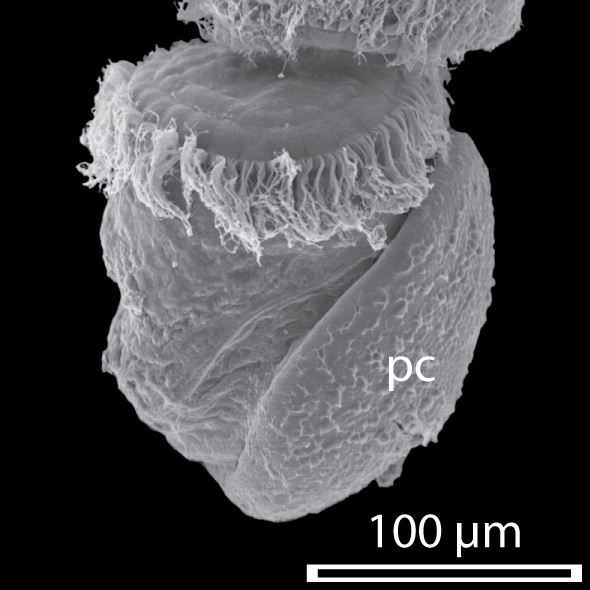
I always have loved the beauty of shells. They are stunning in their delicacy and colorful beauty. Did you know that when a mollusk is born, its apex part of the shell is born with it? This starter part of the shell is called the protoconch.

It is a photo of the Ass’s Ear Abalone, and this is what a mature shell looks like:

As the animal inside the shell grows the animal secretes exactly enough calcium (in beautiful patterns too) that he will need to live at the upcoming size in the chamber. Like this Turritella-


So this has been an interlude of praise for a Creator of extreme intelligence, creativity, beauty, and love. he created this world for humans to populate in order that we might worship Him, and once sin is vanquished (Daniel 9:24) He will restore all to its perfect glory. And blessedly, our current state of imperfect worship and praise that I am exhibiting even now, will become perfect toward Him. As it should be.


Posted in theology

Cut to the Chase discernment: Avoid Jen Wilkin

By Elizabeth Prata

About the series: I have written discernment essays critiquing various teachers. In articles like that, I include sources, explain the teacher’s errors thoroughly, and provide examples. All this make the essays longer. Nowadays however, people like to read less lengthy material. So I cut to the chase and made shorter essays showing why these folks are false. In the Cut to the Chase I include links at the end if you care to go to my longer essays and/or other resources.

Why should we avoid Jen Wilkin?

1. Poor hermeneutic. Wilkin’s emphasis on gender and pushing for opportunities for women to teach (no focus on exercising the other gifts, solely teach, preach, or be hired leader-staff) is starting to twist her hermeneutics. I saw this in each of the messages I watched, including a Bible teaching from 2014 supposedly expositing Joshua, the Rahab segment of that speech. Her teaching is off. I would not trust it and sadly do not recommend Jen Wilkin’s Bible studies. Some have called her recent teachings ‘gynocentric’ which I think is apt.

2. Discernment. Jen is partnering with and promoting questionable/false teachers. She is increasingly speaking with Kelly Minter, Christine Caine, Priscilla Shirer, and Beth Moore. Also Jackie Hill Perry. See one example here. Another is the Lifeway Women’s Leadership conference in February 2020. More recently Jen spoke at an Oklahoma Women’s Retreat alongside Whitney Capps, who is part of false teacher Lysa TerKeurst’s Proverbs 31 Ministries and Lifeway Women…and The Gospel Coalition Women with Muslim Isa-dreams believer David Platt.

3. Egalitarian. In one famous example, Wilkin based her entire talk on the biology of men and women, avoiding the biblical/spiritual foundation. When she does refer to the Bible it was to present a different interpretation of the creation of humans in Genesis 2.

In that speech, Wilkin explained to the attending male pastors and church planters, that it’s important to understand the biology of men and women when you’re planting a church, and so you can use women in “visible leadership”. You hear this phrase from Wilkin a lot … “visible leadership”. She is big on women in visible leadership. As opposed to “hidden leadership”? Wilkin tries to make the case that men and women are interchangeable and therefore their roles are too. She does not preach the beauty of an Abigail, Anna, Lydia, Mary, Dorcas. Her sole focus of late is women who leading, and often mentions Deborah and Huldah. She is against the concept of complementarian helpmeet, which is why she needs to reinterpret Genesis 2.

3. Attitude. Titus 2:3a says, Older women likewise are to be reverent in behavior
Wilkin is on record as being angry and being snarky. Greear said in his introduction about her that he’d first heard of her as ‘The Bible Girl’ and talked with her, testing her for her biblical knowledge, and “she’d always give back a snarky answer, to let me know that she knew a whole lot more than I did about whatever I was asking about, so I learned to be very respectful around her…”

Unknowingly Greear made Proverbs 27:15-16 come to life-

A constant dripping on a day of steady rain
         And a contentious woman are alike;
He who would restrain her restrains the wind,
         And grasps oil with his right hand.

Wilkin sometimes demonstrates a barely suppressed anger, a vitriol that in one case clearly came through. She actually called one noted and credible theologian “a pervert”. It was uncharitable in the extreme. In another case of an author of a commentary writing that Rahab was a prostitute, she said to her audience, “If I ever meet him I’ll probably sock him in the face.” Maybe her anger is not so suppressed after all.

Show yourself in all respects to be a model of good works, and in your teaching show integrity, dignity, 8and sound speech that cannot be condemned, so that an opponent may be put to shame, having nothing evil to say about us. (Titus 2:7-8).

4. Omissions. Wilkin does not teach the role of women as submissive learners, content in her God-designed role to serve at home and humbly in the church. She does not teach women mentoring other women. She does not teach positively about the women who submitted to their biblical roles, like Lydia, Eunice and Lois, Anna. Jen speaks of “the gifts” but restricts ‘the gifts’ to teaching and not the other gifts such as administration, hospitality, support, etc. She focuses on the teaching and positions of women in “visible leadership.” Omissions are harder to detect but once you realize Jen gives only part of the story of our roles and joys, you can’t forget it. She is unduly entranced with gender politics and it’s affected her teaching and her own walk.


Further discernment essays from The End Time critiquing Jen Wilkin-

I went back and re-edited the following two series. They are slightly shorter now.

“If I ever meet him I’ll probably sock him in the face” said Jen Wilkin, Redefining Rahab, part 1

“If I ever meet him I’ll probably sock him in the face” said Jen Wilkin, Redefining Rahab, part 2

“If I ever meet him I’ll probably sock him in the face” said Jen Wilkin, Redefining Rahab, part 3

Slippery Slopes: A discerning look at Jen Wilkin, part 1

Slippery Slopes: A discerning look at Jen Wilkin, part 2

Slippery Slopes: A discerning look at Jen Wilkin, part 3


Posted in end time, perilous times shall come, prophecy

Sin is more easily learned from others than holiness

By Elizabeth Prata

The world is corrupt. We know this. We read our Bibles. All we have to do is look around. If we watch TV for any length of time (a minute?) we see how depraved the world is. But then the Lord peels back a layer and we see, no, it’s WORSE.

Haggai 2:10-14 – “Thus says the LORD of hosts, ‘Ask now the priests for a ruling: ‘If a man carries holy meat in the fold of his garment, and touches bread with this fold, or cooked food, wine, oil, or any other food, will it become holy?'” And the priests answered, “No.” Then Haggai said, “If one who is unclean from a corpse touches any of these, will the latter become unclean?” And the priests answered, “It will become unclean.” Then Haggai said, ” ‘So is this people. And so is this nation before Me,’ declares the LORD, ‘and so is every work of their hands; and what they offer there is unclean.”

What does this mean? Matthew Henry explains it well. “Many spoiled this good work, by going about it with unholy hearts and hands, and were likely to gain no advantage by it. The sum of these two rules of the law is, that sin is more easily learned from others than holiness. The impurity of their hearts and lives shall make the work of their hands, and all their offerings, unclean before God. The case is the same with us. When employed in any good work, we should watch over ourselves, lest we render it unclean by our corruptions.” –End Matthew Henry

In other words, if you drop a white glove in the mud, the mud doesn’t get glovey.

In this, the end time, we are warned repeatedly to avoid being deceived. Deception is the watchword of the day, along with its brothers, false teaching/prophets, and apostasy. The only sure antidote for being deceived is to stay strong in the basic foundations of our faith: daily prayer, daily Bible study, daily worship- seeking His face by remaining receptive to the Holy Spirit.

The Haggai chapters also contain a phrase the LORD uses several times:

“Thus says the LORD of hosts, “Consider your ways” (1:7).

The word consider is used repeatedly in chapter 2. In the NIV it is “give careful thought.” Considering our ways is always a good thing to do. Falling away always starts subtly, and why not? “For the serpent was more crafty than any beast of the field which the LORD God had made.” (Genesis 3:1) He’s not going to grab you and drag you screaming behind the bushes. He’ll start subtly.

Do you have some creeping corruptions that are rendering you unclean? A little mud splatter? A peek at today’s horoscope, perhaps. Hanging with friends who swear, drink, or sleep around. Have you been unable to resist passing along that great piece of gossip? That’s how it starts. And before you know it, your work is unclean. And the more we fail to “give careful thought”, the more we become unclean.

Our uncleanness, (our sin) rubs off on people very easily. The more we fail to ask Jesus to reveal our unholiness to us the more the crafty serpent subtly creeps in, telling us that our unclenness isn’t that much, or isn’t that bad.

Don’t kid yourself that you are persisting with these friends because it’s a chance to witness. The consecrated meat does not consecrate the cooked food, wine, oil, or any other food. Rather, the uncleanness prevails, every time. If you drop a white glove into the mud…the glove does not make the mud white.

Christian, “This know also, that in the last days perilous times shall come.” (II Timothy 3:1) Give careful thought to your ways, and stay clean in these perilous times!

Posted in theology

God cares for us

By Elizabeth Prata

The ultimate care for us is that God sent His Son, Jesus, to live a sinless life, die on the cross shedding His blood as the sacrifice required, be buried, be resurrected and ascend to the place of honor next to the Father. This process opened the door for humans to repent of sin and go to heaven through Jesus as the door, be justified from our sin, declared righteous. The Father sees a repentant human as having Jesus’ righteousness.

Now I make known to you, brothers and sisters, the gospel which I preached to you, which you also received, in which you also stand, 2 by which you also are saved, if you hold firmly to the word which I preached to you, unless you believed in vain.

3 For I handed down to you as of first importance what I also received, that Christ died for our sins according to the Scriptures, 4 and that He was buried, and that He was raised on the third day according to the Scriptures, 5 and that He appeared to Cephas, then to the twelve. 6 After that He appeared to more than five hundred brothers and sisters at one time, most of whom remain until now, but some have fallen asleep; 7 then He appeared to James, then to all the apostles; 8 and last of all, as [e]to one untimely born, He appeared to me also. (1 Corinthians 15:1-8).

This is the Gospel.

God could have wiped out Adam and Eve when they sinned, but He did not, instead shepherding His lambs throughout the eons of history to culminate in the cross. What grace! What love! What care!

My Father, who has given them to Me, is greater than all; and no one is able to snatch them out of the Father’s hand. (John 10:29).

This care is permanent. It is eternal. Who can’t take us from Jesus after we repent and are justified? Who is greater than Jesus to be able to do that? Is there a strong man who can do this? No! This care is not only available, but it is eternal.

Examples of God’s care throughout these eons:

He took care of all the earth’s animals of their kinds, and took care of Noah and his family before, during, and after the terrible deluge.

But God remembered Noah and all the animals and all the livestock that were with him in the ark; and God caused a wind to pass over the earth, and the water subsided. (Genesis 8:1).

Short devotional explaining that God remembering does not mean that God forgot then came to mind. God Remembered Noah

When the Hebrews were wandering in the wilderness, their sandals and clothes didn’t wear out! His care extends from the sustaining of the universe so we can live within it, to the eternality of our souls, down to the minute details of life!

And I have led you in the wilderness for forty years; your clothes have not worn out on you, and your sandal has not worn out on your foot. (Deuteronomy 29:5).

The fresh manna appeared every day except Sunday for 40 years. And meat, too.

At twilight you shall eat meat, and in the morning you shall be filled with bread; and you shall know that I am the Lord your God. (Exodus 16:12b)

He feeds the birds.

EPrata photo

Look at the birds of the sky, that they do not sow, nor reap, nor gather crops into barns, and yet your heavenly Father feeds them. Are you not much more important than they? (Matthew 6:26).

Pau’s thorn was a care! God was guarding Paul from becoming conceited.

And He has said to me, “My grace is sufficient for you, for power is perfected in weakness.” Most gladly, therefore, I will rather boast about my weaknesses, so that the power of Christ may dwell in me. (2 Corinthians 12:9).

If your circumstances are dire, if you are anxious for the near future, just remember no matter the external conditions, your soul is safe, even your daily care down to the smallest detail is in the Father’s hand. Trust Him.

Posted in theology

“Without blame” – Of Epitaphs and Headstones

By Elizabeth Prata

EPrata photo

When a person dies, the eulogy tends to be flowery, and usually leaves out the negative characteristics of a person, and focuses on the positive. We want a dearly departed loved one to be remembered well. We erect gravestones, some larger or more ornate than others. Some of these have simple born-died facts, others have a life verse, motto, or even a flowery description.

“Seventeenth and eighteenth-century stones generally had solemn epitaphs which prompted passers-by to contemplate mortality and the fleeting nature of life on earth.” (Source).

These epitaphs or selected Bible verses on headstones were meant to demonstrate both how the person shepherded his or her life, and to cause those reading the gravestone to think about their own life after death.

Many early New England epitaphs contained this poem, which this blogger calls “The Classic”

“Behold And See As You pass By, As You Are Now So once Was I, As I Am Now So You Must be, Therefore Prepare To Follow Me.”

EPrata photo. “Resting in hope of a glorious resurrection”

An inscription probably from 5th century found in Sicily, reads in translation:

Here lies Marinna who lived honorably and without blame, and left this world to go to the Lord at the age of 37 years, paying her debt on December 24, but she loved God.” source The Catacombs by Paul Carus.

Many early Christians’ graves were marked simply “without blame.” If you ponder that for a second you realize just how beautiful that is. To be a Christian is to be a person whom God sees as without blame (or spot or blemish- meaning, sin).

Catharine Wilcox, Jan 29, 1824 was laid to rest in Mt. Zion Presbyterian Cemetery. The Inscription and Notes read as follows, “Age 25. w/o Cyprian Wilcox. “She was a Christian” : “In that solemn hour when the last enemy appears, what conquering power like this I know my sins forgiven.” (Source).

In fact, if you look up the word ‘blameless’, you see it is often used in both the Old Testament and the New.

What does it mean to be without blame?

but now He reconciled you in the body of His flesh through death, in order to present you before Him holy and blameless and beyond reproachColossians 1:22

just as He chose us in Him before the foundation of the world, that we would be holy and blameless before Him. (Ephesians 1:4)

God said Job was blameless. (Job 1:1). Noah, too. (Genesis 6:9).

EPrata photo

It doesn’t mean that they were without sin. Only Christ is without sin. It means, “not absolute or faultless perfection (compare Job 9:20; Ec 7:20), but integrity, sincerity, and consistency on the whole, in all relations of life (Ge 6:9; 17:1; Pr 10:9; Mt 5:48). It was the fear of God that kept Job from evil (Pr 8:13).” (Jamieson-Fausset-Brown Bible Commentary).

It means that Noah and Job always chose to do good in God’s name, had integrity, and their character was faultless in their constant pursuit of holiness. Satan attributed Job’s character to his prosperity but it was the fear of God that kept Job blameless.

We have the gift of the Holy Spirit to aid us now, so anyone who has repented of sin and is in Jesus is seen by the Father through His Son as blameless, perfectly righteous.

What an incredible shepherding of life to have written on stone that the Christian was blameless in living. They must have borne much fruit to be seen so. Of course the true epitaph occurs in heaven, when we eagerly stand before Jesus upon our arrival and hope to hear those golden words, honey to our hearts,

His master said to him, ‘Well done, good and faithful slave. You were faithful with a few things, I will put you in charge of many things; enter the joy of your master.’ (Matthew 25:21).

How incredible to be ushered into eternal joy, spotless, blameless, all because of the sacrifice of Jesus. He laid down His life, shed His blood as God’s lamb, and was buried. Rising again and ascending to the Father, Christ is and was and always will be blameless. He is the true origin of blamelessness, and we are grateful He ordained His elect to be so, after Him and through Him.

If you’re interested, as I am, lol, in historic cemeteries and gravestones and epitaphs, here are some links that have more information.

A Guide to Reading Early Epitaphs

Cemetery Epitaphs Through Time

Gravestones and Epitaphs

Epitaphs Tell Tales in New England’s Graveyards, New England Historical Society

The Stranger of Gray. Confederate soldier buried in northern New England, grave Maintained by Ladies of the Gray Historical Society. More here