Posted in brethren, commentaries, encouragement, gift

Look what came all the way from California today! Updated

I like to study the Bible. I like history, culture, commentaries, natural history, dictionaries, Greek and Hebrew lexicons…anything to help me understand God’s word better.

Of course, there is no substitute for studying God’s word directly in submission to the Spirit who illuminates it…in prayer and in a spirit of truth and repentance.
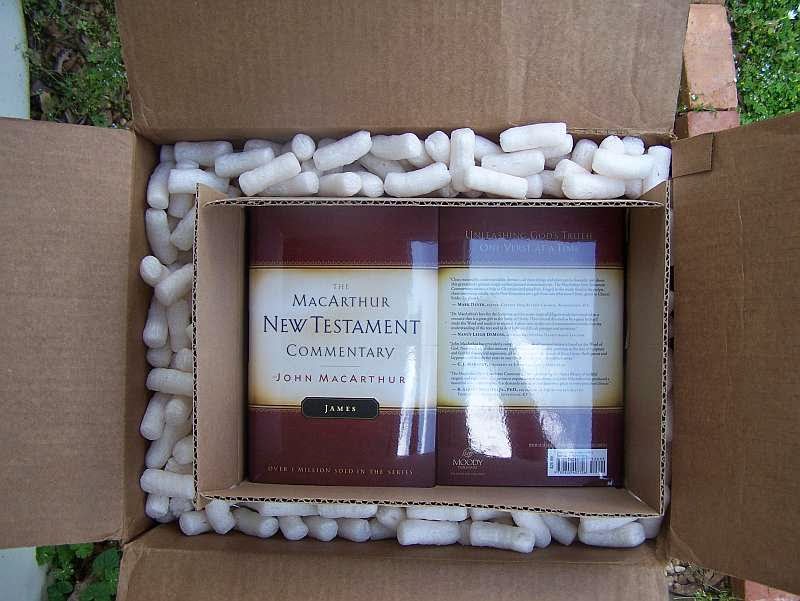
I found two large boxes leaning against my door.
So glad I am on vacation and could retrieve them immediately.
There is no covering or porch to deliver them to and weather is a factor.

However God raised up men throughout each age to help us. Some were preachers, some were scholars, some were professors, some were students…but God raises up men to help us learn His word. We are grateful to the Apostles, Augustine, Hus, Calvin, Luther, Edwards, Clarke, Gill, Henry, Spurgeon, Warfield, S. Lewis Johnson and many, many more who have left behind a written legacy of a lifetime of depth in God’s scripture. We know we benefit from their evangelical and pastoral labors, but we also benefit from their scholarly labors too.

One of these men God has raised up for this generation is John MacArthur. After 35 years of writing and a decade beyond that of preaching, Dr MacArthur completed his New Testament Commentary Series. Upon completion of verse-by-verse explanations of each book of the NT, he and his team have made the commentary available for an incredible price for a limited time.

A lot of books!

A dear, generous brother in the faith contacted me and offered to subsidize part of the sale price, and after thinking about it and prayer, I said yes. Otherwise I’d never have been able to purchase this resource for my own study.

It arrived today, 33 volumes, 3 feet 4 inches of towering knowledge. I live in a 400 square foot apartment and my four bookcases are full. When I ordered the set, I figured I’d cross that bridge when I came to it, and now that day is here. After pondering and looking around and re-arranging, I will later install these wonderful books onto my bookshelves, readily accessible and waiting to be absorbed into my daily studies.

The brother who sent me the donation said it was an investment. We are a body, united through Christ and His blood, death, and resurrection, our old men have been put to shame and death and the new man is growing in each of us. When we all use our gifts to the good of the Body and the glory of Christ, we all benefit. He believed it would benefit the body to ensure I had access to this study aid. How encouraging to be thought of. How wonderful to be given a gift.

I’m humbled by this, and I also take the responsibility seriously. I’m grateful for the opportunity to deepen my study and to be reminded every day when I look at the books, that we are not alone, none of us. What one person does affects us all, to the bad and to the good. I pray I use this gift wisely to the good and glory of the Name who made it possible to be in His body at all, and to have the mind of Christ. (1 Corinthians 2:16).

Sorry kitties, your hidey-hole has got to go.
I need the space now

UPDATE

It took some doing and a bit of culling but I fit it all. I moved several bookcases of books around and had to put away my rocks, gems, geodes and fossils that had been displayed on the shelves of a smaller bookcase. That was not too sad because I’d had to put them all in jars anyway and push them to the back of the shelf because in the wee hours Murray flung them off their decorative dishes and bashed them all around the house. A fossil shell survived the Flood but not the cat. I put them up until he gets older. That freed four shelves and it was just enough.

But in so doing I had an opportunity to re-group my books by subject and size. (Yes, I’m that way). I also cleaned the bookcases since they were emptied. Amazing how much dust collected. All my theological and bible books are together and grouped by subject. I know I’m going on about this but change is hard, even for a good thing. I sit in my wing chair sometimes and simply look at my books on the shelves. (Yes, I’m that way).

Of the half shelf of new MacArthur Commentaries I could fit all my older commentaries on the rest of the shelf. I’ve got commentary on Ecclesiastes, three on Revelation, Daniel, Corinthians, Peter and a few others. Here is how it looks now.

The top shelf is Italy, Renaissance, Art and poetry. The rest is given over to theology, dictionaries, and Christian/missionary biographies.

On my other shelves I’ve got Native American and Border issues, Mythology, classics such as The Peloponnesian war, Socrates, and Tacitus, some medieval diaries and castle stuff, and half a shelf on natural history including field guides to mammals and shells, Stephen Jay Gould and Farley Mowat. A few novels round out the newly freed up shelves with some favorites including “How Proust Changed My Life”, Isabel Allende, etc.

Spring break is here, but summer’s coming! Plenty of time to read and study. Time Enough at Last

Posted in architecture, church, encouragement, new testament, temple

Of church buildings and temples

I’m reading 1 Corinthians 6. The verses at the end of the chapter, 19-20 are as follows:

EPrata photo

Or do you not know that your body is a temple of the Holy Spirit within you, whom you have from God? You are not your own, 20for you were bought with a price. So glorify God in your body.

We are familiar with that passage and no doubt can quote it. In this portion of the chapter Paul is urging the sexually aware and culturally lascivious Corinthian believers to forgo sexual immorality. He said that because the Holy Spirit is inside us, and that we are living temples of Christ, when we sin sexually we make Christ complicit in it in a way that no other sin does. (1 Corinthians 6:15).

In reading my commentary by John R. Rice, he went further in explaining. His focus in this paragraph is not on the body in which the Spirit dwells, making it the temple of God, but on buildings.

What’s in a church building? If you’re an Old Testament worshiper, everything, absolutely everything. If you are a New Testament worshiper, nothing. Absolutely nothing.

EPrata photo

We know that God spent an inordinate amount of ink and inspiration in the Old Testament recording the specifics of the Tabernacle, and later, the Temple’s construction. We have an excellent idea of what they both looked like because of the monumental meticulousness in the OT regarding its dimensions, specifications, and adornments. Some of this information can be read in 1 Kings 5-6, 2 Chronicles 2, Exodus 38, and so on.

The Disciples looked upon the temple in Mark 13:1 and exclaimed over its majestic beauty. There is even much ink given to the construction, location, and adornments of the Temple in the Millennium Age (Ezekiel 40-41), even down to the number of cubits wide each door will be. Revelation 11:19 even mentioned God’s temple in heaven opened up and the ark of the covenant being there.

But did you ever wonder why in all the New Testament, no specificity or even reference is given over to the construction, location, adornments of any church building? None whatsoever?

Here is John R. Rice:

It is significant that not a single church building is mentioned in the New Testament. Were there any church buildings? If so, God was particularly careful that no one should revere or honor them. God does not live in church houses. Many a home where Christians pray and read God’s word and delight in His presence is more nearly a house of God than the church house. It is wrong, then, “to speak of reverence for the house of God.” We should respect the rights of other people. We should see that services are decent and in order, without confusion. We should respect the man of God. But God has no temple on earth but a human body… ~John R. Rice, The Church of God at Corinth: Commentary in 1 and 2 Corinthians, 1973

EPrata photo

We note that the disciples met in the Upper Room after the crucifixion (Acts 1:13, Acts 20:8). When Apollos was expounding in the synagogue, Priscilla and Aquila took him aside to explain the Way more accurately. The verse doesn’t say where they took him, just “aside.” In Acts 19:1 Paul arrived at the interior of Ephesus and found some believers there. The verses don’t say where. We know that early believers initially met in massive numbers in the outer court of the temple. (Acts 2:46). After Paul’s discipleship grew, he quit the synagogue and reasoned “in the lecture hall of Tyrannus” for two years. (Acts 19:9).

We read in Acts 11:25-26 that

And he left for Tarsus to look for Saul; 26and when he had found him, he brought him to Antioch. And for an entire year they met with the church and taught considerable numbers; and the disciples were first called Christians in Antioch.

EPrata photo

Here Paul stayed a year, but again, no big deal is made of the building or place where they met. The church grew hugely, in fact this was where the followers of the Way were first called Christian, and yet…biblical silence on the building or specific location where this happened.

There were house churches. Peter stayed with Simon the Tanner in Joppa (Acts 10:6), believers were gathered at Mary’s house to pray (Acts 12:12), Lydia had a house church, (Acts 16:40), and so did Aquila and Priscilla (Romans 16:3,5; 1 Corinthians 16:19). Nympha hosted a church at her house, (Colossians 4:15). Philemon and Apphia had a house church. (Philemon 1:1-2).

We have absolutely no idea as to the size of these house churches, how regularly they gathered, what their gatherings were like.

EPrata photo

What we do know is that the early believers met in homes, lecture halls, the great outdoors, stadiums, synagogues, wherever they could. Even at the end of the New Testament when Jesus dictates His letters to the seven churches at Ephesus, Smyrna, Pergamum, Thyatira, Sardis, Philadelphia, and Laodicea they must have had a known building since presumably the letter-carrier would have known where to bring the letter. Yet we do not have any specificity of the 7 churches’ size, dimensions, adornments, etc., unlike the Old Testament’s attention to the details of the worship house.

This is because WE are the temple.

Churches today meet in rented school gymnasiums, storefronts, homes, brick buildings with steeples, clapboard structures large and small, majestic buildings, traditional edifices with bell towers, or simple square humble dwellings. It doesn’t matter what the building looks like as long as the temple of people that are gathered are holy and worshiping in spirit and in truth.

Or own church was founded in 1892 and is brick with bell tower, with solid wooden pews, hymn-holders, red carpet, tin ceilings, a pulpit and other traditional architecture. I love it. I’m comfortable there. I love the tradition and solidity of the permanent location of a place that’s immediately recognizable as “worship place.” Yet our church voted to move to a larger facility down the road which is currently a factory by day. The Youth meet there every Wednesday night, and we hold special events intermittently there as we make the transition.

The Old Testament is loud and noisy about the Tabernacle and the Temple. The New Testament is silent on church houses. The obvious variety of the structures in which they met isn’t the point. The point is that they, being the temple of God, met. And they did so continuously, joyously, even when persecution came. They gathered, prayed, baptized, learned, exhorted and proclaimed the Good News from lecture halls, homes, stadiums, hillsides, and temple courts. They met, these people who are the temple of God, they met. The building does not matter. We are His temple. This is what matters-

And the word of God continued to increase, and the number of the disciples multiplied greatly in Jerusalem, and a great many of the priests became obedient to the faith. (Acts 6:7)

Posted in grace, mighty, prophecy, resurrection, risen

He is risen!

The Righteous Reign of the Branch
There shall come forth a shoot from the stump of Jesse,
and a branch from his roots shall bear fruit.
And the Spirit of the Lord shall rest upon him,
the Spirit of wisdom and understanding,
the Spirit of counsel and might,
the Spirit of knowledge and the fear of the Lord.
Isaiah 11:1-2
Posted in arminianism, calvinism, doctrines of grace, easter, resurrection

Understanding the Doctrines of grace in the face of the death, burial, & resurrection of Christ

This Holy weekend we focus on the death, burial and resurrection of our Lord and Savior, Jesus Christ.  I offer these thoughts and this sermon by Phil Johnson which is actually a brief overview of church history with a focus on the doctrines of grace, which most people know as ‘Calvinism’. Initially one may wonder how these two streams of thought are intertwined, but as you will see, they are intertwined so tightly that a clearer understanding of Jesus and the faith he secured for us through His death, burial, and resurrection will be made manifest.

Perceiving that Christ is in total control of each and every salvation, through understanding these biblical doctrines, will hopefully do several things in the reader’s and listener’s heart. One, is that the dear reader will never, ever again use the terrible phrase, “decisions for Christ.” We do not decide to become a Christian. The author and finisher of our faith is Jesus Christ. (Hebrews 12:2).

Secondly, on this most precious of weekends, understanding the biblical doctrines of grace will offer a clearer view of Jesus and His love for humanity. Here is a very good teaching by Phil Johnson. He gives an overview of church history which illustrates when the eruption between the two camps originated. It was 410AD. The two camps are: we decide for Jesus vs. God’s sovereignty in salvation AKA Pelagianism vs. Calvinism. Hopefully, you will understand that the opposite camp, Pelagianism, minimizes the seriousness of sin and nullifies the need for Divine grace. This weekend is about grace!

Pelagianism was declared heresy in 430 AD. Yet its ideas remained, modified somewhat, and then was called Semi-Pelaginaism. This also was declared heresy in 529 at the Council of Orange. Still not firmly stamped out, strains of Semi-Pelagianism ideas advanced and nowadays modern Arminianism is the result of those debates from earlier centuries. If you hear the phrases walk the aisle, pray a prayer and decide for Christ, it’s from Arminianism.

The synopsis of Johnson’s teaching is below. I’m sorry, I was not able to find a transcript. It is audio only with powerpoint slides.

I want to emphasize, WE DO NOT DECIDE FOR CHRIST. On this most important of weekends, understand who Jesus is and what His death, burial and resurrection means, by understanding the full expression of His work in authoring and finishing our faith. Phil Johnson biblically lays this out.

Calvinism is not some quirky anomaly in the history of Christianity. It is not a recent departure from  the mainstream that is headed off in some bizarre direction. The truth is these ideas have always belonged to the mainstream of sound theology throughout church history. It is one of the distinctive doctrines of Christianity itself. It is the anchor of sound doctrine that our faith is the result and not the cause of God’s work in our hearts. ~Phil Johnson

~~~~~~~~~~~~~~~~~~~~~~

Synopsis of the teaching-sermon: The Christian doctrine of ‘Election’ has caused more difficulties to believers than any other. It is indeed one of the most frequently misunderstood of all Biblical teachings. Many have been distressed by what they think this teaching means. But rather than causing Christians concern, this doctrine is actually one that should fill believers with comfort and a much better grasp of the great and sovereign God that they serve. … a very helpful overview of Calvinism and its history, which actually sets the doctrine of election in the context of the Biblical teaching with which it is most commonly associated. Once correctly understood, election is seen to be actually a demonstration of the Lord’s love for his people. These two recordings will be a great help to those who are struggling to understand this most difficult, yet wonderful, doctrine.

~~~~~~~~~~~~~~~~~~~~~~

Guest introduction by R. Craig Fulford:

Given it is Easter weekend you might expect me to post a tremendously dynamic sermon on the resurrection. But I’m not!

Instead I have chosen to share with all of you a sermon delivered by Phil Johnson entitled “The Story of Calvinism”. Now before you run screaming for the exits, allow me to explain.

For the most part, in today’s Church environment, any mention of the term Calvinism is met with an almost automatic response of “thrown up hands” and criticism. And that has been the result of many years in Biblical doctrine being compromised in favor of the belief that somehow man is in control and can make his own decision about whether or not he will accept God’s grace and His gift of salvation. The belief that a lost and spiritually dead man somehow has the “free will” to control his own salvation is now epidemic.

Phil does a tremendously effective job of diffusing the animus which exists between those who adopt the Arminian (Synergistic) view and those who are committed to the Monergistic (Reformed) view. Or at least he makes a strong attempt in trying to accomplish that goal without sacrificing Biblical truth.

Monergism says that the Holy Ghost acts independently of the human “will” in the work of regeneration. Monergism is the position in Christian theology that God, through the Holy Spirit, works to bring about the salvation of individuals through spiritual regeneration without any cooperation (interference) from the individual.

Synergism is the position of those who hold that salvation involves some form of cooperation between divine grace and human “free will”. Synergism is upheld by the Orthodox and Roman Catholic Churches and by the Methodist, Episcopal, Charismatic and Pentecostal traditions of Protestantism. It is an integral part of Arminian theology and is simply the belief that the human can and might choose to cooperate (influence) with the Holy Ghost in His “work” of regeneration.

It’s important to note that “free will” is never once mentioned in Scripture nor is the concept. I know, neither is the “Trinity” but the truth of that concept is unmistakably taught.

So, you must be asking yourself, are there born again believers in churches that have adopted the Arminian doctrine? And if God has already pre-destined those who will be born again, why should Christians ever bother to witness? I mean, “What difference does it really make”?

Listen to Phil’s message and see the slides to have these kind of very serious questions answered! It only seems appropriate, while our minds are on His resurrection this weekend, to examine what it means to us as sinners in need of a Savior. It is too important that we understand what His sacrifice and victory over death represents to get it wrong!

~~~~~~~~~~~~~~~~~~~~~~

Particular atonement: Christ’s death had a particular purpose, and a special reference for the elect, so that God’s design was first of all to save them, and Christ’s death secured the guarantee of their salvation. Christ’s death accomplished everything God designed it to accomplish. ~Phil Johnson

—————————————————————
Further Reading:

Altar Calls: Why You Should Refuse to Walk the Aisle part 1, and 2, and 3.

What is ‘decisional regeneration?’

A holy Saturday

Posted in prophecy, resurrection, scripture

He will not let His Holy One see corruption!

Vyrso Verse of the Day

For you will not abandon my soul to Hades, or let your Holy One see corruption
(Acts 2:27, Psalm 16:10)

He describes his resurrection: God loosed the pains of death, because it was impossible that he should be holden of it; ōdinas—the sorrows of death; the word is used for travailing pains, and some think it signifies the trouble and agony of his soul, in which it was exceedingly sorrowful, even to the death; from these pains and sorrows of soul, this travail of soul, the Father loosed him when at his death he said, It is finished. Thus Dr. Godwin understands it: “Those terrors which made Heman’s soul lie like the slain (Ps. 88:5, 15) had hold of Christ; but he was too strong for them, and broke through them; this was the resurrection of his soul (and it is a great thing to bring a soul out of the depths of spiritual agonies);

this was not leaving his soul in hell; as that which follows, that he should not see corruption, speaks of the resurrection of his body; and both together make up the great resurrection.” Dr. Lightfoot gives another sense of this: “Having dissolved the pains of death, in reference to all that believe in him, God raised up Christ, and by his resurrection broke all the power of death, and destroyed its pangs upon his own people. He has abolished death, has altered the property of it, and, because it was not possible that he should be long holden of it, it is not possible that they should be for ever holden.”

Henry, M. (1994). Matthew Henry’s commentary on the whole Bible: complete and unabridged in one volume (p. 2069). Peabody: Hendrickson.

Posted in crystal cathedral, deception, hour of power, robert schuller

Robert Schuller – Dead today

Robert Schuller, Crystal Cathedral megachurch, founder, dies

The Rev. Robert H. Schuller, a California televangelist and author who beamed his upbeat messages on faith and redemption to millions of followers from his landmark Crystal Cathedral only to see his empire crumble in his waning years, has died. He was 88. Schuller died Thursday at a care facility in Artesia, daughter Carol Schuller Milner said. He was diagnosed with terminal esophageal cancer in 2013.

Schuller had a bigger effect on CHristianity than many are aware. The effect was assuredly negative. Mr Schuller taught many false things, wrapped in positivity, self-esteem, and church growth strategies. Rick Warren is a spiritual child of Schuller. See links at bottom.

For now, here is a Guest Post by R. Craig Fulford in which he encapsulates my sentiments exactly. It is printed with permission

——————————————–

Today was the DOD for Robert Schuller. Many probably said, “Well now he will get what he deserves”! Or something close to that.

But my reaction was very different. I actually found myself with tears in my eyes because his death reminded me that none of us “deserve” God’s Grace and the fact that Schuller lead so many people down the road leading to destruction while knowing that Pastors are subject to even a higher standard regarding the truth means that Schuller is particularly suffering God’s wrath. And that is no cause for joy nor is it a cue for born again believers to say he deserved what he got.

It is, however, especially significant that his death occurred on the weekend that Jesus paid the price for his sins and yet Schuller never came to a saving knowledge of Jesus Christ’s sacrifice. To the contrary, he was one of the most heretical teachers in recent history and laid a foundation for other false teachers to follow.

So today we see an epidemic of “seeker sensitive”, universalistic, easy believism churches that teach “relativism” as the accepted norm and totally misrepresent God’s word in favor of the doctrine of “pragmatism”. And that false doctrine is not just limited to the Charismatic and Pentecostal churches. The same liberal influences have infected the traditional mainline denominations as well.

And yet another less publicized beneficiary of all of this liberal and non-Biblical heresy are those who look at what is now considered to be Christianity and understandably view it as something closely akin to the “Twilight Zone”. And who can blame them?

Biblically sound Churches are becoming almost impossible to find and many “wanna be believers” are settling for doctrines they believe are close enough. But as Spurgeon so famously said:

Schuller’s death could very well be the catalyst born again believers need to realize the spiritual consequences both our friends and even members of our family face. It’s indeed ironic that Schuller died close to three days before Jesus was resurrected. Just saying!

Schuller’s death has caused me to pray, with a new conviction, that those I know and love who are deceived and don’t realize they are, will be convicted unto regeneration by the Holy Spirit. And that God will enable me to speak to them under the control of the Holy Spirit.

I know that my efforts are not sufficient in any way shape or form. But I also know that I’m commanded, not asked, to make sure His word is heard because faith comes by hearing. The rest is up to God!

HE IS RISEN

~~~~~~~~~~~~~~~~

Further Reading

Straight Talk about the Seeker church movement

The Starting Principle of Discipleship

Book Review: Deceived on Purpose by Tim Challies

Posted in costa concordia, depraved, sin

What happens when we can no longer trust the mass transportation drivers who carry us?

Source

Yesterday while on break I was speaking with the teacher with whom I share a classroom, about the Germanwings co-pilot who drove the passenger airliner into the ground. I have been mulling the sea-change his act ushers in.

We have seen hijackers, terrorists, and suicide bombers rush in to kill and destroy. That is horrific. Yet now, the stealthiness of one who is inside, trained to protect lives because they are precious, also killing and destroying, is even more heinous because of the trust that is broken. The very people into whose hands I place my life and assume they will regard it as worthy of protection, have become the ones who treat it as least and worthless. Being trapped on a rapidly moving mass transport and totally helpless to protect myself, get to safety, or help any other person, doesn’t bear thinking about.

I thought of the self-centeredness of the co-pilot Andreas Lubitz, wanting to take his own precious life that God gave him, but also 150 others’. I thought about the Costa Concordia, the largest cruise ship ever wrecked, (in 2012) and its Captain Francesco Schettino’s inattention and series of ridiculously amateur decisions and as a result stoving in his ship on a rock. As the vessel was sinking, the captain abandoned ship, leaving 4200 passengers and crew to their fates. He did not assist in the evacuation or the rescue in any way. The confusion caused by a 6-hour evacuation resulted in 32 deaths and trauma for the rest. Vanity Fair has an excellent article on the event.

“We’ve abandoned ship,” Schettino told him.
De Falco was startled. “You’ve abandoned ship?” he asked.
Schettino, no doubt sensing De Falco’s dismay, said, “I did not abandon the ship … we were thrown into the water.”
When De Falco put down the phone, he stared at the officers beside him in amazement. This violated every tenet of maritime tradition, not to mention Italian law. “The captain had abandoned ship with hundreds of people on board, people who trusted him,” says De Falco’s boss, Cosma Scaramella. “This is an extremely serious thing, not just because it’s a crime.” For a moment he struggles to find a word. “This,” he goes on, “is an infamy. To abandon women and children, it’s like a doctor who abandons his patients.”

Costa Concordia nestled on a rock, site of cowardice, bravery, and death

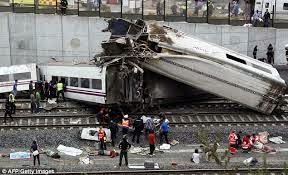
I thought about the Santiago de Compostela rail disaster in 2013 and the conductor driving the train at twice the posted speed, resulting in Spain’s worst rail disaster in 40 years, the deaths of 79 people and injuring scores of others. The driver had previously boasted of how fast “his” trains would go. The driver was later charged with homicide by professional recklessness and numerous counts of causing injury by professional recklessness.

Derailed cars at the site of a train accident near the city of Santiago de Compostela

Like the Dutch pilot who ‘predicted’ Germanwings crash in article about returning to a locked cockpit door weeks before disaster, saying, “I seriously sometimes wonder who’s sitting next to me in the cockpit. How can I be sure that I can trust him? Perhaps something terrible has just happened in his life and he’s unable to overcome it” I was also thinking about who I can trust with my life. There is a funny scene in Woody Allen’s 1977 movie Annie Hall that I never forgot. It shows Allen, Christopher Walken and then Diane Keaton in a car after Walken’s confession. It’s 1:27 minutes long.

I was thinking all these things and discussing them yesterday, deciding to write about it. But Tim Challies beat me to it.

And I’m glad he did. He wrote a piece called The Way The World Works and he discusses the things I’d been pondering: putting ourselves in the hands of others for our safety and our lives, life is precious, the broken trust. Challies did a very good job – much better than I would have done of course – and I commend the piece to you. Here is a taste:

And it is not just our own life that we regard as precious, but all life. Just as we make decisions to protect our own lives, we make decisions to protect others’. We tighten our children’s seatbelts. We put the knives up high. We pay the salaries of police officers. We stop and help when we spot even a stranger in distress.

Life is the most precious thing. The world only works when we maintain this tacit agreement that life is precious, that I will do all I can to preserve both mine and yours, that you will do all you can to protect both yours and mine. Both civilization and civility stand or fall on this simple agreement.

The alternative is unthinkable. The alternative is cars swerving to meet oncoming traffic, bicycles drifting out of the bike lane, toddlers roaming at will, hospitals empty and unstaffed. The alternative might even be a pilot setting his aircraft so that it gradually coasts straight into the ground.

The world reacted with horror—justified horror—when they learned that Andreas Lubitz had deliberately crashed Germanwings flight 9525, taking his own life and the lives of the other 149 passengers and crew members. The reason for our shock is that he violated the agreement. He chose to take life instead of preserve life.

Life is precious. We are made in His image. He formed us in the womb. God is intimately involved with us. Reckless, wanton abandonment of even the most basic precepts of our neighborly co-existence with one another, that we agree life is precious, is just so sad.

“You created every part of me; you knit me together in my mother‛s womb. When my bones were being formed, carefully put together in my mother‛s womb, when I was growing there in secret, you knew that I was there – you saw me before I was born. The days allotted to me had all been recorded in your book, before any of them ever began. Psalm 139:13-16

Posted in A.D. the bible continues, discernment, dr david jeremiah, roma downey, the bible series

(Updated) Why I won’t be watching the miniseries A.D.: The Bible Continues (And I hope you won’t be either)

Two years ago I wrote “Why I am Not Watching History Channel’s ‘The Bible‘. That was the hugely popular, smash-hit television series produced by Roma Downey and husband Mark Burnett broadcast on The History Channel, purporting to show major biblical events from Noah to the Crucifixion of Jesus. In ten hours.

The series writers “took many artistic liberties to compress the story lines while hoping to remain true to the story. A public relations manager for the project described the liberties to me as “extra-biblical but not contra-biblical,” CNN Blogs reported.

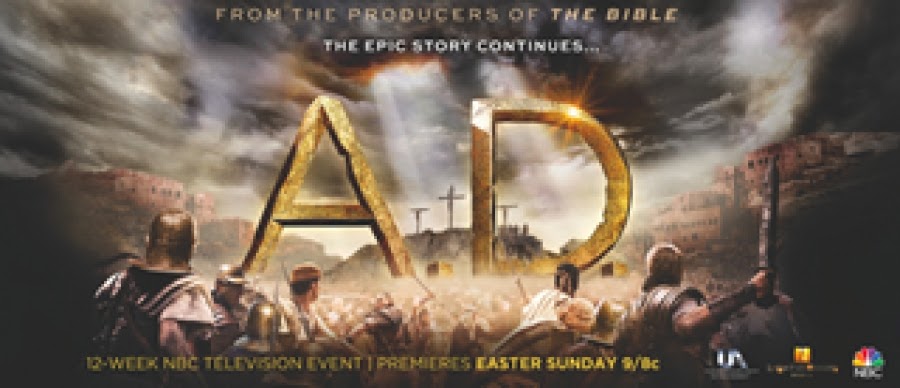
What people fail to understand is extra-biblical IS contra-biblical. Anyway, we don’t need to rehash all of that, except to remark that the duo’s movie theater version of biblical events called “Son of God” was equally atrocious. Now the duo is back with a continuation from 2013’s televised cable series. This time the series will be on regular broadcast TV, on NBC. It will begin on Easter Sunday.

In ‘A.D. The Bible Continues’ the story presented to the world has admittedly even less content taken from the actual bible, and admittedly is even more human-centered rather than Jesus/Gospel focused. The following quote is from an Associated Press story whose title is ‘A.D. The Bible Continues goes beyond the biblical epic’.

This new series, however, goes for a more gritty and human approach that tries to understand the characters as humans caught up in the politics of the day. Only about half of the material comes from the Bible, with the rest from historians of the period.

Downey said,

“If anyone comes to it expecting to see only the Bible, they will be interested to see that we have created a much larger and historic and political contest to set that story in, … I think what it does it allows you to have a fuller understanding of that story because when you see the oppression of the times that they are living in, when you understand that danger lurks in every alley, and the inhumanity of the times.”

So we have already see the following strikes:

  • The show’s writers and producers are pagan and not Christian, therefore they have nothing to say to us about spiritual things (1 Corinthians 2:13, John 14:17)
  • They chose to destroy the sufficiency of scripture by adding extra biblical material, thereby ‘improving on God’, (Genesis 3:1-2)
  • They shifted the focus from Jesus coming to atone for sins to Jesus’ sent ones coming to help the oppressed in their inhumanity (WHY are we inhumane? We sin, something the show divorces from the reason for Jesus’ coming and the Apostles’ going),

 And now this reason:

Feminism

The article reports,

The series has several strong female roles in it, including Leah, the ambitious wife of High Priest Caiaphas (Richard Coyle), who pushes her husband to amass more power.

Phew. I’m glad that the writers rectified what was obviously a glaring omission in the bible of strong female roles and invented a few so we wouldn’t have to take up our pitchforks or fire off ‘strong’ emails. Dorcas, Lydia, Phoebe, Anna, Mary, Susanna, Mary Magdalene, all the mothers who raised the Apostles, Elizabeth (mother of John the Baptist), Candace, Rhoda…etc were obviously either not women (lol) or not “strong” enough for the writers’ tastes.

The bible of course records the story of Old Testament Leah. Biblegateway synopsizes her story, “The Woman Lacking Loveliness Was Yet Loyal, Scripture References—Genesis 29; 30; 49:31; Ruth 4:11”. Deliberately naming a fictional woman in a New Testament tv show the same as a famous Old Testament saint is duplicitous. I notice that the writers also created a fictional male character and chose to name him Boaz. Doing this sows confusion.

Anyway, the wife of Caiaphas is not named in the bible nor is she even mentioned. The reference is in John 18:13, and only to introduce the fact that Annas and Caiaphas were linked through marriage. That’s it. She as not named nor did she have a role in the New Testament, but she gets screen time, unlike REAL women in the bible, who won’t get screen time. The quote from the article continues,

The role of Mary Magdalene is also central. While she doesn’t quite attain the status of head of the nascent church given her by Dan Brown’s “The Da Vinci Code,” she is clearly one of the key members of the group as it tries to figure what comes next after the crucifixion.

But here is the revealing reason women are given such prominence in the series. It is sickening and is one of the many reasons I won’t watch the show

“Our interpretation is that while many organizations are fronted by men, women were the ones that kept the cogs moving,” said Chipo Chung, the actress that plays Mary

Aha. So while the chosen and called male apostles, prophets, and disciples risked their lives, glorified God, suffered and died grisly deaths, these men were only front men while the women did the real work.

So you see, it only takes a moment to read up on the background to the show, investing a bit of time to see what their agenda is. Their agenda is-

  • not to tell the story of the Gospel as spread by the ambassador Apostles and the early church
  • not to glorify Jesus and His monumental work of building the church composed of Jews and Gentiles and enduring persecution and staying strong despite man’s puny political machinations,
  • not to accurately and with integrity share the stories of the men and women who laid the foundation of the faith.

Their intent is obviously to:

  • twist the bible to conform to fleshly, cultural, world tastes (Psalm 56:5, 2 Peter 3:16)
  • deny the sufficiency of scripture (2 Timothy 3:16)
  • reduce the message of Jesus from Deity atoning for our sins to nice guy helping the oppressed recover their humanity (2 Corinthians 11:4, Galatians 1:6)
  • confirm feminism and vault women to roles and political/cultural stature that proportionately reduces men in stature (Genesis 3:16)

So? Do not watch. The bible commands it.

I urge you, brothers and sisters, to watch out for those who cause divisions and put obstacles in your way that are contrary to the teaching you have learned. Keep away from them. (Romans 16:17)

PS: Remember, this is the show that Dr David Jeremiah is promoting and broadcasting on his Turning Point channel. On Easter.

UPDATE. And the agony continues-

This Hollywood Star Is Reportedly Set to Play the Apostle Paul in Major Motion Picture

Actor Hugh Jackman, who has starred in a plethora of well-known films, including “Les Misérables” and the “X-Men” series, is set to reportedly add yet another major motion picture to his resume: “Apostle Paul.” Hugh Jackman will reportedly play the Apostle Paul. The faith-based project will center on Saul of Tarsus…Following the announcement, Jackman’s own religious views were given some attention. As noted by the Guardian, he told Parade Magazine back in 2009 that he follows the School of Practical Philosophy, a belief system that focuses in on the power of wisdom, though it appears that he has some evangelical Christian roots. His told the outlet at the time that his father took him to see famed evangelist Billy Graham when he was a child. “[My dad] takes his religion very seriously and would prefer I go to church. We’ve had discussions about our separate beliefs,” Jackman said. “I just find the evangelical church too, well, restrictive. But the School of Practical Philosophy is non confrontational.”

Well he’s a perfect person to play the fierce and confrontational Paul.(1 Corinthians 4:21, 2 Corinthians 13:2). Not

Posted in discernment, encouragement

Tips for introducing false doctrine in your life, Sunny Shell on shallow prayer, Mission from Mongolia, Vidal Sassoon Jesus, more

Spring Break coming up in four days. The last school break we had was January 21, a three day weekend for Martin Luther King’s birthday. It has been A LONG HAUL. I’m tired, is all I can say.

I’m looking forward to sitting in the lawn swing, watching the birds, picking the wildflowers that are blooming already, reading, studying the word, playing with my photos and using the Pixlr tutorials to learn how to edit them in hipster-beat-retro fashion, and taking naps. Naps. Naps.

As for the photos, For example, here is one that I liked a lot, and below that, my own clumsy attempt at replicating. You can see why I need an entire week off to learn more.

this one by Steve York

Anyway, here is some good stuff I hope you think is good stuff as well.

This was tongue in cheek good fun and informative as well. From “The Messed Up Church”.

“Want Some False Doctrine in Your Life? Try These Handy Tips!”

Don’t be shy about it-admit it: false doctrine is fun and, well, it just feels good. Here are some handy tips to keep you fully deceived and incapable of discernment:

We recently had a mission report at our church from a missionary we support. He serves in Mongolia. This article thus interested me. You can always be encouraged by a good mission report!

James Gilmour of Mongolia

Originally from outside of Glasgow, Gilmour (1843–1891) decided to dedicate his life to bringing the gospel to the people of Mongolia. His giftedness and zeal were evident to his friends in college, and some were surprised that he would choose to work in obscurity in a physically difficult place. From his base in Peking (Beijing), Gilmour repeatedly went into Mongolia with little equipment, encouragement, few or no companions, but strong conviction…

As always Sunny Shell has good thoughts on prayer, this time, shallow prayer. I think we’ve all been there.

When My Prayers Are Shallow

As I was considering why my prayers are sometimes shallow, I realized they stem from one source: lack of consistent reading, meditating and studying God’s Word.

We are not passive consumers of ‘meat’. We who are in the pews have a responsibility too.

The Listener’s Responsibility in Hearing an Expository Sermon
What responsibilities do Christians have to expository preaching? In an age when shallow preaching is common, both shallow hearing and personal application are also common. Jay Adams has observed,

Too many laymen speak about the preaching event as if it were a one-way street, as if the responsibility for what transpires when the Bible is proclaimed rests solely on the shoulders of the preacher. But that’s not so! Effective communication demands competence from all parties.

Understanding expository preaching would not be complete without a word about the listener’s responsibilities in the expository process. Everything culminates in the hearers. The science and art of producing an expository sermon are empty efforts if no one hears and assimilates the message. Three vital principles will aid the listener who wishes to gain the most from an expository message. They are at the same time his responsibilities as well as his privileges.

David Murray wrote a glowing review of A Readable And Enjoyable Book On Apologetics! If you’re searching for a good book on apologetics, that is.

IVP sent me this book a couple of years ago and it went straight to my shelves unopened. I mean, 750 pages on apologetics! Who wants to read that unless they really have to? But a couple of weeks ago I had cause to take it down,dust it off, and have a look inside. And I was stunned. Despite its intimidating size, and despite it being an apologetics textbook, it was one of the best reads I’ve enjoyed in a long time. I know, it’s hard to imagine putting these three words in a headline – apologetics, readable, and enjoyable – but, really, that’s what this book is…. Instead of interacting with alternative Christian apologetic schools of thought (there are only a few paragraphs on Van Til’s presuppositionalism). Groothius’s agenda was to write a comprehensive and accessible book on classical Christian apologetics. He has succeeded magnificently.

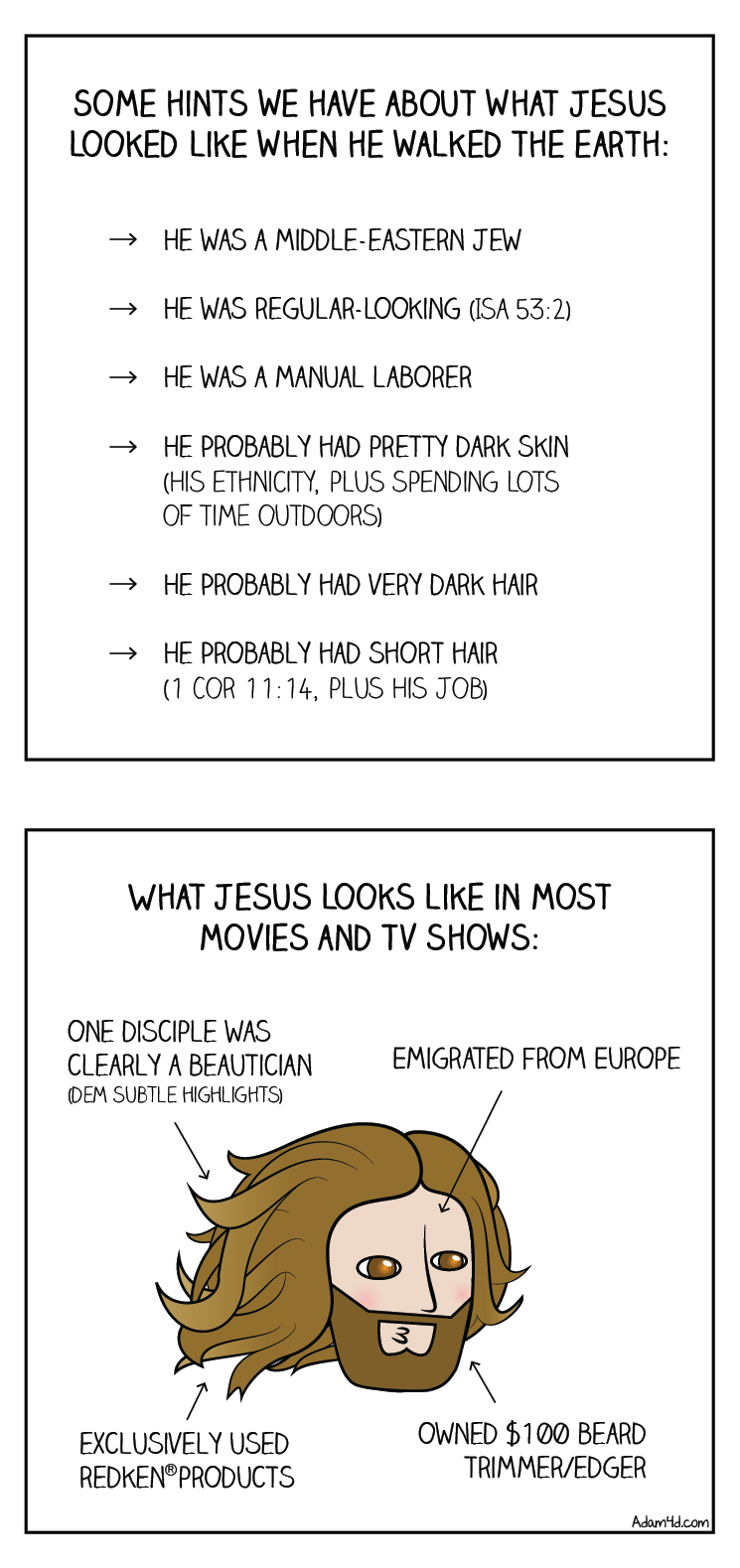
Don’t forget Adam Ford’s continuing good work on Christian visual theology in the form of comics. Like this one:

Praising the Savior for oceans, tides, harbors, inlets, currents, seaweed, …

Lubec Narrows. EPrata photo