
Scripture Photo: Great Supper of God
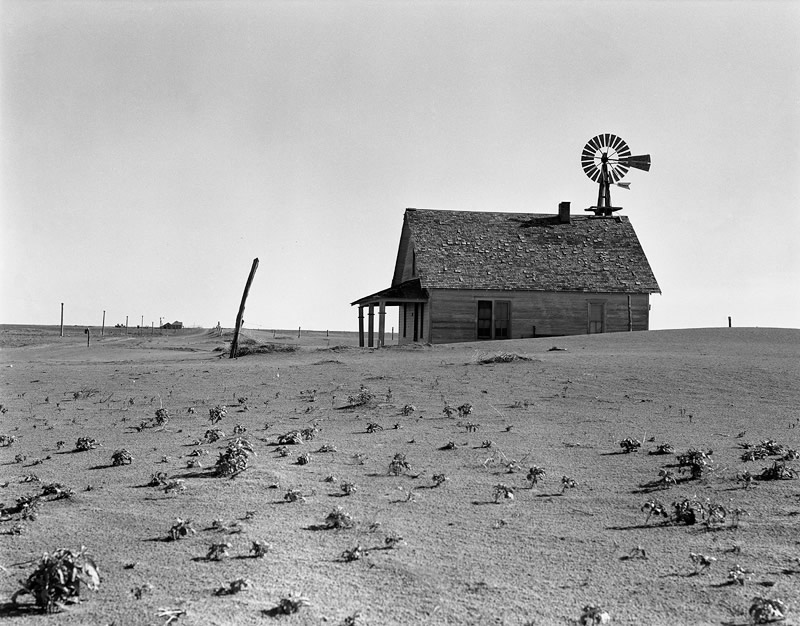 |
| In the Tribulation, agriculture will wither under a scorching sun.
Dorothea Lange, Abandoned farm north of Dalhart, TX. 1938.
|
At the end of the end days, during the Tribulation where all men living on the earth will be judged in wrath, there will be three sets of successively worsening judgments (or four sets, if the Seven Thunders of Revelation 10:1-4 are judgments).
There will first be the 7 Seal Judgments of Revelation 6, they open the Tribulation. Then the wrath of God is demonstrated through 7 Trumpet Judgments of Revelation 8-9. These are terrible judgments, but by God’s grace, some repent through them. After that there are the 7 Bowl Judgments. Revelation 15 opens with the 7 Bowl Judgments.
Then I saw another sign in heaven, great and amazing, seven angels with seven plagues, which are the last, for with them the wrath of God is finished. (Revelation 15:1).
These are the most terrible of all. They are so bad that no one is even allowed in the heavenly throne room sanctuary until they are concluded.
And one of the four living creatures gave to the seven angels seven golden bowls full of the wrath of God who lives forever and ever, 8and the sanctuary was filled with smoke from the glory of God and from his power, and no one could enter the sanctuary until the seven plagues of the seven angels were finished. (Revelation 16:7-8)
One of the Bowl judgments God pours on the people of the earth the plague of a hot sun. By this point in the Tribulation, no one is repenting. They know that God is sending His wrath onto the world, but they shake their fist at Him and refuse to repent. By this time, battle lines have been set in eternal stone. In Revelation 13 people either took the mark of the beast and thereby signaling their worship of satan, sealing their doom, (Revelation 14:9-10), or they refused the mark, thereby signaling their worship of the Lamb who lives forever, sealing most to their martyrdom.

The fourth angel poured out his bowl on the sun, and it was allowed to scorch people with fire. They were scorched by the fierce heat, and they cursed the name of God who had power over these plagues. They did not repent and give him glory. (Revelation 16:8-9).
God makes the sun hotter, so hot that men will be on fire if they are exposed to it. God is powerful and controls the sun!
Let us look to a happier time, the Millennial Kingdom. God’s Prophets had much to say about this period in earth’s history, also. The Kingdom will be set up on earth after the Tribulation is over, and the Old Testament saints and Tribulation saints have been resurrected. Those who refused the mark of the beast and lived will populate this kingdom, too. Because they are mortal, they’ll re-populate the earth. It is at this time the resurrected Old Testament saints whom Jesus promised land and an earthly kingdom with Him (the Lion of the Tribe of Judah, Messiah) on the throne, will have all their promises fulfilled. This is Israel’s gift.
In Isaiah 30:23-25 we read that during this time of the Millennium Kingdom,
And he will give rain for the seed with which you sow the ground, and bread, the produce of the ground, which will be rich and plenteous. In that day your livestock will graze in large pastures, 24and the oxen and the donkeys that work the ground will eat seasoned fodder, which has been winnowed with shovel and fork. 25And on every lofty mountain and every high hill there will be brooks running with water, in the day of the great slaughter, when the towers fall.
John MacArthur says of this time:
In the Messianic Kingdom of that future day, agriculture, cattle raising, food production, and water resources will prosper. The prophet predicted the redemption of nature. (cf. Rom 8:19-21)
In Isaiah 30:26 we read of further blessings:
Moreover, the light of the moon will be as the light of the sun, and the light of the sun will be sevenfold, as the light of seven days, in the day when the Lord binds up the brokenness of his people, and heals the wounds inflicted by his blow.
The light of the sun will be seven times hotter?
MacArthur again:
The benefits from the natural bodies of light will be much greater. Increase of the intensity of their light will work to people’s advantage, not to their detriment as in Revelation 16:8-9.
 |
| In the Millennial Kingdom, a gentle, bright sun seven times warmer will flourish the earth’s crops |
When we read that God is sovereign overall creation, He is sovereign. He created the sun. As the Potter, He can make it do what He wills. During the Tribulation, it will be a mechanism for judgment, scorching men, who curse it. In the Millennium, the sun will be a mechanism for prosperity, and men will bless their Creator for giving them plenteous sunshine, healthful, glowing, and beautiful.
We groan, and cannot wait for redemption of our mortal bodies into glorified vessels worthy of seeing our Holy God. The creation groans too. When the creation is redeemed, it will rejoice also.
For the creation was subjected to futility, not willingly, but because of him who subjected it, in hope that the creation itself will be set free from its bondage to corruption and obtain the freedom of the glory of the children of God. (Romans 8:20-21).
This is how the creation will be set free. The sun will shine upon peaceable kingdom, over a flourishing agriculture, making men and crops thrive. Our Creator is majestic in power and sovereign over creation. He is to be worshiped, loved, praised. Our Jesus who was with God at the creation and who sustains all creation and without whom nothing was made that was made, is our hope. He is the hope of all creation. Our eternal Hope, who reigns forever.
—————————————-
Further Reading
The Glorious Return of Jesus Christ, part 1
Devotion: Three reassuring Signs
He is God and He does have secrets.
“The secret things belong to the LORD our God, but the things that are revealed belong to us and to our children forever, that we may do all the words of this law.” (Deut 29:29.)
However, God also reveals things to us. Sometimes all at once, (creation) sometimes way before the time, (Daniel’s 70 weeks) and sometimes incrementally (Adam’s protoevangelium of the Messiah’s coming).
He is God and He does have secrets. Here are at least 4 things known only secretly to God (according to Gill’s Exposition of Deuteronomy 29:29)
1. Gill: particularly the times and seasons of their accomplishment, which he retains in his own power, Acts 1:6.
1a. Amos 3:7 says, “For the Lord GOD does nothing without revealing his secret to his servants the prophets.” So by this we know that He keeps His own counsel until the time He decides to reveal His plans to us.
2. Gill: “There are many secret things in nature, which cannot be found out and accounted for by men, which the Lord only knows;”
2a. As anyone who follows physics knows, the more that men search for the secret to the universe and believe they have found it, (quarks! neutrinos! Bosons!) the more they know that the secret to His creation is unknowable. God has revealed his creation to us.
Romans 1:20a says, “For his invisible attributes, namely, his eternal power and divine nature, have been clearly perceived, ever since the creation of the world, in the things that have been made.” So we can see His attributes revealed in creation but we cannot know fully the Mind that created it.
3. Gill: and there are many things in Providence, which are unsearchable, and past finding out by finite minds, especially the true causes and reasons of them;
3a. God will reveal Himself by making known His purposes and intentions for us if we diligently seek Him:
—But from there you will seek the Lord your God, and you will find Him if you seek Him with all your heart and with all your soul. When you are in distress, and all these things come upon you in the latter days, when you turn to the Lord your God and obey His voice. (Deuteronomy 4:29-30)
—And He has made from one blood every nation of men to dwell on all the face of the earth, and has determined their pre-appointed times and the boundaries of their dwellings, so that they should seek the Lord, in the hope that they might grope for Him and find Him, though He is not far from each one of us. (Acts 17:26-27)
He is a treasure and you have to seek, dig, find treasure. It does take some work on our behalf to open the secrets of the Bible He has revealed to us. Fortunately, He has sent a Helper to illuminate these to us when we do seek!
Alternately, Parables were open secrets designed to illuminate insights about God and His kingdom to those who have the mind of God and remain hidden in plain sight from those at enmity with Him. In addition, Job searched for a purpose to the things happening to him, but as Gill said, there are many things in Providence which are unsearchable. Yet, though His purpose for troubling Job was never revealed to Job, God revealed His purpose for Job’s trial to us.
4. Gill: and there are many things relating to God himself, which remain secret with him; But those things which are revealed to us are revealed forever.
4a. Amen!
Some thoughts about God, our precious Jesus who came to seek and save the lost, make Himself known to us, and to bring us to His abode when the (secret) time is ready. Here is praise for our knowable/unknowable God:

O Lord My God, You Are Very Great
Bless the Lord, O my soul! O Lord my God, you are very great! You are clothed with splendor and majesty, covering yourself with light as with a garment, stretching out the heavens like a tent. He lays the beams of his chambers on the waters; he makes the clouds his chariot; he rides on the wings of the wind; he makes his messengers winds, his ministers a flaming fire. (Psalm 104:1-4)
Updates at bottom. And still more updates at bottom.
Here is a kind of a part 2:
Fallen Pastors can still lead- here’s how
Billy Graham’s grandson steps down from Florida megachurch after admitting an affair
Billy Graham’s grandson Tullian Tchividjian has resigned from his pulpit at Coral Ridge Presbyterian, a high-profile church in south Florida, after admitting he had an affair. He released the following statement to The Washington Post, saying it was on behalf of him and his wife:
I resigned from my position at Coral Ridge Presbyterian Church today due to ongoing marital issues. As many of you know, I returned from a trip a few months back and discovered that my wife was having an affair. Heartbroken and devastated, I informed our church leadership and requested a sabbatical to focus exclusively on my marriage and family. As her affair continued, we separated. Sadly and embarrassingly, I subsequently sought comfort in a friend and developed an inappropriate relationship myself. Last week I was approached by our church leaders and they asked me about my own affair. I admitted to it and it was decided that the best course of action would be for me to resign. Both my wife and I are heartbroken over our actions and we ask you to pray for us and our family that God would give us the grace we need to weather this heart wrenching storm. We are amazingly grateful for the team of men and women who are committed to walking this difficult path with us. Please pray for the healing of deep wounds and we kindly ask that you respect our privacy.
 |
| source |
Tchividjian is pronounced Cha-vij-in. It’s Armenian. His mother is the oldest of Billy Graham’s children. Tchividjian is the nephew of Franklin Graham.
The first public news of this broke late last night. I was saddened and my spirit was in turmoil. I slept restlessly, awakening to read a rousing chorus of mainstream news article and many bloggers joining the chorus of wh-at?!
Monday Morning, Mrs Kim Tchividjian released a statement to the same newspaper, that indicated she has a different version of events than her husband’s.
“The statement reflected my husband’s opinions but not my own. Please respect the privacy of my family at this time, thank you. I do thank everyone for the outpouring of love for my family as well during this difficult time and we appreciate all the prayers and support we are receiving.”
I had wondered if the two of them wrote the initial statement sent to the Washington Post together, or if he had released it himself. I also wondered even if it was true, why the husband would not want to cover his wife and leave her behavior out if it in his own admission.
What can I, a quiet, non-seminary trained layperson in a rural part of a southern state contribute to the discussion? I’m really nobody, so not too much, but I’ll add a few thoughts. I was preparing to write about John MacArthur today, but this happening now will provide an even better bookend of the extolling I want to do regarding wise and solid pastors (best represented of living pastors in MacArthur). Then I’ll point you to some resources that I believe are better for shedding light on this dark situation.
First the personal. I have seen the effects of adultery in a marriage close-up. When two are married, especially under the Lord’s ordinance as Christians, they become one flesh. Adultery rips the one flesh apart, and it is painful. It hurts in a way that practically no other grief can hurt. Only spousal death is more painful (I imagine) but adultery is almost worse because it is not only a ripping apart, as death is, it’s a betrayal of monstrous proportions.
I can’t imagine the heartbreak in their family right now, and a double adultery is towering in its devastation. They have three children.
 |
| The Tchividjian family |
For pastors the temptation is even worse. It seems there are always available ladies fluttering around, ready to fill in any gaps, real or perceived, in a pastor’s marital situation. And pastors are only men, just men, under stress and overworked and having weighty responsibilities. I understand we are all human and I am glad we have a Savior who understands our human frailties. (Hebrews 4:15).
However the danger of celebrity lifestyles is in view here. A pastor’s primary responsibility is to his flock. Period. This is a non-negotiable. Tied for that primary responsibility/calling is his responsibility to his family. Pastors who are “rising stars,” “prolific authors”, “sought after speakers” mix unbiblical responsibilities with biblical mandates and soon their perspective shifts from Jesus to self. The ones who start extra-biblical parachurches, movements, global outreaches. Tchividjian started the movement “LIBERATE” and his stated reason was “our big goal being to reform Christianity on a global scale” Is that a pastor’s job? To take his eyes of his own flock to reform Christianity? Even the great reformer Martin Luther didn’t have reformation as a goal. He simply asked 95 questions, he didn’t form a focus group, hire website designers, install contributors, then post the 95 questions on the Door at Wittenberg. It was a Spirit-led, organic movement. But today’s celebrity pastors sure do enjoy the book tours, conferences, speaking engagements.
I’m not saying a pastor should never write a book, nor am I saying a pastor should never fill another pulpit or speak at a conference. I’m speaking of the lifestyle and a slow but poisonous gravitation toward a shift in perspective when one shifts their eyes from their primary calling. Here is Joe Thorn on Dethroning Celebrity Pastors.
The “celebrity pastor” is now a thing. Maybe it’s always been a thing (1 Cor. 1:10-17), but over the past few years it has become a source of concern and consternation for many. On the one hand I do see a problem, and on the other hand I can’t help but feel that some speak against popular preachers out of a sense of jealousy. I do not think that a pastor whose “platform” is large, influence is broad, and following is numerous is a celebrity pastor. At least, not in a bad way. The real problem is leadership that loses sight of the glory of Christ and focuses on the glory of man. Or, at least one man.
But Celebrity Pastors do not simply build themselves. They are built with the help of fans. It’s not wrong or idolatrous to get a photo with a person you admire. Nor is it dangerous to love the preaching or teaching of a particular leader. But at some point admiration turns into allegiance, and allegiance gives birth to adoration, and adoration, when it is full grown, produces idolatry. I am not sure exactly when the line is crossed–maybe when we start asking well-known pastors to sign our Bibles. Maybe. But the line is well behind us when a leader’s word is more valuable to us than God’s word and when they become our authority.
 |
| Source |
It’s the losing sight of the glory of God that is the downfall. Pastors who overextend beyond the pulpit will fall. We have seen this borne out time and again. Tchividjian is the fourth megachurch pastor in Florida alone just this year alone, to resign in sin. Then there’s CJ Mahaney, Mark Driscoll…the list goes on. In 2011 John Piper took an 8-month leave of absence from all his duties as pastor and media celebrity expressly to re-evaluate his life. He’d drifted, you see, from the primary goal. He wrote in part that his main goals were four-fold:
to enter this eight-month season of detachment from public exposure and public productivity with a view to serious biblical examination, assessment, nurture, and growth in four areas: 1) our own individual persons, both physically and spiritually; 2) our marriage; 3) our relationship with our children and their families; 4) our pattern of ministry on returning to Bethlehem.
He had begun to recognize the poisonous cup that fame and notoriety brings,
You could view this as a kind of fasting from public ministry. One of the goals in this kind of fasting is to discern levels of addiction. Or, as Paul Tripp or Tim Keller might say, levels of idolatry. The reality check is: What will happen in my soul and in my marriage when, to use the phrase of one precious brother on staff, there will be no ‘prideful sipping from the poisonous cup of international fame and notoriety’?
And that poisonous cup led to a wedge between he and his wife. Families need tending.
But on the other hand, I see several species of pride in my soul that, while they may not rise to the level of disqualifying me for ministry, grieve me, and have taken a toll on my relationship with Noël and others who are dear to me.
It remains to be seen whether his time away strengthened him or allowed the poison to continue but in a slower fashion when still riding the roller coaster of fame and notoriety.
Gross sin among Christian leaders is a signal that something is seriously wrong with the church.
~John MacArthur
Yet pastors who remain true to their primary calling will not fall, we have seen this again and again. There are pastors who lead megachurches, celebrity pastors John MacArthur, fifty years and not a hint of scandal. S. Lewis Johnson, David Martyn Lloyd-Jones, Charles Spurgeon, all long lasting pastors who pastored their churches steadily without scandal. Each was just as busy as Tchividjian. Each were or are famous in their own right. MacArthur is busy, he started a college and seminary, has a global media outreach, a daily radio show, preaches several times per week in church, is a prolific author, and attends conferences several times per year. Not to mention the appearance on television (rarer nowadays). Spurgeon was busy. He started a college, and an orphanage, preached 10 times per week, read 6 books per week, kept up with correspondence and preached to thousands at a time. He worked 18 hour days. Was his the World’s First Megachurch?
As a case in point, Spurgeon preached regularly, often 10 times in a week to audiences of 6,000 and more. He once addressed an audience of 23,654 (without aid of amplification).
Actually, the world’s first megachurch was Peter addressing the thousands at Pentecost and the weeks and months after. And they were celebrities as 1 Corinthians 1:12 shows us. So what makes the difference between busy, famous pastors who fall and those who do not?
Ministry Mag: Why Pastors Fall into Sin
the pattern in their relationship that preceded the fall was similar. In earlier years, they had a call of God upon their lives, a passion in their marriage and zeal for the ministry. But somewhere along the way, misplaced priorities led to a gradual decline in intimacy, and ministry began to take precedence over relationship.
Ed Stetzer wrote in Christianity Today last year, When Pastors Fall: Why Full and Public Repentance Matters
Pastor scandals happen. Needless to say, I don’t say that with any enthusiasm. In fact, it is greatly discouraging to me, but it’s true nonetheless. Furthermore, this is not just a recent phenomenon, though the evangelical world has been filled with reports over the last few months. It’s just disheartening. … What’s more, unless we pastors engage in public repentance, our “bold” preaching about sin and grace often appears to be little more than window dressing. In other words, what we believe about God, sin and grace is proven true when we treat our own sin as seriously as we say others should. Too many leaders are not repenting in accordance to scripture and too many churches don’t know how to work through repentance to restoration. Both matter– and scripture provides a path for both.
It remains to be seen of Tchividjian professes a full and complete repentance, and submits himself to a long process of counseling and restoration at his church under the Presbytery. Given that he apparently hid his adultery from Paul Tripp who had counseled him a few days before and only confessed it when directly asked…doesn’t seem to give rise to immediate optimism. His use of the passive tense in his statement “it was decided” he should resign seems to indicate he has a less than full and thorough grasp of his biblical responsibilities of the situation. Again, time will tell.
 |
| Coral Ridge church, Ft. Lauderdale |
Ultimately the loss of a pastor and the destruction of a family is something one heavily grieves over. More grievous is the blight on the name of Jesus. Pastors are due double honor, rightly so. (1 Timothy 5:17). They are to be respected for their calling, their office, and their work. However their accountability is doubly high (James 3:1) and therefore grief associated with them when they fall below reproach is also worthy of double grief.
It brings such reproach onto the faith and the name of Jesus! Just a few of the heathens’ comments:
I’m not reveling in this. As I said, I had a restless night with little sleep. I thought about the Tchividjian children. However, there needs to be a perspective of the larger reality. Pastors sliding into sin is an age-old problem, because sin is an age-old problem. However, the problem of pastors falling into sin, particularly sexual sin, is by this point in today’s world endemic in our faith. It is practically a given, and it should not be.
Secondly, too many Christians are biblically illiterate. When a pastor scandal happens they immediately call for a restoration- not to fellowship, but to their ministry, and worse, they believe this is helpful to the cause of Christ. It’s not.
Here is John MacArthur on fallen pastors. This was written some time ago and is not a response to the Tchividjian situation.
Should Fallen Pastors Be Restored?
By John MacArthur, September 28, 2009
Excerpts
It has always saddened me over the years as I’ve watched church leaders bring a reproach on the church of Jesus Christ. What’s shocking to me is how frequently Christian leaders sin grossly, then step back into leadership almost as soon as the publicity dies away.
Some time ago I received a CD that disturbed me greatly. It was a recording of the recommissioning service of a pastor who had made national news by confessing to an adulterous affair. After little more than a year of “counseling and rehabilitation,” this man was returning to public ministry with his church’s blessing.
That is happening everywhere. Restoration teams–equipped with manuals to instruct the church on how to reinstate their fallen pastor–wait like tow-truck drivers on the side of the highway, anticipating the next leadership “accident”. Our church has received inquiries wondering if we have written guidelines or a workbook to help restore fallen pastors to leadership. Many no doubt expect that a church the size of ours would have a systematic rehabilitation program for sinning leaders.
Gross sin among Christian leaders is a signal that something is seriously wrong with the church. …
What about forgiveness? Shouldn’t we be eager to restore our fallen brethren? To fellowship, yes. But not to leadership. It is not an act of love to return a disqualified man to public ministry; it is an act of disobedience.
What should you do in the current crisis? Pray for your church’s leaders. Keep them accountable. Encourage them. Let them know you are following their godly example. Understand that they are not perfect, but continue nonetheless to call them to the highest level of godliness and purity. The church must have leaders who are genuinely above reproach. Anything less is an abomination.
Please pray for your pastor. Pray for him to stay on the narrow path and energized by a renewing of his mind daily in the word. The sing of the last days is an increase in wickedness, particularly inside the church. (Mt 24:12, 1 Peter 4:17, 2 Timothy 3:1-5). Stay in the Word yourself, especially if you are in leadership.
But I discipline my body and keep it under control, lest after preaching to others I myself should be disqualified. (1 Cor 9:27)
This is the takeaway. As I read in one essay, satan works overtime in the bedroom of the mind, and pastors and leaders are especially vulnerable. It isn’t a celebrity problem. It isn’t a megachurch problem. It is straying from the primary goal, to stay within the narrow confines of a path that is only as wide as the letters J-E-S-U-S. It’s not about global reformation, it is not about publish or perish, It is not about getting a prime speaking deal. It is not, if you are a pastor of a small church, getting a bigger building, initializing another program. It is an issue of priorities. Jesus-family-flock. The pastors of a church of any size who maintained a healthy prayer and bible life stayed. The ones who didn’t, strayed.
Yet, as a layperson I am wearied by these successive pastor scandals. Come soon, Lord Jesus.
——————————–
Further Reading
Updated to add several other essays in reaction tot he scandal, plus two of MacArthur’s blogs on hypergrace, published prior to the scandal becoming public.
This esay addresses what I believe are the three elephants in the room, Tullian’s blame-shifting, his sinful decision on how he addressed his wife’s alleged adultery, and his free-to-fail grace stance,
An Open Letter to Tullian Tchividjian
By Marshal Segal, When Leaders Fall, All Are Punished, with this excellent quote, “Heaven is not thrown into crisis with a scandal, however shocking or hard the fall.”
Chris Rosebrough (Pirate Christian) over-wrought and emotional with some excessive hyperbole, (“I just witnessed one of the most elaborate satanic schemes pulled off in modern history.” Nooo, that would be the elaborate scheme of the Catholic Church), but important for the fact that Pastor Chris was invited to Coral Ridge to counsel in the days prior to the scandal breaking and thus truly has a unique perspective:
My Perspective on Tullian’s Sin
In this one from The Cripplegate, Jordan Standridge offers his view of Ten Lessons from the Tullian Tchividjian Confession. It is very good. I also enjoyed one of the commenters, Greg Pickle, who offered several wise insights, including this about the conscience-killing effects of hypergrace, and the importance of public rebuke. His entire comment is excellent and should be read in its entirety, as well as the essay itself.
Public rebuke makes people *fearful* of sinning (1 Tim. 5:20). That’s where this confession should lead, whether he is rebuked or not. Paul had no problem naming names when showing Timothy (and the Ephesian church) the deadly fruit of not fighting the good fight of faith and of rejecting a good conscience (1 Tim. 1:18-20).
When he has been happy to sell his books and spread his articles to people in the churches I have shepherded, I have no problem pointing out the devastating fruit of this kind of theology. I’m not going to gloat, but rather pray for him and those involved, while yet saying: “This is exactly where this theology leads.”
Regeneration & Hypergrace (MacArthur on Tchividjian and Coral Ridge are ground zero for Hypergrace Theology)
Abusing Grace (MacArthur on Tchividjian on overemphasizing the role of grace)
Tullian Tchividjian’s Sin and Resignation Attracts Prayers and Piranhas
On Living In Stained Glass Houses
Tullian Tchividjian stripped of ministerial credentials
Tullian Tchividjian files for divorce
There was little public information available about the divorce filing. Under Florida law, one party must establish that the marriage is “irretrievably broken” in order for the union to be dissolved. Tullian and his wife, Kim, married in 1994 and have three children.
And yet, God hates divorce and under most circumstances does not allow it. Grounds for divorce in God’s Law
It’s Father’s Day. I live down south. Fathers are big around here. There are many Facebook posts going up which honor Daddy and Husband. I like to see those, even when they’re not during Father’s Day. I love to see photos of happy families, children loving their Dad.
Respect and honor to the father is commanded in the Fifth Commandment. It is the first Commandment that comes with a promise, too. In listening to RC Sproul yesterday on RefNet radio, he explained The Fifth Commandment by saying the first four commandments define man’s relationship with God. Obeying the first four teaches us the magnitude of His power and name so that we can properly worship Him. The fifth commandment is the first of those that regulate man’s relationship with other human beings.
“Honor your father and mother, that your days may be long upon the land which the LORD your God is giving you” (Exodus 20:12; Deuteronomy 5:16)
I’m glad for those children who have or have had great fathers, and for the wives who honor their husband as the father of the family. But when of the people who have not had a great dad? Who had one who was a divorcer, philanderer, adulterer, fornicator? Who was not saved by grace and sinned mightily with anger and violence within the family? One who was mean with words and chose to be aloof from the children, considering them a drag on his high life? Who absolutely and with finality repudiated all his children? Who was a vicious alcoholic? Abuser?
Here is Ligonier with an excerpt from a short essay about the fifth commandment:
Intractable lovers of self, we find honoring others too difficult—actually, we find it impossible. So we cast about for a way out. Many have good reasons. An anguished young man once asked me, “How am I supposed to honor my father after what he’s done to my mother?” It was a good question. I knew what this father had done. He’d run off with another woman, leaving his pregnant wife to pick up the pieces of the domestic disaster created by his profoundly dishonorable behavior. Nevertheless, God tells this young man to honor his father.
The Pharisees thought they had landed on the ultimate exception clause to honoring parents. They had cooked up a tradition that said when they declared their resources given to God, they were off the hook on the fifth commandment. Jesus exposed the fraud: “So for the sake of your tradition you have made void the word of God. You hypocrites! Well did Isaiah prophesy of you, when he said: ‘This people honors me with their lips, but their heart is far from me’ ” (Matt. 15:6–8).
Only hearts that have been brought near to God in Christ can truly honor mother and father, even parents who have acted dishonorably. Just as “children obey your parents” does not include obeying their sinful commands, so “honor your father” does not include honoring his dishonorable behavior.
Clearly, if Peter can urge first-century believers to honor everyone, including Emperor Nero (1 Peter 2:17), then the command to honor parents isn’t made void by having a dishonorable parent, any more than the command to love our neighbor is void when we have a neighbor who lobs beer cans over our fence. God’s commands still apply in a broken world of imperfect neighbors and dishonorable parents; they were gifted to us by our gracious heavenly Father for just such a world.
Yes, but how? Something that was helpful in the Sproul sermon The Fifth Commandment was this anecdote-
“At the heart of this idea was the dimension of respect.” …
Then Sproul explained when he was in Pittsburgh he worked with a man in labor mediation in the steel industry. Sproul was at one point in a room with people from all different political and spiritual stripes. He and this man had developed a labor-management program based on three principles: love, dignity, and respect. Sproul asked one question to the assembled people in the room:
“How many of you want to be treated with dignity?” And every single person would raise their hand. I could not get a crowd that big to have complete, unified agreement on any other topic, I don’t think. Some were Democrats, some were Republicans, some were Pirates fans, others weren’t. But what they all wanted was to be treated with dignity. And to be treated with respect. Nobody likes to be insulted. Nobody likes to be demeaned.
What we’re talking about here is honor. Because to honor someone is to be respectful of them, to show respect to them. Now this respect in the Decalogue begins with how children are to behave toward their parents. Honor your father and your mother. That’s where the whole concept begins with showing respect to human beings, and respect toward Divinely constituted levels of authority. It is an acknowledgement that God has delegated to parents a certain authority, by which the home is governed.
Then Sproul goes on for a while, then returns to this concept: adult children.
After a child is grown and is not expected to offer slavish obedience to parents, and no longer lives under their roof, at what point in our lives does the mandate to honor our father and mother end? Never. If you look at Israel in the ways the children showed respect to the matriarch or patriarch, whenever the father or head of the house walked int he room, it was the custom of all the children, even the adult children, to rise. They stand in the presence of the father or of the mother, to show respect and honor.
Sproul asks the question, what if my father is not honorable?
God doesn’t say ‘honor your father and mother only when they’re honorable. Theirs is a position. They hold an office. And even if they are unworthy of that office, the office itself is still to be honored.
If your father was a dishonorable person, abusive even, when you think of him, don’t think of the person. Think of the office of father. Honor the office. If it helps, if it is too hard to honor the father who sinned so greatly in adultery, alcoholism, abuse, rejection or abandonment, whatever it is, because you certainly don’t honor sins, but if it helps, honor the office. That way you will be honoring your Father in Heaven, God.

Charles Spurgeon’s Morning Devotional for June 20
“For, lo, I will command, and I will sift the house of Israel among all nations, like as corn is sifted in a sieve, yet shall not the least grain fall upon the earth.”
— Amos 9:9
Every sifting comes by divine command and permission. Satan must ask leave before he can lay a finger upon Job. Nay, more, in some sense our siftings are directly the work of heaven, for the text says, “I will sift the house of Israel.” Satan, like a drudge, may hold the sieve, hoping to destroy the corn; but the overruling hand of the Master is accomplishing the purity of the grain by the very process which the enemy intended to be destructive. Precious, but much sifted corn of the Lord’s floor, be comforted by the blessed fact that the Lord directeth both flail and sieve to his own glory, and to thine eternal profit.
Spurgeon, C. H. (2006). Morning and evening: Daily readings (Complete and unabridged; New modern edition.). Peabody, MA: Hendrickson Publishers.
LOL, “Like a drudge”. That’s all satan can do before God, do with whatever crumb God allows him to have. Always remember the great truth in this devotional: “the Lord directeth both flail and sieve to his own glory, and to thine eternal profit.”
I thought this devotional was comforting in its word-picture and its implicit explanation of Providence. If you are being sifted right now, may this encourage you.

 |
| EPrata photo |
The quote is a little longer than the video. Read the quote then watch the clip. It’s only a few seconds.
Give yourself to the Church. You that are members of the Church have not found it perfect and I hope that you feel almost glad that you have not. If I had never joined a Church till I had found one that was perfect, I would never have joined one at all!
And the moment I did join it, if I had found one, I should have spoiled it, for it would not have been a perfect Church after I had become a member of it. Still, imperfect as it is, it is the dearest place on earth to us…
All who have first given themselves to the Lord, should, as speedily as possible, also give themselves to the Lord’s people. How else is there to be a Church on the earth? If it is right for anyone to refrain from membership in the Church, it is right for everyone, and then the testimony for God would be lost to the world!
As I have already said, the Church is faulty, but that is no excuse for your not joining it, if you are the Lord’s. Nor need your own faults keep you back, for the Church is not an institution for perfect people, but a sanctuary for sinners saved by Grace, who, though they are saved, are still sinners and need all the help they can derive from the sympathy and guidance of their fellow Believers.
The Church is the nursery for God’s weak children where they are nourished and grow strong. It is the fold for Christ’s sheep—the home for Christ’s family.”
Charles Spurgeon, “The Best Donation,” (No. 2234) an exposition of 2 Corinthians 8:5 delivered on April 5, 1891 at the Metropolitan Tabernacle in London, England.
————————–
Further reading
Essay: Pew-Hoppers: How to Shepherd Church Shoppers – Part 1
Essay: Pew-Hoppers: How to Shepherd Church Shoppers – Part 2
Last week I wrote Should We Love False Teachers? in which I took a look at the aforementioned question and put forth an answer. (Answer: no).
 |
| O you foolish Galatians, who has bewitched you!? |
I’m reading the book of Galatians this month, and the associated commentaries. The book I finished before this was 1 Corinthians, all about that rowdy crowd of raucous Christians Paul had to tame by reminding them that Christian liberty is not license to sin. The book of Galatians is a book about defending salvation by grace and not of works. In it, Paul refutes the Judaizers, a gang of false teachers who upset the Galatians into thinking they had to be circumcised and do other Mosaic law keeping in order to be saved. Paul had to remind the Galatians of their freedom in Christ is given by grace and not of works.
When you start reading the book of Galatians, one thing immediately strands out. Paul cut to the chase. Paul is usually blunt, but in no other book, however, did Paul fail at first to give a loving greeting full of thanks toward the recipients. He always found something to commend, even in the rowdy Corinthians.
Not so with the Galatians.
He says, “Hi, it’s me, Paul, and WHAT ARE YOU THINKING?!?!” to paraphrase.
Wait, weren’t the Corinthians worse? Why was Paul being so tough on the Galatians? The answer is, because sinful doctrine is worse than sinful behavior. Here is John MacArthur on the Galatian situation from his commentary.
After exposing the dangers of the false doctrines that threatened the Galatians, Paul exposes the wicked character of the men who espoused the doctrines. Like his Lord, Paul had great patience with those who were caught in even the deepest moral sin. As much as they condemned the sin itself and warned against its consequences, their love for the sinner was always evident. For the oft-divorced woman at Jacob’s well and the woman caught in the act of adultery, Jesus’ rebukes were gentle, and His offers of help were kind and encouraging (John 4:7 26; 8:3-11). And even before the hated and larcenous Zaccheus repented and came to saving faith, Jesus was not ashamed to eat with him (Luke 19:1-10).
But for the self-righteous scribes and Pharisees—whose outward lives were ceremonially impeccable, but who refused to recognize their spiritual need and Who continually corrupted the people’s minds with their legalistic perversion of true Judaism—Jesus had only condemnation. The scribes and Pharisees were the primary teachers and interpreters of Scripture. When a man was initiated into the scribal office, he was given a key that symbolized his qualification to teach. Yet Jesus called them hypocrites, deceivers, extortioners, misguided proselytizes, blind guides, fools, inwardly corrupt and foul, partners with those who killed the prophets and murderers themselves, serpents and vipers, and future persecutors of His church (Matt. 23:13-36). Their worst evil, however, was one that Isaiah had prophesied of them more than six hundred years earlier: “In vain do they worship Me, leaching as doctrines the precepts Of men” (Matt. 15:9; cf. Isa. 29:13).
Paul, too, was longsuffering with those who were caught in sin, as his letters to the immature, factious, and immoral believers at Corinth attest. But also like the Lord, the apostle’s most scathing denunciations were reserved for those who pervert God’s truth and lead others into falsehood.
 |
| EPrata photo |
Paul extols the Law for its place to remind us of mercy. However, misuse of the Law condemns! THAT is the horror of false teachers! Wrong behavior is external and can be corrected, a poisoned heart full of false notions about Jesus is condemning!
Charles Spurgeon said, in his sermon on Galatians 3:13, “The Curse Removed“,
O ye who trust in the law for your salvation! ye have erred from the faith; ye do not understand God’s designs; ye are ignorant of every one of God’s truths. The law was given by Moses to make men feel themselves condemned, but never to save them; its very intention was to “conclude us all in unbelief, and to condemn us all, that he might have mercy upon all.” It was intended by its thunders to crush every hope of self-righteousness, by its lightnings to scathe and demolish every tower of our own works, that we might be brought humbly and simply to accept a finished salvation through the one mighty Mediator
Anyone who believes – or teaches – differently is ignorant:
If anyone teaches a different doctrine and does not agree with the sound words of our Lord Jesus Christ and the teaching that accords with godliness, 4 he is puffed up with conceit and understands nothing. (1 Timothy 6:3-4)

If you watched Monty Python’s Holy Grail movie then you’ll remember the scenes of the plague where the corpse gatherer shouts “Bring out your dead!” (I watched Monty Python in the 70s way before I was saved, don’t judge me).
The London plague of 1665 is synopsized in the UK National Archives this way:
This was the worst outbreak of plague in England since the black death of 1348. London lost roughly 15% of its population. While 68,596 deaths were recorded in the city, the true number was probably over 100,000. Other parts of the country also suffered.
The earliest cases of disease occurred in the spring of 1665 in a parish outside the city walls called St Giles-in-the-Fields. The death rate began to rise during the hot summer months and peaked in September when 7,165 Londoners died in one week.
This artwork depicts the general attitude during the height of the plague.
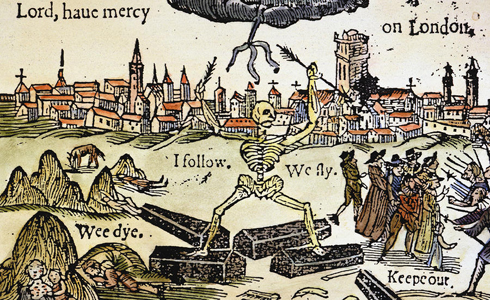
The plague was nothing, nothing, compared to the upcoming Tribulation. Let’s look at what God promises for unbelievers left behind
Current world population (estimate) – 7,321,593,981. That’s 7 billion with a b.
Revelation 6:7-8 says,
When he opened the fourth seal, I heard the voice of the fourth living creature say, “Come!” And I looked, and behold, a pale horse! And its rider’s name was Death, and Hades followed him. And they were given authority over a fourth of the earth, to kill with sword and with famine and with pestilence and by wild beasts of the earth.
So in rapid order, 25% of the earth’s people will die. A quarter of 7.3 billion people is 1,830,398,495 dead. That’s 1.8 Billion dead. Remember the 2004 Banda Aceh Christmas day tsunami that killed 250,000 people? Bodies washing up everywhere? Multiply that by tens of thousands and millions and you have some idea of the deaths that will take place when the fourth seal is opened. It will happen fast, too. The entire Tribulation will only be as long as 7 years, and the Seal judgments are opened at the outset, so pretty quickly bodies will pile up in the streets.
So after a fourth of the population dies, we have 5,491,195,486 remaining on earth. That’s 5.4 Billion people.
Revelation 9:18 says that another third will die quickly also, this time in the Trumpet Judgment. “By these three plagues a third of mankind was killed, by the fire and smoke and sulfur coming out of their mouths.”
This means that a third of 5.4 billion people will die. That’s another 1,812,094,510 billion dead. Billion with a B.
By now there are 3,679,100,976 people left. Of course there area great many fewer because countless numbers die in the wars, die or are killed due to violence because of no restraint on sin, and secondary causes like fires from unattended gas lines or cholera or starvation. So let’s estimate another billion have died from all those causes. That leaves 2.6 billion people and that is only halfway through the Tribulation. We have gone from 7.3 billion people down to 2 billion- or less.
I suspect the death from sin will be much higher than we even can comprehend. The Holy Spirit will not be restraining sin at all. All men will be able to be as bad as they can be, moral depravity will be at highest levels ever. People will kill with impunity, for no reason, just to see you die. They will die from drugs and alcohol other bodily excesses, illness, starvation, and likely suicides. We know that the world will be used to looking at death with no problem, because by the time the Two Witnesses are killed their bodies are allowed to putrefy in the street for three and a half days while the entire world looks at them and dances in joy over their death. (Revelation 11:9-10)
3,642,493,005 or half the current population will for a fact die. All those bodies laying around is unimaginable. Here is one graphic that shows 1 Billion pennies. This is only 1 billion, remember, and they are pennies, very small, not human bodies.
 |
| Source |
Jesus said that if he did not come back, ALL FLESH would die. (Matthew 24:22). When you try to imagine the numbers of corpses it become a horror, unimaginable and hopeless. Burials will not keep up. Every zombie/apocalypse/plague/outbreak/dystopian movie you ever watched won’t even come close. The Left Behind movies were sanitized like meat under cellophane compared to the slaughterhouse the meat came from. The overriding feature of the Tribulation will be…blood.
The first angel blew his trumpet, and there followed hail and fire, mixed with blood, and these were thrown upon the earth. And a third of the earth was burned up, and a third of the trees were burned up, and all green grass was burned up. (Revelation 8:7)
And the winepress was trodden outside the city, and blood flowed from the winepress, as high as a horse’s bridle, for 1,600 stadia. (Revelation 14:20)
When the Lamb broke the fifth seal, I saw underneath the altar the souls of those who had been slain because of the word of God, and because of the testimony which they had maintained; and they cried out with a loud voice, saying, “How long, O Lord, holy and true, will You refrain from judging and avenging our blood on those who dwell on the earth?” (Revelation 6:9-10)
The second angel poured out his bowl into the sea, and it became like the blood of a corpse, and every living thing died that was in the sea. (Revelation 16:3)
And I saw the woman, drunk with the blood of the saints, the blood of the martyrs of Jesus. When I saw her, I marveled greatly. (Revelation 17:6)
I saw thrones on which were seated those who had been given authority to judge. And I saw the souls of those who had been beheaded because of their testimony about Jesus and because of the word of God. (Revelation 20:4)
People say that the Bible is a tale of two cities, Jerusalem and Babylon. We could say without stretching it that the Age of Grace is about the blood of Jesus- Holy blood. And the Tribulation is about the blood of sinners- Judgment blood.
So when I hear someone say “I’m a pantheist, it’ll all pan out in the end,” I know that person has no conception of the prophetic plan of God. They have no care for the billions of people who will die like animals under God’s judgment. The deaths, the stench of death, the desensitization regarding death, it all will be on a scale the mind will not be able to comprehend.
Yet each one of those deaths represent a soul, made in the image of God. (Genesis 1:27)
Truly no man can ransom another,
or give to God the price of his life,
for the ransom of their life is costly
and can never suffice,
that he should live on forever
and never see the pit. (Psalm 49:7-9)
No person, regardless of his means, is able to escape death; it is inevitable. (Hebrews 9:27) This passage anticipates the second death of hell, (cf. Rev. 20-11:15), except those who by faith have repented of their sin and embraced the only adequate ransom, the one paid by the Lord Jesus Christ by His death on the cross. (cf. Matthew 20:28, 1 Peter 1:18-19). ~John MacArthur
Knowing we live in the Age of Grace and were saved in it should give us knee-weakening, heart stopping gratitude to Jesus. And knowing what is ahead for the world and its people should give us knee-weakening, heart stopping fear of God and His mighty power and Holy wrath. He is coming soon.
Be ready.
Live like you’re ready.
Witness like it’s your last day on earth, because it’s could be- for you or for that person.
One of my favorite attributes of God is His sovereignty. One of my favorite doctrines is the Doctrine of Providence. And one of my favorite themes which neatly expresses them is the phrase, “In the fullness of time…” Here are just a few New Testament examples showing God in charge of all things, including events He wants to occur at a certain time.
Galatians 4:4, “But when the fullness of time had come, God sent forth his Son, born of woman, born under the law,”
Mark 1:15, “The time has come,” he said. “The kingdom of God has come near. Repent and believe the good news!“
Romans 5:6, You see, at just the right time, when we were still powerless, Christ died for the ungodly.
1 Timothy 2:6, who gave himself as a ransom for all people. This has now been witnessed to at the proper time.
Let’s go back to Galatians 4:4, the fulness of time. In the John MacArthur Commentary on Galatians, we read,
The fulness of time refers to the period of preparation in God’s sovereign timetable of redemption. When the Law had fully accomplished its purpose of showing man his utter sinfulness and inability to live up to God’s perfect standard of righteousness, God ushered in a new era of redemption. When He sent forth His son, He provided the righteousness for man that man could not provide for himself.
On a spiritual level, we can intuitively understand this is what is meant by the fulness of time, even if our lesser scholarly minds don’t articulate it as well as Dr MacArthur. But in Providential terms, widening our look at the sweep and scope of all redemptive history, the phrase “the fulness of time” takes on even greater and deeper significant implications regarding the sovereignty of God and His divine Providential outworking of all things to His glory. MacArthur again,
When Jesus was born, everything was right for the coming of the Messiah. First of all, the time was right religiously. During the Babylonian captivity, Israel once and for all forsook the idolatry into which she had often fallen. Despite their many other sins and failures, including national rejection of their own Messiah, no significant number of Jews has ever again turned to idolatry.
Also during the Exile, Jews developed synagogues, which they used as places of worship, as schools, and as courts. In addition to that, they at last had the completed Old Testament, assembled by Ezra and others after the return from Babylon. Those features facilitated the proclaiming of the Messiah’s gospel among the people of Israel.
Second, the time was right culturally. Christians who propagated the gospel during the first several centuries had a common language with those to whom they witnessed and with whom they worshiped. Alexander the Great had thoroughly established Greek culture and language throughout the known world, and these continued their dominating influence long after Rome succeeded Greece as world ruler.
Third, the time was right politically. Rome had instituted the pax Romana (Roman peace), which provided economic and political stability. The apostles and other early preachers and teachers cold travel freely and safely throughout the empire and do so on the magnificent system of roads built by the Romans.
Each of those factors was in some unique way a key to the spread of the gospel. God’s timing was perfect.
It is such a comfort to understand everything is in God’s hands.
I have traveled extensively in Italy, including Rome. I’ve rented a car and over several visits, I’ve driven all up and down the peninsula, from Milan and Lake Como to Rome to the Adriatic to France. North, south, north, east, and west. You’ve heard the adage, “All roads lead to Rome”? They really do.
The Miliarium Aureum (golden milestone) was a monument, probably of gilded bronze, erected by the Emperor Caesar Augustus near the temple of Saturn in the central Forum of Ancient Rome. All roads were considered to begin from this monument and all distances in the Roman Empire were measured relative to that point. On it were perhaps listed all the major cities in the empire and distances to them. According to Schaaf, the phrase “all roads lead to Rome” is a reference to the Milliarium Aureum, as the specific point to which all roads were said to lead. Today, the base of the milestone might still exist in the Roman Forum. (Wikipedia)
The Umbilicus Urbis Romae —”Navel of the City of Rome”—was the symbolic centre of the city from which, and to which, all distances in Ancient Rome were measured. It was situated in the Roman Forum where its remnants can still be seen. (Wikipedia)
I’ve been to the Forum and seen the marble mile markers, strolled on the Via Appia, seen the hardiness of the roads, the ancient cobblestones still there, still level, still providing passage for all manner of vehicular and pedestrian traffic. I’ve driven down the smallest of roads on the tallest of Apennines and come to a crossroad and there will be a sign. Rome, that way.
 |
| All roads lead to Rome. EPrata photo |
I can just imagine what a delight it was for Christians moving between cities and between regions to walk or ride a horse or donkey bearing the Good News from town to town. It is a delight today, back then it was a marvel. Yet those Roman roads under the Roman peace allowed for a fast dispersal of the Good News, the tidings of a Risen Christ and salvation for sinners.
And the note about Alexander the Great, and his empire and the Greek language? We do not for a moment believe that was an accident, do we? We know for a fact that the Greek empire was foretold 600 years before Christ came, as we read in Daniel 2 about King Nebuchadnezzar’s dream of the statue of succeeding empires. The Greek kingdom was foretold as the second after the King’s own empire of Babylonians and after the empire of Medes and Persians. The Roster of empires goes: Babylonian, Media-Persia, Greek, Roman, Revived Roman, or Antichrist’s Empire.
Do we believe that God looked down and said, “Oh good, Alexander is instituting Greek everywhere, that will be sooo helpful when my servants spread the Good News.” Of course not! God is in control of history, because He writes it. He determines the times, and He providentially organizes when the time is right and full for the next part of His plan to come to fruition.
Understanding God’s sovereignty, His Divine Providence, and His timing encourages us. Because, the world today could otherwise be very unsettling and to unbiblical eyes, even look chaotic.
 |
| Young boy lured to gay lifestyle |
 |
| A major advertisement, where Lesbians enjoy Chobani yogurt after perverted sex |
 |
| Dangerous killers on the loose could “literally be anywhere”, elude capture |
 |
| Police Officer (representing civil authority) shot dead in clearly marked patrol car (New Orleans) |
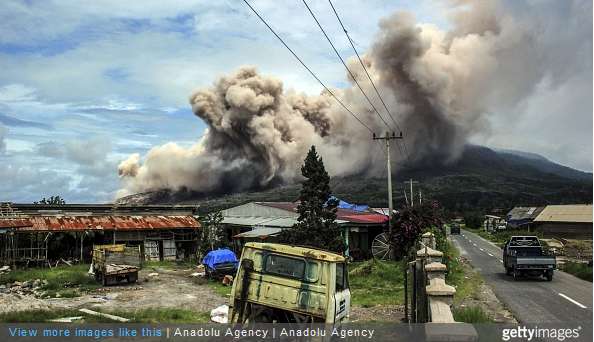 |
| 400 year dormancy of Sinabung Volcano ends with a bang |
 |
| Escapes zoo animals on the loose; tiger kills 1, injures 1 |
It looks like the world is coming upside down, with civil authority under attack, perversity is the norm, zoo animals hunt humans, and unexpected or scientifically abnormal natural disasters.
Yet God, in the fulness of time, causes or allows each of these things to happen and in the background unknown to us, each event furthers His glory and ushers the moment when we will hear the joyous words,
COME UP HERE!
Then we who are alive, who are left, will be caught up together with them in the clouds to meet the Lord in the air, and so we will always be with the Lord. (1 Thessalonians 4:17)
God’s timing is always perfect.
 |
| In His timing, we will fly! EPrata photo |

