It’s the day most of us get to go to church. For some who can’t, they listen or watch the livestream. It’s a day when we worship together, considering who our God is and why He is worthy of worship.
I saw this 3 minute video posted on Twitter by Amy Spreeman, and I watched it. I connected with God initially by his attribute of Creator. Paul appealed to God as Creator when witnessing topagans-
“The God who made the world and all things in it, since He is Lord of heaven and earth, does not dwell in temples made with hands; (Acts 17:24 NASB).
Please enjoy watching this video, and ponder the fact that He made all this. And didn’t make only her but all 8 billion people on the planet, each with unique DNA, and all the people before her, and after.
I think we do enjoy seeing each other’s libraries and study nooks and workspaces. I know I do. So here is mine…
I’ve had 2 weeks off from school and I used it to rest and relax. Also to do a little re-organizing of my laptop files, clearing out dead links and checking bookmarks. I am mulling over the upcoming year’s books I want to read, topics to consider for blogs, and setting up what Bible Reading Plan and which devotional to follow (FYI I chose The MacArthur Daily Bible, Dustin Benge’s new Hearts Aflame Puritan devotional podcast, and Valley of Vision for the afternoon reading).
I have a nice apartment, for which I am extremely grateful. Like, grateful every day. Rents here in this rural area went through the roof in the last few years, and occupancy is almost 100%. We are adjacent to an SEC college city and our county has been ‘discovered’. Realtors call it “fast-growing.” Which practically no one likes, except realtors.
Despite being in a poverty area, our school system is in or near the top ten for the state. It’s a farming community and when I first learned of the farm gate take being in the hundreds of millions, well I was shocked. LOTS of farming, which means pasture after pasture with cows, horses, low roofed chicken houses. All that, combined with (now gone) lower cost of living, proximity to a mid sized city and the bucolic beauty all around, well, suburbia is here. Development is here.
Anyway, back to my apartment and my command central. Though there are several rooms, I spend most of my time in the kitchen at the kitchen table. Here is my command center I’ve created:
The main thing is that everything I need is within reach
The laptop is the main feature, it is my music, sermons, TV, social media, and writing & photography tool. Next to that is my agate coaster, which I switch out for a granite one. I love stone. The green larger piece of round marble is the coaster I place my teapot on.
The brown mini teapot in front of the laptop is a pencil cup. Behind that is a slightly raised up shelf of books. These are the books I am currently reading or referring to for a research into a topic for the blog. And my Bible.
To the left of the pencil-cup teapot are some practical things, hygrometer to check the humidity levels and temperature, lotion for my hands, and extra bookmarks. I have tissues on the bookshelf because I always have a stuffy nose, or for sad scenes in movies, or heartfelt prayer. Also some post it notes, notepaper, and eye drops.
The only thing I don’t like is that I have the laptop cord extending from the table to the wall which is in the way on the floor. I have a lighting problem and needed some extra light for reading at night. But I didn’t want to extend more cords on the floor.
I fixed my lighting problem by getting a chargeable lamp, and a friend bought me another one I put on the right side. And last, on the silver tray is just for beauty. Flowers, flameless tea candles, and crystal holders.
I love flowers. Just love them. If I was a rich lady with a big house that had a foyer (foy-YAY) I’d have a large round oak table with marble on the top and a huge vase of ever-changing fresh flowers. (And a butler to change them out).
I usually read here at the table, but sometimes I go over to the living room and sit in my comfy chair with a handmade quilt over my lap. Everything I need is here and within reach.
For 2025 I am planning to do the same thing I’ve done for the last 18 years, work full time, write every day on the blog, read stuff, and go to church. It’s a little life but it’s a good life.
As 2025 begins, I am reminded that the Lord has been so good to me in these past years, and He will do so again in the next year. Even if whatever happens seems bad to me, it’s good. Why? because all He does is good to those who love Him, and I do love Him.
Do you know what’s precious to God? I do. And I didn’t learn this in a vision or a prompt or intuition. God told us ladies what is precious to Him. It’s in His word! Here it is:
Your adornment must not be merely the external—braiding the hair, wearing gold jewelry, or putting on apparel; but it should be the hidden person of the heart, with the imperishable quality of a gentle and quiet spirit, which is precious in the sight of God. (1 Peter 3:3-4).
Because Jesus is so precious, because He is so lovely, because He is so wonderful, we should care about what He cares about. And He cares that His women have a quiet spirit. Barnes’ Notes on the Bible says:
“The ornament of a meek and quiet spirit – Of a calm temper; a contented mind; a heart free from passion, pride, envy, and irritability; a soul not subject to the agitations and vexations of those who live for fashion, and who seek to be distinguished for external adorning.”
Do we care more about what we wear than what we say? Do we care that our jewelry sparkles more than how our godly spirit is sparkling?
The Lord is not banning use of fine clothes or jewelry. It’s the intent in which we dress finely or wear our jewels. He is reminding us that He is the treasure. Do we seek to be distinguished for external adorning? Or for internal spiritual beauty?
Matthew Henry said, “The apostle directs Christian females to put on something not corruptible, that beautifies the soul, even the graces of God’s Holy Spirit. A true Christian’s chief care lies in right ordering his own spirit. This will do more to fix the affections, and excite the esteem of a husband, than studied ornaments or fashionable apparel“
What does it mean to have a quiet spirit (which, remember, is precious to God)? It doesn’t mean being a doormat. It doesn’t mean submission to anything and everything. It doesn’t mean being silent. It doesn’t mean being afraid to express a thought or an opinion. It does mean this, from Strong’s Greek:
Usage: The Greek adjective ἡσύχιος (hésuchios) conveys a sense of quietness, tranquility, or peacefulness. It is used in the New Testament to describe a demeanor or lifestyle characterized by calmness and a lack of disturbance. This term often implies a state of inner peace and composure, which is reflected in outward behavior.
In the midst of the storm around you, do you retain your composure? In the day-to-day, do you display self-control?
Strive to quell the turbulence of your spirit into a quiet and peaceful one. A tall order some days, I know, when the kids are yelling and the husband is grumpy…you tend to match energy. But that is the exact time to BE quiet and peaceful. Then they can match their energy to yours. It’s a comfort for a child to see such self-control in their parent. It’s a balm for a husband to see such peacableness in a wife when his day is full of the opposite. And, it’s a joy to strive to obtain something that Jesus finds precious.
Cain talked to his brother Abel; and it happened that when they were in the field Cain rose up against his brother Abel and killed him. Genesis 4:8
Adam had relations with his wife again; and she gave birth to a son, and named him Seth, for, she said, “God has appointed me another child in place of Abel, because Cain killed him.” Genesis 4:25.
I’ve often wondered about that first death of a human. How Eve and Adam must have gone looking for Abel their son, finding him dead and bloody on the ground. I wonder how they felt when they learned their other son killed him, and was exiled to live far from them. Adam and Eve lost two sons that day. But that moment when death confronted them in the form of their son Abel, knowing that their disobedience has caused it, added a layer of grief we will never understand.
This painting is called The First Mourning, 1888, By William Bouguereau (1825-1905). As was stated on an art site, “The mourners in the painting don’t make eye contact with the viewer, and the composition is self-contained and intimate. In a barren landscape, Adam and Eve – the first humans – weep for their son Abel. He was slain by his own brother Cain. His body is already pale and bloodless and lies limp in the bosom of his father. The latter is young and strong, has dark hair and a full beard and devotes himself to his wife, who buries her face in her hands in deepest grief. There is no trace of the perpetrator. Only the two sacrificial altars in the background refer to the previous episode.” Source
The Passion Conference is a youth-aimed conference founded in 1995-1997 by Louie and Shelley Giglio. It is held in Atlanta and has a huge following online with tis social media, livestreamed conference, and in-person attendance. There is a split-off conference also in South Africa. The demographic Passion aims to reach is age 18-25, and both young men and women are invited. It is held annually in January. This year’s conference, like most of the previous ones, is sold out. The venue this year is the State Farm Arena which has a capacity of about 19000. There are two dates for the conference, January 2-4 and January 6-8 with different musicians and speakers at each. It regularly sells out, and has sold out for 2025. In the past the conference has been held at the Mercedes Benz arena which holds 71,000.
The conference creates an atmosphere that young people enjoy, which includes lots of glitz, music more rock and roll oriented, light shows, and speakers younger people are familiar with- whether the speaker is a true teacher or false.
Here are some bullet points for why the Passion Conference is one to avoid:
1. False Teachers. The conference features false teachers. This year Jackie Hill Perry is speaking, JHP has admitted she receives visions and instructions from the Lord directly. In the past speakers have been IF:Gathering founder Jennie Allen who also admitted she directly hears from God, Beth Moore, same with the visions and voices from God, David Platt, Kim Walker-Smith of Bethel, Priscilla Shirer, Christine Caine, and others equally as false.
2. Women preachers. Passion Conference platforms women preachers. There is a co-ed audience, with men attending. Women are not to preach to men says 1 Timothy 2:12. (Essay here explaining the scripture).
3. False Doctrine. Passion conference introduces false doctrine in the speeches and in the music, to tens of thousands of youths and sends them back to their local churches carrying these evil seeds. For one example, most notably in the Passion 2012 conference, Beth Moore, Francis Chan, and John Piper performed a version of the Catholic practice of Lectio Divina. See link at end for more on this.
One of Passion’s subsidiaries is Passion Equip, a series of study lessons [led by false teachers], a resource from the Passion movement including tracks, devotionals, messages, articles, podcasts, and scripture study that interested youths may engage in. Again, one’s own pastor is supposed to be the cornerstone of teaching these youths.
4. Manipulative. Passion relies on atmosphere to manipulate youths into spending buckets of money in attempts to cure social ills and perform social justice, such as helping the homeless and ending human trafficking. Passion states that “Since 2007, believing worship + justice are two sides of the same coin.” Thus they promote the social justice gospel. More info here on what the social gospel is.
source as above
5. Divisive. For all the speakers’ talk of “community” the Passion conferences do much to divide it. They forbid parents, senior pastors, elders, and older siblings from attending with the youth. Only the person bringing the youth are allowed to buy a ticket and accompany them. See screen shots of both the 2013 verbiage and the current conference for proof. Passion Conference has always striven to separate youth from the more solid adults in their life.
Church community is a community of people from all ages. Yet the Passion people go on and on about “this generation.” There is so much emphasis on “this generation” but in fact it looks like Passion strives to separate them from the herd. For example, there is Passion Camp where “Middle and high school students gather together for four days of worship, teaching and community. Not to mention, four fun days on the shores of Daytona Beach!“, [MIDDLE schoolers!] We should be suspicious of any organization that aims to separate people from each other, like Passion, Chrysalis weekends for 15-18 year olds, The Walk to Emmaus/The Great Banquet/Tres Dias AKA Cursillo which separates husbands from wives who must attend over different weekends.
6. It’s an industry, not just a conference. Some have called the Passion Industry a “commercialized money grabber.” Here are the subsidiaries: –Passion City Church: A church with locations in Atlanta, Cumberland, Trilith, and Washington D.C. –sixstepsrecords: A music label that represents many prominent contemporary Christian musicians –Passion Publishing: A publishing company –Passion Global Institute: An institute founded by Louie Giglio –Passion Conferences, LLC –Passion Resources –Passion Productions, Inc.
7. Lofty mantras that distract from the local church’s teaching. The Passion devotees are told repeatedly they are part of “a global awakening”, “a movement” for “this generation”. (and they ARE devotees, some youths attend year after year.) What about the other generations? Children? Elders? Isn’t Christianity a global movement already? Being brainwashed into thinking ‘this generation’ is special or different reduces the reality for them to be faithful week after week in their local church, where nothing spectacular seems to happen, unless you count the point of it all, conversions and baptisms. But those pale in comparison to the emotional high of being with tens of thousands of adrenaline-fueled like-minded youths in a music drenched arena being told they are part of something global and meaningful. These youths are not being discipled. They are being infected.
Do you see the magnitude of the problem? All these tens of thousands of youths being given false doctrine by false teachers and a false gospel.
This conference does much to divide the church by capitalizing on a natural youthful zeal and diverts their attention from quiet submission in service to a local church. This co-opting of their zeal to solve a cultural or social ill is not biblical. It sets them up for disappointment.
Hey y’all! I attended Passion a few days ago and I have a lot of mixed feelings. Initially I went with hopes of finding my encounter and connection with God & my faith. Instead I left more confused than ever. I did some research on two speakers and quickly found out they are controversial, for lack of better words. I did research on them because their message was just off putting so I wanted to learn more about them.
The worship music was great. I think during that time was when I felt most in touch and truly felt the Lord. But in a way it all felt so fake? I don’t know how to explain it. It just didn’t sit very well.
In the end I don’t think I was able to find my connection with God. I still feel lost. And I know I shouldn’t hold that against Passion per say but everyone kept telling “you will feel His presence there” and I simply did not. It baffled me that they let these people with heinous backgrounds stand up there and speak to a community when they’re the ones that should be doing some self reflecting as well. It just makes you wonder, how much of this is real and how much of this is all just for show/money?
I will keep holding onto His Word but nowadays it seems as if everyone picks and chooses what they want to preach about.
Am I reading too much into it? Is this just the world blinding me to keep living in sin? I long for that connection with God and I am having so much trouble finding Him. Edit: for context I am still young (21F) and still on my journey regarding my faith. I am so thankful for yalls input and kind words!
Avoid Passion Conferences and all their spokes on their commercialized wheel. Pray, study scriptures with your elder or mentor or parent, attend church faithfully, strive to live out your biblical values in your school or work place, then repeat. For that is the walk of the Christian.
It’s taking stock time. It’s turning over last year’s leaf into a new leaf. It’s time to make decisions. It’s New Year 2025 (almost)!
I took a look at my Goodreads list. I’m not a huge fan of Goodreads, I find the site cumbersome and hard to use. But it is useful. I didn’t record all the books I read this year (2024) on it but I did keep track in my hard copy planner. [I’m old school- a chronicler from 1968, I prefer hard copy]. So I added the books from my planner to Goodreads and it calculated my Year in Reading.
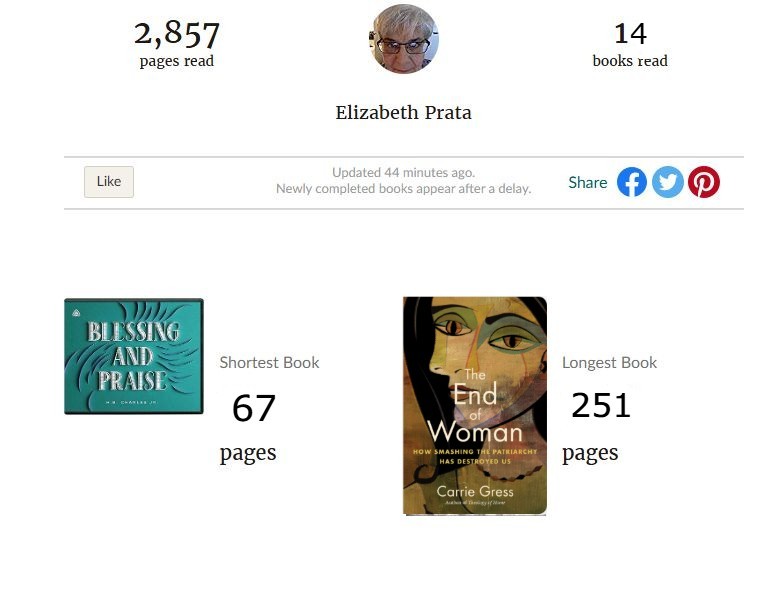
First of all, and I say this every year, I didn’t do as badly as I thought I did. I always consider myself a reading failure but that’s because I really don’t remember the books I’ve read. I read 14 books this year and that is about 10 more than I thought I did.
The book Blessings and Praise: Benedictions and Doxologies in the Bible is by HB Charles and it’s a workbook. It was part of a video study course I took from Ligonier earlier in the year. It is EXCELLENT! Highly recommended.
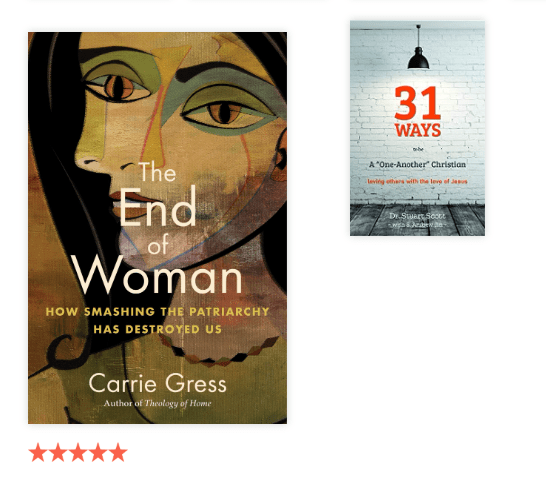
The other one is The End of Woman: How Smashing the Patriarchy Has Destroyed Us by Carrie Gress. It’s a thoroughly researched and extremely well edited book on the origins of feminism and their threads throughout the 1700s, 1800s, 1900s to the 2000s. When I say well edited, it’s because Gress researched voluminously, but crafted such a compelling narrative that puts in exactly the right facts and leaves out anything that would bog down the reader. With a massively researched topic spanning 300 years, it’s hard to know what to put in and what to leave out, and that is what an editor does- does those decisions which makes the story readable. By the way, feminism is evil, but WAY MORE evil than I thought. Ms Gress has the story.
I picked up the Harry Potter book this past summer. I read the first two when they came out, now more than 20 years ago. This summer I thought, well, let me see if I connect with them again, or not.
I mentioned this online and holy guacamole, lots of people got hot under the collar right away, accusing me of all sorts, because Potter is occult! the witchcraft! it’s evil! Etc. I asked sincerely if HP was any different from Lord of the Rings with, you know, wizards and supernatural events and stuff, but they just kept complaining and harassing. So I ignored them and read the first two books again.
Interestingly, Samuel Sey of @slowtowrite asked the following question on Twitter/X and I enjoyed the discussion, which was pretty civil. That debate is here if you want to read it.
Samuel Sey, @SlowToWrite asked – “Are there still Christians who believe people should avoid the Harry Potter books/movies because of its depiction of witchcraft? If so, I’m truly curious: What makes the witchcraft in Harry Potter more acceptable than the witchcraft in Lord of the Rings?“
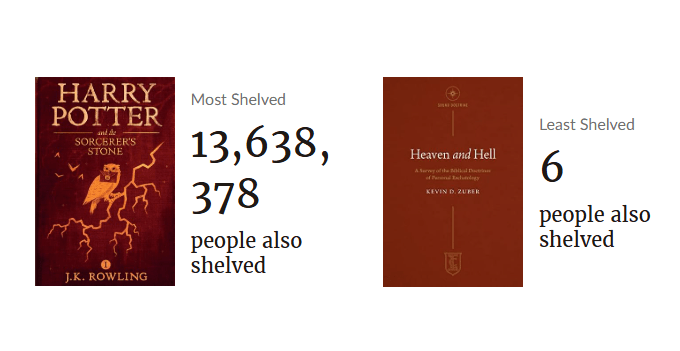
I thought Harry Potter book #1 was engaging enough because it’s well written, creative, and different. But halfway thru book #2 I lost steam and put them aside. Just like 20 years ago. As for the most shelved vs least shelved books on Goodreads as seen above, it’s no surprise to me that HP is on many millions of shelves but Heaven and Hell is only on 6, lol.
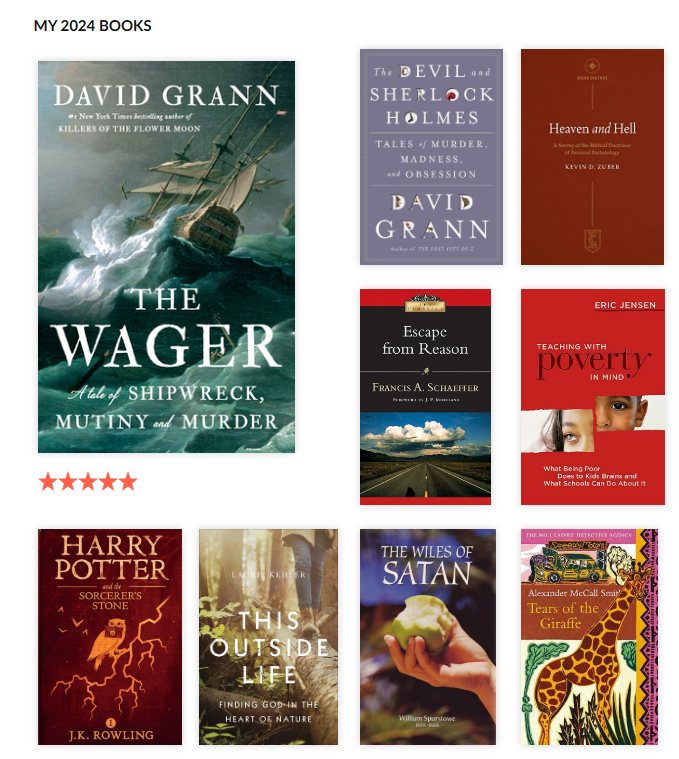
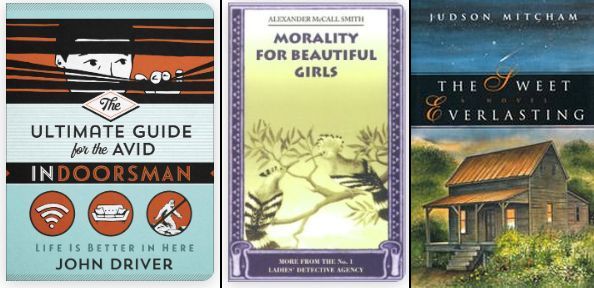
My books for 2024 are as follows
Confession- I have not read Morality for Beautiful Girls yet but I plan to read it today, so technically…
My goals for reading this year 2025 are to…read. I am increasingly tired when I get home from a full day of work as a reading interventionist in an elementary school. My eyes are tired too, they get dry and then they spasm. So I just want to keep the habit going without putting too much pressure on myself. I’ve enjoyed this Christmas break, and summer break I do read a lot, but absent a break, Saturdays seem to be the only day my mind is ready for reading.
I am reading the very long William Carey biography and I’ll continue that. Maybe the book on the ascension called Taken up to Heaven by Derek Thomas. I started Unlawful Killings by Wendy Joseph, a UK judge explaining about how the British court system works and reminiscing on her memorable cases. Beyond that I’ll see what comes up.
In 2023 I read The Art Thief: A True Story of Love, Crime, and a Dangerous Obsession, the one by Michael Finkel not the other similarly named book, and These is my Words: The Diary of Sarah Agnes Prine, 1881-1901 by Sarah Agnes Prine. Those two books were standout books, two of the best I’ve read in years. Absorbing and memorable. I’m still thinking of them over a year later. I hope I find a couple of books in 2025 equally as good as those.
If you are into Christian Reading Challenges, Challies always has a good one, you have to sign up for his newsletter but there is no cost involved and you can unsubscribe if you don’t like the newsletter. G3 has a reading challenge too. Reading challenges are when the organization sets a theme for the books they suggest you read, such as “Read a book over 100 years old” or “Read a book published this year”.
If you want a secular reading challenge, Barnes & Noble has one. Their themes are ones such as a selection of adventure books, meditative, dystopian. In their Empowerment suggestions, I’d avoid Rachel Hollis’s book, and in the Translated section I’d avoid Emily Wilson’s translation of The Iliad. I’d avoid the Memoir section completely. Secular books always come with risks. (Christian books too, but less so). Alternately, you could take just their categories and vet and select your own books.
It’s good to have a goal. Apparently last December 31 at Goodreads I’d set a goal of 13 books. I met it plus one. I find that absent a set goal, I fritter the time away and before I know it, I haven’t done much of anything. Having a Bible Reading Goal is good. I decided on the John MacArthur Daily Bible for my plan and I’ve included Dustin Benge’s Hearts Aflame Puritan reading devotional podcast, with a page of Valley of Vision Puritan prayer devotionals in the afternoon. Setting any goal is good, and setting it down in writing even better. Having set goals provides structure, limits, boundaries and it feels good to meet one’s set challenges.
Happy New Year and thank you for a great year and I pray your year of 2025 is in the Lord- now much else to say because all He does is good for those who love Him and for His glory!
We are at the end of our look at the life of Jesus through scripture. The first section of His life was seen through verses focused on prophecy, arrival, and early life.
The next section of verses looked at Him as the Son, second person of the Trinity.
We are coming toward the end of our look at the life of Jesus through scripture. The first section of His life was seen through verses focused on prophecy, arrival, and early life.
The next section of verses looked at Him as the Son, second person of the Trinity.
We proceeded into looking at Jesus as the Son’s preeminence, His works, and His ministry. Under ministry & works, I chose verses showing His attributes and aspects of being servant, teacher, shepherd, intercessor, and compassionate healer; and His attributes of omniscience, having all authority and power, and sinlessness.
Sixteen years! Next week as of January 9th I’ll have been writing daily on The End Time for 16 years. There are 6,764 essays here. On my other blog The Quiet Life it has been intermittent, but I founded that personal blog 3 years earlier, so, 19 years.
After 2006 other social media came along beyond blogs, such as Facebook, Twitter, Pinterest, Instagram and so on, so I absorbed them into my posting routine too.
The End Time blog is my main ministry though. My goals are to present solid theology, to refer women to credible ministries for further exploration, and to present thoughts about our faith that ultimately exalt and honor Jesus. The public square is marvelous for getting the name of Jesus out there and to share doctrines from a trustworthy source.
When podcasting became a thing I added that to the list. My main goal is to get good theology and resources into the hands of women, many of whom are busy moms. If they can listen to content while driving, cooking, or folding, instead of having to stop to read it, all the better. So The End Time Blog podcast was born.
Spotify keeps an annual analytic they send to creators at the end of the year. This year I stopped in May for a few months as I regrouped from WordPress and Spotify’s divorce, while I looked for another podcast platform to record on. So a good chunk of my analytics were impacted during the pause. Even with not having podcasted for a full quarter, the stats look good. So…thank you!
Apparently according to Spotify’s algorithm I am a Trendsetter personality:
They define the Trendsetter personality this way: “Like a true trendsetter, you have your finger on the pulse, publishing often and keeping it short and sweet. You love sharing your stories with your listeners.” Women have commented to me that they like short podcasts- some because it’s nice to intersperse with others’ longer podcasts, or just because they prefer short for various reasons. Most of my podcasts are under 15 minutes.
New listeners are coming in, so that’s good. Even with not promoting it and having stopped for a few months!
What was my top episode? Well, now there’s a story. If you follow me on Facebook and especially on Twitter you know I post rebuttals, warnings, and frequent criticism of Lori Alexander The Transformed Wife of godlywomanhood (and her husband too). Her ministry is damaging and unbiblical. I like being her gadfly, (to annoy through persistent criticism). I know that criticism is her kryptonite. Husband Ken hates it, too. They are unteachable, arrogant, and have thin skins- not a good look for people claiming to be Christians and teachers of others.
However, Lori has a huge following, I mean it’s near the million mark, so that means her damage goes far. Her false teaching goes far. If even one woman goes away from Lori through anything I post, I will have had a satisfactory day.
THAT’S why I persistently criticize Lori Alexander’s ministry. There are many women out there who think Lori’s output is biblical who would benefit from a wake up warning call, others who are seeking answers to niggling issues that their conscience or Bible study raises about her “teaching” or her behavior, or other ladies who just need confirmation of their own discernment that Lori’s output is not OK.
Other top blogs in 2024 included another discernment essay titled, Beth Moore’s divorced daughter was married this weekend. A consistent top read essay on this site year after year is the one I did comparing two divorces of celebrities in the faith that I wrote in 2016- Summer White and Melissa Moore, titled Two divorce cases: Summer White and Melissa Moore. White is the daughter of theologian James White and Melissa is Beth Moore’s daughter. So it stands to reason that Moore’s daughter’s remarriage this year also garnered a lot of interest.
Inevitably, when I write discerningly about a teacher’s lifestyle or her family I receive lots of comments along the lines of ‘It’s not your business!’ Oh, but it is. If a teacher is teaching publicly in a public ministry, the Bible tells us that their home life, behavior, and character are part of the qualifications for assuming the authority of teaching. (1 Timothy 4:16, Titus 2:7-8, 1 Corinthians 9:27, James 1:21-22).
The Alistair Begg issue (when he told a grandma it was OK to attend her gay grandson’s wedding) was also a well-read, top essay this year. So were the perennial top 10 essays I’ve written in the past but always land in the top 10 or 15, about Joyce Meyer and David Jeremiah.
A few non-discernment essays were also in the top 10, such as A Day in the Life of a Shepherd, an essay about the glory, one about the tree of life, and the like.
I’m happy that anyone reads anything I write. Discernment seems to be needed, and since the Spirit gave me that as one of His gifts of the Spirit, I am happy to employ it. I’m not embarrassed by discernment. I’m also happy when a women reads anything else I write about, and I do write about other topics besides discernment, such as natural history, biblical history, people in the faith (in the Bible or outside the Bible).
My personal favorites are the series I published on “A Day on the Life Of…” and the series on “Little Known Bible Characters” especially the one I researched and wrote about Eutychus (the young man who fell out of the window). That was a fun one to look into.
These are the essays I wrote about “A Day in the Life Of”-
A Day in the Life of: Introduction A Day in the Life of: A Professional Mourner A Day in the Life of: A Fisherman A Day in the Life of: A Potter A Day in the Life of: A Scribe A Day in the Life of: A Shepherd A Day in the Life of: A Tanner A Day in the Life of: A Seller of Purple A Day in the Life of A: Concubine A Day in the Life of: A Roman Centurion
The blog and the podcast are small potatoes compared to a lot of others, but I’m content, because this is what the Spirit has ordained. In truth, I’m still working full time and I do not believe I could keep up if the blog and podcast grew more or expanded faster. I’m not on a “speaking circuit”, the podcast is really small, the blog isn’t a brand, it’s not slick, and to younger eyes the graphics may even look uncool. I’m just an old lady who loves her Savior and writes stuff because that is the way I process concepts. It’s all OK.
When a lady messages to me that she has gone away from this or that false teacher, or has grown thanks to the resources I offered, or just enjoys the writing, it is my reward. I’m grateful for another year here at The End Time, and all glory goes to Jesus.
We are coming toward the end of our look at the life of Jesus through scripture. The first section of His life was seen through verses focused on prophecy, arrival, and early life.
The next section of verses looked at Him as the Son, second person of the Trinity.




 the-end-time.org