Posted in eternity, God, heaven, prophecy, ten thousand year clock

Clock of the Long Now

A man is building a clock in the West Texas Mountains that will keep time for 10,000 years. It is a 10,000 year clock, and the foundation supporting this enterprise is called The Long Now.

It is written about the clock

Designed by Danny Hillis, the Clock is designed to run for ten millennia with minimal maintenance and interruption. The Clock is powered by mechanical energy harvested from sunlight as well as the people that visit it. The primary materials used in the Clock are marine grade 316 stainless steel, titanium and dry running ceramic ball bearings. The entire mechanism will be installed in an underground facility in west Texas.

Why is this man building a clock that will keep time for 10,000 years? Well, why does any man do anything? Why did they climb Everest? Why do they go down to the sea in ships? Why do they tramp the Arctic?

But this man, why is he building a long now clock?

I wanted a symbol of the future, in the same way that the pyramids are a symbol of the past. I wanted to build something that gave us that sense of connection. 

I’m Danny Hillis and I’m building a clock that will last for 10,000 years. ..One of the ways we keep the clock accurate is that we synchronize it to the sun… Exactly at solar noon the chimes begin to play. … They worked out a way of ringing ten bells in a different sequence each day, for ten thousand years. … We’re invested in generational thinking, and answering the question, ‘were we good ancestors?’ 

There’s a problem of people not believing in the future, a long-term clock challenges those short-term civilizational stories. I’m very optimistic about the future. I’m not optimistic because I think our problems are small. I’m optimistic because I think our capacities are great. 

Oh. I see. Like the Tower of Babel.

To see the Clock you need to start at dawn, like any pilgrimage. Once you arrive at its hidden entrance in an opening in the rock face, you will find a jade door rimmed in stainless steel, and then a second steel door beyond it. These act as a kind of crude airlock, keeping out dust and wild animals. You rotate its round handles to let yourself in, and then seal the doors behind you. It is totally black. You head into the darkness of a tunnel a few hundred feet long. At the end there’s the mildest hint of light on the floor. You look up. There is a tiny dot of light far away, at the top of top of a 500 foot long vertical tunnel about 12 feet in diameter. There is stuff hanging in the shaft.

And they said to one another, “Come, let us make bricks, and burn them thoroughly.” And they had brick for stone, and bitumen for mortar. 4Then they said, “Come, let us build ourselves a city and a tower with its top in the heavens, and let us make a name for ourselves, lest we be dispersed over the face of the whole earth.” (Genesis 9:3-4)

The first part of the Clock you encounter on the ascent up the spiral staircase is the counterweights of the Clock’s drive system. This is a huge stack of stone disks, about the size of a small car, and weighing 10,000 pounds. Depending on when the clock was last wound, you may have to climb 75 feet before you reach the weights. 

You keep climbing. For the next 70-80 feet of ascent you pass 20 huge horizontal gears (called Geneva wheels), 8 feet in diameter, each weighing 1,000 pounds. This is the mechanical computer that calculates the over 3.5 million different melodies that the chimes will ring inside the mountain over the centuries. 

And the LORD came down to see the city and the tower, which the children of man had built. 6And the LORD said, “Behold, they are one people, and they have all one language, and this is only the beginning of what they will do. And nothing that they propose to do will now be impossible for them. 7Come, let us go down and there confuse their language, so that they may not understand one another’s speech.” (Genesis 9:5-7)

This is what happens when man worships created things instead of the Creator. Man has an inherent notion of time. Man knows he is in a great slip-stream current of time, connected to those who have passed before us and linked to those yet to come. That is because God has put eternity into man’s heart. (Ecclesiastes 3:11).  Man seeks the great questions, desires to know the end of things, wants to achieve greatness under the sun- or on the plains of Shinar.

The 10,000 year clock’s design and these beginning moments of its construction are truly remarkable. That men could design such a thing does seem to indicate a nearly bottomless well of capacity for accomplishment. Yet man’s capacity is only as deep or as long as the Holy God allows it, as we know the end of the story of the Tower of Babel. What the 10,000 year clock really is, is a monument to man. What a shame to use all that money, time, skill, and labor for something that is really an ode to man.

What blessings he has given us to enter His courts and see the angelic beings with wheels within wheels, TRUE machinery that lasts ten thousand upon tens of thousands of years, eternities.  What greatness He has bestowed on us to hear the trumpet and harps and worship songs that are the chimes of heaven.

In Jesus we have the eternal questions answered. We know that we know we are in His slip-stream of time and in the current that is endless and infinite. We know we are good ancestors because He is our father, the root ancestor, having in us His greatness. Apart from Him we can do nothing, but in Him we can do whatever His will allows and sustains in us to do. From man’s perspective, the clock in the mountain in West Texas is a remarkable thing. It really is. Personally, I’m in awe of it and wonderstruck at the men who are creating it. From God’s perspective it is a mote on a gnat on a flea. My true awe is of the God who invented time. What a blessing He gave His children the eternal answers. We do not have the restlessness of clockmakers, but possess an eternal peace. In Him, in heaven, there is no time, and no need for clocks.

Posted in encouragement, endless, God, infinity

Infinity

We’re familiar with infinity, even if we can’t really comprehend it. We know the Realtor selling point “there’s an infinity pool!” or the Toy Story motto “To Infinity and beyond!” which is pretty funny actually.

In the second grade classroom in which I am stationed as teacher aide, there is a number line above the Smart board. (AKA chalkboard for us old timers). To the left of zero are a host of negative numbers and to the right of zero is a host of increasing whole numbers. The teacher occasionally mentions to the kids that the numbers go on and on, to infinity.

When I was a schoolchild I learned about the number googol. I used to think that a googol was the largest number. It isn’t. But here is a Wikipedia definition of a googol:

A googol is the large number 10 to the 100. In decimal notation, it is written as the digit 1 followed by one hundred 0s. The term was coined in 1920 by 9-year-old Milton Sirotta (1911–1981), nephew of American mathematician Edward Kasner.  A googol has no special significance in mathematics. However, it is useful when comparing with other very large quantities such as the number of subatomic particles in the visible universe or the number of hypothetical possibilities in a chess game. Kasner used it to illustrate the difference between an unimaginably large number and infinity, and in this role it is sometimes used in teaching mathematics. 

The ancients had a difficult time expressing just large numbers. For centuries, the standard way to describe any number over 10,000 was “myriad.” A really, REALLY big number would be ‘myriad myriads’. Here in Deuteronomy 32:30 ISV the rhetorical question is asked how could one of the the thinly populated Jews have put ten thousand soldiers to flight, or two of the Jews put “a myriad to flight”. Other translations say ten thousand.

How can one person chase a thousand of them and two put a myriad to flight, unless their Rock delivers them and the LORD gives them up?

Of course a verse that comes immediately to mind is Revelation 5:11-

Then I looked, and I heard around the throne and the living creatures and the elders the voice of many angels, numbering myriads of myriads and thousands of thousands,

One day, the famous mathematician Archimedes (287BC-212BC) wanted to sort of count the number of grains of sand, Or rather, he wondered how many grains of sand would be the upper limit of grains of sand that could fit into the universe. Archimedes definitely had big thoughts.Yet he knew that ‘myriad upon myriad’ was not going to suffice as a reckoning for this large number experiment he desired to perform. Wikipedia says,

In order to do this, he had to estimate the size of the universe according to the contemporary model, and invent a way to talk about extremely large numbers. … Archimedes had to invent a system of naming large numbers. The number system in use at that time could express numbers up to a myriad (μυριάς — 10,000), and by utilizing the word “myriad” itself, one can immediately extend this to naming all numbers up to a myriad myriads (10 to the 8th power.) 

And Archimedes went from there.

Anyway, the ancients had a hard time naming large numbers, and infinity is just beyond us all. It means endless, and comprehending endless numbers, or endless anything, is impossible.

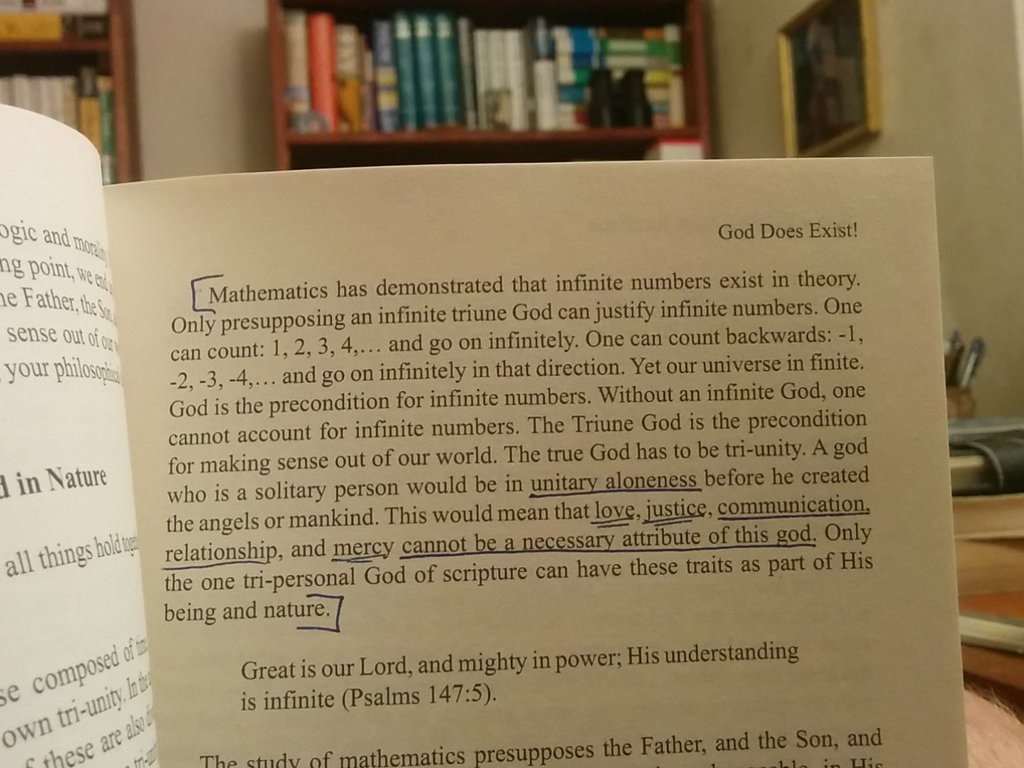
Here’s another brain buster. The only reason we can even have numbers to infinity is because of God. God is infinite. He is beyond everything that there is.

This photo is of a book called God Does Exist!: Defending the faith using presuppositional apologetics, evidence, and the impossibility of the contrary. A Twitter friend posted this page from the book as he was studying. I read the excerpt he posted below, and became entranced with the idea of an infinite God and infinite numbers. You can click on the photo to enlarge it.


Even though in our own crude, puny human way, we can only express the majestic God as myriad upon myriad big, the fact that we have an infinite relationship with Him is enough. Our time with Him is endless, boundless, impossible to calculate. We will worship Him in infinite glory endlessly.

—————————

Further Reading

What is Infinity? Math is Fun

Ligonier Devotional: Our Infinite God

Bible Hub Topic: Infinite

Posted in encouragement, grace, Master, sheep

His sheep know His voice and they follow. Inspiring video

Youtube synopsis:

Published on Nov 17, 2013

A little compilation of a visit to my friend, Christopher Lange’s farm at Harestua, Norway. I have long wanted to film this test, where we call for his sheep in the same words as he uses, and then let him do it. A Biblical lesson to learn from this!

The verse that comes to mind is

My sheep hear my voice, and I know them, and they follow me. (John 10:27)

It’s an inspiring video, especially when we think about Lazarus, who was dead when Jesus called him, and he responded to his Master’s voice by coming alive again! If we are alive when He calls for us in the rapture, we also will respond to His voice, and “come up here” to be with Him.

HT to reader Ruby who alerted me to this video and to Jacco who found it.

Posted in encouragement, Felix, grace, procrastination, salvation, thanksgiving

Thankful for salvation: thoughts on Felix

After some days Felix came with his wife Drusilla, who was Jewish, and he sent for Paul and heard him speak about faith in Christ Jesus. And as he reasoned about righteousness and self-control and the coming judgment, Felix was alarmed and said, “Go away for the present. When I get an opportunity I will summon you.” (Acts 24:24-25)

It is stated earlier that Felix was thoroughly familiar with “The Way”. (v. 22). Whether it was because Felix had been governor in the area for almost a decade, or because his wife was Jewish, or both, Felix was familiar with the facts about Jesus and his “sect” as Paul’s accuser Tertullus put it. Felix was secure in his knowledge of Christianity in the intellectual realms, enough to feel confident to make a decision regarding the case.

But when the case got personal, really personal, Felix became alarmed. He told Paul to go away and when it was a more convenient time, Felix would think about it. The Greek word for time used in this verse means “a suitable time” or “the right moment”. But there will never be a more convenient right moment.

As James Montgomery Boice said of Felix’s procrastination, if you put it off, the same sinful nature that made you put it off today will make you put it off tomorrow. Nothing will be different. In addition, you’ve begun a habit of procrastination which will only deepen and entrench. Tomorrow it will be worse for you. Now is the acceptable time (2 Corinthians 6:2).

Notice Felix’s alarm at being told of sin and judgment. In the Greek the meaning of terror is ‘being in the grip of a great Godly terror’. The word is used 5 times in the New Testament.

–When the women who brought spices to the tomb after Jesus’ death saw the gleaming angels, they were terrified.
–When they were gathered and Jesus appeared to His disciples they became terrified.
–Cornelius’ terror at seeing a holy angel in a God-given vision.
–In Revelation when a great earthquake occurred and a tenth of Jerusalem fell, the people became terrified and gave God in heaven glory.
–Felix, upon hearing Paul speak of sin and judgment.

You see, in each of the four cases, apart from Felix, the people became terrified upon directly seeing a slice of heaven. Or in the case of the earthquake they knew it was a mighty work of God Himself. And just as seeing a holy angel of God or experiencing God’s hand directly, Felix was experiencing heaven. It wasn’t just Paul speaking some words articulately and Felix becoming annoyed or a bit worried. It was the Holy Spirit opening the depths of Felix’s soul to see his own sin compared to heaven. It was a deep, spiritual terror. Paul’s words and their effect should have brought about the same reaction from Felix as Peter seeing Jesus as Lord of creation with the heavy, full nets of fish in Luke 5:8. Peter fell at Jesus feet, saying “Go away from me, I am a sinful man!” Felix said, “Uh, come back later, this is inconvenient for me.”

When Felix was confronted with his sin and positionally saw how far he was from Jesus, he should have done the same as Peter. Yet though the Lord graciously offered Felix the opportunity to see his sin in light of God’s glory, and though Felix did see it and became abjectly afraid, he procrastinated.

This is a decision. Jesus said whoever is not with Him is against Him. (Matthew 12:30).

So don’t let anyone sway you from evangelizing this way, talking of sin, self-control, righteousness, and the coming judgment. “Jesus loves you and has a wonderful plan for your life” doesn’t have the same potential spiritual terror to pierce the soul as “You’re dead in your sins and Jesus is coming to judge you.”

There is no record in the Bible as to whether Felix found “a more convenient time” and reconciled to God. Probably not, seeing as the next verse records that Felix kept Paul in prison to see if Paul would cough up some money for a bribe. In this case, it IS worse for Felix. All that intellectual knowledge will put him in a worse position at the judgment.

For it would have been better for them never to have known the way of righteousness than after knowing it to turn back from the holy commandment delivered to them. (2 Peter 2:21)

It’s Thanksgiving. I can think of no better gift than salvation to be thankful for. A close second is the Holy Spirit as a gift and a deposit inside us, illuminating the wonders of the Holy Bible to our mind and growing us in sanctification. Or perhaps Jesus forgiving our sins after salvation, or maybe it’s His chastisement which refines us into sterling silver and gold. Or maybe seeing the world, on our walk after the meal, and giving God the glory for His beautiful earth. Or His eternal, boundless grace. There is so MUCH to be thankful for, if you are a Christian. Offer the Gospel to someone today, maybe by next year at this time they will be praising God in gratitude for their reconciliation, and blessedly, Thanksgiving will have taken on a whole new meaning for them.

EPrata photo

————————————-

Further Reading

All Dressed Up and No One To Thank

Giving Thanks for Salvation

Posted in courts, encouragement, jesus, mansions, new jerusalem, prophecy

East Greenwich High School senior privileges: The Courtyard

I attended High School between 1974 and 1978. It was an excellent high school, offering high-end academics, a thriving sports program, a beautiful campus, and star teachers. To us, though, it was just high school, and the best thing about it was none of those things.

It was Senior Privileges.

Seniors were allowed entry to spaces in the school that no other students were allowed to enter. These spaces were severely restricted, and anyone who was not senior was barred.

For example, the Health Room was once a senior-only room, and was furnished with couches, a television, and refrigerator, if you can believe it. Even more unbelievable in this generation’s health-conscious era, of the area of the school’s inner courtyard where three brick walls connect was once reserved as a smoking area for students. Smoking is now banned on the entire campus.

I never took advantage of those privileges but there were two others that I enjoyed.

Seniors during the 1970’s and 1980’s could sign themselves in and out of school. If we had a study hall first period of the day, we were able to come in late. We were able to sign out of school in the case of a last period study hall. I used to sign out and go to McDonald’s and get breakfast, which was a new offering back then. McDonald’s introduced the Egg McMuffin in 1972 and a full breakfast in 1977. That was the year I became a senior and the novelty of the McMuffin and hash browns was too luscious to resist. I signed myself out of study hall and drove to get breakfast a la McD’s style, also bringing back orders for friends who didn’t have a car.

But the greatest privilege to me was that seniors-only could use the courtyard. The courtyard was not an arborist’s dream. It was a scrubby place, not really a greenspace, just well-worn paths amid gasping grass, concrete benches, the aforementioned smoking area, and some trees. But the school was large and being able to cut down travel time between classes to beat the bell was extremely compelling. Plus only seniors could go there.

All the Freshmen knew about senior privileges. We’d look upon the seniors emerging from the courtyard with awe, and excitedly talk about the day we, too, would be allowed entry into this most prized restricted area. I don’t have enough words to relate to you the thirst, angst, and yearning for senior privileges. WE were blocked out, but THEY could go hang out! They could go in and come out! They could remain in a private area just for them! We wanted that!

Courtyard at Hotel Inca Real, Cuenca, Ecuador.
EPrata photo

The parallel to God’s courts is the point I want to make here. Do we possess the same fervency to be in God’s courts? Do we yearn for the privilege of being in His courts?

The Psalmist said,

For a day in your courts is better than a thousand elsewhere. I would rather be a doorkeeper in the house of my God than dwell in the tents of wickedness. (Psalm 84:10)

The righteous man will flourish like the palm tree, He will grow like a cedar in Lebanon. Planted in the house of the LORD, They will flourish in the courts of our God. (Psalm 92:12-13)

Enter his gates with thanksgiving, and his courts with praise! Give thanks to him; bless his name! (Psalm 100:4)

I know when the time comes to enter His fabulously luxuriant and holy courts, it will be with thanksgiving and praise. But until then, do we yearn for His home, which is our home? Do we look with joy and anticipation when it will finally be our turn to enter the restricted area, the private area reserved for only those chosen? Do we crave to be there, enjoying the privilege of being in His court?

I can’t imagine what it will look like or what it will be like to enter His courts. The Bible tells us that we can’t conceive of it. My juvenile mind could not conceive of any privilege or any courtyard sweeter than the High School Courtyard reserved for those of a certain age. Just as now, my juvenile Christian mind cannot conceive of a courtyard sweeter or more tranquil that, say, the one at the Hotel Inca Real in Cuenca Ecuador, adorned with plants, tiled floors, resting benches, beauty and peace.

But, as it is written, “What no eye has seen, nor ear heard, nor the heart of man imagined, what God has prepared for those who love him”– (1 Corinthians 2:9)

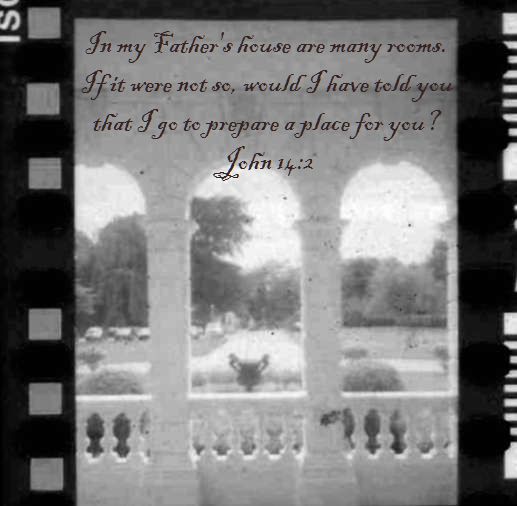
But I can and do joyfully anticipate His courts even without being able to visualize them. It is quite humbling to think of Jesus preparing this place for us.

EPrata photo
Posted in behold, bible, prophecy, thankful

Behold the man! And The Four Beholds

We know Jesus is the Man-God. His divinity was on display when He healed, did miracles, or taught with such authority that the hearers were astounded.

His human nature was on display when He was weary (John 4:6), hungry (Mark 11:12), or thirsty (John 19:28).

When Jesus appeared before the magistrate, Pilate said to the crowd, Behold the man. Here is the verse:

So Jesus came out, wearing the crown of thorns and the purple robe. Pilate said to them, “Behold the man!” (John 19:5)

Most of us are familiar with that phrase, and that momentous event in the life of Jesus. But did you know that Zechariah said it first? In one of the many visions God gave the prophet Zechariah, the phrase appears. Thus Pilate’s utterance was a fulfillment of an Old Testament picture pointing to a New Testament truth.

And say to him, ‘Thus says the LORD of hosts, “Behold, the man whose name is the Branch: for he shall branch out from his place, and he shall build the temple of the LORD. (Zechariah 6:12)

Though the vision actually shows Joshua being crowned, it is in reality a picture of the crowning of Jesus. The Jamieson Fausset Commentary explains further:

Behold, the man—namely, shall arise. Pilate unconsciously spake God’s will concerning Him, “Behold the man” (Jn 19:5). The sense here is, “Behold in Joshua a remarkable shadowing forth of Messiah.” It is not for his own sake that the crown is placed on him, but as type of Messiah about to be at once king and priest. Joshua could not personally be crowned king, not being of the royal line of David, but only in his representative character.

[Source: Jamieson, R., Fausset, A. R., & Brown, D. (1997). Commentary Critical and Explanatory on the Whole Bible (Vol. 1, p. 723). Oak Harbor, WA: Logos Research Systems, Inc.]

Roy Gingrich’s outlines on the prophetic books are helpful here explaining Zechariah’s vision of Joshua’s crowning, and the Heavenly utterance “Behold the Man whose name is the branch!”

THE SYMBOLISM OF THE CROWNING OF JOSHUA 

The crowning of Joshua, a priest, with a regal crown symbolizes the future crowning of Christ, a priest (after the order of Melchisedec), with a regal crown (as Israel’s and the world’s, King) at His Second Advent. 

During Christ’s earthly ministry, He was crowned with a crown of thorns, Matt. 27:29; during His present sitting at His Father’s right hand, He is crowned with a crown of glory and honor, Heb. 2:9; at His Second Advent, He will be crowned with many crowns, Rev. 19:12 (as the King of Israel, Matt. 27:37, and as the King of all the earth’s Kings, Rev. 19:16). 

THE PROPHECIES CONCERNING THE MESSIAH (Zechariah 6:12, 13, 15) 

(Here we have one of the Old Testament’s most complete, yet concise, prophecies concerning the person, the office, and the work of the coming Messiah.) 

1. The Messiah will be the antitype of Joshua (6:12). 

To “behold the man,” Joshua, was to “behold the man,” the Messiah, for the one is typical of the other. The Jews, at Christ’s first advent, “beheld the man,” the Messiah, crowned with thorns, John 19:5. The Jews, at Christ’s second advent, will “behold the man,” the Messiah, crowned with many crowns, crowns of glory, Rev. 19:12.
See the four “beholds,” Zech. 6:12; Isa. 42:1; Zech. 9:9; Isa. 40:9.

[Source: Gingrich, R. E. (1999). The Books of Haggai and Zechariah (p. 34). Memphis, TN: Riverside Printing.]

Here are the four Beholds Mr Gingrich mentioned.

Behold the Man!

And say to him, ‘Thus says the Lord of hosts, “Behold, the man whose name is the Branch: for he shall branch out from his place, and he shall build the temple of the Lord. (Zechariah 6:12)

Behold the Servant!

Behold my servant, whom I uphold,
my chosen, in whom my soul delights;
I have put my Spirit upon him;
he will bring forth justice to the nations.
(Isaiah 42:1)

Behold the King!

Rejoice greatly, O daughter of Zion!
Shout aloud, O daughter of Jerusalem!
Behold, your king is coming to you;
righteous and having salvation is he,
humble and mounted on a donkey,
on a colt, the foal of a donkey.
(Zechariah 9:9)

Behold your God!

Go on up to a high mountain,
O Zion, herald of good news;
lift up your voice with strength,
O Jerusalem, herald of good news;
lift it up, fear not;
say to the cities of Judah,
“Behold your God!”(Isaiah 40:9)

We’re entering the Thanksgiving season, and gratitude and thankfulness are much on our minds. I am thankful for the fact that I shall behold Him! All knees will bow and all tongues will confess, meaning all peoples will behold Him, their God. But I’m grateful I shall behold Him as one who is forgiven by His grace, not ashamed or crushed by fear – but worshiping Him rightly- in Spirit and in truth. My gratitude for Him having delivered the means by which to dwell in righteousness now and forever and to behold His face in love knows no bounds. Brethren, WE SHALL BEHOLD HIM, OUR MAN-GOD, Savior, Lord and King!

Posted in bible, encouragement, good shepherd, sheepfold, shepherd

His sheep know His voice

Jesus only calls those sheep whose names have been written down since before the foundation of the world. (Ephesians 1:4). Those sheep know His voice and listen to them. Those sheep follow Him out of the sheepfold and into green pastures. He doesn’t put a general call into the sheepfold and wait to see who will come out. He knows them by name, and He calls them.

EPrata photo

Truly, truly, I say to you, he who does not enter the sheepfold by the door but climbs in by another way, that man is a thief and a robber. But he who enters by the door is the shepherd of the sheep. To him the gatekeeper opens. The sheep hear his voice, and he calls his own sheep by name and leads them out. When he has brought out all his own, he goes before them, and the sheep follow him, for they know his voice. (John 10:1-4)

John 10:1–2. Verses 1–5 describe a morning shepherding scene. A shepherd enters through a gate into a walled enclosure which has several flocks in one sheep pen. The enclosure, with stone walls, is guarded at night by a doorkeeper to prevent thieves and beasts of prey from entering. Anyone who would climb the wall would do it for no good purpose.

John 10:3–4. By contrast, the shepherd has a right to enter the sheep pen. The watchman opens the gate, and the shepherd comes in to call his own sheep by name (out from the other flocks). Shepherds knew their sheep well and gave them names. As sheep hear the sound of their owner’s familiar voice, they go to him. He leads them out of the pen till his flock is formed. Then he goes out toward the fields with the sheep following him. 

John 10:5–6. If a stranger enters the pen, the sheep run away from him because his voice is not familiar. The point of this figure of speech consists in how a shepherd forms his flock. People come to God because He calls them (cf. vv. 16, 27; Rom. 8:28, 30). Their proper response to His call is to follow Him (cf. John 1:43; 8:12; 12:26; 21:19, 22). But this spiritual lesson was missed by those who heard Jesus, even though they certainly understood the local shepherd/sheep relationship. In their blindness, they could not see Jesus as the Lord who is the Shepherd (cf. Ps. 23).

John 10:7–9. Jesus then developed the shepherd/sheep figure of speech in another way. After a shepherd’s flock has been separated from the other sheep, he takes them to pasture. Near the pasture is an enclosure for the sheep. The shepherd takes his place in the doorway or entrance and functions as a door or gate. The sheep can go out to the pasture in front of the enclosure, or if afraid, they can retreat into the security of the enclosure. The spiritual meaning is that Jesus is the only Gate by which people can enter into God’s provision for them.

When Jesus said, All who ever came before Me were thieves and robbers, He referred to those leaders of the nation who cared not for the spiritual good of the people but only for themselves. Jesus the Shepherd provides security for His flock from enemies (whoever enters through Me will be saved, or “kept safe”). He also provides for their daily needs (the sheep come in and go out, and find pasture).

Source: Blum, E. A. (1985). John. In J. F. Walvoord & R. B. Zuck (Eds.), The Bible Knowledge Commentary: An Exposition of the Scriptures (Vol. 2, pp. 309–310). Wheaton, IL: Victor Books.

The People’s Bible Encyclopedia, Charles Barnes

EPrata photo
Posted in isaac, living water, old testament, wells

Wells of living water: Old Testament pictures are New Testament promises

The passage today is from Genesis 26:17-22. I found that as far as my interpretation of it goes, there seems to be a historical/practical meaning, a spiritual meaning, and a metaphorical meaning. God’s word is great. Here is the passage.

So Isaac departed from there and encamped in the Valley of Gerar and settled there. And Isaac dug again the wells of water that had been dug in the days of Abraham his father, which the Philistines had stopped after the death of Abraham. And he gave them the names that his father had given them. But when Isaac’s servants dug in the valley and found there a well of spring water, the herdsmen of Gerar quarreled with Isaac’s herdsmen, saying, “The water is ours.” So he called the name of the well Esek, [contention] because they contended with him. Then they dug another well, and they quarreled over that also, so he called its name Sitnah. [enmity]. And he moved from there and dug another well, and they did not quarrel over it. So he called its name Rehoboth, [room] saying, “For now the LORD has made room for us, and we shall be fruitful in the land.”

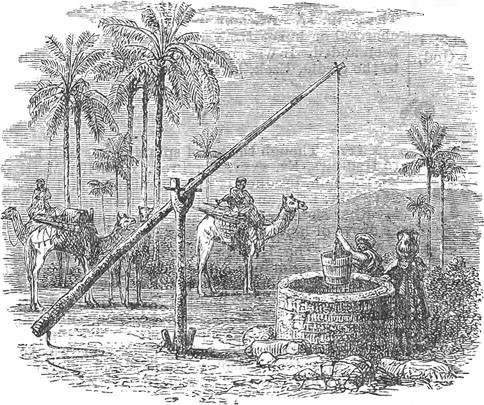
Ancient well diggers dug a shaft to obtain water from a water-bearing layer beneath the ground. They lined the shaft with wood, stone, or baked brick to prevent it from caving in. To keep contaminants from the well and to protect people from falling in, well diggers often built a low stone wall like the one shown here and covered the well opening with a large flat stone. ‎Gen 16:14, Gen 21:19, 25, 30, Exod 2:15, Isa 12:3, Luke 14:5, John 4:1–45. (Source, Myers, R (2012) Logos Bible Images, Lexham Press, images are public domain.)

Practically, as a herdsman Isaac would have depended greatly on water to keep his flock alive. Water was a precious commodity in a dry and thirsty land. Earlier in Genesis 26 it had been reported that Isaac had become a very wealthy man.

And Isaac sowed in that land and reaped in the same year a hundredfold. The LORD blessed him, and the man became rich, and gained more and more until he became very wealthy. He had possessions of flocks and herds and many servants, so that the Philistines envied him. (Now the Philistines had stopped and filled with earth all the wells that his father’s servants had dug in the days of Abraham his father.)

Isaac’s father Abraham had obtained the land legally and rightly, and he had dug the wells. Yet the Philistines stopped them up. And the Philistines’ envy and hatred carried through to Isaac’s day, when they contended with Isaac over the water and there was strife. It must have been a great hardship for Isaac with all his herds, servants, and flocks to go without enough water during the periods the Philistines contended against him. Calvin said of the stopped-up wells,

Moreover, the fact that the wells had been obstructed ever since the departure of Abraham, shows how little respect the inhabitants had for their guest; for although their own country would have been benefited by these wells, they chose rather to deprive themselves of this advantage than to have Abraham for a neighbor; for, in order that such a convenience might not attract him to the place, they, by stopping up the wells, did, in a certain sense, intercept his way. It was a custom among the ancients, if they wished to involve any one in ruin, and to cut him off from the society of men, to interdict him from water, and from fire: thus the Philistine, for the purpose of removing Abraham from their vicinity, deprive him of the element of water.

Aside from the physical need of the practical matter of water, the second item to note is Isaac’s placid response. Stopping up a well is akin to a declaration of war because no water equals financial ruin and perhaps death. The Philistines had already noted Isaac’s large retinue and knew he could have defeated the them yet Isaac did not fight. He simply relied on the Lord’s providential care by abandoning his freshly dug well – several times – and moved on. Talk about turning the other cheek! (Luke 6:29).

Calvin again, this time of the spiritual relationship Isaac had with YHWH-

First, Moses, according to his manner, briefly runs through the summary of the affair: namely, that Isaac intended to apply again to his own purpose the wells which his father had previously found, and to acquire, in the way of recovery, the lost possession of them. He then prosecutes the subject more diffusely, stating that, when he attempted the work, he was unjustly defrauded of his labor; and whereas, in digging the third well, he gives thanks to God, and calls it Room, because, by the favor of God, a more copious supply is now afforded him, he furnishes an example of invincible patience. Therefore, however severely he may have been harassed, yet when, after he had been freed from these troubles, he so placidly returns thanks to God, and celebrates his goodness, he shows that in the midst of trials he has retained a composed and tranquil mind.

Thirdly, the metaphorical aspect. Whenever there is water in the Bible, I pay attention. It is a blessing to me to think of the Lord Jesus as the Living water. With the stopping up of the wells and the final well finally flowing freely in an area of enough “room”, I searched to see if my hunch had been right. Matthew Henry alluded to the flowing water, metaphorical aspect of Isaac’s wells issue.

In digging his wells he met with much opposition, v. 20, 21. Those that open the fountains of truth must expect contradiction. The first two wells which they dug were called Esek and Sitnah, contention and hatred. What is the nature of worldly things; they are make-bates and occasions of strife. What is often the lot even of the most quiet and peaceable men in this world; those that avoid striving yet cannot avoid being striven with, Ps. 120:7. In this sense, Jeremiah was a man of contention (Jer. 15:10), and Christ himself, though he is the prince of peace. What a mercy it is to have plenty of water, to have it without striving for it. The more common this mercy is the more reason we have to be thankful for it.

Source: Henry, M. (1994). Matthew Henry’s commentary on the whole Bible: complete and unabridged in one volume (p. 60).

The two verses which come to my mind are:

With joy you will draw water from the wells of salvation. (Isaiah 12:3).

Whoever believes in me, as the Scripture has said, ‘Out of his heart will flow rivers of living water.’ (John 7:38)
Matthew Henry one more time:

Upon God’s providence, even in the greatest straits and difficulties. God can open fountains for our supply where we least expect them, waters in the wilderness (Isa. 43:20), because he makes a way in the wilderness, v. 19. Those who, in this wilderness, keep to God’s way, may trust him to provide for them. While we follow the pillar of cloud and fire, surely goodness and mercy shall follow us, like the water out of the rock. 2. Upon Christ’s grace: That rock was Christ, 1 Co. 10:4. The graces and comforts of the Spirit are compared to rivers of living water, Jn. 7:38, 39; 4:14. These flow from Christ, who is the rock smitten by the law of Moses, for he was made under the law. Nothing will supply the needs, and satisfy the desires, of a soul, but water out of this rock, this fountain opened. The pleasures of sense are puddle-water; spiritual delights are rock-water, so pure, so clear, so refreshing—rivers of pleasure.

May the Lord bless you abundantly as you drink freely from the well of salvation and refresh your justified soul in the river of living water.