Posted in bible, doctrine, reformed, total depravity, total inability, tulip

Depravity is child’s play

As a child I was often silent or a girl of few words. I was an observer. At recess if it was outdoors I’d stand under the tree on the side of the playground and watch. If it was indoors I’d read and covertly watch. I’d do the same in High School, observe, observe, observe- trying to figure out…people.

The overarching conclusion I came to, no matter my age, is that “people are mean.”

Did I grow up in the Chicago Projects or Fort Apache the Bronx where I saw unspeakable things? No. Did I grow up abused or abandoned so that my perspective has now been permanently tainted? No. I grew up in the wealthiest town in my state with two parents for most of my childhood and all the creature comforts one could want, plus wealthy extras like luxury vehicles, boats, a pool, country club, extended vacations, and occasionally, a maid. My perspective should have been the opposite.

So how, at a tender age, did I come to the conclusion that people are mean? By simply watching them, what they do, how they speak, and how they treat each other, over and over and over. The pattern is clear. People are mean.

Now, if you are in the camp that believes “people are mostly good!” or even “people are mostly good, deep down…” you hold the opposite view of the years of my observations and more importantly, the opposite view of what God’s word tells us people are like. No, people aren’t mostly good. People are mean. Here are just a few verses which remind us of our true nature and our true relationship with God.

Jeremiah 17:9, Psalm 51:5, Psalm 58:3, Ephesians 2:1-5, Romans 3:10-11, John 3:19, 1 Corinthians 2:14, Romans 1:18, Proverbs 14:12, 1 Corinthians 1:18, Romans 8:7.

I’m all grown up now but I’m still an observer. I am a teacher’s aide (AKA para-professional). I spend my work day in classrooms and on playgrounds and in cafeterias watching children. Did you ever notice children playing puppets? They start out all nice and good, and the puppets are doing normal things, but the “play” almost instantly descends into one puppet biting the head off another, or the puppets fighting. If boys are playing dinosaurs, it won’t take long before one dinosaur bites the head off something whether it’s another dinosaur or a toy soldier or the other kid’s finger. Though many children are sweet or nice or kind, their sin-nature eventually reveals itself.

The Doctrine of “Total Depravity” is one that people who think we’re mostly good, or even partly good, find odious. Total depravity is a misnomer in that one way people who lack knowledge of it interpret it to mean that all people are completely depraved all the time. That isn’t what total depravity means. It means,

The effect of the fall upon man is that sin has extended to every part of his personality — his thinking, his emotions, and his will. Not necessarily that he is intensely sinful, but that sin has extended to his entire being. (source)

A better term is “Total Inability.” This means that because our sin nature has extended to all part of us in everr nook and cranny, this fact prevents us from being able to respond to the things of God on our own, in any way. Of course, this doctrine is at “total” odds against Arminianism, which its adherents claim we are able to “choose God”. Of course that’s “total” absurdity. Read this short essay by R. C. Sproul to see why. Or see this below from a different source,

The unregenerate (unsaved) man is dead in his sins (Romans 5:12). Without the power of the Holy Spirit, the natural man is blind and deaf to the message of the gospel (Mark 4:11f). This is why Total Depravity has also been called “Total Inability.” The man without a knowledge of God will never come to this knowledge without God’s making him alive through Christ (Ephesians 2:1-5). (source)

Just watch kids, you’ll see. The simplicity of the child’s faith is on display but equally is their wicked heart quickly seen. The miracle and wonder is that while we were still sinners, Jesus loved us.

but God shows his love for us in that while we were still sinners, Christ died for us. (Romans 5:8).

That while our hearts were darkened and we followed evil and reveled in it, Jesus died for us.

He was delivered over to death for our sins and was raised to life for our justification. (Romans 4:25)

He knows we are totally unable to “choose Christ” or “decide for Jesus” so He made a way. He declared us justified, He gave us a new heart, and He sent the Spirit to conform us to Him. We were totally unable. Yet HE IS TOTALLY ABLE. And He is all we need.

Posted in bible, discipline, reading

Of Reading Plans and Audio Bibles

EPrata photo

This essay will be more if a “fireside chat” than a theological exploration.

I’ve never done a formal “bible reading plan” as you see commonly discussed every January. I just read through a book of the Bible and see where it takes me. But I thought perhaps it might be a good idea this time to formalize my study instead of it being loose and organic as it has been.

I chose to do the Robert Murray M’Cheyne Bible reading plan, and use the audio option. I don’t listen to audio books, I don’t like them. But for some reason I decided to try listening to the Bible (Max McLean reading) and my hunch was right- it brings another aspect to the text. For the texts meant to be heard, such as Peter’s great sermon, or Paul’s sermons, or the legal arguments in Romans, hearing them spoken brings a layer of understanding I’d missed previously. What a joy to hear these sermons and passages read aloud, it ignites a different area of my mind. And no doubt, hearing the names and places in Genesis and Nehemiah spoken correctly is a joy (and a relief).

However the downside is, I don’t feel as though my depth of connection to the text is really there as it has been. I do read along, my eyes going over the text as McLean speaks it, but it’s not the same as when I read it myself. I feel that listening is actually more shallow than the way I used to do it. I gave it a month, and I’ll give it more time to decide if this is working for me. It’s maybe that I just don’t like change.

I’m not impervious to trends and tradition and peer pressure. I see all the hoopla on social media in late December and early January about “which Bible reading plan are you using” and all the posts about the choices and all the Facebook talk about how good these plans are. I think to myself, ‘Should I do one of these? Am I “doing it wrong”? Is there a more rigorous way to go about it? Can I be honoring Jesus further by studying better?’

In the end, I think it’s good to try different ways to read the Bible, such as this plan or that one, or audio v. reading, Kindle vs book, personal reading v. an organized plan. I think it’s good to ask one’s self occasionally if I could be doing better. Slacking is always a problem. The flesh battles with the soul and rebels against the things of Christ, (1 Peter 2:11) so an occasional shake-up won’t harm anything if it’s to ensure that I am still focused on Christ and involved in His word to His glory.

slacker cat. EPrata photo

It’s good to “check in” with yourself to see how things are going, look back over the past year or years to see if your sanctification has leveled off or deepened or weakened, and try to identify the causes. It’s good to be active and proactive about one’s study. The goal of course is to know Christ better, so attempting different levels through the scripture to determine differing measures of successfully engaging with it is OK.

The problem would arise if I sensed that my depth of study was shallower in using a certain Reading Plan and settled for shallow. We always strive to go deeper, know more of Christ, pray for wisdom and insight, pray for the Spirit’s leading on how to use the knowledge gained. Never settle. Strive, press on-

Not that I have already obtained this or am already perfect, but I press on to make it my own, because Christ Jesus has made me his own. (Philippians 3:12)

Posted in study, topical

Was the Holy Spirit present on earth before Pentecost?

Was the Holy Spirit on earth before Pentecost? (the traditional start date of the Church) What ministries did the Holy Spirit engage in before Pentecost, recognized as the traditional start of the church? How did He operate in the Old Testament?

 EPrata photo

He was present on earth and involved on earth since the beginning!

He participated in creation-

In the beginning, God created the heavens and the earth. 2The earth was without form and void, and darkness was over the face of the deep. And the Spirit of God was hovering over the face of the waters. (Genesis 1:1-3)

His ministry of instruction of the ways of God were active and direct.

You gave your good Spirit to instruct them and did not withhold your manna from their mouth and gave them water for their thirst. (Nehemiah 9:20)

His ministry of instruction of the ways of God were active and indirect. The Spirit empowered the men to craft the temple,

The LORD said to Moses, “See, I have called by name Bezalel the son of Uri, son of Hur, of the tribe of Judah, and I have filled him with the Spirit of God, with ability and intelligence, with knowledge and all craftsmanship, to devise artistic designs, to work in gold, silver, and bronze, in cutting stones for setting, and in carving wood, to work in every craft. And behold, I have appointed with him Oholiab, the son of Ahisamach, of the tribe of Dan. And I have given to all able men ability, that they may make all that I have commanded you: (Exodus 31:1-6)

The Spirit acted as comforter and wisdom when God said He would take some of the Spirit that is on Moses and share Him with elders so that the overburdened Moses could share the duties of administering the People of Israel.

Then the Lord said to Moses, “Gather for me seventy men of the elders of Israel, whom you know to be the elders of the people and officers over them, and bring them to the tent of meeting, and let them take their stand there with you. And I will come down and talk with you there. And I will take some of the Spirit that is on you and put it on them, and they shall bear the burden of the people with you, so that you may not bear it yourself alone (Numbers 11:16-17)

and:

Then the Lord came down in the cloud and spoke to him, and took some of the Spirit that was on him and put it on the seventy elders. And as soon as the Spirit rested on them, they prophesied. But they did not continue doing it. (Numbers 11:25)

The Spirit of the Lord was on (not in) people at various times, in this case, on Othniel so he could judge Israel

But when the people of Israel cried out to the Lord, the Lord raised up a deliverer for the people of Israel, who saved them, Othniel the son of Kenaz, Caleb’s younger brother. 10 The Spirit of the Lord was upon him, and he judged Israel. (Judges 3:9-10a)

And on Gideon, (Judges 6:34), and Jephthah, (Judges 11:29) and Amasai (1 Chronicles 12:18), and so on. Sometimes the LORD takes away the Spirit.

Now the Spirit of the Lord departed from Saul, and a harmful spirit from the Lord tormented him. (1 Samuel 16:14)

The Spirit not only guides and instructs, but spoke from God through men. This is David speaking in the verse-
The Spirit of the Lord speaks by me; his word is on my tongue. (2 Samuel 23:2).

The Spirit also spoke through the prophets. (Nehemiah 9:30).

The Spirit of God makes us, as Job noted, (Job 33:4)

There are innumerable ways the Bible shows us that God in all three Persons have been intimately involved with mankind since He created us. The Holy Spirit is a major part of the Trinity and has always had roles to carry out and ministries to perform, since the beginning. Of course my essay is short and only barely scratches the surface, but it’s just a way to get you thinking.

It’s fun and interesting to do a topical study. From time to time I look into one subject and it could be theological like this one about the Spirit or agricultural such as wheat, chaff, and grain production. I enjoyed looking up “linen” and found a wealth of information on it. If you’re wondering what Book of the Bible to read next but can’t decide, as you ruminate, why not to a topical study?

Is the mustard seed really the smallest seed? How big do mustard trees grow? How common was the existence of lions in historic Palestine? And why did they die out?  Why did prophets wear the rough clothing, from whence did that originate? Why was foot washing a big deal and what are the physical and theological implications of the practice? How did they make wine? Is the olive tree the hardiest tree in the region? What were the five major offerings in the Bible and how do they differ from one another?

You see how fun it is to ask questions and then dig in. What would you do a topical study on?

Posted in approach, encouragement, mediator, throne

The approachability of Jesus

There are so many attributes of Jesus Christ than we can praise and ponder. One of them is His kingliness.

He is King of Kings and Lord of Lords. (Revelation 19:16). God has given Jesus all authority in heaven and in earth (Matthew 28:18), therefore He is above all authorities anywhere that can possibly be imagined. He is High and exalted on His throne and He is KING.

On earth few of us have actually been in the presence of a King or Queen. There are relatively few royals on earth, compared to number of the population of the plebeians like us.

If one is favored enough to visit a royal, there is strict protocol. ABC News reminds us, regarding a visit with Queen Elizabeth II-

There is a long list of protocols that guides one’s behavior in the presence of Her Majesty and even though the president and the first lady are not required to abide by all of them, there are certain formalities they do have to follow.

There is the “no-touch” rule…
     Wait until the Queen extends her hand to shake it
     No gripping her hand or tightly pumping it
     No hugs, no kiss on the cheek, no touching the shoulder

Refer to the Queen as “Your Majesty” initially then “ma’am” subsequently
Bow upon being introduced
Do not turn your back to the Queen
Wear conservative clothing with not much flesh showing

And so much more.

I remember the HBO mini-series John Adams. It was an excellent series, showing the life of our second President from a fiery attorney in his youth through to old age, in other words, most of his political life.

There came the moment when the Americans had won the Revolutionary war. Adams had been given the privilege and responsibility as diplomat to begin relations with The United Kingdom as national co-equals. He was to meet with the King. The moment was fraught with tension for two reasons. He had all of the future of America resting on his shoulders in how he approached the Monarch these next few moments. Would the United Kingdom be an enemy or an ally?

The second reason was protocol. Here was a scrappy lawyer born in 1735 in British America, (Quincy MA), and was American through and through, about to meet the most powerful man in the world, King George III. Americans had not been known to stand on formality and protocol, and Adams had been strongly tutored for this meeting. Bow three times, once upon entering, once when halfway to the ‘Royal Presence’ and a third time as you enter the ‘Royal Presence’. Avert your eyes until standing before the ‘Royal Presence’. Wear suitable clothing, “something more British.” Unsuitable clothing has been the undoing of many an Ambassador, we learn.

See how it went, at the link. It’s an extremely memorable cinematic moment and an incredible piece of acting, as well as a visible punctuation for my point. I can’t embed, HBO has disabled it.

There have always been strict protocols when meeting royalty. In Esther 4:11 we read,

All the king’s servants and the people of the king’s provinces know that if any man or woman goes to the king inside the inner court without being called, there is but one law—to be put to death, except the one to whom the king holds out the golden scepter so that he may live. But as for me, I have not been called to come in to the king these thirty days.

This scene is described in Esther 5:1. The King is holding his scepter.

On the third day Esther put on her royal robes and stood in the inner court of the king’s palace, in front of the king’s quarters, while the king was sitting on his royal throne inside the throne room opposite the entrance to the palace.

Wikipedia

Thrones were always higher, set upon a dais in order to visibly indicate the lower position of the person approaching the Royal Presence. This is a photo of Napoleon’s throne. Pharaoh is described as sitting on a throne in Exodus 11:5; Exodus 12:29.

Solomon wrote,

Do not claim honor in the presence of the king, And do not stand in the place of great men; 7For it is better that it be said to you, “Come up here,” Than for you to be placed lower in the presence of the prince, Whom your eyes have seen.

And yet, another aspect of the uniqueness of Jesus continues. He sits upon His throne, the highest of the high and lifted up (Isaiah 6:1) and yet we may approach!

Let us then with confidence draw near to the throne of grace, that we may receive mercy and find grace to help in time of need. (Hebrews 4:16)

In him and through faith in him we may approach God with freedom and confidence. (Ephesians 3:12).

Must we dress in a certain way? Must we wait to be introduced or summoned? Must we bow in sequential order as we reach certain spots in the throne room? Must we avert our eyes until He speaks? No! No! No! No!

Our Lord Jesus is said to be the Mediator between God and man. Now, observe, that the office of mediator implies at once that he should be approachable. ~Spurgeon
He is Lord of Lords and King of Kings and yet He has told us we may approach Him with petitions large and small! He is tremendous. Every time we pray we approach Him. He is a God who sees (El Roi Genesis 16:14) and a God who hears!

In 1920 Frank Boreham wrote a book titled “A bunch of everlasting; or, Texts that made history“. His book contains biographies of famous Christians who came to the saving grace of salvation as the light of one particular verse broke upon their hearts. John Bunyan met Jesus through this verse in John 6:37,

All that the Father giveth me shall come to me; and him that cometh to me I will in no wise cast out.

From Boreham’s text we read,

In his pitiful distress, there broke upon the soul of John Bunyan a vision of the infinite approach-ability of Jesus. John Bunyan’s text-verse was a revelation to him of this approach-ability.

‘This scripture did most sweetly visit my soul; and him that Cometh to me, I will in no wise cast out.” Oh ! the comfort that I had from his word, in no wise! As who should say, “By no means, for nothing whatever he hath done. ‘Him that cometh I will in no wise cast out!’ Like the gate that swings open on hearing the magic ‘sesame’; Like the walls that fell at Jericho when the blast of the trumpets arose; the wall round Bunyan’s mountain fell with a crash before that great and golden word. ‘Him that cometh to Me I will in no wise cast out!’ The barriers had vanished! The way was open!

Christ is approachable. Praise Him! Approach today, with no worries of what you must say or how you must look. He will in no wise cast you out. How sweet is this knowledge.

————————–

Further Reading

Spurgeon sermon- The Approachableness of Jesus

Frank Boreham, A Bunch of Everlastings, online text

Wikipedia entry about John Bunyan

Etiquette: How to Address a King or Queen

Posted in creation, encouragement, God, universe

How big is the universe? How small is the smallest known object?

A friend sent me a link to a video where the scale of the universe is compared. We start with human size and drill down to the smallest known length/size, which is a string of String Theory.

NOVA – Official Website | A Sense of Scale: String Theory says of a string,

The strings of string theory are unimaginably small. Your average string, if it exists, is about 10-33 centimeters long. That’s a millionth of a billionth of a billionth of a billionth of a centimeter. If an atom were magnified to the size of the solar system, a string would be the size of a tree.

Then the scale increases to compare larger objects, and ends with both the known universe’s size and the estimated universe’s size.

It is estimated that the diameter of the observable universe is about 28.5 gigaparsecs (93 billion light-years, 8.8×1026 metres or 5.5×10²³ miles), putting the edge of the observable universe at about 46.5 billion light-years away. (Source)

God is bigger than all that.

The reason the video is fascinating is because of the comparison. It makes more sense to compare objects to determine relative size. If I’d have written “The observable universe is 28.5 gigaparsecs” you’d have gone, “hunh?!” But seeing the sizes of known things and pondering their sizes is easier and more productive when you have a known to latch an unknown onto.

Now, when I was a non-saved person, I’d have eagerly learned these facts about the scale of the universe. It is mystifying and wondrous to see the sizes of these things, a string to a neutrino to a DNA strand to a molecule to… and so on. But just knowing the facts for the sake of knowing them is self-glorifying.

The key for the saved person is making the comparison. God is not only bigger than all that, He MADE all that. In six days. There’s the difference.

When we compare everything to Christ things begin to assume a supernatural element which awes and fascinates.

When Paul preached to the Gentiles, he always began with creation. Gentiles didn’t know or care about the Hebrew scriptures, but every Gentile who walked the earth knew that an earth existed. Who made it? In Acts 14:14-15, the Gentiles thought Paul and Barnabas were gods. Paul told them in Lystra:

Men, why are you doing these things? We also are men, of like nature with you, and we bring you good news, that you should turn from these vain things to a living God, who made the heaven and the earth and the sea and all that is in them. 

In Athens, Paul said,

For as I passed along and observed the objects of your worship, I found also an altar with this inscription, ‘To the unknown god.’ What therefore you worship as unknown, this I proclaim to you. 24The God who made the world and everything in it, being Lord of heaven and earth, does not live in temples made by man, 25nor is he served by human hands, as though he needed anything, since he himself gives to all mankind life and breath and everything. (Acts 17:23-25)

It is so sweet to meditate on creation balanced against the immensity of the fact that our God made it. And His attributes are just as immense, infinite, actually. His love and mercy and omniscience and power and grace…

Posted in bible art journaling, coloring, discernment, mandalas

Bible art journaling: No, no, no (reprise)

Using one’s Bible as a sketch pad for one’s art is becoming even more popular than when I first wrote about it in November 2015. Housewife Theologian Aimee Byrd wrote about it this week here-

You Can Get with THIS, Or You Can Get with THAT

I’ve recently encountered a new trend among women to do some “artistic” journaling in their Bibles. …And before I critique this, let me just say that I’m all for art. … But what I am talking about is more like turning your Bible reading into craft time.

Erin Benziger plans to speak about it in an upcoming Equipping Eve episode. [Link will be posted when available].

I made note of the women above and I’m re-posting my essay below so ladies can get several female perspectives on the trend. In addition to looking at Bible art journaling, in my essay I commented on the trend of Adult Christian Coloring, particularly coloring Mandalas. So here you go: “Bible Art Journaling, no, no, no” redux, with some edits:

—————————-

A friend made a comment on Twitter last night. She posted a photo of a Bible that had been altered by the owner having added paintings all around the edges of the margins. Apparently it’s called Bible Art Journaling. Apparently Bible Art Journaling is a “movement”.

Many visually oriented folks know that prayer journals and art journals are a great way to record thoughts and reactions to scripture. I mentioned in last night’s essay that I made art journals and individual little books during my process of coming to salvation and just afterwards. As a new babe in Christ I had difficulty grappling with new doctrines and I’d often try to visualize them since words failed me. I also used my art journal to make collages in praise to the Lord. I was so excited! The depth of my gratitude overflowed and words failed me then, too, so I’d use pictures to express what I felt. I did them in my blank sketchbook, though, NOT in my Bible.

I have had a lifelong aversion to writing, drawing, or even underlining any book whatsoever. Not novels, not textbooks, nothing. I never even wrote my name in one. I don’t write in my bible nor do I underline anything in it. Since that book is God’s Holy Word I feel even more strongly that a Bible should be handled with gravitas and respect. I’ve never underlined or written anything in any of my Bibles. “Prettying up” a Bible with my own art is not necessary and mixes my paltry words and pictures with God’s. Besides, the Bible isn’t an art project! We don’t need tutorials explaining why gesso is not a good idea to use on the thin pages of God’s word, but stencils are!

Google Image search results page for search term “Bible art journaling”

Now, if the Bibles being decorated don’t violate the Second Commandment by depicting an image from heaven nor does the owner bow down to it, then why am I writing about it? Where is the concern? Isn’t it just a matter of preference?

I have three answers for that.

1. Yes, it is a matter of preference. There is no commandment that a Christian can’t find solace in creative work on the pages of one’s Bible. But not everything allowed is profitable. (1 Corinthians 10:23). See #2.

2. I don’t want to disrespect the young woman linked to here, but I do have concerns with this approach to “encountering Jesus.” This page is a tutorial page on how to “journal your Bible.” It’s called Bible Art Journaling Challenge, and the woman promises to “Help you encounter Jesus through creativity” through “52 weeks of life-changing creative fun!” She’s not the only one. Bible Art Journaling is being promoted this way in many places.

Now here’s the issue. There is nothing wrong with art. There is nothing wrong with creativity. There is nothing wrong with collages, illustrating a prayer, painting a verse. Visuals combined with words often helps us meditate on the Word. Here is a collage I did when I was a babe, regarding 2 Corinthians 4:4 and satan’s blinding of men to the truth. All the while people play games with their life, never heeding the seriousness of it and the squandered worship they could be performing.

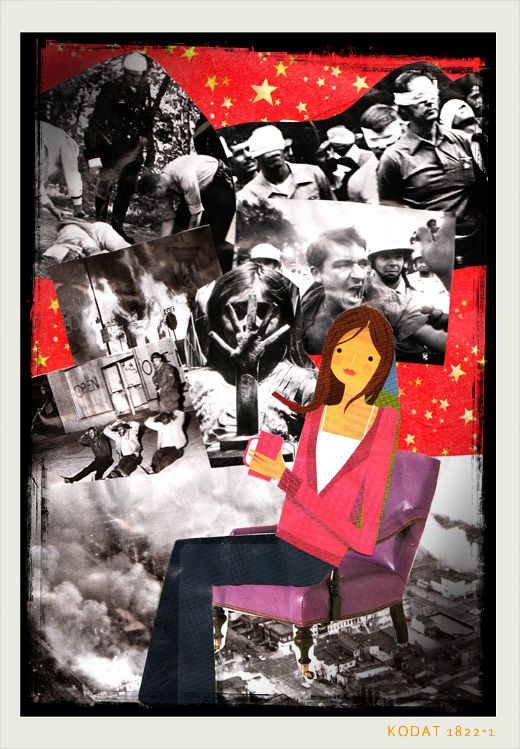
Here is another one I did as a babe in Christ, musing on Philippians 4:7 and the peace that passes all understanding. No matter if there is violence, war, explosions, the gal sipping tea is peaceful and unperturbed because she has Christ.

Another creative outlet I employ is spending a lot of time matching a verse with one of my photographs, all the while thinking of what the verse means. I shared these with you to show I’m not a wordsmith purist nor an old fuddy-duddy, lol. Creativity is good. Visuals are good. It’s just not a substitute for engaging your mind totally on the unadulterated word of God. Reading God’s Word is the encounter with God. Painting swirls on a Bible page is not an encounter with God.

The difference is, God’s word should stand alone and not become an “fun activity.”

We read that satan is the most subtle creature in the Garden. (Genesis 3:1.) If he can do anything to divert a Christian’s attention from the pure, unadulterated word of God, he will do it. This Bible art journaling is just such an activity. The Bible is not an art project. Coloring on its pages does not bring you closer to Jesus. Painting on its pages does not spark an encounter with Him. Reading His word, meditating on it, and obeying it is what illuminates the mind of God to us. Satan is an incremental foe. I have no idea abut the theology of this blogger but this one paragraph struck me as the best description of satan’s ploy in incrementally changing our stance on doctrine.

Incrementalism is the single best arrow in Satan’s quiver…It is a subtle approach to change masked as genuinely positive, and since it always comes in slow, bite size chunks over time, you do not even feel that you have been deceived until too late.

See what this blogger said about her jump into the journaling Bible movement. Again, I don’t disrespect her, but her opening statement seems to perfectly capture the incremental nature of satan’s ploy as explained above,

Truth be told, I had resisted this whole “art journaling in your Bible” movement at first since I already do a lot of Bible studying and I didn’t want to take time away from that in order to “play”. BUT, the seed was planted. Just about every time I cracked open my Bible I could see how I could incorporate this into my life by keeping it simple and recording what I was already learning. (source)

So once the seed was planted when she opened her Bible she didn’t see Jesus anymore but all she saw was how to use the space for her art. See? It’s a problem. We have blank sketch books for art. We have altered book tutorials. Not Bible art. As a matter of fact, Bible art journaling IS a form of altered book art.

Altered books: An altered book is a form of mixed media artwork that changes a book from its original form into a different form, altering its appearance and/or meaning. An altered book artist takes a book (old, new, recycled or multiple) and cuts, tears, glues, burns, folds, paints, adds to, collages, rebinds, gold-leafs, creates pop-ups, rubber-stamps, drills, bolts, and/or be-ribbons it. The artist may add pockets and niches to hold tags, rocks, ephemera, or other three-dimensional objects.

Here is an example of altered book art:

Source

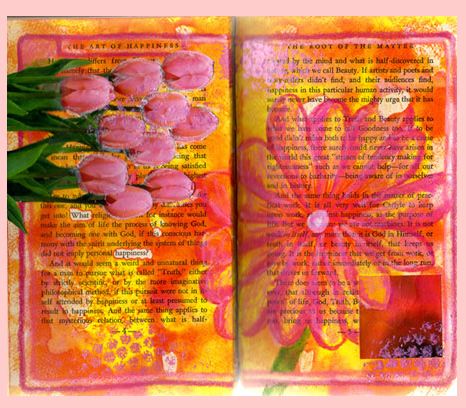
Here is an example of MY altered book art:

EPrata art

Here is an example of altered Bible art:

Source

Bible art journaling obscures God’s word. It competes with it. To be fair, the Bible art journaling blogger does not advocate abandoning devotional time nor substituting creative time for actual Bible study. But that is the subtle genius of satan. He is an incremental foe. A sly insertion of an activity with the Bible instead of reading the Bible itself is the goal. A familiar proverb or saying goes,

“If the camel once gets his nose in the tent, his body will soon follow.”

#3. I’d said that satan is subtle. Usually there is not anything particularly wrong with an activity or practice. You can’t point a finger and show the smoking gun. However the incremental nature of satan, taking an inch here, a half an inch there, over time chisels away at the foundation and all of a sudden you look around and wonder, “how did I get here?”

Just as Catholic labyrinths were re-branded as Protestant prayer walking, just as occult channeling was re-branded as “hearing from God”, just as mystical “contemplative prayer” was re-branded as “Protestant contemplative prayer”, just as Hindu Yoga was re-branded as ‘Christian Yoga’, just as Wiccan pentagrams were re-branded as “circle making”…”. Remember enneagrams? Those have Sufi roots. Bible art journaling is already melding with Hindu Mandala coloring. “Color your way closer to God?” No, no, no.

This Mandala Coloring Book For Grown Ups Is The Creative’s Way To Mindful Relaxation

For the unfamiliar, a mandala is a sacred symbol in Hinduism and Buddhism, made from a nest of squares and circles, that represents the cosmos. As the Asian Art Museum put it: “mandalas are not just images to view, but worlds to enter — after recreating the image in their mind’s eye, meditators imaginatively enter its realm.”

Oh! You mean, an encounter with the divine through creativity! Like this Christian description!

Bible art journaling is part of the growing, Illustrated Faith and Bible doodling movement where many are creating on the pages of their Bible. The idea is to engage more freely with the Word of God in new ways and to record personally inspiring scriptures in creative and artistic ways, which serve to remind us of moments in our personal journey with God. (source)

Or like this book available at Amazon, coloring Hindu mandalas to match Christian hymns.

Abide: An Adult Coloring Book Featuring 30 Great Hymns of the Faith: Where Art-Therapy and Soul-Therapy Meet

With original mandala artwork and hymn excerpts to color, Abide is certain to stimulate spirit and heart. Turn on some background music to play along as you color. Each coloring sheet is one-sided, with hymn texts printed on the back of each design.
Carefully selected hymns to appeal to young and old. Original mandala artwork. Artistic script designs. Simple, but beautiful mandala designs.

Source

People, Mandalas are HINDU. They are not, nor will they ever be CHRISTIAN. They represent something sacred to the unsaved. Something sacred to the unsaved is an IDOL. We are back to the Second Commandment I opened this essay with. Don’t believe me? See mandalas defined-

Definition of mandala:Mandala (Sanskrit Maṇḍala, ‘circle’) is a spiritual and ritual symbol in Indian religions, representing the universe. The basic form of most mandalas is a square with four gates containing a circle with a center point. In Hinduism, a mandala (yantra) is a two- or three-dimensional geometric composition used in sadhanas, puja or meditative rituals. It is considered to represent the abode of the deity. Each yantra is unique and calls the deity into the presence of the practitioner through the elaborate symbolic geometric designs. According to one scholar, “Yantras function as revelatory symbols of cosmic truths and as instructional charts of the spiritual aspect of human experience”. (source)

Do you really think it’s innocent to color a mandala just because some money-grubbing, undiscerning author re-packaged a pagan activity by pasting a line from a beloved hymn over the top of it and adding “Christian” to the title?

That is where Bible art journaling leads. It’s a diversion.

The Puritans had a high view of the Bible. Puritan Richard Baxter wrote in the mid 1600s,

The reading of the word of God, and the explication and application of it in good books, is a means to possess the mind with sound, orderly, and working apprehensions of God, and of his holy truths: so that in such reading our understandings are oft illuminated with a heavenly light, and our hearts are touched with a special delightful relish of that truth; and they are secretly attracted and engaged unto God and all the powers of our souls are excited and animated to a holy obedient life.

Therefore I do not believe that painting butterflies on my Bible’s pages is an encounter with Jesus. Doing so incrementally adulterates it, alters it, and then slowly degrades the high view we should have of it. The Bible is not an art project.

See? I like butterflies. Really.
Posted in cross, encouragement, john macarthur

The word of the cross is the power of God

At the 2003 Ligonier Conference, John MacArthur spoke on “The Myth of Influence”. His assigned topic was to speak on the myth that the Gospel advances on the back of public favor. In other words, that we can somehow influence people into the Kingdom of God if we hide the more unpalatable aspects of the Gospel, if we as a church try to look like the world, if we can stylize our churches in order to minimize resistance, if we make the church going experience comfortable for the non-believer, if we try to be cool they will see that Jesus is cool and then repent. There is only one way to enter the kingdom and it is through the gate of the Gospel.

The Gospel doesn’t advance on the back of public favor, it advances on the back of the Holy Spirit despite public hostility.

Of course this is a myth.

At the beginning his two-par message, Dr MacArthur said that he had endured many battles in his decades as a pastor and teacher. He’s defended the inerrancy of the Bible, battled over the authority of the word of God, battled over the deity of Jesus Christ, battles over the doctrine of the Holy Spirit, battled over paradigms over sanctification. Those were to be expected in the life of a pastor-teacher.

He said,

What I didn’t expect was to spend most of my ministry life battling to rescue the Gospel from evangelicals. That has really been a shock to me. It’s seemingly getting worse all the time as the Gospel sinks below the radar.

Serious worship disappears along with the public ordinances. Biblical, theological exposition of scripture vanishes. Transcendence and profundity are exchanged for mimicking shallow, worldly worship styles. Church discipline disappears, holiness is non-existent, and sin is normalized. The myth is that somehow this is going to get people into the kingdom.

For the word of the cross is folly to those who are perishing, but to us who are being saved it is the power of God. (1 Corinthians 1:18)

Think about that deeply for a moment. The word of the cross IS the power of God. For those of us being saved, the word of the cross is THE POWER OF GOD. Alternately, for those who are perishing, it is folly. Of course the Gospel will be rejected, condemned, dismissed. It is folly to those who are perishing. But for those whom God has ordained salvation, it is power.

Gill’s Exposition makes a distinction between the doctrine of the Christian’s cross, which we are to pick up and follow, and the cross here intended. It is —

of the cross of Christ, the doctrine of salvation by a crucified Christ; or the doctrine of peace and reconciliation by the blood of his cross, and of righteousness, pardon, atonement, and satisfaction by the offering up of himself upon it as a sacrifice for sin,

It is interesting to read Acts 28:22, where we see that even in Christianity’s heyday, the Christian message was reviled. Paul had appealed to Rome to hear his case, and the local leaders were gathered to hear Paul’s argument. They opened the proceedings by saying:

But we desire to hear from you what your views are, for with regard to this sect we know that everywhere it is spoken against.

There is always refreshment to get bask to the original doctrines, to ponder the power and grace of the atonement, to meditate upon the unique Person of Jesus Christ. I pray you and I be not ashamed of this word of the cross today.

If you would care to listen to the entire message, here it is. There’s a part two as well.

Posted in encouragement, soldier, tomb

Tomb of the Unknown v. the Christian soldier: Guarding the empty tomb

This past weekend’s latest ‘snowmageddon’ blizzard, this time, affecting Washington DC, elicited a slew of photos showing the dedicated soldiers protecting the Tomb of the Unknown Soldier at Arlington Cemetery.

The photos were made doubly interesting to me because this November at school, I listened to a speaker who explained the amount of work that must go into training the military personnel who guard the tomb. It’s incredible.

The man is called “The Tomb Guard”. His training begins with a look at the stats. First of all being the Tomb Guard is “an extremely demanding and humbling experience.” Selection for the Tomb Guard begins from the 3rd U.S. Infantry Regiment, called “The Old Guard”, which selects personnel based on “certain intangible traits, and with requirements for height and weight, physical fitness, aptitude scores, and conduct.”

Their mission: The regiment’s mission is to conduct memorial affairs to honor fallen comrades and ceremonies and special events to represent the U.S. Army, communicating its story to United States citizens and the world. (source)

If I remember correctly, though the candidate volunteers for the duty, about 97% of trainees flunk out or opt out of the rigorous cycle of training. The Tomb uniform standards are of the highest and strictest in nature, and are different than that of the Old Guard and regular Army. It takes about five hours alone just to prepare the uniform. The Tomb Guard trainee endures an extremely intense cycle.

…consisting of a series of five exhaustive tests over six to twelve months. The tests focus on outside performance (Changing of the Guard, and “Walking the Mat” 1), uniform preparation, and knowledge. Outside performance tests on weapons manual, ceremonial steps, cadence, military bearing, and orders. Uniform preparation tests on Tomb uniform standards 2 for the Army Dress Blues, Shoes “Spits”, glasses, and brass and metals. Knowledge tests on 35 pages of information on the history of the Tomb and ANC, for which the trainee must recite verbatim – including punctuation.

The tests are progressive, demanding quantifiable improvement and demonstrated performance. If the trainee completes the training cycle and passes the tests, they will be able to flawlessly conduct seven different types of ceremonies, to meet the highest standards of uniform preparation, and recite 35 pages of information without error. (source)

And of course you have seen the photos of the Guard out in all weather.

Source

Every athlete exercises self-control in all things. They do it to receive a perishable wreath, but we an imperishable. So I do not run aimlessly; I do not box as one beating the air. But I discipline my body and keep it under control, lest after preaching to others I myself should be disqualified. (1 Corinthians 9:25-27)

Source

If you look into the requirements to become a tomb guard, it’s amazing and incredible. Seeing the dedication and commitment of the Guards, It made me think of us as Christian Soldiers.

We are soldiers you see. We are in a war, and we must display the same preparation, diligence, and vigilance as the Tomb Guards. Can we recite 35 pages of the Bible without error? The Tomb Guards dedicate themselves to a higher cause (representing our nation and protecting the actual and the symbolical Tomb) with TOTAL commitment. The thing is, their 100% focus and attention cannot be sustained in his own strength. A typical tour of duty lasts a year on average, then most step down.

However we have the Holy Spirit in us. He is eternal, He is all-power, He is all-strength. The Spirit’s 100% focus of pointing to Christ never wanes or falters. IN HIM, we can prepare. IN HIM we can maintain diligence. IN HIM we can be vigilant in protecting the deposit.

Blessed is the man who remains steadfast under trial, for when he has stood the test he will receive the crown of life, which God has promised to those who love him. (James 1:12)

And let us not grow weary of doing good, for in due season we will reap, if we do not give up. (Galatians 6:9)

Praying at all times in the Spirit, with all prayer and supplication. To that end keep alert with all perseverance, making supplication for all the saints, (Ephesians 6:18)

On social media during the recent blizzard, there were many news outlets posting and publishing photos such as the ones above. We are all admiring of the physical AND mental posture of such men- straight as an arrow, 100% focus on the task at hand. If it is possible to apply one’s self with such resolve to a secular task in the flesh, impervious to even weather, then what are the possibilities for the Christian in the Spirit who chooses to train, guard, and maintain vigilance in the spiritual war? Endless, infinite, lavishly innumerable!

There is heavenly power available to us in the Spirit to be soldiers as the ones depicted above. We are moved by the photos showing dedication seemingly beyond human capacity. How much more moving it is, then, for new Christians, veteran Christians, and secular people, to see the power of God demonstrated in the ever-vigilant and focused soldier of God, guarding the blessedly empty tomb?

But they who wait for the LORD shall renew their strength; they shall mount up with wings like eagles; they shall run and not be weary; they shall walk and not faint. (Isaiah 40:31)

The tomb we guard is empty and the Occupant is alive! He is in us, empowering us to remain focused on the task at hand- proclaiming Jesus, training in righteousness, vigilantly pointing to Christ, sharing His message. The Tomb Guard’s vigilance is to promote the message of the United States which is represented in him. The Christian’s mission on this earth is the message of Jesus Christ as salvific Messiah will become known and is represented in us. We have the Holy Spirit to empower us in this eternally glorious task.

But you will receive power when the Holy Spirit comes upon you. And you will be my witnesses, telling people about me everywhere – in Jerusalem, throughout Judea, in Samaria, and to the ends of the earth. (Acts 1:8)

——————————–

Society of the Honor Guard

Posted in bible art journaling, potpourri

Prata’s Potpourri: Master’s Seminary church finder, why so many bad Christian books? Mocking Christianity, Housewife theologian, etc.

On Sunday my interim church (First Baptist Watkinsville) began a 40-day journey through the devotional book The Blessing Life. Look what our devotional has for us on this Tuesday morning,

You make known to me the path of life; in your presence there is fullness of joy; at your right hand are pleasures forevermore.” (Psalm 16:11).

It occurred to me- And WHO is at God’s right hand? Jesus. Acts 7:55, Romans 8:34, Ephesians 1:20, Hebrews 1:3…and so on.

At God’s right hand is Jesus who IS our pleasure forevermore. There are no pleasures which do not stem from Him. Jesus IS the pleasure. We are blessed to experience Him forevermore.

Q. 1. What is the chief end of man?
A. Man’s chief end is to glorify God, and to enjoy him forever.

Source: Westminster Shorter Catechism

~~~~~~~~~~~~~~~~~~~~~~~~

Meanwhile, here are some links to articles you might enjoy.

Ken Ham has some thoughts about a new CBS television show that mocks Christianity

Bud Ahlheim offers some advice on the problem of so many bad “Christian” books:

If you liked my recent post regarding music as music and nor worship, you’ll like this post about a wonderful hymn-
I Woke, The Dungeon Flamed With Light

Joel C. Rosenberg explains The Caliphate vs. The Kingdom. What is “the gospel of the kingdom” of Christ and why is it our hope in such dark times?

Aimee Byrd the Housewife Theologian has some good thoughts on the new fad of art journaling in your Bible. She says much the same thing I did a while back, but in shorter form, lol. I’ve got to work on that…

The Master’s Seminary Church Finder

I receive emails or Facebook messages from people who are thirsty for a good church and ask me to either advise or help them find one. A resource I always turn to is the master’s Seminary Church Finder resource. You plug in your location and it finds churches either planted by or led by TMS graduates. We all know that any graduate who has gone through TMS will emerge with a solid grounding, a love for expository preaching, and right doctrines.

Here is an article with a 2minute:45second interview from TMS Alumni Relations Director explaining the origin and use of the Church Finder page. He said in the interview that it is the number one used page on The Master’s Seminary website. The Church Finder receives 5000-7000 hits per month. I know at least 4 of them were mine.

And here is the Church Finder page.

Erin has some thoughts on self-promotion and selfie-righteousness in general on Social Media. Good words. I enjoy social media for the purpose of making Jesus known. However since I’m a sinner who love my own flesh, I have to constantly monitor my own Facebook Wall to ensure I’m not “using” Jesus as a way to display my own righteousness. That would be ridiculous of course, because I have no righteousness. It’s all from Jesus. Good advice from Erin.

Selfie Righteousness

Posted in hypocrisy, hypocrite, pharisees, sardis, warning

Are you becoming a hypocrite? Do you have an alive reputation but dead works?

Woe to you, scribes and Pharisees, hypocrites! For you tithe mint and dill and cumin, and have neglected the weightier matters of the law: justice and mercy and faithfulness. These you ought to have done, without neglecting the others. (Matthew 23:23)

They were busy, but had neglected faithfulness.

neglect the more important matters of the law: In this fourth woe, Jesus criticizes the religious leaders’ meticulous attention to detail. Their close attention to particulars often went beyond the law, resulting in a disregard for the law’s true heart (see Isa 1:17; Jer 22:3; Zech 7:9–10; Mic 6:8; Hab 2:4). Barry, J. D.,  Faithlife Study Bible (Mt 23:23).

Source, credit: (Jonathan Woodcock/Getty Images)

The love of the Lord was not in the Pharisees, as evidenced by their neglect of the weightier matters. They tried to buy reputation cheap by being busy tithing exact amounts which in the end, cost them nothing. A few verses later, Jesus charged them with being whitewashed tombs- pretty on the outside but dead inside. (Matthew 23:27)

This is similar to the charge to the Church at Sardis where they had a reputation for being alive, but were dead. Jesus said,

I know your works. You have the reputation of being alive, but you are dead. 2Wake up, and strengthen what remains and is about to die, for I have not found your works complete in the sight of my God. (Revelation 3:1a-2)

As with the Pharisees, a group of people were being charged with incomplete works. It’s hypocrisy again.

Christ quickly stripped away their reputation of being alive by declaring, you are dead. Like the Pharisees, their outer appearance was a facade hiding their lack of life (cf. Matt. 23:27–28). Christ added, I have not found your deeds complete in the sight of My God. They were falling far short of fulfilling their obligations as believers. [The Bible Knowledge Commentary: An Exposition of the Scriptures].

More from Matthew Henry:

With a reproof, and a very severe one: I know thy works, that thou hast a name that thou livest, and art dead. Hypocrisy, and a lamentable decay in religion, are the sins charged upon this church, by one who knew her well, and all her works. (1.) This church had gained a great reputation; it had a name, and a very honourable one, for a flourishing church, a name for vital lively religion, for purity of doctrine, unity among themselves, uniformity in worship, decency, and order. We read not of any unhappy divisions among themselves. Every thing appeared well, as to what falls under the observation of men. (2.) This church was not really what it was reputed to be. They had a name to live, but they were dead; there was a form of godliness, but not the power, a name to live, but not a principle of life. 

Dictionary of Bible Themes explains hypocrisy

An outward pretence masking an inner reality. Scripture condemns hypocrisy, especially in matters of faith. Believers should express their commitment to God in their words and their deeds, as well as in their inner motivation.

The origin of hypocrisy
Jer 17:9 See also Hos 10:2 Israel; Mk 7:21-22 pp Mt 15:19

The expression of hypocrisy
Insincere motives Mt 6:2 See also Mt 6:5,16; 15:7-9; 22:18; 23:5-7

When deeds do not match words Isa 29:13 See also Mt 15:7-8 pp Mk 7:6; Pr 26:24-26; Jer 9:8; 12:2; Eze 33:31; Mt 23:28; Ro 2:17-24; Jas 2:14-26

A tendency to judge others Mt 7:5 pp Lk 6:41 See also Ro 2:1

The alternative to hypocrisy
Heb 10:22 See also Ps 24:3-4; 26:4; 32:2; Jas 3:17; 4:8; 1Pe 2:1-3

I post all this to make a warning I personally take to heart for myself and I hope you do too. People tell me that in the past they have fallen under the spell of “doing church”. They mean that they realize they’ve been coasting along doing ministry or attending as a congregant but without heart, without thought. Suddenly they understand that they are coasting along on a former reputation but have lost the warmth or the motivation for being there in the first place. They say they realize now that they had been “playing church.” Sometimes the Lord uses a tragic circumstance to awaken and warm the sleepy Christian. Though it is difficult to go through a tragedy or a trial, this is one way God uses all to the good of those who love Him. Other times, the Spirit gracefully convicts us. Don’t ignore those warnings.

It is easy to become a hypocrite and hard to detect it one’s self. Unfortunately the Pharisees, Sadducees, and scribes never did come out from their hypocritical religion, which was the point of the woes Jesus leveled against them in Matthew 23. They were doomed. The church at Sardis was never complimented for one thing but grace was given to them with a personal rebuke to awaken them from their empty machinations. Did they ever awaken? One does not know since it isn’t declared in scripture. One this is for sure, there is no longer a church at Sardis.

Have you been playing at church? Has your church been coasting on a reputation, looks busy, but is empty inside? I don’t suppose hypocrisy comes on a person or a church like Sardis all at once like a flood, but incrementally. See this from John MacArthur. There were no drastic warnings to alert the church at Sardis that they were dead:

Like the city, the church declined. There was no mention of persecution about Sardis, though there must have been some. There was no mention of corrupt theology on the inside. There’s no mention of false teachers. But the church died. It had a good reputation. It had a name that it was alive. The light was still shining even though the star had died. There was no spiritual life. It claimed to be alive. The claim was a lie.

A slow decline is the hardest to detect. We don’t have the advantage of the Lord personally telling us like He did the church at Sardis that we have slidden from the warmth of a heart rightly motivated in worship, but we do have the Holy Spirit to convict us when we are beginning to hollow out our worship. We have the many warnings in the Bible about hypocrisy. Listen to Him if you feel that church or ministry reputation is all that you have, and have made your works incomplete. Attend to the mint and cumin, but do not neglect mercy and justice.