Posted in discernment, Uncategorized

Thoughts on introspection and journaling

DebbieLynne Kespert wrote a great piece about journaling the other day. I recommend it. I linked to it below, too.

Journaling is the act of consistently writing down one’s thoughts, feelings, and events in a notebook, as the definition goes. Some people do that to track growth, or to leave as a legacy to coming generations, or to vent. Journaling is distinct from many other kinds of diaries, like food diaries people keep for medical reasons, or weather diaries farmers keep, stress or anger management diaries, and the like. Journaling expressly focuses on one’s conscious inner thoughts, sensations, and feelings. It is a method of emotional self-examination.

I’ve never gotten into journaling. I like to experience the day and then move on. As someone on the autism spectrum, I’m not that in touch with my feelings anyway, seeing them as not precisely unnecessary, but usually as unhelpful. Yet many others see journaling as very helpful–

Ever wondered why history’s great minds including Isaac Newton, Abraham Lincoln, Andy Warhol, Leonardo Da Vinci, Marcus Aurelius, Charles Darwin, Winston Churchill, Benjamin Franklin, Ernest Hemingway, George Bernard Shaw and Maya Angelou would spend so much of their precious time writing things that will never be seen by another soul? … Many famous creatives, writers, innovators and original thinkers of our generation keep journals— for many, it is a creative necessity, for others, a place for exploration, and for some an art form in and of itself. (Source)

For Christians, some self-examination is good. It is worthwhile to examine one’s self to see if one is in the faith. Scripture admonishes us to do just that. (2 Corinthians 13:5, 2 Peter 1:10-11).

In the Christian spheres, Charles Spurgeon, the Prince of Preachers, kept a diary and also wrote letters constantly. Those became his autobiography after he died. The great theologian Jonathan Edwards kept a journal. In it, he penned his famous 70 resolutions. As the pastors say at the Netherlands Heritage Reformed Congregation, “these resolutions were birthed out of his felt weaknesses and known deficiencies, not his personal attainments. They represent, therefore, his sanctified, biblically-conditioned aspirations.”

My personal journal: In my journal below, I am trying to figure out from the Bible
about the different resurrections.

Christian journaling can be very good.

However caution abounds. Ligonier says that self-examination is important, but must be done rightly. Faulty self-evaluation, the passage tells us, is an obstacle to walking by the Spirit. If after examining ourselves we “conclude that we are superior to others” the self-examination is faulty, but alternately if we conclude that “if we consider our gifts inferior to those of others, thinking we are unable to assist burdened believers” it is also faulty.

So the Bible does call for some self-examination to be done, and there is a right way and a wrong way to do it.

But is a good thing, ever too much of a good thing? It can be. In her article, Journaling: The Pitfall We Should Recognize, DebbieLynne Kespert says that she journaled for 17 years, venting feelings, writing experiences, and meditating on her disappointments, her frustrations and her fears. Then she had an epiphany. She wrote:

So when someone uses a personal journal to ruminate on their feelings, should it surprise us that we wind up wallowing in self-absorbtion? Self-absorbtion, however, is the antithesis of Biblical Christianity. Christ demands that His followers actually die to ourselves for His sake.

It’s the tendency of sinful man to wallow in self-absorption to begin with. Journaling only increases that tendency. Excessive navel-gazing is not good as it takes our eyes off Jesus, upon whom we are supposed to fix our eyes. (2 Corinthians 4:18, Hebrews 12:2).

Jared Mellinger wrote about excessive self-examination in his piece “Self-Examination Speaks a Thousand Lies. He said,

Unhealthy introspection is a daily threat to our joy in Christ. Many of us tend to examine ourselves in a way that is excessive, inaccurate, and leads to discouragement. God calls us to examine ourselves (2 Corinthians 13:5; Lamentations 3:40), but healthy self-examination is a difficult and dangerous duty. The flesh seizes self-examination as an opportunity to turn our thoughts against us. Introspection is deceptive because it often looks like we’re doing the right thing: we’re not indifferent to our sin — we want to seek it out! But when that introspection makes us self-absorbed instead of Christ-absorbed, we undermine our faith.

Providentially, Randy Alcorn wrote an interesting piece a few days ago as well. It didn’t center on journaling per se, it was about self-control, but it speaks to the where we want our mind to go:

What is your mindset? Do you dwell on selfish, envious, jealous, bitter thoughts? Or do you dwell on what pleases God? Do you focus on God, His Word, and His mighty works on our behalf, or do you focus on woes and misfortunes and abuses suffered at the hands of others? According to Scripture, the choice is yours.

The choice is yours. Journaling can be good when the Christian employs self-control during the introspection process. Do you journal? Do you enjoy it? Has it become simply a way to focus attention on one’s self? Let me know int he comments what your experience has been.

Further reading:

The End Time: Is Christian journaling Good or Bad?
Posted in discernment, Uncategorized

Throwback Thursday: Are there codes in the Bible?

This essay first appeared in November 2010 on The End Time

I hear people all the time say that there are bible codes. That there is some secret, esoteric knowledge hidden within the 66 books of the bible that only people perspicacious enough can unlock and benefit from. This is bunk. God is not the author of confusion and He laid everything out plainly within those pages, so that His knowledge, plan, and wisdom for us would be clear.

They cite, for example, Bullinger, who derived a whole system of meanings from numbers in scripture. Some numbers do have meaning, but not to the extent Bullinger worked up. And anyway, Bullinger believed that the soul died between life and resurrection. He was also an ultradispensationalist, believing that (among other things) the church did not begin at Pentecost but at Paul’s conversion. Um…no.

In another code, “The Bible Code”, it is purported in a paper by Yoav Rosenberg that there was strong statistical evidence that biographical information about famous rabbis was encoded in the text of the Bible, centuries before those rabbis lived. Wikipedia says of the method of extracting the meaning from the coded language is

“the Equidistant Letter Sequence (ELS). To obtain an ELS from a text, choose a starting point (in principle, any letter) and a skip number, also freely and possibly negative. Then, beginning at the starting point, select letters from the text at equal spacing as given by the skip number. For example, the bold letters in this sentence form an ELS. With a skip of -4, and ignoring the spaces and punctuation, the word safest is spelled out.”

No again.

Of course, the primary fault with Bullinger’s numerical code and Rosenberg’s word codes is that the Holy Spirit is taken out of the equation. Believing in codes means man in his own mental acuity can unlock the secrets of the bible, the Spirit is not needed…which is exactly the opposite of what God said would be so.

The question is, “Are there hidden codes in the bible?” The answer is NO. John Macarthur addressed this question quite well, here. His short answer is below.

One of the foundational qualities of the Bible is its clarity (sometimes called perspicuity). That means Scripture’s main teachings are plain enough to be understood without the need of special expertise or church-sanctioned interpretations. 

The Bible frequently speaks about its own clarity. Psalm 119:130 says, “The unfolding of Thy words gives light; it gives understanding to the simple.” The average person who humbly reads the Bible can say, “I have more insight than all my teachers, for Thy testimonies are my meditation” (Psalm 119:99). Psalm 19:7 teaches, “The testimony of the Lord is sure, making wise the simple.” 

The idea of hidden codes in the Bible contradicts all of that by limiting accessibility to the real message of the Bible to so-called experts who can decipher the cryptic messages God “hid” in the Scriptures. But such “experts” aren’t needed because the Bible contains no hidden codes. 

One hidden-code theory works like a common word-search puzzle–hidden messages are supposedly embedded diagonally within the Hebrew text. But that’s as foolish as turning your daily newspaper into a word-search puzzle and expecting to find meaningful stories hidden in it. Newspapers aren’t written to convey messages in secret code, and neither was the Bible. Both should be read using ordinary rules of language. 

Of course there are concepts in the Bible that are hard to understand–even the apostle Peter admitted that (2 Peter 3:15). But the way to discover the meaning of those hard passages is not by seeking out hidden messages, but by engaging in diligent study that accurately handles the word of truth (2 Timothy 2:15). 

Take heart! The Bible is clear and even the most untrained reader can understand it. God wants you to understand the Bible, and He has provided the Holy Spirit as a guide. After all, “man does not live by bread alone, but…by everything that proceeds out of the mouth of the LORD” (Deuteronomy 8:3).

The LORD is not the author of confusion (1 Cor 14:33) but reveals Himself to one and all. If you have the Holy Spirit in you, you have an equal chance to understand what He wrote in it as anyone else. As MacArthur said, prayer, study, and diligence will “unlock” His Word. Not codes. If you believe codes exist in the bible then you accept that the Spirit is out of the equation and people like Bullinger have extra advanced knowledge that you must rely on HIM to unlock for you. No, let it not be so!

Posted in prophecy, Uncategorized

Jerusalem is the center of the world

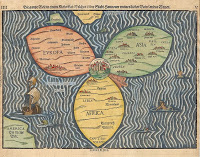
Israel is the center of the world. We know this because in Genesis 12:3 God said to Abraham- “I will make you into a great nation and I will bless you; I will make your name great, and you will be a blessing. I will bless those who bless you, and whoever curses you I will curse; and all peoples on earth will be blessed through you.” Israel is the lens through which God judges nations. What happens to Israel affects the entire world. (Above, Bünting clover leaf map. A 1581 woodcut, Magdeburg. Jerusalem is in the center, surrounded by Europe, Asia and Africa.)

Other nations and cities have incorrectly named themselves the center of the world. When Rome was at its height as a city and as an empire, it called itself the center of the world and even marked the spot with a tower and a plaque. The Romans installed the marker dubbed “navel of the city of Rome” (Umbilicus Urbis Romaen) in the Forum, from which all distances to the ends of the civilized world were marked. It was mile zero. This marker was one of the first things I had wanted to see when I visited Rome, because my travels around Italy, even over obscure and distant dirt back roads, invariably led to a road sign pointing to Rome. It is true, in Italy, all roads lead to Rome.

Ecuador is named after the equator, which runs through the country. A museum complex marks the spot and it is called “Mitad Del Mundo” or Middle of the World. Wikipedia says its 30-meter-tall monument, built between 1979 and 1982, was constructed to mark the point where the equator passes through the country in the geodetic datum in use in Ecuador at that time. I was one of the thousands of goofy tourists who have stood with one foot on one side of the painted red line representing the Equator, and the other foot on the other side, laughing while someone takes a photo of me. It was an interesting place, and I really liked the red line of the physical representation of the middle of the world. (photo right, of the Mitad del Mundo, by Elizabeth Prata)

But Jerusalem is really the navel of the world. In the Middle Ages it was even depicted that way. Did you know, that the Hereford Mappa Mundi, drawn in circa 1300, depicted Jerusalem as the center of the world? In the Church of the Holy Sepulchre in Jerusalem there is also an omphalos, Greek word for belly button or navel. The existence of this stone is based upon the medieval thought that Jerusalem is the spiritual if not geographical center of the world.

In all of history, there’s never been a distinct people group who dwelled outside of a national homeland for thousands of years yet retained their identity like the Jewish people. There has never been a people on earth restored to their homeland after dozens of generations. There has never been a case where generations upon generations who forgot their own language and let it die, had it restored to the entire nation. No people, that is, except for God’s people in God’s land.

This tiny nation is mighty in many ways, because her very existence has generated hate and war since her birth. Just existing provokes the world into hating her. Allowing her to make her own sovereign decisions as a nation inflames the world (satan).

And again, war will come to her but that time it will be one of the last times. We know from prophecy that the Gog-Magog war will be a surprise attack on Israel as stated in Ezekiel 38-39. We know that Damascus will be destroyed (Isaiah 17:1) indicating some kind of war-like event that obliterates the world’s oldest continuously inhabited city. Psalm 83 has variously been interpreted as either an intercessory prayer about a war, or a foretelling of a last days war. And Armageddon, the last war, will occur. The list of wars is long. There will be so many wars that peace does not exist anywhere from the moment the 2nd seal is opened in Rev. 6:4 when peace is taken from the earth, until Jesus returns to restore peace Himself.

Pray for the peace of Jerusalem!
“May they be secure who love you!
7Peace be within your walls
and security within your towers!”
8For my brothers and companions’ sake
I will say, “Peace be within you!”
9For the sake of the house of the LORD our God,
I will seek your good.
Psalm 122:6-9

Posted in encouragement, Uncategorized

How to be a good wife

Our church sponsored a Womans’ Event recently. We ladies had brunch together and then retired to a classroom to hear a talk by a charming and wonderful woman on being a Christian Wife.

Karen Schaeffer is wife of 52 years to Fritz Schaeffer. Now, Dr Schaeffer is a world-renowned Doctor of Chemical Physics. He is one of the most highly cited scientists in the world. He is also a Christian, as is his wife.

I mention Dr Schaeffer’s renown to provide a backdrop for his wife’s talk to us ladies at our church. Wives have a difficult go. Wives who are mothers have an ever harder time. Wives with children who are married to men in the spotlight have even more challenges. Reputable scientists’ wives who are also Christians face challenges most of us never even know.

Being happily and solidly married to a man for 52 years is an achievement. It is only by the Holy Spirit that two people who at birth and up to conversion are selfish and evil. After conversion men and women are still cursed with tendency to either be passive or to usurp. It is by the Spirit that He grows submission, respect, and love between two people. Through Him, man and woman are united and one flesh, living a Spirit-empowered life.

It is with that wisdom we went to hear what we could learn from this remarkable woman.

I noticed immediately her demeanor. A woman is supposed to be a lot of things, according to the Bible. Both men and women are supposed to be meek and gentle and exhibit the fruit of the Spirit which is love, joy, peace, forbearance, kindness, goodness, faithfulness, gentleness and self-control. Add to that special instructions for young women and/or older women as Titus 2 says, and then add to that special instructions for wives as Ephesians, Proverbs, and 1 Peter explain, and we have a lot to consider as we strive to honor our glorious Savior.

Mrs Schaeffer exhibited these qualities and in humility shared from the wisdom gained from her experience as a long-standing wife. Her humble and gentle demeanor was striking and at once noticeable to the ladies in the audience including me.

She began by sharing that in turn, she was mentored and influenced in her younger days by a Godly women, with whom she is still friends. She noted the importance of surrounding one’s self with mature -in-the-faith women from whom one can seek advice, or ask questions. Like this one Mrs Schaeffer had asked her mentor/friend long ago:

Mrs S.: Can you wear jeans to church?
Mentor: Sure. … If that’s the best you’ve got.

Note: Not the Schaeffers

As a wife, she said to be sure not to impose your personality upon your husband. She said for example, that she is an introvert and he is an extrovert, and it would be easy to become dissatisfied with his rambunctiousness, eagerness to be among people, and excitement at trying new things. Be wary, wives, of pressuring him to conform to your personality, Instead, support him in his. “Let your husband be himself”.

This might seem like obvious advice, but how many of us fall in love with a man because of certain qualities he exhibits that we find charming or fascinating, then as the decades go on, those very same qualities begin to grate on us?

t’s easy to compare your husband to others. When we do, we become dissatisfied. “Her husband does the dishes,” one grouses learn to be content. “Her hubby notices things that need fixing without having to nag,” another wife might complain. Do not compare. Consider no others and make no comparisons. You chose him. He chose you. And, you’re no prize, either. 🙂 If your husband isn’t all you want him to be, God might be growing your faith.

If I can interject my thoughts at this juncture, I’d like to say that though Mrs. Schaeffer’s advice to wives to be content and patient may be obvious, it is a revolutionary thought. Many women these days expect immediate results because all they ever wanted was immediately gratified. Many others want what they want Without working for it. Learning contentment is a foreign notion. It wasn’t foreign to Paul, though. Philippians 4:11 says, “I am not saying this out of need, for I have learned to be content regardless of my circumstances.”

Mrs. Schaefer used a vivid symbol here. She said to “fence your marriage.” She was speaking here of becoming too close to other men. “Don’t go to lunch one-on-one with men, do not confide in them. Don’t draw too close in friendship with men.

Criticism. That’s a huge subject. Mrs. Schaeffer said that it seems that men are highly affected by a wife’s criticism. “A little goes a long way,” she said. When something happens, she advised praying for three days. “If you still remember it, if it still seems like something that needs addressing, then bring it up.” But first, cook him his favorite meal, or bring it up when he is feeling good. “Be careful with criticism.”

Note, not the doorknob in question

She related a story about when they lived in Germany for a while. He wanted to go for a long walk on a trail that goes beside the river. They would end up in Munich. “It looks like rain,” Mrs Schaeffer said. The reply was that everything owuld be fine.

Well come a deluge. There was nowhere to hide for miles, and they trudged on. No umbrella, no rain gear, they were simply soaked. They eventually got to their destination, and she said she never said a word and never ever said “I told you so.”

“Don’t yell or argue, ever.” James 3:5-6 was cited here, So also the tongue is a small member, yet it boasts of great things. How great a forest is set ablaze by such a small fire! And the tongue is a fire, a world of unrighteousness. The tongue is set among our members, staining the whole body, setting on fire the entire course of life, and set on fire by hell. 

Humility is in order, forgive as Christ has forgiven you. If you have done wrong, apologize fully, not saying “I’m sorry, but…”

The husband is out in the world, working and providing and persevering, sometimes in a job he loves and sometimes not. Make him happy to come home, Mrs Schaeffer said. “If he is getting criticism at work, then make the home a happy, safe haven. If he’s getting praise in the world, and you criticize at home, then why would he come home? Therefore, no nagging.”

Mrs Schaeffer told a story of the loose doorknob. It was broken, kept falling out. She waited. She asked him to fix it. She asked again. It ground on her nerves. Then she got some perspective. Paraphrasing, she said counted her blessings. “If he can live with it, so can I.” Her advice: Fix it yourself,hire someone to fix it, or ignore it.

I thought important advice to hear was not to rely on him for all your emotional needs. “Have close (female) Christian friends or prayer partners. Develop your talents and hobbies, something he can respect.”

After the Lord, make him your number 1 priority. Get away together alone, occasionally. It’s never a good time to go away but make time.

By the Lord’s grace, perhaps you will be blessed with a 51-year or longer marriage. It isn’t easy, sometimes it is downright boring, but overall, it is worth it to meld together into one flesh on the journey into being transformed into Jesus’ image.

Posted in encouragement, Uncategorized

An encouragement on fixing our eyes on Jesus

Our Church is Reformed Confessing. Prior to the sermon, we have a time of confessional led by one of our Elders. We have 4 elders. One is the main teaching elder, though any of the men can teach at the pulpit. The other three men rotate in leading the confessional. The Confessional-teaching elder gives a short talk based on what the upcoming sermon will be and then stands silently as we individually confess and repent in our pews. Then he closes in an audible prayer. I appreciate the opportunity to set my heart and mind aright, and to confess, particularly when it’s a Lord’s Table Sunday.

This past Sunday, our elder gave  a confessional talk that had so many wonderful points. Well, each week the confessional is always good, but this week I really enjoyed some things that stood out to me. I’m paraphrasing, but-

If You want to look like Jesus, look at Jesus.

Our elder made the statement that we should fix our gaze upon Jesus, not the latest comedy or sports teams. I ended up focusing on the phrase “fix your eyes upon Jesus” from Hebrews 12:2. I looked up the word “fix” and the Strong’s says

872 aphoráō (from 575 /apó, “away from” and 3708 /horáō, “see”) – properly, “looking away from all else, to fix one’s gaze upon” (Abbott-Smith).

How helpful. I should not glance, not peek, not glimpse, but FIX my GAZE upon him, looking away from all else and steadily drinking in all that He is.

I need to spend more time with Jesus to look more like Him. What a great line. Moses only got to see God’s ‘back’ and His face after being with God was so bright it had to be veiled. We have the privilege of looking at Jesus’ “face” as it were, through His word. I want my face to be shining, to have my being conformed to Him, to have my mind transformed. But it won’t happen unless I read the Bible.

I was convicted because I found a new comedy that I got involved in binging this week and let my Bible reading go. I excused it by saying I was tired from the last week of school. All I wanted to do when I get home in this record heat was plop down and not think. But it’s not an excuse. Not at all. I must look away from all other distractions and FIX my GAZE on Jesus. A Bible skim won’t even do.

If you’re interested in hearing the Confessional, here it is, in all its 13 minute power. I pray it convicts you as it did me, in some way that will honor and glorify the Lord as a result. I know what I’m going to be doing when I get home.

May 13, 2018
We become like what we behold.


Posted in mothers, Uncategorized

Mother’s Day: Thank you to Christian Mothers of yesteryear and now

By Elizabeth Prata

Christian mothers are precious in God’s sight. I’ve talked before about the effect Charles Spurgeon’s mother had on him. Today we see the effect Frank Boreham’s mother had. She nurtured and raised a man who became one of Christianity’s top 20 preachers, ever. What a glory to Jesus mothers give, when they raise their children in His name! What a long-lasting effect they have on the faith throughout the ages!

Spurgeon had a mother. She bore 17 children. Nine of them died. Phil Johnson wrote in his essay “How childhood influences shaped a great preacher“,

Spurgeon’s mother was the one whose influence first awakened him to the claims of Christ on his life. Her exhortations to her children, as well as her prayers on their behalf, made an indelible impact on Charles as a young boy.

It is the same with Boreham. From the 4-part video of Boreham’s life, we hear the narrator speak, and then an actor re-enacting Boreham reading from his memoirs.

~~~~~~~~~~~~~~~~~~~~~~~~~~~

Narrator: FW Boreham adored his mother. His admiration was magnified because of the stories she told and the engaging way she told them.

Boreham: I have never heard anybody unfold the classic biblical narratives with such dignity and winsomeness and charm such as she could command. And when she came to the story of the cross, she could move us all to tears. I confess that although betwixt those days and these, I have attended many theological lectures and read ponderous theological tomes. The conception of the cross was always in my mind and in preaching and in writing, is the conception that took shape within me by the fireside in those days of long ago.

Narrator: Boreham could say that on those Sunday nights in front of the fireplace with his mother nine times out of ten the evenings closed with the singing of his mother’s favorite hymn that exactly summed up all her teaching:

Jesus, who lived above the sky,
Came down to be a Man and die;
And in the Bible we may see
How very good He used to be.

Boreham: And all through the long years of pilgrimage I’ve never sung that hymn or heard it sung without experiencing a clutch at the heart and a moistening of the eyes as the fond recollection has swept over me as those heart to heart talks in the flickering firelight of the old home.

~~~~~~~~~~~~~~~~~~~~~~~~~~~

Christian Mothers, thank you!

Posted in discernment, Uncategorized

What is blasphemy, exactly?

One thing I get tired of is the culture blaspheming the Lord.

Psalms 74:10 O God, how long shall the adversary reproach? shall the enemy blaspheme thy name for ever?

Deuteronomy 16:21 – “Do not set up any wooden Asherah pole beside the altar you build to the LORD your God,”

Barnes’ notes on blasphemy:

The word “blaspheme” originally means to speak evil of anyone; to injure by words; to blame unjustly. When applied to God, it means to speak of him unjustly; to ascribe to him acts and attributes which he does not possess; or to speak impiously or profanely. It also means to say or do anything by which his name or honor is insulted, or which conveys an “impression” unfavourable to God.

Eaton’s Bible Dictionary: sacrilege-

The sin or crime of violating or profaning sacred things; the alienating to laymen, or to common purposes, what has been appropriated or consecrated to religious persons or uses.

In 2 Corinthians 6:16 Paul was urging the new believers not to join in with the wicked and the profane, not to attend the festivals where vestiges of the old false gods and the vibrancy of the new false gods still were worshiped openly. He said not to join in any way with their sacrilegious activities. Believers must separate from these activities, soundly and firmly, visibly and demonstrably. Paul wrote: “What agreement is there between the temple of God and idols? For we are the temple of the living God. As God has said: “I will live with them and walk among them, and I will be their God, and they will be my people.”

John MacArthur:

The issue here is an issue of sacrilege. All false religion is demon worship. Listen, now remember an idol is nothing. You can carve an idol out of wood, you can make an idol out of stone, you can make an idol out of silver, you can make one out of gold. You can do whatever you want to paint one on a wall. You can form one out of marble, whatever it is. When you’re done with it, it’s nothing. But the religion and the ideology that it stands for is the teaching of demons. It is lies from the pits. It is the doctrines of demons coming from seducing spirits. So that what happens is demons impersonate the idol and you worship a demon in the idol, though you don’t know it. It is a demon who creates the religion, who conducts the relationship with the worshiper. It is demon communion.

MacArthur was speaking of Manasseh in 2 Kings 21:1-4-

Manasseh was twelve years old when he became king, and he reigned in Jerusalem fifty-five years. His mother’s name was Hephzibah. He did evil in the eyes of the Lord, following the detestable practices of the nations the Lord had driven out before the Israelites. He rebuilt the high places his father Hezekiah had destroyed; he also erected altars to Baal and made an Asherah pole, as Ahab king of Israel had done. He bowed down to all the starry hosts and worshiped them. He built altars in the temple of the Lord, of which the Lord had said, “In Jerusalem I will put my Name.”

He put the idols back into the Temple where the name of the ONE HOLY God’s name resided! One of the false gods they worshiped idolatrously was Asherah. Those old gods are NOT GONE. Satan still perpetuates them, or recycles them. In Josiah’s day it was Asherah. In Paul’s day it was Diana. In our day, Molech has become “Abortion.” The queen of heaven mentioned in Jeremiah 7:18 and  Jeremiah 44:17-25 is now Mary, Co-redemptrix of the Catholics.

GotQuestions explains that blasphemy is:

to speak with contempt about God or to be defiantly irreverent. Blasphemy is verbal or written reproach of God’s name, character, work, or attributes.
Blasphemy was a serious crime in the law God gave to Moses. The Israelites were to worship and obey God. In Leviticus 24:10–16, a man blasphemed the name of God. To the Hebrews, a name wasn’t just a convenient label. It was a symbolic representation of a person’s character. The man in Leviticus who blasphemed God’s name was stoned to death.

The truth is, every time we misrepresent God in word or in behavior, we blaspheme. It’s not just actively worshiping a stone false god that enacts a blasphemy but our own misrepresentation of Him. He is holy and perfect. We should be careful, oh so careful, to ensure that our lives and our words represent Him rightly as the God He is.

Who is like You among the gods, O LORD? Who is like You, majestic in holiness, Awesome in praises, working wonders? (Exodus 15:11).

majestic

Posted in encouragement, Uncategorized

Parables in the Old Testament

We know and love Jesus’ New Testament parables. Here is the parable of the mustard seed.

The Parable of the Mustard Seed
And he said, “With what can we compare the kingdom of God, or what parable shall we use for it? It is like a grain of mustard seed, which, when sown on the ground, is the smallest of all the seeds on earth, yet when it is sown it grows up and becomes larger than all the garden plants and puts out large branches, so that the birds of the air can make nests in its shade”. (Mark 4:30-34)

The seed is the word of God.

The work of grace is small in its beginnings, but comes to be great and considerable at last (v. 30–32); “Whereunto shall I liken the kingdom of God, as now to be set up by the Messiah? How shall I make you to understand the designed method of it?” Christ speaks as one considering and consulting with himself, how to illustrate it with an apt similitude; With what comparison shall we compare it? Shall we fetch it from the motions of the sun, or the revolutions of the moon? No, the comparison is borrowed from this earth, it is like a grain of mustard-seed; he had compared it before to seed sown, here to that seed, intending thereby to show, Source: Matthew Henry’s commentary on the whole Bible

The illustration is, that the smallest seed takes root and grows to something that is strong and fruitful- even mighty. Who doesn’t look on a strong, tall, might tree and feel awe and marvel at its strength, symmetry, and beauty? The seed does not do this of itself, the Grower grows it.

I stopped on my way to work at dawn to admire this tree in the pasture, cows around it, ground mist rising, pond glittering, sky just pinkening:

dawn in ne ga

The parable/allegory of trees is seen in Old Testament texts as well. Yes, the OT has parables! The use of the words parable and allegory are specifically stated in Ezekiel 17:1-2 (NIV). Then the LORD continues after verse 1 in relating to Ezekiel the parable Ezekiel is to relate to the Israelites. From Ezekiel 17:3-10 the parable of the tree continues, with the trees representing kings. In the latter part of the chapter, the LORD explained the parable to Ezekiel (and us!)

There are still other symbolic comparisons to trees in the Old Testament. In Ezekiel 31 in its entirety reveals Assyria’s fate. Here, the tree is likened to nations. In Ezekiel 17 the tree was likened to kings.

Daniel 4 also has a parable of a tree. This time the LORD did not say it as a parable but gave it in a dream to King Nebuchadnezzar. The king did not understand it. He called for Daniel to interpret the dream, which Daniel graciously did, thanks to wisdom from God. In this case, the tree was Nebuchadnezzar, whose kingdom had grown strong and tall, will be cut down, but the stump is banded, and will grow strong once again.

The righteous shall flourish like a palm tree, He shall grow like a cedar in Lebanon. (Psalm 92:12 NKJV).

I have seen the wicked in great power, And spreading himself like a native green tree. (Psalm 37:35 NKJV).

When we say we would like to “dig deeper”into God’s word, this is one way. We can ponder the symbols and parables and allegories in both the Old Testament and the New Testament. Did you know there were parables in the OT? The Bible is rich in learning for us, lyrical as a written form, full of depth and power.

Most important of all, it is where we find truth and life.

Posted in Uncategorized

Call for Comments

Are you a Christian painter, musician, or crafter? Writer, poet, or other creative person?

I’m writing an essay on the Christian and the creative process.

Would you care to contribute a comment for publication on how you engage in your creative process as an image bearer and honoring the creativity God gave you with exalting Him? and the like? Or just how your process goes in ensuring pride-dampening, holy-God-exalting finished pieces? Or anything about the use of the creative talents God gave you?

Send to my email listed at the bottom of the About page for this blog, here

https://the-end-time.org/about/

Sincerely,

Elizabeth Prata

Posted in prophecy, Uncategorized

Holy Fear: The Great Earthquake, part 3/3

This series first appeared on The End Time in March 2011. Today’s essay has been edited & updated.

Part 1 here
Part 2 here

“The earth shook and trembled; the foundations also of the hills moved and were shaken, because He was wroth.” (Psalm 18:7).

The USGS essay regarding the historical New England earthquake of 1727 and its aftermath continues

“The people of New England were affected by this earthquake as they had never been before, being fearful of divine judgments for their sins and lax responsiveness to the call to religious duties. The clergy taught them that it was “a loud call to the whole land to repent and fear and give glory to God.” The next morning great numbers of the inhabitants of Boston gathered at the old North church for prayer and other religious services. The fear of further immediate danger was somewhat dispelled in the pleasant sunlight, but as soon as the sun had set their fright returned, and in greater numbers than in the morning the people crowded to the old Brick church, which could not hold them. The old South was then opened, and those who failed of admission to the Brick church flocked thither, and that was also filled. Rev. Thomas Paine of Weymouth, Mass., and some other ministers, tried to prove to their congregations that the earthquake had not a natural cause, but was a supernatural token of God’s anger to the sinful world.”

“The selectmen of Medford, Mass., appointed the next Wednesday as a day to be observed by fasting and prayer on account of the earthquake; and Lieutenant-governor Dummer recommended that Thursday should be kept in the same way for the same purpose throughout the province. Many sermons delivered on the latter and other days were printed and are still extant. In Salem, Mass., a meeting was held on Saturday at the upper meeting-house (then so called) which was attended by the largest congregation that was ever in that edifice.”

They repented, the fasted, they prayed, and they entreated. The people fell down before a mighty God and supplicated in proper Holy Fear.

In his sermon “A Holy Fear of God and His Judgments” John Cotton defined Holy Fear:

–Trembling for fear of God implies our solemn an awful apprehensions of the great God, who brings such judgments upon us

–Trembling for fear of God means that we are sensibly touched and affected with the consideration of the judgments that are or may yet be brought upon us.

–Trembling for fear of God means our humbling ourselves exceedingly before Him who is thus visiting and threatening us.

Do we tremble? Rarely. We strut, we dismiss, we forget the power He wields, and holds back. Holy Fear, repentance, and awe of His majesty are not popular topics today. Prosperity, ecstatic experiences, all paths leading to heaven are the topics of today, when the bible is even referred to at all.

I remember the bright fall day of September 11, 2001. I was in my newspaper office happily writing the last of the articles for upcoming publication, and then my world shattered. Planes smashed into the Twin Towers in NYC, the Pentagon in Washington DC (where we lost a home town boy) and into the Pennsylvania ground. Our complacency was gone and the world never looked the same after that day.

More to the point, the event shook all of us in America. The next Sunday, churches were full. People wanted – needed – answers. Intuitively we knew any answers that came from ourselves would be inadequate. We sought them from ‘somewhere or something else.’

The rush to church was short-lived, as it inevitably must be in a pagan nation.

After 9/11, a short-lived rush to church: Mark Chaves on how church business boomed briefly after 9/11

Church Attendance Back to Normal

Repenting. Falling down on our faces. These are proper responses when disaster strikes. It’s intuitive that people do these things because as Romans 1:18-20 shows us, we all know, saved or not, that God exists and is in control-

For the wrath of God is revealed from heaven against all ungodliness and unrighteousness of men, who by their unrighteousness suppress the truth. 19 For what can be known about God is plain to them, because God has shown it to them. 20 For his invisible attributes, namely, his eternal power and divine nature, have been clearly perceived, ever since the creation of the world,[g] in the things that have been made. So they are without excuse.

Do we weep day and night for our own sins, faults, and failures? Do we weep for neglecting to give glory to God? We do not react thus: “When I heard, my belly trembled; my lips quivered at the voice; rottenness entered into my bones, and I trembled in myself.” (Habakkuk 3:16).

We shake our heads at the poor folks way over there experiencing natural disaster, such as the Hawaiians losing their homes to the volcano, and we move on. We do not do the first and proper thing: repent. I am talking to believers who may have forgotten what it means to be a sinner falling into the hands of an angry God.

Why are not the churches in America full today? Why are not people weeping at altars, seeking forgiveness? Do we evidence a Holy Fear? No, we talk of prosperity with a flashy smile.

Rev Cotton finishes, “Oh, what need we have then to cry mightily unto God that He will make the impressions lasting on the souls of parents, children, young, old, rich, poor, bond and free! We have done it already. We will continue to do it, and we hope the Lord will not turn away our prayers nor His mercy from us.”

Will the dreadful impressions of God after 9/11-Japan quake-Indian Ocean Tsunami-Joplin tornado swarm-Hawaiian volcano- etc last in you? In me? It is an awesome thing to see His power in creation. It’s even more powerful to see His work in a human soul.

Give glory to God for His power. Give glory to Jesus by repenting, and living an obedient, honorable, and moral life in Him.