
By Elizabeth Prata
My title comes from
Hear, my son, your father’s instruction, and forsake not your mother’s teaching, for they are a graceful garland for your head and pendants for your neck. (Proverbs 1:8-9).

By Elizabeth Prata
My title comes from
Hear, my son, your father’s instruction, and forsake not your mother’s teaching, for they are a graceful garland for your head and pendants for your neck. (Proverbs 1:8-9).
By Elizabeth Prata
Do you enjoy reading the Bible? I do. Too often though, I allow my mind to drift to the novelization of it, laying aside that this book recounts real, literal events with real, literal people. It’s easy to start thinking of the people we read about as either superheroes, or characters in a novel.
To combat the creep of fictionalization of the pages, or alternately, to make them more real to me, I often think about the people in the Bible going about their day. Our teaching elder recently preached through John 4, the Woman at the Well. This scene of this illegitimate housewife is easier to imagine as she goes about her day, because the time of day and her wifely task is often preached as an important part of the scene. How the housewives gathered in the early morning or later afternoon to draw water from the community well because it was cooler. How that was all the water they had to use during the day, unless they wanted to walk the whatever miles to get more from the well. And so on. A housewife’s day is also recounted in Proverbs 31.
But there are a lot of other professions mentioned in the Bible besides housewife. Shepherds are rife throughout the pages. King, scribe, farmer, fisherman. Tanner, tent-maker, baker, fig picker, seller of purple, cupbearer, cook, hunter, and so many other professions mentioned. What was a fisherman’s day like? What did a seller of purple do? What is a tanner, anyway? Is there still a job of cupbearer?
I decided to do a series on people in the Bible going about their day doing their job. For example, A Day in the Life of: A Tanner, A Day in the Life of: A Merchant. A Day in the Life of: A Cupbearer, and so on. I’ll select professions to write about based on the amount of reliable information I can find (and understand, lol). If there is a profession mentioned in the Bible you’re interested in learning about, what a day in that Bible person’s life would have been like, let me know. I’ll do my best to research it out.

By Elizabeth Prata
The thread of Christianity depends on a unity from one generation to the next of mutual understanding of our important words. Hence the Word of the Week.

The simple definition:
Omniscience: God’s knowing all things that are proper object of knowledge, including all future events. Definition from Biblical Doctrine, MacArthur & Mayhue, p. 935
Longer definition & explanation:
God’s omniscience is his perfect knowing of himself, all actual things outside himself, and all things that do not become reality in one eternal and simple (not having any parts but having distinctions) act (exertion of energy). One should note that this definition does not say that God knows things that are “possible”, because in God’s eternal mind and plan there are only actual things, not possible things. He does know what would have occurred if circumstances had been different, but since in his mind and plan they would never occur, they are not ‘possibilities’. Source ibid.
Omniscience is considered by most theologians as an incommunicable attribute of God, though some disagree and believe omniscience will be communicated to us in glory. (Bavinck, Shedd, Hodge, Berkhof).
God’s omniscience is a demonstration of and affirmation of His sovereignty. He knows all because He is the first cause of all. Every plan in the universe originates from God’s all-knowing mind.
While in some ways it is a fearful thing to understand that God is omniscient, in many other ways, it is comforting. He is in control. He loves His believers, even though He knows us and He knows what we think, say, and do, now and in the future. He loves us sinners anyway.
O Lord, you have searched me and known me!
2 You know when I sit down and when I rise up;
you discern my thoughts from afar.
3 You search out my path and my lying down
and are acquainted with all my ways.
4 Even before a word is on my tongue,
behold, O Lord, you know it altogether.
5 You hem me in, behind and before,
and lay your hand upon me.
6 Such knowledge is too wonderful for me;
it is high; I cannot attain it.
(Psalm 139:1-6)

————————————
Further reading
Previous entries in the Word of the Week Series-
8. Heresy
7. Orthodoxy
6. Glorification
5. Sanctification
4. Propitiation
3. Immanence
2. Transcendence
1. Justification
I found the book of Revelation one of the easiest to understand. Its intent for the reader is plain to read, it has its own built-in study guide, and contains a double promise from Jesus that those who read it will be blessed. Jesus WANTS us to read Revelation. It’s a wonderful book. The following was written by Pastor James Bell and I found it concise and helpful. I hope you do too. I love speaking up for the Book of Revelation and I love anyone else who does too! It’s a great book of the Bible, sadly undermined, ignored, and misunderstood. Perhaps this essay below will help dispel that.
The Revelation
By Pastor James Bell, Facebook
Southside Baptist Church, Gallatin TN
PLEASE do not slander the Holy Spirit, the ultimate Author of the last book of the Bible– by claiming that this grand Unveiling of Jesus is hard to understand and scary. The truth is that the primary messages of The Revelation are exceedingly plain to see and the primary truth of the book is most comforting. The Revelation IS scary to satan, demons, and all other haters of God. Doubtless, Satan does not want saints to enter into the profound comfort and instruction that God has in The Unveiling of Jesus. Moreover, let all saints beware of heeding our deceitful flesh that hates the corrections and the commands found in The Revelation!
Through the exiled and imprisoned Apostle John, the Holy Spirit gave The Revelation— which is the unveiling of Jesus as He is today. In this grand unveiling of Jesus, we are given much to heed and much to obey.
We are clearly shown that no matter how bad the storms get on planet earth — Jesus is still the Great Captain of the good ‘ship’ earth! The risen, ascended, ruling from heaven King of Kings and LORD of Lords will accomplish all of the Great Triune God’s good purposes! Jesus is sovereign and Supreme!
*** A WAKE-UP CALL: We are kidding ourselves if we think that we can stand firm in the midst of the present and coming ‘storms’ if we are not deeply grounded in the Unveiling of Jesus AS HE IS TODAY!
Keys to great profit from The Revelation:
[1] REMEMBER that this last book of the Bible was FIRST OF ALL written to persecuted Christians, who needed some encouragement, who needed to know that Jesus, not Rome was in command, who needed commendations, commands, and corrections.
[2] PLACE YOURSELF IN THE MIND-SET of one of those first Christians to receive The Revelation. Family members and other fellow saints were missing. They were not AWOL. No, they had been fed to the lions… or maybe banished like the Apostle John to slave labor on the isle of Patmos. Rome was mighty.
The saints were becoming fearful. Some were wondering if they were but fools. Some were already tolerating sin and apostasy. (Revelation 2-3)
But at just the right moment, Almighty God invaded the isle of Patmos by the Holy Spirit and moved John’s pen! And when The Revelation was completed, some how, God got The Revelation, the unveiling of Jesus Christ, to the churches.
Can’t you just imagine, the persecuted saints at Ephesus, meeting in secret… and a ‘runner’ comes in… and they are startled and wonder, “Is he a spy?” No, he proves his credentials… He has just left the aged pastor/Apostle John and likely reported something like, “I have in my hand a scroll that God has given to John to give to the churches!”
Amazed and excited, they listened as the entire Unveiling of Jesus was read! I am convinced that by the time the last ‘Amen’ of the Revelation was read — well, words cannot capture the joy, the excitement, the hope, the repenting, the revival that took place!
[3] THEREFORE, please, if you have never done this— read The Revelation straight through in one… and with the mind-set of those who first heard it read!
Let us so prayerfully read, so seek to hear, and so commit to obey the things written in The Revelation— That we too, will enter into a new day of joy, excitement, hope, repenting,… in other words— God-sent revival!
—-end Pastor Bell—-
Amen and Amen. Please don’t be afraid to read Revelation. Those are the very last words Jesus chose to speak to His church before He comes again. They are highly important and as Pastor Bell wrote, instructive and comforting.
By Elizabeth Prata
We hear so much these days about women being empowered. Needing empowerment. Wanting power. We hear from the feminists that women in today’s church have been oppressed, marginalized, and discriminated against because they do not have the same ‘opportunities’ that men do. Meaning, the feminists are saying women have been denied the equal opportunity to teach men, preach or pastor a church.
This is bunk, of course.
If we go all the way back to Genesis 1:28, we see that God made us male and female. After making humans in 2 genders, God gave both humans a job:
God blessed them; and God said to them, “Be fruitful and multiply, and fill the earth, and subdue it; and rule over the fish of the sea and over the birds of the sky and over every living thing that moves on the earth.”
God said to THEM. Is there any additional power women need than with men as partner to jointly care for all of the creation? And to do so within clearly defined boundaries, which is a gift, not a restriction?
Along the way, as the Old Testament and New Testament progressed, we see women with amazing abilities being used by God, as well as men. Esther, the Queen who saved her people. Mary, the humble servant given opportunity to first share the Good News of the resurrection. Lydia, Asia’s first convert and host of one of the earliest home churches. The Samaritan Woman, who was discipled one-on-one by Jesus, then she shared news that helped convert a whole village.
Challies says in his book review of John MacArthur’s Twelve Extraordinary Women, that the author writes about-
-the high position given to women within Scripture. Women are never relegated to a secondary status and, unlike so many other religions, are never degraded and considered less important than men. From the beginning of the New Testament era to the close of the canon of Scripture we see God granting extraordinary privilege to women. There are countless women in the Bible who stand as examples of faithfulness, integrity, hospitality and every other admirable virtue.
What more do you want, women who demand empowering?
We see the eternal discontent of feminists as a reflection of what happened in the original Garden. God gave Adam and Eve everything, absolutely everything, except for one thing. It was that one thing satan enticed Eve to want.
So it doesn’t matter if the feminists push their way into the pulpit. Their discontent never stops, because there is always that one thing they will want. The Bible says they cannot preach? They want to. Can’t teach men? They want to. Can’t lead men in spiritual authority? They want to. Can’t be master in the home? They want to. We could capitulate and give it all to them and they’ll still want more. That is because sin is a bottomless pit.
Their discontent stems not only from wanting what is forbidden, but from a failure to be grateful for all the opportunities we women DO have. Want to teach other women? We can. Want to raise children? We can. Want to teach children? We can. Want to be hospitable and open your home to others in His name? We can. Want to minister to the brethren? We can. Want to disciple younger ladies? We can. Want to share the Good News of the Gospel? We must.
And so much more.
We have power, power that God gave us. It’s when women step outside the boundaries of that power that our lives go awry. We ladies should be content with the magnificent privileges God has given us. We should be joyful at the stately way Jesus treated women in His day. We should be busy doing ministry in His name within the bounds of the myriad opportunities He did give us.
As for empowerment itself? What IS power?
Jesus has all power. He gives it as He wills. (Luke 9:1).
The angels have power (2 Peter 2:11).
Jesus gave His two witnesses power. (Revelation 11:6).
Salvation and glory and power belong to our God, (Revelation 19:1).
His divine power has given us everything we need for a godly life through our knowledge of him who called us by his own glory and goodness. (2 Peter 1:3).
An entire level of angels is called powers. (Colossians 1:16).
When you hear women saying they want to be empowered, they are not pushing for power from the men who lead churches or denominations. They are making demands of God. How do I know this? John 19:11a
Jesus answered, You would have no power over me if it were not given to you from above.
All power comes from God. So before you might be tempted to listen to women who go around clamoring for empowerment, stop and think of what they are really demanding and who they are demanding it from.
If we are content, we will be doing what Paul advised in 1 Thessalonians 4:10b-11,
But we urge you, brothers, to excel more and more 11and to aspire to live quietly, to attend to your own matters, and to work with your own hands, as we instructed you.
If we work hard, attend to our own business, and live quietly, we will be doing much better than the loud women who roar for empowerment and make evil claims against a holy God. After all, we have a co-charge to be fruitful and multiply, and fill the earth, and subdue it; and rule over the fish of the sea and over the birds of the sky and over every living thing that moves on the earth. That’s power enough, don’t you think?
This essay appeared on The End Time on August 5, 2010.
By Elizabeth Prata
 Ann Rice is famous for her vampire series of books, her bi-sexual erotica, and her very public conversion to Catholicism ten years ago. Her announcement that she is quitting Christianity is, of course, just as public. She said:
“Today I quit being a Christian. I’m out,” she wrote. “I remain committed to Christ as always but not to being ‘Christian’ or to being part of Christianity. It’s simply impossible for me to ‘belong’ to this quarrelsome, hostile, disputatious and deservedly infamous group. For 10 years, I’ve tried. I’ve failed. I’m an outsider. My conscience will allow nothing else…. In the name of Christ, I refuse to be anti-gay. I refuse to be anti-feminist. I refuse to be anti-artificial birth control. I refuse to be anti-Democrat. I refuse to be anti-secular humanism. I refuse to be anti-science. I refuse to be anti-life. In the name of Christ, I quit Christianity and being Christian. Amen.”
Note: Catholicism is not Christianity. That is why it is so evil- it looks like it could be a form of Christianity, but it is not. Adherents are deceived, sadly. Many of them are deceived eternally!
Rice wrote that she cannot get behind a religion that is “anti-gay”. The culture of our times, here in the last days before the Time of Jacob’s Trouble, is such that man’s personal choices and ideas always trump God’s. His standards for morality and purity are that His men and women refrain from sexual indulgence until marriage, that the married are opposite sexes, that they stay married, that they remain faithful until they die. This notion is mocked and scorned today. The literati firmly claim that it is hopelessly outdated. Even Federal Judge Walker said that the notion of opposite-sex genders as the only qualifiers for marriage is an “artifact from a past time” when he overturned the California constitutional amendment defining marriage as between one man and one woman.
Equally, the notion that God renders consequences on those who choose to set aside His standards is anathema to today’s culture. No one wants to be held accountable and no one wants to think that anything they do has any consequences whatsoever. Ann Rice’s renunciation of the religion, the Bible, yet claims of remaining faithful to Jesus are just another example of the tendency for fallen humans to pick and choose ideals with which they can remain fleshly and indulge in their favorite pastimes.
 It is particularly poignant that she states that she remains “committed” to Christ but quits adhering to His standards, and in His name, no less. One cannot remain committed to someone or something after you selectively decline so many precepts the entirety looks like a foundation-less house. It is not possible to remain “committed to Christ” and repudiate His Word and His standards for purity, marriage, life, and culture. It is simply not possible.
Further, her statement reveals just how little she understood genuine conversion. Upon renunciation of your sins, seeking forgiveness of Jesus for them, and last, submitting to His will for your life, The Holy Spirit then enters and seals you. (Ephesians 1:13). Thinking that even for a minute that man can tell the Spirit to come or go is ridiculous. Thinking for even a minute that man has the power to break a seal that God Himself set is even more ridiculous. And Jesus promised that the gates of Hades will not prevail against His church. (Matthew 16:18). Ann Rice never was a Christian. You can’t leave something you never went to. And sadly, Ann Rice believes she is a friend of God, has the power to break His seal, and can select at will the precepts to which she will adhere. This attitude is prevalent today, held not just by author Rice, but many, even most, Christians and non-believers.
 Of course there is no such thing as an ex-Christian. (1 John 2:19). But it speaks to how far we have fallen and how blinded we have become to even say such a thing with a straight face. The only thing left in Ann Rice’s spiritual landscape is the name of her Savior; the very God who hung on the cross so that she would be allowed to claim Him as savior- or reject Him. Unfortunately, Rice, and all of who believes as she does, will discover the devastating choice she made when Judgment Day rolls around. She can refuse to be anti-gay, anti birth control, anti-feminist all she wants. And she, and all who refuse the Way of Jesus will hear this:
“Not everyone who says to Me, ‘Lord, Lord,’ will enter the kingdom of heaven, but he who does the will of My Father who is in heaven will enter. “Many will say to Me on that day, ‘Lord, Lord, did we not prophesy in Your name, and in Your name cast out demons, and in Your name perform many miracles?’ “And then I will declare to them, ‘I never knew you; DEPART FROM ME YOU WHO PRACTICE LAWLESSNESS.’ (Matthew 7:21-23)
Christian, if you have the Spirit in you, your walk should be closer each today to Him. If you wonder whether you are saved (or are considering “leaving Christianity”), then pray, pray hard and do a heart-check. Appeal to Him to forgive your sins and then repent, which means turn away from temptations and lifestyles that draw you back into lawlessness. It’s now, or then. And for eternity’s sake, turn from lawlessness NOW.
By Elizabeth Prata
Thomas Hooker, a Puritan preacher of the 1600s, said in his book The application of redemption by the effectual work of the word, and spirit of Christ, for the bringing home of lost sinners to God (don’t you love their lengthy titles, lol? And their antiquated spelling? )
who shal comfort, who can releeve what ever he doth, whereever he is, the wrath God abides upon him, thou art not within the Mercy nor the compass of that Redemption?
Jonathan Edwards said the word “wrath” 52 times in his famous sermon Sinners in the Hands of an Angry God. He said “anger” 6 times. He preached,
The Wrath of God burns against them, their Damnation don’t slumber, the Pit is prepared, the Fire is made ready, the Furnace is now hot, ready to receive them, the Flames do now rage and glow.
What IS the wrath? Most people, if they think of God’s wrath at all either think of Jesus exhausting it on the cross for forgiven sinners, or the last day when Jesus returns in wrath, blood, fire etc to pour His wrath out on unforgiven sinners.
The wrath of God is not an easy topic. It is not a popular topic. It is not often directly preached from pulpits, nor spoken of on social media or in conversation. But it is an important topic. Upon death, the final state of all humans who were not saved during life will be to endure horrific wrath forever. The wrath hangs over every unsaved person while they are alive.
The wrath is something that Jesus endured and died for so we believers would not have to encounter it. When we say are saved, what are we saved from? God’s wrath. The wrath is half of the Gospel. So we need to understand it in all its different aspects, speak of it, include it judiciously in conversation. It is an attribute of God. And though we love to think of Jesus the babe meek & mild, He is also wrathful. He will return to deliver that stored-up wrath one day.
However there are different kinds of wrath. Just because we don’t see fire and brimstone raining down from heaven does not mean God is not expressing His righteous anger against sinners this very moment. Let’s look at the different kinds of wrath that exist and have existed for all time.
John MacArthur preached on this a number of times, here is a paraphrase / excerpt from one of the sermons. Please note that though MacArthur put the different wraths in a descriptive list, by no means is the list extra-biblical. It’s just that people aren’t used to thinking about the wrath in different types delivered at different times.
1. Eternal wrath – because it is the punishment that God brings upon unbelieving sinners forever in hell. (Matthew 25:41-46, many other verses).
2. Eschatological wrath, that is the wrath of God that is released at the end of the world described by some of the Old Testament prophets, described by Jesus Christ Himself in the Olivet Discourse, and clearly laid out for us in the book of Revelation. (Luke 21:23, Romans 2:5, Revelation 6-18).
3. Cataclysmic wrath, like a tsunami, a volcano, a hurricane, an earthquake… Noah’s FLood and the destruction of Sodom, Gomorrah, Admah, & Zeboiim are examples of this wrath. Cataclysms are a reflection of the judgment of God. (Numbers 16:31-35).
4. Consequential wrath. Consequential wrath is the sowing and reaping wrath, you live a certain kind of life and you set in motion certain forces that will produce judgment. The resulting wrath can be reflective of the consequence of the sin-choice a person makes. (Acts 5:4-5, 1 Corinthians 11:29-30).
5. The wrath of abandonment. It is that wrath exhibited by God when He turns His back on a group, society, or individual. (Romans 1:24, 28, 28).
We should be careful though, not to attribute any particular event as an example of a specific kind of wrath. The tornado-wind that destroyed Job’s house was not wrath. (Job 18:18). The man born blind did not experience a lifetime of infirmity due to sin. (John 9:2-3). The Tower of Siloam fell over because the Tower of Siloam fell over. (Luke 13:4). Someone whom God has seemed to have turned over to their sin in a wrath of abandonment could become the unlikeliest convert (Saul/Paul).
Unlike in Edwards or Hooker’s time, in today’s Christianity God is talked of as a kindly grandfather in the sky, or Jesus is treated as a romantic boyfriend. However, God’s wrath is real. It is already present and it is also to come. Humans may not live any way we want and God will sit idly by smiling upon His wayward children. He has high moral standards and a high holy standard. Departure from His standard will result in wrath. Since none of us can attain these standards on our own, it means we are all due to experience His wrath. This presents a problem because none is righteous, no, not one. We are all separated from God. Yet He desires communion with His creatures.
Graciously, Jesus lived a perfectly holy life, died on the cross as the sacrifice, having exhausted all of God’s wrath for those whom He will save, and after laying dead in the tomb for three days, God raised Jesus to life. Those who repent of their sins and turn to Jesus as Lord and Savior will never experience His wrath. Praise God for that.
Since we have now been justified by His blood, how much more shall we be saved from God’s wrath through Him! (Romans 5:9).
We truly don’t have any idea of what is coming. Read Nahum for an example. It’s just three short chapters. Read Revelation for a glimpse. God is angry with the wicked every day. (Psalm 7:11).
Repent now, while there is still time.
After the arrest of John, Jesus went into Galilee and proclaimed the gospel of God.and saying, “The time is fulfilled, and the kingdom of God is at hand; repent and believe in the gospel.” (Mark 1:14-15).
—————————————–
Further Reading
Delivered By Grace: The Wrath of God
GotQuestions: What is the biblical understanding of the wrath of God?
By Elizabeth Prata
I went to a funeral last weekend.
There’s something different about a Christian funeral.
Backing up some, growing up, our family’s business was Funeral Homes. My great-grandfather, grandfather, and father were funeral directors. They guided the grieving families through the process of giving over the body, preparing the body, planning the funeral, and the burial. They were involved in embalming, casket selection, flowers, music, location, and interment.
They knew all about the process of dying. They were intimately involved in the showpiece theater of the send off. They recognized the gravity of the graveside service. However, it was at that point that all their knowledge stopped. They did not know what happens after the last clump of dirt was thrown on the plot, the last guest departed the cemetery. When all was said and done, they didn’t know what happened after death. That was a terrifying, black, unknowable void of which they could not comprehend.
How can a person give encouragement, hope, or even momentary advice to a grieving family member when the knowledge of Jesus and His plan is absent from their mind and life? They can’t. One can only offer secular quotes, whose impact falls flat as soon as the words are out and fall thudding to the floor. One can only pat the person’s shoulder and mindlessly repeat, without conviction, “They are in a better place now,'” or, “He didn’t suffer.” Eyes skitter away from the grieving person the moment one utters those platitudes, because one knows that the words are are useless.
How can a person salve the vacuum left behind when a person who was in your life a moment ago, has now left it? How can one deal with the fact that their leaving has pulled all ties to you with them and even now, mere days later, those ties are just fading gossamer threads in an ever-dimming memory of what their face actually looked like? They have gone to that place where they are now, wherever that is or whatever that is like. Or even more hopelessly as some believe, their body, once alive with laughter and love, is now simply and only a husk to be buried in the ground and to decompose ignominiously along with grass and leaves and dirt.
Is this all there is?
No.
There is something different about a Christian funeral.
There is grief, yes. There are tears, and sadness and pats on the shoulder. There is standing at attention when the casket is rolled down the aisle, and the body, now devoid of movement and life, is just a shrunken husk with makeup. But the body was only a temporary cloak. The life and laughter of that dead person is ongoing, it is simply happening in a different location. The life and laughter of the people solemnly standing at attention will someday resume with that person, who is not dead, but alive!
“O death, where is your victory? O death, where is your sting?” (1 Corinthians 15:55)
Jesus was in glory and He left glory to live in a fleshly cloak on earth., he did it because His Father God needed a sacrifice. Jesus was to live a perfect life in holiness and righteousness, be accused without cause, die in humiliation on the cross, and absorb all God’s wrath for elect sinners. He was buried and lay in the tomb for three days.
Pleased with His Son, God raised Jesus from the dead! Death is conquered!
Satan Does Not Hold the Keys to Death
Above all suffering and death stands the crucified and risen Lord. He has defeated the ultimate enemy of life. He has vanquished the power of death. He calls us to die, a call to obedience in the final transition of life. Because of Christ, death is not final. It is a passage from one world to the next. Ligonier Ministry

Grieving friends and family of the departed one do feel sad but ultimately, we have hope, we do not fear, and we enjoy peace. Jesus gave us that hope of seeing them again, because He conquered death and invites us, His children, to participate in eternal life with Him. We need not fear death because we know it has lost its sting.
As the preacher said at the funeral, if a bee stings you it loses its stinger, and you can now put that little bee in the hand of even an infant and it will not harm the babe, only tickle his palm or land sweetly on his nose.*

And which now has been manifested through the appearing of our Savior Christ Jesus, who abolished death and brought life and immortality to light through the gospel, (2 Timothy 1:10)
We have peace because we are in Him, never to be forsaken or separated. If our loved one is also in Him we will reunite with them.
There is something different about a Christian funeral.
The difference is the mighty and glorious Jesus.
——————————————————
*Only honeybees die after they sting. Other species continue to live after they use their stinger
Our fleshly tent is so fragile. When the blood stops pumping, the heart stills, the last breath exits, the body is only a husk. Temporal, feeble, weak, our flesh goes the way of the grass, burnt under a hot sun. Snap, life is over. It is the soul that is strong, eternal.
Death Comes Soon to All
Man who is born of a woman
is few of days and full of trouble.
He comes out like a flower and withers;
he flees like a shadow and continues not.
(Job 14:1-3)

By Elizabeth Prata
The thread of Christianity depends on a unity from one generation to the next of mutual understanding of our important words. Hence the Word of the Week.

Heresy
Two weeks ago in the previous Word of the Week, I’d posted about Orthodoxy. In the religious context, Orthodoxy means truth or doctrine, that is accepted and widely held the global church. Heresy is a teaching or belief that stands in opposition to the orthodox teaching, so much so that to believe it, one essentially declares himself not a Christian. Here is Matt Slick at Christian Apologetics and Research Ministry to explain.
Heresy
by Matt Slick
Heresy is a false teaching. It is a belief or idea that is in contradiction to orthodoxy. In the context of Christianity, heresy is that which deviates from standard biblical teaching. Examples of heresy would be polytheism, a denial of the resurrection of Christ, a teaching that salvation is obtained by works, etc. The Christian church has experienced many attacks by heretics throughout the centuries, but it has fought them successfully – even though many persist. There are modern-day heresies. For example, Mormonism which teaches God is an exalted man from another planet and that we can become gods. The Jehovah’s Witnesses deny the Trinity, deny the deity of Christ, and deny salvation by grace alone through faith alone. Roman Catholicism also and works to salvation and promotes Mary worship.
“Error, indeed, is never set forth in its naked deformity, lest, being thus exposed, it should at once be detected. But it is craftily decked out in on attractive dress, so as, by its outward form, to make it appear to the inexperienced (ridiculous as the expression may seem) more true than truth itself,” (Irenaeus Against Heresies 1.2).
The word “heresy” comes from the Greek ‘hairesis’ which means “choosing” or “faction.” At first, the term heresy did not carry the negative meaning it does now. But, as the early church grew in its scope and influence throughout the Mediterranean area, various teachers proposed controversial ideas about Christ, God, salvation, and other biblical themes.
It became necessary for the church to determine what was and was not true according to the Bible. For example, Arius of Alexandar (A.D. 320) taught that Jesus was a creation. Was this true? Was this important? Other errors arose. The Docetists taught that Jesus wasn’t human. The Modalists denied the Trinity. The Gnostics denied the incarnation of Christ. Out of necessity, the church was forced to deal with these heresies by proclaiming orthodoxy; and in so doing, condemnation upon these heresies and the heretics became a reality.
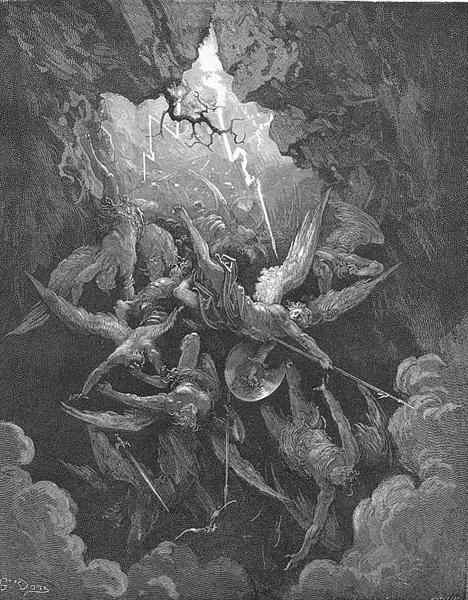
Heretics after death will be cast into hell. Steve Lawson explains further in sermon The Great White Throne Judgment
Gustave Dore illustrator, Paradise Lost by Milton
~~~~~~~~~~~~~~~~~~~~~~
Further reading
Previous entries in the Word of the Week Series-
7. Orthodoxy
6. Glorification
5. Sanctification
4. Propitiation
3. Immanence
2. Transcendence
1. Justification
 the-end-time.org