I’m no Charles Spurgeon, laboring from morning till night on a million different projects that have an impact in my day and 150 years beyond.
I’m no George Muller, trusting the LORD in amazing depth to raise and care for hundreds of orphans.
I’m no John MacArthur, preaching for 50 straight years in one church, faithfully going through every book of the New Testament and seeing the Spirit take the ministry global.
I’m just an old lady in a backwater town in rural Georgia. I go to church, go to work, do my best to obey Jesus daily, confess my sins and ask His help to do better, and move on to the next day. What impact can I have for the Kingdom? I’m not looking for a huge impact or a famous impact, but something, anything for His name, in obedience to His word and gratitude for my salvation. Does what I do matter? Does it have an effect?
Why, yes, what we do in His name when put into His hands will have an impact. Maybe not immediately, but eventually the results will show.
This video is interesting in itself for the science of it, but I’m also thinking of the spiritual reality: One small word spoken in His name can have domino effect that ‘turns the world upside down.’ Amazing. 🙂 Be obedient to His word today and share His truth in word or deed, in even a small way.
so shall my word be that goes out from my mouth; it shall not return to me empty, but it shall accomplish that which I purpose, and shall succeed in the thing for which I sent it. (Isaiah 55:11)
For the weapons of our warfare are not of the flesh but have divine power to destroy strongholds.
(2 COrinthians 10:4)
Video blurb:
A domino can knock over another domino about 1.5x larger than itself. A chain of dominoes of increasing size makes a kind of mechanical chain reaction that starts with a tiny push and knocks down an impressively large domino.
This article from Ed Shaw at The Gospel Coalition Australia is causing a stir. It claims that Jesus “struggled” with sexuality, His gender, and temptation to same-sex sin.
Shaw said in his interview:
TGCA: Tell us about your plans for the youth night on Friday night? Do you see youth as a particularly vulnerable age for confusion on matters of sexuality?
Shaw: I’m wanting the young people who come to this event to know that Jesus is the one person that they can fully trust with their sexualities, identities and gender because he is both their Creator God and a human being who knows what it is like to grapple with a sexuality, identity and gender.
Jesus struggled with same-sex temptations? Thoughts? Lusts? No.
Their basis for saying this, wrongly, comes from a misunderstanding (or a deliberate twisting) of the verses in Hebrews that say Jesus was tempted in every way.
For since He Himself was tempted in that which He has suffered, He is able to come to the aid of those who are tempted. (Hebrews 2:18).
Nor we do not have a high priest who cannot sympathize with our weaknesses, but One who has been tempted in all things as we are, yet without sin. (Hebrews 4:15).
The homosexual lobby is separating the temptation from the sin itself and claiming that the temptation itself isn’t a sin, just the act is sin, so it is OK that Jesus ‘struggled’ with it. And the temptation not being a sin, it isn’t necessary to repent from. That’s a generalization but it’s essentially the issue that is leading to this problem and confusion.
Dr. Denny Burk, Professor of Biblical Studies at Southern Seminary and their undergraduate institution, Boyce College, and author of the book, What is the Meaning of Sex as well as the forthcoming book, Transforming Homosexuality: Living Faithfully with Same Sex Attraction, was interviewed at BiblicalCounseling.com, to discuss the question, Is Same-Sex Attraction Sinful?
His partial response (and the interview is good to read the transcript of or listen to) –
The issue is – and this is one of the things that distinguishes Jesus’ experience from ours – is that Jesus was sinless; that’s what Hebrews 4:15 says, He was “…without sin.” This doesn’t characterize our experience because the Bible says that we have been brought forth in iniquity and conceived in sin. We have a sinful nature. James 1 teaches us that oftentimes our temptations emerge from within and that we have temptations that emerge from our own evil desires. James 1:14 says, “But each person is tempted when he is lured and enticed by his own desire” (emphasis added). We face temptations arising from our own lusts which Jesus never faced. So, what does that mean? It means that sometimes there are dispositions, attractions, desires, which emerge from our own heart that are themselves sinful because we are sinners by nature. Jesus never faced those kinds of temptations so we find ourselves having to repent of our own desires that sometimes come quite naturally to us as sinners.
Whatever the pastoral intent, the argument invokes Hebrews 2:18 and 4:15 in order to claim that Jesus “struggled with” sin and that He was may have “struggled with His sexuality.” This is not an ordinary vanilla way of reading those passages.
The classic definition of Christ’s sinlessness is that He was free from original sin and all of its affects on His will. He suffered from certain effects of internal sin (decay, certain kinds of sickness), but he did not have total depravity as we do.
Jesus did not have disordered desires. He did not have concupiscence (still a relevant term!). He did not consider that sinning might be the right course of action. He didn’t go back and forth about whether to do it. He was perfect and always lived to do the Father’s will.
When it comes to temptation, Jesus was subject to external temptations. But He did not possess internal ones, for those would require a will disposed towards the sin. See the attached Owen quote for one explanation.
Now, what is it to be tempted? It is to have that proposed to a man’s consideration which, if he close withal, it is evil, it is sin unto him. This is sin’s trade: Epithumei—’It lusteth.’ It is raising up in the heart, and proposing unto the mind and affections, that which is evil; trying, as it were, whether the soul will close with its suggestions, or how far it will carry them on, though it do not wholly prevail (p. 194). ~John Owen
So we can’t say that Jesus “grappled with” or “struggled with” sexual temptations. He always had appropriately ordered desires and affections. He was always chaste.
Also, we shouldn’t press “tempted in every respect” to mean that Jesus experienced every possible temptation. This gets ridiculous fast. Was he tempted to mass murder? To enslave children? No.
And terms like “wrestle with,” “struggle with,” “grapple with” are too imprecise for these kinds of conversations. The speaker *may* have some nuance in his mind, but most people just hear those words as saying “an internal battle.” Indeed, they are metaphors involving violence.
I don’t know what sort of connection TGC Australia has with the main TGC, but you would think they would be very upset with that statement from the editors and would look into the matter with some urgency.
We can and should want to have the most-charitable dispositions towards Christians trying to battle against all kinds of sexual temptations. However, we can’t rewrite our systematic theologies to make this an easier task.
I found those explanations to be most helpful. But before we get too far into definitions, explanations and John Owen and the Greek words, here is the simplest and in my opinion the best way to look at it-
Matthew 4. He was led by the Spirit, and He was tempted by the devil. Now you say, “Wait a minute. If God tempts no man” – as we noted, James chapter 1 – “then how in the world can the Holy Spirit drive the Son of God into a conflict with the devil?” Oh because, you see, from God’s viewpoint it was a test to prove His righteousness. It was only a temptation from Satan’s viewpoint. ~John MacArthur, The Crisis of Temptation part 1
See end for a post script.
Let’s finish with a verse from Apostle John,
Do not love the world or the things in the world. If anyone loves the world, the love of the Father is not in him. For all that is in the world – the desires of the flesh and the desires of the eyes and the pride of possessions – is not from the Father but is from the world. And the world is passing away along with its desires, but whoever does the will of God abides forever, (1 John 2:15-17).
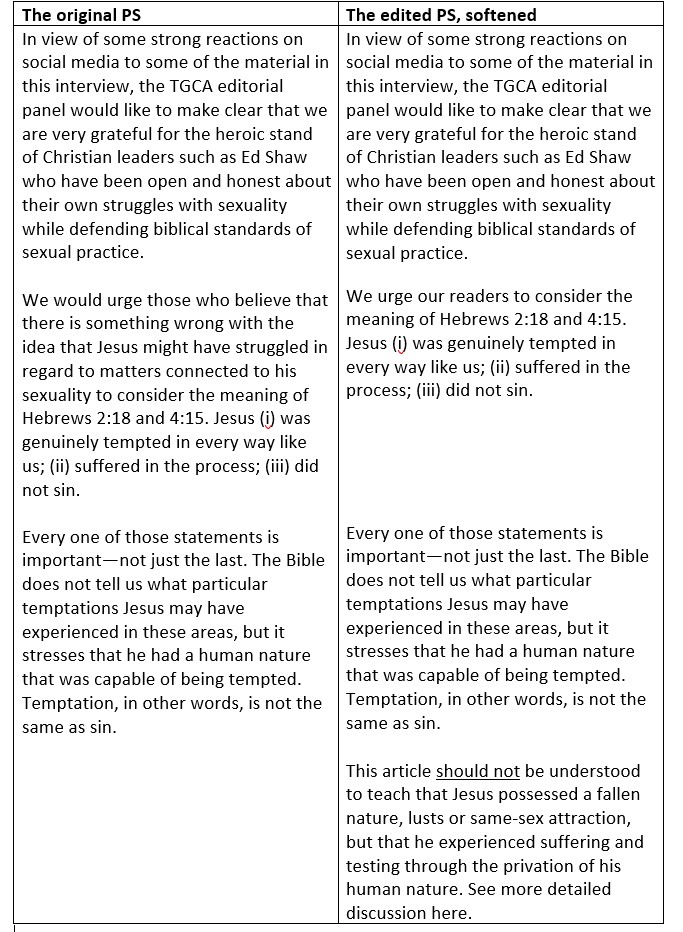
Ed Shaw’s PS at the end of his article at TGC AU, both the original and edited, side by side. My article here was to present proper interpretation of Heb 2:18 & 4:15, as Shaw’s PS recommended.
The thread of Christianity depends on a unity from one generation to the next of mutual understanding of our important words. Hence the Word of the Week.
Immutability: Is the unchanging nature of someone. To be immutable is to be unchanging. God is unchanging in his character, will, and covenant promises. He does not change His mind, His will, or His nature.
Consider what thou owest to his immutability. Though thou hast changed a thousand times, he has not changed once; though thou hast shifted thy intentions, and thy will, yet he has not once swerved from his eternal purpose, but still has held thee fast. – Charles Spurgeon, The Christian—A Debtor, Sermon #96.
For someone to change, there must have been a point in time where the person was something else, or thought something different, or had alternate plans. Then as time passed, the person changed. Since God is outside of time, He is always the same, from point A to point B.
Also, His attributes are unchanging. He doesn’t add to His character nor subtract from it. He isn’t more loving today than when He was in Genesis 1:1 when our time began. He isn’t more wrathful against sin than when He was 15 years ago or 100 years ago. He isn’t more merciful or less compassionate than when Jesus walked in His incarnation.
What does immutability mean for us, His people?
As we read in Hebrews 6:17-18,
So when God desired to show more convincingly to the heirs of the promise the unchangeable character of his purpose, he guaranteed it with an oath, so that by two unchangeable things, in which it is impossible for God to lie, we who have fled for refuge might have strong encouragement to hold fast to the hope set before us.
It means we should be encouraged that His promises are sure. The joy that is waiting for us in heaven, the reunion with the glorified family as adopted sons and daughters, the glory, the sinlessness, all that, is unchanging because God does not change. He promised this. It will happen.
It means doom for those who will not repent. God will not forsake His holiness and allow rebels into heaven. It means the judgment and subsequent hellish torment awaiting many millions is sure. It will happen.
The gulf between the two eternities is never more stark than when considering His immutability. He has forged those two paths and they will not change. Keep both in mind when pondering His immutability.
Laura and Sue have a blog at https://ordinarylifedivinetruth.wordpress.com. I became aware of it when Laura sent me a note through the Contact sheet on this blog. Their latest blog essay recounts a conversation they’d had with Lysa TerKeurst regarding some of Lysa’s concerning teachings and behavior. It was well written and sensitive, laced with grace.
These ladies are also concerned with false teachers of women and have other series describing issues with the various ones populating our Christian landscape. They also have written several series on the topics of Counseling/Abuse, Discipleship, Popular Christian Movies, and more.
Michelle Lesley and Amy Spreeman have started a podcast. It is called A Word Fitly Spoken, from the verse from Proverbs 25:11, A word fitly spoken is like apples of gold in pictures of silver. Their podcast is on various platforms now. https://awordfitlyspoken.life/
Savannah Rae is a 21-year-old college graduate from our church. She started a blog called Vogue and Valor and writes very well. She recently made a decision to work at Echo in Ft. Myers FL as a way to care for those less fortunate, through her faith in Jesus. I’m so proud of her. I’m proud also of the other young men and women from our church who have made decisions and recently departed as faithful milkweed seeds to spread the Gospel through various organizations and means. When the elders founded the church almost 4 years ago they were prayerful about it being a raising-up-and-sending church, deeply focusing on missions. The Lord has been bountiful in aiding us, His flawed human beings, to accomplish this. May His name be glorified.
Here is a good reminder of some recommended resources that are still strong-
The Master’s Seminary Church Search finds churches in your area pastored by or founded by TMS grads.
Alistair Begg, sermons at Truth For Life, aimed at practical Christian living.
Samuel D. James is an excellent writer. He posts thought provoking material on Christian life, culture and other topics at his blog, Letter & Liturgy. His, along with curated guest posts, are a worthwhile read. I liked this one from Caleb Wait, who as a young dad going through seminary looking for ways to save time, discovered that “productivity lit” is generally aimed at the unmarried and/or childless audience- but came up with some tips and aids on his own.
Ken Puls Music has a series on Notes & Commentary on Pilgrim’s Progress. I love the book Pilgrim’s Progress. I need the notes though. Lots of material online offer notes & commentary on this wonderful book. Here is a good series that I enjoyed. Part 1 here.
There are two reasons we don’t follow the man-made philosophy regarding the word of God and listening to false teachers; i.e. ‘eat the meat and spit out the bones’. People who disagree that false teachers should never be tolerated, say that false teachers sometimes teach truth and we should take what is true, i.e. the meat, and spit out the false, or the bones.
No.
No.
No.
Reason #1: In Philippians 4:8-9 we read that we must dwell upon certain things, for one, “Whatever is true.” Steven Lawson preached on these verses in his sermon The Battle for the Mind, saying,
That’s what your mind needs to be fixed upon. “Whatever is true.” This word for true means real, genuine, authentic, that which is reliable, faithful, as distinguished from that which is false, that which is a lie. Do not let your mind be focused upon a distortion of the divine standard, or compromise on which God clearly lays out in his word. Focusing on what us true leads inevitably into true Christianity and results in authentic godliness.
“Whatever is pure.” Pure – that which is not mixed with immorality, moral impurities. It refers to that which is uncontaminated with man’s depravity, unmixed with filth or adulterated with moral corruption. How pure of a life do you want to live. Marginally pure? If we dwell on that which is impure given enough time, we will live an impure life because we have become impure.
So, the Bible says to stay as pure and true as possible. Choosing to absorb that which is untrue and impure directly contradicts the Philippians verse.
Reason #2 we don’t eat the meat and spit out the bones: In our total inability to be holy, with our sin-drenched mind and our constant strong pull toward untruth and impurity, do we really believe we have the sense, strength, and wherewithal to take in a steady diet of lies and remain untainted? Of course we cannot. It’s why we needed Jesus to save us, and the Spirit inside us prodding and guiding to holy excellence.
“if there is any excellence”… Don’t you want to live a life of moral and spiritual excellence? Then clear your mind so that there is holy fodder to graze upon. You’re not eating meat, as Lawson reminded us, you’re eating rocks and dirt and grass and trash.
So stop it.
Here are some good resources, no bones, only meat:
Matthew 4:6 – and said to him, “If you are the Son of God, throw yourself down, for it is written, “‘He will command his angels concerning you,’ and “‘On their hands they will bear you up, lest you strike your foot against a stone.’”
Psalm 91:11-12 – For he will command his angels concerning you to guard you in all your ways. On their hands they will bear you up, lest you strike your foot against a stone.
Psalm 91:13 – You will tread on the lion and the adder; the young lion and the serpent you will trample underfoot.
From Twitter: Jerry Edmonds, (@jerryedmonds) on those verses-
In Matthew 4:6, Satan quotes Psalm 91:11-12 to tempt Christ to disobedience. Read Psalm 91:13 to see the irony of Satan quoting this passage. If you don’t catch the irony, consider this: who does scripture elsewhere call a serpent and a roaring lion?
Barnes’ Notes, “it may be understood figuratively of Satan, who, for his voraciousness and cruelty, is compared to a lion; and, for his craft and subtlety, to a serpent, 1 Peter 5:8.”
Satan unwittingly complied with God’s ordination of prophetic utterance that in fact, does not tempt Jesus but instead negatively characterizes and indicts satan instead!
It’s like Pilate, who, in God’s ordination of all things but in Pilate’s employment of his free will, he unwittingly proclaimed to the world that the person convicted and executed at Calvary was not a criminal but in fact was “Jesus the Nazarene, the King of the Jews.” (John 19:17). The Jews wanted Pilate to write that Jesus said He was king of the Jews, not that He was King of the Jews. Pilate said “I have written what I have written.” Pilate wasn’t made to write it, but he freely chose to write the truth and it was what God wanted.
In my opinion, these are examples of how God’s sovereignty intersects with free will. Satan thought he was outsmarting Jesus by tempting Him, but instead uttered a verse containing a prophecy on how he will be slain, and the Jews thought they would outsmart God by putting Jesus to a criminal’s death but instead was proclaimed King.
Isn’t God wonderful!
“For My thoughts are not your thoughts, Nor are your ways My ways,” declares the Lord. “For as the heavens are higher than the earth, So are My ways higher than your ways And My thoughts than your thoughts.”
Isaiah 55:8-9
As a companion piece from yesterday’s blog essay, I also offer this further thought to you. It shocks us when someone leaves the faith becuase it is always hard to believe someone who professed faith never possessed it.
Perhaps you haven’t had much experience with Josh Harris. But maybe you’ve had people close to you fall away from the faith: a family member, a dear friend, a relative, a colleague, a college roommate, a pastor. But when these events occur, we can’t leave our questions hanging in mid-air. Unless we train our minds to go to the Bible when we hear of professing Christians denying the faith, we will be tossed to and fro by confusion, discouragement, and spiritual insecurity.
I can understand. If you have invested time and money and energy following a teacher and they fall or they ‘leave the faith’ it might send you reeling. ‘What now?’ you might ask. ‘What next?’ Worst of all are the doubts such an event leaves behind. ‘What does this mean for my faith, my discernment?’ Josh Harris, according to Wikipedia,
…is an American author and former pastor. Harris is widely known for his book I Kissed Dating Goodbye, in which he laid out his ideas concerning a Biblically-based Christian approach to dating and relationships. I Kissed Dating Goodbye “helped shape purity culture” for many Christian millennials. Wikipedia
I said ‘alleged’ because there is no such thing as a Christian deconversion. 1 John 2:19 says “They went out from us, but they were not really of us; for if they had been of us, they would have remained with us; but they went out, so that it would be shown that they all are not of us.”
If someone “leaves” Christianity, they never were Christians. It might seem impossible when you’ve been watching a long-term pastor suddenly go out from the faith, or someone who has such good works, or another who wrote books that spoke to your mind and spirit. But external works are not the only evidence of faith. It’s perseverance too. If God has you, He HAS you. He will not allow the evil one to snatch you from His hand, nor can you leave Him (and why would you want to? If His Spirit is in you, you are part of His body).
Let’s say you are a person who has an interest in education, and you silently attended all the classes in a university without having been enrolled, and then after 4 years of participating in study groups, and being seen in the library, and taking all the tests, decided to ‘quit college’. CAN you quit something you never were an official part of? No.
Your fellow study buddies might be shocked, but then when they hear you had never taken SATs, never applied, never were accepted by the Dean, and never actually enrolled, never accumulated any credits, would never be an Alumni, then they’d understand. “Oh!” They would probably say. “He never was part of the College.”
There are many pretenders in the faith. Many. (Matthew 7:22)
If something like the Joshua Harris issue leaves you questioning, that’s good. It’s good to question our own faith once in a while. Examine our motives. (2 Corinthians 13:5). Whether we are truly saved or not saved, we are always moving. The falsely saved/ sadly deluded, as Josh was, move downward and away from the cross. The truly saved in increasing sanctification always move toward the cross.
Almost 40 years ago, writer Eugene Peterson coned the phrase that sanctification is a “Long obedience in the same direction.” Despite his latter difficulties with the faith, that was a terrific coinage. You can turn it around and say the opposite is also true.
The deluded or pretenders display the same thing- a long obedience in the same direction…just movement toward and obedience to satan and not Jesus. Eventually the split becomes obvious to others or unbearable to the false Christian pretender, and they “leave” the faith. The sad punctuation point for Harris is that once you have tasted the Gospel and reject it, you can never be brought to repentance again:
Hebrews 6:4–6, It is impossible for those who have once been enlightened, who have tasted the heavenly gift, who have shared in the Holy Spirit, who have tasted the goodness of the word of God and the powers of the coming age and who have fallen away, to be brought back to repentance.
Because Harris has tasted and spit Jesus from his mouth, so, Jesus will do the same to Harris. (Revelation 3:15-16).
For the truly saved, nothing on heaven or earth can tear us from the Father’s hand. and I give eternal life to them, and they will never perish; and no one will snatch them out of My hand. My Father, who has given them to Me, is greater than all; and no one is able to snatch them out of the Father’s hand. I and the Father are one. (John 10:28-30).
Marty Sampson, a prolific worship music writer known for his work with Hillsong Worship, Hillsong United, Delirious and Young & Free, revealed he is losing his faith and believes Christianity is “just another religion.”
So, this tells us that Marty Sampson was never saved in the first place. Jesus said that no one can snatch us out of the Father’s hand. Once you’re saved, you’re always saved. The Holy Spirit is sealed in us as a guarantee of this. (2 Corinthians 1:22). No man can UNseal what God has sealed.
1 John 2:19 also makes this promise of security of salvation. When someone leaves it’s the evidence they were not ever saved to begin with:
They went out from us, but they were not of us; for if they had been of us, they would have continued with us. But they went out, that it might become plain that they all are not of us.
Thus, you can’t lose your faith.
So how does this happen? How is it that someone who is vigorous for the faith, working inside a church for the church, departs?
It’s a visible demonstration of this verse,
Other seeds fell on rocky ground, where they did not have much soil, and immediately they sprang up, since they had no depth of soil, but when the sun rose they were scorched. And since they had no root, they withered away. (Matthew 13:5-6)
The pagan who is trying to keep up appearances finds that it’s all very tiring. Look how hard the Pharisees had to work to keep up the pretence of care for their flock and submission to God- fussing with lengthening tassels, praying long prayers in public, vying for best seats, outdoing each other in fasting, giving, and memorizing…it’s hard work to pretend.
Eventually the unrelenting spiritual anguish, resulting depression, religious confusion, and physical exhaustion gets to be too much. It’s easier to leave. And that is what Sampson and Joshua Harris and so many others did. Like Demas did, whom Paul said was in love with this present world, left the faith. Judas spent three years with Christ day in and day out, and still was revelaed to be an apostate when he sold Jesus for 30 pieces of silver and left him behind in Gethsemane.
Imagine how hard it was to pretend to care for an unseen world that in your heart of hearts you’re never sure exists, or that you even want to be a part of in the first place.
Here is a sound podcast about the issue of apostatizing.
But there is one thing that never gets easier: when an individual who has professed Christ, immersed in the local church, and served in ministries, departs from the faith. AKA, “apostasy.” John Owen defined apostasy as “continued persistent rebellion and disobedience to God and his word,” or “total and final and public renunciation of all the chief principles and doctrines of Christianity.”
Included in this edition of Prata Potpourri are some things that either aren’t talked about enough (Lake of Fire) or are talked about so much that the wackadoodles have gotten a-hold of the issue and twisted it beyond all recognition (angels, spiritual warfare). Here are some credible links to these and other topics.
Jim Osman and Justin Peters’ video series on Spiritual Warfare is excellent. Here is the 8-part series-
Show 1 of 8: Justin Peters & Jim Osman on the: Doctrine of the Sufficiency of Scripture as it relates to Biblical Spiritual Warfare. Justin Peters interviews Pastor & Author Jim Osman on the subject of Spiritual Warfare and Jim’s book: “Truth or Territory: A Biblical Approach to Spiritual Warfare”. Some examples of False Teaching on Spiritual Warfare are briefly discussed as well as some False Teachers are named. These issues will be discussed in greater detail in coming episodes. Jim Osman starts this series off by giving viewers a brief Testimony of how the LORD changed his thinking on this very important subject, then both Justin & Jim introduce viewers to the topic of the Doctrine of the Sufficiency of Scripture which is briefly defined and defended from 2 Timothy 3:16-17 and 2 Peter 1:3-4.
There have been some high-profile people proclaiming their abandonment of the faith this week. There have subsequently been a lot of response articles of various kinds. Here are two:
Are you surprised when you come across so-called Christians who claim to be followers of Jesus, but never ‘follow’ Him into a church? They say that attending church isn’t necessary to be a fully devoted Christian? I am. I am actually shocked when I deal with this among professing Christians. And it’s spreading.
What DOES the Bible say about angels, anyway? I love the thought of angels and I study Angelology (from credible sources). Here are two credible sources on a teaching about angels you might enjoy.
From Ligonier: The Final State of the Unbeliever. This will happen. Pray evangelistically and frequently! Romans 10:1 says, Brethren, my heart’s desire and my prayer to God for them is for their salvation.