Posted in theology

Sin from the tongue stains our witness and corrupts our ambassadorship

By Elizabeth Prata

Yesterday I was shocked to read a certain tweet from Beth Moore. She had obviously had some kind of interaction on Twitter with a man who was saying some things about her husband, which she did not like. I tried to find the conversation, but could not.

Her tweet stated,


“If you make one more remark about my husband, whom you know nothing about, I will reach through this screen and punch you in the nose.”

I have three points.

1. Threats.

After being shocked at the violent language that, Moore, a Bible teacher representing Christ employed, I was more shocked by the sheer numbers of people who came out of the woodwork to defend her statement.

It is never appropriate at any time to state that if someone does not desist you WILL punch them. I recognize that the statement is probably hyperbole. It’s not likely that Moore will go to where the man is and actually punch him. Conscious of safety, Moore herself employs or has in the past employed a bodyguard.

But in this day and age, who can tell? Maybe her followers will do it. I know of people who were angered at someone mentioning Moore in a slightly negatively way online, but in real life some of her followers stalked the person in retaliation. We read of doxxing, too (where personal information and documents are deliberately leaked online, leading to identity theft and worse.)

In this cultural climate, such threats even from a secular person are not appropriate. It’s not “just” hyperbole (as many stated to me) and it’s not “just” defending her husband. If you say such things at the office, you’ll likely be talking to HR and enrolled in an anger management class. Twitter has a block button. If you’re getting angry with someone online, push back from the computer and go your way.

2. Comportment as Ambassadors.

To comport yourself is to conduct yourself or behave in a certain way. Though I appreciate that the world wide web isn’t regulated and is sort of a Wild West, we ourselves are not free to behave in any way we choose. We are Ambassadors of Christ. Self-control is the rule of the day. (Titus 2:5). What does this mean?

An Ambassador is supposed to be a mirror likeness to the one he represents. The definition of an ambassador is: an accredited diplomat sent by a country as its official representative to a foreign country.

Regenerated people are Ambassadors for Christ. (2 Corinthians 5:19-20).

that God was reconciling the world to Himself in Christ, not counting men’s trespasses against them. And He has committed to us the message of reconciliation. 20Therefore we are ambassadors for Christ, as though God were making His appeal through us. We implore you on behalf of Christ: Be reconciled to God.

Paul directly ties the ministry of reconciliation to our ambassadorship.

All believers should serve Christ as His ambassadors. Paul’s appeal was not a perfunctory pronouncement but an impassioned plea (“we try to persuade men” [v. 11]) addressed to the world on Christ’s behalf: Be reconciled to God (cf. 1 Tim. 2:3–4). ~The Bible Knowledge Commentary: An Exposition of the Scriptures.

What Beth Moore said was the opposite of a ministry of reconciliation. It was an extremely poor witness.

In the Roman Empire, there were two kinds of provinces: senatorial provinces and imperial provinces. The senatorial provinces were made up of people who were peaceful and not at war with Rome. They had surrendered and submitted. But the imperial provinces were not peaceful; they were dangerous because they would rebel against Rome if they could. It was necessary for Rome to send ambassadors to the imperial provinces to make sure that rebellion did not break out.

Since Christians in this world are the ambassadors of Christ, this means that the world is in rebellion against God. This world is an “imperial province” as far as God is concerned. He has sent His ambassadors into the world to declare peace, not war. “Be ye reconciled to God!” We represent Jesus Christ (John 20:21; 2 Cor. 4:5). If sinners reject us and our message, it is Jesus Christ who is actually rejected. What a great privilege it is to be heaven’s ambassadors to the rebellious sinners of this world! Wiersbe, W. W. (1996). The Bible exposition commentary

3. Scripture violation

The Bible, especially Proverbs, is rife with instructions about our language and the tongue. Here are just a few: Proverbs 15:4, James 1:26, Titus 2:5, Proverbs 21:23, Proverbs 15:1, and remember, teachers are judged MORE strictly- James 3:1.

Moore violated all of them, and there is no defense to that. Please understand ladies, this comment by Beth Moore is violent & doesn’t mirror behavior the Bible calls our women leaders & teachers to engage in as women of “noble character”. (Proverbs 31:10).

She opens her mouth with wisdom, and faithful instruction is on her tongue.” (Proverbs 31:26).

When we ourselves are tempted to say something like Moore did, and we all feel that way sometimes, please remember our Ambassadorship. We are not free agents. We are entrusted to carry a message of reconciliation to the world, in hopes that some will repent and believe.

Please remember our tongues are not our own, and take heed to follow the guides, instructions, and warnings about how we are to speak.

4. Sin spreads.

When sin goes unaddressed, it grows. Paul likened irreverent, empty chatter to gangrene. (2 Timothy 2:16-17). Gangrene spreads fast. Sin spreads fast, too. It is always crouching at the door, wanting to have you, but you must rule over it. (Genesis 4:7). Peter warns us in 1 Peter 5:8 to

Be sober-minded; be watchful. Your adversary the devil prowls around like a roaring lion, seeking someone to devour.

Hurling threats of punching is not being sober minded. Sin wants to devour and it must be addressed immediately.

In a congregation it also must be addressed immediately. Either an individual in his or her prayer closet of a pastor enacting church discipline, sin has to be dealt with or it will grow to proportions with tentacles spread far and wide, as it obviously has in Beth Moore. Undisciplined, coddled, and applauded, her witness has grown increasingly tarnished. Let her unacceptable comportment be a lesson to me and all of us. There is no such thing as stasis. There are only two directions for growth, more like Christ, or less like Christ. There is Cain, and there is Abel. Upward in sanctification, or downward into sin.

Moore is demonstrating the latter. Her life as an object lesson is hard to watch, but instructive for all of us. Deal with your sin. Right away.

Final Thoughts:

I truly believe that most people, Christians included, have no clue as to the depth and the power of our sin. God is sovereign, of course, but sin rules this world. Satan is the god of it (2 Corinthians 4:4).  Satan likes sin, incites sin, and doesn’t have to work too hard to get our flesh to sin. Sin’s power in us must be reigned in and mastered, and it begins with the mind and extends next to the tongue. I sin in this area as do we all.

Just because we live with it all around us, don’t become inured to the failings and corruptions of the tongue. Don’t excuse it. It’s easy to dismiss sinful behavior because we do it ourselves, or we’ve become the frog used to hot water, or any of a thousand reasons. Sin’s power was so great that God sent His Son to die in order to break it. (Romans 6:6). We are SAVED from the penalty of sin and the power of Sin, thanks to Christ’s death and resurrection and the indwelling Holy Spirit. We are heirs with Christ.

12 So then, brothers, we are debtors, not to the flesh, to live according to the flesh. 13 For if you live according to the flesh you will die, but if by the Spirit you put to death the deeds of the body, you will live. 14 For all who are led by the Spirit of God are sons of God. 15 For you did not receive the spirit of slavery to fall back into fear, but you have received the Spirit of adoption as sons, by whom we cry, “Abba! Father!” 16 The Spirit himself bears witness with our spirit that we are children of God, 17 and if children, then heirs—heirs of God and fellow heirs with Christ, provided we suffer with him in order that we may also be glorified with him. (Romans 12-17)

Posted in discernment, Uncategorized

Word of the Week: Justification

By Elizabeth Prata

word of the week word cloud
We’re losing the meaning of our uniquely Christian words.

I listened to a Phil Johnson interview last year where he talked about being caught off guard with the flooding-in and vehemence of the social justice movement and the racial equality woke movement.

It is a true fact that many of our younger people think that ‘social justice’ is the same thing as ‘biblical justice,’ when they certainly are not.

Biblical illiteracy is high, and with the lack of actually reading the Bible, younger people are losing the meaning of foundational words like justification, sanctification, glorification.

Some years ago I enjoyed the Apologetic Index’s listing of the Emerging Church: Glossary of Emergent Terms For Those New to the Conversation. It was funny, if you were up on news of he movement. It was also sad to see how devastatingly accurate those writers were about the co-opting of normal terms and made to mean something new. Like this entry to their ‘dictionary’-

Christ – An incredible, outstanding man in the Bible who left behind a valuable story that enables us to make the world a better place. Some people (including some in the emergent conversation) say he is a divine being, but this concept is subject to deconstruction.

Since we in our native countries speak a language to each other and are subsequently understood, we tend to think that language stays the same. It doesn’t. Language isn’t static. Meanings shift and move all the time. Hogwash was a word that came into use, rise in the 1700s, peaked in the 1800s and now you rarely see it written anymore and even more rarely, spoken. Lots of words that are currently in use weren’t a existence when I was a kid, because the thing the word refers to wasn’t invented. Compact Disc (and even that is dwindling as digital music takes over), surf-n-turf, head trip, grok, miniseries, and biohazard were words that were new when I was growing up.

New words today would include adulting, sup, suh, trill…sigh, are currently trendy words.

Old words still exist but change meaning. When I was growing up, incontinent meant liable to urinate one’s pants. 2 Timothy 3:3 uses the word incontinent-

Without natural affection, trucebreakers, false accusers, incontinent, fierce, despisers of those that are good,

No it does not mean that men everywhere will be dribbling. The word in the 1300s-1400s used to mean without self-control emotionally and physically, now it evokes only the lack of control over the bladder. We don’t use the word dayspring much anymore. Suffer in the old translation of “suffer the little children to come unto me” has a different meaning now. We don’t see words like froward, graven, cleave, or husbandman in common use these days.

So words fall in and out of use, new words emerge, and old words shift meaning.

However the thread of Christianity depends on a unity from one generation to the next of mutual understanding of our important words. Words handed down that form the bricks of our faith must be used, taught, and widely understood. We must understand the important terms.

Hence the Word of the Week series. I started the sereies last year and I’m repeating it.

JUSTIFICATION

Defined by Baker’s Exegetical Dictionary, public domain. More at link

Justification is the declaring of a person to be just or righteous. It is a legal term signifying acquittal.

Accordingly it is not surprising that salvation is often viewed in legal terms. The basic question in all religion is, “How can sinful people be just (i.e., be justified) before the holy God?” Justification is a legal term with a meaning like”acquittal”; in religion it points to the process whereby a person is declared to be right before God. That person should be an upright and good person, but justification does not point to qualities like these. That is rather the content of sanctification. Justification points to the acquittal of one who is tried before God. In both the Old Testament and the New the question receives a good deal of attention and in both it is clear that people cannot bring about their justification by their own efforts.The legal force of the terminology is clear when Job exclaims, “Now that I have prepared my case, I know I will be vindicated” ( Job 13:18 ).

Justification means that God brings down the gavel and declares a person righteous, despite their crimes, because they have passed through the Righteous Door of Jesus. This was enacted when Jesus died on the cross, becoming sin for us, and then His righteousness was imputed to us. Therefore God can and does declared His elect justified, i.e. no longer under penalty for their crimes.

Phil Johnson wonderfully explains it here in this sermon-

Who Can Condemn Us? 
May 27, 2018 | Romans 8:34

justify justification verse
——————————————–

More explanations here

Got Questions: What is Justification?

Ligonier: What Are Justification and Sanctification?

Posted in discernment, theology

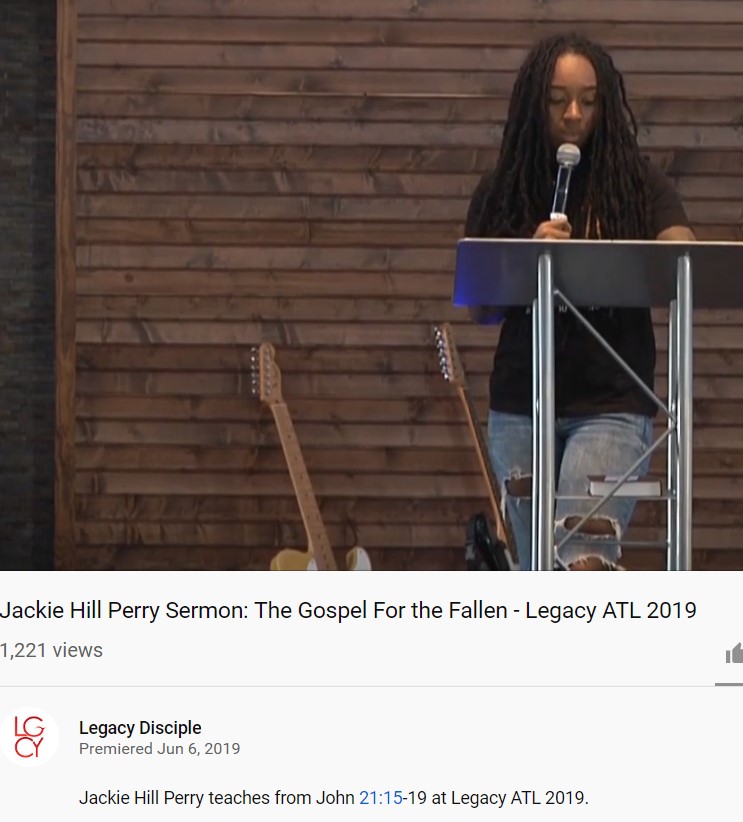
Jackie Hill Perry: Discernment Review

By Elizabeth Prata

Jackie Hill Perry is a self-described rapper, writer, teacher, and poet. She is also a married mother and an ex-Lesbian converted to Christianity ten years ago at age 19. She expresses her Christianity through spoken word poetry, music, and essays (some at The Gospel Coalition). She has published two CD’s, and is author of the 2018 book Gay Girl, Good God: The Story of Who I Was, and Who God Has Always Been. An upcoming Bible study is due to be released this October called, Jude: Contending for the Faith in Today’s Culture. Perry says she feels compelled to share the wondrous truths of Jesus through her God-given gifts as communicator.

Perry is also friends with and partnered to in ministry with some spurious characters, all in the name of ‘not being tribalistic’ according to Perry. She recently photographed herself with Bethel Church’s Jenn Johnson of Bethel Church (daughter-in-law of Bethel cult founder Bill Johnson, who along with her husband Brian founded Bethel Music and MusicU) and pronounced her a friend. Perry also has partnered with false teacher Christine Caine, speaking at Caine’s Propel Activate conferences. Perry wrote that she is concerned about several theologically sound preachers complicit in “white supremacy who are faithfully inspired by the theological musings of slave masters”. Perry is a strident social justice warrior.

She has also just been UNinvited to the Answers in Genesis/Answers for Women 2020 conference.

So, Jackie Hill Perry is a study in contrasts.

Justin Peters (@JustinPetersMin) wrote on Twitter this week,
August 26, 2019

As has Francis Chan, Jackie Hill Perry, sadly, has now endorsed some of the most rank heretics and obvious false teachers in the “evangelical” world.

Pastor Gabe Hughes also asked (@Pastor_Gabe) @JackieHillPerry-

Mrs. Perry, you were included in the documentary “American Gospel: Christ Alone,” exposing the heresy of the prosperity gospel movement. Yet now you are partnering in ministry with one of the very churches (Bethel in Redding, CA) critiqued in that film. Are you not aware of this?

Finally, though she says “where I disagree, I’m open to discussion, and where I can learn, I have ears to hear,” she instead, rebuked those who attempted to share concerns regarding the above listed statements and partnerships, implying that distancing one’s self from those who practice discerning separation is itself loveless and arrogant.

Reading her Twitter feed is a study of social justice and racial reconciliation.

She begs the age-old question, when is it time to warn against a person who seems to be on a downward slope into false religion?

Well, it seems, now.

Perry’s commitment to the pure Gospel seemed solid until lately when she wrote a concerning rant on her Instagram (August 26)

There are several worrisome phrases in her piece that concerned me. I’m sure there are other concerning aspects that more discerning and articulate people will spot that I have not addressed.

Tribalistic

It depends on what one means when they say they aren’t tribalistic. Though Seth Godin used the term “tribes”, it was Mark Driscoll in his earlier days that popularized it. Here from First Things in 2013, we have a short history of how this ridiculous term came into Christian use-

Driscoll tells Christians that they need to learn from each other, rather than criticize each other. He’s speaking to Evangelicals. He claims that Evangelicalism has been “tribalized.” In order for these tribes to be effective they need to cooperate and learn from each other. This talk of “tribe” is trendy thanks to guys like Seth Godin. Mark Driscoll has always been a trend follower.  He claims that the tribes of Evangelicalism manifest themselves through “magazines, publishing houses, blogs, social media, conferences, and schools.” These tribes are led by tribal chiefs.

Now, back to JH Perry, she said she is ‘not tribalistic’. There’s a good not tribalistic, like, in terms of ensuring that one does not divide into factions, following certain teachers to the exclusion of others, with pride on the rise. The Bible dealt with that in 1 Corinthians 1:12. Paul rebuked those who haughtily claimed he or she ‘follows’ Apollos, vs follows Paul, vs follows Peter vs follows Christ. We remember we are one body, united by Christ’s blood.

That said, there is bad not “tribalistic” to use the faddish term, in who we should partner with in ministry. There IS such a thing as purposeful separation. The correct kind of separation glorifies God. The called-for separation is from those who teach false doctrine, promote doctrines of demons, and who snatch the unwary. (1 Timothy 4:1, 2 Timothy 4:3-4, Jude 1).  As Justin Peters wrote this week:

Friends, the Bible is not unclear about how we are to deal with false teachers. We are not to partner with them. We are not to treat them as believers, befriend them (though we may evangelize them) or endorse them. They are to be marked and avoided (Rom. 16:17; 2 Jn. 9-11).

So yes, there are tribes. There’s the tribe destroying the faith, and the tribe upholding the faith.

Perry has chosen to ignore all the Bible verses that call for separation from false teachers and instead deliberately partners with them, in a twisted name of love.

White Supremacy

Perry, to her credit, has for years spoken of her commitment to the gospel of Jesus Christ, the inerrancy and authority of Scripture, and love for God and neighbor, as she stated in her recent Instagram, and her music, interviews, and book.

Sadly, though, she has recently added another criteria to her bundle of characteristics that evinces a Christian. It’s whether or not they are “being blindly complicit when it comes to white supremacy, who are faithfully inspired by the theological musings of slave masters.”

Huh? That really does not make sense. The Bible is always clear. When you start overlaying cultural trends with advocacy of how to behave, that’s when things get muddy real fast, as they do here.

In 2017 Perry was hurt by “The decision made at #SBC17 to not denounce white supremacy”.

In 2018 she advocated for the church to ‘call sin sin, and to be aware of the small, flippant, and even subtle ways people speak about race.

Her emphasis on race might be a personal concern, having grown up black, just as divorce is a personal concern of mine having been the child of divorced parents, but using her platform to single out one sin that by default should be decried along with all other sins anyway, speaks to an undue emphasis that skews one’s perception of unity in the church. She believes she’s promoting unity in the church when overemphasis on race is actually divisive. Over the years as the groundswell of thrown-about terms such as white supremacy, slave masters, slaves, and racism had grown, Perry has drifted more toward the singled-out version of calling sin sin by more narrowly focusing on race, rather than promoting unity through Christ where all sins are a blot against Him.

Hers is social justice language and has nothing to do with Christianity. It is unknown whether Perry is immaturely following a trend, or allowing her deep-seated feelings on the subject of black vs white to finally emerge, but this faddish talk of slave masters and using scare quotes on “theologically sound” people influenced by white supremacy and old slave masters is unhelpful. Any time we see a fixation on cultural issues as criteria for partnering or even loving those around us who also claim Christ is a concern.

Discernment

She lacks it. This became quite evident in her follow up rebuttal to the outcry of partnering with Jenn Johnson & Bethel Music. On August 29, Perry issued a tweet of a 7-page screen shot of her written response to concerned brother’s email and also here continued. In it, Perry announces that she does not believe Word of Faith doctrine is heresy.

She’s wrong. It is.

She does not believe that the Charismatics are in error, just misguided and uninformed.

For someone who wants us all to be “nuanced” she certainly has lumped in 300 million people along a wide Charismatic spectrum into one group- and has declared them all genuine Christians.

In fact, JHP has been partnering with Propel Women and false teachers such as Lisa Harper, Christine Caine, Lisa Bevere, Priscilla Shirer, Shelley Giglio, Jenn Johnson and Bethel Music, since at least 2017 (sourcesource), and also with Sarah Jakes Roberts, daughter of TD Jakes (source)

She says that people’s reactions to her partnering with Bethel & Jenn Johnson were merely visceral reactions, and insinuates therefore that such concerns are dismissable, (while obviously her immediate response tweets were measured and worthy).

She says that she operates in “spaces” that are “primarily Conservative-Evangelical and Reformed” but she does not always remain in those “boxes” and she is free to move about, doctrinally. She said she doesn’t want people to have expectations of her that she doesn’t have for herself.

It’s not a measure of maturity to hop from one doctrinal camp to another, it’s the opposite. (Ephesians 4:14).

I’m sorry, but we do have expectations that especially our leaders remain theologically settled. We do expect that laymen and leaders won’t hop around like a bunny from one group of friends touting one doctrine to another group touting a different one. Peter did that and was rebuked to his face by Paul. (Galatians 2:11). The Circumcision group was cast out and the Nicolaitians were decried.

We are not free to be doctrinal shape-shifters. Our settled convictions forming the basis of our ministries aren’t “boxes”. She speaks of the context of her life primarily of people who have influenced her rather than doctrines she believes. She says she “doesn’t define false teachers in the way that others do,” which is not a mark of maturity nor of discernment.

Disbelief in absolutism

Post-modern adherents disbelieve there is such a thing as absolute truth. We saw hints of that in Perry when she claims that her ministry “isn’t in a box” and she is “too free” to stay in one tribe or another. Now in her rebuttal she said that it grieves her that people are put into categories, or have been classified as this or that. She said, “There’s more depth and nuance to where someone stands than there is as shown in their books or their talks.”

No. No, there isn’t. When someone writes a book outlining their theological convictions or when someone stands on a stage or a pulpit proclaiming their theological convictions, they are literally telling you where they stand. You don’t rely on unseen depths or nuances. Your job is then to compare what they say to the Bible.

Now these were more noble-minded than those in Thessalonica, for they received the word with great eagerness, examining the Scriptures daily to see whether these things were so. (Acts 17:11).

Perry is actually demonstrating in herself and advocating that others employ an indistinct theological viewpoint and accept all who claim Christ unless they are at some far, far end of an undefined spectrum. Yet doctrine is actually narrow, divides, and excludes most people, even and especially many who claim Christ. (Matthew 7:21).

Preaches to men

She preaches sermons, called sermons, to both men and women. She did at UYWI National Conference in 2017, Chicago’s Legacy Disciple Conference, Legacy ATL 2019, and many other venues. Partnering with women such as Christine Caine & Propel Activate does not bode well since the women involved in that conference also preach and believe it is totally OK with God that they do so.

Conclusion

Perry converted at age 19 in 2009. A year later she made news and notice when she issued her spoken word rap called “My Life as a Stud” (about taking on the manly role in a lesbian relationship). A couple of years later came the famous “Jig-A-Boo”. Many people were stunned at such a young person’s wisdom and courage contained in the title and the lyrics of Jig-A-Boo, myself included. The problem is that young, untested people launched into positions of acclaim or responsibility before they are tested often leads to downfalls, pride, or drifting into false teaching. I hope that is not the case with Perry, she said herself at the end of her 7-page response that she’s young and to pray for her and give her time. But the slide is evident and it’s not new.

Remember, her original rant on Instagram and her 7-page response is to push-back to the rant are all so that she can defend her decision to partner with one of the worst cult leaders operating today and other false teachers. Her refusal to separate from Jenn Johnson, Bethel, Propel, and to listen to those who urge her to do so are marks of someone who should not be followed, at least not at this time.

I do pray this young woman will heed correction and that the Lord will graciously guide her back to solidity. She is a gifted communicator who loves the Lord and obviously has much to say and an ability to say it.


Posted in Proverbs, theology

Proverbs: Who Can Understand It?

By Elizabeth Prata

I love the wisdom literature (Job, Proverbs, Psalms, Ecclesiastes, Song of Solomon). The purpose of wisdom, Proverbs 1:3 says, is to receive instruction in righteousness.  Its not to boast in how “wise” we are. Wisdom literature makes me think.

Not that the narratives or the historical books etc don’t make me think, the entire Bible does. But the wisdom literature is especially full of metaphors and symbols and cloaked language that I, who takes things literally, finds hard to understand. It’s a challenge, but a happy one.

Here’s a passage I read and loved, but found difficult to unravel. But below the passage, Barnes’ Notes helped:

I passed by the field of a sluggard,
by the vineyard of a man lacking sense,
31and behold, it was all overgrown with thorns;
the ground was covered with nettles,
and its stone wall was broken down.
32Then I saw and considered it;
I looked and received instruction.
33A little sleep, a little slumber,
a little folding of the hands to rest,
34and poverty will come upon you like a robber,
and want like an armed man.
(Proverbs 24:30-34)

Barnes’ Notes

The chapter ends with an apologue, which may be taken as a parable of something yet deeper. The field and the vineyard are more than the man’s earthly possessions. His neglect brings barrenness or desolation to the garden of the soul. The “thorns” are evil habits that choke the good seed, and the “nettles” are those that are actually hurtful and offensive to others. The “wall” is the defense which laws and rules give to the inward life, and which the sluggard learns to disregard, and the “poverty” is the loss of the true riches of the soul, tranquility, and peace, and righteousness.

I never, never, never would have gotten that. David Hubbard wrote in The Preacher’s Commentary Series, Volume 15: Proverbs, that the wisdom literature, especially Proverbs is rarely preached on because,

A further reason for their neglect may be the detached nature of the sayings, especially those in 10:1-22:16 where verse-by-verse exposition is difficult and discovery of the context of a given proverb even more so

If you also find the wisdom literature lovely but challenging, here are a few resources:

Books & Commentaries:

W. Robert Godfrey: Learning to Love the Psalms

The Preacher’s Commentary – Vol. 15: Proverbs by David A. Hubbard

Derek Kidner, The Wisdom of Proverbs, Job and Ecclesiastes

David J.A. Clines — Job 1-20; Job 21-37 (Word Biblical Commentary)

Sermons:

Paul Twiss at Grace Community Church, Sermons on Proverbs

Sinclair Ferguson: Ligonier Ministries “Don’t Answer a Fool, Answer a Fool“, Proverbs 26: 4-5. This message is from our 2002 National Conference, War on the Word.

proverbs

Posted in theology

Are you wise in your own eyes?

By Elizabeth Prata

The rich man is wise in his own eyes, But the poor who has understanding sees through him. (Proverbs 28:11).

I couldn’t help but stop and ponder this. I thought of the Rich Young Ruler of Mark 10:17-27. He asked Jesus as the “Good Teacher” what must he do to be saved, who thought that he had perfectly kept the first commandments, but refused to give up his money, “for he had much property”.

The MacArthur Study Bible says that this verse contrasts the discerning poor with the rich man, who is deceived by his self-confidence. Riches are not always possessed by the unrighteous and wisdom by the poor, but more often than not, his is the case due to the blinding nature of wealth.

The Rich Young Ruler was wise in his own eyes, thinking that his property and wealth would comfort him to the end. But in the end there is only Jesus and one’s sin. Your property is gone. Your wealth is gone. There is only yo, and your soul, and the Lord of our souls, Jesus. How had one dealt with one’s sin? Repentance and seeing it thrown into the Lake of Fire? Or had one clutched tightly to one’s sin and now it AND your soul will be thrown into the Lake of Fire?

I think of a certain old man, whose entire life had been a fervent and focused accumulation of money. The money enabled him to buy things, and he delighted in having these things. He loved having them first in the neighborhood. He gloated over having the largest and the best. He loved work but he loved work because it brought him money and the money brought him things. But in the last seconds of his earthly existence he lay on a hot pavement, dying, and even as his body stilled and drained of life the next second his soul was cast into the even hotter regions of the universe, for he had many things, but no faith. Faith is the only thing that lasts, and it is the only thing that brings you to the feet of Jesus, the safest and best place in the universe.

The pursuit of things took his eyes away from God’s creation where He has revealed himself, and to the casting away of the Gospel when it was offered. Keep your eyes on Jesus, whether or not you have wealth. But if you do have wealth, don’t let self-confidence mar your vision of the only thing you need: The Gospel.

cross

Posted in theology

“You’re so arrogant to think that…!”

By Elizabeth Prata

If you have been in the faith for more than a minute, you are aware that when we share the Gospel or defend the faith by saying Jesus is the only way to God, people hurl the accusation of “Arrogant!” “You’re so arrogant to think that!” I know I have been on the receiving end of that accusation, and I’ve seen it happen to others.

RC Sproul preached about a time when he was first saved and then went to college, and his Professor said it was arrogant to believe that God would make only one way to heaven. Of course, being RC, his defense of that accusation is beautiful and God-honoring. His response is also logical. It brought tears to my eyes and made me think for a long time.

In thinking, it occurred to me that the arrogance is not on the side of the Christian sharing the one and only way to heaven, which is through Jesus (John 14:6).

Pagans (and I was one for 42 years myself) on the whole, believe that there is a heaven. People generally believe that it’s perfect and beautiful and there will be no strife or anything to interrupt their eternal drift. They think that because they are a pretty good person, that when they die, they’ll go there. As far as the unsaved person’s thinking goes, that’s usually as deep as they go into the topic.

Sometimes they think that their works will get them there. I personally know someone who has said to me, “I’m on the (false) church board and I do good in the community and I’m a good person,” she said when I asked her to share her thoughts on the afterlife. Lots of people think the same way. They give to a charity or they serve the homeless or because they’re a deacon, those or other works they perform will be the ticket into heaven.

Here’s the question: Isn’t it arrogant to think that the works you do will bring you to heaven? The works done from a fleshly mind the same mind that thinks perverted thoughts or mentally proposes violence against a neighbor or nurses grudges and gossips against a fellow? Isn’t it arrogant to believe that our own self is beautful enough to go to the most beautiful place?

Yes, that’s the true arrogance.

heaven

Posted in theology

Thinking you don’t have an effect in the kingdom or for His Name? You do!

By Elizabeth Prata

I’m no Charles Spurgeon, laboring from morning till night on a million different projects that have an impact in my day and 150 years beyond.

I’m no George Muller, trusting the LORD in amazing depth to raise and care for hundreds of orphans.

I’m no John MacArthur, preaching for 50 straight years in one church, faithfully going through every book of the New Testament and seeing the Spirit take the ministry global.

I’m just an old lady in a backwater town in rural Georgia. I go to church, go to work, do my best to obey Jesus daily, confess my sins and ask His help to do better, and move on to the next day. What impact can I have for the Kingdom? I’m not looking for a huge impact or a famous impact, but something, anything for His name, in obedience to His word and gratitude for my salvation. Does what I do matter? Does it have an effect?

Why, yes, what we do in His name when put into His hands will have an impact. Maybe not immediately, but eventually the results will show.

This video is interesting in itself for the science of it, but I’m also thinking of the spiritual reality: One small word spoken in His name can have domino effect that ‘turns the world upside down.’ Amazing. 🙂 Be obedient to His word today and share His truth in word or deed, in even a small way.

so shall my word be that goes out from my mouth; it shall not return to me empty, but it shall accomplish that which I purpose, and shall succeed in the thing for which I sent it. (Isaiah 55:11)

For the weapons of our warfare are not of the flesh but have divine power to destroy strongholds.

(2 COrinthians 10:4)

Video blurb:

A domino can knock over another domino about 1.5x larger than itself. A chain of dominoes of increasing size makes a kind of mechanical chain reaction that starts with a tiny push and knocks down an impressively large domino.


Posted in theology

Did Jesus struggle with his gender and his sexuality? Was he tempted to same-sex attraction?

By Elizabeth Prata

This article from Ed Shaw at The Gospel Coalition Australia is causing a stir. It claims that Jesus “struggled” with sexuality, His gender, and temptation to same-sex sin.

Shaw said in his interview:

TGCA: Tell us about your plans for the youth night on Friday night? Do you see youth as a particularly vulnerable age for confusion on matters of sexuality?

Shaw: I’m wanting the young people who come to this event to know that Jesus is the one person that they can fully trust with their sexualities, identities and gender because he is both their Creator God and a human being who knows what it is like to grapple with a sexuality, identity and gender.

Jesus struggled with same-sex temptations? Thoughts? Lusts? No.

Their basis for saying this, wrongly, comes from a misunderstanding (or a deliberate twisting) of the verses in Hebrews that say Jesus was tempted in every way.

For since He Himself was tempted in that which He has suffered, He is able to come to the aid of those who are tempted. (Hebrews 2:18).

Nor we do not have a high priest who cannot sympathize with our weaknesses, but One who has been tempted in all things as we are, yet without sin. (Hebrews 4:15).

The homosexual lobby is separating the temptation from the sin itself and claiming that the temptation itself isn’t a sin, just the act is sin, so it is OK that Jesus ‘struggled’ with it. And the temptation not being a sin, it isn’t necessary to repent from. That’s a generalization but it’s essentially the issue that is leading to this problem and confusion.

Dr. Denny Burk, Professor of Biblical Studies at Southern Seminary and their undergraduate institution, Boyce College, and author of the book, What is the Meaning of Sex as well as the forthcoming book, Transforming Homosexuality: Living Faithfully with Same Sex Attraction, was interviewed at BiblicalCounseling.com, to discuss the question, Is Same-Sex Attraction Sinful?

His partial response (and the interview is good to read the transcript of  or listen to) –

The issue is – and this is one of the things that distinguishes Jesus’ experience from ours – is that Jesus was sinless; that’s what Hebrews 4:15 says, He was “…without sin.” This doesn’t characterize our experience because the Bible says that we have been brought forth in iniquity and conceived in sin. We have a sinful nature. James 1 teaches us that oftentimes our temptations emerge from within and that we have temptations that emerge from our own evil desires. James 1:14 says, “But each person is tempted when he is lured and enticed by his own desire” (emphasis added). We face temptations arising from our own lusts which Jesus never faced. So, what does that mean? It means that sometimes there are dispositions, attractions, desires, which emerge from our own heart that are themselves sinful because we are sinners by nature. Jesus never faced those kinds of temptations so we find ourselves having to repent of our own desires that sometimes come quite naturally to us as sinners.

Associate Pastor of Faith Ref. Presbyterian Church Steven Wedgeworth wrote on Twitter, explaining the issue this way

Whatever the pastoral intent, the argument invokes Hebrews 2:18 and 4:15 in order to claim that Jesus “struggled with” sin and that He was may have “struggled with His sexuality.” This is not an ordinary vanilla way of reading those passages.

The classic definition of Christ’s sinlessness is that He was free from original sin and all of its affects on His will. He suffered from certain effects of internal sin (decay, certain kinds of sickness), but he did not have total depravity as we do.

Jesus did not have disordered desires. He did not have concupiscence (still a relevant term!). He did not consider that sinning might be the right course of action. He didn’t go back and forth about whether to do it. He was perfect and always lived to do the Father’s will.

When it comes to temptation, Jesus was subject to external temptations. But He did not possess internal ones, for those would require a will disposed towards the sin. See the attached Owen quote for one explanation.

Now, what is it to be tempted? It is to have that proposed to a man’s consideration which, if he close withal, it is evil, it is sin unto him. This is sin’s trade: Epithumei—’It lusteth.’ It is raising up in the heart, and proposing unto the mind and affections, that which is evil; trying, as it were, whether the soul will close with its suggestions, or how far it will carry them on, though it do not wholly prevail (p. 194). ~John Owen

So we can’t say that Jesus “grappled with” or “struggled with” sexual temptations. He always had appropriately ordered desires and affections. He was always chaste.
Also, we shouldn’t press “tempted in every respect” to mean that Jesus experienced every possible temptation. This gets ridiculous fast. Was he tempted to mass murder? To enslave children? No.

And terms like “wrestle with,” “struggle with,” “grapple with” are too imprecise for these kinds of conversations. The speaker *may* have some nuance in his mind, but most people just hear those words as saying “an internal battle.” Indeed, they are metaphors involving violence.

I don’t know what sort of connection TGC Australia has with the main TGC, but you would think they would be very upset with that statement from the editors and would look into the matter with some urgency.

We can and should want to have the most-charitable dispositions towards Christians trying to battle against all kinds of sexual temptations. However, we can’t rewrite our systematic theologies to make this an easier task.

I found those explanations to be most helpful. But before we get too far into definitions, explanations and John Owen and the Greek words, here is the simplest and in my opinion the best way to look at it-

Matthew 4. He was led by the Spirit, and He was tempted by the devil. Now you say, “Wait a minute. If God tempts no man” – as we noted, James chapter 1 – “then how in the world can the Holy Spirit drive the Son of God into a conflict with the devil?” Oh because, you see, from God’s viewpoint it was a test to prove His righteousness. It was only a temptation from Satan’s viewpoint. ~John MacArthur, The Crisis of Temptation part 1

See end for a post script.

Let’s finish with a verse from Apostle John,

Do not love the world or the things in the world. If anyone loves the world, the love of the Father is not in him. For all that is in the world – the desires of the flesh and the desires of the eyes and the pride of possessions – is not from the Father but is from the world. And the world is passing away along with its desires, but whoever does the will of God abides forever, (1 John 2:15-17).

apple1


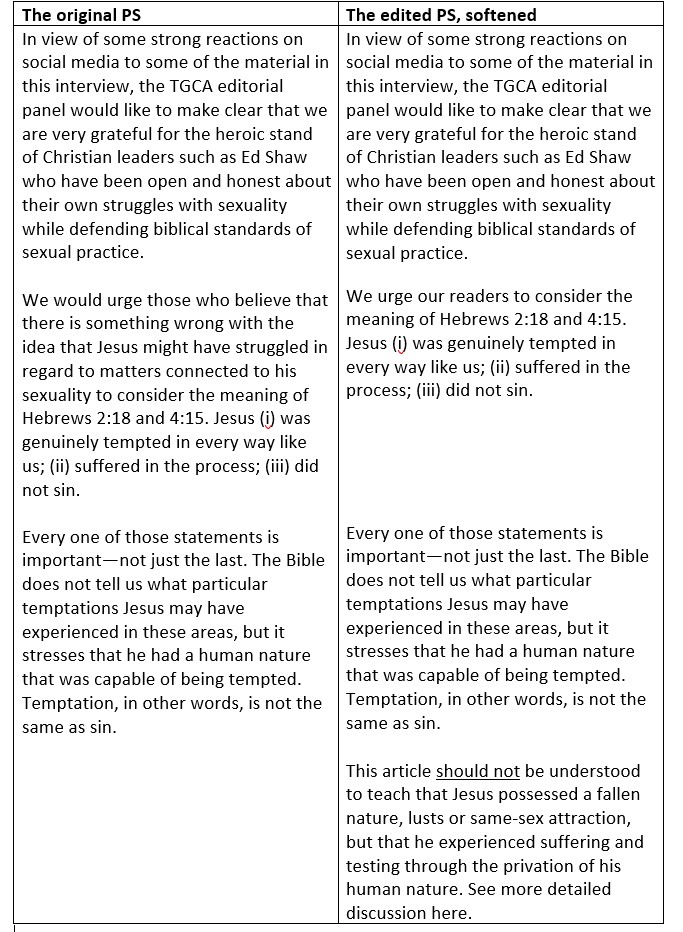
the original PS compared
Ed Shaw’s PS at the end of his article at TGC AU, both the original and edited, side by side. 
My article here was to present proper interpretation of Heb 2:18 & 4:15,
as Shaw’s PS recommended.
Posted in theology, word of the week

Word of the Week: Immutability

By Elizabeth Prata

The thread of Christianity depends on a unity from one generation to the next of mutual understanding of our important words. Hence the Word of the Week.

8341e-word2bcloud

Immutability: Is the unchanging nature of someone. To be immutable is to be unchanging. God is unchanging in his character, will, and covenant promises. He does not change His mind, His will, or His nature.

Consider what thou owest to his immutability. Though thou hast changed a thousand times, he has not changed once; though thou hast shifted thy intentions, and thy will, yet he has not once swerved from his eternal purpose, but still has held thee fast. – Charles Spurgeon, The Christian—A Debtor, Sermon #96.

For someone to change, there must have been a point in time where the person was something else, or thought something different, or had alternate plans. Then as time passed, the person changed. Since God is outside of time, He is always the same, from point A to point B.

Also, His attributes are unchanging. He doesn’t add to His character nor subtract from it. He isn’t more loving today than when He was in Genesis 1:1 when our time began. He isn’t more wrathful against sin than when He was 15 years ago or 100 years ago. He isn’t more merciful or less compassionate than when Jesus walked in His incarnation.

What does immutability mean for us, His people?

As we read in Hebrews 6:17-18,

So when God desired to show more convincingly to the heirs of the promise the unchangeable character of his purpose, he guaranteed it with an oath, so that by two unchangeable things, in which it is impossible for God to lie, we who have fled for refuge might have strong encouragement to hold fast to the hope set before us.

It means we should be encouraged that His promises are sure. The joy that is waiting for us in heaven, the reunion with the glorified family as adopted sons and daughters, the glory, the sinlessness, all that, is unchanging because God does not change. He promised this. It will happen.

It means doom for those who will not repent. God will not forsake His holiness and allow rebels into heaven. It means the judgment and subsequent hellish torment awaiting many millions is sure. It will happen.

The gulf between the two eternities is never more stark than when considering His immutability. He has forged those two paths and they will not change. Keep both in mind when pondering His immutability.

1 immutabilty sunday

Posted in potpourri, theology

Ladies, a few more resources; new ones and reminders of established ones

By Elizabeth Prata

Laura and Sue have a blog at https://ordinarylifedivinetruth.wordpress.com. I became aware of it when Laura sent me a note through the Contact sheet on this blog. Their latest blog essay recounts a conversation they’d had with Lysa TerKeurst regarding some of Lysa’s concerning teachings and behavior. It was well written and sensitive, laced with grace.

These ladies are also concerned with false teachers of women and have other series describing issues with the various ones populating our Christian landscape. They also have written several series on the topics of Counseling/Abuse, Discipleship, Popular Christian Movies, and more.

Michelle Lesley and Amy Spreeman have started a podcast. It is called A Word Fitly Spoken, from the verse from Proverbs 25:11, A word fitly spoken is like apples of gold in pictures of silver. Their podcast is on various platforms now. https://awordfitlyspoken.life/

Savannah Rae is a 21-year-old college graduate from our church. She started a blog called Vogue and Valor and writes very well. She recently made a decision to work at Echo in Ft. Myers FL as a way to care for those less fortunate, through her faith in Jesus. I’m so proud of her. I’m proud also of the other young men and women from our church who have made decisions and recently departed as faithful milkweed seeds to spread the Gospel through various organizations and means. When the elders founded the church almost 4 years ago they were prayerful about it being a raising-up-and-sending church, deeply focusing on missions. The Lord has been bountiful in aiding us, His flawed human beings, to accomplish this. May His name be glorified.

Here is a good reminder of some recommended resources that are still strong-

Equipping Eve, podcast by Erin. Latest edition, Episode 96: Faithfulness in the Little Things

The Master’s Seminary Church Search finds churches in your area pastored by or founded by TMS grads.

Alistair Begg, sermons at Truth For Life, aimed at practical Christian living.

Samuel D. James is an excellent writer. He posts thought provoking material on Christian life, culture and other topics at his blog, Letter & Liturgy. His, along with curated guest posts, are a worthwhile read. I liked this one from Caleb Wait, who as a young dad going through seminary looking for ways to save time, discovered that “productivity lit” is generally aimed at the unmarried and/or childless audience- but came up with some tips and aids on his own.

Ken Puls Music has a series on Notes & Commentary on Pilgrim’s Progress. I love the book Pilgrim’s Progress. I need the notes though. Lots of material online offer notes & commentary on this wonderful book. Here is a good series that I enjoyed. Part 1 here.

watkinsville 1.jpg