Posted in theology

Independence Day in the US today, but a future freedom awaits

By Elizabeth Prata

For our citizenship is in heaven, from which also we eagerly wait for a Savior, the Lord Jesus Christ; (Philippians 3:20)

Charles Spurgeon preached on this verse:

Citizenship in heaven

Our text, I think, might be best translated thus— “Our citizenship is in heaven.” The French translation renders it, “As for us, our burgess-ship is in the heavens.” Doddridge paraphrases it, “But we converse as citizens of heaven, considering ourselves as denizens of the New Jerusalem, and only strangers and pilgrims upon earth.”

I. The first idea which is suggested by the verse under consideration is this: if our citizenship be in heaven, then WE ARE ALIENS HERE; we are strangers and foreigners, pilgrims and sojourners in the earth, as all our fathers were. In the words of Sacred Writ “Here we have no continuing city,” but “we desire a better country, that is an heavenly.”

Let us illustrate our position. A certain young man is sent out by his father to trade on behalf of the family: he is sent to America, and he is just now living in New York. A very fortunate thing it is for him that his citizenship is in England; that, though he lives in America and trades there, yet he is an alien, and does not belong to that afflicted nation; for he retains his citizenship with us on this side the Atlantic.

Yet there is a line of conduct which is due from him to the country which affords him shelter, and he must see to it that he does not fail to render it. Since we are aliens, we must remember to behave ourselves as aliens should, and by no means come short in our duty. We are affected by the position of our temporary country.

Do you eagerly await our savior? I do. It’s Independence Day here in the United States. There will be fireworks, barbecues, beaches, parades, and gatherings. When Jesus comes, we will have a magnificent independence! The Great Gathering will happen and then we will be freed from this body of death. We will be free from the presence of sin. We will be free to gaze in adoration upon the Savior all the day long, and bask in His glory light in wonder and in love.

So if the Son sets you free, you will be free indeed. (John 8:36).

No flags in heaven, but the presence of every nation, tribe, and tongue.

After this I looked, and behold, a great multitude that no one could number, from every nation, from all tribes and peoples and languages, standing before the throne and before the Lamb, clothed in white robes, with palm branches in their hands, 10 and crying out with a loud voice, “Salvation belongs to our God who sits on the throne, and to the Lamb!” (Revelation 7:9-10).

collage fourth of july

Posted in theology

Our associations matter: Biblical study on when to stay and when to separate

By Elizabeth Prata

We live in the age of “tolerance”. It’s not the tolerance you and I might have grown up with. The Merriam Webster dictionary defines tolerance as

sympathy or indulgence for beliefs or practices differing from or conflicting with one’s own, or : the allowable deviation from a standard

The issue in this decade is that in the secular world, liberals set the standard – and don’t allow any deviation from it. They also do not display any sympathy for those who differ. (Not all of them, I’m not speaking of an absolute, but a generality common to many people). Sadly of late the same is happening in the Christian world. Liberal Christians, some truly saved and others who aren’t, display the same attitude.

There are many reasons for this latter unfortunate circumstance. One of them, in my opinion, is that there is a throng of false teachers whose fetish in teaching is grace only, usually focusing on “love” to an extreme and never mentioning sin/repentance/wrath. After a decade or more of love-love-love, people have just as twisted understanding of what love is as they do the new version of tolerance.

That, in combination with a lack of ability or willingness to study and understand scripture, has brought forth a horde and a herd of folks ready to squash anyone whose understanding on these matters is biblically based on scripture.

This effect of the false teachers’ teaching was brought home to me yesterday as I was having conversations on social media about the need to separate from some professing believers  at prescribed times is a matter of command and prescription. When you look at the myriad scriptures, there are actually quite a few situations when brethren are supposed to divide from other brethren, and even in some cases, the lost.

This fact was met with incredulity, horror, and anger as one after another of these women, and some men, pushed back against this notion. Sharing the scriptures does not resolve anything. It often actually makes them angrier. Many simply ignore the shared scriptures and resort to calling names.

So I thought I’d do a study on what the Bible says about our associations with other people, when to leave a brother alone. This is hopefully to show that as with many other circumstances in our earthly life as humans, the Holy Spirit has given us wisdom and understanding about our associations, friendships, and fellowship.

While it seems “unloving” or dare I say “intolerant” to separate from a brother, there are sometimes good reasons for it, as we’ll see.

In many cases, when discerning brethren warn about this or that false teacher, the person will say, “Did you go to him?” meaning, did you have a private conversation with that public teacher before you said anything negative about his or her teaching? This refers back to Matthew 18. Going to a false teacher prior to critiquing his or her lessons is not necessary, because they are public teachers. The Matthew 18 verses are concerned with sinners in church.

It’s baffling to think that they will cling to Matthew 18:15-17 in the first place but avoid the end result of that process just 3 verses later, which is separation. Her is the process for dealing with a sinning brother in church-

Step 1: If your brother sins, go and show him his fault in private; if he listens to you, you have won your brother.

Step 2: But if he does not listen to you, take one or two more with you, so that by the mouth of two or three witnesses every fact may be confirmed.

Step 3: If he refuses to listen to them, tell it to the church;

Step 4: and if he refuses to listen even to the church, let him be to you as a Gentile and a tax collector.

The separation in this last step to treat them “as a Gentile and a tax collector” means-

In the narrative’s Jewish context, Gentiles and tax collectors would be regarded as outsiders. This instruction to cut ties with the unrepentant sinner is intended to remove sin from the local group of believers. Faithlife Study Bible (Mt 18:17), Barry, J. D.,

The individual person’s involvement in this scenario is in step 1 and 2. When it gets to steps 3 and 4, it is the pastor’s duty to make this judgment call, and the individual sister’s onus to submit to the assessment of her leaders in church. You see the reason for this called-for separation; to prevent sin from spreading.

A little leaven leavens the whole lump of dough. (Galatians 5:9).

In another case of called-for separation, we see in 1 Corinthians 5:9, 11 of Paul that,

I wrote you in my letter not to associate with sexually immoral people;

But now I am writing to you not to associate with anyone who bears the name of brother if he is guilty of sexual immorality or greed, or is an idolater, reviler, drunkard, or swindler—not even to eat with such a one.

Paul expected them to disassociate with all who said they were brothers but had a consistent pattern of sin, particularly sexual sin. In the culture of the day eating with someone was a sign of acceptance. Therefore if breaking bread with a homosexual, an adulterer, fornicator etc it was a sign that their behavior was accepted by Christians, who otherwise called for holy living.

Paul said that sexual sin was a sin that brethren were not to tolerate, even to the point of breaking fellowship, because as he explains the verses in 1 Corinthians 6:15-19,

The believer’s body is not only for the Lord here and now (v. 14), but is of the Lord, a part of His body, the church (Eph 1:22,23). The Christian’s body is a spiritual temple in which the Spirit of Christ lives, therefore when a believer commits a sexual sin, it involves Christ with a harlot. All sexual sin is harlotry. (John MacArthur Study Bible note.)

So, that’s pretty obvious why we are to separate.

Here is another example regarding the limits of Christian fellowship.

So when you are assembled and I am with you in spirit, and the power of our Lord Jesus is present, 5 hand this man over to Satan for the destruction of the flesh, so that his spirit may be saved on the day of the Lord. (1 Corinthians 5:4-5).

This is the famous case of a man sleeping with his father’s wife. The Corinthians were tolerating it. In today’s parlance, were they trying to “be loving”? Would they think it “mean-spirited” to ostracize this man from their fellowship? Paul pulled no punches with what they were to do.

Satan is the ruler of this world, while Jesus is head of the Church. (Not that he isn’t the ultimate Ruler). Since it was known that the man was engaged in sexual immorality to the point of incest, the Corinthians were to put him out where satan reigns. Turning a believer over to satan puts him back into the cold world to be on his own, apart from the care and support of Christian fellowship inside the warmth of the church, as John MacArthur explains in his commentary.

That person has forfeited the right to participation in the church of Jesus Christ, which He intends to keep pure at all costs. MacArthur, Commentary

As always, the goal is reconciliation. Making this shocking move would let the believing sinner know the limits of tolerance.

We have another example of separation in 2 John 1:8-11

Watch yourselves, that you do not lose what we have accomplished, but that you may receive a full reward. 9Anyone who goes too far and does not abide in the teaching of Christ, does not have God; the one who abides in the teaching, he has both the Father and the Son.if anyone comes to you and does not bring this teaching, do not receive him into your house, and do not give him a greeting; 11for the one who gives him a greeting participates in his evil deeds.

Here in this epistle John is giving limits to Christian hospitality. We are to separate from people who go beyond the teaching of Jesus. Do not even greet those who teach beyond what is written. Back then hospitality was important because there were no hotels, so traveling teachers lodged with believers.

John isn’t prohibiting people from sharing the Gospel with unbelievers or the ignorant, or even those in cults and false religions. We always want to evangelize. But remain apart from and do not even welcome those false teachers, because welcoming them to your home affirms their teaching and gives them credibility. What we say is important but also what we do is equally important. Housing and welcoming false teachers who labor in the faith (to deceive followers) would confuse people and offer a massive stumbling block.

It might seem “unloving” to say that there comes a point where we don’t offer the Gospel to a lost person but there are even limits to associating with the unsaved.

Do not give what is holy to dogs, and do not throw your pearls before swine, or they will trample them under their feet, and turn and tear you to pieces. (Matthew 7:6)

Jesus’ point is that certain truths and blessings of our faith are not to be shared with people who are totally antagonistic to the things of God. … Jesus did not give all of his teaching to everyone who happened to be listening. (Matthew 11:25, 11:11-13). … There will be times when the Gospel we present is absolutely rejected and ridiculed and we make the judgment to turn away and speak no more. JMac Commentary

We are given the same admonition in Matthew 10:14 where we are told to shake the dust off our feet and move on.

One commenter gives a word of caution though,

But while the indiscriminately zealous have need of this caution, let us be on our guard against too readily setting our neighbors down as dogs and swine, and excusing ourselves from endeavoring to do them good on this poor plea. Jamieson Faucett

Even Jesus closed His public ministry at a certain point, after He had given sign after sign and miracle after miracle and taught all the days long, and many were still questioning, demanding, and rejecting. So He closed it down and privately taught only the believers and eventual apostles. After His resurrection He only appeared to believers.

We have seen that with love and discernment, there are times to make a judgment call and separate from people who profess Christ but persist in unrepentant sin. Against the backdrop of the lovey tolerance of today, doing so seems harsh and cruel. But do we today care more about the feelings of the unrepentant professing believing rebel than the Savior who died to give us power by the Spirit to slay those sins?

Look at Acts 5:13,

But none of the rest dared to associate with them; however, the people held them in high esteem.

The watching pagans respected the followers of Jesus, but feared to join them. Why? Were they scary No, they were respected, not feared. The fear came because it was obvious that the followers were serious about sin and hypocrisy in the church. Ananias and Sapphira had just been smote. The followers were obviously part of something that was holy and pure. Bystanders respected their witness and were counting the cost of joining. Only serious sin-slayers need apply.

Nowadays people are encouraged to follow Jesus and bring their sin with them.

We love our neighbor in the next pew, yes, but loving that believer doesn’t mean overlooking their sin. Sadly there are times and cases when separation from the believers we associate with is called for. With everything, do so cautiously, in love, and after study and prayer. Some of these situations are pretty clear and others are more gray. Err on the side of love, but remain strong in respecting biblical limits of associations and fellowship. We strive to be strong in both doctrine and life.

DSCN3922

Posted in prophecy, theology

The Lord will Thresh and Winnow

By Elizabeth Prata

It’s vacation week for much of America. I’m going to go a little easy myself this week and get a bunch of reading done. I thought for this week I’d bring forward some of the early essays I wrote.

With 5,200 essays written here since 2009, there are some you may have missed, lol. I published this one in May 2009. You can see my heart even since the earliest days of this blog. Agricultural allusions, and judgment.

bd618-sheavesSheaves of Wheat, Van Gogh

God uses a process as an example in His Word that would have been immediately identifiable to His agricultural people: threshing and winnowing. He talks of the threshing floor, the threshing barn, the winnowing fan and fork, chaff and sheaves…all these are examples of His sorting process in judgment. We have lost contact with the land. Do we fully understand know what these prophetic scriptures mean? Most of them refer to the end of days and final admonitions and judgments. We should learn them.

For behold, the day is coming, burning like a furnace; and all the arrogant and every evildoer will be chaff; and the day that is coming will set them ablaze,” says the LORD of hosts, “so that it will leave them neither root nor branch.” (Malachi 4:1)

Before the decree takes effect–The day passes like the chaff–Before the burning anger of the LORD comes upon you, Before the day of the LORD’S anger comes upon you. (Zephaniah 2:2)

You will winnow them, and the wind will carry them away, And the storm will scatter them; But you will rejoice in the LORD, You will glory in the Holy One of Israel. (Isaiah 41:16)

His winnowing fork is in his hand, and he will clear his threshing floor, gathering his wheat into the barn and burning up the chaff with unquenchable fire. (Matthew 3:12, Luke 3:17

Threshing floor

After reaping, the grain is gathered and prepared for processing. In Jesus’ times, the main grains were wheat, which made better bread but required good soil and water, two items lacking in the desert; and barley. Barley was used for bread by less wealthy people, because it would grow in harsh conditions with more ease.

(John 6:9:”There is a lad here who has five barley loaves and two fish, but what are these for so many people?“)

Grain reaping was completed either by pulling it up by the roots, or cutting it with a type of sickle. The grain when cut was generally put up in sheaves (Genesis 37:7; Leviticus 23:10-15; Ruth 2:7, 15; Job 24:10; Jeremiah 9:22; Micah 4:12). You can see sheaves stacked together in the Van Gogh rendering above. Afterwards the sheaves were gathered to the threshing-floor or stored in barns (Matthew 6:26).

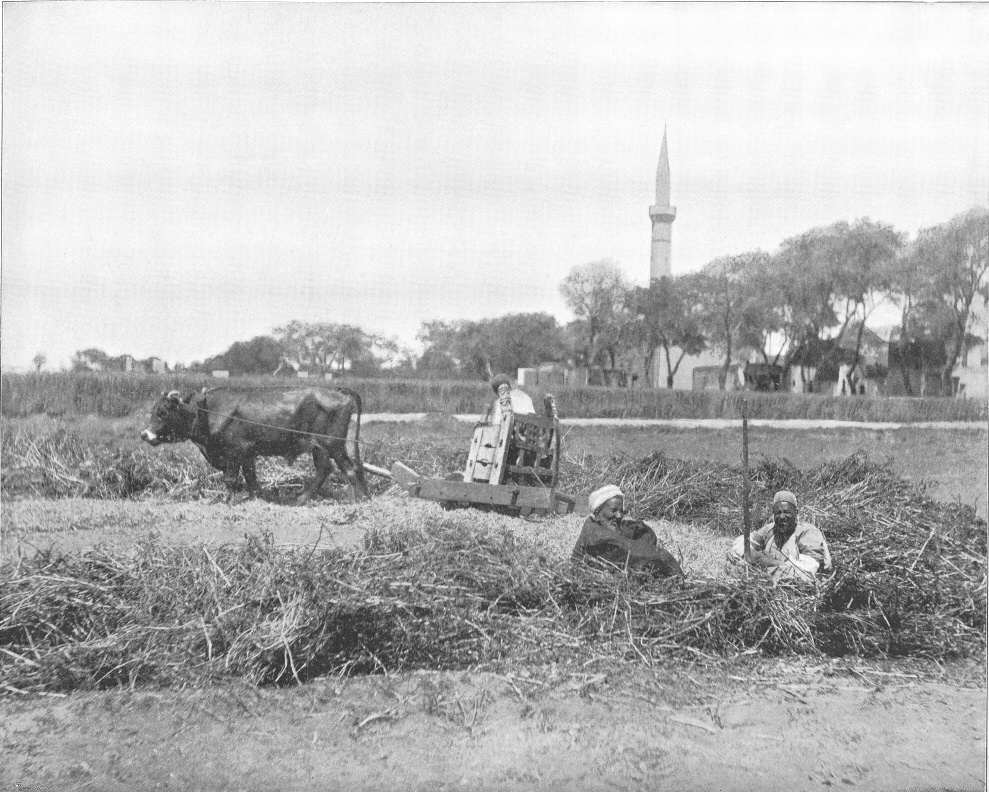
Threshing with ox

Next comes threshing. Circular floors were prepared on hilltops, where there was more wind. A threshing floor is a specially flattened surface made either of rock or beaten earth where a farmer would thresh the grain harvest by spreading the sheaves on the threshing-floor and causing oxen and cattle to walk repeatedly over them (Deuteronomy 25:4; Isaiah 28:28) using a threshing roller or sledge (2 Samuel 24:22; 1 Chronicles 21:23; Isaiah 3:15).

However, the a sledge sometimes damaged the grain, but that couldn’t be helped. This process got the grain off the stalk.

Next, winnowing. Now that threshing got the grains off the stalk, it was still lying on the threshing floor among all the other parts of the plant, the grass, leaves, and stalk. Winnowing is sifting the grains from the stalks and leaves.

After the grain was threshed, it was winnowed by being thrown up against the wind (Jeremiah 4:11) to sift it. The wind would carry away the grass, leaves, and stems. The grain, being heavier, would fall back to the floor. The shovel and the fan for winnowing are mentioned in Psalm 35:5, Job 21:18, Isaiah 17:13. The refuse of straw and chaff was burned (Isaiah 5:24). Freed from all the extras like the stalk, grass, and leaves, the grain was then stored in granaries till used (Deuteronomy 28:8; Proverbs 3:10; Matthew 6:26; 13:30; Luke 12:18). It would be ground into flour and baked as bread.

Are you wheat, good men who will be gathered from the barns to His bosom? Or are you chaff, which will be left behind and burned with unquenchable fire? Do not wait for the very end to find out, to be winnowed and sifted, the good from the bad. Pray to Jesus today and ask to be forgiven of your sins, and He will do so. Ask Him to be the Lord of your life, and He will be so. Then when the time of judgment comes, you will know with certainty where you stand in the winnowing.

Picture gallery-

Source- Earthly footsteps of the Man of Galilee, 1893, public domain

Caption:

‎The threshing scene which our picture represents we witnessed between the Garden of the Virgin and the Obelisk of Heliopolis. What a commentary is this upon that vanity of earthly greatness that men should be threshing upon the very site of one of the proudest and most influential cities of ancient times. The mowraj is a threshing machine which is drawn over a floor by a yoke of oxen till the grain is separated from the straw, and the straw itself ground into chaff. The Egyptian mowraj has rollers which roll over the grain. Circular saws are sometimes attached to the rollers. Source: Earthly Footsteps of the Man of Galilee.


Winnowing with the wind. Source, Images from The People’s Bible Encyclopedia, by Charles Barnes, 1912

Sweeping the threshing floor in order to pile up the seed. Source: Wikiwand
Posted in theology

About those verses of braided hair…

By Elizabeth Prata

I’ve been watching The Waltons in my free time here during summer break. It’s a sweet drama based on writer Earl Hamner, Jr.’s life on the fictional Walton’s Mountain. His actual boyhood home was in in the Appalachians of the area of Schuyler in Nelson County, Virginia. The time is during the Depression.

The mother is named Olivia (played by the lady Michael Learned) and in the show her hair is always is a simple twist on the nape of her neck. It’s very pretty hair and the loose tendrils that escape during the inevitable hard labor chores frame her face. Very occasionally, if Olivia is shown in bed attire or having gotten up in the middle of the night, her hair is down in one long braid. I always liked how the show did up her hair. I don’t know if her hairstyle is authentic for the 1930s or not, but I always thought the simple chignon was pretty.

Jane Seymour starred with Christopher Reeve in the romantic movie Somewhere in Time. Jane’s character also had beautiful hair, of which I was fascinated. Above, the character Olivia Walton.

Farrah Fawcett was known for her hair, a style which defined the 70s and caused many to swoon. Jennifer Aniston’s hair also did the same for the 1990s. When one thinks of these and other beautiful actresses, their long, flowing hair dressed in feminine style is usually the first thing that comes to mind. Who doesn’t remember a a kid brushing Barbie’s long hair, or even the Trolls’? And that is the point. Long, luxurious hair is always identified with womanly femininity.

Our Sunday School lesson is currently in 1 Peter. We are going through section by section this summer. Yesterday was 1 Peter 3:1-6.

Your adornment must not be merely external—braiding the hair, and wearing gold jewelry, or putting on dresses; 4but let it be the hidden person of the heart, with the imperishable quality of a gentle and quiet spirit, which is precious in the sight of God.

In this verse, is the Holy Spirit against braided hair and gold jewelry? No. If one takes a correctly literal but incorrectly narrow view of this verse, a women could highly adorn her hair not in braids but in a French knot and wear not lots of gold or pearls but pounds of platinum and say she is being consistent with the verse, literally. So what does the verse mean?

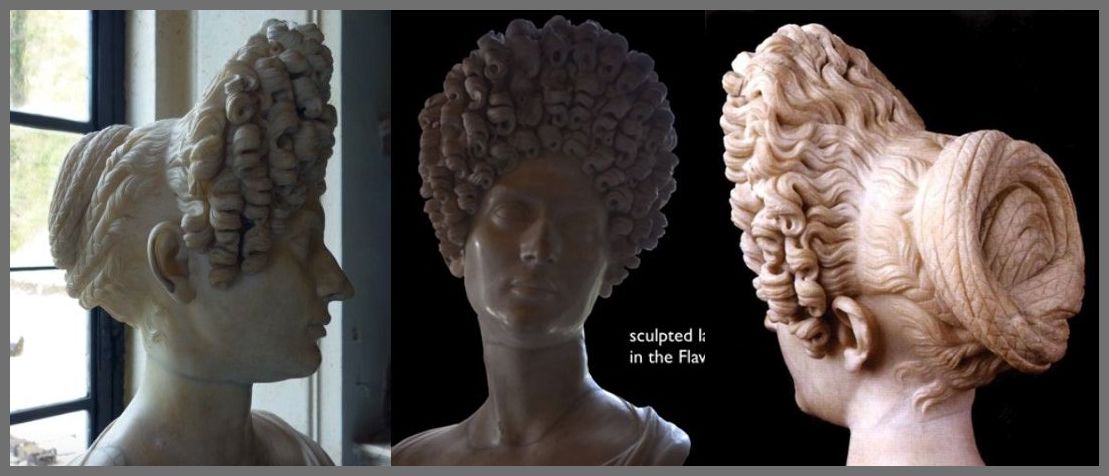
Julia was the Roman emperor Titus’s daughter and thus part of the Flavian era, which ran during its three emperors reign from about 65-100 AD. The Flavian Dynasty bore the emperors Titus, Domitian, and Vespasian. These three reigned just after the abusive and cruel time of Nero. Vespasian was the emperor who built the Colosseum.

In the earlier days of the Empire, Roman women wore their hair relatively simply, in one long plait, or loose with a headband. High-born vs. low-born women could not readily be distinguished. Their clothes also were relatively simple, with no patterns except the stripe of purple the very rich could afford, or perhaps by the quality of the linen (or its sheerness, of one was a prostitute).

By the time Julia came along, those simpler days were gone. She sparked a hairstyle craze of elaborately coiffed curls, stacked in layers. And then as now, when a high-ranking women or a celebrity display a certain hairstyle, the other women follow suit. Remember the desire for Princess Diana looking hair? Or Dorothy Hamill cuts? Or Michelle Obama bangs? Back in Peter’s day, women wanted Julia-hair.

Portrait Bust of a Flavian Woman (Fonseca Bust), from Rome, c. 100 C.E., marble. Kahn Academy

Since dress was fairly uniform, it was the hair that was the main event. Since all Roman women believed that loose hair was a sign of barbarianism and coiffed hair was a sign of civilization and even literacy, they all did their hair. They all wore it up, except for young girls, or at funerals.

lot could be told about a woman’s social status by her coif. The more intricate it was, the more it was obvious that the woman had leisure time to spend on personal appearance, and more slaves to attend to her. Some wore gold hair nets, or included pearls or jewels in the braiding. Some sprinkled gold on their hair to look blonder (a sought after hair color, then as now).

Olivia Walton’s hair, held in place in a bun with one un-elaborate pin, would be worn by lower class women. The higher the class, the higher the hair, and the more elaborate the pins. Lower to middle class women would go find a tonstrix shop, that’s the Latin word for female barber (tonsor is the male). They were mentioned in ancient literature and usually lined up on one street or in a neighborhood section. Wealthy women would have an ornatrix to attend her hair and dress at home, from the pool of slaves she would invariably own. The relief blow shows a wealthy woman with four ornatrices.  An orantrix didn’t just handle hair, she perfumed, made-up, rearranged clothing, anything to make her Lady look good to the public.

Relief of slaves adorning a woman. Rheinisches Landesmuseum, Trier, Germany. (2nd-3rd c. AD)

The styles took hours to accomplish. Before you go all “that’s such a waste of time!’ think of how long it takes to do cornrows, hair extensions, or perms. Uh-huh.

What Peter was saying in 1 Peter 3 and what Paul was saying in 1 Timothy 2:9 is that the adornment we should display is Christ. We need not spend hours in an activity whose main aim is to get people to look at us. A woman’s character of humility meekness, warmth, love, and kindness are the statements we want to achieve. Being consumed with outward appearance inhibits a woman from loving Christ and others as the primary occupation of her life. It also distracts her from the service she could be performing and the money she could be spending elsewhere.

Hair styles come and go, as well as preferences for certain kinds of jewelry or clothing. But the principle the Apostles were asking the women to apply is to dress modestly, according to the individual conscience, but to also monitor why one might be spending longer times on one’s appearance, or more money, than she used to. We do want to be properly adorned on the outside but it’s the inner adornment that matters: Christ in us. Don’t let anything perishable compete with that.


Posted in missions, theology

‘Every tribe and tongue’ an encouraging mission movie (30-min)

By Elizabeth Prata

I know there has been a lot of negativity lately. I know you, as I do, look around at our country and the world and see so many lost souls, see the name of Jesus stomped on, and discouragement can creep in.

But then I see things like this and I remember that His name IS spotless and will always remain so, no matter how many people raise their fists at Him. He is working in the world to save souls, and His glory goes before Him and trails after Him. And one day, we will be IN his glory, seeing Him, and seeing all the people he has brought to Himself.

I enjoyed this 30 minute documentary about the call, training, installment, acculturation, and work of a moder day missionary among the YembiYembi tribe of Papua New Guinea. If you feel any sort of sadness or discouragement then this should fix it.

All glory to His name!


YembiYembi: Unto the Nations from Jesse Low on Vimeo.

Posted in discernment, theology

Even Salon.com says “Joel Osteen Worships Himself” (re-post)

By Elizabeth Prata

I was working on an essay about the Drag Queen programs in public libraries but I simply could not continue. Here is a repost of an essay I wrote in June 2012. Joel Osteen is a false teacher, you guys.

——————————

Joel Osteen worships himself
At a D.C. rally, it’s clear that the megachurch pastor’s childlike faith is really about the power of narcissism

The article is from Salon.com, a fairly liberal media outlet. I found it interesting that Mr Osteen’s obvious narcissism is apparent even to someone who may be liberal and may be an outsider to the faith.

Pastor Mike Abendroth at No Compromise Radio and Bethlehem Bible Church says that when people realize Abendroth is a pastor, they try and make an attempt at spiritual connection with him by saying, “I listen to Joel Osteen.” He said as an example to one lady who’d shared that, he had replied,

“Joel Osteen doesn’t like to talk about sin because he says we all know about it and we all get enough about that so let’s talk about other positive things. Paul talked about sin first. Peter talked about sin first. John the Baptist talked about sin first. All the prophets talked about sin first. And Jesus even talked about sin first. If you don’t know you’re a sinner, you don’t need to know about your savior. If you know how great your sin is, you don’t need a greater Savior than all your sin.”

The Salon.com author Mr Chris Lehmann stated in the article that it’s obvious Osteen “subtly downgrades” the magnificent and transcendent God “into a glorified lifestyle concierge”…into a “genial cruise director,” “through talismanic faith in positive utterance.”

He wrote, “The believer’s chief task is to ratify the preexisting divine script of success in his or her individual life — and then to bear testimony to that joyous transformation in a community of like-minded success believers.’

He’s right, that is what Mr Osteen preaches, and it is a far cry from true worship of the Living God.

So what IS worship of the True and Living God? Exodus 15:2 gives one example: “The LORD is my strength and my song; he has become my salvation. He is my God, and I will praise him, my father’s God, and I will exalt him.”

Psalm 66:4: “All the earth bows down to you; they sing praise to you, they sing praise to your name.”

Rather, in the article, Lehmann states, Osteen has the “outlook of someone possessed of grandiose fantasies about the imperial reach of the self.”

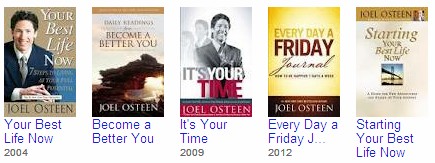
It is not about us. I don’t recall David preaching or writing one Psalm that says we can have our best life now. I don’t recall Jeremiah the weeping prophet pronouncing that ‘It’s your time’. Mr Lehmann ends devastatingly with this thought on Mr Osteen’s approach, which is a:

theology-free success gospel, pitched exclusively to tales of individual triumph. Osteen’s sermons all begin with a self-empowering chant from believers. “This is my Bible,” it goes in part; “I am what it says I am. I have what it says I have.” But there are legions of dead — now confined by definition, it’s true, in the hated past — who come bearing the testimony that the Bible is not actually about you.

It is about the Holy One of Israel, the Word made flesh!!

Woodcut, 1695, Title, “Word” by artist Johann Christoph Weigel. Source

Fear God! Keep your vows! “Guard your steps when you go to the house of God. Go near to listen rather than to offer the sacrifice of fools, who do not know that they do wrong.” (Ecclesiastes 5:1).


Posted in discernment, theology

Learning when to stay in and when to separate out

By Elizabeth Prata

Proverbs is one of the Bible’s Wisdom books. The others are Job, Psalms, Ecclesiastes, Song of Songs.

We Christians love all people, because we know that all people are image bearers of God. We also love them because we are to live our lives as a witness to the power of Jesus to change lives of sinners to people of love.

There are different kinds of love though. God loves the world, beneficently, but He loves His people covenantly. So do we.

We aren’t doormats, mindlessly loving all people no matter what. There are times and circumstances where we are told to separate from a person, or if you’re a pastor, to excommunicate a person. (1 Corinthians 5:5). We don’t partner with the unsaved or the professing false in spiritual endeavors, nor marry unbelievers. (2 Corinthians 6:14).

Paul was horrified the Corinthian church was tolerating the incest of a man and his mother-in-law’s sexual union. (1 Corinthians 5:1). We are told not to associate with sexually immoral people who claim Christ but live unrepentant, unholy, sexually immoral lives. (1 Corinthians 5:9).

And we all know this one, if you’ve given the Gospel to someone and they revile it and trample it, move on. You can continue to love them by praying for that Gospel seed to take root.

Do not give what is holy to dogs, and do not throw your pearls before swine, or they will trample them under their feet, and turn and tear you to pieces. (Matthew 7:6)

Paul wasn’t speaking of standing apart and refusing to talk with or be with the unsaved. They can’t help what they do, and they need the verbal witness of the Gospel spoken to them and the tacit witness of a life lived for Christ. We’re still in the world, after all.

The issue is with professing Christians. It’s more significant when it involves professing Christians, because of the blot on Jesus’ name. There is a time to love and engage with those who profess Christ, and there is a time to shun them who say they love Jesus but say or do things consistently that belie that profession.

There’s another verse that speaks to to this issue, from Proverbs-

A man of great anger will bear the penalty,
For if you rescue him, you will only have to do it again.
(Proverbs 19:19)

I knew a man like that. He wasn’t in Christ. His anger was always bubbling, ready to erupt. He lodged a lot of lawsuits, he did a lot of yelling, grumbling, hating. The commentaries on the Proverb say,

Repeated acts of kindness are wasted on ill-natured people. John MacArthur Study Bible Note 

The sense of this proverb seems to be that the connection between unseemly anger and punishment is so invariable that any effort to save such a man from the disastrous consequences, which he brings upon himself by his anger, would do little good; because it wouldn’t be long till he would again need deliverance.” Coffman’s Commentaries on the Bible 

for if thou deliver him, yet thou must do it again; if he is got out of one broil, he will get into another quickly; if he clear of one lawsuit, another will be commenced against him in a short time; if he is discharged and freed from a penalty he is justly subject to, it must be done again and again; he will fall into the same evil, and there is no end of appearing, for him and serving him; a wrathful man brings himself into great trouble, Gill’s Exposition of the Entire Bible

MacArthur preached,

“You have heard that it was said, ‘An eye for an eye and a tooth for a tooth.’ But I tell you not to resist an evil person. But whoever slaps you on your right cheek, turn the other to him also. If anyone wants to sue you and take away your tunic, let him have your cloak also. And whoever compels you to go one mile, go with him two. Give to him who asks you, and from him who wants to borrow from you do not turn away.” … At first reading, it sounds like Jesus wants to make us all into sanctimonious doormats.

“The fact that your heart is prone to retaliation, to get even, is evidence enough that no system of human religion can deal with the heart of the human problem. You need a Savior, a righteousness beyond our own.” That’s what He’s saying, and that’s the heart of the matter here.

In other words, don’t start a feud, or a vengeance thing. Don’t get some revenge going, that’s all He’s saying. He’s not talking about categorical evil and letting it overrun your life

Read the word, learn from commentaries, pray, and be aware that loving one’s neighbor sometimes means there are cases where it is better not to have anything to do with him than to be tempted to seek revenge, or continue to help out an angry man, or to partner with someone who is sexually immoral, etc. We’re always to be kind and reasonable, but we’re not doormats either.

separate

Further Resources

The Purpose of Wisdom Literature

How can a Christian avoid being a doormat for other people?


Posted in love, theology

What is love?

By Elizabeth Prata

I don’t like writing about myself and I never talk about my internal emotions and thoughts. I’d really rather die than talk about what’s going on inside me. But I have to this time, because it’s about Jesus.

As a woman who grew up in a difficult circumstance, I learned to rely only on myself and to be strongly independent and self-sufficient, and have been so for 50 years (since I was 8). Yet when I was given the grace of salvation 15 years ago, I learned also that the Lord wants me to share my burdens and to interlock in mutual submission with others in caring relationships. I don’t know how to do this, it’s literally beyond my life experience and my emotional capacity. But with God all things are possible.

I am learning His lessons about trusting Him in sharing burdens and loving others- as well as accepting love from others. My prayers are being answered day by day, His glory is being shown- through all of my different families- Twitter tweeps, School family, Church body in a huge and impactful way.

Life before salvation and outside of church, was a bewildering swirl of relationships between others…not knowing how to break in or even particularly wanting to:

relationships1b
I still have difficulty with socializing and developing or maintaining relationships. It’s not a matter of trying harder or willpower or shyness. It’s irritating when people try to sympathize by saying “I’m shy too” when it’s literally a matter of different brain wiring, and not behavior modification. I know they are trying to be nice, but it’s a totally wrong thing to say.

Though my brain is made differently, nothing is too difficult for God. Through the incessant work of the Holy Spirit, like water eventually wears through stone, the glory of God that is shown through my friends, after 5 decades and a loving set of families the Lord has given me, we have this:

relationships2b
I still don’t know the “how” of it. But I can feel the love. I love you back.

The important thing is to keep persevering.

persevere
Further Resources:

RC Sproul lectures: Love

19 Secrets Autistic People…(what not to say)

14 Things not to say to an Autistic Person (I’ve actually had someone say #11 to my face, except it was phrased more rudely)

Love for the Long Haul: The Autism Pastor

Posted in encouragement, theology

Good fruit (Not what you think)

By Elizabeth Prata

I was cutting up a nectarine that had been sitting in my fruit bowl for many days. “Surely it will be ripe by now” I thought.

I began chopping it into chunks to add to my oatmeal, and it was still hard and unripe. Gah! Other times when I think the piece of fruit is ripe, it’s dried out and mummy-like inside.

It’s not that I can’t tell when a piece of fruit is ripe, I can. It’s that the declining quality of the fruits makes it hard to determine if this one is juicy or this one is always going to remain a rock. Lately at the grocery store, choosing fruit has been like Fruit Roulette.

I remember my friend and I driving in the Tuscan countryside (yes, really) and we got behind a small tractor pulling a trailer of artichokes. The road was bumpy and occasionally an artichoke tumbled out and bounced on the pavement in front of us. We laughed and started saying, ‘Did you think I fell off the artichoke truck yesterday?’ changing the idiom from ‘the turnip truck’.

Here he is after turning down the driveway to a farm:

tuscan artichoke wagon.jpg

In New England, where I used to live, fall meant apples, cider, vivid foliage,and pumpkins. I lived near a pumpkin farm. Imagine pulling up pounds and pounds and tons of pumpkins and loading each one onto the wagon. Oof, hard labor for sure. Here’s the wagon, so colorfully enticing for buyers looking for a pumpkin to make that perfect jack-o-lantern-

pumpkins.jpg

I live in a farming community now and the farmer’s markets are filled with abundance, like this watermelon farmer’s truck.

watermelon

I think of the passages that promise abundance during the 1000 reign of Christ.

Each of them will sit under his vine And under his fig tree, With no one to make them afraid, For the mouth of the LORD of hosts has spoken. (Micah 4:4)

In that day,’ declares the LORD of hosts, ‘every one of you will invite his neighbor to sit under his vine and under his fig tree.  (Zechariah 3:10)

If the earth is so beautiful now, (under its curse), and there is abundance rising from it (with toil and sweat, yes), then how beautiful will the coming kingdom be? How will it feel to sit in the sun and have a conversation with a beloved member of the redeemed body, and not worry about where your pickpockets and thieves? Not fear assault? No mass shootings?

What will these figs and their foods taste like? Heavenly, literally. My fruit on the plate will be ripe, beautiful, perfect. No more disappointments cutting into a piece of fruit only to find it withered or hard or juiceless.

I know we praise Jesus for the big things, like redemption, grace, propitiation, etc. But I also look forward to the peace and tranquility the coming kingdom will afford His people, and its fruits.


Posted in book review, theology

Book Review Shots: Updates on books read and to-read

By Elizabeth Prata

Time for a reading update!

I am on summer break from my job in an elementary school. I’m a teacher’s aide, now called “para-professional.” I enjoy summer break enormously and one of the ways I try to ‘redem the time’ is to catch up on some quality reading.

I set aside a bunch of books to read, and a schedule to read them in. Here’s the list of books and my short reviews of each.

  • Bible
  • Biblical Doctrine, John MacArthur et al
  • Competing Spectacles, Tony Reinke
  • Her Husband’s Crown, Sara Leone
  • Idols of a Mother’s Heart, Christina Fox
  • In a Different Key: Story of Autism, John Donovan
  • Internet Inferno, John Michael Beasley
  • It Can’t Happen Here, Sinclair Lewis
  • Life of David, RC Sproul (lectures)
  • Lit!, Tony Reinke
  • Margaret Paton Letters from South Seas, Margaret Paton
  • Phantom Rickshaw & Other Eerie Stories, Rudyard Kipling
  • Selina Countess of Huntingdon, Faith Cook
  • The Believer’s Joy, Robert M’Cheyne
  • Valley of Vision, Arthur Bennet, Ed
  • Where the Crawdads Sing, Delia Owens

I have added a few books to my original list:

Empty Nest, What’s Next by Michele Howe
Mayflower by Nathanial Philbrick
Life of Moses by James Boice

I decided to read Internet Inferno again even though I finished it, it’s THAT GOOD.
Books I’ve finished:

I mentioned that Beasley’s Internet Inferno is good. He applies the warnings and commands of James about the tongue to our practices and behavior online. Very clear writing and excellent application of the verses. Highly recommended.

The Phantom ‘Rickshaw & other Eerie Tales, is a collection of short stories by Rudyard Kipling, first published in 1888. I always try to include a literary classic in my summer list, and this book was it. I’d found it in a vintage store for $1 and was delighted to try a Kipling. #TrueConfession: I’ve never read The Jungle Book or any other Kipling.

Kipling is no doubt a literary giant and a master storyteller. He is so good in fact, that this eerie set of stories made me highly uncomfortable and creeped me out. I stopped reading the book at the story about the living dead, it was vivid and put pictures in my mind I didn’t want to carry with me. However, the stories are well-done so if you’re less sensitive than me I recommend the book. It’s little known so you might have difficulty finding it.

It Can’t Happen Here is a Sinclair Lewis political novel written in 1935. It’s about just how easily a representative democracy (ours) can become a dictatorship. Last summer I’d read Lewis’ Elmer Gantry, (1927) which turned out to be the best book I ever read on religious hypocrisy. Talk about chilling, Kipling has nothing on creeping you out. Lewis definitively captured the emptiness and evil of a Christ-less convert turned celebrity pastor. The book was long and a bit of a slog, but I kept with it and I was glad I did. The book still haunts me.

It Can’t Happen Here is also a slog, but try as I might I couldn’t get through it. Lewis’ language is terrific, his turns of phrase and word pictures are unmatched. It’s just that there is so much of it. The story slows down and suffers because it seems Lewis was more entranced with his artful turns of phrase than just telling a good story. Gantry was a masterpiece, Happen Here, sadly, isn’t. I took it off my ‘currently reading shelf.’ Maybe next year.

FMI on 4 Lewis books that are better than It Can’t Happen Here

Where the Crawdads Sing by Delia Owens (2018) was a ‘can’t put down book’. It’s everything a well-written, gripping, emotional novel should be. I raced through it. When I wasn’t reading it, I wished I was. Recommended.

I reviewed Her Husband’s Crown earlier this summer. It was just a 42 page book, a small pamphlet really. It’s a practical bundle of advice aimed at pastors’ wives but applicable to any women who is a member of a church. Recommended.

My Bible reading right now is through Proverbs, which, being wisdom books, coincide nicely with Lit!, Competing Spectacles, and Internet Inferno.

Ladies, don’t feel bad about reading books, even novels. Sometimes I get a twinge, thinking that if I have this time shouldn’t I devote it totally to the Lord, and read only the Bible and theological books. Are novels, or even historical fiction, taking away time I could better redeem? Tony Reinke in Lit! answers that. And because I agree with him, lol, I’ll post his bullet points here.

  • Fictional literature can help us explore abstract human experiences
  • Fictional literature can deepen our appreciation for concrete human experience
  • Fictional literature expands our range of experiences
  • Fictional literature provides beauty and creativity to be enjoyed

In Owens’ Crawdads book I thoroughly enjoyed her atmospheric descriptions of the Low Country, the marshes, estuary, and ocean of South Carolina, and the lushness of her language. The scenery reminded me of a fond memory I have of anchoring our sailboat in the Georgia marshes and hearing the rushes shake as the tide turned, and the owls hooting under the moonlight.

As for the remaining books on my list that I’ve begun already, I am enjoying them to greater and lesser degrees. I grade them all from a B to A+. More to come as I progress through each book.

Happy Summer Reading!

summer reading