When Isaiah was brought up to the Throne Room of heaven and saw God in His glory, he fell down and said,
“Woe is me! For I am lost; for I am a man of unclean lips, and I dwell in the midst of a people of unclean lips; for my eyes have seen the King, the LORD of hosts!” (Isaiah 6:5).
Being in the presence of God induces that kind of reaction, and not just in Isaiah. In everyone who encounters Him.
On January 20 she announced her pregnancy, their second child was expected.
On January 20th also, she posted on their anniversary how much she loved her husband.
Just two days later, on January 22, he was shot dead on the street in front of her and her toddler.
The sin-washed world sinks under the weight of its own groaning. The burdens of sin and grief stagger us, our hearts weighed with the sadness that sin brings. Oh, foul fiend, our ball and chain of sin attached, we moan in the night. But in the morning, THAT blessed morning, joy will come. How long, O Lord?
“How Long, O Lord” Sovereign Grace Music
Our tomorrows are not guaranteed. Cherish your spouse, adore your children, worship your God.
Isaiah was lifted up in a vision to see the throne room of God. He saw the I AM seated and being praised by Seraphim who shouted,
“Holy, Holy, Holy, is the Lord of armies. The whole earth is full of His glory.“ (Isaiah 6:3)
Isaiah’s response was:
“Woe to me, for I am ruined! Because I am a man of unclean lips, And I live among a people of unclean lips; For my eyes have seen the King, the Lord of armies.” (Isaiah 6:5).
The word ‘Woe’ here means in the Hebrew, to cease, to destroy, to be cut off. THAT is how powerful glimpsing God’s glory is. We know from the reactions of those who have seen the LORD’s glory that they marvel that they are still living. But why did Isaiah not say, “I am a man of unclean heart?” especially since from the heart flows all sin. Or why didn’t he say “I am a man of unclean soul (or spirit)?’ Why lips?
Matthew Henry wrote of the scene,
“[I]t may be taken more generally; I am a sinner; particularly, I have offended in word; and who is there that hath not? Jam. 3:2. We all have reason to bewail it before the Lord,
(1a.) That we are of unclean lips ourselves; our lips are not consecrated to God; he had not had the first-fruits of our lips (Heb. 13:15), and therefore they are counted common and unclean, uncircumcised lips, Ex. 6:30. Nay, they have been polluted with sin. We have spoken the language of an unclean heart, that evil communication which corrupts good manners, and whereby many have been defiled.”
(1b). “We are unworthy and unmeet to take God’s name into our lips. With what a pure lip did the angels praise God! “But,” says the prophet, “I cannot praise him so, for I am a man of unclean lips.” … The impurity of our lips ought to be the grief of our souls, for by our words we shall be justified or condemned.
“(2.) That we dwell among those who are so too. We have reason to lament not only that we ourselves are polluted, but that the nature and race of mankind are so; the disease is hereditary and epidemic, which is so far from lessening our guilt that it should rather increase our grief, …” Henry, M. (1994). Matthew Henry’s commentary on the whole Bible: complete and unabridged in one volume (p. 1089). Hendrickson.
Let’s look at that Hebrews verse Matthew Henry mentioned-
Hebrews 13:15 says, “Through Him then, let’s continually offer up a sacrifice of praise to God, that is, the fruit of lips praising His name.“
Our lips are what form the words of praise or the words of sin. See also Isaiah 57:19; Hosea 14:2. We might be redeemed and have the Holy Spirit dwelling in us, but we still sin. We are justified, but not yet glorified. Our lips still sin, as we see from James 3:8-10 says,
But no one among mankind can tame the tongue; it is a restless evil, full of deadly poison. With it we bless our Lord and Father, and with it we curse people, who have been made in the likeness of God; 10 from the same mouth come both blessing and cursing. My brothers and sisters, these things should not be this way.
There is a little known prophecy in Zephaniah. One glorious day it will come to pass:
Zephaniah 3:9, For then I will restore to the peoples pure lips, So that all of them may call on the name of the Lord, To serve Him shoulder to shoulder.
Our mouths will be glorified, pure and without sin. Our praises, which the Lord is due, will come from clean lips, praises gloriously melding together from all those redeemed who are also singing exaltations to the Lord. We will be standing shoulder to shoulder in our white robes of sinlessness, praising Him eternally…purely and cleanly.
Imagine having everything. You have earned a law degree and aMaster’s in Business, and are a success at it. You’ve earned many National Championships from various events. You’re beautiful, and won the Miss USA Pageant. You have been nominated twice for a Daytime Emmy Award for your broadcasting work on the television news/entertainment show Extra. You’re known as an activist for all the right causes, generously donating your time and money to them. You are beloved by family and fans alike. You have become a success in every arena in which you’ve attempted. You’ve done all this before the age of 30.
Yet, all this leaves you empty.
All this leaves you looking at the milestone birthday with skepticism, depression, and a haunting sense of pointlessness.
Writing for Allure in March 2021, Magazine, Miss USA Cheslie Kryst said,
“Why earn more achievements just to collect another win? Why pursue another plaque or medal or line item on my resume if it’s for vanity’s sake, rather than out of passion? Why work so hard to capture the dreams I’ve been taught by society to want when I continue to only find emptiness? …
Sadly it seems that Miss Kryst could not satisfactorily answer her questions in a way that filled her with hope, but instead only led to more emptiness and despair.
“Meanwhile, I was rewarded with a lonely craving for the next award…“
The plaintive cry in her article revealed similar sentiments that a famous king also wrote about: Solomon. Ecclesiastes is THE Bible book of man’s default state of hopelessness and vanity.
Solomon wrote how fame is fickle and recognition is fleeting. (Ecclesiastes 4:13-16). One’s fame rarely lasts after you’re gone, people quickly forget who you are or what you did. Miss Kryst felt this. She wanted to use her reign as Miss USA to make a difference. She spoke out on injustice and other meaningful issues, but her fans didn’t want that. They wanted beauty that held middle-of-the-road opinions. They rejected her opinions. Kryst wanted a life of substance. Her fans wanted an illusory life of external adornment.
Miss Kryst sensed the folly of youth and the awfulness of aging unto emptiness. She turned 30 years old recently and that apparently had done her mind in with fear and worry.
“Each time I say, “I’m turning 30,” I cringe a little. … but turning 30 feels like a cold reminder that I’m running out of time to matter in society’s eyes — and it’s infuriating.”
Aging is a dread prospect for us all, but particularly for a woman whose biggest laurels rest on beauty, fashion, and style. Outward appearance brought her to heights, its fleetingness scared her to death. All humans sense the futility of life apart from Christ.
“All flesh is like grass, And all its glory is like the flower of grass. The grass withers, And the flower falls off, But the word of the Lord endures forever.” (1 Peter 1:24-25)
Solomon also addressed aging in his monumental book on the vanity of life:
“the time of old age, which is evil, i.e. burdensome and calamitous in itself, and far more grievous and terrible when it is loaded with the sad remembrance of a man’s youthful follies and lusts, and with the dreadful prospect of approaching death and judgment, which makes him see that he cannot live, and yet dare not die“, Jamieson-Fausset-Brown Bible Commentary on Ecclesiastes 12, aging.
Upon what do we rest our achievements? What foundation? Why do we pursue excellence? And why does it leave us empty when we get there? This is the biggest question in life. Why do we do what we do, and for what purpose? Kryst felt this.
“I discovered that the world’s most important question, especially when asked repeatedly and answered frankly, is: why?”
Reading about this young woman brought tears to my eyes. She was so bright, so accomplished, so beautiful. Yet she sensed the futility of a life that honors God not, lived a life that pursued fleeting vanities, only to see them wisp away as she felt compelled to pursue the next one.
What broke my heart further was this despairing plea from an unknown person who read this sad news and replied with her own sense of the hopelessness of the Great Chasm:
What hope do any of us have? Apart from Christ, there is none. There is no hope at all. Sadly, some people discover this early. The weight of futility can only be suppressed for so long, and then? Darkness envelops the aching heart and the worst happens, suicide.
This news sparked articles talking about the need for more mental health conversations. That’s good, but I hope and pray that this news sparks in Christians a renewed understanding of the hopelessness Gentiles feel, and their ultimate need, the Gospel.
So many are lost!
The reality of death apart from Christ further fueled my own quiet aching for all the lost people who dwell apart from Christ, both in this evil world, and in the nether regions undergoing the beginning of their torments. For them, death is not the peace and solace they sought, but only the beginning of a hopeless and punishing eternity.
“Now, I enter year 30 searching for joy and purpose on my own terms — and that feels like my own sweet victory.” ~Cheslie Kryst
O! The woes of the lost who want life on their own terms and not the Great I Am’s. Even those seeking death on their own terms they discover too late, far too late, the tragic mistake of living for themselves and dying on their own terms.
Christian, let this sad situation be a lesson for us, a renewal of the compassion we must feel for those who dwell upon the earth in hopeless despair. In darkness. In futility. Their smile may hide it. Their life may seem perfect. But all humans apart from Christ feel an aching nothingness that lurks, that nibbles and scratches at their conscience, whispering, “what if this is all there is?”
Seeing the crowds, He felt compassion for them, because they were distressed and downcast, like sheep without a shepherd. (Matthew 9:36).
Let us show them that there is more, much more! There is Christ, there, in the Light where peace and joy dwells. Where His Gospel infiltrates the wondering heart and brings soothing light to the stinging conscience. Where fulfillment bounds the aching heart to calm and wrest away all doubts of the futility of life. For in Christ, all hope dwells.
“And in His name the Gentiles will hope.” (Matthew 12:21).
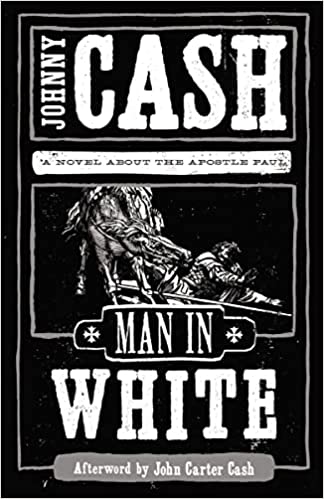
Johnny Cash wrote a novel on the life of Paul. Yes, THAT Johnny Cash, known as the Man in Black. (1932-2003).
It shouldn’t really be a surprise, because although Cash was known for his singing, he was also a songwriter. He was inducted into the Nashville Songwriters Hall of Fame in 1977. He wrote over a hundred songs. He was also an actor, appearing in television shows and movies, more of them than you think. He was creative.
Cash also is famously known for his struggles, his Christianity, and his marriage, usually all tied up on one knot.
He began drinking and using drugs in the late 1950s when his career took off and he needed to stay awake on the punishing long tours. He drank. He became drug addicted. He smuggled drugs, caused a terrible forest wildfire that nearly killed him, was arrested several times, divorced his first wife, and spun out. He sobered up stayed in control for some years in the 1970s, and got addicted again winding up in the Betty Ford clinic for drug rehabilitation in the 1980s. His final rehabilitation was in 1992.
Cash was raised by Southern Baptists. He claimed to be a Christian throughout his life. With wife June, Johnny completed a two-year course of study in the Bible through Christian International Bible College, receiving a theology degree. He and June made a pilgrimage to Israel in November 1978. He was also ordained as a minister around that time.
Johnny Cash was a creative Christian man interested in the things of Christ, so it’s no wonder he wrote a novel about the Life of Paul. It’s called “Man in White.” I looked at the question of “Is novelizing a book of the Bible or a Bible character’s life adding to scripture?” here. Some believe yes others, no.
I appreciated Cash’s preface to the book. In it, Cash described his research process, his interviews with Jewish rabbis and biblical scholars, and his trip to Israel. He described his thoughts about why he wrote the book. He explained it humbly, too, another thing I liked about the introduction. His explanations satisfied any lasting qualms I had about a novelization of a Bible character’s life.
In reading Man in White, it seemed to me that Cash took what was known about Paul, the culture of the day, the temple, the Pharisees etc, and depicted it accurately. We know of Paul’s zeal for Christ as one of Paul’s endearing and awe-inspiring character traits. We also know that Paul prior to conversion was zealous for the Temple and that he was fervent in killing Christians. Cash took that personality trait of Paul’s – his unswerving religious zeal and his staunch commitment to God – and aptly showed how the Lord turned murderous zeal into a Gospel fervor for Jesus.
For example, we know Saul had a letter from the High Priest allowing Saul to kill Christians. Cash did a good job of showing Saul’s irritation at Christians over time turned into an almost unmanageable zeal and how it seemed to be unbalancing him. Saul ignored warnings from friends and the High Priest alike. Cash used the Bible’s letter scene by showing Saul committing to a 7-day fast in preparation for putting into action his commitment to wipe out Christians everywhere he found them. Yet also sensitively showed Saul’s niggling doubts, and how he suppressed the truth in unrighteousness every time his conscience reared up.
We know that Paul had a father who was a Pharisee. (Acts 23:6). We know he had a sister and a nephew, mentioned in Acts 23:16. We also know that Jesus said he would cause division in families. (Luke 12:49-56). So Cash took that concept and made an issue with Saul’s conversion from zealous Pharisee to fervent Christian and depicted a split in the family between his sister and her husband. Cash created a fictional but plausible scenario where after Paul’s sister might have converted, and her husband then sought a bill of divorcement and also split from Paul. The sister’s resulting struggles as a hunted single Christian woman were similar to struggles we know Christian characters had with converting during that time of persecution.
I also thought Cash’s depiction of the three days of blindness Saul/Paul had after encountering Jesus on the Road to Damascus was plausible. He wrote what Paul must have been thinking, of the fears of Christians to have Paul in their midst, and so on.
Where it depicts biblical events, it’s accurate. Where it shifts into novelization, it’s plausible, staying true to the concepts of the time. All in all, my opinion is that “Man in White” is a worthwhile book.
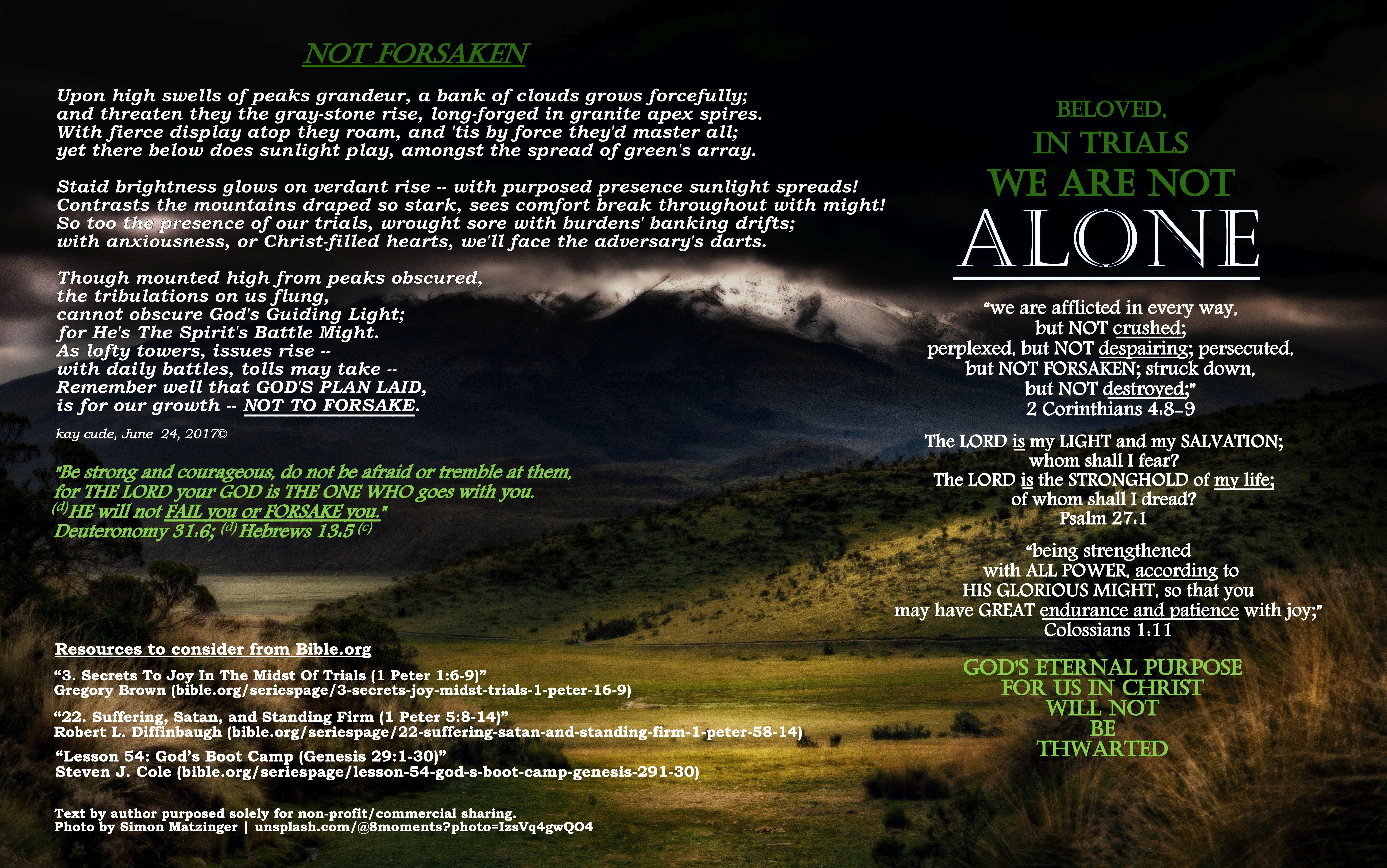
Poetry by Kay Cude. Used with permission. Right-click on photo to see larger in new tab. Artist’s statement below.
Artist’s Statement:
Sometimes the trials we go through seem never-ending! It often appears that they are gathered together and perched atop a high place just waiting for an “exacting” moment in which to unleash themselves. Even worse, they seem to multiply in force, if not line up one-after-another like a hoard of paid hooligans determined to batter us down into hopeless and “fruitless” Christians–or worse as assassins, prepared to annihilate us completely!
As they strengthen the tactics of those “assaults,” we can be assured that God remains in control, from the start of the trial to the very end. He will not forsake us–He will grow us!! He provides the “weapons” we need to endure and overcome, as well as prepares us by the renewing of our minds through His Word! The battles are His. Trusting and relying on Him enables us to learn, endure and overcome! Trusting and relying on our “flesh” enables disastrous consequences.
When at our lowest point, that point of exhaustive weakness where we become more vulnerable to fleshly speculation, we must not permit ourselves to wonder if we are alone. We are not!! And we know this!! We will remember that our weakness is exactly where it must be; for in that weakness, our strength is Christ! Through difficulties, trials or persecution, God is present and He is working. He never abandons His beloved redeemed–He teaches and strengthens us! We must allow Him to mature us and stop employing our “fleshly” reasoning and efforts!
We will remember Paul’s example in 2 Corinthians 12:9-11: 9 “And He has said to me, ‘My grace is sufficient for you, for (A)power is perfected in weakness.’ Most gladly, therefore, I will rather (B)boast [a]about my weaknesses, so that the power of Christ may dwell in me. 10 Therefore (C)I am well content with weaknesses, with [b]insults, with (D)distresses, with (E)persecutions, with (F)difficulties, (G)for Christ’s sake; for (H)when I am weak, then I am strong.”
We will remember that it is God who sovereignly allows our tempering as fine gold through the many refining fires of trials. Therefore, let us be refined into the golden metal of God’s mettle. And in our trials display the strength of character with Spirited determination that marks the mental and emotional character unique to those matured through the purposeful workings of the Holy Spirit of God in us!
YES AND AMEN!! GOD’s eternal purpose for us IN CHRIST will not be thwarted! What joyful hope and assurance we have obtained!
We are in deep throes of winter. There are blizzards up north, there are frigid temperatures down south, it’s a January morning. I like winter in Georgia, but many Georgians do not. They are used to the hot summers, whereas I, being from New England, am not fond of 100 degree heat.
But the LORD created seasons each for their time. I love to see the progression of seasons and their changes through the calendar and I think of Jesus sustaining it all with the power of His word.
And He is the radiance of His glory and the exact representation of His nature, and upholds all things by the word of His power. (Hebrews 1:3).
While the earth remains, Seedtime and harvest, Cold and heat, Summer and winter, And day and night Shall not cease. (Genesis 8:22)
Let’s be grateful that the LORD created it all, upholds it all, and,
He has made everything beautiful in its time. … (Ecclesiastes 3:11 ESV).
This past October, the United States pulled out of Afghanistan, a war that we had entered and ended in a defeat for us. Our pullout was chaotic, and it left behind a good many Americans stranded and alone. Worse, the pull-out also left behind some Christians who are now at the mercy of hostile religious forces. I saw this tweet and it had been retweeted by noted missionary Paul Washer, so I believe it is credible. Our brothers and sisters are still in Afghanistan, even if we have forgotten them or moved on from this news cycle.
Justin Peters has begun another great series. It is called “Why are Charismatics So Weird?” The introduction video is about 15 minutes long and includes a segment about “Holy Spirit Activate” which many Charismatics chant or sing. “Holy Spirit activate”?! They forget Ananias and Sapphira. They forget that the Spirit told the Antioch church to set aside Barnabas. The Spirit told Philip to speak to the Eunuch. Spirit needs no one to “activate Him”! Every regenerate Christian on the face of the planet has been touched by the Holy Spirit. Activate? He IS busy!
This blog post from Team Pyro is an oldie but a goodie. By the way, the Pyromaniacs have years and years of great content. This one was re-posted recently and it concerns men’s eyes, and how women dress for church.
“[U]nless I’m happily mistaken: some good Christian sisters will not dress as helpfully as they could.” Read the post for more good thoughts from Dan Phillips.
Sometimes us Baptists are called the “frozen chosen” because we don’t move or dance or raise our hands when the singing comes on. Or the praying. Or anytime, really. We are accused of limiting our personal worship experience by not ‘letting loose.’ Some even go to an extreme and claim that ‘raising holy hands’ is mandated from the Bible. But is it? Is it really? Here is Chris King from G3 Ministries with a look from the Bible on the issue of raising hands during the church service. I found it interesting, I hope you do too. It’s an issue that is rarely explored, biblically, so here’s your opportunity!
I love all things creation. I used to be an adult pagan who looked at the world, and knew, just knew, it wasn’t made by an impersonal bang. But I was confused as to its origins. My, how I was spiritually relieved and completely satisfied when I learned the truth! God made it. So I am of course a fan of the creation ministry Answers in Genesis. Ken Ham, founder of AIG, recently wrote a family curriculum/devotional I’d like to bring to your attention.
Creation to BabelBy Ken Ham. “In a society mired in godlessness and humanism, parents are given the high calling of raising children who will know the Truth, live the Truth, and take the Truth into the next generations. In Creation to Babel, today’s Christian family will find a unique commentary on Genesis 1 – 11 to ensure the biblical foundation is established in their children’s hearts. Perfect for family devotions and Bible studies, Creation to Babel:
Offers parents a powerful combination of apologetics and doctrine.
Instills biblical answers to contemporary issues such as gender, gay “marriage,” abortion, racism, and others.
Provides answers to the most-asked questions people have about these passages with applications to personal living.
Helps families put themselves under the authority of the Word, and not over it.
“Can we trust the New Testament? Many people do not believe that the Bible is a reliable document of history. But, the fact is the Bible is very trustworthy as a historical document. When we compare the biblical documents to any other ancient historical document, we would see that the Bible is in a class by itself regarding the number of ancient copies and their reliability. Please consider the chart below.” More here.
I hope you find these edifying, interesting, or otherwise worthwhile. Thanks for reading!
Dreamers! So many people have claimed to have had a dream… ‘O, it was so vivid … I have never dreamed like this before … it HAS to be from God … what does it MEAN?’ they say.
Have you heard a false teacher claiming a dream came to them from God? Has a friend said that? I have read that and heard people say that. With the weird dreams comes an attempt to interpret them. It’s natural to be curious about what goes on in our minds, especially when we are asleep.
Dreams and interpretation of dreams occurs often in scripture. Joseph in the Old Testament had dreams, Abimelech, Jacob dreamed of a ladder to heaven, Pharaoh, Solomon… Famously, Pharaoh’s dream was upsetting to him and he brought his dream interpreters to the throne room and asked them to interpret. They couldn’t.
Joseph told the cup bearer and the baker while he was in prison that interpretations belong to God. Joseph asserted God’s sole power to interpret dreams again when Pharaoh asked him for help, after Pharaoh’s own interpreters had failed.
Scientists aren’t even sure where dreams come from or how they are. The International Standard Bible Encyclopaedia article author of dreams articles, WG Clippinger, says,
The stimuli of dreams may be of two kinds. First, they may be physical and objective, or they may be due to suggestions and the association of ideas. They may be due to some physical disorder, such as imperfect digestion or circulation, improper ventilation or heating, or an uncomfortable position. Since by the very nature of the case dreams do not occur in a conscious state, the real cause cannot easily be discoverable and then only after the subject is entirely awakened through the effects of it. They may also be due to the association of ideas. Suggestion plays a large part. The vividness and recency of a conscious impression during the waking state may be thrown up from the subconscious region during the sleeping hours.
That paragraph alone gives lots of reasons why the origin of our dreams are suspect. You’re cold, uncomfortable, suggestible, digestion gone awry…
There are many people in the Bible who had legitimate dreams sent from the One True God. But that doesn’t mean that in today’s time, the dreams we have and that we’re sure came from God, actually are. They could just be that leftover pizza causing physiological disruption. You want to be careful not to attribute something to God when it’s just gas!
Did you know there is a name for pagan dream interpretation services? Those who claim ability to divine the ephemeral wisps of unconscious activity are called Oneiromancers. The practice of divining dreams is called Oneiromancy. (Oh-nigh-row-mancy). It is the practice of interpreting dreams in order to foretell the future. There were plenty of these guys roaming around Egypt when Joseph was in prison, and elsewhere too. Oneiromancy is a form of divination, and divination was forbidden by God. He said not to do it. (Leviticus 19:26). He calls it rebellion and sin. (1 Samuel 15:23).
In the Bible days people used to seek dreams on purpose. Some thought that if they slept in or on the graves of those who were dead the dead would speak to them in dreams. Really. I am not making this up. The International Standard Bible Encyclopaedia says-
"The other species of dreams consists of such as are induced by what is called “incubation,” i.e. by sleeping in a sacred place where the god of the place is believed to reveal his secrets to the sleeper. Herodotus (iv.172) says that the Nasamonians, an Egyp tribe, used to practise divination by sleeping in the graves of their ancestors. The dreams which then came to them were understood to be revelations of their deified ancestors". Source- The International Standard Bible Encyclopaedia, TW Davies.
Everything old is new again, we see people doing that today, believe it or not! It is called ‘grave sucking‘ today and false prophet Bill Johnson of Bethel started it.
Buddhists, Hindus and other religions practice oneiromancy today. In this study, the scientists concluded, “We observed that while Abrahamic monotheisms (Judaism, Christianity, and Islam) recognize dreams as a way to communicate with God to understand the present and predict the future, the traditional Indian religions (Buddhism and Hinduism) are more engaged in cultivating self-awareness…”
Buddhists and Hindus engage in “Yogic Sleep,” Transcendental Meditation, Lucid Dream practice and more in order to gain insight from ‘the other side’. Lest we think that stimulating a dream and subsequently interpreting it is relegated to other religions, dream interpretation services remain alive and well today in ‘Christian’ circles.
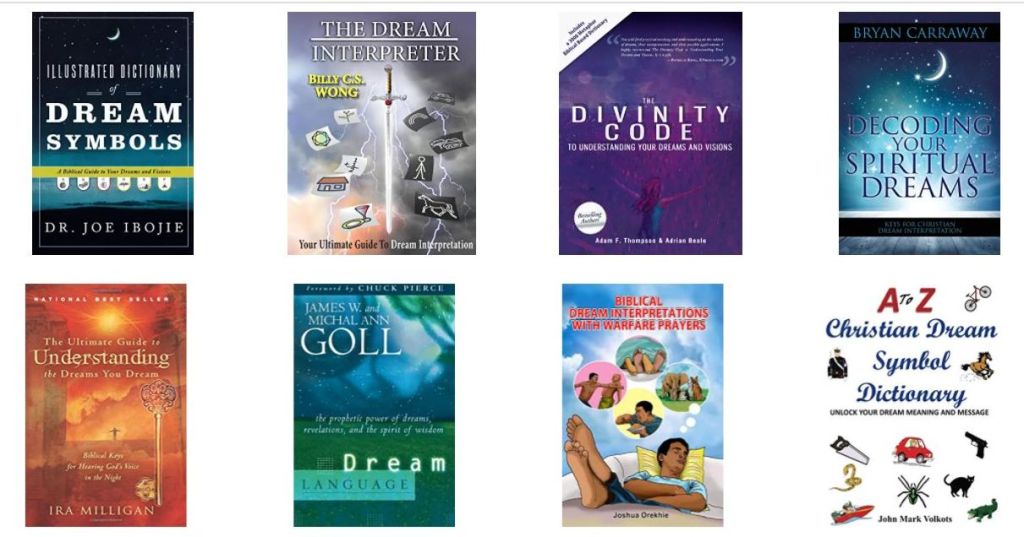
Just a quick scan on Amazon searching for “Christian Dream Interpretation” yields many results. These books in the screen shots below are written by ministers, or pastors, or people claiming connection to Christ, based on scripture they say, specifically for the Christian who may be curious about the dream they may have had and what it means. No. No. No.
Dream interpretation is sorcery, or divination. The Bible is strong on the magic arts. People who practice divination or sorcery won’t gain heaven. They will remain ‘outside’.
Outside are the dogs, the sorcerers, the sexually immoral persons, the murderers, the idolaters, and everyone who loves and practices lying. (Revelation 22:15).
Sisters, be careful what you do. These things are not innocent. Laying hands on a grave in order to force a dream, or buying a book from Amazon in order to interpret them, is rebellion and sin.
Yes we see dreams in the Bible as a form of communication from God to man, and yes we see the verse from Acts quoting the verse from Joel 2:28 “Your old men will have dreams, Your young men will see visions.” In the Old Testament days of the Law and in New Testament days of the church, many did dream. Those were legitimately sent by God as one way He communicated with people. But when the Bible was completed, revelatory dreams ceased, as did visions and foretelling prophecy. All we need to know is in the word of God. Dreams may revive in the Millennial kingdom, or even during the Tribulation, but they are not currently a mechanism God uses to directly communicate with us. He spoke through His son Jesus, and that word is contained in His Bible.
God, after He spoke long ago to the fathers in the prophets in many portions and in many ways, in these last days has spoken to us in His Son, whom He appointed heir of all things, through whom He also made the world. (Hebrews 1:1-2).
Watch out for charlatans who try to steal your blessing, swerve your walk, or otherwise try to convince you they have heard from God through dreams. Avoid those who try to teach you how to interpret your dreams for you. Reject that you can hear from God too in a dream and stop trying to purposely stimulate a dream (especially by laying on a grave!?), and don’t try to interpret them. As Joseph said, ‘Do not interpretations belong to God?‘ (Genesis 40:8; Genesis 41:16.)
Genesis 30:14-16. Rachel ‘bought’ Jacob by trading him to Leah for a night of passion because she wanted Leah’s son Reuben’s mandrakes that Reuben had found and brought to Leah.
“Mandrakes! I want those!,” Rachel said, coveting. She schemed and bargained for them. So what’s so hot about mandrakes? What are mandrakes? Are they valuable? Are they a plant, mineral, or something else? Why did Rachel want them so badly she was willing to give over her precious Jacob to the ‘lesser’ wife for a night in order to obtain them?
When you read the Bible, allow your mind to ask questions of it as you go. Then delve further when your reading is finished to learn more about what God has put down in His word. It’s how I learn best, anyway. Asking questions of the text may help you, too. Remember, the Spirit is in us to help illuminate the word. Asking questions of the text is a way to ask the Spirit, and his ministry will lead you to illumination. It’s a more active form of learning than just passively reading.
Let’s start with the verse:
Now in the days of wheat harvest Reuben went and found mandrake fruits in the field, and brought them to his mother Leah. Then Rachel said to Leah, “Please give me some of your son’s mandrakes.” But she said to her, “Is it a small matter for you to take my husband? And would you take my son’s mandrakes also?” So Rachel said, “Therefore he may sleep with you tonight in return for your son’s mandrakes.” When Jacob came in from the field in the evening, Leah went out to meet him and said, “You must have relations with me, for I have indeed hired you with my son’s mandrakes.” So he slept with her that night.
Mandrakes are in the field, so they are likely a plant. Let me look them up.
From Holman Illustrated Bible Dictionary:
MANDRAKE Small, perennial plant (Mandragora officinarum) native to the Middle East. Although not grown for food, its root and berries are edible. The ancient Near East viewed it as an aphrodisiac and fertility drug. It is often called love apple or devil’s apple. According to Gen. 30:14–16 a barren Rachel bargained with Reuben (Leah’s oldest son) for some mandrakes which he had found. Leah, however, produced the children (Gen. 30:17–21). Only when God “remembered Rachel” did she bear Joseph (30:24).
Ah! It’s a fertility plant. Or allegedly it brings babies. Remember, Rachel was barren at that time. Leah had borne boys already. The competition was on. No wonder Rachel was hot to get those mandrakes.
But it’s the same old story. Man (or woman) scheme to get their way when God is sovereignly in control. Sarah used Hagar to get a child when God had already promised one to Abraham.
In fact God gave Leah two more sons after this incident, Zebulun and Issachar. Rachel remained barren for a long time after.
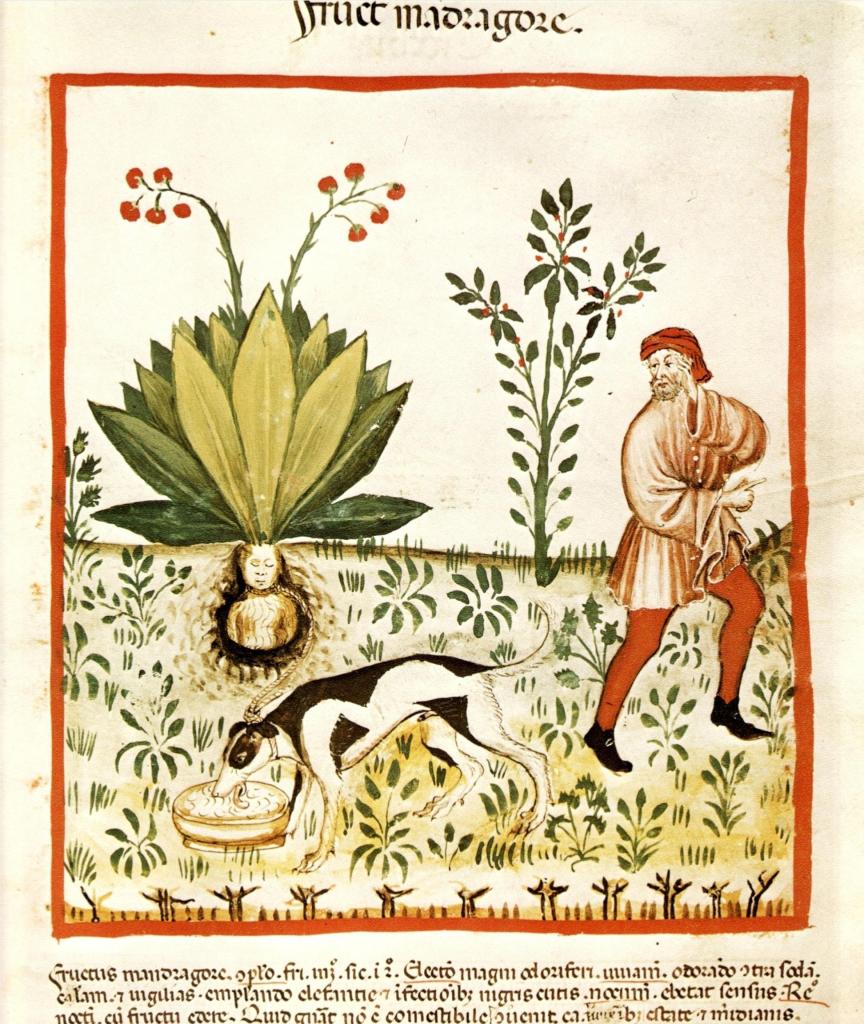
Mandrake, species name Mandragora officinarum, belongs to the nightshade family. All parts of the mandrake plant are poisonous if ingested in sufficient amounts. The parsnip-shaped root contains several different hallucinogenic alkaloids and is often branched, resembling a human figure. The root has long been used in magic rituals due to its shape and psychoactive properties. Leah sold some of the mandrakes that her son Reuben found to Rachel in exchange for uncontested time with Jacob; their son Issachar was conceived that night (Gen 30:14–16). Gen 30:14–16, Song 7:13.
Source for illustration and caption information from Myers, R. (2012). Images from The Temple Dictionary of the Bible.
The ancient Palestinians in the Near East thought mandrakes were an aphrodisiac. They used it as a fertility drug. It is interesting that it is known as the love apple or the devil’s apple. Biblical Studies Press says,
The unusual shape of the large forked roots of the mandrake resembles the human body with extended arms and legs. This similarity gave rise to the popular superstition that the mandrake could induce conception and it was therefore used as a fertility drug. It was so thoroughly associated with erotic love that its name is derived from the Hebrew root דּוֹד (dod, "love"), that is, דּוּדָאִים (duda’im) denotes "love-apples." Source Biblical Studies Press. (2006). The NET Bible First Edition Notes (So 7:11–13).
Ah! Becoming much clearer to me now.
One more tidbit.
According to the legend, when the root is dug up, it screams and kills all who hear it. Ancient literature includes complex directions for harvesting a mandrake root in relative safety. For example, Josephus (circa 37–100 AD) of Jerusalem gives the following directions for pulling it up:
A furrow must be dug around the root until its lower part is exposed, then a dog is tied to it, after which the person tying the dog must get away. The dog then endeavours to follow him, and so easily pulls up the root, but dies suddenly instead of his master. After this, the root can be handled without fear.
Rachel put her trust in a plant from the ground instead of the LORD above. Her scheming did not work out, it actually backfired. The LORD kept her barren a long time and she had to deal with her scheming personality, her competitiveness, and her impatience until He deemed her ready to bear a child.
We should trust in Him always. God knows best. He is perfect and has promised good to us. Seeking relief for infertility from a toxic plant doesn’t even compare to the goodness of our holy God.
Are there ‘mandrakes’ in your life? In mine? Do I seek my own way and scheme to fulfill personal desires, or do I pray to Jesus giving Him my cares and leave them in His hands? This is something I need to ask myself every day. The spirit is willing but our flesh is weak. (Matthew 26:40-43). Rachel eventually realized this. God is better than mandrakes.
The other day I introduced a series examining the LORD’S “Four Sore Judgments.” (Links just above). In other translations they are called the “LORD’S Four Severe Judgments.” They’re mentioned in Ezekiel 14:21: “For thus says the Lord God: How much more when I send upon Jerusalem my four disastrous acts of judgment, sword, famine, wild beasts, and pestilence, to cut off from it man and beast!“
The four are Sword, Famine, Pestilence, and Beasts. Wesley's notes says, "How much more - If they could not be able to keep off one of the four, how much less would they be able to keep off all four, when I commission them all to go at once."
It is a very dread situation when all four are unleashed. If you read Revelation 6, you will see that the four are unleashed all at once, or in very rapid succession. Jesus called it the worst time on earth there ever has been or ever will be. (Matthew 24:21; also Revelation 6).
We looked at the correlation between Sword (war), famine, and disease. Now we will take a look at the biblical judgment of Beasts.
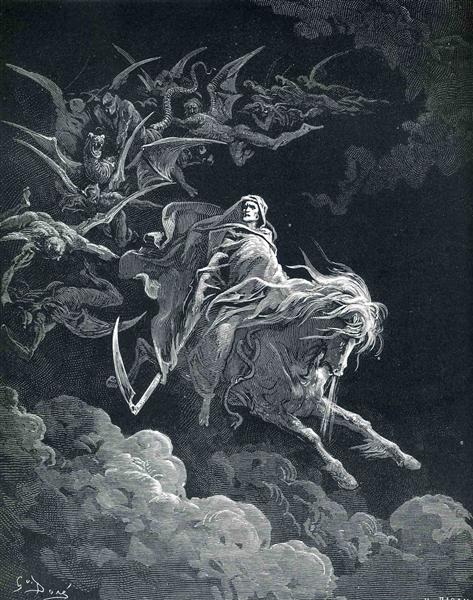
Vision of Death, Gustave Dore, 1865. Public domain
“When the Lamb opened the fourth seal, I heard the voice of the fourth living creature say, “Come!” I looked, and there before me was a pale horse! Its rider was named Death, and Hades was following close behind him. They were given power over a fourth of the earth to kill by sword, famine and plague, and by the wild beasts of the earth.(Revelation 6:7-8)
The Greek word for “beasts” is just that, the generic term always used for ‘wild animal.’ I’ve written about Death by Beasts before, here.
While we have always had war, famines, and epidemic diseases, death by beasts is more unusual. Let’s look at man’s relationship to beasts since the beginning, through the flood, and afterwards up through the Tribulation and ending at the Millennium.
When Adam was created, one of the jobs God gave him to do is name all the beasts of the earth. (Genesis 2:19-20). At that time before the Fall of Man in the Garden of Eden, the beasts were friendly and herbivorous. (Genesis 1:29-30). Man was still sovereign over them, but it was not a bloody relationship.
After the fall, the first death was actually an animal, since God gave Adam and Eve animal skins to wear. (Genesis 3:21). Animals also became meat for humans. (Genesis 7:2, Genesis 10:9). The Flood came. After the flood waters receded, the relationship between man and beasts changed once again. God put the fear and dread of man into them. (Genesis 9:2).
In the Millennium kingdom, He will reverse that curse and all will be reverted back to the original state of peaceful co-existence. Children can put their hand into a snake’s hole and not be bitten. The wolf will lay down with lamb, and the lion shall be tame. (Isaiah 11:6-9).
Elisha and the boys in Bethel, Matthaeus Merian the Elder, 1625
But before that, between the receded Flood waters and the peace of the Millennium, it seems that there will come another change of the relationship between man and beast, though this once is more implied rather than stated. It will occur in the Tribulation.
It seems that in the Tribulation, the Lord will (perhaps) have removed the fear and dread of man from the wild animals. I can’t point to a specific scripture that tells this explicitly, but implicitly I gather than the progression of man’s relationship with beasts changes from a contentious one as it is now, but with their fear removed. If a quarter of the world dies by the aforementioned plagues and one of them is beasts, it seems that there will be a lot of hunting going on- and not just man upon beast, but beast upon man.
Today, if a beast does become a “man-killer” it has to be killed. God said in Genesis 9:5 that from the man-killing beasts he will require capital punishment. In Exodus 21:28 we read that if an ox gores a man the animal is to be killed and its flesh not eaten. But if the animal is previously in the habit of goring and the owner is warned, and the animals kills a man or woman, then the animal AND the owner are to be killed. (Exodus 21:29)
Did you ever wonder why the animals that could do us the most harm don’t simply hunt us down and eat us, like, all the time? But they don’t. When I was in Big Bend National Park in SW Texas, hiking in the Chisos Mountains, Rangers told us if we come upon a mountain lion to stand tall, and throw stones at it. The lion would leave us alone. LOL, I’m glad we never had to test that, but the idea is that the lion would see you as a bigger threat and leave.
Even today if a wild animal kills a man, the Rangers, or zookeepers, or whoever, usually kills that animal. In most cases the Ranger is not responding explicitly to God’s instructions laid down in Exodus 21, but they instinctively are. If an animals kills a person, it means they have lost the fear and dread and is all the more dangerous to humans.
In the Chisos Mountains in Big Bend a few years ago, the Austin newspaper reported, there had been a mountain lion attack. The people chased it off by throwing a backpack at it. However, the report made this particular family who camped there the day after the attack hyper-aware. They decided to stay in the lodge instead of the tent, and when they went to the restaurant for dinner from the lodge room, they held their child’s hand, one parent on either side. They walked on the lit walkway between the two populated buildings. However, the lion attacked the boy anyway, dragging him away from his parents to a nearby bush. The parents then attacked the lion! The boy is chewed up some, but he is OK. Rangers said it was highly unusual for a mountain lion to attack on the pavement between populated buildings. If the animal was caught, they said, it would be killed.
War brings famine to animals, too. Their natural habitats are disrupted, and food gets hard to find. The stress often leaves them no choice but to start looking at humans as food, and attacks increase. That would seem to be a normal outcome of the other sore judgment: famine.
John MacArthur preached on the Revelation 6:7-8 verse here. He preached in part-
"...The most deadly creature on the face of the earth? Not a snake, not a lion, not an alligator. A rat. Historically the deadliest creature on the face of the earth. Why? Rats are annually responsible for the loss of billions of dollars of food in America alone and death all over the world. Rats infested with Bubonic Plague killed one third of the population of Europe in the fourteenth century, that's Encyclopedia Americana's own figure. Rats can carry as many as thirty-five diseases at once and amazingly if ninety-five percent of the rat population is exterminated in the given area, it will replace itself in less than a year. It has killed more people than all the wars of history and it always makes its home where men dwell."
Death by rats is certainly a likely possibility. More than likely, given the history cited above which bears this out.
You can imagine the rats bringing a killing disease after the catastrophic events of Revelation 6 that are prophesied to occur before the Fourth Seal is opened. So, death by beasts could be concerning the plagues that rats bring.
But I think it is more that that. Yes, each plague/seal/judgment is bad enough, but how bad will it be when all four are unleashed at once? Terrible! Fortunately in His mercy, He made a way for His beloved sheep to escape all these things. SALVATION in the Church Age, AKA Age of Grace. Judgments in the Tribulation will be delivered “to finish the transgression, to put an end to sin, and to atone for iniquity…” as Daniel hears in his vision in chapter 9, verse 24. He learns why the LORD will send the Tribulation judgments: to finish allowing sin to complete itself.
We are sinners, whose rightful place is hell after death, to be punished for our sin-crimes against God. If we ask the Lord to forgive those sins before our death, understanding Him as Lord and Savior, who came to earth to live the sinless life so He could be the perfect atonement, slain for our iniquities, and was accepted by God of that sacrifice and brought out of death to eternal life, then we will not be in the Tribulation when the whole earth will be judged for their sins. Our sins will have been pardoned, so He will sweep us up to heaven in our glorified bodies and allow us to be in His presence forever!!!
Do not put off your repentance. Intending to repent still means you are still as much an enemy of God as the fist-shaking atheist. Alternately, believe this:
How much better will it be when He calls His sheep home to the Marriage Supper of the Lamb in perfect New Jerusalem by the living waters and the street of gold?!! Don’t you want to be there, your sins pardoned and forgotten? Putting off repenting means you choose the Four Sore Judgments. How? If you are not for Him, you are against Him. (Matthew 12:30). Personally, I have found a multitude of peace and blessings in living FOR Him. I hope you will think about it. But not for too long… OK?