Driving to school in the morning I encountered heavy fog. To a New Englander, fog is an old friend. Its constant presence, threat of presence, or dissipating presence is part and parcel of the daily life of a Yankee who lives near the sea.
Those horizon level coils of wiry dark, looking like far off barbed wire wrapped in a pillow soft and damp, rolls in and rolls out. Its silent stealth can envelop you as you’re mowing, as you’re driving, as you’re sailing.
We encountered fog numerous times while sailing. Seeing the fog bank up ahead causes you to jump down to the navigation table with alacrity, take a few more positional calculations, check the soundings, and then, blink, you’re enveloped. Like a misty blanket, the fog surrounds you ever more presently until you cannot see the end of your own bowsprit.
You peer ahead for any landmark, anything solid. The mushiness of seeing through fog is disorienting. Suddenly you don’t know up from down.
So I was driving along to school in the wee, dark hours. I marveled that a loose conglomeration of mist droplets could seem so solid. It was astonishing how the fog, heavy as it was to subdue my headlights’ beams to mere slivers, yet seemed to enhance the Christmas lights on the houses I passed by into a glistening glow.
Everything I viewed along the ride was murky, distorted, at the same time beautiful and terrifying. I didn’t know what to be scared of and what to feel secure in. Was that a cluster of leaves blowing in front of the car, or an animal? Why are the white lights glowing so golden?
Then as I neared my school in a blink I was out of the bank. I popped out quicker than a grasshopper in front of a combine. Suddenly everything was sharp and clear. Though a fog bank is indistinct, it is evident. Though it is unformulated, it is palpable. And then it was gone. Or at least, behind me.
It made me think of life here on earth and life in heaven. The verse ‘through a glass darkly’ came to mind. Suddenly, in the blink of an eye, we will see Jesus, as He is, his heaven, which is the REAL place to dwell. No more veil. No more sin-nature obscuring our vision and darkening our heart.
The blind will SEE! We see now, to be sure, but only through a fog of unreality and sin. When the fog lifts, we will see everything clearly. It will happen. It will happen abruptly, unexpectedly, but it will happen. We will see Jesus clearly in person, and what a sight that will be. When the indistinctness of life here in the dim dark clears to display diamond glittering brilliance of God’s glory, we may well indeed shout, Praise to the Father of Lights!
Thank you to the newcomers to the blog! A new year brings lists, and if I’m on a list then people come over here and check the blog out. For that, I thank you for taking the time. Here is some information about The End Time and its Administrator and sole author: Elizabeth Prata (me!)
The end of the year often comes with reflection, and lists, and resolutions. It’s human nature to ponder. We like stark demarcations like borders, end of year reflections, anniversaries, things that help us say ‘this is this and that is that’.
Growing up, I never had much exposure to church. We were Methodist for a while, then Unitarian. Then nothing. Church education and attendance was spotty at best. My parents shall we say, did not practice godly living. (It was the 60s and 70s after all).
I was saved later in life at about age 43. I don’t have an exact date but a time frame, sometime in December 2003/January 2004.
Being a loner and having no understanding of what the Church is all about, for 18 months or so, I resisted attending church (even though deep down I knew I should).
I thought that watching Joel Osteen on TV every week was good enough.
Now that I was in Christendom, I thought that I was finally ‘safe’ and nothing bad would ever happen again. I was wrong! Christianity is full of strife and trouble, (but so worth it!)
When I finally got a Bible and compared Osteen’s words to it, by the Spirit’s grace, I knew that this kind of worship wasn’t proper.
I felt gypped, lied, to and upset at the notion that a pastor could be false and waste my spiritual time by hindering my walk, but I soon learned this is more frequent in Christendom than people think. But the Romans 8:28 ‘good’ that came out was that the feeling of loss and worthless worship at experiencing a false teacher now propels me into discernment. It is my desire that this does not happen to anyone else.
My first series I listened to under John MacArthur, whom I found as another graceful doing of the Spirit, was “Battle for the Beginning“. I love beginnings and endings, that’s why Genesis and Revelation are my favorite books of the Bible.
I am a faithful member of a Reformed church led by 4 elders who preach verse-by-verse with occasional topical short series.
I enjoy taking classes through The Masters’ Seminary Institute for Church Leadership (ICL), and through Ligonier Connect. ICL offers classes to individuals. You do not need to apply through the seminary, but the courses are offered by the same men. They are not expensive, and several times a year they offer one for free or half price. They also offer certificate tracks. At ICL, I’ve especially enjoyed Brad Klassen’s course on Prayer so much, and at Ligonier, Derek Thomas’ course on Bunyan’s The Pilgrim’s Progress.
I’ve kept this blog for 14 years (as of this January 9), with a blog published every day, sometimes two blogs in a day. I’ve written over 6,000 blogs with few repeats (thanks to the sustaining of the Holy Spirit).
My early years on the blog was full of breathless newspaper eisegesis, but I make no apology, because finally I was beginning to have answers to questions that plagued me so! With a sudden change in worldview, now, everything made sense! I’ll never forget that euphoria at having the big questions settled. Why are people so evil? Why is Israel always hated? Why are there earthquakes and other disasters? My worldview had shifted rapidly and I blogged in order to sort it all out. Shifting from a secular world view to a biblical one gave me answers and I was thrilled! Thankfully that focus died down and I began writing about doctrine more.
I was raised in the north and was unfamiliar with Southern Gospel music but once I heard it I loved it! I especially love Southern Gospel quartets.
My heart is for discernment, that women would think critically and biblically about their savior and their walk. It’s also for missions, and being a good student of the word, and encouraging women to live a lifestyle that exalts Jesus, no matter what stage of life they are in.
Speaking of lifestyle, I was divorced prior to salvation and have been single ever since. My idols prior to salvation were marriage and husband, but being unsaved I didn’t enter into it for the right reasons or manage it properly, since, of course, it was an idol and not part of Godly living. After conversion the Lord gave me a contentment in singleness, and I use the time and space He affords me to continue this writing ministry. (1 Corinthians 7:34).
I recently had a birthday, turning 62- officially entering a retirement age/stage of life. Let me tell you, life IS a vapor! More on that in another blog essay.
I am grateful for every reader who comes to The End Time blog. Why ‘the end time’? Because we are IN the end of time, the time between Jesus’ ascension and return. Time is short. You are never closer to your eternal destination than you are each day that passes. Make the most of the time He has given us.
Knowledge that all this will come to an end suddenly and unexpectedly should give us a fervor for right living, for proclaiming His gospel, and for speaking His excellencies wherever and whenever we can. This is my goal, and Lord willing, I’ll keep doing it in 2023.
A clip of former pastor of Saddleback Church Rick Warren made the rounds on Twitter the other day. It was Warren on camera explaining to an off-camera person Warren’s philosophy of ministry. He led the cameraman through his massive library to what he called his “Bucket of Ministry” containing tools and implements. Warren said when people ask him ‘What does a minister do?’ he refers them to his bucket. The staff represents he is a shepherd, the fruit picker reminds him that people grow fruit in their lives, the pitchfork stands for a minister’s cultivation of people, the sword stands for battle; and so on. He lifted the shovel last and said:
EPrata transcription of Warren’s statement, applied to screen shot of video
Despite having in his Bucket of Ministry a staff, a pitchfork, a sickle, a fruit picker, a fishing rod, a sword, and a tennis racket representing all the different aspects of a pastor’s work, Warren focused on the shovel as the tool representing 90% of his work. And saying straight to the camera without any sense of embarrassment, that the shovel represents his own people’s issues and concerns as excrement.
I thought this was a devastating moment, revealing the heart of this man who is in fact a wolf. Many times, people don’t accept that this man or that woman is a wolf, because they envision the wolf as an ugly, snarling, drooling, feral animal, which it is. But the wolf doesn’t appear as that, he appears as a nice, helpful, kind, soft spoken sheep. The two don’t jibe with the person’s view so they discount the wolf aspect because all they see is smiles and seeming helpfulness. But the mouth reveals all things, which pour from the heart. (Luke 6:45). We must listen, and look deeper when assessing a person claiming to be Christian, especially one who teaches.
I think not enough people understand this is an urgent verse:
“Behold, I send you out as sheep in the midst of wolves; so be shrewd as serpents and innocent as doves.” (Matthew 10:16).
As for Pastor Rick as he is known, it would do him well in my opinion, to heed this verse:
Do not store up for yourselves treasures on earth, where moth and rust destroy, and where thieves break in and steal. But store up for yourselves treasures in heaven, where neither moth nor rust destroys, and where thieves do not break in or steal; for where your treasure is, there your heart will be also. (Matthew 6:19-21).
A true, godly, Spirit-raised shepherd is supposed to care for his flock, because the shepherd knows the Lord purchased his people with His own blood. His people are only temporarily given to the shepherd, they are in truth the Great High Priest’s people. Jesus as THE Great Shepherd did not consider his people’s concerns to be excrement. He healed the blind with compassion, He touched lepers, He counseled Martha in kindness, He gently spoke to Nicodemus, addressing his concerns and questions with love. Jesus did not put on one public face to His people, then retire to Capernaum for the night and complain about having to shovel their poop.
Be on guard for yourselves and for all the flock, among which the Holy Spirit has made you overseers, to shepherd the church of God which He purchased with His own blood. (Acts 20:28).
If you have a good pastor, who crafts his own sermons, who shepherds his monies for the betterment of the kingdom and not to accumulate and boast, who loves you with a Gospel love, you have a good pastor. Pray for him.
HOWEVER, I trust little online these days. I always want to verify. Maybe the clip went on with him saying, ‘Just kidding!’ but it was cut off so as to manipulate our view of him. Maybe it wasn’t all it seemed, and his words were cut and edited somehow.
It looked like the same one. Warren was in his massive library leading an off-camera person through it, pausing to stop and explain certain objects.
I slid the slider back and forth looking for that part about the Bucket of Ministry and did not see it. Hmmm. Maybe it was edited out. I went back and asked the original tweeter where she got it from, but received no answer after
I decided to search further on my own. Here is what I discovered. Ultimately, I still did not discover the original video containing the context around he aforementioned clip, but I found a blog article about it from people I know to be resourceful. And here’s what else I found.
Google suppresses results.
The Chrome browser using Google to search for +”rick warren” +poop” results are zero. See screenshot below.
It yielded nothing. The interview was just 11 months ago, and I saw the clip of Warren saying it, so why are there NO results? I tried various search terms, but still nothing. Hmmm, let me search on Dissenter browser, which uses DuckDuckGo for its searches, not Google.
Immediately there was a result! It is an article on Disntr, It’s not affiliated with the browser named Dissenter, it’s simply a blog that used to be called Reformation Charlotte renamed Disntr.
So isn’t that interesting, NO results at all on Google but immediately a top result came up using DuckDuckGo.
I decided to google that. I asked Google “Does Google suppress results?” and I received lots of high-minded explanations from Google explaining sincerely that if there are too many results, they limit the number, or if there is potential for identity theft, they limit results. Sounds helpful, eh? Well not so much.
If you ask the same question on DuckDuckGo using Dissenter browser, you get an article at the top of the results from Business Insider, “Google reportedly manipulates search results to hide controversial subjects and favor big business.” With what we now know for certain about Twitter thanks to Elon Musk, its new CEO unveiling the dirty acts of the Twitter execs, then, yes, of course it stands to reason Google does the same.
Even searching using that exact title on google failed to lead me to the article. It was referenced here and there, but not the blog itself. Below is that article, and a reminder to my dear readers that Google is not the be-all or end-all of searching. As time progresses and the world hates Christianity more and more, hates anything even smacking of conservatism, this kind of thing will occur as a matter of course, until the day when even posting a simple Bible verse will be suppressed.
I named this blog The End Time because we are IN the time of the end. This means the prophecies about Jesus’ return could be fulfilled at any moment, His appearing during this long era has always been imminent. So with that truth in the forefront of our minds, we as believers should be about His business sharing the Gospel and glorifying Him daily and with fervor. Right now it’s easy and free to share edifying content. It may not always be so.
I dithered about which Bible reading plan to follow, until yesterday. Talk about cutting it close. It’s not a question that I follow a plan. It affords me structure and a goal for what is a must to do each day.
For 2 years I did my seminary friend’s personally constructed plan which followed the chronological writing of the Bible, i.e. reading which books were written first all the way to last. That one started with Job, traditionally seen as the oldest book, and ended with Revelation, known to be the last written.
Justin Peters is reading what appears to be M’Cheyne’s plan, (the link is to Jan 1 reading, https://youtu.be/ewqy6JKOhAM – go to his landing page to subscribe to get the recordings that come out each day.)
So I’ve read thru based on chronological, on order written, and several plans that combine OT, NT with Psalms and Proverbs interspersed. What plan should I turn to next? From what angle can I absorb the treasures of Christ?
In the end I chose the one my elder recommended, the G3 plan. It’s called 5 Day Bible Narratives Reading Plan, a 52-week Bible reading plan that focuses only on the narratives of Scripture, along with all of the psalms and proverbs. About this plan:
–Read through all of the major narratives of Scripture, plus Psalm and Proverbs, in a year. –Read only 5 days per week, catch up on the weekends. –Perfect especially for children, families, or individuals who wish to focus a year’s reading only on the Bible’s narratives
The site offers free downloads, or a packet for purchase containing all the goodies. ($12.99 includes a chronological reading plan along with a 52-week catechism, memory passage for each week, and hymn of the week. Finally, it contains a guide for each day of readings that includes study notes, a brief description, and questions for personal or group reflection. I bought the packet.
EPrata photo. Taken in Prata, Italy, “Door with cane”
Last week I turned 62. I’m OK with the advancing age. That isn’t what this essay is about. I was rather tickled to think I’ve now entered into the official Social Security senior citizen era.
My bemusement comes from the fact that once again, the Bible is right. Life is a vapor. It really does emerge, happen, and extinguish in what feels like mere moments.
My first memory occurred 8 weeks after I turned 3. That means I have 59 years of memories. Fifty-nine years of experiences. Fifty-nine years of the good, the bad, the inconsequential. It’s a heavy load to carry that many memories, and I suspect it gets heavier as time goes on. If the Lord continues my life 10, 20, even 30 more years, that’s a lot more emotional gear attached to my heart.
Yet you do not know what your life will be like tomorrow. For you are just a vapor that appears for a little while, and then vanishes away. (James 4:14)
But more than that obvious statement about age and memories and baggage etc., which is nothing new under the sun, is the notion that it all happened in the blink of an eye. You know this, older people have been telling you ‘It goes so fast!’ all their life. You understand this as a fact, because in addition to hearing it from older relatives, the Bible advises on the brevity of life over and over.
But once you experience it, man, it gets real.
How quickly does the steam disappear over the teacup? How far out from our mouth does thee cold frozen air extend? How high does the haze from the hot pavement rise?
You, indeed, have made my days as handbreadths, and my lifetime as nothing before You. Truly each man at his best exists as but a breath. Selah (Psalm 39:5)
When I turned 30 I quit my teaching job and sailed off to the Bahamas with a blue eyed handsome man. When I was 40 I started a newspaper, using it to ‘clean up this town’. When I was 50 I returned to education as a career. At 61 I was just working as a teacher’s aide and not looking ahead too much. But I got COVID, and was out of work for 2 and a half weeks. I was deathly ill. A nurse friend wanted me to go to the hospital, but I refused. I spent 9 days with a fever of 102 or higher, and my oxygen levels dipped low. My brain felt good and fried by the end but I made it. It took me a long time to recover and I’m still not the same as I was before I had that awful flu. That event caused me to really think hard about life and death. Only two times before in all my life was I that ill.
Man is like a breath; his days are like a passing shadow. (Psalm 144:4)
That’s been my pattern – big life changes at each decade.
I clearly remember my 30s. It truly feels like yesterday. I think of something that happened “last year” and it was in fact ten years ago. Because we are warned about the brevity of life, because we are told how fast it all goes, (even if he is gracious to give us 70 or 80 years), then what manner of life shall I live for God? How shall we live? Are we glorifying God to the best of our ability? Even to half our ability? Do we think of Him more than we think of family, work, personal needs and wants? If the chief end of man as the Westminster Catechism says, is to glorify Him and enjoy Him forever, are we enjoying Him?
For my days vanish like smoke, and my bones burn like glowing embers. (Psalm 102:3)
Putting off till tomorrow is easy to do. Then suddenly you’re 62 and realize that all the days of tomorrows have piled into years. Why will we cry in heaven and He has to wipe away tears? Will it be because we realize then how much time He gave us and how much of it we squandered?
I’ll add my voice to the chorus, young ladies, life does traverse the streams of time quickly. It might feel like a gentle meander in a raft down a lazy river, but you are truly riding a speedboat in the rapids. Use your time well, each and every day. Love your husband, raise your children, hug them!! Or if you are single, all the more to live for Him- and enjoy Him.
This is the time of year when bloggers, reporters, other writers do the round up of their year, making lists. I think it’s interesting to look back and see what people were most interested in, on this blog anyway. What were the top read or viewed blog essays here at The End Time?
But first, some stats:
My readership seems to be holding steady at about half a million views per year. I don’t receive a huge amount of comments, nor lengthy back and forth arguments (I’m grateful for that one!)
I seem to get a lot of traffic from the referrers of Facebook, and also Android. As one might expect, my audience is mainly from English speaking countries, from the US, Canada, UK, Australia and South Africa. But also in the top ten countries from which visitors view The End Time is the Philippines, India, Singapore, and Nigeria. Welcome everyone!
After “Unknown search terms,” the #1 search term that brought people to The End Time was “types of glory” which pleases me.
Top Posts:
Home page / Archives
Bullet points on why Joyce Meyer is a false teacher (2021)
Dr David Jeremiah’s shocking apostasy, Updated (2015)
Beth Moore is finally “home” (2021)
Jackie Hill Perry comes out as a ‘prophet’ (2022)
“The walls are coming down” says Dallas Jenkins of The Chosen. But should they? (2021)
Two divorce cases: Summer White and Melissa Moore (2016)
Exactly what ARE the ‘Treasures in Heaven’? (2021)
According to prophecy the Nile River will dry up (2012)
One more reason to avoid Lysa TerKeurst of Elevation Church (2016)
It amazes me that something I wrote ten years ago is in the top ten this year. Go figure. I hoope I wrote it right back then…
Eight of the top ten are discernment essays. The other one was prophecy. People are obviously interested in discernment, especially when it comes to Christian celebrities. Christian celebrities rack up huge numbers of followers. Some of those followers seem to have become concerned with the doctrine and lifestyle of whom they are following, so they google it. They may be looking for confirmation of a radar alarm of discernment going off in their head.
I remember in 2010, 2011 I was looking for information on Beth Moore. I’d become terribly concerned with her antics, her doctrine, and her growing cultish-celebrity following. I couldn’t find much discernment on her back then, except from Chris Rosebrough and Dale Ford. I’ve always been grateful to have found their discernment essays on that particular celebrity, confirming and putting into concise words based on the Bible of what I’d been sensing.
Or, people come to the discernment essays on The End Time perhaps are wondering IF they should begin to follow this person, absorbing their teaching or mimicking their behavior or their lifestyle. This is good. I applaud it.
The Lord instilled in me a drive for discernment and a Spirit-founded ability to smell something off from 20 paces. Errant doctrine grieves me almost physically, wounds me emotionally, and tears at me mentally. Since discernment is a gift from the Spirit, I won’t apologize for using it, nor for writing discernment essays. Exalting the Lord means we proclaim His excellencies, but we also cherish the brethren and protect them from wolves by warning them in loving discernment.
Also in the top 20 this year are essays about Beth Moore, Rick Warren, Jen Wilkin, and the IF:Gathering. More discernment seekers, good!
The all-time essay on this site consistently has been one I wrote in 2016: Two divorce cases: Summer White and Melissa Moore (2016). Melissa Moore is Beth Moore’s daughter. In that essay I compared two Christian women (or one who is and another who claims to be) and their reasons for and process of divorce. I culled public documents and statements from each lady, and wrote about it.
I remember catching a lot of flak for that, with Beth Moore groupies crying out that I had no right to delve into anyone’s life. Oh, but I do. A teacher of the Bible, especially a public teacher, must maintain lifestyle standards as well as doctrinal purity. We compare both their doctrine AND their life to the Bible. After all, if they teach doctrine perfectly but disobey the Bible with their life, they are still a rebel.
Personally, the essays I’ve enjoyed researching and presenting to the public this year have been:
The antichrist will conquer by flatteries, because I got to examine how people use language to manipulate, a subject of my college and graduate education, and afterwards. I love examining how language is used, and when it’s used in a Christian or religious context, all the better to look into it.
I’m curious about the natural history of vegetation and animals mentioned in the Bible. I wrote “What is the almug tree?” and I enjoyed researching that one.
On January 9, in a week or so. I will celebrate the 14th anniversary of writing this blog. I’ve written daily here for 5,110 days straight, with few repeats. I praise the Spirit for His support of this ministry. I’ve written so many blogs…6,006.
Therefore, since we receive a kingdom which cannot be shaken, let’s show gratitude, by which we may offer to God an acceptable service with reverence and awe; (Hebrews 12:28)
The Lord will tell me whether my service has been acceptable. I pray it is. My prayer is that I continue with this ministry as long as the Spirit desires me to; that I remain doctrinally sound; that I stave off weariness in the doing good but persevere; and that I serve ladies of the faith well.
Now may the God of peace, who through the blood of the eternal covenant brought back from the dead our Lord Jesus, that great Shepherd of the sheep, equip you with every good thing to do His will. And may He accomplish in us what is pleasing in His sight through Jesus Christ, to whom be glory forever and ever. Amen. (Hebrews 13:20-21.
Yesterday I posted about the value of reading challenges. For me, there were at least 5 benefits to doing one last year, even though I felt I’d failed. They push you to read books you’ve always wanted to read, to read books that are already on your shelf, you read books you might not have otherwise read, you absorb good material into your heart and mind, you track your reading and objectively see that you’re not so much of a reading failure after all!
If I relied on my memory I’d have thought I’d read barely anything, but discovered I’d read 24 books. I did see my pattern, though, and why I thought I’d not been reading much. Months went by with no tracked reading of note, but during school breaks, I see I went ahead with much reading. If that’s my pattern, then oh well, OK.
Here are a few links to some good essays about reading and links to some booksellers.
Do you ever feel guilty reading a classic or even a secular novel? Do you feel like you’re ‘wasting time’? I mean, if I’m reading, shouldn’t I be reading Christian, edifying material? Spurgeon certainly read widely, and if it was good enough for him.. lol, here’s an essay about Spurgeon’s reading habits: Follow Spurgeon’s example in reading good books
I like dystopian fiction. Dystopian is the opposite of utopian. Instead of everything being perfect (utopia) it’s gone really, really wrong. I wrote about why reading dystopian literature might be useful-
100 Great Works of Dystopian Fiction: Tales about a world gone wrong. I’ve read 13 of these on this particular list. Stephen King’s The Stand is hands down THE best dystopian novel ever. I found Ender’s Game at the thrift store yesterday and scooped it up for 50 cents, I was thrilled. I started reading it.
Open Book is a podcast from Stephen Nichols at Ligonier, interviewing theologians on what books influenced them, what books are on their nightstand, and generally about their favorite books! Season 1 featured RC Sproul speaking about books he enjoyed, season 2 was interviews with John MacArthur, season 3 features Joel Beeke.
I never forgot Sproul’s passion for the Herman Melville book Redburn. He also loved Moby-Dick, in fact, wrote his thesis on “The Existential Implications of Herman Melville’s Moby-Dick,” an essay I wish I could read (I cannot find it online). Sproul loved Melville, and in his interview went on about the most monumental chapter on holiness, “The Whiteness of the Whale”
From Banner of Truth we read Why Christians Must Be Readers, when Paul called for Timothy to ‘bring the books’, “Even as the shadow of eternity fell upon him, he was anxious that his dying days should be also learning days and days of progression. Evidently there were still things he had to learn, and he was humble enough to indicate his readiness to learn from books.”
As every new year comes around so do the ‘Reading Challenges’. And every year I commit to a reading challenge, and every year I fail. Or I think I do. I come home from work wiped out, mind bleary and only able to absorb kitten or thrifting videos … picking up but then putting aside the book I’m reading “until tomorrow”. Until suddenly it’s December and the same book is still staring dolefully at me from the same place I’d put it down.
So this year I vowed to ignore all Reading Challenges.
Then GoodReads sent me a link to “My Reading Activity” this year. I put my hand over my eyes like I was watching a horror film and clicked…but it wasn’t so bad. Hey! I read more books than I thought I did! I perked up and took a good look at the stats.
Twenty-four books, not so bad. I didn’t finish a couple, like the Trueman book, but I did skim the rest of it after I read the first chapters. I put down the “Book Lovers” book because it was supposed to be a romantic comedy but it was filled with rough language (f-bombs). Like, why do that? So I quit that one pretty early. Not all books are winners.
My favorites were A Night To Remember, A Sheep Remembers, Puritan, and Johnny Cash’s bio of the Apostle Paul, Man in White. Y’know, those were GOOD BOOKS! I’m glad I read them! So that is number 1 reason to dive into a reading challenge, you end up reading good books! Maybe not as many as I’d wanted, but some!
Looking back, another value of the reading challenge for me was that I know I would not have read Treasure Island unless I’d been challenged to. It is a classic and I like to read the classics, but I always put them off in favor of some other book, either an easy fiction or a spiritual book. Not so this time, and I completed the book. I’m glad I did. It was haunting and interesting and truth be known, challenging to read. So that’s good.
Another value of the Reading Challenge is that I tend to track my progress at GoodReads. I know in addition to the 24 books listed I read a few other booklets from Chapel Library, but now I do not remember which ones. At least I have these I’d tracked thanks to GoodReads.
And the value of tracking is not only to help me remember what I’ve read (either to revisit my enjoyment of the book or to continue to apply edification of the book’s concepts to my heart and mind) but to help me stop beating myself up for ‘failing’ to meet some goals. Now can objectively assess my reading progress rather than through the veil of “I’m too tired” and “I’m a failure”.
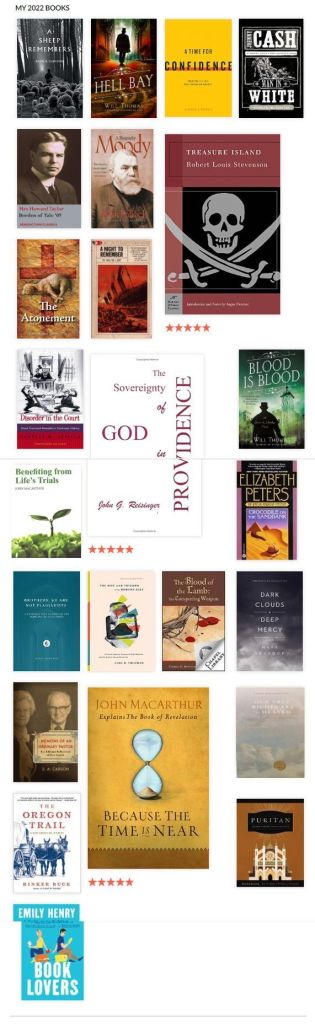
Hm, I guess there is value in doing a reading challenge after all. So far I’ve counted 4 valuable lessons for participating in one, with a 5th below. Here are the books I read in 2022.
A Sheep Remembers Calhoun, David B. Jan 2022
Hell Bay (Barker & Llewelyn, #8) Thomas, Jan 2022
A Time for Confidence: Trusting God in a Post-Christian Society Nichols, Stephen J. Jan 2022
Man in White Cash, Johnny Jan 2022
Borden of Yale ’09 Taylor, Geraldine Guinness Apr 2022
Moody: A Biography Pollock, John Charles Apr 2022
The Atonement Murray, John May 2022
Treasure Island Stevenson, Robert Louis May 2022
A Night to Remember Lord, Walter May 2022
Disorder in the Court: Great Fractured Moments in Courtroom History
Sevilla, Charles M May 2022
The Sovereignty of God in Providence Reisinger, John G. May 2022
Our True Riches in Heaven MacArthur Jr., John F. Jun 2022
Blood Is Blood (Barker & Llewelyn, #10) Thomas, Will Jun 2022
Crocodile on the Sandbank (Amelia Peabody #1) Peters, Elizabeth Jun 2022
Brothers, We Are Not Plagiarists: A Pastoral Plea To Forsake The Peddling Of God’s Word Schrock, David Jul 2022
The Rise and Triumph of the Modern Self: Cultural Amnesia, Expressive Individualism, and the Road to Sexual Revolution Trueman, Carl R. Jul 2022
The Blood of the Lamb: The Conquering Weapon Spurgeon, Charles Haddon Jul 2022
Dark Clouds, Deep Mercy: Discovering the Grace of Lament Vroegop, Mark Aug 2022
Memoirs of an Ordinary Pastor: The Life and Reflections of Tom Carson Carson, D.A. Aug 2022
Because the Time is Near: John MacArthur Explains the Book of Revelation MacArthur Jr., John F. Nov 2022
The Oregon Trail: A New American Journey, Buck, Rinker Dec 2022
Benefiting From Life’s Trials: [James 1:2-18] (John MacArthur’s Bible studies) MacArthur Jr., John F. Dec 2022
Book Lovers Henry, Emily Dec 2022
To God’s Glory: Lessons on Puritanism: Puritan DVD Workbook, by Joel Beeke Dec 2022
Right-click to see larger in new tab.
I see my pattern. I started off gangbusters in January, fresh from the new year, entering a new challenge. Then not much (at least not recorded) in Feb-March. April we have a week-long break so I read at home then. And of course as the end of May, June, July came I am on summer break, so I see I resumed then. September and October I’m in the flush of a new school year and consumed with that, so I see the reading dropped off. Then as November’s Thanksgiving and December’s Christmas school break approached and with it, the end of the year, I resumed my gangbusters attitude to try and meet the Challenge goals.
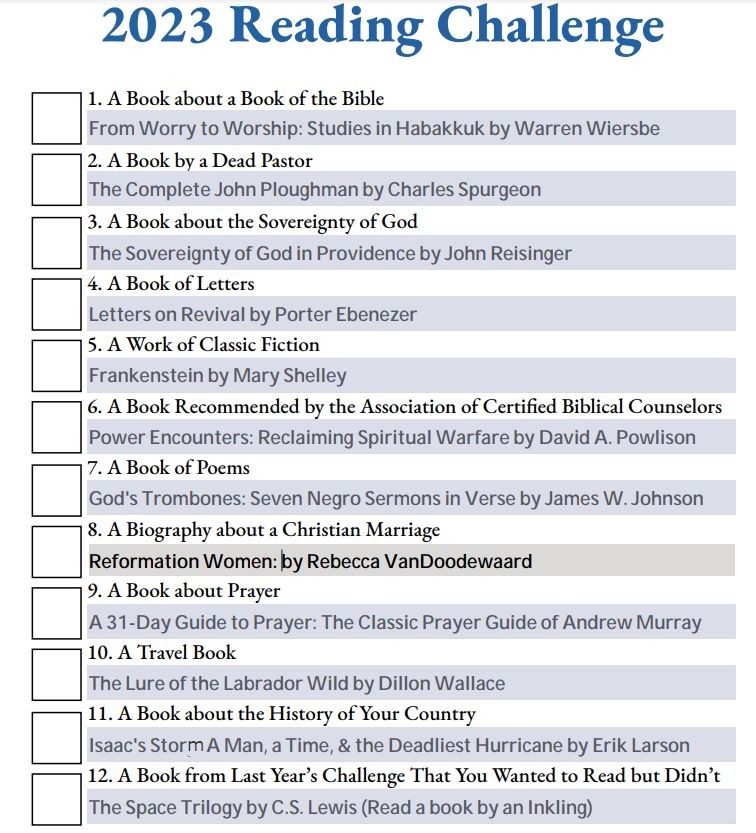
I decided to go ahead and do another Reading Challenge. I picked the G3 Reading Challenge again, because I like those guys and because I’m attending the National Conference this September. Below are the suggested books and the ones I chose under each suggested category. The Reformation Women book by VanDoodewaard isn’t strictly a marriage biography, but first, I own it already, and second, I want to see how these women, if they were married, managed in making such a global impact while married and attending to their home duties.
And that’s the other thing, I own these books already, except for Powlison’s Power Encounters. There is time enough to find that one either at a library or a book sale, or at the least, Amazon when the time comes to read it. That’s another benefit a Reading Challenge does for me, makes me take a hard look at my shelves, and focus on reading the books I already own.
So here is my checklist of books I’ve picked for the G3 2023 Reading Challenge:
I was glad to review my reading throughout the year because it helped me see my patterns. I don’t want to let two months go by without absorbing some good material. Of course, it isn’t a total black hole, I’m reading the Bible, and also stuff given out in Sunday School class, but still, it’s too long to just sink into a routine of only watching media and not reading.
I’m looking forward to this year’s books. What are your thoughts on Reading Challenges and such? Do you have reading goals for the New Year?
Ladies, as a New Year approaches, you might be thinking you’d like to change up who you follow for women’s ministries. Or maybe the Spirit grew you in discernment and you’ve abandoned some less solid ministries but aren’t sure who to turn to next. I can recommend these ministries of women by women, though you’re certainly NOT restricted to women only! I do encourage women to follow solid men too.
I personally follow WWUTT.com (Pastor Gabe Hughes at When We Understand the Text, DB Harrison and Virgil Walker at the Just Thinking Podcast, and anything from The Master’s University or The Master’s Seminary. There are so many other male-led podcasts I can recommend too, Reagan Rose at Redeeming Productivity, the guys at Ligonier and Ligonier Connect, Chris Hohnholz and Rich Story at Voice of Reason radio, Nathaniel Jolly and Ekkie Tepsupornchai at Truth be Known podcast, Andrew Rappaport’s Striving for Eternity, and so many others.
Here are some ladies’ podcasts I think you may enjoy:
The Women’s Hope podcast, with Dr. Shelbi Cullen and Kimberly Cummings. “Join Dr. Shelbi Cullen and Kimberly Cummings as they bring hope and encouragement through 25 years of combined experience in biblical discipleship and counseling as ACBC counselors.”
Susan J. Heck With the Master. “Susan is a certified counselor with the Association of Certified Biblical Counselors (biblicalcounseling.com) since 2003. She is also the author of With the Master Bible study series for ladies and many books. She has memorized the entire New Testament along with two books from the Old Testament!”
Martha Peace. “…Received training and certification from ACBC, which stands for Association of Certified Biblical Counselors. Martha teaches counseling classes and counsels in her church’s Certified Counselor Training Center. She has also written many books, most notably “The Excellent Wife.” She is a noted church and conference speaker, too.
Amy Spreeman and Michelle Lesley “A Word Fitly Spoken“. Each of these women have separate ongoing ministries in the form of blogs, Bible studies, and other written material, links to which are inside the podcast link on their About page. Michelle has a long-standing blog of discipleship and discernment issues, has written Sunday School curriculum for publishers, and has authored a book, in addition to traveling for speaking engagements. Amy also has much written material on topics of discernment and discipleship and also founded Naomi’s Table Bible Studies for women, and participates in speaking engagements.
Brooke Bartz, founder of the free online annual conference, Open Hearts in A Closed World Women’s Online Conference, Brooke has authored “Chronic Love: Trusting God while suffering with a Chronic Illness” and the Christian teen book “Godly Ever After (Fiona’s Faith, 1)”
These women are solid.
What I look for in a podcast, either from men or women, is a serious podcast that takes on biblical concepts unafraid and unapologetic, in love and gentleness. If the podcast discusses cultural issues, do they do so in a tone of charity, yet being solidly informed?
I think too many podcasts from ladies send too much of the podcast time giggling, horsing around, and talking of inane things. It is insulting to me, to think that of a 40 minute podcast I’ve got 20 minutes to waste. I don’t. I have limited time and increasingly as I age, with limited mental energy to devote. My ‘think time’ has shrunk! If you’re a younger woman, you only have so much time before the baby wakes up, the dinner has to be cooked, the husband arrives home, etc. If I want to indulge in a mental break or some inanity I’ll watch Green Acres or a few kitten hijinks videos. Spending half your podcast time in personal conversations with each other, swapping in-jokes, and larking about, is self-indulgent! It also displays a lack of control and women who teach are supposed to display control. Titus 2:5, 7 says older women are supposed to teach the younger to “be sensible…dignified, sound in speech which is beyond reproach,” yet they themselves are not sensible or self-controlled. Ugh.
Secondly, I also think it lowers the credibility of a woman’s podcast to spend time with giggling and tomfoolery, and then turn to the word of God to share eternal concepts. A podcast to me, IMO, is kind of like a pulpit. If you’re going to relate biblical concepts to people, do so with gravitas and a commitment to the One who authored it, in seriousness and earnestness.
So look for podcasts from women who are sensible, self-controlled, dignified in speech, true to the word, and talk about Jesus more than themselves.
I know we are all crunched for time most days, and every minute is precious. If you don’t listen to many podcasts (or sermons, teaching series, audio books, hymns, or Bible studies) I ask you to consider doing so. In the in-between times, like when folding laundry, doing errands in the car, or over a quick lunch, we can fill our mind with Bible-based, edifying material. Even 5 or 10 minutes’ worth will be edifying. 10 minutes 6X a week is an hour. An hour a week is 4 hours a month, and that adds up to 48 hours a year of “extra” edifying material. After all, our mind is how the Spirit transforms us, through the Bible’s good word and through discussions over the Bible’s concepts and doctrines.











 the-end-time.org