The culmination of the age of man ends with two great feasts. In one, believers will dine with the glorious King of all Kings!
“Then I heard what seemed to be the voice of a great multitude, like the sound of many waters and like the sound of mighty thunderpeals, crying, “Hallelujah! For the Lord our God the Almighty reigns. Let us rejoice and exult and give him the glory, for the marriage of the Lamb has come, and his Bride has made herself ready; it was granted her to be clothed with fine linen, bright and pure”-for the fine linen is the righteous deeds of the saints. And the angel said to me, “Write this: Blessed are those who are invited to the marriage supper of the Lamb.” And he said to me, “These are true words of God.” (Revelation 19:6-9)
In the other, the dead on the earth after Armageddon will BE the supper…for vultures:
“Then I saw an angel standing in the sun; and he cried with a loud voice, saying to all the birds that fly in the midst of heaven, “Come and gather together for the supper of the great God, that you may eat the flesh of kings, the flesh of captains, the flesh of mighty men, the flesh of horses and of those who sit on them, and the flesh of all people, free and slave, both small and great.” And I saw the beast, the kings of the earth, and their armies, gathered together to make war against Him who sat on the horse and against His army. Then the beast was captured, and with him the false prophet who worked signs in his presence, by which he deceived those who received the mark of the beast and those who worshiped his image. These two were cast alive into the lake of fire burning with brimstone. And the rest were killed with the sword which proceeded from the mouth of Him who sat on the horse. And all the birds were filled with their flesh.” (Revelation 19:17-21).
The Pharisees asked Jesus when the Kingdom would come, and where. He answered:
“And they answered and said unto him, Where, Lord? And he said unto them, Wheresoever the body is, thither will the eagles be gathered together.” (Luke 17:37)
Eagles (other translations say vultures) will flock to where the prey is and they flock most to where there is easy prey. Jesus was saying that eagles will gather where the dead are- the wicked dead. Unless we each individually repent and are forgiven by Jesus, we are dead in our sins. (Colossians 2:13).
Unless this nation which accepts and codifies homosexuality, abortion, greed, usury and other sins abhorrent to God, repents and is forgiven, we are a dead nation.
Will you dine? Or will you be dined upon? Both suppers will happen. Repent now and fall on Jesus asking for forgiveness from the King who accepts worship from forgiven sinners.
This documentary packed a punch. And I’ve seen a lot of documentaries.
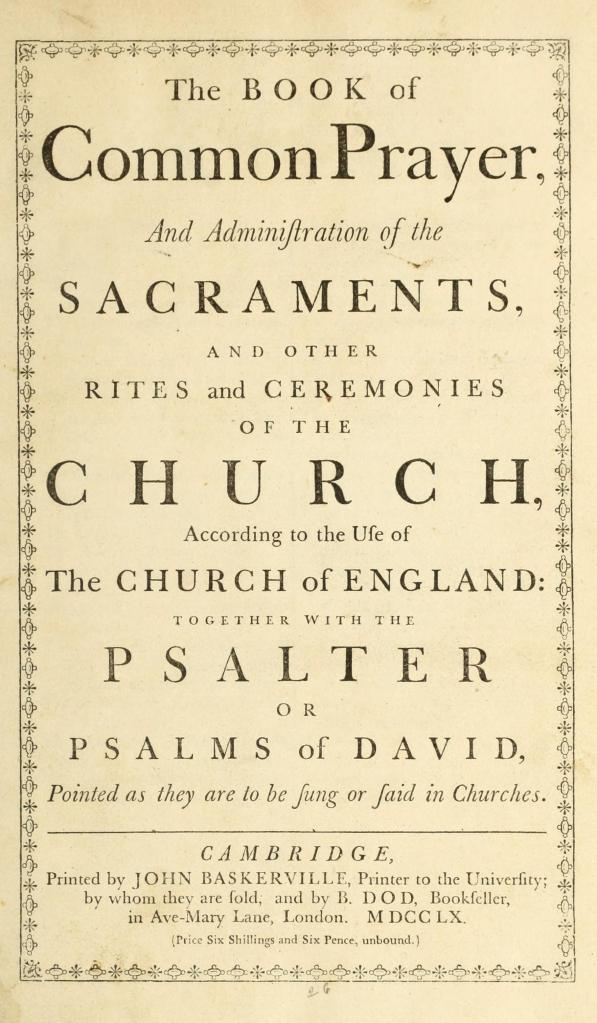
The film began with a recounting of a crucial moment in church history with the ever growing tension between King and Church. It was 1657 and Britain’s King Charles I had been encroaching on the sphere of the church with mandates of what to pray and from what book to pray. He had been insisting on using Episcopal rites and now, insistence on using the Book of Common Prayer added to the tension.
The final showdown occurred when the minister in St Giles’ Cathedral began reading from the Book of Common Prayer at a service in which Jenny Geddes was sitting. Outraged, Jenny, a lowly market women, threw her stool at the minister’s head, and is claimed to have yelled, “Devil cause you colic in your stomach, false thief: dare you say the Mass in my ear?”
A fracas ensued as others began picking up the beat.
Her act is reputed to have sparked the riot that led to the Wars of the Three Kingdoms, which included the English Civil War.
Many such moments have appeared in Church history, where the pushme-pullyou tension between government and church comes to a head. It doesn’t often begin with a splashy bigness. The Lord often uses the weak and insignificant as the spark. Individuals who retain a supernatural conviction in the midst of a storm, stalwart and unmoved by the pressure of the government coming against them.
The film continues with the struggle of the Scottish Covenanters movement that formed after Jenny threw her stool, to John Bunyan, the Great Ejection, and the Puritans from past history. Weaving into these pivotal moments in church history the film recounts a similar recent battle between the Canadian government and pastors James Coates & Tim Stephens, and John MacArthur and California’s intrusion into worship.
The Covid-19 so-called “pandemic” era struggle of three churches is highlighted as part of this long history of opposing the government when it dares to enter into church matters: California’s Grace Community Church led by Pastor John MacArthur and its elders, James Coates of GraceLife Church of Edmonton Canada, and Tim Stephens of Fairview Baptist Church of Calgary Canada.
Tim Stephens of Calgary Canada
The documentary interviews elders and the pastors concerned with the line between obeying government as the Bible says we must do, and defying government when it intrudes on matters only Jesus administers, also as the Bible says we must do. The thought process and final decision processes were described by all of the church players in this drama. [The government players refused to be interviewed].
The Canadian pastors were actually jailed in maximum security prison for continuing to hold in-person services during the time when government said no such gatherings were allowed. Pastor-teacher John MacArthur was threatened with jail.
James Coates of Edmonton Canada
The film then recounts the legal battle of Grace Community Church, the arrest and imprisonment of Coates and Stephens, and the effect on their families. The film did well illustrating the conviction of courageously certain believers of the past, unmoved and refusing to sign/agree/kowtow to governmental authorities who would press them to violate their conscience- even to the point of threatened death and martyrdom for some.
It sensitively portrayed the spiritual heartache of the currently embattles pastors who looked out upon empty pews, aching to deliver the precious word to their sheep. Their angst was palpable, their anguish real. So was the heartache of elders prevented from visiting their shut-ins and their hospitalized congregants. Men who labor for Jesus and His truth are knit to Him strongly and feel the weight of their calling to bring truth, song, fellowship and succor to their people. The empty pews, the scattered sheep, were a grief to them and makes the point how church is essential.
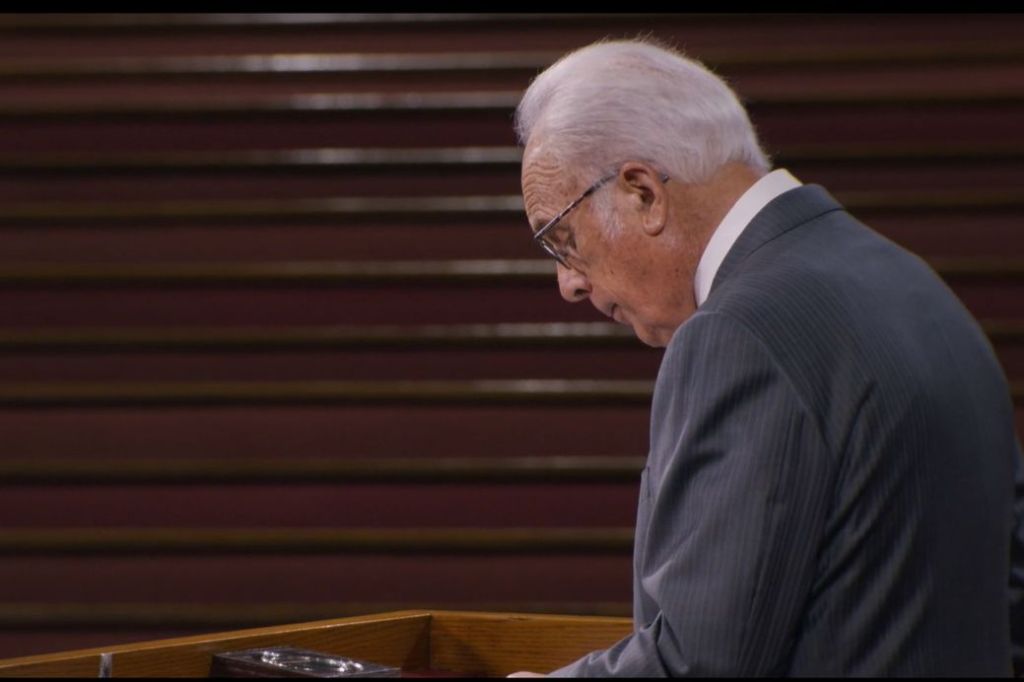
MacArthur preaching to empty pews and a camera lens
Rev. Ian Hamilton serves as minister of Cambridge Presbyterian Church and was interviewed several times. Hamilton asked what I believe was the crucial question of the movie. The film wasn’t about expose covid lies, although those were exposed. It wasn’t solely about a recounting of church history, though it was recounted. Nor was it to highlight the courage of Christian convictions in the face of terrible pressure and even death, though certainly that was present in the film. No. It was this:
“Who has the right to govern my conscience?”
The Essential Church is extremely well done, extremely. It ends with a warning and a hope. One of the final statements was by Phil Johnson of Grace Community Church. Even though the church was successful in court, the battle is not over. And then John MacArthur gave the Gospel.
MY REACTION
My opinion is that it is a pivotal film and one that everyone who believes in Jesus should see. We increasingly in these days are viewing a Romans 1 judgment tightening the noose around the false church and revealing the true. At some point, soon perhaps, each and every one of us will have to sift through the Bible’s precepts, apply them to our individual consciences, and make a stand.
Margaret Wilson, Scottish Martyr, killed at age 18. By John Everett Millais – DMVI, Public Domain
It was noted strongly in the film that government is not neutral. Yes, it was established by God to restrain sin, and to a large extent it does that, but it is also corrupt and hates both of the other spheres God has established- Family and Church. Church history shows that given even half an inch, government will tyrannically try to overpower both to become the dominant force in every human’s life.
In the end of the end, government will succeed (for a time).
I was glad I watched at home. I cried and cried and cried. I first cried in joy at the Lord’s provision of strong pastors. He raises up good men in each era to lead by conviction with a true heart for the people and His word. The Lord is good to keep our church leaders strong. I was glad to learn about Coates and Stephens. The Lord has many others all over the world at this moment who are unknown to us but laboring with lion-heart convictions. This is a blessing and an encouragement.
Then I cried in frustration and rage at recalling what the evil the government did to us during 2020-2022 – the frail and old dying alone in nursing homes, fomenting false fear based on lying science, BLM/rise of Marxism, and worst of all, Tim Stephens’ little boy sobbing as they arrested Tim, saying “bye daddy!” and his little hand reaching for dad as the police drove Tim away. Then cried at the end when JMac gave the Gospel, in crushing humility that the All Powerful One who saves, and saved me.
I started an occasional series covering little known Bible characters. These are men or women who are named in the Bible, but we do not know much about apart from their names. Though, the Word of God is always worth plumbing its depths, and we can elicit from the text more than we think.
I had thought of several people named in the New Testament to focus on, but as our teaching elder concluded his series on Ezra, the last chapter listed by name, many offenders. That is what the section of text is called in my NASB Bible, “The List of Offenders”.
And among the sons of the priests there were found that had taken strange wives: namely,… (Ezra 1018a).
GIll’s Exposition:
And among the sons of the priests there were found that had taken strange wives,…. So that it need not be wondered at that this evil should spread among the people, when those who understood the law, and should have instructed the people in it, set such an example: namely: of the sons of Jeshua the son of Jozadak; who was the high priest; and perhaps for this fault of his, in not restraining his sons from such unlawful marriages, is he represented in filthy garments, Zechariah 3:3, and his brethren, Maaseiah, and Eliezer, and Jarib, and Gedaliah; these were the brethren of Jeshua.
The Holy Spirit chose to name the men who had grievously sinned by marrying foreign women who brought foreign idols into the sheepfold. The offense was not marrying women of different race or ethnicity, but that they worshiped other gods.
We saw the problem when Solomon married foreign wives who worshiped other gods.
Again, it wasn’t their ethnicity. Canaanite Rahab converted and married Joshua, Moses married Zipporah a Cushite, Ruth was a Moabite.
Do not be mismatched with unbelievers; for what do righteousness and lawlessness share together, or what does light have in common with darkness? (2 Corinthians 6:14).
and you might take some of his daughters for your sons, and his daughters might prostitute themselves with their gods and cause your sons also to prostitute themselves with their gods. (Exodus 34:16)
There were only about 100 or so who intermarried, among tens of thousands of returnees from Babylon, but remember a little leaven… spreads like gangrene. Ezra was so appalled he tore his clothes, his hair, and his beard, and sat in a puddle of prayers appealing to God for mercy.
Every man who had married an unbeliever and thus brought idolatry into Israel was named. This is the “List of Offenders” at the end of Ezra 10.
Imagine…being named in the Bible. So many people were named as a congratulations for their faith. There’s Hebrews Hall of Faith in chapter 11, where men and women are expressly named and commended.
The positively named in Hebrews are, Enoch, Noah, Abraham, Sarah, Isaac, Moses’ parents, Moses, Rahab, Gideon, Barak, Samson, Jephthah, David, Samuel, and the prophets.
Others from the New Testament were named for their faith and/or service also: Anna, Mary, Dorcas, Lydia, Tychicus, and many others of course. We can be sure when they arrived in God’s holy abode in heaven, Jesus was pleased to say to them, “His master said to him, ‘Well done, good and faithful slave. You were faithful with a few things, I will put you in charge of many things; enter the joy of your master.'” (Matthew 25:21)
But to be named in the Bible because of your sin, enscripturated forever as an example of disobedience, what a woe and embarrassment to them! And what a warning to us.
–Sin is a corrupting influence –Leaders should be an example to the positive, not the negative –Sin hurts the reputation of the church and brings reproach to the name of Jesus.
Sin must be dealt with. If we don’t address it with genuine repentance, God will.
In this New Testament era, our names are written in heaven in the Book of Life. What a grace, mercy, and gift! Let us be thankful and do our best to follow the Lord’s statues in obedience as a thank you in return.
Instruct me, O Yahweh, in the way of Your statutes, That I may observe it to the end. (Psalm 119:33).
A number of you have said on Facebook or have emailed me that the times are certainly troubling you, and your spirits have wilted in discouragement. I always respond that there are two sure-fire ways to stay encouraged. No, three!
2. Stay in the word. Open your Bible and taste. Taste and see that the LORD is good. Oh, the joys of those who take refuge in him! (Psalm 34:8)
Those two disciplines keep your eyes on the Lord, which is both being obedient to Him and keeps us in His peace.
3. Listen to great sermons from credible Bible expositors. Hearing the word explained and participating in a joyful exposition is a wonderful way to stay encouraged. I recommend:
I know there are many other preachers and teaches who edify you and me, for example, Alistair Begg, Charles Spurgeon (audio reading of his sermons is available) and of course my/your own pastor, among many others.
I am adding a 4th mechanism to the list. I have been reading missionary biographies and I personally find them extremely encouraging! I hope you do too! For example, John G. Paton’s “Thirty Years Among the South Sea Cannibals” is a tremendous story that shows the difficulty of the spread of the Gospel (only 1 soil in four accepts it), the tribulations of missionaries, their total reliance on Jesus and how their faith increased because of it, their constant heavenward perspective, the beauty and celebration when a soul converts, and much more. Missionary stories humble me, make me grateful, and help me picture heaven
It is the Christ of the Bible which John G. Paton took with him to the New Hebrides Islands in 1858, to witness to the natives among the island group now known as Vanuatu. The book depicts Paton’s mission, a Scottish born man and called to minister to the cannibals of Tanna Island. Landing with his pregnant wife in 1858 he recounts the labors among “painted savages who were enveloped in the superstitions and cruelties of heathenism at its worst.” There’s joy when one native converted, weeping when there is betrayal by tomahawk or war club. Paton’s wife and child died, Paton himself was ill to near death many times from fevers and ague, and most other missionaries were killed outright. His life was threatened daily and the physical work of just staying alive was very trying. Yet Paton persisted lovingly in sharing Jesus’ Gospel with the natives, and also dispensed medicines and education.
Four years later, the natives loving Paton but hating “The Worship and his Jehovah,” caused Island-wide war to break out. He and two remaining missionaries were evacuated off the island. Paton spent some years in Australia and Scotland fundraising for the mission. He returned on the missionary ship Dayspring 4 years later.
There is much more. His personal story does have a happy conclusion. When he and his new wife returned, they re-settled on a different island, and over the course of many years successfully shared the Gospel and the natives were converted.
Here are a few sweet excerpts. Paton’s relationship with his father is beautiful.
that blessed custom of Family Prayer, morning and evening, which my father practised probably with out one single avoidable omission till he lay on his death bed, seventy -seven years of age; when, ever to the last day of his life, a portion of Scripture was read, and his voice was heard softly joining in the Psalm, and his lips breathed the morning and evening Prayer, falling in sweet benediction on the heads of all his children, far away many of them over all the earth, but all meeting him there at the Throne of Grace.
The first of many war scenes, early in the book:
Party after party of armed men going and coming in a state of great excitement, we were informed that war was on foot; but our Aneityumese Teachers were told to assure us that the Harbor people would only act on the defensive, and that no one would molest us at our work. One day two hostile tribes met near our Station ; high words arose, and old feuds were revived. The Inland people withdrew; but the Harbor people, false to their promises, flew to arms and rushed past us in pursuit of their enemies. The discharge of muskets in the adjoining bush, and the horrid yells of the savages, soon informed us that they were engaged in deadly fights. Excitement and terror were on every countenance ; armed men rushed about in every direction, with feathers in their twisted hair, with faces painted red, black, and white, and some, one cheek black, the other red, others, the brow white, the chin blue in fact, any color and on any part, the more grotesque and savage-looking, the higher the art! Some of the women ran with their children to places of safety; but even then we saw other girls and women, on the shore close by, chewing sugar-cane and chaffering and laughing, as if their fathers and brothers had been, engaged in a country dance, instead of a bloody conflict.
The beginning of the end, war breaks out and Paton fled, spending the night high in a tree above marauding cannibals.
Being entirely at the mercy of such doubtful and vacillating friends, I, though perplexed, felt it best to obey. I climbed into the tree, and was left there alone in the bush. The hours I spent there live all before me as if it were but of yesterday. I heard the frequent discharging of muskets, and the yells of the savages. Yet I sat there among the branches, as safe in the arms of Jesus. Never, in all my sorrows, did my Lord draw nearer to me, and speak more soothingly in my soul, than when the moonlight flickered among these chestnut leaves, and the night air played on my throbbing brow, as I told all my heart to Jesus. Alone, yet not alone! If it be to glorify my God, I will not grudge to spend many nights alone in such a tree, to feel again my Saviour’s spiritual presence, to enjoy His consoling fellowship. If thus thrown back upon your own soul, alone, all, all alone, in the mid night, in the bush, in the very embrace of death itself, have you a Friend that will not fail you then?
With no mission board to support or guide her, and less than ten dollars in her pocket, Gladys Aylward left her home in England to answer God’s call to take the message of the gospel to China. With the Sino-Japanese War waging around her, she struggled to bring the basics of life and the fullness of God to orphaned children. Time after time, God triumphed over impossible situations, and drew people to Himself. The Little Woman tells the story of one woman’s determination to serve God at any cost. With God all things are possible! Gladys lived from (1902-1970).
Through Gates of Splendor is the true story of five young missionaries who were savagely killed while trying to establish communication with the Auca Indians of Ecuador. The story is told through the eyes of Elisabeth Elliot, the wife of one of the young men who was killed.
Find some other missionary stories, there are many lists out there of “10 Missionaries every Christian ought to know” and so on. Many missionaries have gone forth. The more modern stories can be heard or read from Dispatches from the Front: Stories of Gospel Advance in the World’s Difficult Places. I am sure that their stories will inspire you and encourage you. We all need some encouragement in these days. I can’t wait to meet Paton, Nate Saint, Gladys Aylward, and all the rest in heaven!!
For the love of Christ controls us, having concluded this, that one died for all, therefore all died; (2 Corinthians 5:14).
Powerful. Have you ever thought about that before? That the love of God controls us? Or as KJV says, constraineth us? The word here whether it’s control, constrain, or compel, means in the Greek,
I press together, close, (b) I press on every side, confine, (d) I urge, impel,
Picture our ever growing sanctification as entering the wide end of a funnel, and slowly being drawn down the narrow end, the sides all around being Christ’s love to us which we ever grow in reflecting back.
Or, picture the scene where Balaam’s donkey was on a path so narrow the hedges pressed him in on all sides and the animal could not even turn around.
Some commenters on the subject-
with irresistible power limits us to the one great object to the exclusion of other considerations. The Greek implies to compress forcibly the energies into one channel. Love is jealous of any rival object engrossing the soul. Jamieson, Fausset, & Brown
Love has a constraining virtue to excite ministers and private Christians in their duty. Our love to Christ will have this virtue; and Christ’s love to us, which was manifested in this great instance of his dying for us, will have this effect upon us, if it be duly considered and rightly judged of. Source- Matthew Henry’s commentary on the whole Bible.
The phrase “the love of Christ” means His love for us as seen in His sacrificial death. “We love Him, because He first loved us” (1 John 4:19). He loved us when we were unlovely; in fact, He loved us when we were ungodly, sinners, and enemies (see Rom. 5:6–10). When He died on the cross, Christ proved His love for the world (John 3:16), the church (Eph. 5:25), and individual sinners (Gal. 2:20). When you consider the reasons why Christ died, you cannot help but love Him. Source, Warren Wiersbe, W. W. (1996). “Be Series.” The Bible exposition commentary.
Yes, we cannot help but love Him! Jesus is the most lovely, wondrous, majestic person in the entire universe! He created all things and upholds all things, yet condescended to incarnate into human flesh, and live among sin, sinners, and this sinful world! He died on the cross shedding His blood for us.
Let the love of Christ control you today. Let the love of Christ constrain you today. Let the love of Christ compel you today.
We are so used to certain phrases in the Bible that we may have lost the original sense of the meaning. For example:
The fly in the ointment is from Ecclesiastes 10:1, and a drop in the bucket is from Isaiah 40:15.
You’ve heard of “cast the first stone” right? Well, in Deuteronomy 17:7 we learn what it means. In a capital case, upon the finding of a perpetrator guilty, the witness must cast the first stone and thus begin the execution.
This is sobering. It ensures that the witness was sure about what he saw or said, else his conscience would be heavy. Also, the LORD would judge that witness guilty on judgment day.
John 8:7 a similar situation existed where Jesus said to the false witnesses of the woman caught in adultery, “When they persisted in asking Him, He straightened up and said to them, “He who is without sin among you, let him be the first to throw a stone at her.”
No one on earth is without sin, so Jesus did not mean anyone who is sinless may cast the stone. No, as Geneva Study Bible explains, the comment was meant-
Against hypocrites who are very severe judges against other men, and flatter themselves while they are sinning.
Barnes’ Notes on the Bible says of the John 8 verse,
This was in order that the witness might feel his responsibility in giving evidence, as he was also to be the executioner. Jesus therefore put them to the test. Without pronouncing on her case, he directed them, if any of them were innocent, to perform the office of executioner. This was said, evidently, well knowing their guilt, and well knowing that no one would dare to do it.
We should have soft consciences, pricked at wrongdoing. I see so much false witnessing, people flinging accusations and bearing false witness that seems not to affect their conscience at all.
In Romans 2:14-15, the word used for conscience is Suneidesis. It is used 32 times in the New Testament. The International Standard Bible Encyclopedia defines it as, “An inner witness that testifies on the rightness or wrongness of one’s actions or motives and, on the basis of them, pronounces judgment concerning the worth of the person.”
What is conscience? “The conscience is generally seen by the modern world as a defect that robs people of their self-esteem. Far from being a defect or a disorder, however, your ability to sense your own guilt is a tremendous gift from God. He designed the conscience into the very framework of the human soul. It is the automatic warning system” ~John MacArthur
It is a heavy, heavy thing to make an accusation and then have enough of a clean conscience to start the execution – the killing – of a human being. Be careful not to harden your conscience. Bearing false witness, especially on social media, seems like an easy thing for people to do. And the more they do it the easier it gets to press enter.
I recently read a book called Taming the Fingers: Heavenly Wisdom for Social Media by Jeff Johnson. It is very short, 88 pages. But it has scripture laden advice for monitoring one’s self on social media.
With wisdom from the Proverbs, Pastor Jeff Johnson offers five practical questions that can help us cultivate heavenly wisdom in our use of social media:
Am I controlled?
Am I calm?
Am I careful?
Am I compassionate?
Am I conscientious?
I have found that asking myself these questions has helped slow me down to make sure I am not impugning anyone’s reputation by insinuating wrong things or worse, making a false accusation.
Let none of us be hypocrites by casting the first stone.
I studied Colossians 2:13-15. I especially enjoyed Colossians 2:15-
“And having disarmed the powers and authorities, he made a public spectacle of them, triumphing over them by the cross.”
I used the NIV translation there because I like the word ‘spectacle’. The word in Greek is deigma, and the definition is “I hold up as an example, make a show of, expose.” (Strong’s 1165)
I love to think of how the demons were partying down when Jesus died on the cross, and suddenly He shows up! It is always especially humiliating when you’re at the pinnacle of gloating and someone comes along to puncture your balloon and show how wrong you were.
Barnes Notes says of the verse, (I really like Barnes Notes, and I use them a lot)
The terms used in this verse are all military, and the idea is, that Christ has completely subdued our enemies by his death. A complete victory was achieved by his death, so that every thing is now in subjection to him, and we have nothing to fear. … He made a show of them openly – As a conqueror, returning from a victory, displays in a triumphal procession the kings and princes whom he has taken, and the spoils of victory. This was commonly done when a “triumph” was decreed for a conqueror. On such occasions it sometimes happened that a considerable number of prisoners were led along amidst the scenes of triumph. Paul says that this was now done “openly” – that is, it was in the face of the whole universe.
So then I’m reading along in 1 Corinthians 4:9, and I see that word spectacle again
“For I think that God has exhibited us apostles as last of all, like men sentenced to death, because we have become a spectacle to the world, to angels, and to men.”
Italy Forum. EPrata photo
Once again, the allusion is military. After a successful military campaign, a triumphal procession was held. Flowers were strewn along the triumphal route, so that when the horses, chariots, and carts rolled over them, the fragrance of the triumph would permeate the city. A triumph granted to a general was the crowning achievement of his career. It marked his victory over opposing forces and was a platform for him to assert personal power.
“The Roman triumph (triumphus) was a civil ceremony and religious rite of ancient Rome, held to publicly celebrate and sanctify the military achievement of an army commander who had won great military successes, or originally and traditionally, one who had successfully completed a foreign war.”
“On the day of his triumph, the general wore regalia that identified him as near-divine or near-kingly, and a laurel wreath was held above his head. He rode in a chariot through the streets of Rome in unarmed procession with his army and the spoils of his war. At Jupiter’s temple on the Capitoline Hill he offered sacrifice and the tokens of his victory to the god. Thereafter he had the right to be described as vir triumphalis (“man of triumph”, later known as triumphator) for the rest of his life.“
It was a spectacle, all right. This was the order of procession, which stayed the same during the 500 total Triumphs held over the 1900 year history of the Roman Empire:
Order of Procession:
The Senate, headed by the magistrates without their lictors.
Trumpeters
Carts with the spoils of war
White bulls for sacrifice
Exotic animals from the conquered land
The arms and insignia of the conquered enemy
The enemy leaders themselves, with their relatives and other captives
The lictors of the imperator, their fasces wreathed with laurel
The imperator himself, in a chariot drawn by two (later four) horses
The adult sons and officers of the imperator
The army without weapons or armor (since the procession would take them inside the pomerium), but clad in togas and wearing wreaths. During the later periods, only a selected company of soldiers would follow the commander in the triumph, as a singular honour.
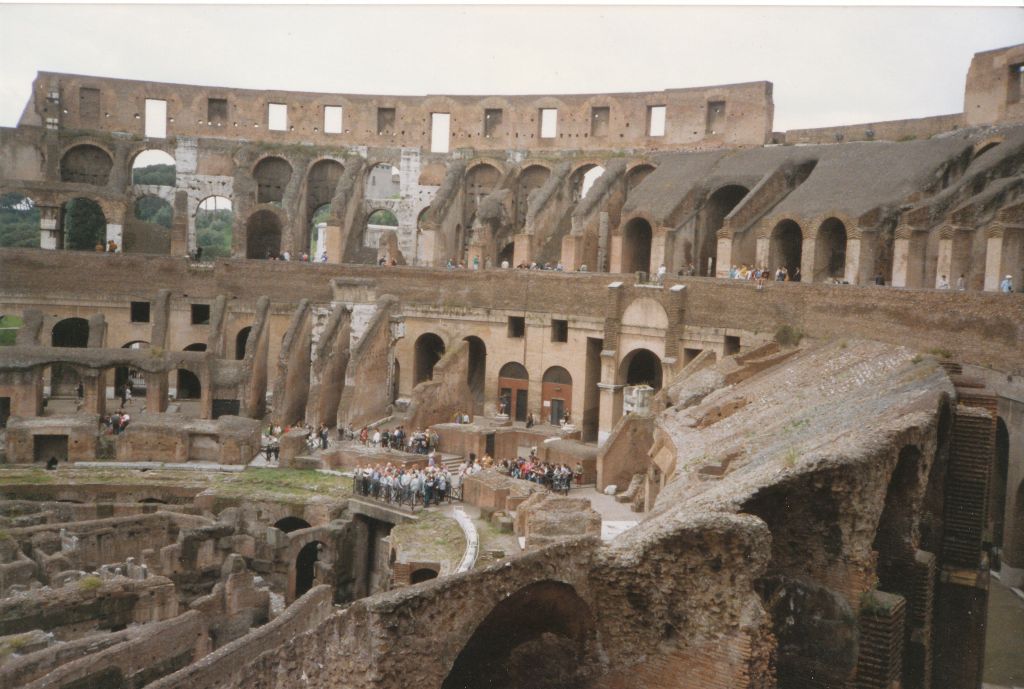
Rome- Colosseum. EPrata photo
To the Roman, the more impressive the array of high-ranking prisoners, famous names, kings, etc, the better the Triumphal parade. The more powerful, dangerous, or news-worthy the prisoner, the better the public spectacle of their execution.
Barnes explains his interpretation of 1 Corinthians 4:9, the public spectacle of the apostles, setting the scene in the Roman Colosseum as an example:
“Paul represents himself as on this arena or stage, contending with foes, and destined to death. Around him and above him are an immense host of human beings and angels, looking on at the conflict, and awaiting the issue. … The whole verse is designed to convey the idea that God had, for wise purposes, appointed them in the sight of the universe, to pains, and trials, and persecutions, and poverty, and want, which would terminate only in their death.”
See Hebrews 12:1 for a similar word-picture of the universe looking on in this ongoing battle of darkness and light:
“Therefore, since we are surrounded by so great a cloud of witnesses, let us also lay aside every weight, and sin which clings so closely, and let us run with endurance the race that is set before us”
It seems to me that we are duly reminded by scripture of two things:
1. God points to His own glory and His own sovereignty at all times and in all ways 2. God uses all beings to serve His purposes- whether demons, His own Son, Apostles, the unsaved, or His believing sheep.
Understanding that we are His spectacle, on display to a great cloud of witnesses, with the universe looking on and knowing even angels long to look into these things, (1 Peter 1:12), how might we behave? The Gospel is the universe’s Triumph, the Good News from age to age, from beginning to end. It is the one and only processional that counts. We are privileged to be His captives, put on display for His purposes- whether unto death as martyr in a jeering theatre of mockers, or unto life as a display of His mercy.
Paul said it best, “But thanks be to God, who in Christ always leads us in triumphal procession, and through us spreads the fragrance of the knowledge of him everywhere.” (2 Corinthians 2:14)
EPrata photo. Not a photo of our office, but another local building who put up an enormous flag
I was in my newspaper office. Tuesday is a big paper day, we go to print Wednesday morning. I rented the office from my friend who lived a big farmhouse, and she called me from her living room. I thought it was unusual that she phoned, being just a few feet away from me in the same building. But her voice evaporated all other thoughts. She said quietly but with fervor, “COME HERE NOW”.
The first plane had just hit the twin tower in NY. We watched with eyes open, breathing shallowly, standing with arms numbly at our sides…until the second plane hit at 9:03. Our eyes locked together, and we knew without saying a word that this was an attack. We also knew that nothing would ever be the same. We watched until another plane hit the Pentagon 34 minutes later. It felt like the world was coming to an end. It really did. We thought the world was ending. A knot was in my stomach and coherent thoughts refused to form in my head. We got our purses and the first thing we did was walk across the street to the hardware store and we bought the biggest flag they had. We went back to the office and put it up. Then we went to the bank to get money. Cash was going to be important if the electricity went out or we were ordered to evacuate. We didn’t know what was coming next and we wanted to be prepared. It could have been a nuke coming next, for all we knew. At the bank, they had the TV on in the break room with the door open and the volume up so customers could hear what was going on. A fourth plane had just gone down in PA. We saw the smoking crater. We knew that plane was part of whatever was happening.
We resolved that our freedom was under attack. Running a newspaper which reported the news and offered a platform for the people to speak their thoughts on any political or civic matter freely, we decided our most patriotic thing we could do to support the Constitution that day was to get the paper out. The terrorists were not going to stop the presses. They were not going to stop freedom from ringing out. And that is what we did.
Churches were full that Sunday, though a bit less full the following Sunday. By about four slim weeks, churches were back to their spotty attendance. Why is this? Why do people fly planes into buildings and kill others? Why is there murder? Why is there war? Why are there conflicts at every level? Because man is inherently wicked. Our hearts are evil above all things, who can know it? (Jeremiah 17:9). Because man is basically evil. If we didn’t have laws and limits we would be killing each other at every moment.
Jesus is the hope we have to become good. Not on our own merits. We do not become good through our own efforts. No, “Why do you call me good?” Jesus answered. “No one is good–except God alone.” It is not a popular thing to say, that we are not good, but we are not. [Click on the link for John MacArthur’s sermon the Sunday after 9/11/01 as he takes us through a biblical understanding of death, terrorism, and the Middle East]
I thank Jesus that He poured out His life so that we may live…and become righteous. “It is because of him [God] that you are in Christ Jesus, who has become for us wisdom from God—that is, our righteousness, holiness and redemption.” (1 Corinthians 1:30). Even at that, our fleshly lives on earth are a struggle, a struggle against sin and growth in righteousness. I long for the day when flesh shall be glorified and sin shall be banished.
So people are evil, and we struggle against our nature. We want what we want and we sometimes terrorize or go to war to get it. Such will be the way, until the end. The end that comes before the beginning!
In the meantime, as we watch the death throes of this old world (which means the birth of the Glorious World!)…we mourn but also we love our nation America.
The song you are about to listen to is from a Las Vegas Diamond Rio concert. They received an immediate resounding standing ovation, and continue to do so every time they perform it!
Here in America, In God We STILL Trust:
On the day of 9/11 there were people trapped above the strike zones who thought it would be preferable to hurl themselves out the shattered windows of the twin towers rather than burn to death. One photo in particular caught the world’s attention. It is called “Falling Man” and it seems that his graceful swan dive plummet was poignant in the extreme. Here is the back-story of that photo.
Five months after 9/11 the Superbowl came along, just as it always does. The Superbowl is noted for artful, funny, or avante garde commercial debuts, due to the high viewership of the game. Budweiser showed a commercial called “Respect” and showed it only once, then until now. Thanks to Youtube, the ad has resurfaced. It is sure to bring a tear to your eye. We remember American greatness, American products, American ways.
Jesus will return in glory with His glorified saints. He will institute new nations and new cities populated by sinless resurrected chosen ones. There will be no more war because our hearts will be made right with Him. There will be no more terror because we will want nothing, having been given it all by our Savior. If you bow low to the Savior, He will lift you up high. Please do it soon.
And that’s a shame, because it is the central point of all of the story of Redemption. God is Holy. That means He is perfect, sinless, well, Holy.
And one called out to another and said, “Holy, Holy, Holy, is the LORD of hosts, The whole earth is full of His glory.” (Isaiah 6:3)
Humans are not holy. We were originally created sinless, perfect, but through free will, Adam and Eve in the garden decided to follow Lucifer’s suggestion to eat the forbidden fruit, and in doing so, directly disobeyed a command from God. That is what sin IS, disobeying God. I used to tell my children in the Good News Club, an after school Bible club, that sin is anything we think, say, or do that displeases God. Since we have thoughts, words and actions that displease God all the time, and couldn’t stop if we tried, it means we are sinners with a sin nature. Paul refers to our sinful nature in Galatians:
The one who sows to please his sinful nature, from that nature will reap destruction; the one who sows to please the Spirit, from the Spirit will reap eternal life. (Galatians 6:8)
Even if you do not believe in Adam and Eve and the garden and the forbidden fruit, you know deep down, that you are a bad person who does wrong things. Even if you ever said one lie to spare a person’s feelings (“Yes, that dress looks great on you!”) you are disqualified from being with God in heaven. Why? His Holiness is eternal. So is that lie. Sin is eternal, too. It doesn’t go away after you say it or do it or think it. It remains. And your sin and His holiness shall never meet.
Why would a liar think he is qualified for heaven? A cheater? As self-admitted liars and cheats and adulterers, and gossips and lusty people, why do we think we are “a basically a good person” and therefore qualified to dwell forever with a Holy God? We aren’t.
However, God so desires a relationship with us, that He made a way. He sent Jesus to us. I used to think that Jesus first came to us at Bethlehem on Christmas. But that is not so. He has been with God since the beginning. Genesis 1:1-26 shows that the Father God, Jesus and the Spirit were all involved in the Creation. And just in case there is confusion on this point, John 1:1-3 says
In the beginning was the Word, and the Word was with God, and the Word was God. He was in the beginning with God. All things came into being through Him, and apart from Him nothing came into being that has come into being. In Him was life, and the life was the Light of men. The Light shines in the darkness, and the darkness did not comprehend it.
At one point known only to God, God said
“I will surely tell of the decree of the LORD: He said to Me, ‘You are My Son, Today I have begotten You.(Psalm 2:7)
And God’s Plan to send a Holy One to redeem us was enacted, as reiterated by Paul in Acts 13:33:
that God has fulfilled this promise to our children in that He raised up Jesus, as it is also written in the second Psalm, ‘YOU ARE MY SON TODAY I HAVE BEGOTTEN YOU.’
So if we’ve all been sinners since Adam and Eve and He is Holy and cannot dwell with us, that’s it, then, isn’t it? Not quite! We love because He first loved us (1 John 4:19) He loves us SO MUCH! He sent Jesus to us to minister and preach and heal, so that our only, ONLY call to the road to heaven is “This is the work of God, that you believe in Him whom He has sent.” (John 6:29b)
It is very simple. Believe. All other verses are spokes stemming that central truth: for example, believing in “the One” means believing in the Messiah. Why was He sent? To seek and save the lost. Why are we lost? We sin. Why is He Messiah? Because He is the ONLY one who is qualified to forgive our sins, being sinless. Why would we confess? Because He came to seek and save us from our sins, therefore it makes sense that we would acknowledge those sins through our stated belief in Him.
Many people believe in God. Believing in Jesus is a huge leap because the gulf between (Jesus and us) and (God and us) is sin. If you believe in Jesus you believe you are a sinner, like the thief on the cross did, because a person is finally recognizing his OWN sin in the face of the obviously Sinless one. Many people believe in God without believing they themselves are sinners and they leave Jesus out of the equation completely.
Because God is HOLY, and we sin, man must “reform your ways and your actions and obey the LORD your God. Then the LORD will relent and not bring the disaster he has pronounced against you. (Jeremiah 26:13)”
Believe, and turn from your sin. Repent and be dwelling in perfect love for all eternity! Love, love, love, we love because HE FIRST LOVED US! He is wonderful and a holy God like no other. “In the year that King Uzziah died, I saw the Lord sitting on a throne, high and lifted up, and the train of His robe filled the temple,” that is how holy He is. Yet for all His holiness, “Seeing then that we have a great High Priest who has passed through the heavens, Jesus the Son of God, let us hold fast our confession. For we do not have a High Priest who cannot sympathize with our weaknesses, but was in all points tempted as we are, yet without sin. Let us therefore come boldly to the throne of grace, that we may obtain mercy and find grace to help in time of need.” (Hebrews 4:14-16) He is waiting there for you with open arms.
Look in the Bible for how many times clouds are mentioned. The word is used for different reasons and in different ways. It is fun to think of His grace in giving us the literal clouds, which shield us from the hot sun, or which gives us rain. The variety and wonder of the different shapes of clouds: nacreous, cumulus, tubular, cirrus, etc, and the different reasons for clouds, both literal and symbolic, is a study in itself.
The best reason to think of clouds is that Jesus will return in one!











 the-end-time.org