I wrote this a couple of years ago, but our elder preached on this Sunday so I unearthed my essay to re-read it and mull over what he said. I hope you enjoy it too.
Jesus Cleanses a Leper
When Jesus came down from the mountain, large crowds followed Him. And a leper came to Him and bowed down before Him, and said, “Lord, if You are willing, You can make me clean.” Jesus stretched out His hand and touched him, saying, “I am willing; be cleansed.” And immediately his leprosy was cleansed. And Jesus said to him, “See that you tell no one; but go, show yourself to the priest and present the offering that Moses commanded, as a testimony to them.” (Matthew 8:1-4).
Notice that in the Bible it’s almost always (with two exceptions) a cleansing of a leper, not a healing of a leper. This essay examines why that distinction exists, and looks at the life of a person in New Testament times who has the disease of leprosy.
I totally get Paul’s lament in Romans 7:15: “For what I am working out, I do not understand; for I am not practicing what I would like to do, but I am doing the very thing I hate.” Every day I ask the Lord for opportunities to obey. For the most part I do, but sometimes I don’t. I hate that. I love Jesus and I want to make a Kingdom difference, but when He presents something I still balk sometimes. As Paul said, “I don’t understand what I do…”
There are a lot of serious illnesses, heartaches, and tremendous difficulties facing our people. Many people are hurting in some way or another.
I am so, so, so sick of sin, in other people of course- isn’t it easier to hate sin in others? lol, but I truly hate it worse in myself. I hate my sin!!! I’m convinced that the Bible’s promises of entering His rest (Hebrews 4:1) do not mean rest from labors. We will be doing a lot of work on New Earth and New Jerusalem. Adam was created to work the garden. I am convinced the verse means rest from our struggles with sin. In our glorified bodies in a sinless world, we will no longer have to guard every thought, control the tongue, fail, confess, obey, and repeat the fleshly cycle. It’s tiring. I can’t wait for rest. I really can’t.
The best part thought is that He is so present in the world, and so active and alive in us. He is so gracious to accept my repentance when I fail, and to bless me afterwards with a peace that He knows my heart (and loves me anyway.) I love Him so much. We have the truest God and the best God possible.
Prophecy gives us urgency. It reveals God’s plan and offers us the wonder of seeing it fulfilled to the jot and tittle, from the past by reading the Bible, and the future as we await His return. Prophecy shows us His holy anger, of which we must fear. We gain comfort and hope- think of Simeon and Anna in the temple, eagerly awaiting the Consolation of Israel, their hope and comfort fulfilled before their eyes as Mary and Joseph came to present the babe. (Luke 2).
I like being heavenly minded. I think of seeing the face of Jesus, singing to Him with all the redeemed. I think of the street of gold, the saints of the past I’ll get to know, and so much more. Being heavenly minded also means seeing the justice of God as He renders it in the final judgments. Judgment, wrath, and hell. There but for the grace of God go I… He took my ragged and pitifully polluted life and turned it into something glorious for the Father. He put in me a new heart and my soul daily being cleansed of sin.
In all the ways above and many more, prophecy demonstrates His glory.
I encourage you all to read and study the Book of Revelation. It is not difficult, and the Spirit will make it clear. You know, it is written in that book that we receive a blessing if we read the Book of Revelation. Zechariah has as much prophecy in it related to the final days on earth as Revelation does, if not more. I enjoyed Steve Hadley’s verse-by-verse sermons from Zechariah. There is so much prophecy in the Old Testament. I guess I should just say that the entire Bible is wonderful. Some say that a quarter of the whole Bible is prophetic. There is history, Law, narrative, poetry, wisdom, and prophecy. Something for everyone! So get to it today, don’t shy away from prophecy, especially Revelation.
Prophecy puts me in my place. I am a crumb, saved by grace, and at His perfect appointed time, placed within the Age of Grace to do His will, and perhaps gloriously see His return while I’m alive. What a privilege. Share Jesus with another, His prophetic timetable is moving quickly toward the climactic moments on earth.
Christians who diligently focus on worship, study, encouragement, and ministry are doing the right thing. But Paul eagerly looked forward to his crowns and to the rewards awaiting him. He often encouraged his brethren with news of the future rewards and glory. “I have fought the good fight, I have finished the race, I have kept the faith. Finally, there is laid up for me the Crown of Righteousness, which the Lord, the righteous Judge, will give to me on that Day, and not to me only but also to all who have loved His appearing.” (2 Timothy 4:7-8). We are made a promise, “Be ye strong therefore, and let not your hands be weak: for your work shall be rewarded.” (2 Chronicles 15:7) It is right and also good to look forward to what the Lord has prepared for us, including rewards, for they are also His handiwork.
In 2000, miners accidentally broke through to a heretofore unknown chamber. It contained the most magnificent crystals ever seen anywhere on earth, absolutely stunning the geologists. Some of the crystals had grown to be 60 feet high. The place is called the Cave of Crystals and it is in Naica, Mexico. Because the chamber is exceedingly hot and humid and humans are overcome with the bad air within minutes, and also to preserve the display, the cave is closed to visitors except under strict circumstances. “This year, BBC Two sent Professor Iain Stewart into the cave, and he “got a rare glimpse of the subterranean spectacle while filming for the new BBC series “How the Earth Made Us.” If you ignore the show title and focus on the cave, you will be blessed. The trailer is only 1:20 minutes.
Now, Christian, capture the wonder and amazement of the beauty of these magnificent and translucent crystals and translate that to a tiny window of the beauty of the gems and crystals that are awaiting us in New Jerusalem!
The New Jerusalem
“Then I saw a new heaven and a new earth, for the first heaven and the first earth had passed away, and there was no longer any sea. I saw the Holy City, the new Jerusalem, coming down out of heaven from God, prepared as a bride beautifully dressed for her husband.” (Rev 21:1-2)
“The wall was made of jasper, and the city of pure gold, as pure as glass. The foundations of the city walls were decorated with every kind of precious stone. The first foundation was jasper, the second sapphire, the third chalcedony, the fourth emerald, the fifth sardonyx, the sixth carnelian, the seventh chrysolite, the eighth beryl, the ninth topaz, the tenth chrysoprase, the eleventh jacinth, and the twelfth amethyst. The twelve gates were twelve pearls, each gate made of a single pearl.” (v. 18-19)
“The great street of the city was of pure gold, like transparent glass.” (v. 21)
“I did not see a temple in the city, because the Lord God Almighty and the Lamb are its temple. The city does not need the sun or the moon to shine on it, for the glory of God gives it light, and the Lamb is its lamp.” (v. 22-23)
Oh, the tremendous beauty that is awaiting us with our Lord! His creativity is unparalleled. That He will share this beauty with us is amazing in itself, but that He is creating it for us, to dwell with him, is enough to bring me to my knees. When you watch this video of the gorgeous crystals, think of the street of gold in New Jerusalem, think of His light and His glory illuminating the entire city, the world, the universe. Think on this: “And if I go and prepare a place for you, I will come again, and receive you unto myself; that where I am, there ye may be also.” (John 14:3). The place He is preparing is so much more beautiful than the Crystal Cave at Naica, the mind cannot conceive its artistry.
Will YOU be there? You will be if you ask Him forgiveness of your sins and make Him the Lord and Savior of your life. Understand that sin cannot enter into the heavenly realms and that you, if you have sin in you, will be excluded from this glory. But if you repent of it and ask Him to forgive, you will be walking the street of gold with all the other forgiven sinners in eternity.
Christian, the Crystal Cave at Naica is not what awaits. What He is preparing for us is even better. Can our eyes take it in? Can our hearts remain beating or explode with joy at His grace and generosity? When you feel tired, when satan whispers ‘it’s not worth it’ or ‘why bother’, think on New Jerusalem’s beauty that the Lord took care to make for us, and persevere.
I was thinking of how wonderful God is. The Trinity, Three-In-One, Father, Son, Spirit are intimately involved in our lives. The Father’s Providence, bringing all things to pass at the good will and pleasure of Himself. The Spirit, dwelling inside us as a deposit of the guarantee to come. The Son, Priest, interceding for us on our behalf in heaven. Each Person of the Godhead intimately knowledgeable of each one of us and loving us and leading us and providing for us. It is amazing.
The Bible’s treasures are limitless. Each time we open it to read more of what God will reveal to us about Himself is a journey into love, wonder, and awe.
“I will not leave you as orphans; I will come to you.” (John 14:18).
The word orphan here means fatherless, bereft, desolate. In the context of the entire passage, Jesus is comforting the disciples, because He is going to leave them. They are lost, confused, heartbroken. They don’t quite understand but they sense something bad is about to happen and they are upset. Jesus is reassuring them. He is explaining that He is going to prepare a place for them and will return. He says He will not leave them as orphans, He will come to them.
Alexander McLaren’s commentary is excellent in explaining this beautiful moment. Imagine, the God of the Universe, softly and reassuringly comforting His little children. That was how Jesus began the conversation in chapter 13:33- “Little children.” He IS our Father, and He will not leave us Fatherless as orphans. See McLaren on the unification of the Christ and the Spirit. One says He is leaving, but One is actually present.
Then, note, further, that this coming of our Lord is identified with that of His divine Spirit. He has been speaking of sending that ‘other Comforter,’ but though He be Another, He is yet so indissolubly united with Him who sends as that the coming of the Spirit is the coming of Jesus. He is no gift wafted to us as from the other side of a gulf, but by reason of the unity of the Godhead and the divinity of the sent Spirit, Jesus Christ and the Spirit whom He sends are inseparable though separate, and so indissolubly united that where the Spirit is, there is Christ, and where Christ is, there is the Spirit. These are amongst the deep things which the disciples were ‘not able to carry’ at that stage of their development, and which waited for a further explanation. Enough for them and enough for us, to know that we have Christ in the Spirit and the Spirit in Christ; and to remember ‘that if any man have not the Spirit of Christ, he is none of His.’
“Christ is the only Remedy for the orphanhood of the world” ~McLaren
What a mystery the Trinity is! How tremendous His care of us in sending the Spirit! I can hardly contain myself. McLaren again-
Then, note, further, that this present Christ is the only Remedy for the orphanhood of the world. The words had a tender and pathetic reference to that little, bewildered group of followers, deprived of their Guide, their Teacher, and their Companion. He who had been as eyes to their weak vision, and Counsellor and Inspirer and everything for three blessed years, was going away to leave them unsheltered to the storm, and we can understand how forlorn and terrified they were, when they looked forward to fronting the things that must come to them, without His presence. Therefore He cheers them with the assurance that they will not be left without Him, but that, present still, just because He is absent, He will be all that He ever had been to them.
And the promise was fulfilled. How did that dis-spirited group of cowardly men ever pluck up courage to hold together at all after the Crucifixion? Why was it that they did not follow the example of John’s disciples, and dissolve and disappear; and say, ‘The game is up. It is no use holding together any longer’? The process of separation began on the very day of the Crucifixion. Only one thing could have stopped it, and that is the Resurrection and the presence with His Church of the risen Christ in His power and in all the fullness of His gifts. If it had not been that He came to them, they would have disappeared, and Christianity would have been one more of the abortive sects forgotten in Judaism. But, as it is, the whole of the New Testament after Pentecost is aflame with the consciousness of a present Christ, working amongst His people. And although it be true that, in one aspect, we are absent from the Lord when we are present with the body, in another aspect, and an infinitely higher one, it is true that the strength of the Christian life of Apostles and martyrs was this, the assurance that Christ Himself-no mere rhetorical metaphor for His influence or His example, or His memory lingering in their imaginations, but the veritable Christ Himself-was present with them, to strengthen and to bless.
Please know, no matter what you are going through, no matter how trying the hardship, no matter how difficult the circumstances, your Comforter is here. He has not left us as orphans.
My other blog is called The Quiet Life. It refers literally to the fact that I do not like noise. I like to live where there will not be loud noises, sustained interrupting noises, or any otherwise unpleasant noises. I do not like them.
More philosophically the blog title refers to this verse from 1 Thessalonians 4:11 which is an important verse to me,
and to aspire to live quietly, and to mind your own affairs, and to work with your hands, as we instructed you,
I like the word ‘aspire’ and then the surprise of what comes next- ‘live quietly’. Usually aspirations include lofty things like winning the Pulitzer or becoming President of the US. Or at least, getting that raise or becoming a homeowner. One does not aspire to be quiet. Not unless you’re a Christian and you’re used to the Bible illustrating an upside down lifestyle. The first shall be last and the last shall be first. Meek shall inherit the earth. Do not expect to be served but to serve. Now we see that a holy aspiration is to live quietly. Why?
Excerpt:
First, his readers should lead a restful life. The word translated quiet (hēsychazein) means quiet in the sense of restfulness (cf. Acts 22:2; 2 Thes. 3:12; 1 Tim. 2:2, 11), rather than quiet as opposed to talkativeness (sigaō; cf. Acts 21:40; 1 Cor. 14:34). The former means “undisturbed, settled, not noisy,” while the latter means “silent.” Paul was telling the Thessalonians to be less frantic, not less exuberant. A person who is constantly on the move is frequently a bother to other people as well as somewhat distracted from his own walk with God. The latter can lead to the former. But a Christian who strives to be at peace with himself and God will be a source of peace to his brethren. Such quietude constitutes a practical demonstration of love for others.
Second, Paul recommended minding one’s own business. The connection with love for the brethren is obvious (cf. Prov. 25:17).
Third, working with one’s own hands demonstrates love for the brethren because a self-supporting person is not a burden to others. Paul himself set the example by working with his hands when he was in Thessalonica (1 Thes. 2:9). Too restful a life can be a problem also, and Paul guarded against that with this instruction. This verse dignifies manual labor. The reference also suggests that many, perhaps most, in the church came out of the working class. The Greeks deplored manual labor and relegated it to slaves as much as possible. But the Jews held it in esteem; every Jewish boy was taught a trade regardless of his family’s wealth. Work itself is a blessing, and working with one’s hands should never be despised by Christians. A man who is willing to work with his hands demonstrates his love for his brethren by being willing to humble himself to provide for his own needs so that he does not depend on others but provides for himself.
Source: Constable, T. L. (1985). 1 Thessalonians. In J. F. Walvoord & R. B. Zuck (Eds.), The Bible Knowledge Commentary: An Exposition of the Scriptures
Live quietly, be diligent in our spiritual duties, raise a family, work well at our jobs…a quiet life serving the Lord pleases Him.
The “Woman at the well” passage always blesses me when I read it. The verses in John 4:1-42 are rich with lessons of all kinds. Dwelling on each one could be enough sermons for a year. However, today the phrase the woman uttered “He told me everything I ever did” stays with me and it is the focus of this essay.
The woman went to the well at midday, instead of early morning and late afternoon with all the other women, likely because she was a known sinner and shunned from respectable company. Furthermore, she was surprised that Jesus asked her for a drink. When Christ asked her for water, she said as much, “the woman of Samaria said to Him, “How is it that You, being a Jew, ask a drink from me, a Samaritan woman?” For Jews have no dealings with Samaritans.” (verse 9).
She had had five husbands and the man she was living with then was not her husband. Six husbands/lovers in even a mid-sized city is a lot of men.
Thus began their conversation that rings through the ages. During the conversation, the woman’s spiritual awareness grew and grew, until she realized just Who it is that she was talking to, which Jesus confirmed. The woman marveled, “Come, see a Man who told me all things that I ever did. Could this be the Christ?”(verse 28)
“He told me all that I ever did.”
If that thought doesn’t strike fear in the believer’s heart, I don’t know what will. Though Christ’s death on the cross enabled God to obtain for us the legal discharge from the handwriting of ordinances, which was against us, (Col 2:14) believers must still present themselves to Jesus and account for what they have done for Him subsequent to accepting His gift of grace. This ceremony is known as the Bema Seat.
Romans 14:10-12: “For we shall all stand before the judgment seat of Christ. For it is written: “As I live, says the LORD, Every knee shall bow to Me, And every tongue shall confess to God.” So then each of us shall give account of himself to God.”
“He told me all that I ever did.”
Second Corinthians 5:10 tells us, “For we must all appear before the judgment seat of Christ, that each one may receive what is due him for the things done while in the body, whether good or bad.”
“He told me all that I ever did.”
We are not to stand before Jesus at the Bema seat for judgment nor condemnation. “There is therefore now no condemnation to those who are in Christ Jesus, who do not walk according to the flesh, but according to the Spirit. ” (Romans 8:1). But we will stand and answer for everything we ever did, so that Jesus may know how many rewards to bestow. It will be visible and it will be one-one-one. Just as He spoke with the woman at the well, and confronted her sin directly, so He will do with us.
“He told me all that I ever did.”
“According to the grace of God which is given unto me, as a wise masterbuilder, I have laid the foundation, and another buildeth thereon. But let every man take heed how he buildeth thereupon. For other foundation can no man lay than that is laid, which is Jesus Christ. Now if any man build upon this foundation gold, silver, precious stones, wood, hay, stubble; Every man’s work shall be made manifest: for the day shall declare it, because it shall be revealed by fire; and the fire shall try every man’s work of what sort it is. If any man’s work abide which he hath built thereupon, he shall receive a reward. If any man’s work shall be burned, he shall suffer loss: but he himself shall be saved; yet so as by fire.” ( 1 Corinthians 3:10-15)
The more works that are burned as hay or stubble, the fewer rewards we will receive. Not condemnation, but greater or lesser rewards. Still, I have no doubt that the feeling will be excruciating. At the moment Jesus stands before each of us individually and confronts everything we ever did (after the pardon of forgiveness was given), I know that no matter how much I think I have done for Him, I will want to have done more. I will want to have done better. I will be ashamed that so much would be burned as hay or stubble.
“He told me all that I ever did.”
Are you ready to have a one-on-one conversation with Jesus where He will not only tell you everything you ever did but burn some of it before your eyes as worthless? Are you ready for Him to lift up the scales containing your good work for Him of gold and silver? If you have unconfessed sins in your life, confess them now. If you think your work is only hay or stubble, ask the Spirit to help you change that work to gold and silver.
Our work does not save us, but the work we do for His glory after being saved will be evaluated, scrutinized, weighed and either burned or rewarded. Are you ready to have Him tell you everything you ever did?
Above, Matthias Grünewald, detail of the Isenheim Altarpiece, “He must become greater and I must become less“.
Do you realize that? John the Baptist performed not one miracle. As a matter of fact, until Jesus came and changed the water into wine at Cana, no miracle had been performed in Israel for 800 years! Not since the time of Elijah and Elisha. No prophet had spoken to Israel as the messenger of God for 400 years, not since Malachi! No angel had appeared to the people (as far as we know) for 500 years!
So why was the greatest man who was born of woman until his time, (Mathew 11:11) and who was one of the greatest (and most successful) Old Testament prophets never been given the power to perform one miracle?
John the Baptist was a forerunner to the Messiah, one who was prophesied to come and who did come. (Isaiah 40:3-5; John 1:23). He had one message and one message only: repent and be saved. (Matthew 3:2; Mark 1:4). One would not think that a man with a singular message of sin, sinners, repentance and baptism would be popular. Men who preach that are not popular today. But John the Baptist had throngs of followers who listened to him. He had throngs who followed his preaching with a life choice to become baptized in water, in preparation for the Messiah’s coming when they would be baptized by fire. Even King Herod liked to listen to John, even though John was no shirker of his responsibility to point out to the King his sinful actions! (John 6:18).
Giovanni Tiepolo: John the Baptist preaching
“Then Jerusalem and all Judea and all the region about the Jordan were going out to him, and they were baptized by him in the river Jordan, confessing their sins.” (Matthew 3:5-6).
Of course, some undoubtedly followed John because they loved hearing him charge the religious leaders of the day with hypocrisy. Some undoubtedly followed John because he was the most interesting thing going on. Some undoubtedly were excited to think of their Messiah coming in all glory to rip the Romans from the death-grip they had on the land. But those were likely in the minority.
The fact is, John was filled with the Holy Spirit at birth, and a man speaking truth about the Messiah from a pure, Holy Spirit-filled heart is the most powerful miracle there is.
You can read about how demon-drenched the place was. (Luke 6:17-19). No prophet had spoken. No angel had come. No miracle had occurred. The religious services were saturated with hypocrisy, filthy lucre, and idolatry thanks to the failure of the leaders of the day and the years before and the generations preceding. The people were tired of sin- their own and others’. The whole land was crawling with demons.
In my opinion, John’s ministry was miraculous in the way that it shows us what preaching the word does to weary hearts. Weary hearts want the word. They want to hear about the Messiah. They want hope of His coming to enter their hearts and fill them with knowledge of His glory.
Their hearts were hungry for message of hope, and even for a message of hard truths; a message of their sins and the hope of the coming of the Perfect who would deliver them.
You can imagine how hungry hearts are today. And as it was true then, it is true now: the preaching of repentance and the coming of the Messiah prepares us for Him
Though our generations will not be blessed with national revival, but instead be cursed with global apostasy, (Revelation 2:5; 2 Thessalonians 2:3; 2 Timothy 4:3-4), we know that individual hearts are still hungry. Individual hearts still thirst for the Living Water and we still need to proclaim it.
My wish for us all is that we resolve to cling to the Holy Word by diligent study, knowledge of, and living it out. I pray for us that we resolve to speak it, proclaim it, contend for it. His word, the holy Bible, is now the miracle that sustains us and is His sign that He is living and active. (Hebrews 4:21).
Can we resolve to focus on the coming Messiah? Can we dedicate our lives to serving Him? Can we devote ourselves to proclaiming the only message worth sharing? The power of the holy Word has been demonstrated throughout the record of the bible. It has demonstrated itself through its staying power throughout the centuries. It has shown itself powerful by its ability to penetrate hard hearts and claim souls.
Do you know it? Do you read it? Do you hide it in your heart for the moment the Spirit might prompt you to share a message of sin and repentance?
In most artistic renderings of John, he is shown with a hand or a finger pointing up toward heaven. My task for myself and my hope for all Christians everywhere is that we follow the example of John in pointing our lives toward Jesus. Do not seek after signs and manifestations, but rely on the sure word.
Above, John the Baptist, by Preti, MetMusum. “Saint John the Baptist is shown seated in the wilderness exhorting the viewer to repentance, his right hand pointing heavenwards, his skin tanned through years in the desert. The lamb stands for Christ, the “lamb of God.“
Isaiah said that one like John would come–
“A voice of one calling: “In the desert prepare the way for the LORD; make straight in the wilderness a highway for our God.” (Isaiah 40:3)
John did come.
“He said, “I am the voice of one crying out in the wilderness, ‘Make straight the way of the Lord,’ as the prophet Isaiah said.” (John 1:23).
“In all your ways acknowledge him, and he will make straight your paths.” (Proverbs 3:6) “The righteousness of the blameless keeps his way straight,” (Proverbs 11:5a)
Keep on the straight and narrow, and always point to Christ. “For the law was given through Moses; grace and truth came through Jesus Christ.” (John 1:16-17)
When the herdsmen saw what had happened, they fled and told it in the city and in the country. 35 Then people went out to see what had happened, and they came to Jesus and found the man from whom the demons had gone, sitting at the feet of Jesus, clothed and in his right mind, and they were afraid. 36 And those who had seen it told them how the demon-possessed man had been healed. 37 Then all the people of the surrounding country of the Gerasenes asked him to depart from them, for they were seized with great fear. (Luke 8:34-37).
Many Samaritans from that town believed in him because of the woman’s testimony, “He told me all that I ever did.” 40 So when the Samaritans came to him, they asked him to stay with them, and he stayed there two days. 41 And many more believed because of his word. 42 They said to the woman, “It is no longer because of what you said that we believe, for we have heard for ourselves, and we know that this is indeed the Savior of the world.” (John 4:39-42).
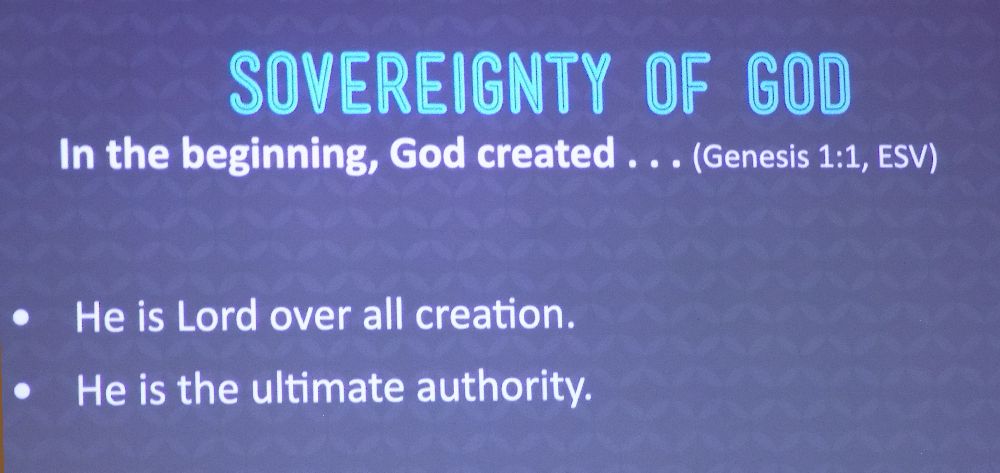
In one town, they saw Jesus perform a miracle, delivering the man from his legion of demons. Jesus demonstrated his sovereignty over creation, including the demons in the spiritual realm. The people saw, and rejected.
In another town, one woman’s testimony, a well-known immoral woman, seemed to have been changed. Her shame was gone, or at least diminished in the face of the incredible news that this man who told her all she ever (shamefully) did (but seemed to love her anyway), could be the Christ.
Source: Sychar. Earthly Footsteps of the Man of Galilee, 1894
Things to ponder:
1. Just because they witnessed a miracle does not mean that belief always follows. Some believed because of the signs (John 2:11, John 2:23, John 11:45). Others saw signs and miracles and did not believe (John 11:46).
2. Far from being dry, dusty, and unnecessary, doctrine leads one to faith and repentance. Doctrine is the act of teaching or that which is taught. “Doctrine is teaching imparted by an authoritative source.” (GotQuestions). Like the Bereans who consulted the word after hearing Paul, the townsmen of Sychar were open to hearing Jesus teach. They listened and heard. “And many more believed because of his word”.
3. Some in the same crowd or the same room or in the same family believe, and others don’t. That’s the way it always has been and always will be. Some wonder why that is when we all have free will. Our will isn’t as free as one thinks it is. Our will is a slave to sin, it’s bound. Belief comes when Jesus opens ears and eyes to see and repent, gives a spirit of repentance. He intervenes from outside of earth, outside of ourselves, from heaven and breaks the binding of our soul to sin by giving us the Holy Spirit. There is nothing in us that can awaken our dead soul. Picture Lazarus dead in grave cloths, awakened by the sovereign call of Jesus. That was a picture of God’s sovereign election of individuals to save whom He decided in eternity past to save, before history began. Did Lazarus have free will? Only to remain dead.
The Reformed view of election, known as unconditional election, means that God does not foresee an action or condition on our part that induces Him to save us. Rather, election rests on God’s sovereign decision to save whomever He is pleased to save. (Source: Ligonier, Tulip & Reformed Theology: Unconditional Election)
Two towns, Gadara and Sychar. Two individuals in the same family, the unconverted and the saved. One rejects and departs, one repents and believes. Continue to pray for those in unbelief.