Posted in discernment, Uncategorized

The Pharisees plotted to kill Him from that day

Jesus raised Lazarus from the dead. God’s glory showed through this magnificent sign, and many believed in Jesus from that day. (John 11:40, 45).

However, some of the Pharisees did not believe. Further, the sign inflamed their darkened and evil hearts, and they plotted to kill Jesus from that day.

First, note the two different reactions. These are the only two reactions to Jesus, ever. Ultimately there’s belief or hardening. Next, we read, Continue reading “The Pharisees plotted to kill Him from that day”

Posted in discernment, Uncategorized

Should we shut off our mind?

I saw tweet below posted by Joyce Meyer on Twitter. Someone had retweeted it with a comment correcting Mrs Meyer’s stance.

Joyce Meyer Verified account ‏@JoyceMeyer:

Sometimes we need to shut off our minds and pay attention to our heart. -Joyce

Meyer was asked by someone on her stream about the danger of listening to the heart, and she countered with a single verse of Psalm 51:6, and I post the verses before and after for context:

For I know my transgressions, and my sin is ever before me. 4Against you, you only, have I sinned and done what is evil in your sight, so that you may be justified in your words and blameless in your judgment. 5Behold, I was brought forth in iniquity, and in sin did my mother conceive me. 6Behold, you delight in truth in the inward being, and you teach me wisdom in the secret heart.

Continue reading “Should we shut off our mind?”

Posted in discernment, Uncategorized

Are you a Bible-thinking woman?

I’m just a regular church woman. I attend services consistently, I read my devotional Valley of Vision regularly, I read the Bible and I study it too. I listen to sermons online as I go through the week, and I pray, though not as often as I should.

When I’m in small group I try to be the elder model of the Titus 2 woman for the younger, and I do my best to submit to authority in spiritual life as well as secular.

I don’t hold special seminary degrees, though I take classes online when I can. I have a talent of writing I use for the Lord within the scope of the Spiritually delivered gifts (discernment and encouragement). I’m not trained in any exceptional way, and I’m mindful of that when I write and speak.

My heart is firmly locked in the battleground between true doctrine and false doctrine. I hate false doctrine. I hate anything that steals glory from Jesus, and false doctrine does that. I hate anything that draws women away from seeing the glory of Jesus, and false doctrine does that. Continue reading “Are you a Bible-thinking woman?”

Posted in discernment, Uncategorized

How dangerous are para-church women’s ministries?

Last week Jen Hatmaker, a popular writer who claims Christianity as her belief system, came out in full support of homosexual marriage. As a response. LifeWay, arguably America’s largest Christian bookseller, stopped selling Hatmaker’s books.

Also last week, virally popular blogger, recently divorced Glennon Doyle Melton, who claims Christianity as her belief system, came out as gay, announcing that she was dating a female soccer player.

So what? one may say. Who are these women anyway? There is a bigger story behind the Hatmaker debacle. Christianity Today published an article by Kate Shellnutt titled The Bigger Story Behind Jen Hatmaker. In it, we read:

Titles by Bible teachers Lysa TerKeurst, Priscilla Shirer, and Beth Moore regularly outsell new releases from pastors such as Max Lucado and T. D. Jakes, according to rankings from the Evangelical Christian Publishers Association. Bloggers such as Hatmaker and Ann Voskamp—with books popular enough to land on The New York Times bestseller lists—have triple as many Facebook followers as the biggest congregations in the biggest denomination in the country.

And we know the demographic that largely uses Facebook: women. And these ‘Bible teachers’ are influencing your girls, wives, women, sisters…etc. Worse, these ‘Bible teachers’ are not associated with any church. Pastor, do you ask the women in your flock who they are reading? You should.

Hannah Anderson was quoted in Shellnutt’s CT article because she has recently discussed this very issue in her podcast. Two women exchanged emails in a deeper follow up. Shellnutt asked Anderson the following- “What do you see as some of the pros and cons of having so much momentum around women’s ministry at a national level?” and Anderson’s answer is sobering,

Consider how few female evangelical leaders are visibly attached to an institution such as a church, seminary, or non-profit that did not grow up around their personality. Name a male leader like Rick Warren and you immediately think of Saddleback Church. Say Beth Moore or Ann Voskamp or Jen Hatmaker and most of us will draw a blank about which local church these women affiliate with. This is not to say that they aren’t connected, but their local church isn’t a visible or central a component to their public ministry. Hannah Anderson blog

I don’t lay the blame for the emergence of extra-church false teacher female ministries totally at the feet of the local church, nor do I agree that it’s because women ‘can’t find space’ at their church as mentioned below. Or, maybe it is, the discontented women who want leadership roles and step outside their church tor form organizations that will allow them to do that, such as Jennie Allen of IF:Gathering, and Christine Caine of Propel.

However, the fact is, if you think about the most popular national women’s ministries, they’re led by women who don’t seem attached to their own local church.

Being distanced from ecclesiastical institutions also means women’s ministry inadvertently becomes shaped by market forces. Nationally known female spiritual leaders are by-and-large entrepreneurs and most often, out of necessity. Because women struggle to find space in the established Church, they end up creating their own institutions, whether as collectives or around themselves. The latter is both fed by and feeds evangelical celebrity culture. Kate Shellnutt

I recommend the article by Hannah Anderson linked just above. It’s extremely well-written and laser focused on the issue of para-church female-led ministries being influenced by merchandising and that the reason they are so influenced is that they are unhitched from a church.

I’ve always said that if Jesus came back the first place he’d go today would be the Christian Bookseller’s Association…” RC Sproul, sermon “The Cleansing of the Temple”

Posted in discernment, Uncategorized

Mail Call: How can some good pastors be so off-track and not see doctrinal error in materials they use in church?

Occasionally I receive email or Facebook messages asking questions about various topics and issues within the faith. Here is a question I received recently, and it dovetails with an essay I’m preparing for tomorrow based on a verse in John 11.

3. How can a pastor who I believe loves Christ be so off track?

This question, which was from more than one person, revolved around pastors who are OK in the pulpit but allow false teachers to infiltrate Sunday School, Women’s Ministry, or the Youth group; or who recommend books or materials to their members that are less that solid.

There are many possible reasons. Here are a few I can think of.

One reason in answer to the question might be simply the pastor’s inattention and/or busyness. I remember a powerful sermon from about 4 years ago delivered by Pr. Jim Murphy of First Baptist of Johnson City NY in a sermon called “The Subtlety of Satan“. He repented on the pulpit and also charged his church to repent too. He said that he had allowed satan to get his tentacles on his congregation via the church library, the Sunday School, and the Women’s ministry (including Beth Moore materials.) He said he was protective of the pulpit but had been inattentive and too busy to guard those other areas and the devil had gotten in.

However, there is one critical difference between a false pastor and a true pastor who has simply become busy and inattentive. The true pastor will listen to your concerns and prayerfully consider them by checking against the Bible and with his elders. He would either teach you in all gentleness why you are in error, (2 Timothy 2:25, Galatians 5:23, Ephesians 4:2) or in all humility, accept what you’re saying and check it out for himself. A false pastor will become angry, and make accusations against you and blame you. Thankfully, if the cause of being off track is inattention, it does not last forever. Eventually the Spirit brings him to repentance, as Pastor Murphy powerfully and transparently showed us in his own life.

Another reason a pastor can be so off track is that he might be lazy. It’s easier to allow the ladies to continue in their Beth Moore study than it is to confront them and endure their lady-wrath. Or another way to be lazy is simply not check the materials his people are using and rely too much on the Sunday School Superintendent or Ladies Ministry leader to make these decisions. However, a good shepherd will remember he is responsible for the souls of all his sheep’s souls, and won’t over-rely for long.

If he is lazy, one way to check is by googling his sermon titles and key points of the sermon and find out if he is plagiarizing, that is, passing off his sermons as his own but they are really canned from some storehouse online somewhere. If he is lazy at the pulpit he will be lazy elsewhere, like not being diligent in vetting study materials for the women and Sunday School. Plagiarism by the way, isn’t a new problem. God charged the false prophets leaders of Israel thru prophet Jeremiah of plagiarism. It is the lazy way out.

Therefore, behold, I am against the prophets, declares the LORD, who steal my words from one another. (Jeremiah 23:30).

Sadly, one reason he could be off-track could be that he may not really be a believer. I’m very sorry to have to say this. We say it carefully and only as a last resort. The Bible is clear about how powerfully the false convert can mirror a real one. For one, Judas was living intimately with the disciples, and when Jesus said one of them will betray Him, not one disciple asked if it was Judas. They all asked if it could be themselves rather than Judas. (“Is it I?”) He had all the disciples well fooled. Philip baptized Simon the sorcerer, he had Philip fooled, but his dark heart was revealed later when Simon asked Peter to give him the Spirit for money. Demas walked with Paul and only betrayed his black heart when he left to go join the world. Demas had fooled Paul. So false converts can rise to even leadership positions, and fool all those who know them. For a while. Sin eventually shows itself, or there’s an eventual failure to bring fruit.

In any case, you look at your pastor or any believer over time. There are only two ways to go. The believer grows, is on the narrow path, and is developing fruit. Upward. The lost, false convert, even a false pastor, is on the broad path, goes downward, and develops thorns and thistles. The Holy Spirit in the true believer will NOT allow false doctrine to remain in that person for long. That’s why we look over time. Any person can make a mistake, even pastors. That’s OK, it happens. The key is the reaction by the pastor when he is respectfully asked about whatever it is concerning you. Hopefully he will make a course correction be repented of, and the pastor AND his flock grows because of his humble example. If not, then the Spirit is not in him.

If you see something of concern, first, pray. The Spirit’s ministry is to point to Christ. The Holy Spirit wants purity and truth. He is always working. So pray to Him for your pastor, and He will be the catalyst for the necessary changes in him…or you! In all things, submit to those who lead you and pray for them. Love is patient and love is kind (1 Corinthians 13:4-8)… As a matter of fact, before you go speak to your pastor about your concerns, Love your pastor this way-

Love is patient and kind; love does not envy or boast; it is not arrogant 5 or rude. It does not insist on its own way; it is not irritable or resentful; 6 it does not rejoice at wrongdoing, but rejoices with the truth. 7 Love bears all things, believes all things, hopes all things, endures all things.

Posted in discernment, Uncategorized

The Forgotten Victorian Craze for Collecting Seaweed, and other biblical thoughts on women’s roles

I subscribe to a funky and interesting magazine called Atlas Obscura. The daily digest presents articles about little known places and events from today or the past and brings new life to them. For example, did you know that all the NY City Public Libraries were built with apartments in them, so the caretaker could live on premises? This was to keep the coal stoves burning, which had to be stoked constantly. Photos of the now-defunct spaces intrigued me. The empty, roomy apartments in the most contested real estate locations fire up my imagination.

I read yesterday of a fad in Victorian times (that’s the period Queen Victoria reigned from 1837-1901). It was seaweed collecting. Natural history was a huge endeavor back then. As travel became easier (trains, steam ships) and missionaries went abroad, so did flora and fauna collectors. Carl Linnaeus’ work as a zoologist and botanist led to the creation of modern-day biological nomenclature for classifying organisms. This work has led to Linnaeus’ distinction as the father of taxonomy, says the Carl Linnaeus page. Charles Darwin’s Theory of Evolution also fueled interest in classifying and organizing the world around us.

As the Atlas Obscura reports,

Nineteenth century Britain was a hotbed of biological enthusiasm. “Natural history was absolutely huge,” says Dr. Stephen Hunt, a researcher in environmental humanities who works at the University of the West of England. Households filled up with painstakingly stuffed mammals and birds. So-called “gentlemen scientists” traveled the world drawing, describing, and collecting plants and animals. As railway networks grew, and labor advances led to more leisure time, ordinary citizens got in on the trend. Microscopes became more affordable, and collecting clubs popped up across Britain.

Ease of travel and new theories sparked an interest in the natural world and the Britons ambled over hill and dale, mountain and sea to collect, classify, draw, press, save, and discuss what they had collected.

One can easily imagine the draw toward the seashore, in Victorian times as now. When I was traveling on a sailboat, I collected shells. I organized them in a fishing tackle box according to the taxonomy outlined by Linnaeus. It was fun to try and organize the world. It was interesting to connect to the sea creatures around me. Shells are fascinating and beautiful, and for the budding botanist, I suppose their fascination with the plant world equaled mine of the sea.

In Victorian times, the beach-going women wore their multiple layers of wool skirts to the ankle, parasols overhead, mincing delicately along the wavelets lest a female should fall and expose something, like a shinbone or that most enticing of cartilage, the kneecap.

The reason that there was not a Victorian-era craze of women collecting seashells or plants and only of seaweed collecting, is because of sex. Atlas Obscura continues,

Women, though, were still largely left out. The biggest natural history clubs of all, the Royal Society and the Linnaean Society, refused female members, and barred women even from their “public” meetings. Hunting animals was too dangerous, and digging up plants was, well, too sexy. “There was a taboo on botany, because Linnaean botany was based on the sexual parts,” says Hunt. “That was seen as controversial.”

The excessive prudishness and rigid, Pharisee-like adherence to gender roles (especially for women) of the Victorian era was a pendulum swinging response to the loose morals and licentiousness of the Regency period immediately prior to Queen Victoria’s ascension to the throne. Cultural prohibitions against women collecting flowers because they might be unduly stirred by a stamen … seems excessive.

That is precisely why we don’t look to the culture for guidance as to male and female roles. The old chestnut that ‘back in Bible days women were regarded as chattel’ and ‘we have made advances in culture and societal understanding’ does not hold true. Liberals say, ‘Women can and should teach in church and even be pastors, not like in those dim old days.

We have a mere 70 or 80 yer life span on average. Sometimes it’s much shorter. We have no long-term cultural memory. We are too deeply involved in society to be able to have any sort of objective perspective on changing times, shifting morals, or what is considered a normal cultural standard.

After the Victorian era came the short Edwardian period, then the flappers, higher hemlines, women entering the workforce as secretaries, telephone operators, and nurses. The pendulum had swung again. Cultural changes happen more often and more rapidly than we think. In the United States, it only took 15 short years for all 50 states to change the high and narrow standard for allowing divorce to a no-fault, EZ, anytime divorce. That’s lighting fast.

God is called the Ancient of Days. He alone has the high perspective of us humans. He alone has the invention of time itself in His hand. He knows what we believers need. He instituted roles for men and women, youths and elders. He set the qualifications of deacons and pastors. He inspired scripture urging fathers and mothers to perform their respective roles. There are no cultural reasons for allowing women to teach in the structure of church and no cultural reasons for men to abdicate leading in the structure of the church. There are only biblical reasons and Godly standards. God’s standards are always best.

I do not permit a woman to teach or to exercise authority over a man; rather, she is to remain quiet. (1 Timothy 2:12).

Now go collect some plants and shells, you never know when the pendulum will swing the other way and those activities will be seen as too salacious. 😉

Posted in encouragement, Uncategorized

From unclean to pure lips

Do you ever feel like such a terrible sinner that the very words of repentance and sorrow pouring from your lips in prayer to heaven is a blot on the name of Jesus?

But the tax collector, standing far off, would not even lift up his eyes to heaven, but beat his breast, saying, ‘God, be merciful to me, a sinner!’ (Luke 18:13)

I can relate to Isaiah (the lips part, not actually seeing the LORD!)

And I said: “Woe is me! For I am lost; for I am a man of unclean lips, and I dwell in the midst of a people of unclean lips; for my eyes have seen the King, the LORD of hosts!” (Isaiah 6:5).

But then in His Day He will purify our lips and when we praise Him we will be clean! Imagine praising Him from pure lips!

Then I will purify the lips of the peoples, that all of them may call on the name of the LORD and serve him shoulder to shoulder”. (Zephaniah 3:9 NIV)

Posted in movie review, Uncategorized

The River Thief: A movie review

Source

A new movie starring Joel Courtney, Raleigh Cain, and Tommy Cash, (Johnny’s brother), called The River Thief is out in selected theaters. It is being billed as a faith based movie, or a Christian movie.

For what is being said is a faith movie, it’s an unusual one, to be sure. However in my opinion it is far from being anything remotely Christian. It’s more of a freshman entry of an action movie from writer/director ND Wilson than it is anything faith-based.

The film focuses on a youth named Diz (Courtney) who drifts from town to town along the Snake River in Idaho, stealing to survive and also just for the fun of it because he’s good at it. He calls himself Diz, and though it’s never explicitly stated, we surmise the namesake is from St. Dismas. In Catholic tradition, St. Dismas was the name of the Penitent Thief on the Cross. Diz is a motherless boy turned drifter and thief whose father left before he was born. He is on his own, great at stealing, but now wanting a change in his life and haphazardly trying to find his long-lost dad as he goes from town to town.

Diz slows down and remains in and around one particular nameless town along the river, struck by the waitress in the local diner. Diz had racked up a $30 bill and snuck out without paying, the spitfire waitress named Selah (Raeleigh) chases after him and gives him a piece of her mind. Her granddad Marty (Cash) reaches out to Diz, paying his bill and inviting him to dinner at the house he shares with Selah.

During the course of events, Diz also unfortunately steals a million dollars in drug money from two men, one the town’s bad cop, the other named Clyde, who works for the Sinaloa Cartel. Diz clumsily attempts to woo Selah, fend off vague spiritual approaches by Marty, and survive the vicious intent of the bad guys to catch and skin Diz for making off with their million dollars. It all comes to a surprising conclusion and the credits roll with a voiceover.

First, the pros:

Lead actor Joel Courtney is a wonderful, natural actor. He was in Super 8 and his acting was well-received. Tommy Cash is the grandfather who is a little less a natural actor but is warm and sincere and generally seen as a good man by even the evil men. Marty rings true in the movie. Selah is spunky, bordering on angry-bitter. While her character is less developed and more perplexing, she has flashes of natural acting in several scenes as well.

The cinematography is stunning. The look of this movie is a stark beauty which bespeaks hopelessness and hope both at the same time. The aerial shots as well as the scenes by the river are tremendous. The opening scenes with cat burgling Diz deftly lifting valuables from one and all along the river, even boats anchored in the middle of it, are tense and well executed. Just the opening scenes with little to no voice acting give insight into the thieving character that promises to plumb depths … which are sadly never attained.

Cons

For a “Christian” movie, there is a high body count. Six people are killed at point blank range in the film, quite a lot for an 87 minute movie. There is also profanity, light and sparsely uttered, but it’s there.

The grandfather, Marty, sings a few verses of Will the Circle be Unbroken, but there are no church scenes, church is not mentioned, and either is prayer mentioned or seen. Jesus is only mentioned once, when Marty said “Jesus gave me a thief…” . The Gospel is not given. Once Marty said to the bad guy, “you picked the wrong side”. There are no bible verses spoken that I can remember, but instead, homilies imbued with a sense of importance as if they were verses. There are only vague references to Someone who created Diz, (Who gave you those hands? Those eyes?). The boy wants a change in his thieving life and the best the grandfather can say is that it is “gratitude that sets you free.”

No. It is not. Repentance and faith in Jesus is what sets you free.

The climactic scene in which we would expect the Gospel to be given, instead is a disappointment. All the Grandfather said was “Can you hear the angels singing?” as he looks beatifically at the ceiling.

One reviewer on IMDB said,

This movie is advertised as a Christian movie, but, other than some random Bible verses quoted a few times by one of the older gentlemen in the movie, there wasn’t much to identify it as such.

Lol, and they weren’t even Bible verses, but platitudes, delivered with solemn gravity to make them seem Bible-ish.

The initial promise of the film to be a gritty action film are never realized as the film lurches from interesting scene to interesting scene with halts and perplexing segues in between. The initial promise of the film to be a redemptive character study within the context of the Christian faith are also sadly never realized either.

This reviewer said it well: (SPOILERS!)

One of the great virtues of The River Thief is an atmosphere of deeper significance which attends one scene after another— or, what poet Robert Wrigley referred to as the “air of meaning more” in a class I took from him back in college. The “air of meaning more” is that hard-to-pin-down quality of ineffable suggestiveness which emerges from referencing the right objects, the right names, the right places, and using the right words. The “air of meaning more” is the sensation that there is something behind a closed door, even if it is never opened…. However, a few moments later, as a dead Diz speaks to us from the Resurrection of the Righteous, I had to wonder whence came the salvation of this character?

Simply using a voiceover with lyrical scenes of a stark landscape do not make the Gospel. The Gospel makes the Gospel clear. The ‘air of meaning more’ in the end lets us down and the whole movie means less than it ought.

I do not recommend it.
Posted in discernment, Uncategorized

Discernment Case in point: Glennon Doyle Melton comes out as gay

Two and a half years ago, in spring of 2014, I wrote about a popular blogger and author named Glennon Doyle Melton. Melton’s blog called Momastery boasted 70,000 views per day, hordes of followers calling themselves ‘Monkees’, and a fan base for her books most bloggers only dream of. Melton’s influence in the mom world and faith world cannot be overestimated. The Houston Chronicle wrote of Melton this past September,

The world can be divided into two groups: those who’ve never heard the name Glennon Doyle Melton, and those who know pretty much everything there is to know about her. … The number of people who know these things about Doyle Melton is not insignificant. She’s a writer whose publicity team estimates that her blog and social media posts reach 7 million readers a week. And that camp is about to get a lot bigger. [with the upcoming release of her new book]

To millions of women, Melton was THE Christian example.

Continue reading “Discernment Case in point: Glennon Doyle Melton comes out as gay”

Posted in poetry, Uncategorized

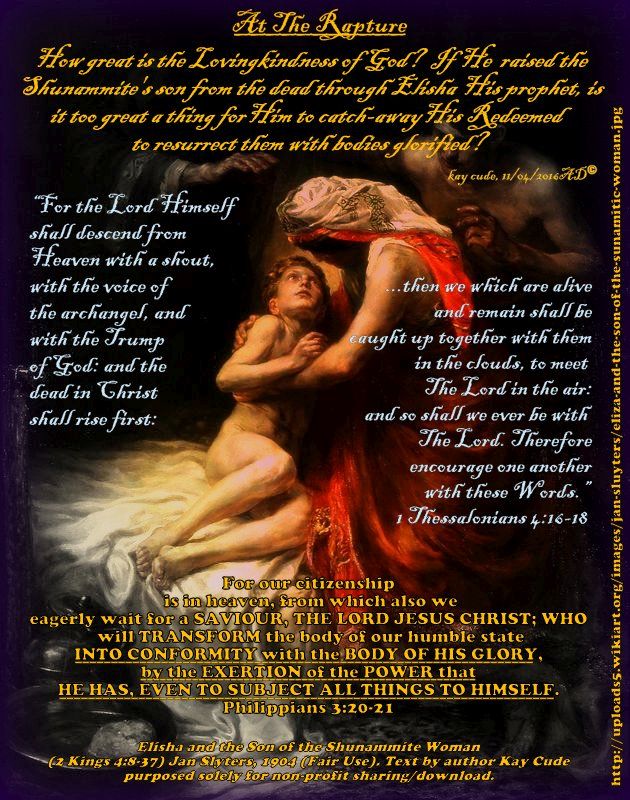
Kay Cude Poetry: At The Rapture

Kay Cude poetry. Click to enlarge. Used with permission.

Artist’s Statement:

I was deeply drawn to this painting because of the look on the face of the child clutched out of death into the arms of his beloved mother. I see peace mixed in with awe as he looks into the face of one who has nurtured him since birth; the face of the one he is so grateful to see. I am reminded of the nurturing love of the Father and Son for Their beloved redeemed; perhaps we will have that same look upon our faces as we look into the glorious and wonderful face of Christ Jesus at the Rapture.