Kay Cude poetry, click to enlarge. Used with permission
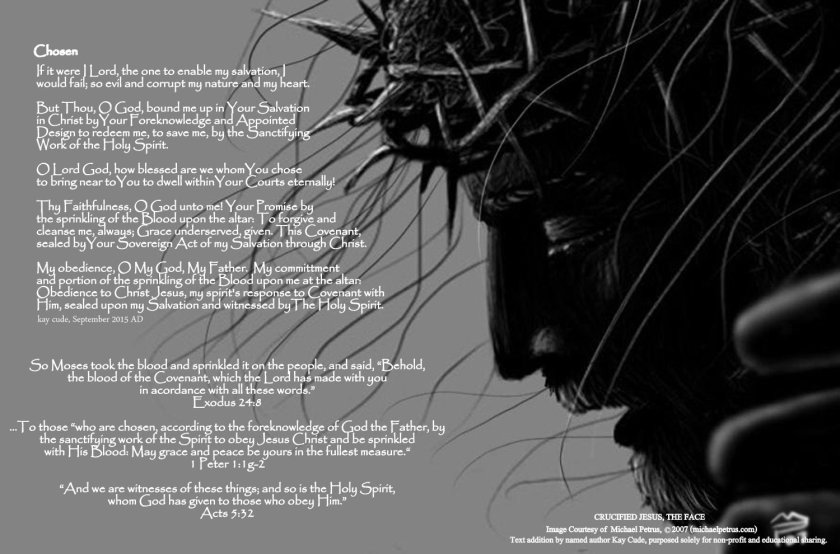
Kay Cude poetry, click to enlarge. Used with permission
I like natural history. It’s God’s creation. I like thinking about how He has created everything from nothing with just a word. I see the intricacy of His creatures and flora and fauna and I’m just amazed. But reading natural history books is a two-edged sword. Most are written from a secular point of view, and at some point the pricks of the constant lies within such books grate, and I abandon the endeavor.
Only to try again later, lol.
I wrote recently about the Victorian craze for seaweed collecting. This was a craze in which mostly women who were constrained by cultural pressure not to collect the more seductive looking plants participated. It was based on an original article at Atlas Obscura, which is a secular magazine. My article was to look at the issue through a biblical lens.
One of the natural history books mentioned in the Atlas Obscura article was a seaweed journal by Margaret Gatty. AO wrote of her,
One of the best known and most dedicated of these so-called seaweeders was Margaret Gatty, a children’s book author who took up the hobby while convalescing in Hastings, on Britain’s southeast coast, in 1848. Gatty’s crowning work of algology, British Sea-Weeds, is an exhaustive compilation of local seaweeds, fully described and illustrated in 86 colored plates.
These are selected plates of her seaweed drawings,
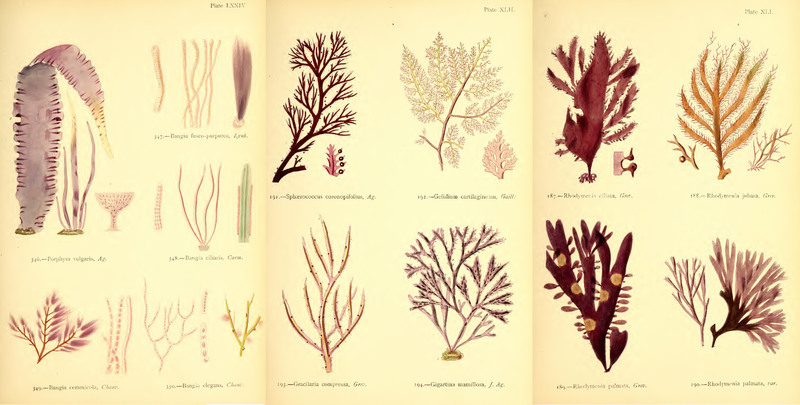 |
Selected plates from Margaret Gatty’s “British Sea-Weeds.” BIODIVERSITY HERITAGE LIBRARY/PUBLIC DOMAIN
I love those colored plates from natural history books from the 1800s. I own two rare books,
A popular history of the mollusca : comprising a familiar account of their classification, instincts and habits and of the growth and distinguishing characters of their shells, by Mary Roberts, 1851; and
Popular British conchology. A familiar history of the molluscs inhabiting the British Isles, By George Brettingham Sowerby, 1854.
I love the hand colored plates of the plants or animals they carefully drew. I also have several books by Harvard University paleontologist Stephen Jay Gould (secular guy, sigh). There’s French poet-philosopher Paul Valery in his engaging meditation on the aesthetics of the seashell, as Amazon describes his work. Anne Morrow Lindbergh’s musings on shells in her famous Gift from the Sea. And so many other books. I guess now that I’m thinking of listing them, my library contains quite a few natural history books. Rachel Carson, Farley Mowat, John Hay, Abbot & Dance…
In this article I enjoyed from the New York Times Review of Books, I learned from this article “What the Trees Say,”
In 1664 John Evelyn, diarist, country gentleman, and commissioner at the court of Charles II, produced his monumental book on trees: Sylva, or a Discourse of Forest Trees. It was a seventeenth-century best seller. Evelyn was a true son of the Renaissance. His book is learned and witty and practical and passionate all by turns. No later book on trees has ever had such an impact on the British public.
I love trees. Maybe I’ll get that book. Hmmm. Maybe you’ll get those books.
As much as I love reading about the creation from scientists of various kinds, there’s nothing like reading the Bible, God’s actual account of His world. As poetic as Lindbergh was, as witty as John Evelyn was, as precise as Sowerby or Roberts was, the thrill of reading about the creation from God Himself never fails to thrill me. As familiar as these verses are, they still ignite a reverent awe at His power:
In the beginning, God created the heavens and the earth. 2The earth was without form and void, and darkness was over the face of the deep. And the Spirit of God was hovering over the face of the waters.
3And God said, “Let there be light,” and there was light. 4And God saw that the light was good. And God separated the light from the darkness. 5God called the light Day, and the darkness he called Night. And there was evening and there was morning, the first day.
6And God said, “Let there be an expanse in the midst of the waters, and let it separate the waters from the waters.” 7And God madeb the expanse and separated the waters that were under the expanse from the waters that were above the expanse. And it was so. 8And God called the expanse Heaven. And there was evening and there was morning, the second day. (Genesis 1:1-8)
Nature displays God’s glory. The best place to read about that is His word, what He, Himself, has declared.
Let the heavens rejoice, let the earth be glad; let the sea resound, and all that is in it. Let the fields be jubilant, and everything in them; let all the trees of the forest sing for joy. (Psalm 96:11-12)
We are glad because as Job 12:10 says,
In his hand is the life of every creature and the breath of all mankind.
Is there any better place to be, if you’re saved? In His hand? Is there any worse place to be, if you’re not saved?
It is a fearful thing to fall into the hands of the living God. (Hebrews 10:31)
Let’s compare some statements of kings in the Bible who spoke offensively.
and the king answered and said, “Is not this great Babylon, which I have built by my mighty power as a royal residence and for the glory of my majesty?” ~ King Nebuchadnezzar, Daniel 4:30.
Grabbing God’s glory is never good. In Nebuchadnezzar’s case, the Lord gave him a declaration that his sovereignty had already been stripped from him even as Nebuchadnezzar’s words were still in his mouth. God said Nebuchadnezzar would be driven from mankind and live like a beast eating grass for 7 years. God was gracious to Nebuchadnezzar, because the time of beast-like living and insanity only lasted 7 years and when Nebuchadnezzar came out of it, he repented and gave God the glory for everything under the sun.
This next one is King Herod.
On the appointed day, Herod donned his royal robes, sat on his throne, and addressed the people. And they began to shout, “This is the voice of a god, not a man!” Immediately, because Herod did not give glory to God, an angel of the Lord struck him down, and he was eaten by worms and died. (Acts 12:21-23).
In this second case where someone was stealing God’s glory, God employed His perfect judgment upon Herod, and did not allow him to repent. Herod was killed immediately for speaking like a god in God’s place. Grabbing His glory is never good.
This third case is a modern one. It’s Perry Noble. Noble was the pastor of the largest church in the Southern Baptist Convention, NewSpring Church, located in Anderson, SC. He was fired for alcohol abuse, Perry’s posture towards marriage, other unnamed behaviors, and a refusal to be corrected. Since his firing, it turns out in news this week that Noble has decided to become a church consultant. He issued a letter explaining this, and in the letter he outlined his skills.
“What separates you from other church consultants,” you ask.
Simple – I’ve actually planted and built a great church
The Bible says something about planting and growing-
So neither he who plants nor he who waters is anything, but only God who gives the growth. (1 Corinthians 3:7).
God surely is gracious. Noble is receiving a reprieve so far, because he has not been turned into a grass eating beast nor has he become a worm-eaten sack of flesh. But remember, grabbing God’s glory is never a good thing.
For, “In just a very while little, He who is coming will come and will not delay.” (Hebrews 10:37)
———————————————-
Further Reading
Occasionally I receive email, blog comments, or Facebook messages asking questions about various topics and issues within the faith. Here is a question I received recently about false teachers and the people who follow them.
Q. Are they truly deceived and cannot bear to hear any disagreement about the theology of their beloved [false] teacher?
A. The scriptures say that in the latter days (now) “For the time is coming when people will not endure sound teaching, but having itching ears they will accumulate for themselves teachers to suit their own passions,” 2 Timothy 4:3.
Note the action here. The false teachers are not accumulating followers. It’s the believers who go out and heap up false teachers for themselves! These false teachers like Joyce Meyer or Beth Moore would not exist if they had no followers (because there would be no money- the Bible’s explanation for the reason false teachers go into the false teaching business). The people who heap up these false teachers cannot endure sound teaching. It’s that simple. There is some sin in them that clings to what the false teacher is offering that will not allow them to endure the full truth.
When the false teacher’s aberrant theology is pointed out to the follower, the follower shrinks back in anger and defensiveness, the need to protect their pet false teacher rising hard and fast in their darkened heart. We will go to great lengths to protect our sin.
This good quote from Tom Ascol is the antidote for falling into the sin of heaping up a false teacher:
Mature Christians are those whose lives are marked by such stability that they are not easily led astray by teachings and practices that are contrary to the Word of God. On the contrary, mature believers are “growing up in every way” into Christ. —Tom Ascol in Tabletalk Magazine
The way to avoid being tossed by every wind of doctrine and landing in partnership with a false teacher in the sin-dance is to stay grounded in the Word. Read it, study it, and meditate on it.
Charles Spurgeon had some things to say about the false teachers-
He who does not hate the false does not love the true; and he to whom it is all the same whether it be God’s word or man’s, is himself unrenewed at heart. . . . substituting for honest manliness a mass of the tremulous jelly of mutual flattery.
Oh, if some of you were like your fathers you would not have tolerated in this age the wagon loads of trash under which the gospel has been of late buried by ministers of your own choosing. You would have hurled out of your pulpits the men who are enemies to the fundamental doctrines of your churches, and yet are crafty enough to become your pastors and undermine the faith of a fickle and superficial generation. I cannot endure false doctrine, however neatly it may be put before me. Would you have me eat poisoned meat because the dish is of the choicest ware? It makes me indignant when I hear another gospel put before the people with enticing words, by men who would fain make merchandise of souls; and I marvel at those who have soft words for such deceivers.
~Charles Spurgeon, sermon “Under Constraint,” 1878.

God is many things. His attributes are infinite. We know that God is love. Did you know that “God is light” too?
See the verse.
This is the message we have heard from him and proclaim to you, that God is light, and in him is no darkness at all. (1 John 1:5).
I like thinking of Jesus as Light. It’s one of my favorite ways to think of Him. I use a lighthouse quite often in my blog banners and avatars.
God is light. What does that mean? We know what it means on a surface level. We understand and can read the words on the page. It’s easy enough to understand the fact of the sentence. But what does it mean, spiritually? How can it inform me of His attributes and increase my knowledge of Him so I can love Him more and worship Him properly?
The word light in this verse is from a Greek word meaning phós. Strong’s Concordance says it is defined this way-
in the NT, the manifestation of God’s self-existent life; divine illumination to reveal and impart life, through Christ.
When were saved, our citizenship transfers, from being children of darkness to children of the Light. (1 Thessalonians 5:5). Light does reveal, doesn’t it? It reveals all. What glorious light He is!
God is light—What light is in the natural world, that God, the source of even material light, is in the spiritual, the fountain of wisdom, purity, beauty, joy, and glory. As all material life and growth depends on light, so all spiritual life and growth depends on GOD. As God here, so Christ, in 1 Jn 2:8, is called “the true light.” Jamieson, R., Fausset, A. R., & Brown, D. Commentary Critical and Explanatory on the Whole Bible
How are we women to love Jesus? What is the nature of our love to our Savior? Or even of His love to us corporately and individually? Are there different kinds of love?
There are different kinds of love. In English, we use the word love in many ways, but it’s still the word love. I love ice cream. I love a short commute. I love my sister. I love my husband. I love Jesus.
In the Greek however, the language of the New Testament, there are different words to express different kinds of love. There is agápe, éros, philía, and storgē.
Storge is used in the Greek to indicate a strong familial affection. I love my family, Also, I love my country. Storge is not in the Bible.
Philia was famously used by Peter in his response to Jesus when Jesus asked Peter, “Do you love me?” (John 21:15-16). Philia is a kind of strong brotherly affection. It’s where the word Philadelphia comes from. When Jesus asked Peter if Peter loved Jesus, using the word agape, Peter (ashamed) persistently used the word philia in reply.
Agape love is used in the Bible several times and it an important version of the word. Agape means love but when it’s used in the Bible it specifically means a love from God, defined by God. It is the very nature of God, “God is [agape] love”. (1 John 4:8). Agape is a sacrificial love. It’s the kind of love displayed by the Good Samaritan to the beaten and robbed man in the road. It’s the kind of love we’re called upon to love our enemies with, by the way. (Matthew 5:44). It’s God’s love, holy and good.
Eros is a sexual love, or at the very least, an intimate physical love. It’s a fleshly sensual love.
I’ve written about the romaticizing Jesus movement. This is a movement where a female “Bible teacher” teaches or sings or speaks about a Jesus where we have intimacy with Him. These women use language to indicate physical activity with Jesus is part of our normal relationship with Him. These women have taken the concept of love and twisted it. They have stretched the metaphorical biblical language in the Bible of Bride (church) and Groom (Jesus) into realms where the actual marital bedroom benefits with an actual husband on earth are also part of our heavenly relationship with Jesus.
Ladies, this should not be.
“While it is true that the Bible utilizes images of marriage to parallel Christ’s relationship to the church, two things must be taken into account. Firstly, Christ relates to the church as a collective unit. He is married to the community as a whole and not to billions of individuals who claim to serve him–he is not a polygamist. Secondly, the love Christ shares with his church is not defined by the Greek term “eros” from which the English word “erotic” is derived, but is expressed with the noun “agape” (pronounced ah-gah-pay) which denotes love demonstrated in deeds. Those who view themselves as children of God are not called to exercise eros but agape; they are not invited to brief episodes of self gratifying sexual intimacy but to a lifetime of social and spiritual interaction.” (Spectrum Magazine)
The word eros is the kind of love to Jesus and from Jesus these female teachers write about. I could post many examples from popular female “Bible teachers” who constantly express this kind of love in their lessons, or who describe their relationship with Jesus in this way, but I won’t. You know what I’m talking about.
The word eros is not in the Bible. Not once. This erotic kind of love between a woman and her husband is fine and biblical. It’s implied for example in Paul’s missive to husbands and wives in 1 Corinthians 7. Yet even when Paul alludes to marital bedroom activity however, he never uses the word eros.
So for a teacher to use the word eros between women and her Savior is not biblical at all.
Ladies, when you hear a Bible teacher saying we love Jesus like a boyfriend, we are being enfolded in His arms, and worse things relating to our body, you know this woman is not teaching rightly. She cannot be rightly dividing the word of truth when she discusses physical intimate love to & from the Savior because that kind of love is not in the Bible. So where would she be getting this aspect of love from? Her flesh. False teachers always appeal to the flesh.
But false prophets also arose among the people, just as there will be false teachers among you, who will secretly bring in destructive heresies, even denying the Master who bought them, bringing upon themselves swift destruction. 2 And many will follow their sensuality, and because of them the way of truth will be blasphemed. (2 Peter 2:1-2).
We see so often depicted in this lyric by Kelly Carpenter and many other woman teachers a Jesus depicted romantically, but it’s false.
You are my desire, no one else will do
‘Cause nothing else could take your place
To feel the warmth of your embrace
Kelly Carpenter – “Draw Me Close”
As a final thought, ladies, we can know Jesus through His word and learn of His many and infinite attributes through study of it. His character is endlessly fascinating, and it’s deeply satisfying to ponder His attributes. Why add an attribute to our relationship with Him that does not exist? We have enough in Him already. His grace alone is sufficient. He is wonderful and true and good. He is not our lover and He is not our boyfriend. He is not our cheerleader. He is the Ancient of Days, come to take His seat and make the earth His footstool! He is-
the firstborn from the dead, and the ruler of the kings of the earth. (Revelation 1:5)
the first and the last, who died and came to life (Revelation 2:8)
the Son of God, who has eyes like a flame of fire, and whose feet are like burnished bronze. (Revelation 2:18).
The moment you hear or read of a singer or teacher speaking of Jesus is this eros way, now you know to avoid her immediately, and why. It’s simply not biblical.
~~~~~~~~~~~~~~~~~~~~~~~~~~~~~~~~
Further reading:
Sisters, Jesus is not your cheerleader
Toning down the truth of Jesus to make him more palatable actually does the opposite—he loses all richness of flavor and becomes a bland imitation. . . . The news we get to share is so much better than ‘You’re okay, I’m okay.’
If we eroticize God, we may end up worshiping a buddy/boyfriend who bears little resemblance to the King of Kings and Lord of Lords. As Nichole Nordeman said so aptly in song, “Let me not forget to tremble.”
Romance with Jesus: the Bigger Picture
A common thread here is relating to or experiencing Jesus in a specific way, through the imagination or imagery of romance whether based on human relationships or subjective, mystical ecstasy in the mind. This places a human idea on a pedestal and exchanges something glorious for something dull. Human romance may seem wonderful when it’s between a man and woman, and it is. But should it be our model for relating to God? Last time (and every time) I checked, the Bible doesn’t say, “Women, love Jesus as wives romantically relate to their husbands or as girlfriends romantically relate to their boyfriends.”
Let’s think about this verse today:
And when the Pharisees heard that Jesus had silenced the Sadducees, they themselves gathered together. One of them, an expert in the law, tested Him with a question: “Teacher, which commandment is the greatest in the Law?” (Matthew 22:34-36).
This lawyer was an expert not in civil law, but in religious law. By that time of Jesus’ incarnation, there had been added to the original ten, 603 laws. The Jews were laboring under a heavy yoke of an expectation to keep 613 laws.
Here is a website with which I’m not familiar, but lists a simple version of all 613 laws with their scripture. Continue reading “The Lawyer tested Him on the Law”
My next eBook in the series ‘In Grace’, the book “Prophecy In Grace”, is available for purchase at the Amazon Kindle store! So excited! Here is the summary:
Almost a third of the Bible is prophecy, and though some of it is fulfilled, much of remaining prophecy is unfulfilled. What is to come? Can we know the future? What did Jesus say will happen? Is prophecy too complicated to understand? This book contains essays explaining the future history of believers and non-believers alike. What is the Rapture? Does Israel have a future? What about the nation of Egypt? Jordan? What about the timing of prophesied events? The author uses proper interpretation, scripture and commentaries from noted theologians to explain answers to these questions and more. Prophecy is the ultimate encouragement because it demonstrates the faithfulness of Jesus and His sovereign control over all things, including the history of man.

Also available is the first book in the series, Encouragement In Grace. It’s at the Amazon Kindle store here.
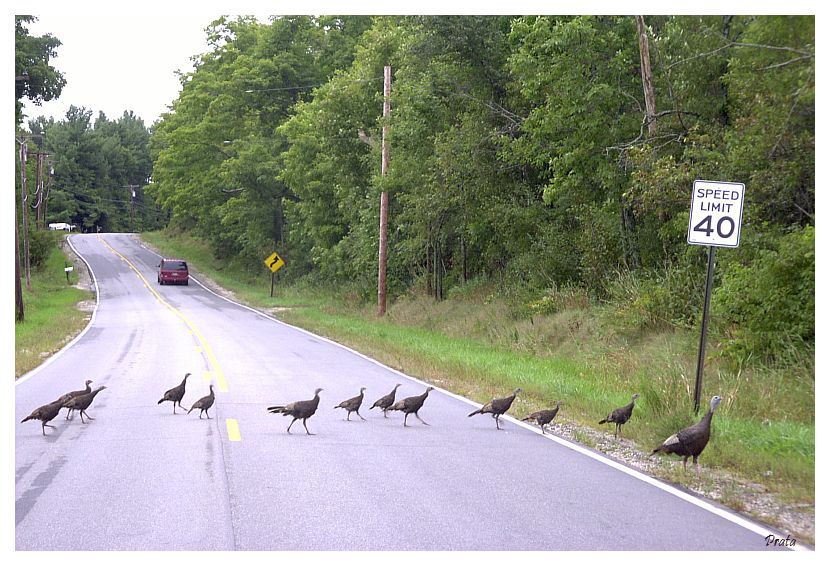
Why did the turkey cross the road?
To prove he wasn’t chicken!
Enjoy your meal, breaking bread with friends and family.

For 43 years I rebelled against Christ, and He plucked me from my mire and saved me anyway. Today I’m thankful for grace.

Happy Thanksgiving everyone. I hope your travel goes smoothly, your meal is delicious, and your family is tame.
Kay Cude poetry. Used with permission. Click to enlarge
Artist’s statement:
The beginnings of a trial can be tumultuous and heart-wrenching, as well as physically and emotionally exhausting. But as we seek Scriptural guidance and encouragement from fellow believers, we quickly see that all of our communication and advice must center upon Christ and our personal relationship with Him. It is when one relies upon “other” solutions (or self), that one quickly experiences the futility of our “natural” reasoning and responses. When our trials exclude Christ as the resource of resolution, fleshly reactions will lead us into deeper distress with greater turmoil; an impasse can arise and anger, hurt feelings, confusion and chaos usually pursue.
I don’t like painful trials; I don’t know anyone who does. Yet I am so very grateful that Christ captures my attention during those times and makes it abundantly clear that He is the only source who can truly sustain, teach, discipline and encourage me while He refines and strengthens me, in and for Him. It is Christ who must always be the primary topic during our trials, because without the working of His indwelling spirit, our words and actions become futile.

 the-end-time.org