Posted in encouragement, Uncategorized

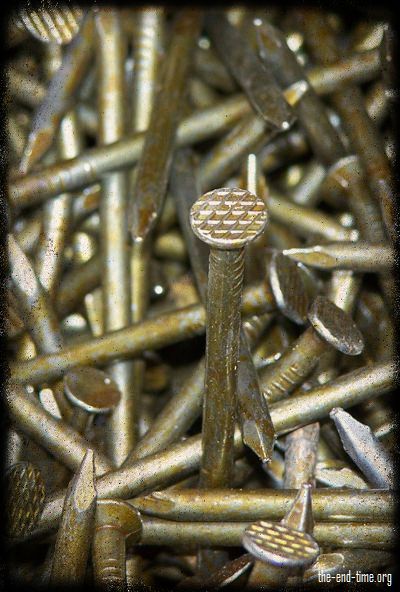
What’s in your pocket? Lists? Or nails?

We are sinners. The Syro-Phoenician woman knew that. (Mark 7:26). The Tax Collector in the temple knew that. (Luke 18:13). Mary knew that. (Luke 1:46). We know we are sinners.

No one believes in Jesus Christ the savior unless they see a need in Him. Martyn Lloyd Jones, sermon Isaiah 1:10, Repentance and Salvation.

Before we are saved, we are blind to our sin. After the Lord graciously gives us the ability to see ourselves as we are, the scales having fallen off our eyes so to speak, (Acts 9:17-18), we repent of our sins. But that does not mean we stop sinning. We have the Power to resist sin thanks to the Holy Spirit in us, but we still sin. (Matthew 16:24). We will continue to sin until we are glorified.

Legalists like the Pharisees to whom Jesus contrasted the Tax Collector, believed they would attain heaven by their good works. This belief is not expired. People believe it to this day. If you watch street pastors Ray Comfort or Todd Friel, when they ask people on the street if they expect to get to heaven and how, the people always respond that they are a good person doing good things so surely they will go to heaven.

We ourselves are Jews by birth and not Gentile sinners; yet we know that a person is not justified by works of the law but through faith in Jesus Christ, so we also have believed in Christ Jesus, in order to be justified by faith in Christ and not by works of the law, because by works of the law no one will be justified. Are you so foolish? (Galatians 2:15-16)

After we are saved, however, we still have a tendency to give in to our to our sinful nature. We can easily start to believe satan’s propaganda that we earn God’s regard by doing good things, that we maintain our salvation by doing good works. Or we start to make lists of the things we must do to preserve our good name before the Lord. Paul addressed this in Galatians 3:3, asking rhetorically,

Having begun by the Spirit, are you now being perfected by the flesh?

John MacArthur said of the verse,

The notion that sinful, weak human nature could improve on the saving work of the Holy Spirit was ludicrous.

We should always remember that it is by grace through faith that we have been saved, not by works. After salvation, the good works that we do are an inevitable result of our gratitude for this great gift, and it is the proof of the existence of the new creature. But our works do not save us and they do not add to the preservation of our salvation. Martin Luther said,

We all carry about in our pockets His very nails.

Erik Raymond at The Gospel Coalition succinctly said,

Legalists keep lists in their pockets, while Christians keep nails.

What’s in your pocket today? Lists? Or nails?

Posted in encouragement, Uncategorized

Here I raise my Ebenezer

We sing the hymn Come Thou Fount of Every Blessing at our church. Hopefully you do as well. It is a beautiful hymn written in 1757 by Robert Robinson. Here are the original lyrics from the first two of five stanzas. Some hymn books have updated it to modern language but I like the original.

Come, Thou Fount of every blessing,
Tune my heart to sing Thy grace;
Streams of mercy, never ceasing,
Call for songs of loudest praise.
Teach me some melodious sonnet,
Sung by flaming tongues above.
Praise the mount, I’m fixed upon it,
Mount of Thy redeeming love.

Sorrowing I shall be in spirit,
Till released from flesh and sin,
Yet from what I do inherit,
Here Thy praises I’ll begin;
Here I raise my Ebenezer;
Here by Thy great help I’ve come;
And I hope, by Thy good pleasure,
Safely to arrive at home.

What is an Ebenezer? Our church had put an explanation in a box at the bottom of the bulletin, which was helpful. We should know what we are singing. Words matter. When we sing in church, or pray, or listen to the sermon, we are meeting with God, eating at His table. We should know what we are about and be mindful of the things we say or do or read or sing.

The phrase comes from 1 Samuel 7:12. Here’s the verse:

Then Samuel took a stone and set it up between Mizpah and Shen and called its name Ebenezer; for he said, “Till now the Lord has helped us.”

In the first narrative (1 Samuel 4:1-11 ), the Philistines defeat the Israelites, even though the Israelites brought the Ark of the Covenant onto the battlefield in hope of it bringing them a divinely assured victory. As a result of the Philistine victory and the Ark’s presence on the battlefield, it was captured by the Philistines, and not returned until many months later (1 Samuel 6:1-2).

In the second narrative (1 Samuel 7:2-14 ), the Israelites defeat the Philistines, after Samuel has offered a sacrifice. Samuel puts up a stone in memorial and names it Eben-Ezer (the placename in the previous narrative resulting from this). This monument is referred to in the hymn Come Thou Fount of Every Blessing. (Source)

The Lexham Bible Dictionary also explains-

EBENEZER 

“The stone of help” that Samuel set up to commemorate a great victory over the Philistines (1 Sam 7:12). Also the name of the place where the Philistines defeated Israel and captured the ark of the covenant (1 Sam 4:1; 5:1). 

Ebenezer as a Place Name

First Samuel 4 describes a battle between the Philistines and Israel, whose army was camped at a place called Ebenezer (1 Sam 4:1). The battle ends in disaster for the Israelites, as the Philistines defeat the Israelite army, kill many men, and capture the ark of the covenant.

Ebenezer as a Monument 

Scripture also refers to Ebenezer as the monument stone that Samuel set up after a successful battle against the Philistines. Several months after Israel’s defeat at Ebenezer, Samuel called for the people of Israel to gather at Mizpah and repent of their sins (1 Sam 7:2–14). The Philistines again massed their armies to attack; but as Samuel was praying, God threw the Philistines into a panic. The Israelites cut down the Philistines as they fled, chasing them “as far as below Beth-car” (1 Sam 7:11). In commemoration of the victory, Samuel erected a stone “between Mizpah and Shen and called its name Ebenezer; for he said, ‘Till now the Lord has helped us'” (1 Sam 7:12 NRSV).

Raise your own Ebenezer in thanks to the Lord for His help. Our victories are not ours, but His. God is our refuge and strength, a very present help in trouble. (Psalm 46:1).

So that we may boldly say, The Lord is my helper, and I will not fear what man shall do unto me. (Hebrews 13:6 KJV).

Posted in discernment, Uncategorized

Miracle Max explains Arminianism v. Calvinism

“With all dead, there’s only one thing you can do. Go through his pockets and look for loose change.”

LOL. For those who might not know, Miracle Max is a fictional character in the movie The Princess Bride. Of course, the movie was an entertainment fairy tale move, not a theological treatise. But Max’s words summed up a critical difference in the two actual approaches to salvation.

The Arminian believes we are slightly alive, and that in some corner of the heart, we can at some point in life choose salvation.

The person who understands the Doctrines of Grace knows that divine grace is the only catalyst for salvation, and that we have nothing to do with it. God saves us. As a matter of fact, He chose every person He decided He was going to save before the foundation of the world. (Ephesians 2:1-6).

There’s a big difference between Mostly Dead (Arminianism) and All Dead (Calvinism). Miracle Max, you are very wise!

Posted in discernment, Uncategorized

Mail Call 4: Why do some women discern false teachers and others accept false teachers?

Q. A reader asked how can she understand that Beth Moore and Joyce Meyer and other false teachers like them go dramatically outside of Scripture, while other women don’t?

A. The Holy Spirit is giving discernment. Discernment is a skill. You as a believer pray, study, read, and work the scriptures through your mental capacities and reactions. Like any skill, it grows muscular through use. Other women who don’t use it, are weak. They are the ones who get captured, laden down by many sins. The Bible says “For among them are those who creep into households and capture weak women, burdened with sins and led astray by various passions,” (2 Timothy 3:6.)

It is a process. If you abort the process at the start, and do not read scripture and study it and allow it to divide marrow from bone (Hebrew 4:12), then we have these ladies who are laden down. They are unable to endure sound doctrine because the sin in them prevents clear thinking. Then they seek a false teacher to suit their passions so the sin in them won’t collide so harshly with the sound doctrine of the Bible. Last, they begin heaping these teachers up. There is a flavor of a false teacher for every flavor of sin. Beth Moore offers psychology and self esteem, also emotionalism. Joyce Meyer offers health-wealth. Christine Caine offers social justice. IF:Gathering women offer a faux-discipleship/fellowship.

Discernment begins with prayer, study, and repentant worship. The discerning ones can spot and resist these false teachers because they are not laden with sins and seeking fulfillment though them by following a teacher who promotes one’s pet sin.

This is my take on it. Other thoughts and verses welcome. As always, check the Bible and test what is written her and anywhere. 🙂

Posted in encouragement, Uncategorized

Natural History lesson, Acacia wood

I mentioned before about Bible reading plans. I have been following a plan of ‘Read the Bible in 90 days”. I’ve read through Genesis and Exodus so far.

In Exodus, you can’t swing a cat and not read that God ordered someone (usually Moses) to build something or other (always for the tabernacle) out of acacia wood. After so many mentions of acacia wood, I decided to look it up.

11527335486_c18f6c28d9_z

Above: Acacia Tree Straw beehives dangle from the branches of an acacia tree south of Arba Minch, Ethiopia. David Stanley photo, Creative Commons.

Sometimes it helps just to look up the plants, animals, processes, and materials mentioned so frequently in the Bible. I’ve done a study on ancient linen making, onions of ancient Egypt, how grain was threshed, wine-making, sheep, almond blossoms, and more.

So here is a short study on acacia wood. First, some verses-

[ The Ark of the Covenant ] “They shall make an ark of acacia wood. Two cubits and a half shall be its length, a cubit and a half its breadth, and a cubit and a half its height.” (Exodus 25:10)

[ The Table for Bread ] “You shall make a table of acacia wood. Two cubits shall be its length, a cubit its breadth, and a cubit and a half its height.” (Exodus 25:23)

[ The Bronze Altar ] “You shall make the altar of acacia wood, five cubits long and five cubits broad. The altar shall be square, and its height shall be three cubits.” (Exodus 27:1)

And so on. What IS acacia wood? What are its properties? What is is about those properties that made it such a good selection for the task at hand? These are the kind of questions one can ask as they read. As I told my second graders today, ‘good readers think’, and ‘good readers ask questions’.

ACACIA: Hard wood with a beautiful fine grain or close grain, which darkens as it ages. Insects find the taste of acacia wood distasteful, and its density makes it difficult for water or other decaying agents to penetrate. The Israelites pitched their tents by Jordan, from Beth-jesimoth as far as Abel-shittim, translated “meadow of the acacias” (Numbers 33:49). Holman Illustrated Bible Dictionary (p. 15).

Ahhh, so that’s it. The wood had properties within it that made it super resistant to decay. Well, that makes sense because the tabernacle was assembled, disassembled, moved, and used by the Israelite priests for over 400 years.

Moses received the instructions for the building of the tabernacle on Mount Sinai (Exod. 25–35), in the Arabian Desert (Gal. 4:25) where acacia is among the larger of the few timber species to be found. Items constructed for the tabernacle of acacia (shittim) wood include: the ark of the covenant and its poles; the table of showbread and its poles; the brazen altar and its poles; the incense altar and its poles; and all the poles for the hanging of the curtains and the supports (Exod. 36:20, 31, 36; 37; 38).

The acacia wood was so precious that Exod. 25:5 says that besides the offering of silver and brass, every man who had acacia (shittim) wood brought it for the Lord’s offering. In Joel 3:18 Judah will be blessed “in that day” with a spring that will water the valley of Shittim. Holman Illustrated Bible Dictionary (p. 16)

Acacia wood (a branch). The International Standard
Bible Encyclopaedia (Vol. 1–5, p. 27)

Bible trivia:

SHITTIM (שִׁטִּים, shittim). City in the plains of Moab located just east of the Jordan River. The Hebrew city name Shittim means “acacia trees.” The city was likely named after a great quantity of the trees present at its location. Acacia wood was a valuable commodity in the ancient Near East, and Shittim would have been a key locale for trade and commerce. The Lexham Bible Dictionary. Bellingham, WA: Lexham Press.

The yellow blooms of a modern variety of the acacia (shittim)
tree in Israel. In Holman Illustrated Bible Dictionary (p. 1495).

Ten Things you didn’t know about African Acacia Trees

They protect themselves

The African acacia is self-protecting in many ways. First, most species have long, sharp thorns, which prevent (most) animals from eating their leaves. Second, sometimes stinging ants live inside hollowed-out thorns, which provides another disincentive for predators. And furthermore, the trees create poisonous chemicals when they detect an “assault.” Not only can these chemicals be fatal to animals, but the trees “warn” nearby acacias to start making their own poison. How it works: When the leaves begin to fill with poison, they release ethylene gas, which drifts out of their pores and toward other acacias (within 50 yards). In response, the nearby trees begin to manufacture poison themselves.

So that is a quick lesson on acacia, its location, its uses, properties, and how it looks. It is the iconic tree of Africa, and remember, Africa is where the Israelites were released from as they fled Pharaoh and crossed the Red Sea on dry land.

God is good!

Posted in discernment, Uncategorized

Are all doctrines equal? Or are some primary and others secondary?

As I’m going through the online lessons at Ligonier Connect, the second lesson in the course “Principles of Biblical Interpretation” opens with the teacher, RC Sproul, asking his audience if, after sharing an interpretation of scripture with a person they have ever been confronted with the rejoinder “That’s your interpretation!” Sometimes the person means to give a subtle (or not so subtle) rejoinder that really means, ‘You’re wrong!’ Most often it can mean that the person believes that there are multiple ways to interpret a specific verse or passage of scripture.

There aren’t.

Did you know that the Author of the Bible intended only ONE meaning for each and every passage of Scripture? There is only one way to interpret it and be correct. There are multiple ways to apply the verse, but only one meaning the Author intended.

For example, we know that God is three-in-one. If a person says “I interpret 1 John 5:7-8 as God being three persons in one Being” and the other person says, “No, I interpret that verse as God being only one being but three personalities at any given time,” one of these people would be wrong. One person says you should be baptized by sprinkling and another says you should be baptized by immersion, one of those people are going to be wrong because they are opposite actions. One person says the rapture will come before the Tribulation and the next person says that the rapture will come after the tribulation…well one of those is wrong. They are not both right. Contradictions mutually exclude each other.

Scripture cannot contradict itself.

Sproul said,

The right of private interpretation carries with it the responsibility of correct interpretation. Our interpretation must always be monitored and compared to the collective wisdom of others.

Now, knowing that there is only one correct interpretation of scripture puts more light on the Author than it does on the interpreter, hopefully. We know He intended one meaning. But He is God, and we are not. Because we are sinful human beings, we must approach the interpretation of the scriptures humbly. We use a systematic theology, not Bible Dip, do not strip away the context, we’re not helter skelter or haphazard about it. As noted above, the privilege of being given God’s word comes with it a responsibility to interpret it correctly.

Relying on the collective wisdom of others is also a good idea. God raised up men and women in previous generations who taught, wrote, and interpreted in ways that have remained and remained for a reason. Their works come to us in these newer generations. This is important- it’s not ‘cheating’ to use commentaries or theological tomes of yore that add to our wisdom. We don’t use them to the exclusion of the Bible, but as a supporting method. Secondly, since we do rely on the collective wisdom of others in learning the historic faith, we do not go after the lone outlier who says “I have a new way!’ Or, “I cracked a code no one has ever noticed before!” When the canon closed, so did the availability to interpret wildly new things from it that very from the historical faith.

But even if we or an angel from heaven should preach to you a gospel contrary to the one we preached to you, let him be accursed. (Galatians 1:8).

Thirdly, there are some doctrines with which we must have a settled conviction and do not compromise. These are known as the primary essentials. They are primary because they are salvific. They are essential because the Bible declares them so. Scripture on this point must be interpreted and held dearly among those of the truth faith. These foundational tenets comprise the historical faith.

Other, secondary matters (non-salvific) interpreted differently between two people don’t have to mean that one breaks fellowship over them. If one says baptism is sprinkling and the other says baptism is immersion, well, what they are both saying is they agree that the Bible does present an ordinance of baptism. That much is clear. They just differ on how.

Here is a good link explaining primary essential doctrines. They both are to Christian Apologetics and Research Ministry, (CARM). This first one is a visual doctrine grid. This one is to an essay explaining each essential doctrine and why they are essential.

Alternately, back when he was a PyroManiac, Phil Johnson wrote about why the distinction between essential and peripheral is doctrines so crucial. He wrote again on how the Bible itself teaches us how to distinguish between primary and peripheral doctrines. Pastor Johnson concluded his essay by saying,

I’m as eager to see evangelical unity as I am to attack ecumenical compromise. But in order to keep the two straight, it is crucial to have clear biblical reasons for treating various doctrines as either fundamental or secondary.

Hence, this post and the links to good resources on the subject.

Happy studying 🙂

Posted in encouragement, Uncategorized

Just a closer walk with Thee

I like the Appalachian fiddle instrumental version of the old song Just a Closer Walk With Thee. Here are the lyrics, written by an anonymous or unknown author

I am weak, but Thou art strong;
Jesus, keep me from all wrong;
I’ll be satisfied as long
As I walk, let me walk close to Thee.

Refrain:
Just a closer walk with Thee,
Grant it, Jesus, is my plea,
Daily walking close to Thee,
Let it be, dear Lord, let it be.

Through this world of toil and snares,
If I falter, Lord, who cares?
Who with me my burden shares?
None but Thee, dear Lord, none but Thee.

When my feeble life is o’er,
Time for me will be no more;
Guide me gently, safely o’er
To Thy kingdom shore, to Thy shore.

The only mention of anything sovereign is the word ‘kingdom’ in the last line.

I’ve been watching the biography of Queen Elizabeth II, called The Crown. It’s an excellent biography, by the way, well written, well acted, with sumptuous production values. It is Netflix’s most expensive series to date. They spent a lot of money replicating the surroundings of the kings and queens depicted, and nearly exactly replicated the events they lived through.

One thing that this first season’s series has firmly shown, is that while the crown is a successive institution, the people inhabiting it alternate. Yet the people inhabiting it are still distinct from the commoners. The Queen, her mother, her sister, her father, any of the sovereigns, are isolated. They live behind fences and high walls. When they appear in public they are again shielded. If they are walking, there is always a large distance between the rows of people and the Queen (or the King as it may be). They might walk past the people, but they do not walk with the people.

Jesus is our King. He is King of KINGS and Lord of LORDS! He is the highest of the high. Has any King ever invited the commoners to walk with Him? No! Did King Ahasuerus (Esther’s husband) invite people to walk with Him? No! He decreed that anyone entering his throne room without him having called them there would be put to death! Did King Herod go out and stroll around with Lydia and Timothy and James? No!

Jesus invites us to be His friend, He is our Father, our Brother, our Intercessor, our Priest, our Redeemer, and our Savior. Yet…walking with the King is unheard of!

We sing that song in a lively fashion when we hear it on the radio, because it’s familiar to us and it’s sweet. But think about the words, really think about them. We ask Jesus to walk closer to us And He will!

None of this is news to any of you. But it does us good to think about Him once in a while as the amazing Person He is, King, who does not isolate Himself behind fences and walls. In what other kingdom at any time or anywhere, does the King invite His people to walk with Him? The King who does not dismiss the commoners, but invites them to participate with Him in his sovereignty is to be praised in wonder and awe.

Walking the long road with the King!
Posted in discernment, Uncategorized

9Marks’ Church Mailbag, a great example of “keeping watch on yourself” AKA Practical Theology

Watch your life and doctrine closely. Persevere in them, because if you do, you will save both yourself and your hearers. (1 Timothy 4:16, NIV)

Keep a close watch on yourself and on the teaching. Persist in this, for by so doing you will save both yourself and your hearers. (1 Timothy 4:16, ESV)

Paul advised young pastor Timothy to do two things. Paul said to watch yourself, and watch your doctrine. People usually focus on one to the exclusion of the other. It’s both of these that make the pastor, and by extension, the Christian. When I share a discernment lesson here on the blog about a teacher I’m concerned with or encouraged by, I always say to watch what they say (doctrine) and watch what they do (life). Barnes’ Notes says of the verse,

Take heed unto thyself – This may be understood as relating to everything of a personal nature that would qualify him for his work. It may be applied to personal piety; to health; to manners; to habits of living; to temper; to the ruling purposes; to the contact with others. In relation to personal religion, a minister should take heed:

I’m encouraged by the men at 9Marks. I like the 9Marks organization. 9Marks was founded by Washington DC pastor Mark Dever in the late 1990s, and has grown to include Jonathan Leeman, and a host of other writers and leaders who contribute to the ministry. I’ve bought and read several of the books Dever has authored, including the original, 9Marks of a Healthy Church. Their own mission statement reads,

9Marks exists to equip church leaders with a biblical vision and practical resources for displaying God’s glory to the nations through healthy churches. To that end, we want to see churches characterized by these nine marks of health:

The 9 Marks of a Healthy Church
I. Preaching
II. Biblical Theology
III. The Gospel
IV. Conversion
V. Evangelism
VI. Membership
VII. Discipline
VIII. Discipleship
IX. Leadership

John Samson of Reformation Theology wrote in 2009 of 9Marks, that the ministry promotes,

a biblical model for the church actually looks like, building on the foundation of the Gospel. As the book title would suggest, Dr. Dever outlines nine distinctive features of a church that is seeking to conform itself to a biblical pattern for church life and ministry.

If you go to their page, each of the 9Marks is clickable and each one is described on a biblical basis. My own newly planted church was founded based on these marks from the 9Marks’ organization. I like what 9Marks says and I like what they do.

As 9Marks has grown, they began to answer questions that have been submitted to them from the public about church life. I enjoy reading these questions and the answers from 9Marks, for a variety of reasons.

The questions that arise- the ones they publish anyway- are based on scripture. As Paul noted in the verse at the beginning, there’s doctrine, and then there’s living out the doctrine. This interplay between what is written in the Word and how to apply it in life, is always challenging, interesting, thrilling, and open to a variety of interpretations, lol.

The 9Marks people answer these life-doctrine questions from the public according to their best interpretations of scripture. They do so in a way that educates not only according to doctrine, but according to “our life” as Paul had advised. The content of their answers is edifying. The tone of their answers (as far as one can detect on the cold impersonal internet), is also edifying.

Please enjoy the current and previous 7 Mailbag answers and hopefully you will see what I mean and concur. They educate as to doctrine and as to life. Watch both.

Mailbag #47: Applying Paul’s “Able to Teach” Qualification; Confidentiality between Pastors and Members?

Mailbag #46: Tricky Membership Question about Immigration; Pastoring a Church with Lots of Divorcees

Mailbag #45: Transgender Pronouns & Marrying an Egalitarian Couple

Mailbag #44: Applying “Husband of One Wife”; Leaving the Church but Attending Bible Study; Women Voting in the Church

Mailbag #43: Relationship to Excommunicated Members; Baptism & the Developmentally Disabled

Mailbag #42: Hypocritical Church Discipline; Pre-Marital Counseling for Two Unbelievers?

Mailbag #41: When the Church Votes “No” on a Clear Discipline Case; The Biblical Case of “Lay Elders”

Mailbag #40: Too High a Standard for Church Membership; Where Are Churches Commanded to Gather Weekly

—————————————-
Further Reading

Tim Challies’ Book review of 9Marks of a Healthy Church

9Marks Bookstore

Posted in discernment, Uncategorized

Did God really say “You are precious to me, you are honored, and I love you”? Women’s ministries today

Sure, I walk around every day in Renaissance hair and a wedding dress
clutching a crumpled leaf. FYI, read to the end regarding this very verse.

Over these last ten and twenty years we have become used to women’s ministers and Bible teachers preaching the consistent message of female empowerment of one sort or another. They put out messages like, “You are beautiful”, “You are wonderful.” “Jesus created you with a cosmically important job that only you can do”. These Bible teachers seek to encourage women, which is good, but they do so by appealing to our self-esteem and growth on the basis of strengths and qualities we possess. What their message boils down to is that we become God-approved by becoming more of ourselves. The cumulative message from all these teachers leads to a place no Christian wants to be. The end result is not growth, but apostasy; not encouragement, but despair.

Here is an example of the mixed messages we see, these are from Christine Caine, founder of Propel, a female empowerment ministry. Caine is an activist, not an evangelist, though she claims the opposite.

Live an unexplainable life, because you were chosen uniquely for a cosmic task ONLY you can accomplish (not God?) so press through and take risks. But don’t be arrogant, self-assertive or self-confident about it! #Mixed messages, Mrs Caine.

That’s the trouble with appealing to women’s emotions and qualities. While these teachers want to make affirmations to women that we are sensitive snowflakes melting in love with Jesus who is in turn melting in love with us, we also possess power, accomplish important tasks, and live a risky unexplainable life to accomplish it all. That is why the encouragement turns to despair- it doesn’t add up. The cognitive dissonance grates.

While previous generations of Bible teachers like early Kay Arthur and Elisabeth Elliot taught that our power is in God through submission to Him within the limits of the roles He has outlined for us, these past few generations of Bible teachers teach that our power is in us as women and it demonstrates sanctifying growth when we act on it, which God affirms by giving us more power.

Blogger Phylicia Delta wrote this week on the topic. It’s a good essay that makes the point, from which I’ll post some excerpts below-

Dear Women’s Ministry, Stop Telling Me I’m Beautiful

If I judged Christianity by its women’s conferences, I’d be led to believe that the Bible is no more than a series of compliments from God to man. Instead, the real story is far less complimentary and far more humiliating. Jesus didn’t come to earth because we were beautiful, special, or great. He came because we were too grossly sinful to bridge the gap between ourselves and God.

That’s not a message we want to hear from the stage of Extraordinary Women, is it? But it’s the one we need, because women who think they’re pretty awesome don’t need a Savior. [emphasis hers]

The truth is that I’m not beautiful, special, or all that unique. I’m born into sin, bent to rebellion. My insecurities and fears are too deep, pulsing through Adam’s blood in my veins. They can’t be rooted out with shallow “encouragements”.

The solution is simple. Stop preaching the easy message, and start preaching the right one. Stop exalting us as women and start exalting Christ.

A few days later, I noticed this satirical post from the Babylon Bee, which makes the point about the end result of all these esteem-laced female “encouraging messages”.

Woman Unsure Why She Needs Jesus After Preacher Spends 30 Minutes Telling Her How Amazing She Is

TWIN OAKS, AZ—According to reports coming out of Hope Community Church, first-time visitor Brittany Wilson remains unsure about why she needed “this Jesus guy” in her life after the pastor spent the entire Sunday sermon reiterating how awesome, amazing, unique, and special she is.

“The message was super-encouraging. It was all about how I need to let the goodness within me shine and ‘just do me,’ without worrying about all the haters,” Wilson said after the service.

“But then the pastor said I needed Jesus, out of the blue. Like, what? It made no sense. I’m not sure what He has to offer that I don’t, based on how wonderful the pastor said I am.”

Do you see the devastating cumulative effect of the mixed messages? The point of these particular kind of women’s studies and Bible teachers is to appeal to the pride of life. Satan did it in the Garden with Eve. Resist, ladies! The main way to resist being deceived is to stay in the Word. Read and study the Bible. Another way is also feed on good and solid books and studies, like this one-

Women’s Ministry in the Local Church

I have not read this book but it is on my ‘to-read’ list.

There is a way to do women’s ministry biblically. This book addresses that. Here is the publisher’s synopsis:

Susan Hunt and Ligon Duncan walk through the Scriptures to help readers better understand what it means to have an effective, biblical women’s ministry in the church. The benefits of women’s ministries are great: training and discipling, evangelizing, and reaching out to the poor and needy. This book, written by seasoned ministry leaders, provides many proven tools to help start a women’s ministry in your church.

Here is a verified purchaser’s review of the book:

This book was very helpful in understanding the biblical view of women’s roles in the church. It encourages the empowerment of women in a positive way. This is an excellent guide for developing a meaningful ministry to women of all ages within the church body. Women want to know how God can use them to make a difference for His kingdom and this book addresses that concern very well.

As for the difficulty with many female Bible teachers in this day and age, and the Instagram, Pinterest, & other Social Media picture verses they put out… the Isaiah 43:4 verse above is a partial verse! Usually when a partial verse is written, it’s proper to indicate so, either by stating it or by putting a or b after the verse to show if it’s the beginning part of the verse one has excerpted or the latter part of the verse you’ve excerpted. In this case, the verse should read Isaiah 43:4a since the author saw fit to only paste the first half of it.

The FULL verse reads:

Since you were precious in my sight, you have been honorable, and I have loved you: therefore will I give men for you, and people for your life.

The word “since” here is key. It connects the former verse to the latter verses. It is a concluding thought. As a reader one must have the previous verses in mind when arriving at the conclusion, which in this case begins “Since”. Excising the since off the verse destroys both the meaning and the context.

So first, ladies, when you re-post a social media verse like this, check the actual Bible to see it is at the address stated and if it is the entire verse.

Secondly, CONTEXT is key. In the verse, God has been talking to the Prophet Isaiah to tell the NATION ISRAEL His message, not special snowflake ladies in the 21st century. Moreover, He is not telling them that He is so in love with them, as the way the verse is presented over the photo. He is saying that he is setting apart the NATION and will keep it intact, even to the point of KILLING men (nations) to do so. Puts a different spin on the whole thing, doesn’t it? Barnes’ Notes explains the verse:

Since thou wast precious in my sight – This verse contains another reason why God would defend and deliver them. That reason was, that he had loved them as his people; and he was willing, therefore, that other people should be overcome in order that they might be saved. 

Thou hast been honorable – This does not refer so much to their personal character, as it does to the fact that they had been honored by him with being the depository of the precious truths of his religion. It means that he had made them honorable by the favors bestowed on them; not that they were honorable in reference to their own personal character and worth. [emphasis mine]

Therefore will I give men for thee – As in the case of Egypt, Ethiopia, and Seba Isaiah 43:3. He would cause other nations to be destroyed, if it were necessary, in order to effect their deliverance, and to restore them to their own land.

Puts an entirely different spin on things, doesn’t it?

I hope you have enjoyed reading this two-fold lesson. Firstly, we looked at women’s ministries and how their skewed emphasis perverts the mind of women into thinking their inherent worth is the reason God is so concerned with them. I quoted from two articles, one was a well-written article from Phylicia Delta and the other was a satire piece from the Babylon Bee.

Secondly I used as an example one of the women’s ministry photos I found on Pinterest to demonstrate how verses are twisted to falsely emphasize how God is allegedly concerned with women as special women He is in love with. Double check all memes before posting, please.

Now that you are aware of these discernment issues, what can we do about them? You can buy the above mentioned book by Duncan and Hunt about Women’s ministries. You can pause before clicking the meme to check that it’s actually a verse, the whole verse in context, and the correct address. You can check out the MOOC (Massive Online Open Course) offered for free at Southwest Baptist Theological Seminary called Biblical Theology of Womanhood I and II. It’s free. I have not taken it so I can’t say one way or another if it’s good. I have signed up. I’ll let you know. There are many free courses, usually MOOCs, that can be taken either through colleges or seminaries or places like Ligonier or other parachurch ministries. As always, use your prayerful discernment when submitting to teaching.

Ladies, don’t be taken in by pop psychology self-esteem teaching. We love who Jesus made us to be, but we love him more for who He is.