I focused on the phrase “fix your eyes upon Jesus” from Hebrews 12:2. I looked up the word “fix” and the Strong’s says
872 aphoráō (from 575 /apó, “away from” and 3708 /horáō, “see”) – properly, “looking away from all else, to fix one’s gaze upon” (Abbott-Smith).
How helpful. I should not glance, not peek, not glimpse, but FIX my GAZE upon him, looking away from all else and steadily drinking in all that He is.
Looking away from all else…what does that mean? It means not being attached to the things of this world. Your country, your job, your family, your spouse, your car, your ‘stuff’, your health, is not more important than Jesus. He is the source and the giver of those things. Fix your eyes on Him.
We need to spend more time with Jesus to look more like Him. Moses only got to see God’s ‘back’ and His face after being with God was so bright it had to be veiled. We have the privilege of looking at Jesus’ “face” as it were, through His word. I want my face to be shining, to have my being conformed to Him, to have my mind transformed. But it won’t happen unless I read the Bible. I must look away from all other distractions and FIX my GAZE on Jesus. A Bible skim won’t even do.
Poetry by Kay Cude. Used with permission. Right click on image to open larger in new tab. Artist’s statement below.
I keep returning to our (me!!) needing to “remember” God’s promises and provision. GOD THE I AM is the only fortress in Whom we find a righteous protector, defender and provider. He is the only place of eternal refuge from the world’s continuing tragedies and chaos. He is the stronghold Who is and Who will provide peace, wisdom, understanding, instruction and endurance.
But realize this, that in the last days difficult times will come. For men will be … 5 holding to a form of godliness, although they have denied its power; Avoid such men as these. (2 Timothy 3: 1-2,5).
As a kid on Easter morning in a secular household, it was all about the basket. The eggs, the chocolate, and toys. Even the fake green grass. Our baskets were always generously filled, and I especially loved the centerpiece of a large chocolate bunny on the mound of grass.
As a kid, if you see a 5 inch chocolate bunny you get very excited. You don’t think about how much to eat or not eat, you don’t think about the appropriate time of the day to eat it. You just rip the cellophane and chomp.
I remember being disappointed that the bunny was hollow. As a kid, I could not tell the difference between a solid bunny and a hollow one, they looked the same to my immature eyes. But when I bit into the ear it seemed to be a total gyp when it crumbled to bits because it had no interior support. The bunny had only a form of solidity.
We are told over and over in the Bible that the last days would be filled with deception, false pastors and false prophets, wolves in sheep’s clothing, antichrists, false apostles, false doctrine … and are repeatedly warned not to fall for it.
How can we tell if a bunny is solid chocolate or hollow? Test by eating it, you say? Satan is poison, his deceptions are poison. Who wants to eat poison? Ingesting falsity for too long will inevitably pollute. As mature Christians, we must be able to discern and detect hollow Christianity and false teachers who only have an appearance of Godliness early on, before it permeates the entire congregation, or our own heart.
Are you a child in Christ, seemingly mature but having fallen out of the habit of testing the scriptures for yourselves? Have you lost the ability to test the spirits? Are you, yourself hollow? Professing a form of godliness but denying its power? Have you departed from the spiritual disciplines of prayer, reading the word, giving, fellowship, and gathering with saints for worship? Abandoning these will hollow youout.
Ephesians 4:14 tells us not to be babes. “Then we will no longer be infants, tossed back and forth by the waves, and blown here and there by every wind of teaching and by the cunning and craftiness of men in their deceitful scheming.”
Pray for experience, wisdom, and discernment through a healthy relationship with the Holy Spirit.
Let us be mature, our faith be solid. We should not have only a veneer of godliness but be solid to the core, strong, with the interior support of the Holy Spirit. A counterfeit Christianity will reveal the person to be a child, rushing toward something that looks oh so good to eat but biting into the hollowness to be disappointed, but perhaps already hooked by its tastiness. Do not be a baby in discernment! Do not be hollow in faith!
But solid food is for the mature, who because of practice have their senses trained to discern good and evil. (Hebrews 5:14).
The word of God is a sure way to stay close to Jesus and grow in faith to mature, solid Christians, who in turn extend a hand to new babes in Christ and help them along. And so it goes.
I love to read. With the New Year and all the ‘Reading Challenges’ that emerged in January as people make decisions back at the start of the year, I’d decided to go back to reading for pleasure. This is an activity that had fallen by the wayside as I got busier, and my eyes grew more tired at night. Aging. It’s not for sissies, lol.
EPrata photo
I do need more often to shop my own shelves rather than buying more books! But I’m weak, lol. If I am of a mind to read fiction, I usually stick with the same novelists I’d read before (Grisham, Charles Martin, Will Thomas, and the like). When I find one author I like I tend to read more of their books, because the first one was ‘safe’ so I figure subsequent works have a higher likelihood of being be ‘safe’ too.
A while ago I had read The Rain, a self-published work by Chris Skates and Dan Tankersley. It is a fictionalized recounting of the Biblical Flood. There is a lot of ink in the Bible about the lead-up to the flood, the flood itself, and the aftermath. The authors didn’t have a lot of holes to fill. But still, dialog must be constructed, extra-biblical characters created, and some gaps must be filled by imagination. I thought they did a great job. I enjoyed the book.
That’s why I was disappointed in their sequel, The Tower. To be sure, there is little ink in the Bible about the Tower of Babel. Only 245 words, I’ve heard. So the authors had to invent more. Theirs IS a book of fiction. So I get it. I am not quibbling about filling gaps in a fictionalized biblical story.
But two things bothered me about the book. Full disclosure: I read very little of it. First, the modern language. In The Rain, the dialog, while imagined, was of a tone that seemed old timey. It wasn’t stilted, but the authors kept modern words and idioms out of the characters’ conversations. They didn’t put idioms into the characters’ mouths that a person would say today. As a reader visualizing any scene in The Rain, I could picture the characters saying what they said.
In The Tower, the idioms, words, tone, and language were very modern. It was jarring. As an author, what you want to do is create a bubble for the reader to relax into. It’s a delicate bubble, but if you can hold the reader’s attention, they will descend into your world and stay IN the bubble. You don’t want to jar the reader out of your constructed reverie and become distracted. A distracted reader stops reading. This is what I learned in journalism class. You do not want to do anything to break that bubble.
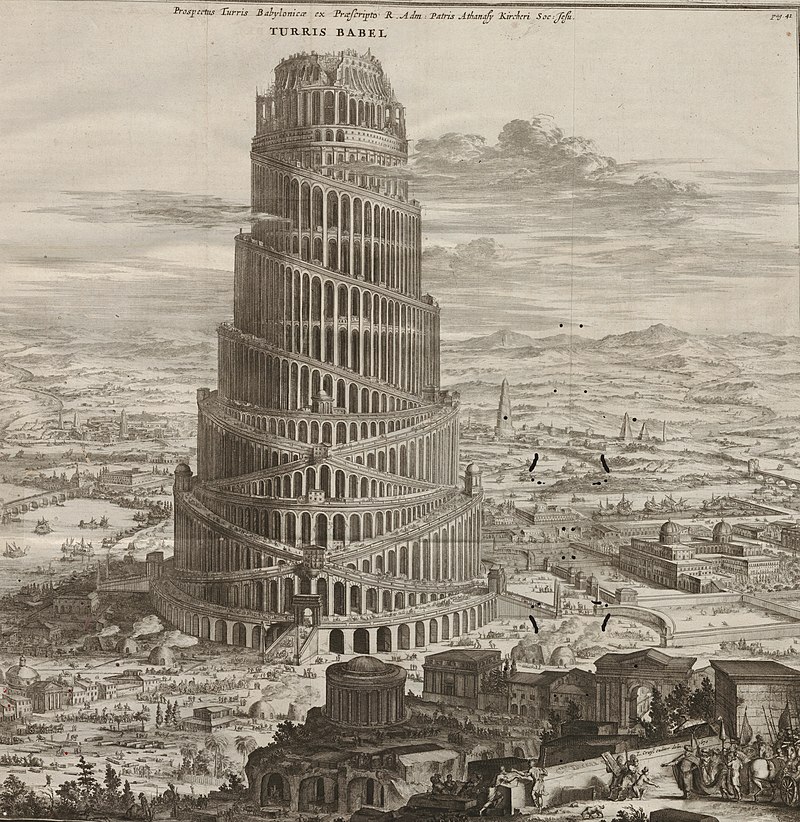
Turris Babel from Athanasius Kircher, source wikipedia
In addition to modern language in The Tower that jogged me out of the bubble I was trying to stay inside of, the authors needed an editor. Badly. It was a self-published book as mentioned, and often than means not employing a skilled or professional editor, or even a copy editor. Copy editors check copy for wrong words, punctuation, mechanical errors in the text.
The authors used wrong words several times in the few pages I read. For example, gig for did. Site for sight, twice. Ugh. There is nothing that gets me more irritated than wrong homophones, unless it’s spelling errors. So this book had issues with the text itself. That, combined with the issues of language, meant I couldn’t read in relaxed fashion, I kept being booted out of 2300BC. I quit reading won’t pick the book up again.
If you would like information on the Tower of Babel from a credible Bible-based ministry, here is Answers in Genesis’ answer to the question, “When was the Tower of Babel Built?“
Some people object to fictionalizing stories from the Bible. Can we fictionalize biblical stories by recounting them and filling in gaps with our own imagined characters or situations? Hmmm, yes and no.
The most important point is, have you read enough of the Bible, OT and NT, to be familiar with what SHOULD be presented in a work of fiction based on a biblical story? If you’re reading a fiction book about Rachel, have you first read and are familiar with the actual Rachel of the Old Testament? If not, then you are at risk of accepting the author’s version of a true biblical person.
I thought The Rain did a good job of sticking to the biblical concepts. Though I personally have not read The Chronicles of Narnia, people tell me CS Lewis did a credible job with creating a biblical allegory that mirrored biblical concepts. As did John Bunyan in The Pilgrim’s Progress. The television series The Chosen did not do a good job of gap-filling, but twisted the Bible to suit man’s desire to diminish Jesus and hide attributes He has which make man uncomfortable.
The problem with fictionalizing, or making plausible leaps where the Bible is silent, is that very thing- our flesh gets in the way.
And our flesh has an agenda. So does satan.
So in a way, Christian fiction books are the most unsafe books of all. Take the book The Shack, for instance. This was a runaway bestseller back in 2007-2008 and onward. It was sold in Christian bookstores as a Christian book. Its author, William Paul Young, wrote about a man who was staggering under heavy grief due to the kidnapping and death of his little daughter, her death had occurred in a derelict shack.
One day the man received a handwritten note in his mailbox to go to the same shack. Reluctant but curious, he goes, and there he ‘meets’ Jesus and the Holy Spirit in addition to being greeted by ‘God.’ It turns out that according to Young’s presentation of the Trinity, God is a woman, as is the Holy Spirit. The book goes on to present discussions between the persons of the Trinity and the man, regarding sin, evil, salvation, judgment, and other doctrines. The book teaches that sin is its own judgment and there is no other, that hell exists to purge away unbelief (not punish for sin), that there is universal reconciliation, among other aberrant, non-biblical doctrines.
Many credible leaders in the faith negatively reviewed the book. I reviewed it negatively also. A common rebuttal to our negative view of the book was, “Lighten up. It’s only fiction!” Or, “It’s only a novel!”
Dear reader, novels teach an author’s point of view, either subtly or overtly. It’s no different for Christian novels. Novels with Christian themes use narrative to teach. We must all be Bereans and check to see that these things in the ‘Christian’ book are so, in whatever form the doctrines are coming to us. Doctrine is taught in songs, poems, sermons, lessons, theological books…and fiction.
Dr. R. Albert Mohler Jr. serves as president of The Southern Baptist Theological Seminary. Dr. Mohler offers thoughts on the missing art of evangelical discernment as encapsulated by evangelical response to The Shack. He wrote:
“In evaluating the book, it must be kept in mind that The Shack is a work of fiction. But it is also a sustained theological argument, and this simply cannot be denied. Any number of notable novels and works of literature have contained aberrant theology, and even heresy. The crucial question is whether the aberrant doctrines are features of the story or the message of the work. When it comes to The Shack, the really troubling fact is that so many readers are drawn to the theological message of the book, and fail to see how it conflicts with the Bible at so many crucial points.” [underline mine]
EPrata photo
In that article, we see that Christian fiction is deliberately used to bring heretical ideas to the masses and worse, popularize them. Christian reader, beware! It’s not “just fiction”! Simply because a book is listed as Christian fiction does not mean we can let down our guard. We need to put up higher guards!
“When we think about the role of reading in our spiritual formation, we generally think of non-fiction books that help us understand scripture and theology, but fiction powerfully shapes the ways in which we think faithfully about God and the world.” C. Christopher Smith
Fiction is storytelling. Christian fiction walks a thin line between green pastures of heaven and boiling hot lava, in that the story an author is telling is based on the Bible but the Bible is not fiction. It’s history; true, and real. It’s dangerous to tinker with God’s word, yet stories must be told. CS Lewis did it well with Screwtape Letters and Bunyan with Pilgrim’s Progress. William Paul Young did it badly with The Shack, Dallas Jenkins with The Chosen.
Be discerning. The worst Christian fiction often popularizes heresy. The best Christian fiction prompts a reader to run to the Bible to absorb more truth. It also glorifies God.
Dr. Mohler said that even Christian fiction is a work of sustained theological argument. Let’s compare two books to see how this fleshes out: Elmer Gantry and The Shack.
One of my favorite books is Elmer Gantry by Sinclair Lewis. It tells the story of a false convert who rose to fame and celebrity pastor status, all the while not being a believer in any sense. The Bible tells us that this will happen, it’s a biblical concept. The message of the book was to illustrate how this can happen, not to promote that hypocrisy is to be accepted. The sustained theological argument of Elmer Gantry is that hypocrisy happens in religion and it is always bad. It wasn’t promoting hypocrisy or apostasy as good. Meanwhile, the sustained theological argument in The Shack is that God does not punish sin and everyone will eventually be reconciled to God.
We must be Bereans and test every theological argument that we absorb. If this sounds like a lot of work, it is. Paul repeatedly advised his readers to be vigilant. (For example, 1 Corinthians 16:13). We are on a battlefield in a war, and we don’t only hear the cannons booming, but we must be alert for snipers, too. When it comes to accepting things not of the Lord, it all matters. Christian books are never “just fiction.”
Blessed be the God and Father of our Lord Jesus Christ! According to his great mercy, he has caused us to be born again to a living hope through the resurrection of Jesus Christ from the dead, (1 Peter 1:3)
Well that says a lot! Each phrase is an encouragement. I’m focusing on living hope today. Our living hope is not a dead hope. It is not surmise, speculation, or empty ‘what if’. It is a living hope because we are IN Christ and He is living and He is our Hope.
Gill’s Commentary says
Saints are both begotten again to the grace of hope, and to the glory which that grace is waiting for”. Our hope is because of Christ, it is in Christ and it is Christ. It is a living hope
Genesis 22 has the story of the great test of faith of Abraham. God called to Abraham one day, and Abraham answered “Here I am!” God told Abraham to sacrifice his son Isaac, his only son, who Abraham loves. Abraham was to do this on Mt Moriah, a place God initially told Abraham would be a place He would tell Abraham. Not even initially knowing where, Abraham hastened to obey, and the two hiked to the fateful spot.
Theologians have examined this scene and compared it to Christ’s sacrifice so I am certainly not plowing new ground. I have no deeper insights. But in this day and age, with fears and tribulations, and griefs and apostasy, it is always refreshing to keep our eyes on Christ. It is always edifying to see how in the word, the LORD God has it all under control and His plan is unfolding from that day to this in magnificent fashion, and will continue to do so.
Italian Renaissance painter Caravaggio’s depiction of the sacrifice of Isaac:
Comparison of Old Testament texts with New Testament texts. Isaac pre-figures Christ.
The cross is the epitome of redemptive truth, foreshadowed in the acceptable sacrifice of Abel, foreshadowed in the ark of safety that saved Noah, foreshadowed in the sacrifice provided on Mount Moriah–a ram in the place of Isaac, prefigured in the deliverance of Israel from Egypt, where Moses said, “The Lord is my strength, and my song, and He has become my salvation.” We see the cross foreshadowed in the smitten rock in the wilderness that brought forth water to quench the thirsty people. We see the cross foreshadowed in the Levitical ceremonies, sacrifices and offerings. We see it foreshadowed in the serpent lifted up in the desert for healing. We see it even in Boaz, the kinsman redeemer. We see the cross detailed in Psalm 22 and Isaiah 53. We see the pierced and wounded Savior in Zechariah, chapter 12–all the way through Scripture. J. MacArthur
Scripture is amazing and wonderful. Read your Bible today.
But what fruit were you getting at that time from the things of which you are now ashamed? For the end of those things is death. (Romans 6:21)
Paul is asking this rhetorical question in the majestic section of “The Wages of Sin.” What has sin profited you? What fruit, then, has sin produced?
I’m a lover of art. I saw Caravaggio’s Bacchus in the Uffizi some years ago. Caravaggio’s Bacchus is a decadent painting, becoming more so as one gazes at it. Bacchus was the Roman god of the grape harvest, winemaking and wine, of ritual ecstasy, fertility and so on. Dionysus was the parallel Greek god. Here he is:
How is it decadent, one asks? We see the heavy-lidded youth, the Bacchus, reposing against his dirty sheets, with his own covering having slipped off, exposing his fleshy upper torso. He fingers the opening suggestively. His face appears ruddy, from outdoor farm work in the vineyards, or perhaps more to the point, the florid blush of too much wine. On close inspection, the bowl of fruit shows its over-ripeness. The pears are bruised and browning. The figs are burst and oozing. The peaches are in obvious decay.
Decay, rot, decomposition is the theme of the entire portrait. And anyway, it’s a false god.
But the fruit of the Spirit is love, joy, peace, patience, kindness, goodness, faithfulness, gentleness, and self-control. (Galatians 5:22-23)
Does sin bring the fruit of love? Does sin bring the fruit of peace? Does sin bring the fruit of patience? Does sin bring the fruit of kindness? Does sin bring the fruit of goodness? Does sin bring the fruit of faithfulness? Does sin bring the fruit of gentleness? Does sin bring the fruit of self-control?
Can you think of any sin which brings any of the good fruit of the Spirit? Does jealousy bring love? Does bitterness bring self-control? Does gossip bring kindness? Does adultery bring peace?
Or does sin’s fruit bring decay, rot, and decomposition? The fruit of love only grows brighter as it ripens. The fruit of sin brings festering putrefaction, flies, and disease. Eventually, death.
For the wages of sin is death, but the free gift of God is eternal life in Christ Jesus our Lord. (Romans 6:23).
Flee from that sin, sister. Resist it, slay it. God has given us His Spirit to aid us in this, and the free gift of eternal life is ours so we can enjoy His Holy self forever.
I like the Appalachian fiddle instrumental version of the old song Just a Closer Walk With Thee. Here are the lyrics, written by an anonymous or unknown author
I am weak, but Thou art strong; Jesus, keep me from all wrong; I’ll be satisfied as long As I walk, let me walk close to Thee.
Refrain: Just a closer walk with Thee, Grant it, Jesus, is my plea, Daily walking close to Thee, Let it be, dear Lord, let it be.
Through this world of toil and snares, If I falter, Lord, who cares? Who with me my burden shares? None but Thee, dear Lord, none but Thee.
When my feeble life is o’er, Time for me will be no more; Guide me gently, safely o’er To Thy kingdom shore, to Thy shore.
The only mention of anything sovereign is the word ‘kingdom’ in the last line.
I watched the TV series of Queen Elizabeth II, called The Crown. It’s an excellent series, well written, well acted, with sumptuous production values. It is Netflix’s most expensive series to date. They spent a lot of money replicating the surroundings of the kings and queens depicted, and nearly exactly replicated the events they lived through.
One thing that the first season’s series has firmly shown, is that while the crown is a successive institution, the people inhabiting it alternate. Yet the people inhabiting it are still distinct from the commoners. The Queen, her mother, her sister, her father, any of the sovereigns, are isolated. They live behind fences and high walls. When they appear in public they are again shielded. If they are walking, there is always a large distance between the rows of people and the Queen (or the King as it is now). They might walk past the people, but they do not walk with the people.
Jesus is our King. He is King of KINGS and Lord of LORDS! He is the highest of the high. Has any King ever invited the commoners to walk with Him? No! Did King Ahasuerus (Esther’s husband) invite people to walk with Him? No! He decreed that anyone entering his throne room without him having called them there would be put to death! Did King Herod go out and stroll around with Lydia and Timothy and James? No!
Jesus invites us to be His friend, He is our Father, our Brother, our Intercessor, our Priest, our Redeemer, and our Savior. Yet…walking with the King is unheard of!
We sing that song in a lively fashion when we hear it on the radio, because it’s familiar to us and it’s sweet. But think about the words, really think about them. We ask Jesus to walk closer to us And He will!
None of this is news to any of you. But it does us good to think about Him once in a while as the amazing Person He is, King, who does not isolate Himself behind fences and walls. In what other kingdom at any time or anywhere, does the King invite His people to walk with Him? The King who does not dismiss the commoners, but invites them to participate with Him in his sovereignty is to be praised in wonder and awe.
Our church has a healthy demographic of college kids and young marrieds. Some time ago I was watching an Instagram video story a young friend posted of a bunch of the youths in high spirits romping around the college campus at midnight, then heading to a local store for sodas, laughing and pushing and giggling.
I smiled, remembering my own hi-jinks and clean fun- road trips and loud laughter and silly fun. Ahhh, youth.
Those kind of memories are satisfying because that is how youths act, college or no. They’re boisterous, they’re lively, they’re carefree, they’re happy.
Kim Shay at The Upward Call blog published a good essay about older women not being a trope. (In TV or Movies a trope is a common overused theme or device). In many TV shows, the older women is depicted as silly, or a gossip, or a busybody. Think Hyacinth Bucket (Bou-quet) or the sanctimonious Church Lady of Saturday Night Live by Dana Carvey. Or Mrs Bridgette McCarthy on Father Brown, a church secretary, gossip, and often at odds with and acerbic toward other characters.
Shay’s essay was a look at how older women should act according to Bible verses that command reverence and sober-mindedness.
I’m an older woman now. I’m almost 64 years of age. I have completely white hair, overweight, a lumbering stiff walk, and oh my achin’ back. All the things that come with old age, including sagging skin, age spots, and general droopiness.
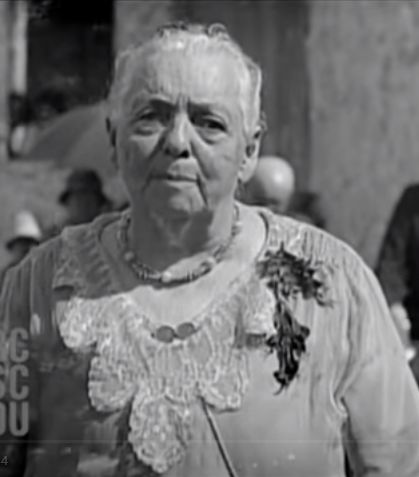
Not me. But sort of me.
I remember being a teen at a friends’ house listening to the latest music laying upside down, college road trips, my car stuffed with gangly youths, a young adult with my posse playing bar trivia…it was yesterday. Ladies, age creeps up on silent cat feet (with apologies to Carl Sandburg). The boisterous hi-jinks no longer suit. If I were to gadabout at midnight with pals, they’d lock me up for being crazy. Why? That’s not how older women act.
We line the wall at dances sitting in folding chairs, purses firmly atop lap. We tut-tut at the beauty and litheness of the young ones sailing by. We cook and serve the meals with a knowing nod and quiet hospitable satisfaction. We accept collect calls from grandkids at midnight when the car breaks down on the way home from hi-jinks. We rearrange the potlucks on the sagging table, they form the cleanup swat team afterwards. I say, we. I’m a we now.
I know some of these are a writing trope in themselves, but they are tropes because they are true.
Kim Shay wrote: “My husband once asked me with regard to the women who have spoken at my church’s women’s conferences: “Why is the speaker always young and beautiful instead of old and plain?”
I was noticing that, too. So many of the speakers at conferences now are younger women. Do younger women have something to say? Yes, but so do older women. And the elder females have been at it longer.
So since we have been at it longer what do we say about how to conduct ourselves? Well, whatever the Bible says we are to act.
Before I get into the nuts and bolts of biblical behavioral standards, I’ll mention that whenever I discuss behavioral standards, particularly applied to false teachers, these comments receive the most negative feedback of all the kinds of comments I make online. People hate to be reminded that the Bible endlessly outlines behavioral standards of any kind. There are general calls for certain kinds of good behavior, there are specific calls for individual demographics, and there is a reminder that we will be judged on how we behaved as well as what we believed.
In one set of verses we read about how we are to act, and the reason for it-
as servants of God we commend ourselves in every way: by great endurance, in afflictions, hardships, calamities, 5 beatings, imprisonments, riots, labors, sleepless nights, hunger; 6 by purity, knowledge, patience, kindness, the Holy Spirit, genuine love; 7 by truthful speech, (2 Corinthians 6:4-7a)
Why?
“so that no fault may be found with our ministry” (2 Corinthians 6:3b).
But what specifically of elder women? If we are married to a overseer, act in ways that aid him in keeping order in the household. (1 Timothy 3:4). If married to a deacon, the same, (1 Timothy 3:12. Additionally, deacon’s wives must be dignified, not slanderers, but sober-minded, faithful in all things. (1 Timothy 3:11). I am assuming that wives of pastors and deacons aren’t entirely youthful because the qualifications for pastors are not to be recent converts (1 Timothy 3:6) and to have built up a good reputation- which takes time. (1 Timothy 3:7).
If we are a widow, Paul in 1 Timothy 5 described real widows as: “Now she who is a widow indeed and who has been left alone, has fixed her hope on God and continues in entreaties and prayers night and day.” Which reminds me of Anna at the temple in Luke 2.
A widow could be put on the list for church aid if she had behaved in the following way-
A widow is to be put on the list only if she is not less than sixty years old, having been the wife of one man, 10having a reputation for good works; and if she has brought up children, if she has shown hospitality to strangers, if she has washed the saints’ feet, if she has assisted those in distress, and if she has devoted herself to every good work.
An elder married woman is not to be contentious, as Syntyche and Euodia were. (Philippians 4:2). Titus 2 is the famous verse that outlines how older women are to act-
Older women likewise are to be reverent in behavior, not slanderers or slaves to much wine. They are to teach what is good, and so train the young women to love their husbands and children, to be self-controlled, pure, working at home, kind, and submissive to their own husbands, that the word of God may not be reviled.
Reverent in behavior. Self-controlled. Kind. These are not hard to understand and not unreasonable to ask. When I write about behavioral standards other women rush to scream and rant, but really, what is there to rant against? They want to lose control? Be irreverent? Unkind?
Anyway, the Bible outlines behavioral standards for all ages. As I pass through the aging eras and enter the golden gate of elder womanhood, I’ll try to be mindful of how the Bible expects me to behave, so as not to discredit the ministry. Plus, in the Lord’s grace, I’ll try not to be a trope!
Further Reading
This makes a nice companion piece. Jared Wilson, that whippersnapper at age 49, not only muses on growing old, but provides some helpful tips to grow old gracefully.
In tweeting about transgenderism, an angry person – obviously not a believer – challenged me with this-
you’re the reason baptists churchs are removing “baptist” from their names. How many divorced adulterers u take money from #hypocrite
He has a partial point. We make much of the homosexual and the transsexual, rightly holding up the doctrines of the Bible that speak to sexual sin, but often overlook the same doctrines that speak of divorce and unrighteous re-marriage. In those cases the remarried Christian is seen by God as an adulterer. Isn’t unbiblical divorce and adultery sin, too? Of course it is.
We all know the famous “God hates divorce” from Malachi 2:1. His command regarding divorce is reiterated in 1 Corinthians 7:10–11:
But to the married I give instructions, not I, but the Lord, that the wife is not to leave her husband. (but if she does leave, she must remain unmarried, or else be reconciled to her husband), and that the husband is not to divorce his wife.
He still hates divorce. But God did give some wiggle room for an allowable divorce. Not a desirable divorce, but an allowable one: if the spouse is unfaithful (Matthew 5:32), and if the spouse abandons the other spouse. (1 Corinthians 7:15).
Speaking of persistent sin, if there is someone getting a divorce on unbiblical grounds, for example, this is how MacArthur handles divorce as written in Grace Community Church’s Distinctives this way. His church’s distinctive is based on the Bible verses about divorce:
“Believers who pursue divorce on unbiblical grounds are subject to church discipline because they openly reject the Word of God. The one who obtains an unbiblical divorce and remarries is guilty of adultery since God did not permit the original divorce (Matt. 5:32; Mark 10:11-12). That person is subject to the steps of church discipline as outlined in Matthew 18:15-17. If a professing Christian violates the marriage covenant and refuses to repent during the process of church discipline, Scripture instructs that he or she should be put out of the church and treated as an unbeliever (v. 17). When the discipline results in such a reclassification of the disobedient spouse as an “outcast” or unbeliever, the faithful partner would be free to divorce according to the provision for divorce as in the case of an unbeliever departing, as stated in 1 Corinthians 7:15. Before such a divorce, however, reasonable time should be allowed for the possibility of the unfaithful spouse returning because of the discipline.”
But how often does a local church practice discipline like that? Discipline grows a church, doesn’t shrink it. (Acts 5:11-14). I think many churches have become somewhat like the world in that regard. They pull out the stops to prevent homosexuality from entering but have allowed other sins like divorce to become commonplace.
God’s people are united to their husband, Christ, by faith. This indissoluble union begins when we place our faith in the one who is “chief among ten thousand.” A significant implication emerges from this truth: Heaven is eternal because we are married to Christ, and God hates divorce. God would first have to sin by dissolving our union with Christ before Heaven could end. When God sins in this manner then Heaven will end.









 the-end-time.org
