Posted in encouragement, Uncategorized

The Approachableness of Jesus (reprise)

There are so many attributes of Jesus Christ than we can praise and ponder. One of them is His kingliness.

He is King of Kings and Lord of Lords. (Revelation 19:16). God has given Jesus all authority in heaven and in earth (Matthew 28:18), therefore He is above all authorities anywhere that can possibly be imagined. He is High and exalted on His throne and He is KING.

On earth few of us have actually been in the presence of a King or Queen. There are relatively few royals on earth, compared to number of the population of the plebeians like us.

If one is favored enough to visit a royal, there is strict protocol. ABC News reminds us, regarding a visit with Queen Elizabeth II-

There is a long list of protocols that guides one’s behavior in the presence of Her Majesty and even though the president and the first lady are not required to abide by all of them, there are certain formalities they do have to follow.

There is the “no-touch” rule…
Wait until the Queen extends her hand to shake it
No gripping her hand or tightly pumping it
No hugs, no kiss on the cheek, no touching the shoulder

Refer to the Queen as “Your Majesty” initially then “ma’am” subsequently
Bow upon being introduced
Do not turn your back to the Queen
Wear conservative clothing with not much flesh showing

And so much more.

I remember the HBO mini-series John Adams. It was an excellent series, showing the life of our second President from a fiery attorney in his youth through to old age, in other words, most of his political life.

There came the moment when the Americans had won the Revolutionary war. Adams had been given the privilege and responsibility as diplomat to begin relations with The United Kingdom as national co-equals. He was to meet with the King. The moment was fraught with tension for two reasons. He had all of the future of America resting on his shoulders in how he approached the Monarch these next few moments. Would the United Kingdom be an enemy or an ally?

The second reason was protocol. Here was a scrappy lawyer born in 1735 in British America, (Quincy MA), and was American through and through, about to meet the most powerful man in the world, King George III. Americans had not been known to stand on formality and protocol, and Adams had been strongly tutored for this meeting. Bow three times, once upon entering, once when halfway to the ‘Royal Presence’ and a third time as you enter the ‘Royal Presence’. Avert your eyes until standing before the ‘Royal Presence’. Wear suitable clothing, “something more British.” Unsuitable clothing has been the undoing of many an Ambassador, we learn.

See how it went, at the link. It’s an extremely memorable cinematic moment and an incredible piece of acting, as well as a visible punctuation for my point. I can’t embed, HBO has disabled it.

There have always been strict protocols when meeting royalty. In Esther 4:11 we read,

All the king’s servants and the people of the king’s provinces know that if any man or woman goes to the king inside the inner court without being called, there is but one law—to be put to death, except the one to whom the king holds out the golden scepter so that he may live. But as for me, I have not been called to come in to the king these thirty days.

This scene is described in Esther 5:1. The King is holding his scepter.

On the third day Esther put on her royal robes and stood in the inner court of the king’s palace, in front of the king’s quarters, while the king was sitting on his royal throne inside the throne room opposite the entrance to the palace.

Wikipedia

Thrones were always higher, set upon a dais in order to visibly indicate the lower position of the person approaching the Royal Presence. This is a photo of Napoleon’s throne. Pharaoh is described as sitting on a throne in Exodus 11:5; Exodus 12:29.

Solomon wrote,

Do not claim honor in the presence of the king, And do not stand in the place of great men; 7For it is better that it be said to you, “Come up here,” Than for you to be placed lower in the presence of the prince, Whom your eyes have seen.

And yet, another aspect of the uniqueness of Jesus continues. He sits upon His throne, the highest of the high and lifted up (Isaiah 6:1) and yet we may approach!

Let us then with confidence draw near to the throne of grace, that we may receive mercy and find grace to help in time of need. (Hebrews 4:16)

In him and through faith in him we may approach God with freedom and confidence. (Ephesians 3:12).

Must we dress in a certain way? Must we wait to be introduced or summoned? Must we bow in sequential order as we reach certain spots in the throne room? Must we avert our eyes until He speaks? No! No! No! No!

Our Lord Jesus is said to be the Mediator between God and man. Now, observe, that the office of mediator implies at once that he should be approachable. ~Spurgeon
He is Lord of Lords and King of Kings and yet He has told us we may approach Him with petitions large and small! He is tremendous. Every time we pray we approach Him. He is a God who sees (El Roi Genesis 16:14) and a God who hears!

In 1920 Frank Boreham wrote a book titled “A bunch of everlasting; or, Texts that made history“. His book contains biographies of famous Christians who came to the saving grace of salvation as the light of one particular verse broke upon their hearts. John Bunyan met Jesus through this verse in John 6:37,

All that the Father giveth me shall come to me; and him that cometh to me I will in no wise cast out.

From Boreham’s text we read,

In his pitiful distress, there broke upon the soul of John Bunyan a vision of the infinite approach-ability of Jesus. John Bunyan’s text-verse was a revelation to him of this approach-ability.

‘This scripture did most sweetly visit my soul; and him that Cometh to me, I will in no wise cast out.” Oh ! the comfort that I had from his word, in no wise! As who should say, “By no means, for nothing whatever he hath done. ‘Him that cometh I will in no wise cast out!’ Like the gate that swings open on hearing the magic ‘sesame’; Like the walls that fell at Jericho when the blast of the trumpets arose; the wall round Bunyan’s mountain fell with a crash before that great and golden word. ‘Him that cometh to Me I will in no wise cast out!’ The barriers had vanished! The way was open!

Christ is approachable. Praise Him! Approach today, with no worries of what you must say or how you must look. He will in no wise cast you out. How sweet is this knowledge.

————————–

Further Reading

Spurgeon sermon- The Approachableness of Jesus

Frank Boreham, A Bunch of Everlastings, online text

Wikipedia entry about John Bunyan

Etiquette: How to Address a King or Queen
Posted in prophecy, Uncategorized

Preaching in Jesus’ name

Therefore thus says the Lord concerning the men of Anathoth, who seek your life, and say, “Do not prophesy in the name of the Lord, or you will die by our hand” (Jeremiah 11:21).

and when they had called in the apostles, they beat them and charged them not to speak in the name of Jesus, and let them go. (Acts 5:40).

The name of Jesus Christ is extremely powerful. I’m not talking that it’s powerful like a magic charm, or a mantra, or a mystical incantation. His name is powerful because Jesus is the most powerful person in the Universe, because He sustains the world with His will, because He became the unique, one and only sacrifice for sin, died, and rose again defeating death.  He is the I AM. He is the Authority. It’s that simple.

And Jesus came and said to them, “All authority in heaven and on earth has been given to me.” (Matthew 28:18)

You can preach in any other name and the heart of the listener might or might not be emotionally or mentally affected. He might become emotional at a good speech delivery. She might feel temporarily joyful or sad but that burns off because an emotional reaction it doesn’t reach the soul. Only the word of God can affect the soul, and the only name in which we preach the true word is Jesus.

When the words affect the soul, the reaction has staying power, whether it’s to cause the person to retreat further into sin, or to convert under grace.

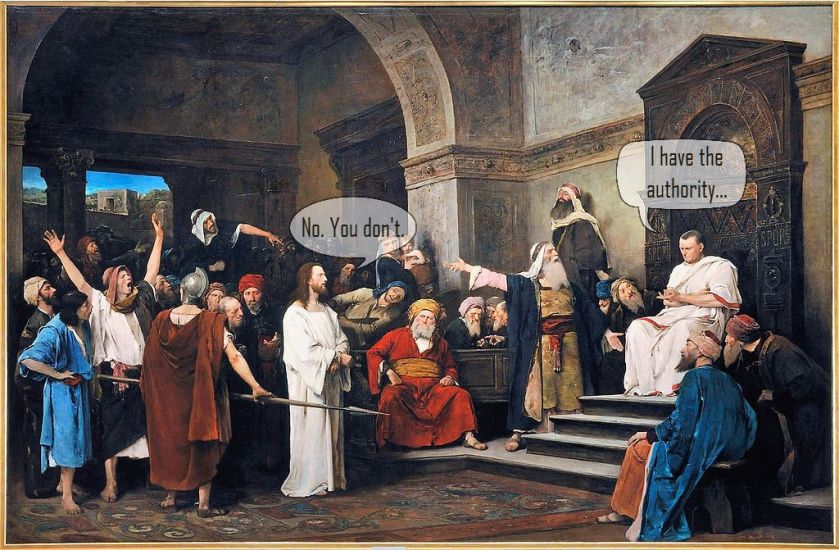
In the New Testament we know that the party opposing Jesus (Scribes, Pharisees, Sadducees) hated the name of Jesus. They hated His teachings, His disciples, His power, His authority, His resurrection. They thought they had authority, but they did not.

Pilate thought he had power and authority. He did not know that his authority was not his own, but was from above.

So Pilate said to Him, “Do You refuse to speak to me? Do You not know that I have authority to release You and authority to crucify You?” Jesus answered him, “You would have no authority over me at all unless it had been given you from above.” (John 19:10-11)

Jesus’ name has power. Not because it’s a magic mantra. But because all authority in heaven and on earth has been given to Jesus. He is the ultimate authority over men. And men’s souls sense this. We rebel against authority. We fight authority but authority always wins, sang John Cougar Mellencamp in his “The Authority Song”. We been doin’ it since we were young mean and we come out grinnin’.

We think it’s funny to rebel against parents, teachers, employers, police, the law, the government. But who we’re really rebelling against is God and God alone. He is the authority and He gives His authority to parents, teachers, employers, police, the law, the government. However, He retains sole claim to all authority and dispenses it to whom He desires. That is why when we rebel it is against Him and Him alone. (Psalm 51:4).

The authority of the name of Jesus calls for men’s submission to that name, but in our sinful state we protect our rebellion instead of submit to authority. We are rebels, sinning at every turn and hating those who tell us to stop.

Fortunately, Jesus’ name does have power. Without His power, we would never be saved. Jesus lived a perfect and holy life under the Law. He fulfilled every bit of it, and was crucified unjustly. He took on all man’s sins and endured God’s wrath for that sin. He died and was buried.

Three days later He rose again victorious over death!

“O death, where is your victory? O death, where is your sting?” The sting of death is sin, and the power of sin is the law. But thanks be to God, who gives us the victory through our Lord Jesus Christ. (1 Corinthians 15:55-57)

Vainly attempting to grasp our rebellion against authority, or foolishly trying to keep whatever scraps of authority we think we have, will always end in one moment, one act: bowing before Jesus and confessing Him as Lord. It’s better to submit to His authority now and be adopted as son and friend, than to have confess to Him as a rebel.

Munkacsy_-_Christ_in_front_of_Pilate
With apologies to artist Mihály Munkácsy, “Christ before Pilate, 1881

Posted in encouragement, Uncategorized

War no more

Sin is the oldest negative thing on earth. After God created the world and the two people and called it all “very good”, sin came. Shortly after that came murder, lying, anger, jealousy, polygamy, and war.

War has been with us for so long.

I remember growing up, the Viet Nam War. It was the first war to be broadcast on television, and in living color, too. There were reports every single night. We’d hear the tally of dead and wounded. Scenes to my young eyes of limbless men hanging off gurneys in the jungle, helicopters, camouflaged men skulking with rifles pointed through the leafy undergrowth were plenty scary. They were scenes of chaos and blood.

That’s war.

I saw a news article from the Canadian Broadcasting Company.

A cannonball fired by the British during the Battle of the Plains of Abraham in 1759 has been unearthed at a building site in Old Quebec. The rusted, 90-kilogram projectile was unearthed during excavation work last week at the corner of Hamel and Couillard streets and still contained a charge and gunpowder. The work crew that found the ball picked it up and gathered around it for photographs, unaware that it was still potentially explosive.

The cannonball is from Britain and was fired at Quebec City from Lévis,
across the St. Lawrence River. (Facebook/Lafontaine Inc)

In Genesis 4 we have the first murder. The Bible isn’t specific on how Cain killed Abel. Later in Genesis 4:22 we read, Zillah also bore Tubal-cain; he was the forger of all instruments of bronze and iron

Knowing that Tubal-can was in the line of ungodly descendants of Cain, and knowing the evil heart of man, I’d say with near certainty that some or all of those instruments were instruments of war. Many of those implements were likely arrows, shafts, spikes, and the sort.

Then by Genesis 6:11 we read Now the earth was corrupt in God’s sight, and the earth was filled with violence.

Violence that included war, with implements, I’m sure.

We all know about Galileo. He was famous for looking through his telescope and making

“observations that strengthened his belief in Copernicus’ theory that Earth and all other planets revolve around the Sun. Most people in Galileo’s time believed that the Earth was the center of the universe and that the Sun and planets revolved around it.” (Source: NASA).

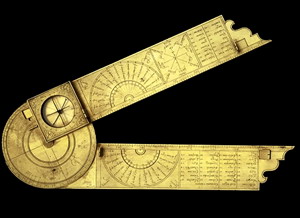
But 20 years before that, Galileo experimented with, produced, and wrote about military technological advances, in a treatise called The Operations of the Geometrical and Military Compass. Galileo’s invention of the military compass was used to calculate precise trajectories of cannonballs and other military killing projectiles.

Throughout the Renaissance many attempts were made to develop a universal instrument  that could be used to perform arithmetical calculation and geometric operations easily. This need was felt especially in the military field, where the technology of firearms called for increasingly precise mathematical knowledge. … The geometric and military compass of Galileo belonged to this class of instruments. [T]he Accademia Delia was founded in Padua to provide mathematical instruction for young noblemen training for a military career.

Imagine how much of our mind will be released when we don’t have to devote so much of it to devising evil. Imagine when we are freed to think up ways to worship Jesus, or ways to praise Him, or anything else, than to creating military items that maim and kill and destroy.

He shall judge between the nations, and shall decide disputes for many peoples; and they shall beat their swords into plowshares, and their spears into pruning hooks; nation shall not lift up sword against nation, neither shall they learn war anymore. (Isaiah 2:4)

Jesus will dissolve the earth in a fervent heat. When He creates a new earth, there will never be a cannonball to dig up. There will never be any implements of war found anywhere, like arrowheads or bullet casings or swords. Forgers of instruments of bronze and iron will be making plowshares and pruning hooks.

Won’t it be great when we will study war no more? Peace. Peace will reign in men’s hearts, between men and Jesus, and between men and men (and animals). Peace, shalom, war no more.

Posted in discernment, Uncategorized

Lucky Dipping

In RC Sproul’s class called Knowing Scripture, in lesson 4, “Literal Interpretation,” Sproul taught against a certain popular method of decision making he calls “lucky dipping.”

In this method, when the believer wants to hear from God or wants to make a decision, they ask God to lead and guide them, and then they open the book and let their finger or their eye fall on a particular passage. They read the passage and then rest on it as their “answer” to their problem. Sproul said that this is a spiritualistic method of interpretation that rips verses from the Bible’s context. He said,

“God did not inspire passages of Scripture many years ago to tell us answers totally unrelated to the literal meaning originally intended. God does use Scripture to speak to us, but the message is always consistent with the literal interpretation.” Sproul, Knowing God

He gave an example of a hypothetical believer who asked God to lead him. He opened his Bible and read Matthew 27:5, ‘And throwing down the pieces of silver into the temple, he departed, and he went and hanged himself.’

The audience laughed. Sproul went on. He said that the person didn’t like the ‘answer’ at all, muttering ‘That can’t be right’. He repeated, ‘Lord, lead me’, and opened the Bible and dipped again, landing on Luke 10:37. “You go and do likewise.”

Sproul’s exaggerated example reveals the ridiculousness of using the Bible like a Magic 8 Ball.

I think we can all agree that dipping is unwise and we should avoid it. Sometimes when pastors preach exclusively in the topical method, they can tend to ‘lucky dip’, too. Not that they use it as a method for finding personally tailored advice, but as a method for coming at the scriptures with a topical agenda in mind.

But if topical preaching is the main method of preaching and teaching, rather than expositional verse-by-verse, then a lazy tendency can creep in. Sometimes the leader can handle the scriptures carelessly, selecting different verses from different Testaments or different literary genres to support their point. With a careful pastor who normally exposits, occasional topical preaching can be fine or even necessary. Sometimes the congregation needs clarity on an issue, especially if there has been a national or local tragedy, or if there has been a particular problem in the membership that is causing confusion or division.

But if a teacher or pastor continually preaches topically, then lucky dipping could become a problem. If the pastor doesn’t take the care that’s necessary, the sermon could simply become a mere listing of of verses disconnected from the overall argument.

And back to the original statement about laymen doing the lucky dip. If a pastor or teacher teaches topically all the time, taking verses from here, there, and everywhere, or worse, from all different translations in order to support the topic, he or she is actually teaching his congregants to lucky dip. With less training than the teacher, the church member might say, ‘Well, he/she goes all over the place with the verses, it must be OK if I do too’. And then you wind up with people who might eventually use the scriptures as a Magic 8 Ball, divining God’s will or manipulating His word to make it say what it doesn’t say.

It’s admittedly easier to open the Bible and find the one verse that will seem to help for the moment, rather than setting down to carefully study a passage in context. That is why a lazy tendency can creep in. Resist that. And resist following teachers who do that all the time. The Bible is God’s own word to humankind, the only supernatural message we have ever received with purity and unimpeachable truth. Handle with care.

I argue that the primary reason we misinterpret the Bible is not because the Holy Spirit has failed to do His work, but because we have failed to do ours. Essential Truths of the Christian Faith by R. C. Sproul

Clipboard
Sing to tune of Pink Floyd’s The Wall, “We don’t need no divination…”
EPrata photo
Posted in encouragement, Uncategorized

Humdrum to Terror: A Sailing Story

I lived on a sailboat for two years. It was a Tayana 37 with a full cast iron keel and a wooden mast. A cutter rig. It was a pretty boat, a standout in the harbor.

I sailed with my husband from Maine to the Bahamas and back, worked for a year and did it again. We sailed and motored down the Intracoastal Waterway (ICW) combined with “outside” overnight passages, and made it to our terminus of Georgetown, Exuma, Bahamas in 6 months. After languishing in harbor for a while, we turned around and sailed back up.

boat

The Intracoastal Waterway (ICW) is a series of Bays, Sounds, Lakes, Canals, and Rivers that connect, from Cape Ann Massachusetts to Key West, FL. (and beyond) There are man-made parts that the Corps of Engineers dredge and maintain, and there are natural parts that form the connection, like Albemarle Sound or the Neuse River. The technical portion of the Waterway begins at Mile Marker 1 in Norfolk VA, because you can go all the way from Norfolk to Key West without having to enter the Atlantic Ocean. However the informal ICW goes all the way to Maine. In order to make passages north or south most live-aboards use a combination of staying inside and going outside.

220px-CapeCodCanalEastEndAerialCape Cod Canal, Wikipedia photo

When you’re motoring or sailing down the ICW, what you’re really doing, apart from cruising and sightseeing, is commuting. If you are on a sailboat, your maximum speed is likely going to be 3-5 miles per hour. That’s only how fast sailboats go.

So traveling down the ICW means you’re seeing the eastern seaboard at a rate most people can walk or jog. Progress is incremental at an agonizingly slow rate. Since there are only so many daylight hours, and since it’s inadvisable to travel the ICW at night, and since you need to chart ahead to make the next anchorage and bed down before it gets dark, you get up at dawn and start aiming to hit that anchorage before dark.

So, you’re essentially commuting. You can make between 30-50 miles per day on average, given weather conditions and ICW traffic. The traffic you share on the ICW is a mixture of other sailboats, motorboats, small pleasure craft, commercial fishermen, and commercial traffic such as tugboats and barges. It’s busy.

Getting up at dawn and turning on the motor and setting off for the day, every day, repeatedly, lulls one into a routine. We’d check the engine first, all the belts, the oil, and the pistons. We’d do a once-over topside to make sure things were still hunky dory. We’d turn on the engine, my husband would up the anchor, and off we’d go.

anchor 2

Leaving a Georgia anchorage at dawn. EPrata photo

Mainly, life commuting down the waterway was humdrum. You turned on the motor, did the same thing each day, and you anchored down at night. You made slow progress. Sometimes you had to look at a map just to see IF you’d made any progress. It seemed that the ICW was very long and the amount traveled in a day was very short, inconsequential even. Looking at the 1700 miles from start to finish it seemed like we would never get there.

The humdrum routine was punctuated by occasionally pulling into a town. It was always interesting learning about a town’s history, getting some local food, and/or replenishing the larder. It was fun to hop into the dinghy and putt-putt into a town for recreation. Even doing a laundry run was all right if it got us to walk and stretch our legs a bit. Getting off the boat added a little different something to the day-to-day commute.

Cruising the ICW was fun and good, sometimes thrilling, but it was far from being the glamorous yachting life you see in jetsetting magazines. Routine is routine. Humdrum.

Then some days an unexpected kind of comet would burst into your life and BLAM! you would almost die.

There was the sunny, calm day like all the previous days in northern FL when we were cruising north, in tandem with a tug pushing a barge. Barges are big. The part of the ICW we were motoring was narrow and crowded. We were ahead of the barge and both of us were cruising at the same speed. We had been in close VHF radio contact and were friendly with each other, courteously minding the navigable ‘rules of the road’ and frequently making way for each other in minor ways that helped us travel safely.

The bottom was sandy, which tends to silt up at the edges. We both tried to stay in the middle so we wouldn’t ground. The tug & barge had a draft of only a foot or so but we needed at least 6 feet of water under us to stay afloat and not touch bottom.

At one point in the long day, the tug radioed and asked if we could pull to the right a bit, as he wanted to pass us. He had to do some maneuvers up ahead as his turn off the ICW into his home port on the St. John’s River was approaching.

We edged over and slowed to just enough speed to keep way on. The tug and barge passed us. We sped up and started coming back to the center of the river. We made it!

BLAM!

Underwater in the middle of the channel was a hump of sand, enough to ground us. We grounded so hard nothing on the boat even jiggled. It was instant and it was final. I was below making lunch, and all I heard and felt was a JOLT. I looked out the porthole and the trees were not going by. We were stopped.

IF we had still been traveling in front of the tug and barge, we would be dead. The tug and barge are too large a vessel to be able to stop on a dime. Think 18-wheeler, on water. It would have crushed our boat, ramming us and pushing the debris down into the mud below, and us along with it. Or perhaps my husband who was steering in the cockpit would have had time to jump off, but with me being below I certainly would have died instantly.

But those thoughts didn’t come until later. For the present, we had a terrible problem of being stuck in the middle of the channel and exposed to all other motorboats, barges, tugs, and whatever else came along. We enacted the protocol for this situation where you put the anchor into your dinghy, row out to deeper water, set the anchor, and then get back on the boat and winch yourself forward off the obstruction. Fortunately, this worked. After some hard work, terror, sweat, and skittish eyes looking down the waterway for oncoming craft, we shook loose of the keel grabbing sandbar and got afloat again.

We were extremely grateful we had a full keel and it could withstand the jolt. We were very grateful we had no adverse effects except a little lost time. It could have been so much worse.

giww-tug-colo-locks

A tug and barge, not THE tug and barge., Photo TX DOT

As we processed what had happened and realized our extremely close call, we shivered and shuddered. Our days and days of tedium had been shattered in an instant by a near death experience we would never forget. That is liveaboard cruising on the ICW, long periods of humdrum routine punctuated buy sudden terror.

And that is the Christian life too.

Sometimes it seems like you’re making no progress. It feels like you’ve come only inches and there are miles to go. Can you even see your progress? It’s only incremental. It feels like you’ll never get there. You go days and days and wonder if you added anything of value to the Kingdom at all. It’s just routine. Tedium. Then BLAM! , a life changing event stirs you out of your mundane life and suddenly you’re scrambling.

A car accident. A cancer diagnosis. An injured child. A lost job. Homelessness. Whatever it is, one day you’re sailing along and the next you’re struggling for your life. Job knew. Elijah knew. Mary knew. Paul knew.

Does God use His interruptions to our daily life to shake us? Our pastor had given us the example of the fish tank. He said he had known someone who had a fish tank with fish in it but sometimes it got dirty. The water looked clear and clean. But if you were walking by and bumped it, the sludge on the bottom would drift up. He said that sludge accumulates, laying there, invisible, until a bolt from the blue comes along and then you see how much there is to clean out.

guillaume-150

Photo by Guillaume on Unsplash

That’s us believers. Our hidden sins, ruts, and blots lay in the bottom of our heart lurking and waiting undetected. When an unexpected life-comet zooms in, you turn to God. Prayer suddenly becomes fervent. Diligence in spiritual disciplines become tantamount. Pleading with tears ensues.

Does God uses the occasional BLAM in our lives to shake us? I think He does. Progress might be slow, tedium might even enter in. But when the jolts come, thank the Lord for them. He is using them to do a good work in you. It will be OK.

Posted in discernment, Uncategorized

Jonah and his leaf: a Lesson in Priorities

God relented from the disaster He’d promised upon the Ninevites.

But it displeased Jonah exceedingly, and he was angry. (Jonah 4:1).

Then God gave Jonah some shade.

Now the LORD God appointed a plant and made it come up over Jonah, that it might be a shade over his head, to save him from his discomfort. So Jonah was exceedingly glad because of the plant. (Jonah 4:6)

As our pastor preached on Sunday, “This seems kind of backward!” What are your priorities? What are mine?

Sometimes we can detect our own heart condition by what makes us exceedingly glad and what makes us exceedingly angry.

leaf1
EPrata photo

Posted in discernment, Uncategorized

5 Indicators of an Evil Heart

This past February I wrote a two part series on the problem with evil. The problem with evil is, its beauty. I’d written about how hard it is for us, even saved Christians, to grapple with a very present evil in our lives, and the difficulty of identifying it correctly. The worst evil is so beautiful, so harmless-seeming, so gentle, that our minds often refuse to discern it.

Part 1, Part 2

Leslie Vernick at the Association of Biblical Counselors wrote an essay titled

5 Indicators of an Evil Heart

In her introduction, she writes:

As Christian counselors, pastors and people helpers we often have a hard time discerning between an evil heart and an ordinary sinner who messes up, who isn’t perfect, and full of weakness and sin.
I think one of the reasons we don’t “see” evil is because we find it so difficult to believe that evil individuals actually exist. We can’t imagine someone deceiving us with no conscience, hurting others with no remorse, spinning outrageous fabrications to ruin someone’s reputation, or pretending he or she is spiritually committed yet has no fear of God before his or her eyes.

She summed up exactly what I’d been writing about a few months ago, but shorter. It’s clear, scriptural, and helpful. Of course, I hope you never have to encounter a truly evil person, but if you do, this piece will help you discern it.

The piece5 Indicators of an Evil Heart is organized into ten slides with a photo and a short blurb, with scripture, that help the  counselor, pastor or layperson identify evil from a temporary stumble. I offer this essay to you as a very good resource.

Text version here

evil

Posted in discernment, Uncategorized

Billy Graham Waffles for Breakfast #2: Is AIDs a judgment from God?

Waffles for Breakfast #1: Billy Graham on the Nixon Tapes, remarking about the Jews

This series is a study on hypocrisy. Number 1 is above. The series is based on the following verses.

it is not what goes into the mouth that defiles a person, but what comes out of the mouth; this defiles a person. (Matthew 15:11).

Woe to you, scribes and Pharisees, hypocrites! For you are like whitewashed tombs, which outwardly appear beautiful, but within are full of dead people’s bones and all uncleanness. 28 So you also outwardly appear righteous to others, but within you are full of hypocrisy and lawlessness. (Matthew 23:27-28)

Waffling is a secular term that means changing one’s mind frequently on a topic. “For breakfast” means to do it easily. That defines world-famous evangelist and itinerant crusade preacher Billy Graham, whose going back and forth on theological issues was so easy and so frequent it became second nature to him.

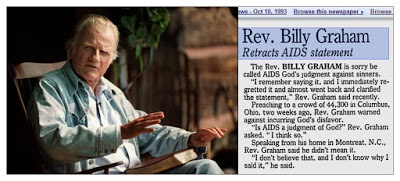
His slide from what he stated he believes, into doctrines so far outside orthodoxy, was so incremental and so little reported, that many people don’t know that he spent a lot of time retracting, clarifying, re-explaining and watering down any doctrine where he encountered push-back. Here is one example. In a sermon given on September 1993 in Columbus OH he remarked about AIDs

Is AIDs a judgment of God? I could not say for sure, but I think so.

Afterwards, Graham received many protest letters. He contacted the Cleveland Plain Dealer newspaper and retracted what he’d preached. His stated reason for saying it in the first place was that he was tired.

“I do believe God stands in judgment of all sins but AIDs is a disease that affects people and is not part of that judgment. To say God has judged people with AIDs would be very wrong and very cruel. I would like to say that I am very sorry for what I said.”

When Graham preached about sins, he said he wasn’t sure if AIDs was a judgment of God, but when experiencing criticism for saying it, suddenly he is sure that it is NOT a judgment for sins.
aids graham final

Here is a comparison to Graham’s waffle on AIDS of how a preacher of God’s word is clear on biblical doctrines. He is supposed to be able to succinctly give an answer, and then stand on the Rock when the waves of cultural anger resulting from his firm stand wash up upon him. Here is John MacArthur on the same subject 4 years before Graham dealt with it in his sermon.

People have asked me whether I believe that AIDS is the judgment of God. My response is that AIDS is the judgment of God in the same sense that cirrhosis of the liver is the judgment of God or that emphysema is the judgment of God. If you drink alcohol, you’re liable to get cirrhosis of the liver. If you smoke, you’re liable to get emphysema or heart disease. And if you choose to violate God’s standards for morality, you’re likely to contract venereal disease—even AIDS. It is a law that the Bible describes in terms of sowing and reaping. Article You can Trust the Bible, 1988

When a preacher is at the pulpit, it is assumed that he has been confirmed by elders as to his calling, been trained, and has studied/ prepared for the sermon. He should then declare the biblical truths with clarity and conviction. If there exists a pattern of waffling, retracting, and constantly clarifying, then it is perhaps either an issue of his qualifications for preaching (able to teach- 1 Timothy 3:2) or his heart, with hypocrisy leaking out.

Paul’s criterion “able to teach” in 1 Timothy 3:2 refers to the ability to communicate and apply the truth of Scripture with clarity, coherence, and fruitfulness. Source

Watch out for the constant clarifying, retracting etc. A preacher is supposed to be a declarer of truth, not a constant retractor of tired sermon mistakes. Such a pattern could betray either hypocrisy as stated in the two verses above, or the following:

Woe to you, when all people speak well of you, for so their fathers did to the false prophets. (Luke 6:26)
for they loved the glory that comes from man more than the glory that comes from God. (John 12:43)
For am I now seeking the approval of man, or of God? Or am I trying to please man? If I were still trying to please man, I would not be a servant of Christ. (Galatians 1:10)

Posted in discernment, Uncategorized

Billy Graham Waffles For Breakfast #1: The Jews

Billy Graham Waffles for breakfast #2: AIDs as a Judgment from God 

This is a study on hypocrisy. Hypocrites deceive us so easily, sad to say. They deceive themselves, worse to say. Hypocrisy is poison for everyone involved.

This series is based on two verses.

it is not what goes into the mouth that defiles a person, but what comes out of the mouth; this defiles a person. (Matthew 15:11).

Woe to you, scribes and Pharisees, hypocrites! For you are like whitewashed tombs, which outwardly appear beautiful, but within are full of dead people’s bones and all uncleanness. 28 So you also outwardly appear righteous to others, but within you are full of hypocrisy and lawlessness. (Matthew 23:27-28)

BG-NIXON
Billy Graham with Richard Nixon in 1968. Source 

Waffling is a secular term that means changing one’s mind frequently on a topic. “For breakfast” means to do it easily. That defines world-famous evangelist and itinerant crusade preacher Billy Graham, whose going back and forth on theological issues so easily it is second nature to him.

It’s been 15 years since Graham’s last crusade. His heyday of the 1960s, 70s, and 80s was well before this latest generation’s knowledge and experience. Youngsters don’t know who Graham is, except for the name. Hence, this essay series.

As for the waffling, Graham’s pattern has been to say something in an interview or in print and when it causes a ruckus, then he apologizes, or says he was misquoted, or he didn’t mean it, or he doesn’t remember saying it. Back and forth the waffling goes, on issues like creation/evolution, baptism, AIDS, alien life outside the planet, and more, over every decade of Graham’s life.

It is well known that Graham has been a friend and counselor to Presidents. He has counseled every President of the United States, since WWII up through #45, Donald Trump.

Richard Nixon, who served from his election in 1969 until his resignation in 1974, met with and took phone calls from Billy Graham on a regular basis. They were personal friends and had been since before Nixon’s election.

Unbenownst to Graham, Nixon secretly recorded all his phone calls and visits inside the White House, and later, at Camp David, the presidential retreat. The recordings of course included calls to and from Graham.

In 2002, hours of the Nixon tapes were released to the National Archives. In one that was recorded on February 1, 1972, Nixon and Graham can be heard discussing Nixon’s and Graham’s true feelings about the Jews. This conversation was secretly recorded with H.R. Haldeman in attendance, who also kept a diary, (archives here) in which he further reported that Graham said that “the Bible says there are satanic Jews and that’s where our problem arises.”

In the tape under consideration today, February 1, 1972, Nixon is complaining about the Jewish dominated media. In researching Graham’s flip-flops on different theological topics, I’d read one in which great evangelist Graham is quoted as explaining why he chose NOT to evangelize Jews. (as stated in Christian News April 24, 1972, “The Conversion Of The Jews” where Graham said he does not judge the Jews as a people lost to salvation).

Really? So I researched further, googling “Graham evangelize Jews.” What I found was equally disturbing. The Nixon Tapes. I had not been aware of Graham’s recorded conversation revealing his thoughts on what he deemed as a Jewish problem.

Here is the (near) transcript I put together from various quoted articles and also some of the actual tapes. The conversation was held after Graham had led a White House prayer breakfast. The NY Daily News called the conversation “chilling and frightening.” I agree.

Source 1
Source 2 (short)
Source 3 (long)

Graham had said he’d planned a meeting with editors of Time Magazine

Nixon: You meet with their editors, you better take along your Jewish beanie (yarmulke).
Graham: That right? /chuckles/
Nixon then said that media such as Life magazine, Newsweek, the New York Times, the Los Angeles Times, and others, are “totally dominated by the Jews.” Nixon goes on to say that network TV anchors Howard K. Smith, David Brinkley and Walter Cronkite were “front men who may not be of that persuasion,” but that their writers are “95 percent Jewish.”

Graham: This stranglehold has got to be broken or the country’s going down the drain.
Nixon: You believe that?
Graham: Yes, sir.
Nixon: Oh, boy. So do I. I can’t ever say that but I believe it.
Graham: No, but if you get elected a second time, then we might be able to do something

Nixon: … not all the Jews are bad, the best Jews are the Israeli Jews
Graham: That’s right … but there’s a powerful bloc of Jews … opposing you in the media.
Graham: And they’re the ones putting out the pornographic stuff.

Graham later confides to Nixon how he acts when Jews are around.

Graham: I go and I keep friends with Mr. Rosenthal at The New York Times and people of that sort, you know. And all — I mean, not all the Jews, but a lot of the Jews are great friends of mine, they swarm around me and are friendly to me because they know that I’m friendly with Israel. But they don’t know how I really feel about what they are doing to this country. And I have no power, no way to handle them, but I would stand up if under proper circumstances.
Nixon: You must not let them know.

Graham’s actions of friendliness to Jews to their face and internal hatred for their control of media and their destruction of the country, in addition to being satanic, is hypocrisy at its worst.

In 1994 when the Haldeman diaries were published and Graham was questioned about Haldeman’s memory of events, Graham said flatly that “those are not my words.”

He lied.

A false witness will not go unpunished, and he who breathes out lies will perish. (Proverbs 19:9).

Imagine, to lead a prayer breakfast so sensitively delivered that Nixon said people were in tears, and then for Graham to turn around and speak about the Jewish controlled media that is ruining this country, and colluding with the President to “do something about it” is venal beyond belief.

They are Graham’s words. In 2002 when the tapes themselves were released, it turned out to be true that Billy Graham had indeed spoken those words. He is either a deeply anti-Semitic man, or pretended to be in order to curry favor with a President and keep his seat at the power table. Either way, it’s gross.

In 2002 when the tapes were released, The Nation magazine sought reaction to Graham’s remarks from some prominent Jews. Here is one:

“He just showed that he was the pious hypocrite that we all knew that he was anyway,” says Arthur Schlesinger Jr., who had served in the Kennedy White House a decade earlier. “Sinclair Lewis wrote about all those fellows in the great Elmer Gantry.”

Schlesinger nailed it when he referred to Elmer Gantry.

Gantry is an incendiary look at hypocrisy from the inside. I don’t know how author Sinclair Lewis did it so expertly, but he showed us the very thought process and the slow hardening of heart of one pastor over a lifetime, who inside his whitewashed tomb was evil, lusty, craven, self-seeking, vainglorious, greedy, and more. Read that book.

Oh! The waffle? It came in a 2002 statement.

Although I have no memory of the occasion, I deeply regret comments I apparently made in an Oval Office conversation with President Nixon. They do not reflect my views, and I sincerely apologize for any offense caused by the remarks.’ NY Times