We should fix our gaze upon Jesus, not the latest comedy or sports teams. Viewing those things is not a sin, but fixing on them, that would be a sin.
Let’s focus on the phrase “fix your eyes upon Jesus” from Hebrews 12:2. I looked up the word “fix” and Strong’s says
872 aphoráō (from 575 /apó, “away from” and 3708 /horáō, “see”) – properly, “looking away from all else, to fix one’s gaze upon” (Abbott-Smith).
How helpful. I should not glance, not peek, not glimpse, but FIX my GAZE upon him, looking away from all else and steadily drinking in all that He is.
I need to spend more time with Jesus to look more like Him. What a great line. Moses only got to see God’s ‘back’ and Moses’ face after being with God was so bright it had to be veiled. We have the privilege of looking at Jesus’ “face” as it were, through His word. I want my face to be shining, to have my being conformed to Him, to have my mind transformed. But it won’t happen unless I read the Bible.
In the beginning, God created the heavens and the earth
When God created the earth, He could have made it colorless. He could have used only His brush strokes of black, or gray, or brown. The world could look like this:
EPrata photo
Did you ever wonder why God graced us with a common grace of color? He has made the world beautiful in its time, says Ecclesiastes 3:11. This beauty includes the spectrum of colors which we enjoy in all its prettiness. I particularly enjoy colorful flowers.
EPrata photo
EPrata photo
EPrata photo
The Bible has in it of course, references to colors. It doesn’t, however, really explain if colors of the tabernacle meant anything, if they individually had a symbolism. Other colors do have a symbolism. Here is Baker’s Evangelical Dictionary’s entry on color:
Although the Bible contains relatively few references to individual colors, their symbolic associations are theologically significant. Colors usually symbolize redemptive and eschatological themes. The Bible is, however, silent on whether the colors used in the tabernacle, temple, and priestly garments held symbolic meaning.
Black signifies gloom, mourning, evil, judgment, and death (Lam 4:8; Micah 3:6; Zechariah 6:2 Zechariah 6:6; Revelation 6:5 Revelation 6:12). Its image is often one of dense, impenetrable darkness (Job 3:5; Isa 50:3). The terms “darkness” and “night” parallel this usage (Job 3:3-7; Joel 2:2; Zeph 1:15). Hell is the place of “blackest darkness” reserved for the godless (2 Peter 2:17; Jude 13).
The pale horse of Revelation 6:8 resembles the color of the terror-stricken and corpses (cf. Jer 30:6; Dan 10:8). The horse’s color matches the work of its rider. Its rider is called Death, who, with Hades, goes forth to kill a fourth of humankind.
An expensive dye, purple represents wealth and royalty (Judges 8:26; Est 8:15; Daniel 5:7, Daniel 5:16, Daniel 5:29; Luke 16:19); for this reason, idols were attired in purple (Jer 10:9). The purple dress of the harlot symbolized Roman imperial rank (Rev 17:4; Revelation 18:12, Revelation 18:16). Before his crucifixion, Jesus was robed in purple in mockery of him as “king of the Jews” (Mark 15:17, Mark 15:20; John 19:2, John 19:5; cf. Matt 27:28,; “scarlet robe”). Garments of purple suitably clothe a wife of noble character (Prov 31:22).
Red symbolizes blood. Israel’s sin as brilliant scarlet and deep-red crimson is analogous to the bloodstained hands of murderers (Isaiah 1:15 Isaiah 1:18). The images of red, blood-soaked garments of God as an avenging warrior (Isa 63:1-6) and the fiery red horse bringing slaughter through warfare (Zech 6:2; Rev 6:4) describe divine retribution against evildoers (see also Joel 2:31; Rev 6:12). The red color of the dragon (Rev 12:3) and beast (17:3) symbolizes the shedding of innocent blood (11:7; 16:6). The red heifer (Nu 19:1-10) and scarlet wool (Heb 9:19) symbolize the Old Testament means of purification through blood; the New Testament powerfully expresses the fullness of Christ’s atoning work through a contradictory color image: believers’ robes are washed pure white through the blood of the Lamb (Revelation 7:9 Revelation 7:13-14 ; 19:13-14).
White signifies purity and holiness. It depicts complete forgiveness of sin. David and Israel’s bloodguilt would be fully removed, leaving them whiter than snow/wool (Psalm 51:7; Isa 1:18). It represents the absolute moral purity of God (Da 7:9), Christ (Rev 1:14; Mark 9:3; pars.), angels (Mark 16:5 ; pars. Acts 1:10), and believers (Rev 2:17; 3:4-5; 4:4), and thus of the divine judgment of God (20:11) and Christ (14:14). It indicates the certainty of God’s conquest and victory over evil (Zechariah 6:3 Zechariah 6:6; Rev 6:2; 19:11).
H. Douglas Buckwalter, Bibliography. G. W. Thatcher, Hasting’s Dictionary of the Bible, 1:456-58; P. L. Garber, ISBE, 1:729-32; A. Brenner, Colour Terms in the Old Testament; “Color, ” BEB, 1:494-96.
Color is a common grace. Every person on the planet whether young or old, saved and acknowledging the creator or unsaved and worshiping the creation, enjoys the colors of this earth. Everyone can admire a sunset, colorful avian plumage, floral hues that delight the senses.
Common Grace refers to the grace of God that is common to all humankind. It is “common” because its benefits are experienced by the whole human race without distinction between one person and another, believers or unbelievers. It is “grace” because it is undeserved and sovereignly bestowed by God.
The Lord God created a world that is beautiful. Its beauty is enhanced by the colors He created for us (and Him!) to enjoy in our common grace. The painted desert, the lush tropics, the animals, insects, and fish in all their rich tones and hues are a joy. He didn’t have to but He did.
Kay Cude poetry. Used with permission. Right-Click to enlarge or read text below.
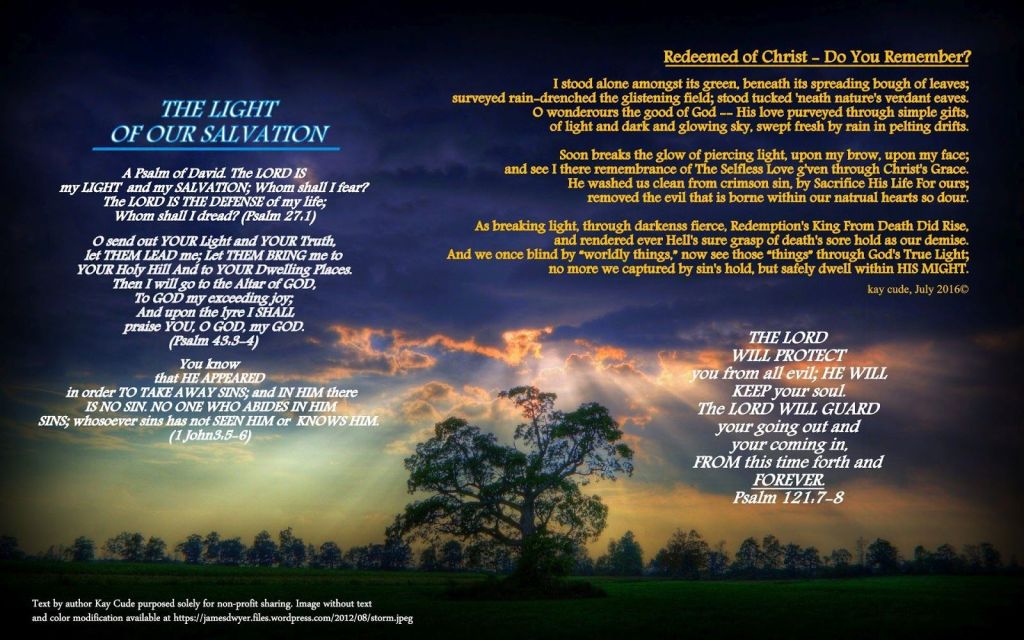
Redeemed of Christ – Do You Remember? I stood alone amongst its green, beneath its spreading bough of leaves; surveyed rain-drenched the glistening field; stood tucked ‘neath nature’s verdant eaves. O wonderours the good of God — His love purveyed through simple gifts, of light and dark and glowing sky, swept fresh by rain in pelting drifts.
Soon breaks the glow of piercing light, upon my brow, upon my face; and see I there remembrance of The Selfless Love given through Christ’s Grace. He washed us clean from crimson sin, by Sacrifice His Life For ours; removed the evil that is borne within our natural hearts so dour.
THE LORD WILL PROTECT you from all evil; HE WILL KEEP your soul. The LORD WILL GUARD your going out and your coming in, FROM this time forth and FOREVER. Psalm 121.7-8
THE LIGHT OF OUR SALVATION A Psalm of David. The LORD IS my LIGHT and my SALVATION; Whom shall I fear? The LORD IS THE DEFENSE of my life; Whom shall I dread? (Psalm 27.1)
O send out YOUR Light and YOUR Truth, let THEM LEAD me; Let THEM BRING me to YOUR Holy Hill And to YOUR Dwelling Places. Then I will go to the Altar of GOD, To GOD my exceeding joy, And upon the lyre I SHALL praise YOU, O GOD, my GOD. (Psalm 43.3-4).
You know that HE APPEARED in order TO TAKE AWAY SINS; and IN HIM there IS NO SIN. NO ONE WHO ABIDES IN HIM SINS; whosoever sins has not SEEN HIM or KNOWS HIM. (1 John 3.5-6)
We are at the end of our look at the life of Jesus through scripture. The first section of His life was seen through verses focused on prophecy, arrival, and early life.
The next section of verses looked at Him as the Son, second person of the Trinity.
We are coming toward the end of our look at the life of Jesus through scripture. The first section of His life was seen through verses focused on prophecy, arrival, and early life.
The next section of verses looked at Him as the Son, second person of the Trinity.
We proceeded into looking at Jesus as the Son’s preeminence, His works, and His ministry. Under ministry & works, I chose verses showing His attributes and aspects of being servant, teacher, shepherd, intercessor, and compassionate healer; and His attributes of omniscience, having all authority and power, and sinlessness.
We are coming toward the end of our look at the life of Jesus through scripture. The first section of His life was seen through verses focused on prophecy, arrival, and early life.
The next section of verses looked at Him as the Son, second person of the Trinity.
This section of verses that show Jesus’ life are focused on His attributes. In His earthly ministry we’ve seen Him as servant, teacher, shepherd, intercessor, and healer. We then looked at His attributes of omniscience, His authority, and now His sinlessness.
He came from glory where righteousness reigns. He descended to an earth that’s cursed where every single human is depraved, thoroughly drenched with a sin nature. He lived among us, sinlessly and perfectly fulfilling the Father’s commands for righteous living. He did this at every moment in every way. Not one blot, not one thought, not one act of anything less than perfection.
For this, He was reviled, mocked, hated, and killed.
In what sense did Jesus become “sin on our behalf”? Does that phrase mean that Jesus literally became a sinner on the cross? …
Based on the above passages, we can safely determine what 2 Corinthians 5:21 does not mean. It cannot mean that Jesus became unrighteous, or that He became a sinner, or that He took on a sin nature, or that He literally embodied sin. … So, then what does it mean? This brings us to our third point. … 3. The best way to understand Paul’s statement (that Jesus became sin on our behalf) is in terms of imputation. Our sin was imputed to Christ, such that He became a substitutionary sacrifice or sin offering for all who would believe in Him.
On the cross, Jesus took our sin upon Himself and purchased our salvation. We have “been justified by his blood” (Romans 5:9), and part of that justification is an imputation of His own righteousness. Paul puts it this way: “For our sake [God] made [Jesus] to be sin who knew no sin, so that in him we might become the righteousness of God” (2 Corinthians 5:21). Jesus is righteous by virtue of His very nature—He is the Son of God. By God’s grace, “through faith in Jesus Christ,” that righteousness is given “to all who believe” (Romans 3:22). That’s imputation: the giving of Christ’s righteousness to sinners.
Ligonier: Jesus’ Sinless Life Jesus lived a representative life. Jesus lived a sinless life, and it was, therefore, a life of representative sinlessness. Our Lord’s obedience stands in the place of His people’s sin. His law-keeping is counted as the law-keeping of those who have faith in Him.
~~~~~~~~~~~~~~~~~~~~
Thirty Days of Jesus Series-
Introduction/Background
Prophecies:
Day 1: The Virgin shall conceive Day 2: A shoot from Jesse Day 3: God sent His Son in the fullness of time Day 4: Marry her, she will bear a Son
Birth & Early Life-
Day 5: The Babe has arrived! Day 6: The Glory of Jesus Day 7: Magi seek the Child Day 8: The Magi Offer gifts & worship Day 9: The Child Grew Day 10- the Boy Jesus at the Temple Day 11: He was Obedient
The Second Person of the Trinity-
Day 12: The Son! Day 13: God is pleased with His Son Day 14: Propitiation Day 15: The Gift of Eternal Life Day 16: Kingdom of Darkness to Light Day 17: Jesus’ Preeminence Day 18: The Highest King Day 19: He emptied Himself Day 20: Jesus as The Teacher Day 21: The Good Shepherd Day 22: The Intercessor Day 23: The Compassionate Healer
Attributes
Day 24: Jesus’ Omniscience Day 25: Jesus’ Authority
We have been through a section of verses that show Jesus’ life in His earthly ministry. We’ve seen Him as servant, teacher, shepherd, intercessor, and healer.
Now we look at His attributes. Today- Omniscience.
CARM.org: The sovereignty of God: His omniscience, omnipresence, omnipotence Omniscience is an attribute of God alone. It is the quality of having all knowledge (Isaiah 40:14). God knows all things possible as well as actual because He has ordained whatsoever will come to pass according to the counsel of His will (Eph. 1:11). He does not need to experience something to know about it completely.
Ligonier: Scripture and the Two Natures of Christ The historic Christian understanding of the person of Christ is that He is one person who possesses two natures: a divine nature and a human nature. Each nature retains its unique properties, and the two natures remain distinct, though inseparably united in Christ’s person. Thus, according to His divine nature, as the second person of the Trinity, the Son of God is omniscient, omnipotent, and so forth. According to His human nature, the incarnate Christ needs to eat food to survive, grows in knowledge, and so forth.
GotQuestions: What does it mean that Jesus is omniscient? Despite the condescension of the Son of God to empty Himself and make Himself nothing (Philippians 2:7), His omniscience is clearly seen in the New Testament writings. The first prayer of the apostles in Acts 1:24, “Lord, you know everyone’s heart,” implies Jesus’ omniscience, which is necessary if He is to be able to receive petitions and intercede at God’s right hand.
~~~~~~~~~~~~~~~~~~~~~~~~~~~~~~~~~
Thirty Days of Jesus Series-
Introduction/Background
Prophecies:
Day 1: The Virgin shall conceive Day 2: A shoot from Jesse Day 3: God sent His Son in the fullness of time Day 4: Marry her, she will bear a Son
Birth & Early Life-
Day 5: The Babe has arrived! Day 6: The Glory of Jesus Day 7: Magi seek the Child Day 8: The Magi Offer gifts & worship Day 9: The Child Grew Day 10- the Boy Jesus at the Temple Day 11: He was Obedient Day 12: The Son! Day 13: God is pleased with His Son
The Second Person of the Trinity-
Day 14: Propitiation Day 15: The Gift of Eternal Life Day 16: Kingdom of Darkness to Light Day 17: Jesus’ Preeminence Day 18: The Highest King Day 19: He emptied Himself Day 20: Jesus as The Teacher Day 21: The Good Shepherd Day 22: The Intercessor Day 23: The Compassionate Healer
We are in the section of my Advent thirty day flow where we examine PROPHECY, ARRIVAL, and EARLY LIFE of Jesus.
In this section I chose verses that reflect the prophecies that predict His coming. Prophecy warns of coming judgment but it also comforts in that it foretells the holy and wonderful resolution of all things for the believer. This resolution didn’t begin with Jesus’ incarnation as a babe in the manger, it began before the foundation of the world when the God-head held an intra-council discussion and Jesus voluntarily chose to become the sacrificial Lamb.
Thirty days of exalting Jesus through selected verses with pictures representing the prophecy, life, death, resurrection, and Second Coming of our Savior.
We are in the flow of verses that prophesied his coming.
History tells us this is exactly what happened, with David’s royal dynasty all but dying out as a result of God’s judgment of His people through Assyria and Babylon. Nevertheless, Isaiah also saw that while the Davidic line would seem to be dead, life would remain within the stump. A shoot—life barely detectable at first—would emerge. But once this shoot went forth, it would become a mighty tree.
He comes forth out of the stem, or stump, of Jesse. When the royal family, that had been as a cedar, was cut down, and only the stump of it left, almost levelled with the ground and lost in the grass of the field (Dan. 4:15), yet it shall sprout again (Job 14:7); nay, it shall grow out of his roots, which are quite buried in the earth, and, like the roots of flowers in the winter, have no stem appearing above ground. The house of David was reduced and brought very low at the time of Christ’s birth, witness the obscurity and poverty of Joseph and Mary. The Messiah was thus to begin his estate of humiliation.
Jesse [Jĕs’se]—jehovah exists or firm. The son of Obed and father of David, and grandson of Boaz and Ruth, and an ancestor of Christ (Ruth 4:17, 22). Jesse had eight sons and two daughters by different wives (1 Sam. 17:12-14, 25). Isaiah speaks of “the stock of Jesse,” a phrase indicating that it was from Jesse the Messiah would come. The humble descent of the Messiah is contrasted with the glorious kingdom He is to have (Isa 11:1).