I was listening to RefNet.fm (Ligonier’s 24-hour Christian station) and Psalm 136 was read aloud. The recurring phrase “for His steadfast love endures forever” seeped into my soul and covered it like a balm. The whole Psalm was refreshing in its praise of God. I pray you have an opportunity to find an audio of the Psalm and hear it. Though it was not sung as it originally was, spoken aloud it had a ring of love and truth that was not otherwise impactful to me as I’d read it myself in the past. I dug deeper and looked into the origin of the Psalm and found these study notes. I pray you are refreshed and encouraged as you read them sometime yourself.
Psalm 135-136, from John MacArthur Study Bible Notes.
These two Psalms complete the “Great Hallal.” The composer and occasion of Ps. 135 are unknown but likely postexhilic. Psalm 135:15-20 is strikingly similar to 115:4-11.
Psalm 135
I. Call to Praise (135:1-2)
II. Causes for Praise (135:3-18)
God’s Character (135:3)
God’s Choice of Jacob (135:4)
God’s Sovereignty in Creation (135:5-7)
God’s Deliverance of Israel (135:8-12)
God’s Unique Nature (135:13-18)
III. Concluding praise (135:19-21)
Psalm 136 This Psalm, extremely similar to Psalm 135, closes the “Great Hallal*.” Unique to all the Psalms, Ps. 136 uses the antiphonal* refrain “for His steadfast love endures forever” after each stanza, perhaps spoken by the people in responsive worship. Author and occasion remains unknown.
I. Call to Praise (136:1-3)
II. Causes for Praise (136:4-22).
God’s Creation (136: 4-9)
God’s Deliverance (136: 10-15)
God’s Care and Gift (136:16-22)
III. Concluding Praise (136:23-26).
*antiphonal = of music, especially church music, or a section of a church liturgy) sung, recited, or played alternately by two groups.
Four years ago I posted a few articles looking at and critiquing the women of She Reads Truth (SRT) and IF:Gathering.
This week a reader emailed a question to me. She wanted to know what I thought of the women of IF and SRT now, after four years had gone by. She asked mainly about She Reads Truth. I’ll update my thoughts on that movement on another day, but today I’m going to focus first on the IF:Gathering:
She asked great questions and valid ones, to be sure. I had thought about doing an update, and her question spurred me to do it. In God’s providence and timing, last week the two women of Sheologians, Summer White and Joy Temby, did a podcast reviewing IF:Gathering. Yay! I listened to it. I am including notes on their insights and review. My thoughts will follow.
As a side note, the Sheologians ladies (Summer White and Joy Temby) mentioned how difficult it is to do discernment ministry. Not that the Sheologians, or even I, focus solely on discernment. But whenever we feel called to write about a person, teaching, or movement in the discernment spheres, it is hard. It is hard on the soul to listen and hear such things said about our God or against our Jesus. It is hard to write negatively. It is hard to think of the people that will be hurt by the conclusions we come to. It’s hard – but it’s important. So we do it.
We don’t do it lightly. I pray, I do hours of research, of course consult the Bible, and I check in other discernment ministries, like I did with the Sheologians. I work hard to be accurate and fair, being biblical without compromise despite a certain person’s or movement’s popularity. That said, here is a synopsis of Sheologians’ PLUSES and PRAISES of IF:Gathering:
They said that the IF ladies produce a conference well, and they know a lot about organizing and using social media and the internet to get their message out.
They mentioned that the Huffington Post did an article about the women and their movement a few years ago, noting in the article the movement’s emphasis on social justice. Sheologians said that if even a secular publication notices a Christian movement, it’s something. I’ll make a few notes about the social justice and popularity below.
The Sheologians noted that the IF website and live gatherings are known for their beautiful long tables laden with flowers backlit by fairy lights, gifts, womanly takeaways, and Pinterest-perfect backgrounds and tablescapes. Summer White wondered, what is the IF:Gathering attracting people TO? If you stripped away all of this, would they still come? Is the movement focused solely on aesthetics? Summer said that Jennie Allen addressed this in her speech, downplaying the aesthetics part of their movement and was relieved because of Jennie’s assurances.
Note- Not an IF:Gathering, just a simulation of one*
The Sheologians praised the IF:Gathering emphasis on the local church as important, and liked that the IF ladies stated that biblically equipping women is their goal. Summer White said that in Jennie Allen’s speech, Allen said that it is the church that must grow. That if the IF:Gathering disappears, who cares as long as local church is strong. This was the right priority, they said.
Many minutes went by in Jennie Allen’s speech without scripture, no Gospel talk, no talk of sin. When sin was mentioned, it was framed as part of our ‘brokenness’ or just that the devil was after you.
When Allen did mention sin 20 minutes into the speech, she made joke about sin, undermining confession of sin and undermining local church by joking about not confessing sin to people you’re in an actual relationship with.
The Sheologian women noted that Jen Hatmaker and Sarah Bessey have spoken at the conference. Both these women are overtly and obviously heretical. This is a problem.
Too much of a focus on emotionalism at the conference. There was a wrackingly grief laden testimony from a women whose small child died. Sheologians agreed that faith through grief can help, but there seems to be an over-emphasis with IF ladies. Also, that is the extent of it, there is no scriptural digging. Lots of emotion but not a lot of Jesus. They noted that story time is only beneficial as long as it ultimately points to Jesus.
Women do not need more emotionalism, we get that in our daily life we need to be pulled away more than running to it.
Jennie Allen got the Trinity wrong in her 2014 book Restless. She wrote that the Holy Spirit is a form of Jesus Christ. He most definitely is not, Summer White said. He is the Third Person of the Trinity. He is God.
There’s a lot of ‘God told me’, which is another mixed message since they talk a lot about women being in the scriptures, so why the emphasis on God directly telling them things, Summer White mused.
Sheologians’ Conclusion
Ultimately the Sheologians noticed that the IF Ladies say one thing and do another. They say they want to promote the local body, but joke about confessing sin to people you actually worship with.
You can’t preach the importance of the local body when you’re going to remove the necessity of confessing sin to people you’re in a relationship with.
You can’t preach importance of local church when you invite speakers who also undermine that doctrine with their heresies and various declarations against the church.
They could not take the IF ladies’ stated commitment to the Bible seriously when they constantly speak of directly hearing from God.
MY THOUGHTS
My warning about the IF:Gathering remains the same as four years ago, if not more fervent. Imagine, a woman who writes a book misrepresenting the Trinity formed a movement that same year where they intend to equip other women. This cannot be.
Direct revelation, ergo, Bible not sufficient
Their continual stance IS direct revelation. Regarding direct revelation, Jennie Allen revealed at the first IF:Gathering how IF got started. The ladies’ penchant to say ‘God told me’ that Summer noticed is in actuality not just a millennial-youth casual phrase. It is based on something terribly unbiblical. Here are Founder Jennie Allen’s words, transcribed from a video clip, actual video below:
For one second I want to give you a behind the scenes of where this all came from. About 7 years ago, a voice from the sky…[nervous laughter] which doesn’t often speak to me, but that day, there was this whisper. It was the middle of the night actually. It was ‘gather and equip your generation. … and for two days my bones hurt.
Doesn’t OFTEN speak to her?
Jennie went on to advise that
not all voices from the sky are God, FYI, but if it IS God he will give you what you need to accomplish what he spoke.
And this women who can’t figure out the Trinity can figure out which voice from the sky is God’s and which is the devil’s?
Margaret Feinberg was a speaker this year at IF:Gathering 2018, and is known for her book “God Whispers: Learning to Hear His Voice” and is a woman who even a liberal book reviewer called an evangelical mystic.
To me, this destroys any credibility the IF Ladies have in urging women to dive into scripture. Obviously for the IF women, it’s important to dive into scripture, as long as there isn’t a voice from the sky giving other orders or whispering into your ear. Then the Bible goes by the wayside.
Popular
HuffPo wrote of the movement back when it first started, piercing the notice of even that secular publication. I always go back to Luke 6:26 which I call the curse of popularity.
Woe to you when all men speak well of you, for according to these things their fathers used to treat the false prophets likewise.
Their first conference sold out in minutes. They were popular even at the start and are gathering even more steam as time goes on. This to me is suspicious, because of the verse. People don’t generally clamor in droves to a solidly Gospel Bible study, in fact, they reject it. Whenever something is instantly wildly popular, be suspicious.
Social Justice
The IF:Gathering is based on social justice, not a Gospel emphasis. They want to equip women with the biblical grounding SO THAT they can be ‘unleashed’ (whatever that means) to go out and promote “healing and reconciliation in the world.” The following is transcribed directly from their own words, an affirmation to the US Federal Government on their non-profit IRS returns,
To gather a new generation of women, equip them with the tools to know God more deeply and live out their purposes and unleash a movement to promote healing and reconciliation around the world.
This new wave of evangelical women is fueled by an ever-growing online culture of high-profile women bloggers and savvy social media types who have laid the groundwork for the new focus. [in Christianity of social justice]
While Christians are called to display kindness and charity to those less fortunate, and to meet saints’ needs, it is not our calling to rectify the sins of man globally. Social Justice is not the Gospel. Here is GotQuestions on Social Justice.
Emotionalism
Though we as women do feel things deeply, and it is our calling and privilege to nurture, we go overboard with the emotions sometimes. Emotional testimonies are not the Gospel.
The IF:Gathering IRS statement of purpose unfortunately includes an attitude of feelings regarding Bible verses rather than equipping women through teaching its intended meaning. Here is their statement of purpose transcribed. Links are below in the resources section.
“IF:Equip- A holistic, strategic, deep way to connect online with a like-hearted community and relevant resources. We hope to prepare women around the world to know God more deeply and to live out their purposes by sharing comments and feelings about daily passages posted online.”
Associations
The Sheologians made mention of several speakers whom the IF ladies had invited to speak at their annual gathering that illustrated problematic associations. Associations are not by themselves an indicator of solidity in a teacher or program, but it is to be taken into consideration. The Bible strictly warns to stay away from those who promote heresy. Mark and avoid them, (Romans 16:17), shut the door and do not even let them into the house. (2 John 1:10).
False teachers corrupt the divine standard and pollute the word, drawing away the unwary and are out greedily to kill, steal, and destroy. Therefore coffee klatches, sympathetic conversations, and mild-mannered toleration is not the biblical method for dealing with them, and are unwise in the extreme to employ.
In its first IF:Gathering, the speakers included feminist heretic Sarah Bessey and Bible-rejecter and church hater Jen Hatmaker.
This year’s Gathering, which concludes tonight, includes
IF:Gathering’s Board of Directors for each of tax years 2013, 2014, 2015, 2016 consisted of Larry Cotton with his wife Diann also as a Director. Sadly from the NY Times last week we learn that Pastor Cotton, who led Austin Stone Community Church, was “placed … on leave last Friday while it investigates “his qualification for his current role of leadership.” This was due to Cotton’s alleged participation in the coverup of a 1998 allegation of sexual abuse by a youth against one of the other pastors working with Cotton at the time, Andy Savage. While the statute of limitations has run out and Savage will not be prosecuted, the fallout of the accusation includes investigation of Cotton into his possible part in the incident and alleged coverup, so he is relieved of ministerial duty. It will be interesting to see what the IF Ladies, especially Jennie Allen, who called both Larry and Diann mentors, will say or do, if anything.
Associations matter.
I believe enough credible and long-term information exists to illustrate that submitting to Bible studies generated by these women is not healthy for your spiritual life. That pursuing unleashing,global healing and reconciliation, and social justice is not the Gospel call to women for a long-term or even short term lifestyle. That these ladies are to be avoided. There are other women to learn from. My stance is that women do not have to learn from women. They can and should learn from men. But if you feel compelled to search for women to learn from, Bible studies or devotionals to obtain, here are a few choices. I also enjoy and take inspiration from the older missionary stories, such as Gladys Aylward whose story is captured in A Little Woman or Elisabeth Elliot, or biographies of theologians’ wives such as Martin Luther’s wife Katherine Von Bora, or Susannah Spurgeon for example.
Ladies, please stay away from IF:Gatherings.
—————————————————-
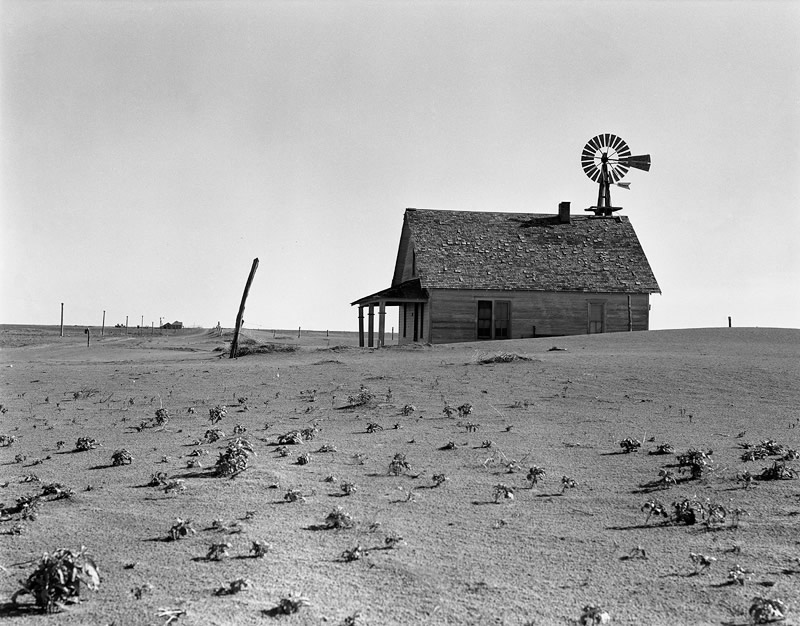
In the Tribulation, agriculture will wither under a scorching sun.
Dorothea Lange, Abandoned farm north of Dalhart, TX. 1938.
At the end of the end days, during the Tribulation where all men living on the earth will be judged in wrath, there will be three sets of successively worsening judgments (or four sets, if the Seven Thunders of Revelation 10:1-4 are judgments).
There will first be the 7 Seal Judgments of Revelation 6, they open the Tribulation. Then the wrath of God is demonstrated through 7 Trumpet Judgments of Revelation 8-9. These are terrible judgments, but by God’s grace, some repent through them. After that there are the 7 Bowl Judgments. Revelation 15 opens with the 7 Bowl Judgments.
Then I saw another sign in heaven, great and amazing, seven angels with seven plagues, which are the last, for with them the wrath of God is finished. (Revelation 15:1).
These are the most terrible of all. They are so bad that no one is even allowed in the heavenly throne room sanctuary until they are concluded.
And one of the four living creatures gave to the seven angels seven golden bowls full of the wrath of God who lives forever and ever, 8and the sanctuary was filled with smoke from the glory of God and from his power, and no one could enter the sanctuary until the seven plagues of the seven angels were finished. (Revelation 16:7-8)
One of the Bowl judgments God pours on the people of the earth the plague of a hot sun. By this point in the Tribulation, no one is repenting. They know that God is sending His wrath onto the world, but they shake their fist at Him and refuse to repent. By this time, battle lines have been set in eternal stone. In Revelation 13 people either took the mark of the beast and thereby signaling their worship of satan, sealing their doom, (Revelation 14:9-10), or they refused the mark, thereby signaling their worship of the Lamb who lives forever, sealing most to their martyrdom.
The fourth angel poured out his bowl on the sun, and it was allowed to scorch people with fire. They were scorched by the fierce heat, and they cursed the name of God who had power over these plagues. They did not repent and give him glory. (Revelation 16:8-9).
God makes the sun hotter, so hot that men will be on fire if they are exposed to it. God is powerful and controls the sun!
Let us look to a happier time, the Millennial Kingdom. God’s Prophets had much to say about this period in earth’s history, also. The Kingdom will be set up on earth after the Tribulation is over, and the Old Testament saints and Tribulation saints have been resurrected. Those who refused the mark of the beast and lived will populate this kingdom, too. Because they are mortal, they’ll re-populate the earth. It is at this time the resurrected Old Testament saints whom Jesus promised land and an earthly kingdom with Him (the Lion of the Tribe of Judah, Messiah) on the throne, will have all their promises fulfilled. This is Israel’s gift.
In Isaiah 30:23-25 we read that during this time of the Millennium Kingdom,
And he will give rain for the seed with which you sow the ground, and bread, the produce of the ground, which will be rich and plenteous. In that day your livestock will graze in large pastures, 24and the oxen and the donkeys that work the ground will eat seasoned fodder, which has been winnowed with shovel and fork. 25And on every lofty mountain and every high hill there will be brooks running with water, in the day of the great slaughter, when the towers fall.
John MacArthur says of this time:
In the Messianic Kingdom of that future day, agriculture, cattle raising, food production, and water resources will prosper. The prophet predicted the redemption of nature. (cf. Rom 8:19-21)
In Isaiah 30:26 we read of further blessings:
Moreover, the light of the moon will be as the light of the sun, and the light of the sun will be sevenfold, as the light of seven days, in the day when the Lord binds up the brokenness of his people, and heals the wounds inflicted by his blow.
The light of the sun will be seven times hotter?
MacArthur again:
The benefits from the natural bodies of light will be much greater. Increase of the intensity of their light will work to people’s advantage, not to their detriment as in Revelation 16:8-9.
In the Millennial Kingdom, a gentle, bright sun seven times
warmer will flourish the earth’s crops
When we read that God is sovereign overall creation, He is sovereign. He created the sun. As the Potter, He can make it do what He wills. During the Tribulation, it will be a mechanism for judgment, scorching men, who curse it. In the Millennium, the sun will be a mechanism for prosperity, and men will bless their Creator for giving them plenteous sunshine, healthful, glowing, and beautiful.
We groan, and cannot wait for redemption of our mortal bodies into glorified vessels worthy of seeing our Holy God. The creation groans too. When the creation is redeemed, it will rejoice also.
For the creation was subjected to futility, not willingly, but because of him who subjected it, in hope that the creation itself will be set free from its bondage to corruption and obtain the freedom of the glory of the children of God. (Romans 8:20-21).
This is how the creation will be set free. The sun will shine upon peaceable kingdom, over a flourishing agriculture, making men and crops thrive. Our Creator is majestic in power and sovereign over creation. He is to be worshiped, loved, praised. Our Jesus who was with God at the creation and who sustains all creation and without whom nothing was made that was made, is our hope. He is the hope of all creation. Our eternal Hope, who reigns forever.
This short encouragement first appeared on The End Time in March, 2011
~~~~~~~~~~~~~~~~~~~~~~~~~~~
Who can understand a power so great the earth trembles at a mere glance, yet is also gentle enough to wipe our tears from our face? THAT is our God. Never forget that.
“He looketh on the earth, and it trembleth: he toucheth the hills, and they smoke.” (Psalm 104:32)
“He will swallow up death in victory; and the Lord GOD will wipe away tears from off all faces; and the rebuke of his people shall he take away from off all the earth: for the LORD hath spoken” (Isaiah 25:8)
“And God shall wipe away all tears from their eyes; and there shall be no more death, neither sorrow, nor crying, neither shall there be any more pain: for the former things are passed away.” (Revelation 21:4)
I will bless the LORD, who has given me counsel: my reins also instruct me in the night seasons. (Psalm 16:7)
I am not sure what this means but the poetic language moves me. Here is Matthew Henry on it:
He repeats the solemn choice he had made of God for his portion and happiness (v. 5), takes to himself the comfort of the choice (v. 6), and gives God the glory of it, v. 7. This is very much the language of a devout and pious soul in its gracious exercises.
…
Making a good use of it. God having given him counsel by his word and Spirit, his own reins also (his own thoughts) instructed him in the night-season; when he was silent and solitary, and retired from the world, then his own conscience (which is called the reins, Jer. 17:10) not only reflected with comfort upon the choice he had made, but instructed or admonished him concerning the duties arising out of this choice, catechized him, and engaged and quickened him to live as one that had God for his portion, by faith to live upon him and to live to him. Those who have God for their portion, and who will be faithful to him, must give their own consciences leave to deal thus faithfully and plainly with them.
All this may be applied to Christ, who made the Lord his portion and was pleased with that portion, made his Father’s glory his highest end and made it his meat and drink to seek that and to do his will, and delighted to prosecute his undertaking, pursuant to his Father’s counsel, depending upon him to maintain his lot and to carry him through his undertaking. We may also apply it to ourselves in singing it, renewing our choice of God as ours, with a holy complacency and satisfaction.
Henry, M. (1994). Matthew Henry’s commentary on the whole Bible: complete and unabridged in one volume (p. 763). Peabody: Hendrickson.
So, one does their best to adhere to God’s statutes, acting in His best interest and according to His will. Where we stumble, we repent. And then in the night seasons, let the conscience percolate, giving space and room to the Spirit to convict, admonish, encourage, or bring things to mind. Is that how you see the verse too?
We read of Jael in the Bible Reading Plan today. God’s providential intervention is evident in today’s reading.
Jael
Jael was the wife of Heber the Kenite. Sisera had been cruelly oppressing the Hebrews for 20 years. The people cried out. Deborah was civic leader at that time, prophesying and judging. She sent for Barak, the military leader and told him to go take care of the problem. Barak could freely decide what to do. He could go or he could not go, the choice was his. He said he would not go unless Deborah came with him. (Judges 4:8). His answer was in effect, no. Deborah replied that she would go with Barak, but it would be an embarrassment to him because God would deliver Sisera into the hands of a woman, and Barak would not get the military glory for the victory.
Barak freely made his choice, but now the outcome would occur from another quarter, just as Mordecai had said it would if Esther decided against her action.
Into the story enters Jael. After Barak routed Sisera’s army, Sisera fled. Sisera aimed toward the tent of Heber the Kenite. Sisera knew there was peace between Jabin the king of Hazor (Sisera’s King) and the house of Heber the Kenite. Heber had separated from the Kenites and was settled far from the action. Sisera ran, believing he was safe to go toward the area where there was no fighting and where there was peace between the parties. Normally he would be right, especially since hospitality customs were so strong in protecting those who are invited into the tent. However in this providential case, Sisera was wrong. Jael invited Sisera into the tent, gave him drink, and covered him as he fell asleep.
Note that Sisera fell asleep. He had a hard day of fighting, but even though his life was in peril he felt comfortable enough where he let down his guard and fall asleep. Women in those days were responsible for pitching the tents and so Jael was strong enough and familiar enough with how to efficiently hammer a tent peg into the ground. As Sisera slept, she drove a tent peg into his temple and pinned his head to the ground. The verse succinctly states, “So he died.” (Judges 4:21b).
And behold, as Barak was pursuing Sisera, Jael went out to meet him and said to him, “Come, and I will show you the man whom you are seeking.” So he went in to her tent, and there lay Sisera dead, with the tent peg in his temple. 23So on that day God subdued Jabin the king of Canaan before the people of Israel. (Judges 4:22-23).
Barak had kind of said “I will go” but not really. Placing conditions on your obedience to God isn’t really obedience to God. I like how the verse says God subdued Jabin.
Whether Esther went in or didn’t go in, God would deliver the Jews from Haman. Whether Barak went to battle or didn’t go to battle, God would deliver the Jews from King Jabin and Commander Sisera. Both Esther and Barak freely decided on a course of action. Yet both outcomes occurred at the providential hand of God.
And Abraham said of Sarah his wife, “She is my sister.” And Abimelech king of Gerar sent and took Sarah. 3 But God came to Abimelech in a dream by night and said to him, “Behold, you are a dead man because of the woman whom you have taken, for she is a man’s wife.” 4 Now Abimelech had not approached her. So he said, “Lord, will you kill an innocent people? 5 Did he not himself say to me, ‘She is my sister’? And she herself said, ‘He is my brother.’ In the integrity of my heart and the innocence of my hands I have done this.” 6 Then God said to him in the dream, “Yes, I know that you have done this in the integrity of your heart, and it was I who kept you from sinning against me. Therefore I did not let you touch her. 7 Now then, return the man’s wife, for he is a prophet, so that he will pray for you, and you shall live. But if you do not return her, know that you shall surely die, you and all who are yours.” So Abimelech rose early in the morning and called all his servants and told them all these things. And the men were very much afraid. (Genesis 20:2-8)
Porn: I’m not hurting anybody. It’s my decision. I’m the only one affected.
Adultery: Nobody knows, it’s fine. No one else is hurt by it.
Drunkenness: So what if I drink alone in my house, nobody else is being hurt, are they?
And so on. Sin is sin. Sin affects not only the perpetrator of sin but those around him or her.
Abraham told a half-truth. Sarah was his half-sister. But he left off a critical piece of information, one that Abimelech was seeking in good faith: is Sarah married? Abraham was silent on that score. He committed a sin of omission.
James 4:17 declares, “Anyone, then, who knows the good he ought to do and doesn’t do it, sins.”
Abraham also committed a sin against God by not trusting Him with the circumstance.
Poor Abimelech. There were certain things he had to do as a result of Abraham’s lie, such as returning Sarah, making arrangements to get Abraham back, telling the servants and so on. Abraham caused an upset against another person, a major one that almost cost Abimelech his life.
Think of Achan in Joshua 7. He stole some things in the military victory, though the Israelites were warned not to. Although the account shows that Achan individually was guilty of coveting and taking these war spoils, Joshua 7 opens with a declaration that the whole community of “the children of Israel [had] committed a trespass” (Joshua 7:1). Achan’s sin wasn’t individual, for 36 men lost their lives in the battle of Ai, which was lost because of Achan’s sin. (Joshua 7:11). All of Achan’s family were stoned as a result. (Joshua 7:24).
Whether sins of omission or commission, sin is never individual. It harms the person sinning, it harms the family, church, or even the nation. Most of all, personal sin is against God. Like ripples in a pond, sin extends it tentacles outward.
Finally, as David declared in Psalm 51:4,
Against you, you only, have I sinned and done what is evil in your sight, so that you may be justified in your words and blameless in your judgment.
Lest you be wise in your own sight, I do not want you to be unaware of this mystery, brothers: a partial hardening has come upon Israel, until the fullness of the Gentiles has come in. (Romans 11:25).
The fullness of the Gentiles, that is when the full number of Gentiles are redeemed, the fullness of the Gentiles will bring the salvation of Israel. Follow now; the fullness of Israel will bring the kingdom. So you have the fullness of the Gentiles and then they’re raptured out, God redeems Israel and when the fullness of Israel is redeemed, the kingdom comes. And so with great joy does Paul predict this tremendous event that will bring about what it says in verse 26, “And so all Israel shall be saved,” after the fullness of the Gentiles have entered in.
At a certain point in earth’s history to come, it is promised to us that Jesus will lift His church composed of Christians dead and alive, into heaven to be with Him. Then he will hurl His stored-up wrath upon earth to punish the unbelieving nation Israel, and the sinful Gentile world. Some people say there will be no rapture at all. Others say that it will happen at the end of or in the middle of the time of wrath (AKA the Tribulation, or Time of Jacob’s Trouble). Since the rapture is in the Bible, and since it is a single even that is promised to occur, it can’t happen both before the Tribulation and at the end. Therefore one of those positions is right and one of them is wrong.
Scripture supports this stance that the rapture will happen before Jesus begins the last days punishments. Paul taught this in his treatment of the subject in 1 Thessalonians and 1 Corinthians 15:42-57, it’s in Revelation, as well as being taught implicitly throughout other books of the Bible.
The event is supposed to be a hope to believers, and an encouragement, said Paul in 1 Thessalonians 4:18. When you look around the dark world with its sin and evil, take hope in the knowledge that Jesus has a plan. His plan includes filling a quota for His Church (Romans 11:25). When that occurs, He will remove His Bride from the wrath, because we are not appointed to it. (Revelation 3:10). We will appear before His Bema seat to receive rewards for our service to Him while we were on earth, (2 Corinthians 5:10), and then enjoy the Marriage Supper of the Lamb. (Revelation 19:7–10). Meanwhile on earth, the Tribulation will have begun.
It is a joy to understand that God has not cancelled His promises to Israel and will return His attention ot his chosen nation in due time. He will fulfill His promises, sadly, the wrath, then joyfully, the bliss.
In our Bible Reading Plan we’d read Isaiah 23. In it, was Isaiah’s prophecy against Tyre. Tyre was a major city on the coast, to which many ships from afar brought their goods to trade and sell. Tyre was held in high esteem by all around. (Isaiah 23:8). It had prestige and renown.
Is this your exultant city whose origin is from days of old, whose feet carried her to settle far away? 8Who has purposed this against Tyre, the bestower of crowns, whose merchants were princes, whose traders were the honored of the earth? 9The LORD of hosts has purposed it, to defile the pompous pride of all glory,c to dishonor all the honored of the earth. (Isaiah 23:7-9)
When a city becomes so vaunted, the leaders of the city become proud. Hence the reason for Isaiah’s oracle against Tyre. (Isaiah 23:9). They attributed their success and fame to themselves, and not to God.
This situation reminded me of the scene in Daniel 4. King Nebuchadnezzar displayed the same problem.
and the king answered and said, “Is not this great Babylon, which I have built by my mighty power as a royal residence and for the glory of my majesty?” (Daniel 4:30).
He attributed the city of Babylon’s success and fame to himself, and not to God. For his selfish boastfulness and pride, God determined to remove the kingdom from Nebuchadnezzar for 7 years, wherein he would live among beasts as a mad person and eat the grass of the field. When 7 years was over, God restored reason to the king and also the kingdom. Nebuchadnezzar praised God for all His glory.
When we see the glittering towers of the city, its cathedrals, towers, strongholds, and castles, we tend to become proud of our accomplishment in building them. We admire the Eiffel Tower, the Statue of Liberty, the Sears Tower, the Windsor Castle, the Taj Mahal… We enlarge our sea ports and construct airports and enjoy the trade and commerce merchants willingly bring to the city.
We applaud man’s ingenuity in building these majestic buildings, we love the fame and renown these landmarks bring to the city and we become boastful inhabitants. But we forget that we have no strength of our own, and no intellect, or ability unless God grants it.
Tyre was razed in 332 BC when Alexander the Great conquered it. And Babylon, we know was felled in one night as described in Jeremiah 51:8 and Daniel 5:30.
If a prophet were to prophesy today, what oracle might be spoken about New York City? Los Angeles? Paris? London? Ezekiel 38:20 prophesies a future day when all walls will crumble to the ground. This page shows how many times God said He will destroy a city for its pride and rebellion. We know He destroyed four Cities of the Plain in one night, Sodom, Gomorrah, Admah, Zeboiim.
The end result of pride, is destruction. This is reiterated in the New Testament, in today’s reading of Matthew 11. There is a section between verses 20-24 called “Woe to Unrepentant Cities” such as Chorazin, Bethsaida, Tyre, Sidon, and Capernaum.
Pride goes before destruction, and a haughty spirit before a fall. (Proverbs 16:18). The verse applies to cities as well. The Isaiah verse we’d read yesterday is warning about this.
Church signs. Most of them are cringeworthy. The messages on them try to be clever, punny, funny, or light-heartedly serious. The worst simply promote false doctrine or are erroneous in terrible unintended double entendre ways.
None really work, or at least not the way the sign-writer intended them. Why not just put a Bible verse on there? Or announce the times of worship and welcome one and all?
A few days ago, a friend sent me an email that contained a motto from a streetside Baptist Church sign. The sign read,
“No one can separate you from the love of God but you”.
This is not true. If we could separate from God’s love, we would be God, because we’d be stronger than Him. Let’s look a bit closer:
First, the saved. Can they be separated from God’s love?
We are sealed with the Holy Spirit. (Ephesians 1:13). Can man UNseal what God has sealed? No. We do not have that much power
Next, the unsaved: can they separate themselves from God’s love?
If they refuse to repent, they can. But all people are so drenched in their sin nature and blinded to God’s love no one would ever repent by themselves, unless God drew them first. (John 6:44).
So no matter who you’re talking about, we cannot separate ourselves from God’s love. I reject the statement on that church sign as false. Friends, don’t believe every sign.