Poetry by Kay Cude. Used with permission.
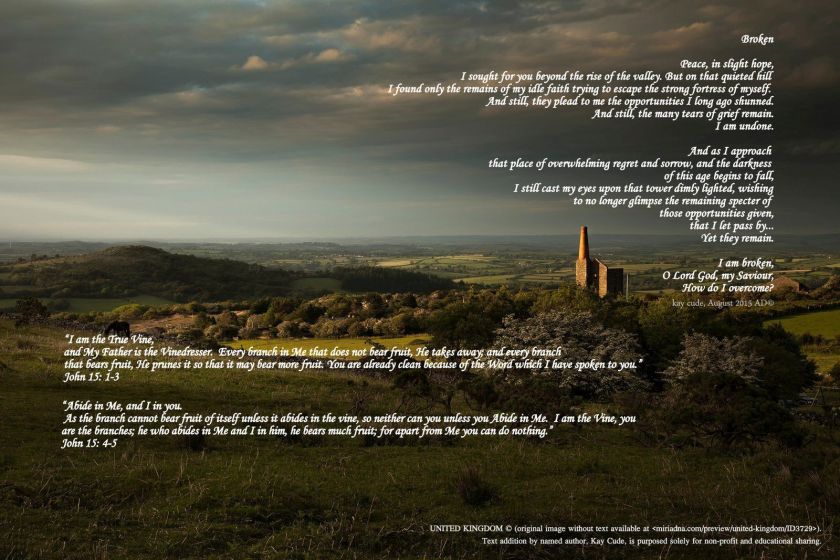
Whoever has the Son has life; whoever does not have the Son of God does not have life. (1 John 5:12)
Poetry by Kay Cude. Used with permission.
Whoever has the Son has life; whoever does not have the Son of God does not have life. (1 John 5:12)
So cute!
But not cute.
This Grace To You essay brings the point home.
What do you think about when you see a nativity scene? We might recognize the baby in the manger as God in flesh. But seeing Christ as a helpless and vulnerable infant can delude us into thinking that the humility of the incarnation was not isolated to His physical form—that somehow, His deity was also diminished.
And it’s easy to read the birth narratives in the gospel accounts without gaining a full sense of Christ’s eternal glory and supremacy. Those attributes figure more prominently at the end of His earthly sojourn rather than the beginning.
Where can we see that glory and supremacy? Is it on the cross? The Man-God hung on that tree, He was perfect in every way yet absorbing all God’s wrath for sin, separated from His eternal father for agonizing hours. He was the suffering servant, bleeding and wounded and humble, and scorned and rejected. He hung there…
But He is not still there.
We look to Jesus when we want to praise or seek comfort, and we often think of the cross. The cross is the symbol of death, new life, eternity. We respect the cross as the execution method of what Jesus suffered for us in obedience to the Father. The cross is everything to us, but it is not all.
Because Jesus rose.
So the bloody, unrecognizable fleshly Man is not still on the cross. He is in heaven, robed majestically, at the right hand of the Father, ministering as KING OF THE UNIVERSE!
12Then I turned to see the voice that was speaking to me, and on turning I saw seven golden lampstands, 13and in the midst of the lampstands one like a son of man, clothed with a long robe and with a golden sash around his chest. 14The hairs of his head were white, like white wool, like snow. His eyes were like a flame of fire, 15his feet were like burnished bronze, refined in a furnace, and his voice was like the roar of many waters. 16In his right hand he held seven stars, from his mouth came a sharp two-edged sword, and his face was like the sun shining in full strength. (Revelation 1:12-16)
Don’t leave the baby in the manger or the man upon the cross. When you think of Jesus daily, remember Him as He is now.

This was first published in January 2017. It’s been updated in minor ways and some resources added. Enjoy!

Q. A reader emailed and asked how can she understand that Beth Moore and Joyce Meyer and other false teachers like them go dramatically outside of Scripture, while other women don’t?
A. The Holy Spirit is giving discernment. Discernment is a skill. We as believers pray, study, read, and work the scriptures through your mental capacities and reactions. Like any skill, it grows muscular through use. Other women who don’t use it, are weak. They are the ones who get captured, laden down by many sins. The Bible says “For among them are those who creep into households and capture weak women, burdened with sins and led astray by various passions,” (2 Timothy 3:6.)
It is a process. If you do not read scripture and study it and allow it to divide marrow from bone (Hebrew 4:12), then we have these ladies who are laden down, confused. They are unable to endure sound doctrine because the sin in them prevents clear thinking. The longer it goes, the worse it gets. Then they seek a false teacher to suit their passions so the sin in them won’t collide so harshly with the sound doctrine of the Bible.
Last, they begin heaping these teachers up. (2 Timothy 4:3). There is a flavor of a false teacher for every flavor of sin. Beth Moore offers psychology and self esteem, also emotionalism. Joyce Meyer offers health-wealth. Christine Caine offers social justice. IF:Gathering women offer a faux-discipleship/fellowship.
Some women (and men) have been given the gift of Discerning of Spirits (1 Corinthians 12:4-11). They are the ones whom the Holy Spirit has installed in a local congregation for the purpose of edifying others, building up the body through their extra dose of the gift, if you will. They are the encouragers, gentle path-correcters, alarm ringers.
Discernment begins with prayer, study, and repentant worship. The exercise of the discernment muscle comes in when you check the scriptures to see if the things you are taught are so, as Paul noted that the Bereans did. (Acts 17:11). Hebrews 5:14 says that we train ourselves in discernment to go from milk to meat. It is by ‘constant use’ of the skill that it is honed, the verse says.
The more you listen, check, pray, and read from the Bible, the more you are exercising that muscle, and it will get strong. The discerning ones who diligently strive to retain clear vision can spot and resist these false teacher. The Word has divided false from true, not man’s wisdom.
This is my take on it. Other thoughts and verses welcome. As always, check the Bible and test what is written her and anywhere. 🙂
———————————————-
Further Reading:
Expository Listening: A Practical Handbook for Hearing and Doing God’s Word
“Do not merely listen to the word, and so deceive yourselves. Do what it says.”––James 1:22 In many people’s mind, if they don’t get anything out of the sermon, it’s the preacher’s fault. But that’s only half true. The Bible teaches that listeners must partner with the preacher so that the Word of God accomplishes its intended purpose of transforming their life. Expository Listening is your handbook on biblical listening. It is designed to equip you not only to understand what true, biblical preaching sounds like, but also how to receive it, and ultimately, what to do about it. You need to know how to look for the Word of God, to love the Word of God, and to live the Word of God. In this way, God and His Word will be honored and glorified through your life
John MacArthur: A Plea for Discernment, sermon series
Tim Challies: The Discipline of Spiritual Discernment (a book)
I was looking through my laptop files for a photo to go with my blog essay. The writing of the essay is easy for me, but finding a photo to visually represent what sometimes are very abstract concepts is hard. I am fairly literal, so it takes me a good while to come up with something.
So I was looking and looking at many photos I’ve taken since moving to Georgia 12 years ago. It seems like just yesterday, but it’s in fact over a decade since I got here. Time flies.
I noticed after a while in looking at photo after photo, that a lot of the people I’d taken photos of are dead now. More than a few. Most of them were elderly, but one sweet little boy I’d had in school died very young.
I pondered this for a few days.
Meanwhile, I received a Facebook message from someone I didn’t know but I knew her name. That is because I knew her dad. We never met in real life, but he was stuck with my writing ministry and occasionally corresponded. I had not heard from him in a while. She was messaging me to let me know he had died after a struggle with cancer.
We never really know what kind of effect we have on people. In real life or online, we affect the fellow believers, like a rock plunked into a pond. The daughter wanted me to know that he expressly wanted me to know of his passing. This was impactful to me.
Meanwhile, my father had passed away three years ago, the first significantly close-to-me person to leave this earth and fly toward the final destination. He was 81. My mother is 80. Her sister is 85. Other aunts are over 80. Life might be long on this earth, but it’s not eternal. I read the obituaries regularly now.
I used to think that was funny, or weird, or morbid, when my relatives did it. Now I’m their age when I saw them do it and I do it too now. I’ve turned in to my grandmother.
You get older and you realize that something you remember or that happened was not ‘just a few years ago’ but a few decades ago. I have more than 5 decades under me. I have active memories that span 55 years. I remember when the Beatles played on Ed Sullivan in February 1964. The men who walked on the moon. The 1968 Democratic Convention riots. Civil rights marches, hippies, burning bras, openly gay people in the streets for the first time, Reagan getting shot, Berlin Wall coming down, the US Hockey team beating the Russians at the Olympics, American hostages released from Iran, OJ Trial, 9/11, Arab Spring, and so on.
It really makes you wonder about the brevity of life. The Bible tells us it is a vapor. (James 4:14). When you get older, you begin to realize just how vaporous life is.
To that end, I recommend a book I’ve just finished reading. It’s Living Life Backward: How Ecclesiastes Teaches Us to Live in Light of the End, by David Gibson. The book blurb says:
What if it is death that teaches us how to truly live?
Keeping the end in mind shapes how we live our lives in the here and now. Living life backward means taking the one thing in our future that is certain—death—and letting that inform our journey before we get there
Looking to the book of Ecclesiastes for wisdom, Living Life Backward was written to shake up our expectations and priorities for what it means to live “the good life.” Considering the reality of death helps us pay attention to our limitations as human beings and receive life as a wondrous gift from God—freeing us to live wisely, generously, and faithfully for God’s glory and the good of his world.
Here is another resource: an article titled
The Stings of Death: An Article Not Just for Old People
However, in today’s world, there are practical, earthly matters that intensify the sting of death for those left behind. There are stings still related to death. Burying a loved one can be a complex and confusing matter that feels like an intrusion in one’s time of grieving. The good news is that there are several ways to take care of these practical matters surrounding death ahead of time so those you leave behind will be more able to mourn in peace.
The good news of Jesus sacrificial death and resurrection mans that we do not have to live an eternal life in punishment in hell. We who have repented and believed on Him will live forever in bliss, joy, and glory with Him. He has imputed His righteousness to us, and when God looks at us, He sees us through His Son.
Our death is simply a transition from one state of being to another. And I’m glad that we will not mourn in heaven, and He will wipe all tears from our eyes. Our joy will be complete.
Then I heard a voice from heaven say, “Write this: Blessed are the dead who die in the Lord from now on.” “Yes,” says the Spirit, “they will rest from their labor, for their deeds will follow them.” (Revelation 14:13)

Does it ever make you feel awe-inspired to know that you and I are in a line that extends all the way back? That people like Ruth and David and Paul and Justin Martyr and Jonathan Edwards and Charles Spurgeon and John MacArthur are in the same line we are in? Because of Christ’s blood, we are part of a Godly lineage that from one generation to another that is passing the baton of faith forward.
It’s a shame more people don’t study and read about church history. It’s fascinating.
One thing I do know, our elder says that it’s good to read ‘old books’, you know, the dead old guys. We in the present time can’t see our blind spots, but when we read the older tomes, we can. Here is John MacArthur’s take on it:
If I want to test my interpretation of Scripture, invariably I go backwards to those in the past who have the noble, proven, interpreters of Scripture whose books are still in print because they have stood the test of time and the scrutiny of scholarship. And I go back to make sure that I’m not inventing something. I just want to take the baton from somebody. I want to interpret the Word of God the way it’s always been interpreted and I want to be faithful to those in the past who were led by the Spirit of God to understand the Word of God. ~Source
Our elders quote the Puritans a lot. Currently Jonathan Edwards and John Owen are getting heavy rotation, lol, to use old disc jockey lingo. There are a lot of Puritans worth reading. They are so edifying. John Bunyan for example, wrote so much more than Pilgrim’s Progress, though that book is the most famous Christian book after the Bible and has never been out of print for 340 years!!
From a purely literary viewpoint, The Pilgrim’s Progress is without a doubt the greatest allegory ever written. Critics have called it “a hybrid of religious allegory, the early novel, the moral dialogue, the romance, the folk story, the picaresque novel, the epic, the dream-vision, and the fairy tale” (Lynn Veach Sadler, John Bunyan, Twayne Publishers, 1979). The world over, The Pilgrim’s Progress is the second best-selling book in history (the first is the Bible) and has been translated into over 200 languages. ~Source
The Puritan Study (Part 1) The Delights and Pains of a Puritan Study
Here begins a several part study on building (and using) a Puritan library of your own. Of all the areas of my library, the Puritan section is the most useful.
The “Puritans” are a group of people I (very) loosely define as faithful Christians of the 16th and 17th centuries, as well as those who carried on the Puritan tradition into the 18th and 19th centuries. My definition includes John Bunyan and John Owen (true Puritans), Jonathan Edwards (post-Puritan), and Charles Spurgeon (who carried the Puritan tradition). Other names you may not be familiar with include Brooks, Boston, Burgess, Sibbes, Flavel, Reynolds, Ames, Manton, Rutherford, Newton and Clarkson. You will become more familiar with the names as we continue on.
This series is based upon two fundamental convictions.
First, the church today benefits most from leaders and preachers who are burdened to present expositional messages – sermons drawn from principles clearly demonstrated in scripture. The preacher is to “preach the Word” by taking every precaution in the name of accuracy and then exhorting and encouraging by earnest application.
Secondly, an efficient and workable library of the best Puritan literature is a great way to faithfully preach and apply scripture to the hearts of your hearers. The Puritans are no substitute for careful exegesis and use of contemporary commentaries. But once the foundational research is complete, the Puritans will open up new threads of understanding and application on your text. Pastors and congregations today truly need the Puritans.
I would not be writing this series if I were not personally acquainted with the great fruitfulness of Puritan study. The Puritans have matured my understanding of God, the Christian life, the idols of my heart, marriage and parenting. I have a deeper appreciation for the Cross, grace and the resurrection because of their words.
Well, there ya go.
Click here to access all posts in Reinke’s The Puritan Study series.
Part 1: The delights and pains of Puritan study
Part 2: The rules of a Puritan library
Part 3: The people of a Puritan library
Part 4: Why our effective use of the Puritans begins with our Bibles
Part 5: Print book searches
Part 6: Electronic searches
Part 7: Using the Christian Classics Ethereal Library
Part 8: To quote or not to quote?
Part 9: The strategy of building a Puritan library
Part 10: Concluding thoughts, part 1
Part 11: Concluding thoughts, part 2
Part 12: Q&A > Which Puritan should I start with?
Part 13: Photographs of the Puritan Library
And under that, there’s another set of links reviewing various Puritan books.
Here are even more resources for you.
Tim Challies:
The Puritans: John Bunyan, Thomas Boston, Stephen Charnock, Richard Baxter (and so on!)
A few practical lessons from the Puritans
Search at his site challies.com by plugging in ‘Puritans’, there are even more search results that come up than I have posted here
Phil Johnson says of the Mt. Zion Bible Chapel online library
A wonderful collection of literature and sermons from Mt. Zion Bible Church in Pensacola, FL. This church’s literature ministry has quietly, faithfully been sowing seed for years. Only heaven will reveal how bountiful the harvest has been. The Web site has an amazingly full collection of choice documents—including the complete works of John Bunyan. Mt. Zion supplied many Spurgeon sermons for The Spurgeon Archive
They have free study guides and courses. For example, there’s a study guide to go along with reading Bunyan’s Pilgrim’s Progress. So wonderful! A plethora of resources.
Enjoy!

Cast your burden upon the LORD and He will sustain you; He will never allow the righteous to be shaken. (Psalm 55:22)

Matthew Henry Whole Commentary:
Care is a burden; it makes the heart stoop (Prov. 12:25); we must cast it upon God by faith and prayer, commit our way and works to him; let him do as seemeth him good, and we will be satisfied. To cast our burden upon God is to stay ourselves on his providence and promise, and to be very easy in the assurance that all shall work for good. If we do so, it is promised,
1. That he will sustain us, both support and supply us, will himself carry us in the arms of his power, as the nurse carries the sucking-child, will strengthen our spirits so by his Spirit as that they shall sustain the infirmity. He has not promised to free us immediately from that trouble which gives rise to our cares and fears; but he will provide that we be not tempted above what we are able, and that we shall be able according as we are tempted.
2. That he will never suffer the righteous to be moved, to be so shaken by any troubles as to quit either their duty to God or their comfort in him. However, he will not suffer them to be moved for ever (as some read it); though they fall, they shall not be utterly cast down.
Henry, M. (1994). Matthew Henry’s commentary on the whole Bible: complete and unabridged in one volume (p. 823). Peabody: Hendrickson.
If you are in Christ, the Lord will provide for you, He will be with you in trials, He will use you for His glory – and your good. Depend on these truths. Cling to them.
The Bible Belt has been on a diet. The belt keeps tightening its notches as the belly shrinks… which is to say that the Bible Belt isn’t really as fat with Bible as people think.
I surmise that nowhere is as biblical as people think. Everywhere has its challenges.
However, in the south, we use words that are Christian-y. Due to a lack of comprehension about what these words actually mean, they’ve been drained of meaning.
Fellowship is one of those words.
We use the word fellowship here as a synonym for most any social gathering where some Christians are likely to be congregating, and even non-Christians with us. Now, it’s OK to gather in social affinity, like-minded people enjoying each other. But fellowship under the umbrella of Christian love means something specific in the Bible. Here, Baker’s Evangelical Dictionary helps bring the word and its command into clarity
To appreciate the full meaning of the word-group in the New Testament that conveys the nature and reality of Christian fellowship (i.e., the noun koinonia [koinwniva], the verb, koinonein [koinwnevw], and the noun koinonos [koinwnov”]) as used in the New Testament, it is necessary to be aware of two fundamental points.
First, the fact and experience of Christian fellowship only exists because God the Father through Jesus Christ, the Son, and by/in the Spirit has established in grace a relation (a “new covenant”) with humankind. Those who believe the gospel of the resurrection are united in the Spirit through the Son to the Father. The relation leads to the reality of relatedness and thus to an experienced relationship (a “communion”) between man and God. And those who are thus “in Christ” (as the apostle Paul often states) are in communion not only with Jesus Christ (and the Father) in the Spirit but also with one another. This relatedness, relationship, and communion is fellowship.
In the second place, it is probably best not to use the word “community” as a synonym for “fellowship.” The reason for this is that in modern English “community” presupposes “individualism” and thus carries a meaning that is necessarily foreign to biblical presuppositions since individualism (i.e., the thinking of a human being as an “individual” and as the basic unity of society) is, technically speaking, a modern phenomenon. So “community” seemingly inevitably today usually refers to a group, body, or society that is formed by the coming together of “individuals” in a contractual way.
The emphasis is on the initiative of the “individuals” and on the voluntary nature of the group thus formed. In contrast, koinonia [koinwniva] has its origin in a movement out of the internal, eternal relation, relatedness, and communion of the Godhead of the Father and the Son and the Holy Spirit. Koinonia [koinwniva] for baptized believers is thus a participation within human experience of the communion of the living God himself.
There is a difference between community and fellowship. Community is not fellowship, because Christians are not individuals, but part of one body- Christ’s, bound by the Spirit’s indwelling, under the ordination of God.
If this is a little confusing, then here is a short book to help. It’s by John Owen. Most of what Owen wrote is dense and difficult because of archaic language and outdated writing style, but this little book is accessible to the modern reader.
There are two sections of the book. The first regards rules with respect to walking in fellowship with the pastor, and the second regards rules with walking in fellowship with respect to other believers.
9Marks reviewed this book favorably. Healthy (true) fellowship makes for healthy churches.
What makes a healthy church? That’s a question many prospective pastors are asking as conversations about church planting, church revitalization, and church membership seem more popular than ever. Does church health depend on a particular model, set of programs, or a good marketing strategy? Or is it something else altogether? How do we know?
Thankfully, Scripture doesn’t leave us in the dark. We’re not the first generation of Christians to wrestle with this question … The book is comprised of 22 “rules” or Scriptural commands [to fellowship] that Owen says are responsibilities of every member of a Christian church. These rules are broken down into two distinct sections…
More at the link above.
Takeaways
#1: Understand exactly what fellowship means.
Not this (necessarily):

This:

#2. Fellowship is a command
That which we have seen and heard we proclaim also to you, so that you too may have fellowship with us; and indeed our fellowship is with the Father and with his Son Jesus Christ. (1 John 1:3).
And think about this too:
Two are better than one, because they have a good reward for their toil. For if they fall, one will lift up his fellow. But woe to him who is alone when he falls and has not another to lift him up! Again, if two lie together, they keep warm, but how can one keep warm alone? And though a man might prevail against one who is alone, two will withstand him—a threefold cord is not quickly broken.
(Ecclesiastes 4:9-12)
That is, that we may be mutually encouraged by each other’s faith, both yours and mine. (Romans 1:12) .
Have you ever thought about the frequency of the word daily in practical, Christian life?
And he said to all, “If anyone would come after me, let him deny himself and take up his cross daily and follow me. (Luke 9:23)
Taking up your cross does not mean having to deal with a trivial unpleasant circumstance, your job, your boss, your hostile colleague, your irritating mother in law or your wayward teenager … It means to endure hatred, hostility, rejection, reproach, persecution, shame, and even the most horrible death; to say no to self and no to safety for His sake (cf. 1 Peter 4:16). ~John MacArthur Commentary on Luke 9:23b
Every day, pick up that cross.
Give us each day our daily bread, (Luke 11:3).
Jesus said in that verse from Luke that we pray for our provision each day. He sustained the wandering Israelites in the desert with daily manna. He sustains us daily with the temporal provision we need each day. As I heard someone preach, if we don’t have it today, that means we don’t need it.
Therefore do not be anxious about tomorrow, for tomorrow will be anxious for itself. Sufficient for the day is its own trouble. (Matthew 6:34).
After we pick up our cross and then pray for provision and thank Him for it, we consult the scriptures daily.
Now these Jews were more noble than those in Thessalonica; they received the word with all eagerness, examining the Scriptures daily to see if these things were so. (Acts 17:11).
Our growth is from the word of God, absorbing it, learning it, living it. Man’s wisdom will not grow us. Drifting away from the Bible will only put us at risk of neglecting so great a salvation. They not only consulted the word, but did so with eagerness.
I admit I do not consult the scriptures daily. I do a lot, often, but sometimes not daily. Sometimes I don’t even do it with eagerness.
We as believers need life defining decisions. We decide to do these things daily, making a life commitment to the One who taught us how to live. We have to think and live like the Teacher. Not just believe, but actively be discipled to Him, by obeying and doing.
Every day.

I’m reading a martyr/persecution story called Hearts of Fire. Or, rather, I was reading it last summer. I stopped. I want to read the rest, but I feel too guilty.
Hearts of Fire is a publication from Voice of the Martyrs. The book blurb says,
The eight modern-day pilgrims featured in “Hearts of Fire” are the hidden jewels in the church universal. They are worthy role models of faith and passion, and women of every age will gain new strength and hope for their own times of crisis and trial as they read these inspiring stories.
Women, Men, families, and children undergo traumatic persecution which is recounted in the book. These are true stories. Some have happened in the recent past, others in the more recently distant past. Many Christians in this world experience these things every day. They run from men wielding machetes. The watch their church get bombed. They’re inside their church when it’s bombed. They come home to a burning house. Their children are kidnapped, or killed in front of them. They lose jobs, are exiled, flee to exile, and more.
Nothing of the sort is happening to me.
I live in America and Christians are not experiencing hard persecution yet. It is no risk to our lives to proclaim our faith. Not yet.
Even so, other people experience job pressures or soft persecution at their place of employment. Some live with the daily struggle of how to submit to an unbelieving spouse. Others in business experience the tidal wave of a litigious society bent on pushing the homosexual agenda. Still others live where there is no solid fellowship, doctrinal teaching, or support at their home churches. I don’t even have a dread disease to struggle with and learn how to exalt Jesus through it all.
To be clear, my life has not been a bed of roses. I have experienced traumatic events post-salvation for the cause of Jesus, but they haven’t lasted long or been life-threatening, or even put me off-kilter for more than a few weeks.
I’m not experiencing any of those pressures.
I feel guilty about it.
Of course, I don’t want persecution to come to me at this juncture, who would ask for it? I don’t want soft persecution in the form of harassment or employment pressure to come to me, who would? I don’t want hard living with a daily struggle of marital pressures of a child murder or spiritual wilderness living apart from any congregation of good doctrine.
But why should I escape?
If there is such a thing as survivor guilt, I have persecution guilt, or better stated, non-persecution guilt. If that makes sense.
Someone said to me that I am not going through a season of difficulty right now so that I can pray for others who are. That could be. It’s of some comfort. I do pray, so…
And yet I know the Lord is sovereign, and His ways are just and perfect. He has my life in His hands. He deems for it what is necessary for His glory and my sanctification. Who am I to grumble if I am in the pit of despair? Who am I to grumble if I am on the heights of comfort?
The lesson for me is to make the most of this time where my equanimity is abounding and I can study, pray, write, and help. I know that the Lord promised that any true believer will experience difficulties for His name. So I’m waiting. Tomorrow I may be diagnosed…be in a car crash…learn something terrible about my family…experience job loss…
Or I may go to the County Library book sale, get a coffee and come home.
The Lord is mysterious. Praise the Lord.

DebbieLynne is a gracious lady. If you think of it, please send a prayer up for her and her husband.
 Over the past few months, John and I have seen the need to let my evening Personal Care Attendant go. The reasons are best unmentioned, especially as I struggle with feelings of unforgiveness, but suffice it to say that we kept her on because we understood her financial situation and didn’t want her to lose any income. Hopefully, I’m not boasting about any magnanimous attitude on our part — we simply wanted to be as obedient to the Lord as possible under frustrating circumstances.
So whatever you wish that others would do to you, do also to them, for this is the Law and the Prophets. ~~Matthew 7:12 (ESV)
A few weeks ago, however, we realized that keeping her just wasn’t fair to us. The encroachment on my time (her schedule necessitated putting me to bed earlier than I wanted) left little time to do digital art for this…
View original post 224 more words

 the-end-time.org