We have 4 elders. One is the main teaching elder, though any of the men can teach at the pulpit. The other three men rotate in leading the confessional. The Confessional-teaching elder gives a short talk based on what the upcoming sermon will be and then stands silently as we individually confess and repent in our pews. Then he closes in an audible prayer. I appreciate the opportunity to set my heart and mind aright, and to confess, particularly when it’s a Lord’s Table Sunday.
On a past Sunday, our elder gave a confessional talk that had so many wonderful points. I’m paraphrasing, but-
If You want to look like Jesus, look at Jesus.
Our elder made the statement that we should fix our gaze upon Jesus, not the latest comedy or sports teams. I ended up focusing on the phrase “fix your eyes upon Jesus” from Hebrews 12:2. I looked up the word “fix” and the Strong’s says
872 aphoráō (from 575 /apó, “away from” and 3708 /horáō, “see”) – properly, “looking away from all else, to fix one’s gaze upon” (Abbott-Smith).
How helpful. I should not glance, not peek, not glimpse, but FIX my GAZE upon him, looking away from all else and steadily drinking in all that He is.
I need to spend more time with Jesus to look more like Him. What a great line. Moses only got to see God’s ‘back’ and His face after being with God was so bright it had to be veiled. We have the privilege of looking at Jesus’ “face” as it were, through His word. I want my face to be shining, to have my being conformed to Him, to have my mind transformed. But it won’t happen unless I read the Bible. I must look away from all other distractions and FIX my GAZE on Jesus. A Bible skim won’t even do.
If you’re interested in hearing the Confessional, here it is, in all its 13 minute power. I pray it convicts you as it did me, in some way that will honor and glorify the Lord as a result. I know what I’m going to be doing when I get home.
It is Reformation year 504. Five hundred and four years ago this October 31st, Martin Luther nailed his 95 theses to the door of the All Saints’ Church in Wittenberg, Electorate of Saxony within the Holy Roman Empire. Luther wrote,
Out of love for the truth and from desire to elucidate it, the Reverend Father Martin Luther, Master of Arts and Sacred Theology, and ordinary lecturer therein at Wittenberg, intends to defend the following statements and to dispute on them in that place. Therefore he asks that those who cannot be present and dispute with him orally shall do so in their absence by letter. In the name of our Lord Jesus Christ, Amen.
Here are the actual 95 theses if you want to read them: The 95 theses
Luther spent his early years in relative anonymity as a monk and scholar. But in 1517 Luther penned a document attacking the Catholic Church’s corrupt practice of selling “indulgences” to absolve sin. His “95 Theses,” which propounded two central beliefs—that the Bible is the central religious authority and that humans may reach salvation only by their faith and not by their deeds—was to spark the Protestant Reformation
Is there any event that is not connected in time by a previous event? Isn’t time a constant stream of events, all tumbling one after another, connected by their confinement to the visible riverbanks by the hands of God? Did the Reformation emerge all of a sudden, or were there catalysts and stepping stones laid first? Were there forerunners? I believe so.
As RC Sproul said, that before Luther there was Hus, (or Huss, spellings vary) who was preceded by Wycliffe, who was preceded by Augustin who was preceded by Paul who was preceded by Jesus.
The reason there are forerunners to Martin Luther and the Reformation is that Jesus never leaves Himself without a witness, and He as Master Husbandman tends soils so that there is always a soil ready to receive the Gospel. Even in “The Dark Ages”, the Gospel was doing its work in hearts. Salvations were always occurring.
Burk Parsons wrote of this connection from one era to the next, the vine as I envision it. It is planted by God and watered by Him, with men springing up along the vine as forerunners to His particular plan and path regarding the Reformation.
John Wycliffe was the morning star of the Reformation. He was a protestant and a reformer more than a century before Martin Luther ignited the Protestant Reformation in 1517. Through Wycliffe, God planted the seeds of the Reformation, He watered the seeds through John Hus, and He brought the flower of the Reformation to bloom through Martin Luther. The seed of the flower of the German Augustinian monk Luther’s 95 theses was planted by the English scholar and churchman John Wycliffe.
–2017 with an emphasis on the Reformation and how our salvation is directly connected to the work of the Reformers. R. C. Sproul writes, “The Reformation was not merely a Great Awakening; it was the Greatest Awakening to the true Gospel since the Apostolic Age.”
During the days that preceded the Reformation, the Bible had been locked away in a dark dungeon by the Roman Catholic Church. They insisted that the Word of God must be heard by the priests, who would speak it only in Latin. The Roman Catholic Church insisted that the common person was unable to understand the Word of God without the aid of a priest. However, they were unwilling to release control of the Bible, and in order to prevent anyone from getting their hands on the Word of God—they would burn people at the stake as an example to all who resisted their authority.
Under John Calvin’s leadership in Geneva Switzerland, thousands of missionaries were being trained and by 1562, over 2,000 churches had been planted in France. In 1560, the Geneva Bible was published which was greatly used in Europe and was also the Bible that was brought off of the Mayflower by the early Pilgrims of America. Through the Reformation, an explosion of gospel missions took place that shook the world.
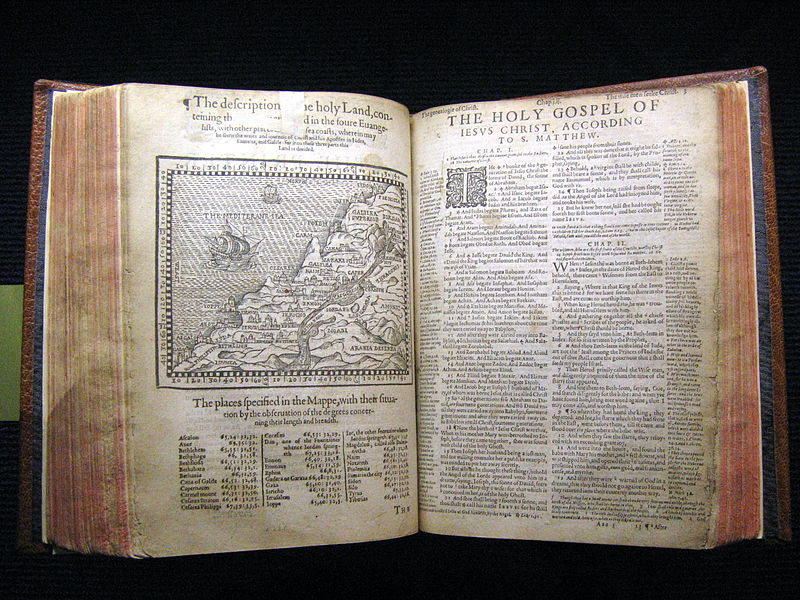
The Reformation is an extremely important part of church history. One would think with the release of the Bible in the people’s language, the explosion of missions, the work of the Gospel in the hearts of many subsequent to the reformation, that our ecclesiology would progress in an upward trajectory. But satan does not like upward, only downward. He fights back. He fought back since the moment the first Geneva Bibles were released. And the Geneva Bible’s history is interesting in itself! It was the first Bible to be translated directly from the Hebrew. It had extensive notes and cross references, making it the first study Bible. It was translated so that the people could read it. More here.
Sadly, 500 years after the start of The Reformation, there is currently a definite softening toward the Catholic Church by many people who should know better.
Philosopher and poet George Santayana famously said,
Those who cannot remember the past are condemned to repeat it. (The Life of Reason: Reason in Common Sense. Scribner’s, 1905: 284)
We must remain vigilant because we are not unaware of satan’s schemes. (2 Corinthians 2:11). We should learn the past in order to remember the past and to push forward with clear, honest, uncomplicated Gospel evangelization. We shouldn’t ever remain ignorant of what has happened in the past of our church history. This is the 500th year of the Reformation. Here are some resources for you to learn more: The Heresies of the Catholic Church
Memoirs of a Medieval Woman: this is a biography of Margery Kempe, taken from her dictated autobiography. She was born sometime around 1373 and died after 1438, which makes her a devotee of the Catholic Church at a time when both the rise of the Lollards (Wycliffe followers) was gaining traction and also the incessant Catholic pilgrimages to Jerusalem were occurring. It is also set in the time just prior to the Council of Constance. This Council was held between 1414 and 1418, principally to reunite Christendom from the ‘too many popes’ syndrome (schism) but also to examine the teachings of John Wycliffe and Jan Hus and to reform the RCC as a reaction to the attack on the Church’s authority.
Wikipedia lists her as “an English Christian mystic, known for dictating The Book of Margery Kempe, a work considered by some to be the first autobiography in the English language.” Kempe wrote of it all from a first person perspective. I liked the book for its attention to vivid detail on the practices of the Catholic Church, the realities of the pilgrimage journeys to the middle East, the ecstatic visions and examination of same by any and all church authorities Margery could get to listen (anchorites, priests, bishops, other mystics like Julian of Norwich, lay people…)
the women should keep silent in the churches. For they are not permitted to speak, but should be in submission, as the Law also says. (1 Corinthians 14:34).
Paul was exhorting about orderly worship here. Worship had gotten out of hand. Worship must be orderly, quiet, and respectful, that was the watchword. And Paul gave that word in this passage.
Is there a time for a woman to holler and throw stools at the pastor? Apparently there was for Jenny Geddes. She’s gone down in Reformation History as someone who stood up for Jesus. Here’s how.
Jenny Geddes (c. 1600 – c. 1660) was a Scottish market-trader in Edinburgh, who is alleged to have thrown her stool at the head of the minister in St Giles’ Cathedral in objection to the first public use of the Anglican Book of Common Prayer in Scotland. The act is reputed to have sparked the riot which led to the Wars of the Three Kingdoms, which included the English Civil War.
Well, that’s some stool. It all happened on July 23, 1637 in Edinburgh.
Always independent, the Puritan Scots had become suspicious of the increasing encroachment of liturgy and rigid traditions a la the Roman Catholic Church. They had observed King Charles Is’ coronation rites and were displeased with his use of Anglican rituals. Next came forced use of the Book of Common Prayer, a high Episcopalian book, with its readings in the Apocrypha. King Charles issued a warrant in 1635 declaring his spiritual power over the Church of Scotland, insisting that the Church would be issued with a new book of liturgy which would be read at services. And on July 23, 1637 in St. Giles Cathedral, the Common Book of prayer was opened and John Hanna, Dean of Edinburgh, began to read.
Jenny Geddes sat fuming on her “fald stool” or a “creepie-stool” meaning a folding stool. Finally she had heard enough and stood up and cried; “Deil colic the wame o’ ye, fause thief; daur ye say Mass in my lug?” meaning “Devil cause you severe pain and flatulent distension of your abdomen, false thief: dare you say the Mass in my ear?” And at that she hurled her stool straight at the Dean’s head. This sparked a full scale riot in the church. one congregation member who had been heard uttering a response to the liturgy was thumped with Bibles. The Dean took cover and the Provost summoned his men to put down the disturbance. The rioters were soon ejected from St Giles and the Bishop of Edinburgh appealed for calm. However this was not going to end quietly…
The national spiritual unrest was real, but overlaid upon the spiritual unrest was political unrest too. Hence the riots that sparked the Wars of the Three Kingdoms, and then the English Civil War. You can read about that part of the history elsewhere.
Jenny Geddes’ anger at the encroachment of evil into the pure worship service reminded me of another, more recent ‘Jenny Geddes.’
On November 10, 2013, Memorial Church of the Reformation in the city of Speyer, Germany hosted Karl Jenkins’ performance piece, titled “A Mass for Peace- “The Armed Man” where as part of the performance, the Islamic call to prayer is performed by an Imam.
German woman Heidi Mund had heard of this performance, grabbed her flag on which is emblazoned “Jesus Christ is Lord” headed to the church, and bought her ticket. But first, Ms Mund said, she prayed. To make matters even more emotional, the church the performance was to be held at was the Memorial Church of the Protestation in Speyer Germany, constructed specifically in 1900 where,
Its construction was supposed to be a reminder of the protest action that the imperial evangelical states brought to bear in 1529 at the Reichstag in Speyer. The Luther memorial in the vestibule and the adjacent statues of local Protestant rulers serve as reminders of this event.
Having no particular plan, she quietly listened to the music and readings, but when the Imam began praying to Allah in Arabic and saying, “Allahu Akbar!” she felt what she called a holy anger rising up in her. Much like Jenny Geddes, who was righteously aggrieved with the blasphemy in her midst, Mund stood up at this “interfaith event” and fearlessly began shouting that Lord Jesus alone is God and proclaimed His supremacy over all the earth.
If we are confronted with something of like kind, what would be our reaction? There is a time to sit silently and submissively, but is there ever a time for disruption and holy anger? Jenny Geddes threw a stool, narrowly missing the preacher’s head. Physical violence is never appropriate. How would we react to the incursion of evil into a holy place, a place set aside for the proclamation of the pure word? Just food for thought.
Both Geddes and Mund knew of what was to happen during the service. Neither were surprised. Mund prayed ahead, one can surmise that perhaps Geddes had also prayed ahead. In one way or another, we are all confronted with false doctrine creeping in. Start praying ahead for strength in the Lord to react in ways that honor and glorify Him.
———————————— Further Reading
Trivia: Scottish Poet Robert Burns named his mare Jenny Geddes
Sinning. Every human on the planet, no matter his or her age, is good at sinning. Hands down. Me included.
EPrata photo
Look at this example from scripture.
Woe to you, blind guides, who say, ‘If anyone swears by the temple, it is nothing, but if anyone swears by the gold of the temple, he is bound by his oath.’ You blind fools! For which is greater, the gold or the temple that has made the gold sacred? And you say, ‘If anyone swears by the altar, it is nothing, but if anyone swears by the gift that is on the altar, he is bound by his oath.’ You blind men! For which is greater, the gift or the altar that makes the gift sacred? So whoever swears by the altar swears by it and by everything on it. And whoever swears by the temple swears by it and by him who dwells in it. And whoever swears by heaven swears by the throne of God and by him who sits upon it. (Matthew 23:16-21).
What this section of scripture is about is Jesus pronouncing woes upon the Pharisees. The Pharisees were one of the two ruling classes in Israel, the Sadducees being the other. The Pharisees had twisted the faith into something unrecognizable, laying incredible burdens down on the people, (like over 600 laws!) failing to minister to sinners, making sons of hell twice as worse as they were, and being total hypocrites. When Jesus pronounced His many woes upon them, this particular set of woes involved swearing by the LORD and lying.
The Pharisees had cunningly devised a way to appear to swear by the Lord but be able to get out of it later. As Romans 1:18 says, we all know the truth but we suppress it in unrighteousness. They knew what they were doing but they were devising evil in rationalizing what they THOUGHT were clever ways to wriggle out of it.
They THOUGHT that if they swore an oath by the temple and not by the gold of the temple, they could break their oath later with no repercussions. Or swear by the altar and not the gift on the altar, or by heaven and not by the throne in heaven. As President Bill Clinton famously said when he was trying to avoid an answer, “It depends on what the meaning of is is.”
Photo Pixabay.com. cc.
Look how finely they were splitting hairs! They were dead wrong, as we read Jesus’ excoriation of their sly practices. All the hairs matter.
But you see how we as humans excel at sinning and rationalizing our sin. We’re really, really good at it. “It wasn’t that bad.” “It wasn’t a real promise.” “No one keeps promises anymore.” “I’m not gossiping, I’m sharing a prayer request.” “It wasn’t as bad as that other guy’s sin over there.” “No one saw.”
All rationalizations are simply self-justifications. And there is only One who justifies, Jesus. Our pitiful attempts to justify ourselves when we sin are just evil blasphemies and vain delusions. When we transgress God’s laws, we injure ourselves and dig ourselves deeper into the pit we will eventually fall into. (Matthew 15:14)
As I go through the day I ask Jesus to show me where I am sinning but I’m rationalizing it away. Where I am too ignorant or blind to see my own sin. I ask Him to help me sin less against Him tomorrow than I did today, by the Spirit’s conviction and strength. I am not only the Chief of Sinners, I am Queen of Rationalizations! Open the eyes of my heart, Lord. I pray mine and your walk grows purer with each day and each step. Paul was so wise to pray this for his people:
I pray that the eyes of your heart may be enlightened in order that you may know the hope to which he has called you, the riches of his glorious inheritance in his holy people, (Ephesians 1:18).
Lord open the eyes of my heart so I may see and repent of the sins that lurk there. All the ways of a man are pure in his own eyes, but the LORD weighs the spirit. (Proverbs 16:2).
Your eyes are too pure to look upon sin but my eyes are too depraved to see holiness. I need Your eyes, Lord.
Yes, they are.I discuss Alisa Childers' shift toward engaging with false teachers to reach the lost. While some support this view, I warn against the dangers of false teachers, asserting they corrupt faith and lead believers astray. I emphasize the importance of avoiding such influences, offering evidences of biblical warnings regarding sin and temptation.
Kay Cude, poet. Used with permission. Artist’s statement on Beulah Land
I think what affects me the greatest about this song is the identifying that His redeemed have a pronounced longing to be with their beloved Saviour and God The Father. Secondly, we will have resurrected and glorified bodies and no more fleshly infringement with which to wage war. And thirdly, the entire body of Christ (centuries worth, from Adam onward!) will no longer be apart! What a great day for us to wait upon! –To look into the face of Him whose death and resurrection became our atonement; He, Who became our individual and personal Saviour. Yet, when for the very first time that we hear His voice as He calls us each by name–perhaps that will be the second greatest joy we will ever know! For the first will be our being in His presence, prone on our faces in unspeakable love and worship, before our King, our Saviour, our Master and Lord, The Christ!
Seven years ago I wrote a series on the IF Gathering. (2014). Four years ago I did an update. (2017)
The organization reports that in 2021, there were 6,648 IF:Local events in 66 countries. Because this para-church organization is still growing so much, it’s time for another reminder in discerning love and care for women everywhere, to avoid IF:Gathering.
The IF:Gathering and its women have only embedded themselves deeper into the faith and are tainting even more women with their brand of liberal theology, shaky hermeneutics, usurping lifestyles, and their idol of social justice. After 8 years of watching this organization (since its inception in 2013) we can see by now that it is essentially a female takeover of the church as a feminist, para-church/social justice/liberal organization, where women are drawn out from under their pastoral authority of the local church, fed false notions about Jesus and about our own identity, and reinserted as thorns and weeds to infect the local church with these modernly false ideas, only to turn around and recruit more women to do the same. It’s a multiplying movement that fulfills several scriptures about how false doctrine gets into the church.
Source and video below.
PROBLEM #1: Their premise is based on doubt.
The title “IF:Gathering” comes from their motto, “If God is real, then what?” The purpose statement on their IRS forms is to equip women by having them share their feelings about Bible passages posted online, and the by-product is to instill or institutionalize doubt. Their IRS tax form statement of purpose states:
If:Lead: equipping women to share and learn through Christ-centered discussions

IF:Austin: a two-day gathering that brought thousands of women together in Austin and at local gatherings across the globe. The gathering is a fresh, deep, honest space for a new generation of women to wrestle with the essential question: if God is real… then what?

If:Equip: a holistic, strategic, deep way to connect online with a like-hearted community and relevant resources. We hope to prepare women around the world to know God more deeply and to live out their purposes by sharing comments and feelings about daily passages posted online.
PROBLEM #2: It’s based on feelings we have, not on biblical truths revealing who Jesus is
Did you notice the ‘like-hearted‘ community? The Christian faith is not about feelings, but about what we know about Jesus. It’s supposed to be like-minded. This is an organization that calls their homes ‘spaces’, their local communities ‘contexts’, and their goal is to ‘change the world’. Its mission is to wrestle with the notion IF God is real. Using this amorphous, non-specific language helps cultivate the doubt, which is the opposite of the certainty we are supposed to preserve and promote as believers. We’re believers, not doubters. It’s Good News, not Maybe News.
The ‘gathering’ part is actually brilliant. They aim to disciple women in gatherings at homes, dorms, and other locales, sometimes churches. It’s not public, nor it is under the authority of local churches or of men. Participants know where to gather through social media, which is employed in a major way. It’s why this is a stealth approach to infect the church. Galatians 2:4 and 2 Peter 2:1 said this would happen. Yet discipleship is supposed to take place within and around the local church.
PROBLEM #3: Secretiveness (I haven’t looked lately to see if they are still secretive, Jan, 2025). But for years, they were.)
There aren’t any posters, advertisements, billboards, pamphlets that one can see. They don’t normally make known who will be speaking at the annual large Gathering ahead of time. That’s allegedly so that people don’t come for the personalities but for the fellowship and learning. But would you want to spend time and money to go to a conference without being able to vet the speakers? Or your own pastor helping you vet the speakers?
Instead, there’s texts, social media whispers, person-to-person promotion, all of it done in a way that is more subterranean than any other generation’s Christian activity (apart from the actual persecuted church.)
IF:Gatherings are ongoing in living rooms and lawns by the thousands. There are A LOT OF GATHERINGS. Look. This map is four years old and their gatherings are only increasing in number:
The idea to disciple women is a good one. However, that is an activity that the church is responsible for. These gatherings take place outside of the auspices of the local church and its pastoral authority and is based on curricula that has shaky scripture interpretations at best.
PROBLEM #4: Founded on direct revelation
The gatherings were born from the mind of a young woman named Jennie Allen. At the first Gathering, she revealed that she had heard God whisper to her, and after a few years decided to step out from her church to enact this so-called God-whispered “vision to gather, equip, and unleash women to live out God’s calling on their lives.”
“together with a team of friends, formally established IF:Gathering. … Some of the first friends to believe in her vision put aside their own individual ministries to leverage their collective influence for the glory of God and the good of His Church.” (Source, source).
So they abandoned their local ministries to go online for the good of the global church? Exactly wrong. Here is Jennie Allen claiming direct revelation from God as the catalyst for IF.
PROBLEM #5: Draws women away from local churches, the place where we’re supposed to disciple
They abandoned their ongoing locally accountable ministries, to follow a young woman who’d heard a whisper, in order to establish Bible studies about a God they doubted existed, in order to equip women to discuss feelings about the Bible, enact social justice, reconcile the world, heal the nations, and disciple a generation. Hmmm. I’m not being satirical. All that verbiage is from their own statements.
PROBLEM #6: Feminist oriented
The constant refrain in the IF material is that these women will “change the world” (source, 2022 promotion). This is why I call it a stealth feminist takeover. I’m not being hyperbolic, it’s actual, from their own vision statement
women out from local authority, changing the world based on misinterpreted Bible verses and their feelings. Not promoting Jesus of the Bible to call people to repentance and salvation.
I wonder how it works to be submitted to a local church, yet to draw away women from other churches to come to your house to discus your feelings about direct revelation, extra biblical Jesus while then returning to church to ‘take initiative.’
IF’s founders are paying lip service to the concept of local church, while the entire movement’s thrust is about taking initiative to change the world, start global movements, heal the world, etc. (SOURCE) Not to return to one’s church, submit to local leadership, and operate in our spheres, nor to find contentment in our roles as wives and moms. There is nothing local about IF:Gathering.
Problem #7: If:Gathering and subsidiary output platforms false teachers such as Ann Voskamp, Christine Caine, some of which preach. This provides a poor example to younger women, who absorb the idea that women can preach despite what the Bible says about it.
Conclusion- Concerns with IF:Gathering are:
Founded on Direct Revelation: Founder Jennie Allen said she heard a whisper from God telling her to start a discipleship group. (source, also see above). Direct revelation is hazardous to one’s soul. If you test a direct, audible command from God against the Bible and it’s there, you do not need the audible command. If it is not there, it’s a lie and you don’t need it anyway. That’s a paraphrase from John Owen.
Doubting God: The premise itself is based on study of a God that those who gather doubt exist. IF God is real? Doubt is not noble. The Bible says doubt is a destroyer of life. (James 1:5-8).
Lack of male oversight and involvement and severe emphasis on women-led initiatives: Jennie’s husband Zac says he provides theological oversight, but he is listed as working only 10 hours per week at the 501(c) 3 non-profit, and the only other male on the Governing Board is David Willis for 2 hours per week. The 40-hour/weeks are put in by Jennie and Lisa Huntsberry. It’s Jennie’s baby, she is listed as Principal Officer on the tax forms. It’s led by Lisa Huntsberry who’s listed as CEO. The fact is, it operates as a woman-led, para-church organization with little male accountability or pastoral oversight.
The IF:Gathering’s premise is flawed and so are its goals. Again, from their IRS form, it states that their goals are to foment a ‘global movement’ that ‘promotes healing around the world’. Is that what the Bible says women are to do? Unleash movements? These women are mothers. With children at home. The Bible tells us what we are to do: raise the kids, support the husband. Did even Jesus come to promote healing around the world? And just what IS “healing”, anyway?
Goals are postmodern and extra-biblical: As Tim Challies said, the words reconciliation and healing have a different meaning to the postmodernist liberal than they do to the Christian fundamentalist:
“…perverts the Biblical meaning of “reconciliation.” The Bible does not use this word arbitrarily, but speaks of the reconciliation of man to God and how this can be accomplished. It speaks of redemption! Salvation! Our ministry of reconciliation is not relational healing of myself to my neighbor (right and good as that may be), but the far more important relational healing of a sinful man to a holy God.
The ‘reconciliation’ the IF-ladies intend is the latter, promoting relational healing. Hence their emphasis on feelings and their activity of social justice.
Liberal-to-false teachers as partners and speakers. For example- Ann Voskamp. Does she even know how to use the English language anymore? Below is her tweet. I thought teachers were supposed to be ‘able to teach’. (2 Timothy 2:24). Being able to teach presumes a facility with the language so as to communicate truths in a way that will edify the hearer. Voskamp’s gone beyond #babble all the way to to #Babel.
The list of IF speakers for the recent gathering that concluded in March 2021 is posted but their talks are behind a paywall. Nevertheless, this list is only a quarter of the amount of listed speakers, and demonstrates immediately that the speakers are part of the problem with IF:Gathering leaders’ discernment. Francis Chan, Christine Caine are false teachers, Lauren Chandler and Lysa TerKeurst are heavily suspect, as well as severe concerns with Jackie Hill Perry and Jefferson Bethke (of the ‘Why I hate religion‘ author)
Jo Saxton (Female Pastor. A director of yet another ‘movement’ whose goal is “to CHANGE the world by putting DISCIPLESHIP and MISSION back into the hands of everyday people.” Emphasis theirs.
No town is too small, too rural, too citified or too sophisticated to host an IF:Table. The brand of Christianity the women promote is far from the Bible’s call to obedience for women, due to their emphasis on social causes, feminist living and usurping thrust of the IF:Movement, doubting God, and discussing their feelings. I pray you protect your daughters and granddaughters from any and all IF activities.
IF:Gathering says, IF God is real, then what? Satan says, “If you are the Son of God, command this stone to become bread.” Satan says, “If you are the Son of God, throw yourself down from here…” (Luke 4:3, Luke 4:9)
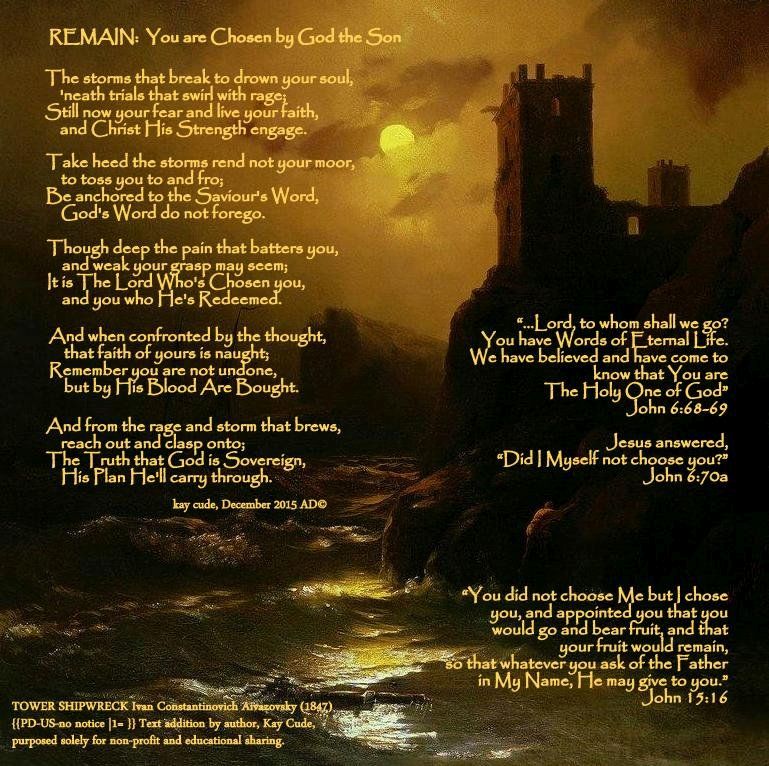
Kay Cude poetry. Used with permission. Right click to open larger in new tab
Artist’s statement:
The beginnings of a trial can be tumultuous and heart-wrenching, as well as physically and emotionally exhausting. But as we seek Scriptural guidance and encouragement from fellow believers, we quickly see that all of our communication and advice must center upon Christ and our personal relationship with Him. It is when one relies upon “other” solutions (or self), that one quickly experiences the futility of our “natural” reasoning and responses. When our trials exclude Christ as the resource of resolution, fleshly reactions will lead us into deeper distress with greater turmoil; an impasse can arise and anger, hurt feelings, confusion and chaos usually pursue.
I don’t like painful trials; I don’t know anyone who does. Yet I am so very grateful that Christ captures my attention during those times and makes it abundantly clear that He is the only source who can truly sustain, teach, discipline and encourage me while He refines and strengthens me, in and for Him. It is Christ who must always be the primary topic during our trials, because without the working of His indwelling spirit, our words and actions become futile.
Kay Cude poetry. Right-Click to see larger in new tab. Used with permission.
Artist’s Statement:
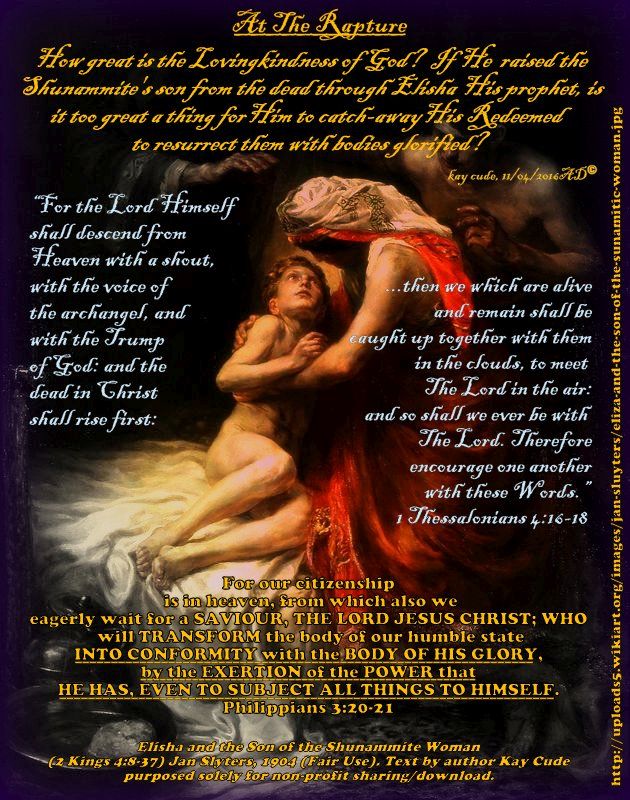
I was deeply drawn to this painting because of the look on the face of the child clutched out of death into the arms of his beloved mother. I see peace mixed in with awe as he looks into the face of one who has nurtured him since birth; the face of the one he is so grateful to see. I am reminded of the nurturing love of the Father and Son for Their beloved redeemed; perhaps we will have that same look upon our faces as we look into the glorious and wonderful face of Christ Jesus at the Rapture.








 the-end-time.org