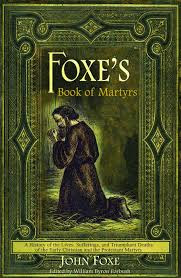
Foxe’s Book of Martyrs. According to this summary from Christian Book Summaries,
Writing in the mid-1500s, John Foxe was living in the midst of intense religious persecution at the hands of the dominant Roman Catholic Church. In graphic detail, he offers accounts of Christians being martyred for their belief in Jesus Christ, describing how God gave them extraordinary courage and stamina to endure unthinkable torture.
From the same link, the book’s purpose was fourfold:
- Showcase the courage of true believers who have willingly taken a stand for Jesus Christ throughout the ages, even if it meant death,
- Demonstrate the grace of God in the lives of those martyred for their faith,
- Expose the ruthlessness of religious and political leaders as they sought to suppress those with differing beliefs,
- Celebrate the courage of those who risked their lives to translate the Bible into the common language of the people.
Last Sunday I’d ended the first phase of the Apostolic persecutions with the death of Apostle John. He was the last of the first generation martyrs. In Foxe’s Book it is described thus: “Chapter One: History of Christian Martyrs to the First General Persecutions Under Nero”.
In the course of that first wave, Paul and Peter were martyred. In summary, Foxe wrote,
“To their names may be added, Erastus, chamberlain of Corinth; Aristarchus, the Macedonian, and Trophimus, an Ephesian, converted by St. Paul, and fellow-laborer with him, Joseph, commonly called Barsabas, and Ananias, bishop of Damascus; each of the Seventy.”
Under Nero’s persecution after the Great Fire at Rome of 67AD, the church at Rome was scattered, and this blew the seeds of the Gospel outward toward Asia. (1 Peter 1:1). The 7 Churches of Asia Minor were founded at that time. However, it wasn’t long before persecution followed the Christians at the cities far from Rome, and this is what Peter meant when he wrote, ‘you are being tested in various trials’ in 1 Peter 1:6.
This first wave of the persecution of the original generation continued under Domitian. Foxe’s summary again,
“Nicodemus, a benevolent Christian of some distinction, suffered at Rome during the rage of Domitian’s persecution. Protasius and Gervasius were martyred at Milan. Timothy was the celebrated disciple of Paul, and bishop of Ephesus, where he zealously governed the Church until A.D. 97. At this period, as the pagans were about to celebrate a feast called Catagogion, Timothy, meeting the procession, severely reproved them for their ridiculous idolatry, which so exasperated the people that they fell upon him with their clubs, and beat him in so dreadful a manner that he expired of the bruises two days later.”
After Apostle John died in around 98AD, The Third Persecution, Under Trajan, A.D. 108, began.
“Pliny was a governor of a Roman province at the beginning of the Second Century. He was monitoring those who identified themselves as Christians in order to make report to the Emperor Trajan. He wrote to Trajan around 100 AD.” Foxe wrote of Pliny’s letter to Trajan,
“In the third persecution Pliny the Second, a man learned and famous, seeing the lamentable slaughter of Christians, and moved therewith to pity, wrote to Trajan, certifying him that there were many thousands of them daily put to death, of which none did any thing contrary to the Roman laws worthy of persecution. “The whole account they gave of their crime or error (whichever it is to be called) amounted only to this-viz. that they were accustomed on a stated day to meet before daylight, and to repeat together a set form of prayer to Christ as a God, and to bind themselves by an obligation-not indeed to commit wickedness; but, on the contrary-never to commit theft, robbery, or adultery, never to falsify their word, never to defraud any man: after which it was their custom to separate, and reassemble to partake in common of a harmless meal.”
~~~~~~~~~~~~~~~~~~~~~~~~~~~~
Hatred of Christians is coming to America. Persecution is coming. Christians have always suffered horribly in all the world throughout all ages. Christians in America have not. We are the cushiest, most comfortable generation, and as a result have grown casual to the Gospel and irreverent toward Christ. The charge of Jesus to the church at Laodicea could well be taken as a charge against us today:
“I know your works: you are neither cold nor hot. Would that you were either cold or hot! So, because you are lukewarm, and neither hot nor cold, I will spit you out of my mouth. For you say, I am rich, I have prospered, and I need nothing, not realizing that you are wretched, pitiable, poor, blind, and naked.” (Revelation 3:15-17).
It is the church at Laodicea which Jesus asks to open the door and let Him in when He knocks. It is the church at Laodicea that has left Jesus off the list of ingredients when they play at church.
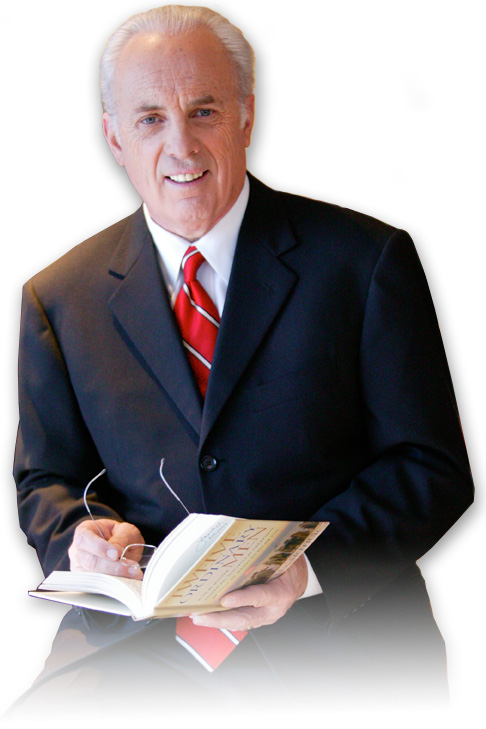
Of the true church, Dr. John MacArthur wrote this to his subscribers in 2013, “It’s no surprise that true Christians are feeling pressures we’ve never before experienced. Believers today face open hostility simply for what we believe.”
[Ed Note: Brings to mind Pliny’s perplexity of the hatred leveled against Christians who were simply praying, vowing to do good and having harmless meals together…]. Continuing MacArthur-
“Our gospel, our values, our priorities, our doctrine, what we love and what we hate what we live for and what we die for- our lives are more permanently and comprehensively at odds with the world. What’s more, the situation can and will still get worse. I’ve commented several times recently that I believe that hostility toward Christians in the West will eventually give way to full-blown persecution, just as it already has in other parts of the world.”
“As the pressure on Christianity has increased, it has been interesting to see so many supposed Christian institutions caving in and surrendering. We’re now finding out what people really believe and who is willing to stand for truth. Christian organizations are having to ask themselves, What are we going to say about immorality, premarital sex, drunkenness, and homosexuality? Sadly, many are waffling.”
Dr. MacArthur continued in his letter,
“Our view is that the more heated the battle becomes the clearer we need to become on our biblical convictions. The true church will always embrace persecution when it comes, rather than run from it. Suffering for Christ is a blessing from God with purifying effects for true believers. When suffering comes, the church actually thrives. Of course that doesn’t mean that facing hostility and persecution is easy, or that it doesn’t raise practical questions about the present and the future- no Christians cherish the thought of their children or grandchildren suffering…”
The call for today is to remember the martyrs even as hostility and persecution comes to us in the West. Align yourself with the stance that Dr MacArthur outlined:
“As other organizations seek to evolve with the times, insulate themselves from hostility, and accommodate the culture, our plan is to actively stake out the biblical positions everywhere we can. We are going to articulate biblical truth more clearly and assertively than ever. In fact, as the culture continues to degenerate and biblical standards are challenged, every new attempt to undermine Scripture is going to elicit from us a loving- but clear-confrontation.”
“Dear friends, do not be surprised at the fiery ordeal that has come on you to test you, as though something strange were happening to you.” (1 Peter 4:12)
One of the reason above that Foxe said he wrote his book of martyrs is to “Demonstrate the grace of God in the lives of those martyred for their faith.” I plea for you to become solid in your stance and firm in your conviction to demonstrate that very grace. Get clear on your convictions and the biblical worldview we need to have. Stand on the rock.
When I originally started this series 7 years ago, I could see the need coming to re-connect with what real persecution is and to take inspiration from those who died for the faith without reneging on their convictions. It is doubtless coming to us in America.
The simmering hatred is more visible now in 2020. The COVID-19 virus and subsequent lockdown has taught us just how easy it is for Government leaders to shutter churches. The difficulty in opening churches back up as the COVID-19 virus slows its progress through the population shows just how much of a target churches are of that hatred.
Let us continue in the faith, a long, unbroken line of glory from the first martyr to the last, praising Jesus under all circumstances. Let us gird our loins and stand firm on the Gospel, no matter what may or may not be coming to America in future days.
Ignatius was a beloved father in the faith in the time of Trajan’s persecution. He said, “Now I begin to be a disciple. I care for nothing, of visible or invisible things, so that I may but win Christ. Let fire and the cross, let the companies of wild beasts, let breaking of bones and tearing of limbs, let the grinding of the whole body, and all the malice of the devil, come upon me; be it so, only may I win Christ Jesus!”
He was eventually convicted and thrown to the lions. Ignatius “heard the lions roaring, saying: “I am the wheat of Christ: I am going to be ground with the teeth of wild beasts, that I may be found pure bread.”
May you be found to be pure bread, with no leaven, for the name of Jesus and His eternal glory.