Posted in discernment, encouragement, God, prophecy, sovereign, spring

3 Bad Reasons to Leave your Church, How cults begin, Spring has sprung

At the Millennial Evangelical blog, Chris Martin wrote a piece on 3 Bad Reasons to Leave Your Church. Chris is 24 years old, feels called to be a pastor and currently works as a Social Media Facilitator at LifeWay Christian Resources and is pursuing his M.Div. at Southeastern Baptist Theological Seminary.

I have not read a great quantity of articles at his site, but I did enjoy this piece. At the bottom of it, he has a link to a companion piece called 3 Good Reasons to Leave Your Church. Here is 3 Bad Reasons’ opening paragraph:

Stop treating your local church like your high school girlfriend, and start treating it like the bride of Christ.

You don’t leave the church when it doesn’t share the same musical interests, when it hurts your feelings, or when a newer, more popular one catches your eye.

The people of God, the Church around the world, is the bride of Christ, and the bride of Christ deserves the faithfulness of a bride, not the summer crush you bailed on when you were a jerk in college.

Your church is broken because it’s made up of broken people, including yourself. Abandoning the local church is only acceptable under a few extreme circumstances we’ll address on Friday. Other than in certain circumstances, the people of God have the responsibility to sacrificially love their local churches as Jesus has.

If anyone has the right to abandon the adulterous, idolatrous bride called “Church,” it’s God, and he hasn’t, so we need to be careful how quick we are to bail when the going gets tough.

Here are three bad reasons to leave the local church:

Read more by clicking the link above

This is how cults begin.

False teachers generate followers for themselves, not for Jesus. If the teacher is beloved more than the object of her teaching is, then there is a problem. Like this:

The tweeter could have meant to say “I’ll read her inspiring piece later” but given the amount and fervency related to Mrs Moore, I doubt it. Moore so often repeats the mantra that she talks with God and He gives her things to say, that it is no wonder her followers mistake her blog essays for inspired writing, no different than the truly God-breathed words given to the 66 writers of the bible.

Or this:

Manic women from Houston do not have the power to awaken a soul. That is the supernatural work of the Holy Spirit. Even creepier, is the reference to ‘mama Beth.’ it couldn’t be any closer to the verse in Revelation 2:23 where the LORD promises to strike the metaphorical false prophetess Jezebel’s spiritual children (of her second generation of false teaching) dead unless they repent.

I did not have to cherry pick these. It was a day where Mrs Moore had written some drivel on her blog and the followers were discussing it in droves. There was a lot of chatter. There was SO MUCH of this kind of adulation and worship of Beth Moore it was actually hard to narrow it down to these two.

These tweets and the thousands just like them aimed at Moore, and the millions just like them aimed at Joyce Meyer, Benny Hinn and others, fulfill the promise made via the Spirit by Timothy:

For the time is coming when people will not endure sound teaching, but having itching ears they will accumulate for themselves teachers to suit their own passions, (2 Timothy 4:3)

These women are heaping up false teachers to suit their passions. Whatever passion you want to fleshily indulge, there is a false teacher to fit.

Spring has sprung, by the weather (for us here in GA) and by the calendar. My yard has a burst of color, a chorus of tweets, and two new baby lambs added to the farm family. When I arrived home at 3:30 after a long week of school, the warm sun and bird song drew me to the swing, and not to the front door. I dumped my stuff, dug out my camera, and walked the yard taking photos. Then I simply sat in the swing and gently rocked in the sun, listening to birds, the sheep, some children playing next door, the occasional car, and the trees in the breeze.

I stayed there until the sun went behind the house, almost two hours. I thought about the regularity of the cycles, the silent march of invisible seasons gracing the earth for a time and then wisping away to make room for the next season’s turn to touch the earth. The time now is for new life, buds, birds, bushes.

I thought about the majesty of our God, ordaining each and every day under the sun. There is nothing new, but then again every year it is all new again. The dogwood blooms. The forsythia blooms. The baby birds explore. The lambs are born.

He made the moon to mark the seasons; the sun knows its time for setting. (Psalm 104:19)

You alone are the LORD. You made the heavens, even the highest heavens, and all their starry host, the earth and all that is on it, the seas and all that is in them. You give life to everything, and the multitudes of heaven worship you
. (Nehemiah 9:6)

For in him all things were created: things in heaven and on earth, visible and invisible, whether thrones or powers or rulers or authorities; all things have been created through him and for him. (Colossians 1:16)

We are truly blessed to worship the one true God. He alone is worthy, for the earth is His and everything in it. What a beautiful world. What a beautiful God.

Posted in beth moore, john hagee, judge not, prophecy, sarah young

Thoughts about the judge not crowd, fringe prophecy, use of photos, my friend bronchitis

Here are a few updates and thoughts about the blog.

Last October I got the flu. By November it had left me with bronchitis. I’ve been struggling with bronchitis ever since. In November I went to the walk-in clinic and got a course of antibiotics, but it did not defeat the bronchitis. By December, the flu season was in full sway and it was impossible to get seen at the local clinics. I tried three times in person, and once I called for a renewal of the antibiotics. No go. Packed.


In January and February it subsided to manageable levels, and I coughed only infrequently, but was still dragging. The daytime work takes it all out of me and at night it’s only through the strength of the Holy Spirit that I write and study and complete my personal chores around the house. Last week, I got a cold and it revived the bronchitis totally. Yesterday I coughed non-stop. I am home on a sick day today. Even though the course of drugs in November didn’t help, nothing else since has helped either. (Rest, fluids, over the counter remedies, home remedies…) I will likely have to go back to the clinic. I do not like the clinic.

If you notice the photos on the blog, some are labeled “EPrata photo”. I have lots of photos and I like to use them. However you may see other photos with no attribution. It is not that I am failing to attribute, but these photos are Creative Common, license-free photos that require no attribution. Here is a snippet of a photo I used earlier and the CC statement:

Here is the terms of use:

Via download provided Images on Pixabay are bound to Creative Commons Deed CC0. To the extent possible under law, uploaders of Pixabay have waived all copyright and related or neighboring rights to these Images. You are free to adapt and use the Images for commercial purposes without attributing the original author or source. Although absolutely not required, a link back to Pixabay would be nice.

Pixabay is a nice site and I appreciate the donated photos.

I monitor comments and when warranted, I ruthlessly delete. However for the most part, I do try to give people their say and I enjoy that it gives me an opportunity to engage with folks, and to share insight and verses with them and from them. However I am getting impatient with the plethora of comments that incorrectly use the “judge not lest ye be judged” verse from Matthew 7:1.

It seems that it is the go-to response of everyone who wants to criticize. I appreciate criticism, but when a person uses the ‘judge not’ chestnut, I know they have no biblical understanding of sin, of studying the bible correctly and are simply parroting the one verse they have learned, bless their heart. Most don’t even to add the chapter and verse, but simply and out of context say ‘judge not’ as if that solves everything. It is the religious equivalent in a debate to Godwin’s Law.

Godwin’s Law (or Godwin’s Rule of Nazi Analogies) is an Internet adage asserting that “As an online discussion grows longer, the probability of a comparison involving Nazis or Hitler approaches—​ that is, if an online discussion (regardless of topic or scope) goes on long enough, sooner or later someone will compare someone or something to Hitler or Nazism. … there is a tradition in many newsgroups and other Internet discussion forums that once such a comparison is made, the thread is finished and whoever mentioned the Nazis has automatically lost whatever debate was in progress. This principle is itself frequently referred to as Godwin’s law. (Wikipedia)

We can say the same about “Judge Not”. It is the religious Godwin’s Law. Let’s call it the UnGodly Law.

‘UnGodly Law is a new Internet adage asserting that “As an online discussion about sin, especially homosexuality, grows longer, the probability of a comparison involving judgment approaches—​ that is, if an online discussion (regardless of topic or scope) goes on long enough, sooner or later someone will trot out the misused verse from Matthew 7:1 and say “judge not!”. … there may be a new tradition forming in many newsgroups and other Christian discussion forums (OK, just on this blog) that once such a statement is made, the thread is finished and whoever mentioned the judge not chestnut has automatically lost whatever debate was in progress and will be deleted without mercy or second thought.’

I decided that if anyone uses the ‘judge not’ verse in the incorrect way from now on it will be a trigger for automatic delete. In the past, I’ve attempted to reason with the judge not crowd, but their gross lack of understanding is too weighty to overcome in the space allowed in the comment box, and too deep to instruct in the time a life can be lived. So. Delete.

Back when I started the blog 8 years ago, I enjoyed posting some of the more speculative prophetic passages such as Nephilim, or cryptids, or sinkholes, or the changing behavior the animal kingdom is exhibiting, and musing on them in light of contemporary news. The autistic brain excels at seeing patterns, and with the Holy Spirit inside, and the bible to show all of human history, detecting a pattern is made even easier.

I still enjoy seeing today’s news, knowing history, and looking back to see where the current news fits in to the past pattern. However I haven’t posted about that for a while. Here’s why.

— I don’t want to go beyond scripture. I don’t think I have done that in the past, but I don’t want to even creep off the yellow center line by an inch because the longer I go on in sanctification the less I trust myself,

— I don’t want to cause someone else to stumble,

— Mainly because it seems that even a mere mention of such things nowadays opens the floodgates. In the last 5 years, people have gotten both stupid and irrational about the scriptures. Not that people weren’t before, but like interest that compounds, the stupidity and irrationality has compounded to levels unmanageable by me. Spiritual discernment is at an all-time low (a record which will likely be broken tomorrow) and biblical literacy is at an even all-time lower level. People don’t know their bible, they don’t quote their bible, they don’t use the bible as a basis for discussion, and they go off the deep end into conspiracies at the drop of a hat.

The acceptance of demonic proclamations by Beth Moore and Kim Walker Smith in visions and Sarah Young’s declarations in book form attest to this. So does the popularity of Johnathan Cahn’s books in 2012 such as The Harbinger and the Mystery of the Shemitah: The 3,000-Year-Old Mystery That Holds the Secret of America’s Future, the World’s Future, and Your Future!, and John Hagee’s  Four Blood Moons: Something Is About to Change book published a year later.

I mean, come onnn. The hubris of Cahn’s proclamation that he knows the future of all persons on earth (who would buy his book) and the world’s future ‘unlocked’ nearly equals satan’s when satan promised to unseat God from the throne.

And as bad as Edgar Cayce and Jeanne Dixon were, at least they were more specific in their false prophecies than Hagee, who simply subtitles his book, “something is about to change.” Really? I’d never have guessed that. Let me know when it happens.

That people accept these ‘Christian’ books and visions and attempt to learn from them is saddening. In stepping to the fringe, people nowadays seem to more easily hurl themselves off the edge of solid biblical foundations. They gleefully run toward the latest prophetic fad, and in so doing, give real prophecy a bad name. It makes many people not want to study prophecy and the times, but that is not good either. As my friend and pastor in Maine said,

My brothers and sisters, I urge you in the name of the Lord not to dismiss current events or to become discouraged by them. 

We don’t live under a rock. We live in the world, and that means we are living in biblical prophecy because prophecy is always current. World events are important, and when understand the times and we point to the Lord it ignites our fervor for His soon return, which grounds us in our work until He comes.

However today’s superficial, nominal, or false Christian doesn’t get to the end of the last sentence. They focus on current events as if they are the be-all and end-all of truth. When I try to turn their head to Jesus, the author of these events, they balk. When you try to say that some of these things go beyond scripture and we should be careful, they scream judge not! ‘men of Issachar!’

Of Issachar, men who had understanding of the times, to know what Israel ought to do, 200 chiefs, and all their kinsmen under their command. (1 Chronicles 12:32)

As the Treasury of Scripture says of the Men of Issachar verse,

understanding of the times That is, as the following words indicate, intelligent men, who understood the signs of the times, well versed in political affairs, and knew what was proper to be done in all the exigencies of human life; and who now perceived that it was both the duty and political interest of Israel to advance David to the throne.

If I may be allowed to paraphrase, we have understanding of the times, That is, as the following words indicate, intelligent men, who understood the signs of the times, well versed in political affairs, and knew what was proper to be done in all the exigencies of human life; and who now perceived that it was both the duty and spiritual interest of the church to advance Jesus on His throne.

I have been remiss. I have not thanked you, the readers, in a while. I do thank you and am energized by you and I do love you. The Holy Spirit fills me with strength and insight and for the sake of the Name I want to share what He does in my mind and heart when I open the bible. That people out there would read and respond and as some of you have said, pray for me, is simply lovely. It is the expression of the Kingdom on earth, the church glorious and invisible, worldwide and intimate. Thank you friends.

Posted in encouragement, exhort, prophecy, salvation, steven lawson

Some good stuff!

Some good things! A smorgasbord for you

The Long View on Pastoral Ministry
John MacArthur March 10, 2015

Why We’ll Never Bake Your Fake ‘Wedding’ Cake
Matt Barber March 9, 2015

Are wives really to submit in everything?
Sharon Lareau March 8, 2015

Salvation: How to be absolutely sure
Steven J. Lawson March 4, 2015

The Power of Thy Word
Tony Kiar March 8, 2015

What is closeness?
Dalrock, March 8, 2015

The Eye Scanning Password Authenticator, A Biometric Device That Safeguards a Person’s Digital Data
E.D.W. Lynch March 10, 2015

20 Finalists of the Smithsonian Photo Contest Show Earth’s Awesome Beauty
Alice Yoo March 9, 2015

Photo Anthony Smith
Posted in prophecy

The hope that prophecy brings

It is noteworthy that in no other religious writings in the world do we find any specific predictive prophecies like we find in the Scripture. You will find no predictive prophecies whatsoever in the writings of Buddha, Confucius, Mohammed, Lao-Tse, or Hinduism. Yet in the Scripture there are well over two thousand prophecies, most of which have already been fulfilled.

Though the Bible has been attacked at every other place, the one place where God rests His inspiration is that the things He foretells come infallibly to pass.

The Bible prophecies are altogether unexpected! I know of no one ever prophesying that any other human being would rise from the dead and ascend into heaven. That is exceedingly improbable. The chance of it happening by coincidence is incalculable. No, the Bible is not merely a book written by men; it is a book written by God through men, and the heart of its prophetic message is Jesus Christ.

Kennedy, D. J., T. Cabal(2007). Christ: The Fulfillment of Prophecy.

Posted in bible, encouragement, judgment, prophecy, tribulation

End time encouragement from a long-past prophet: Habakkuk

My friend, Pastor Phil Andrukaitis of the First Baptist Church of South Portland Maine, preached on Habakkuk 3 recently. I am on the email list for the sermon notes, and I was struck by how encouraging the notes were. Because:

  • it is always good to be energized by the profound truths of God’s word
  • it is always wonderful to remember that prophecy points to the sovereignty of God
  • it is comforting to see there are faithful pastors laboring in all parts of this country and the world, serving and ministering to our Lord

I asked Pastor Phil to reprint the notes. They include a thoughtful and discerning introduction. Please be encouraged with either or both, the introduction or the sermon notes themselves. I added the photos and artwork. They are not original to the sermon.

Please continue to pray for pastors all over the world who preach the Gospel faithfully and discerningly. There are 4,500 pastors meeting in Sun Valley CA right now at the annual Grace Community Church/Masters College Shepherds’ Conference. There are thousands of other pastors right now working out sermon notes, praying in tears for their sheep, visiting the sick, building a new church, or doing any of the myriad and seemingly impossible things God calls His under-shepherds to do.

Pastor Phil Andrukaitis

It is only by the Holy Spirit that these men are able to lift themselves up each day under the workload, to have the word of God illuminated to them, to have kindness and comfort to offer the grieving or sin-stricken, to have strength to have the difficult conservations and uncomfortable confrontations.

And when I came to you, brethren, I did not come with superiority of speech or of wisdom, proclaiming to you the testimony of God. For I determined to know nothing among you except Jesus Christ, and Him crucified. (1 Corinthians 2:1-2)

Good pastors are a gift from God.

And I will give you pastors according to mine heart, which shall feed you with knowledge and understanding. (Jeremiah 3:15)

The introduction and sermon are long. Print it out, mull it over, return to it when you have time. These are God’s words, delivered through a pastor’s heart, and offered in love and truth to comfort you.

SERMON INTRODUCTION

Phil Andrukaitis
Good afternoon my family and friends,

As a pastor, I have a divine responsibility to shepherd my flock [and to encourage other Christians] by strengthening their faith with the Bible and by preparing them for future trials and tribulations, which lie ahead for all of us. Knowing my own weaknesses and failings, I still press on to model my faith with my life, as this is part of the process of making disciples.

Question: My family and friends, are we ready to experience the difficult times that are coming to our country? As I read the Book of Habakkuk, this prophet of God was told what was in store for his nation. This news was so disturbing for Habakkuk, it caused him to tremble. I believe God is allowing discerning Christians, along with many American citizens, to see ominous signs for our nation. And some folks are trembling.

The concept of the Rapture is embraced as an escape plan among many Christians. While I believe Scripture promises the church to escape the “Great Tribulation,” the church may very well experience smaller tribulations [e.g., the collapse of our economic system, martial law, restricted freedoms, fear in the streets, etc.] before the actual rapture of the church.

My brothers and sisters, I urge you in the name of the Lord not to dismiss current events or to become discouraged by them. Rather, we are to embrace God and His Word, as did Habakkuk. Therefore, let each Christian embrace his God-given assignment and enable the church to fulfill the Great Commission, making disciples of Jesus Christ.

I pray that Habakkuk’s message will strengthen your faith and prepare you to stand firm on the Rock of our salvation, Jesus Christ.

Your servant in Christ,
Pastor Phil

SERMON TRANSCRIPT

This morning, I begin this sermon not with a story to illustrate the passage; rather, with the text itself. It is one of the most magnificent pieces of Hebrew poetry [comparable to Psalm 23]; the closing verses in the Book of Habakkuk (3:17-19 – NASB):

Though the fig tree should not blossom and there be no fruit on the vines; though the yield of the olive should fail and the fields produce no food; though the flock should be cut off from the fold and there be no cattle in the stalls; yet, I will exult in the LORD, I will rejoice in the God of my salvation. The Lord GOD is my strength, and He has made my feet like hinds’ feet, and makes me walk on my high places.

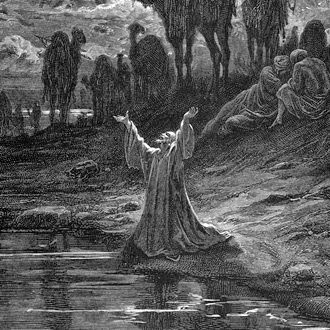
Gustav Dore: Habakkuk crying out in prayer

Did you hear Habakkuk’s words with your soul? But wait: Unless we understand these words in the context of the chapter, in the context of the book, and in the context of its setting, Habakkuk’s words of praise would be wrongly interpreted and misapplied to our lives. Therefore, let us begin with the fact that Habakkuk is a devout servant of God who…

  • grieved over his nation’s wickedness,
  • wrestled with theological perplexities,
  • and shook with fear when God told him what was coming to the nation.

God was bringing judgment to His people. Yet, Habakkuk declared his faith and expressed praise to the Lord GOD, in spite of the news he learned (Habakkuk 3). How is that possible?

So as not to get ahead of myself, permit me to ask you two questions: First, what was the most gut-wrenching, painful experience you have ever had? Second, how long did it last and what were the consequences? Perhaps some of you have experienced one or more of the following:

• The death of a parent, spouse, child, or friend
• An act of violence committed against you [rape, beaten, robbed, etc.]
• News that your health is failing – you have only three months to live
• The rejection of your spouse [divorce]; the betrayal of a friend; the discipline of a church
• The consequences of a sinful decision that brought overwhelming guilt and shame

Okay, now that you are in the moment for just a moment, what were your thoughts towards God when you were in that time of trouble? Were you praying? Were you crying? Were you afraid? Were you angry? Did you doubt God’s love? Were you filled with despair? How did you get through this painful experience?

Transitional Sentences

Having jolted your memory, you are now ready to connect with the prophet’s words and emotions; but just for a little bit. I do not want to offend anyone by minimizing your gut-wrenching painful experience, but when God told Habakkuk what was coming to the nation, within the prophet’s lifetime, Habakkuk wrote,

I heard and my inward parts trembled, at the sound, my lips quivered. Decay enters my bones, and in my place I tremble. Because I must wait quietly for the day of distress, for the people to arise who will invade us (Habakkuk 3:16 – NASB).

Yet, immediately following these words,

• Habakkuk did not stare at the horrific news he just received.
• Habakkuk did not become paralyzed in his walk with God.
• Habakkuk did not run away from God; rather,
• Habakkuk grounded himself in what he knew to be true about God and praised the Lord.

Historical Setting

Okay, before we proceed further, you might be asking, who is Habakkuk? There is nothing known about the prophet’s personal life. While students of Scripture have speculated that Habakkuk was of a priestly family, the Scripture is silent on this issue.

Habakkuk’s name means, “to embrace.” Based on the prophet’s words, it appears that Habakkuk embraced God [God’s glory, will, purity, heart, people, and suffering]. While all the other prophets spoke for God to the people, Habakkuk speaks openly to God about people.

Habakkuk wrote this book approximately 2 years before the first of three deportations to Babylon [B.C. 605, 597, 586]; 20 years before king Nebuchadnezzar eventually destroyed Jerusalem with a great slaughter. Habakkuk was a contemporary of Jeremiah. Moreover, there is a sense in the text that Habakkuk is also living in Jerusalem.

• We know that Jeremiah lived through the two-year siege of Jerusalem. Jeremiah describes God’s wrath against Jerusalem (Lamentations 2), whereby the Babylonian military forces first starved the people into submission and then broke through Jerusalem’s wall, slaughtering, plundering, and destroying the people and the city.

• However, as for Habakkuk, we do not know if he perished in the two-year siege or died by the sword when the Babylonian forces ransacked the city. However, when the prophet heard the news from God, what was to come, it is no wonder the prophet shook with fear.

I heard and my inward parts trembled, at the sound, my lips quivered. Decay enters my bones, and in my place I tremble. Because I must wait quietly for the day of distress, for the people to arise who will invade us (Habakkuk 3:16 – NASB).

In order to understand more fully Habakkuk’s prayer of praise in Chapter 3, let us review quickly a summary of the Chapters 1 and 2.

Summary Points in Chapter 1

Habakkuk’s 1st Complaint (1:2-4)

• God, why do You seem so indifferent to my prayers?
• God, why did You allow Israel to go so far with their sins?
• God, why do You not bring justice to the land?

Evidently, the time for divine judgment was now. From the Book of 2nd Chronicles, the godly reforms King Josiah instituted were reversed by his wicked sons, especially by king Jehoiakim. Consequently, Israel was rife with the following sins:

The people were idolatrous, especially as they sacrificed children upon the altars of demons, for financial and agricultural prosperity.

  • Corruption in the highest political and religious offices were the norm [Observation: perhaps that is why the nobility were first to be carried off in the first of three deportations to Babylon].
  • Jerusalem’s officials abused their authority and power, bringing injustice to the widows and the poor.
  • Bloodshed and crime were rampant throughout the land.
  • The Word of God was rejected; so were the prophets, as they were persecuted.
  • Consequently, the people of the land refused to repent of their sins.

God’s Reply to Habakkuk’s 1st Complaint (1:5-11)

God said, I am bringing the Chaldeans [Babylonians] to judge My people [Israel].

Habakkuk’s 2nd Complaint (1:12-2:1)

• But God, the sinfulness of the Chaldeans is worse than the sinfulness of the Jews!
• God, how can You endorse evil people to do Your divine work?
• God, You are too holy to look upon sin.
• God, the cruelty of the Chaldeans is known worldwide! They will destroy us!

To feel the horror that filled Habakkuk’s soul, imagine ISIS forces overwhelming this nation, as they are overwhelming the nations of Iraq and Syria.

Summary Points in Chapter 2

God’s Reply to Habakkuk’s 2nd Complaint (2:2-20)

• God declares: The just shall live by faith [present the gospel]
• God declares: I will judge the Chaldeans for their sins [5 woes]

–greed and aggression (5-8)
–exploitation and extortion (9-11)
–violence (12-14)
–immorality (15-17)
–idolatry (18-20)

Summary Points in Chapter 3

Even though Habakkuk did not understand everything about God and the course of action He was taking against Israel, the prophet offers a powerful prayer of praise.

First, Habakkuk makes a request of God (2).

–Revive Your work.
–Make Your work known.
–Be merciful when You express Your wrath.

Observations about Habakkuk’s request

1. Habakkuk knows what is coming and expressed his fear, along with his faith in God.

2. Understanding that God is holy, Habakkuk knew that God must judge sin. Habakkuk does not ask for personal deliverance, ease of suffering, defeat over the Chaldeans, or for Israel’s deliverance.

3. Rather, Habakkuk asked for God’s will to be done. Hmmm, this is reminiscent of the Lord’s Prayer. Consider the following questions: Are we more concerned about…

…our personal welfare or God’s will in our lives?
…which political party will win next year’s election or purity of the church?
…becoming more like Christ or securing material possessions?
…our comforts in this life or the kingdom of God?

Do you seek the shadow of the Jesus’ cross looming over this passage? Habakkuk asks, “in wrath remember mercy.” Habakkuk knew that God could no longer tolerate Israel’s sin. God’s righteous character demands that He judge sin.

God is still the same God today. He does not change. He cannot look upon our sin without judging us. That is why God sacrificed His Son on the cross for our sins. When Jesus hung on the cross, He alone bore the wrath of God so that you and me could escape God’s wrath. Indeed, God did remember His mercy while pouring out His wrath on His Son. We do not deserve to be saved. God held back the judgment we deserve [mercy] and gave to every sinner who has believes, eternal life [grace].

Listen, my friends, there is no sin in your life beyond the cross. Even though no one else knows about your sin, God knows. Come to Him in faith, believing that the blood of Jesus cleanses you from all your unrighteousness.

And to my brothers and sisters in Christ, God continues to bestow mercy and grace on our lives. Forsake the sin that so easily cripples your walk with God by calling out to Him to revive your heart for Him.

Second, Habakkuk remembers the deeds of God (3:3-15).

God displayed His majesty to the world.
God displayed His power over the nations [the Exodus and the plagues].
God displayed His presence among His people [Mount Sinai].
God displayed His glory, causing the nations to fear Him [Joshua 10].

What was God’s purpose in all of His deeds? The answer is clear: To demonstrate to His salvation for a people He loved.

Applications from Habakkuk’s remembrance

1. Read Scripture and understand how God has demonstrated His faithfulness in the past. A good place to begin would be at the cross. Think through how God took steps to bring Jesus into this sin-cursed world. In your mind, imagine yourself among the fickle crowds that called for the death of Jesus. See with your mind’s eye how Jesus carried His cross for you; the soldiers who nailed Him to the cross. Listen to His last words from the cross. These actions on our part have a way of strengthening our faith and making more intimate our personal relationship with Jesus.

2. Think back how God has delivered you in the distant and recent past. Be sure to tell others about His faithfulness.

3. Parents and grandparents, how are we demonstrating our faith and what values are we setting before our children? It is true that many young people are leaving the church. Might the problem lie in our homes and the manner in which we live out our faith?

Third, Habakkuk confesses his fear because he knows what lies ahead of him (16).

Habakkuk knew what was coming. If the Spirit of God told us of our future, I do not think we would be able to handle it, as God permits a measure of intense suffering for many of us. Read Peter’s first letter as suffering is a major theme he addresses (1st Peter 2:20-25; 3:13-17; 4:12-19).

Is it any wonder then, that we often times design our lives to avoid future suffering? God’s Word says, “Many are the plans in the heart of man, but the answer comes from the Lord.” God desires that we learn to walk by faith and not by sight or to solely lean on our own understanding (Proverbs 3:5-6). Therefore, as Habakkuk’s heart melted in fear, his faith did not paralyze his walk with God.

Applications from Habakkuk’s confession

I do not read tea-leaves. I do not listen to Glenn Beck. I am not a pessimist. However, you do not have to be a rocket scientist to see that difficult days lie ahead for this nation.

God has not spoken to me, as He did to the prophet Habakkuk; however, His Word speaks to all of us. And our country, like ancient Israel, is rife with the same sins. God is going to judge America for her many sins. The question is, when will this judgment fall?

As your pastor, I have a divine responsibility to strengthen your faith with the Word of God and by modeling my life before you; making disciples of Christ.

My brothers and sisters, are our souls ready to experience what is coming to our country? God told Habakkuk what was coming and the news caused him to tremble. God is allowing us to see the signs in our country and across the world and I sense that people are beginning to tremble.

I believe many of us think that the Rapture is the church’s escape plan. Yes, I believe Scripture promises the church to escape the Great Tribulation; however, there will be many smaller tribulations, [like the collapse of our economic system, martial law, restricted freedoms, fear in the streets, etc.] that impact the church.

My brothers and sisters, I urge you in the name of the Lord not to dismiss current events or to become discouraged. Rather, we are to embrace God, as did Habakkuk, seek to fulfill our mission as a church, bringing Jesus into the lives of others.

With that being said, let us look at the final portion of Habakkuk’s prayer of praise.

Fourth, Habakkuk praises God because… (17-20)

–God’s sovereignty never changes (17).
–God’s salvation is sure (18).
–God’s strength will help us walk with Him (19)

Though the fig tree should not blossom and there be no fruit on the vines;
though the yield of the olive should fail and the fields produce no food;
though the flock should be cut off from the fold and there be no cattle in the stalls;
yet, I will exult in the LORD, I will rejoice in the God of my salvation.
The Lord GOD is my strength, and He has made my feet like hinds’ feet,
and makes me walk on my high places.

Applications from Habakkuk’s praise

When the Chaldeans ransack the nations, they wiped out the permanent crops [figs, grapes, olives], the basic food and the flocks. In other words, God oversaw the destruction of Israel’s economy. What did that mean for the people of Israel? There was no food in the land. The absence of social services, like those of today, guaranteed that the young, the old, and the sick would most likely die of starvation.

What do we say today, when any of us lose our job and become unemployed; when the insurance runs out; when social security check is denied? Even worse, what might be our reaction should Wall Street collapse, wiping out all of our savings?

A word to the wise and prudent: Our country is on the verge of economic collapse. Even now, America is financially bankrupt, not to mention morally and spiritually bankrupt. Even though many people may lose everything, God remains in control. After all, He is responsible for removing those things in our lives.

Conclusion

This is Communion Sunday. Someone has said that God tries our faith so that we may try God. When God gives His people unwanted burdens, God also provides His undeserved blessings. Therefore, thankfulness comes from what is in our hearts, not what is in our hands.

Even though I have lost everything [consider Job], I will rejoice in the Lord for He has guided my steps into this experience. May each of us cultivate a heart like that of Habakkuk, of Job, and of Jesus. Amen.

—————————————————————-

First Baptist Church 879 Sawyer Street ~ South Portland, Maine 04106
Office: (207) 799-4565 Fax: (207) 799-5922
Website: http://www.spfbc.com Email: southportland.fbc@gmail.com


Posted in ephesus, ice, love grown cold, love Jesus, prophecy, revelation

Encased in ice

Yesterday I wrote about Love Gone Cold. I am still thinking about love gone cold among those in the church, and thinking further still of just how cold that will be when the prophecy Jesus pronounced in Matthew 24:12 comes to full fruition in the Tribulation.

Of course, the weather in these parts (Georgia) is the basis for the thinking- it’s cold. It’s icy. We had an ice storm Tuesday which knocked out power for anywhere from a few minutes to two days. Mine was out for 12 hours. We had a winter storm warning two days after that, threatening a quarter inch of ice build-up, power outages, and sleet driven snow and rain. Fortunately that storm just nicked us as it took a sudden northerly turn. The sleet we did receive amounted to no damage and was quickly gone. Thank you Lord.

On Tuesday after the first predicted ice storm did hit, I went out and took lots of ice photos in my yard. We lost some limbs, the man next door lost a tree. All the grass, trees, and bushes were encased in ice. I looked in the bible and in poetry and online for uses of the word encased, and I found so little after so much looking I became at first frustrated, then amazed. Encased is not such an archaic word, after all. I liked my photo of the holly bush outside encased in ice. It seemed to me that the branches were veins of a living body, the blood flowing slower and slower as the ice built up on the outside, reflecting the slow drain of love away from the heart. Love gone cold.

Anyway I settled on a Robert Frost poem. We know from the bible that the world WILL end in fire (2 Peter 3:10) but prior to that, the Matthew 24:12 verse will make the world seem like it is encased in ice. The unbeliever of the Tribulation will not love. The believers will have love initially, but “the many” believers will grow increasingly cold, as the prophecy says.

It’s interesting that Frost makes the comparison of hate with ice. Just as I mentioned, we think of love being warm or hot, but hate is cold. “Revenge is a dish best served cold” … “a cold and icy stare”… “cold as ice” … “break the ice”… “put the project on ice” …

It makes me all the more grateful for the warm envelopment of grace and love the Lord bestows upon us daily. I pray my own love for Him and my love for other believers who have Him in them does not grow cold, dim, wane, or diminish in any way, as Jesus charged the church members at Ephesus-

But I have this against you, that you have abandoned the love you had at first. (Revelation 2:4)

Let this be ever on my mind and heart:

Teacher, which is the great commandment in the Law?” And he said to him, “You shall love the Lord your God with all your heart and with all your soul and with all your mind. This is the great and first commandment. And a second is like it: You shall love your neighbor as yourself. On these two commandments depend all the Law and the Prophets.” (Matthew 22:36-40)

EPrata photo

Posted in olivet discourse, prophecy, spurgeon, tribulation

Love gone cold in a world gone cold: Spurgeon and "A Prophetic Warning"

What word in the New Testament is used only once, in Matthew 24:12?

First, the scene.

Olive Trees With Yellow Sky and Sun. Van Gogh 1889

The disciples had asked Jesus about the Temple, the times, and when His return would be. His answer is the longest discourse in the NT after the Sermon on the Mount, and the longest answer to any question the disciples asked. It comprises the entire chapters of Matthew 24 and goes on to Matthew 25. The response, given on the Mount of Olives and thus known as the Olivet Discourse, is about the Tribulation period. The Time of Jacob’s Trouble, when Jesus pours out His wrath on the unbelieving world, and punishes Israel for the final 7 years of time, three and a half of which are called the Great Tribulation. (Revelation 12:14, Daniel 7:25; Daniel 12:7).

Jesus lists the conditions that will be on earth during the time, synopsis of the lengthier descriptions of the judgments of Revelation 6-18, which parallel Matthew 24 and 25. Jesus said one of the conditions on earth will be:

And because lawlessness will be increased, the love of many will grow cold. (Matthew 24:12)

The “many” here means the “majority.”

Jesus means lawlessness in the spiritual sense. The Tribulation will be a time when Jesus asked if He would even find faith on the earth, so few will real believers be, (Luke 18:8) compared to the numerous population that will revel in a false religion of the global deception that the antichrist will perpetrate. The Greek synonyms for lawlessness in this verse are disobedience and sin, the end-result of a negative influence on a person’s soul.

iniquity is especially injurious to the growth of love.
~Charles Spurgeon

It is an interesting metaphor, the love gone cold. We often think of love between a man and a woman or husband and wife, in romantic terms as fiery, hot, the spark between us, a fire is kindled. When love dims between unsaved people, the songsters sing of love cold as ashes, the fire is gone out, the heat is gone. Of course, the songsters and poets mean sexual love and romantic love, but it is a common metaphor, love is hot or cold.

The unusual word Jesus uses uniquely here in Matthew 24:12 is psuchó. Psucho is used this one and only time in the NT. Strong’s Concordance defines it:

originally, “to breathe out,” cf. J. Thayer) – properly, “to blow, refresh with cool air” (figuratively) “to breathe cool by blowing, to grow cold, ‘spiritual energy blighted or chilled by a malign or poisonous wind’, used only in Mt 24:12.

Here Jesus means the love of Christians will grow cold. Love will be cold for Him, and love will be cold for each other (the two greatest commandments).

What could not be accomplished by persecutors outside the Church and traitors inside, would be attempted by teachers of heresy—“Many false prophets shall rise, and shall deceive many.” They have risen in all ages! In these modern times they have risen in clouds till the air is thick with them, as with an army of devouring locusts!

These are the men who invent new doctrines and who seem to think that the religion of Jesus Christ is something that a man may twist into any form and shape that he pleases. Alas that such teachers should have any disciples! It is doubly sad that they should be able to lead astray “many.” Yet, when it so happens, let us remember that the King said that it would be so.

Is it any wonder that where such “iniquity abounds” and such lawlessness is multiplied, “the love of many shall grow cold”? If the teachers deceive the people and give them “another gospel which is not another,” it is no marvel that there is a lack of love and zeal.

Spurgeon, sermon #3301, A Prophetic Warning

Spurgeon spoke more as to the specifics of what causes love to grow cold, as the Strong’s definition interestingly shows us from this basis, “spiritual energy blighted or chilled by a malign or poisonous wind'”. Spurgeon poetically and theologically describes just how spiritual energy is blighted-

Iniquity is naturally opposed to Grace, but it is most of all injurious to the Grace of love. If sin abounds in a Church, it is little wonder if the love of many should grow cold. Young members introduced into the Church after a short time find that those whom they looked upon as being examples are walking disorderly and using lightness of speech and of behavior. Those young people cannot be very warm in love—they are led to stumble and are scandalized. Older saints who have for years held onto their way in integrity, and by Grace have kept their garments unspotted from the world, see those around them who have come into the Church who seem to be of quite another race, who can drink of the cup of Belial and of the cup of the Lord, who seem to follow Christ and the devil, too! Seeing this evil, these godly men and women gather up their garments in holy indignation and find it difficult to feel the love of purer days.

Oh, Friends, if the frost of sin rules in a Church, every tender flower is injured and nothing flourishes! Love is a sensitive plant and if it is touched by the finger of sin, it will show it. The lilies of Love’s Paradise cannot bloom amid the smoke and dust of unholiness!

I was reading the passage this week and thinking deeply about the theological definitions and implications of love gone cold (and Revelation 3:15-16 also). I was also reading the ‘Christian” headlines and noting the devastating apostasy abounding, the acceptance of gay marriage in the church, the refusal to draw doctrinal lines between believers and unbelievers, the refusal to rebuke false teachers, the refusal even to recognize them, the seeking after pornography, the ridiculous church services that are mere entertainments for the goats…and I noted finally the weather.

I could not help but notice the rapid apostasizing of “Christians” and the rapid cooling of the world, especially Israel and America. The word psucho and its definition, “to breathe cool by blowing, to grow cold”.

Love gone cold in a world gone cold
Niagara Falls, frozen over. Photo: Lindsay Dedario/Reuters

Chill wind gives cardinal bad hair day. Mary Reed Runyon photo
Snowflake. Mary Reed Runyon

Blizzards sweep Middle East, blankets even Negev, rare.

The army has put tracked vehicles on standby to help civilians in the least accessible areas after the latest blizzard. In neighbouring Jordan, most roads were blocked, including those in the capital, Amman. Authorities broadcast warnings to people not to leave their homes. Lebanon also saw heavy snowfall, with schools closed across the country and some mountain roads blocked. “There was heavy hail in Beirut, and snow has fallen from 200 metres above sea level,” said Wissam Abu Hashfeh of Lebanon’s Meteorological Service.

Snow in Golan Heights

A rare snow in the Negev Desert. Source JPost

Siberian Express Grips Midwest, Northeast, South; Four Cities Set All-Time Record Lows

120-year-old record low broken in D.C., one of many today and in the past week

source

‘Ice volcano’ forms at New York state park

The arctic conditions have turned a fountain at a state park in western New York into a five-story-tall “ice volcano.” The pressure-fed fountain is in a pond near the Glen Iris Inn at Letchworth State Park, which straddles the Wyoming-Livingston county line 40 miles south of Rochester. Days of subzero temperatures have formed a solid cone of ice several feet thick with water still spouting out of the top. Park officials tell local media that the formation dubbed an ice volcano is at least 50 feet high.

Great Lakes most ice since recorded time

“Great Lakes ice is now running ahead of last year and ice will increase with more brutal cold coming,” says meteorologist Joe d’Aleo. “We are likely to have the most ice since records began.”

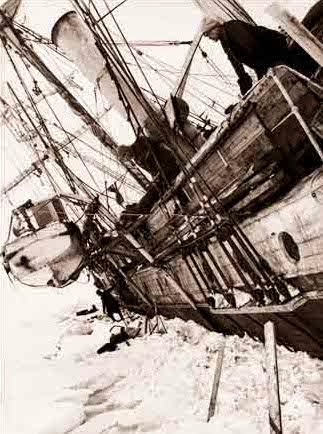
O church, where are you? Spurgeon said that a boat is fine even when waters storm outside it. But when the waters breach and stream inside the boat, the boat is in danger. It is the same with the church. When the world stays outside, no matter how they rage and storm, the church is OK. When the pollution of sin streams inside, there is the danger. Picture a boat frozen fast in the ice. Perhaps Shackleton’s The Endurance…

As long as the mighty ship bounded over waves she was OK. It was what she was built for. But once she became stuck in the ice and no longer moved, the ice built up. It built up and climbed over the top of the masts. It pressured, and pressured, and pressured against her, until one day, the icy cold broke a plank. The frigid water streamed in, and once it did, it formed more ice. The heaviness of the icy weighed her down, eventually thwarting her ability to move. She was completely stuck.

Shackleton looking down as the ship lists

As plank after plank broke and the water breached, she sank.

The final sinking

So you see the cycle. Love grows cold, and that is because sin abounds. If not dealt with, the icy sin’s fingers reach more hearts, and the ship of the church grows heavy and stuck. Sin unaddressed allows more sin, and eventually the pressure of so much sin breaks a plank and the world streams in. As it streams in, the ship of the church grows heavier, and eventually the pressures within and without sink her.

Of course the true church will never sink, but listen to Spurgeon’s pleas from his sermon A Prophetic Word, Matthew 24:12

As all the water outside a vessel can do it no harm until it enters the vessel, itself, so outward persecutions cannot really injure the Church of God. But when the mischief oozes into the Church and the love of God’s people grows cold—ah, then the boat is in sore distress! I fear that we are much in this condition at the present hour. May the Holy Spirit bless the alarming prophecy now before us to our awakening!

And how much more applicable is the urgency at this hour, over one hundred years later!

Go to your Master and ask Him to fan the fire within you to a great heat, that if there should be cold everywhere else, there may be warmth in your bosoms! The Lord help you to do this, dear Friends, for Jesus Christ’s sake! Amen.

Posted in prophecy, rapture, second coming

Prophecy is incredible: biblical proof

Last June, I wrote a message to “pan tribbers.” I’d written,

But there is an even worse tribulation position than the denial of the rapture, the partial rapture, the post-tribulation rapture. It is the “Pan-Tribulation” position.

It is the position for some reason that irks me the most. You hear it sometimes from Christians, who, when discussing the rapture and last things, and the rapture’s timing, they say, “I’m a pan-tribulationist. Everything will work out in the end. HAR HAR HAR.” They think this is funny. They think this is clever. They even think this is pious.

It isn’t.

Here is more for the people who believe prophecy, especially second coming prophecies, are an afterthought, an unpalatable subject, or a marginal doctrine.

It isn’t.

  • Prophecy occupies at least one-fifth of the Scriptures if not more.
  • The second coming of Christ occupies one-third of that one-fifth.
  • There are over 660 general prophecies. Half of them are concerning Jesus Christ.
  • Of these 333 prophecies concerning Christ, 109 of them were fulfilled in His first coming.
  • 224 prophecies are yet to be fulfilled in His second coming.
  • Of the 46 Old Testament prophets, less than ten of them speak of events in Christ’s first coming
  • 36 Old Testament prophets speak of events connected His second coming.
  • There are a total of 1,527 Old Testament passages referring to the second coming.
  • 1 out of 25 New Testament verses refer directly to the second coming of Jesus Christ.
  • Next to the subject of faith, the subject of the second coming is the most dominant subject in the New Testament.
  • For every time in the Bible the first coming is mentioned, the second coming is mentioned eight times.
  • For every time the atonement is mentioned once, the second coming is mentioned twice.
  • The Lord refers to His return 21 times.
  • And 50 times plus men are exhorted to be ready for the return of Jesus Christ.
  • All of the prophecies related to His first coming were literal, then if God is consistent all the ones related to His second coming will also be literal.

Source: John MacArthur

Each day that passes is a day closer either to your own death, or a day closer to when He returns to judge the living and the dead. Being ready for His return is critical for life and eternal life. Are you ready?

Posted in ISIS, jesus, jordan, nimrod, prophecy

ISIS, Jordan and prophecy

Jordan is much in the news today, due to the horrific killing of its downed pilot. The world became aware of the pilot’s killing because the Muslim terror group ISIS released a video of it.

ISIS’ brutal killings, march of terror over the interior Middle East, and its famed videotaped beheadings certainly bring back to mind their ancestors, the Assyrians. In this same region several thousand years ago, the mighty kingdom of Assyria had arisen, with its capital, Nineveh. God used this nation to punish Israel.

In 722 BC, the Assyrians conquered Israel. The Assyrians were aggressive and effective; the history of their dominance over the Middle East is a history of constant warfare. In order to assure that conquered territories would remain pacified, the Assyrians would force many of the native inhabitants to relocate to other parts of their empire. They almost always chose the upper and more powerful classes, for they had no reason to fear the general mass of a population. They would then send Assyrians to relocate in the conquered territory.

When they conquered Israel, they forced the ten tribes to scatter throughout their empire. For all practical purposes, you might consider this a proto-Diaspora (“diaspora”=”scattering”), except that these Israelites disappear from history permanently; they are called “the ten lost tribes of Israel.” (Virtual Jewish Library)

One small section of Sennacherib’s Lachish relief. Wikipedia

Assyrian King Sennacherib’s statement inscribed on the relief: “Sennacherib, the mighty king, king of the country of Assyria, sitting on the throne of judgment, before (or at the entrance of) the city of Lachish (Lakhisha). I give permission for its slaughter

The Assyrians were known for their terrible brutality. When Sennacherib defeated Israel’s second most important city, Lachish, he commissioned a 12 foot tall relief commemorating the effort. In the Lachish relief we see the Assyrians flinging Israelites off the ramparts, leading them in a line with meathooks in their jaws, and worse. Just the name of Assyria brought terror to the hearts of its enemies.

In His sovereign plan, God used Assyria as His rod of judgment upon Israel. We read When Assyria was God’s Rod…

In Isaiah 10 our Lord spoke about the coming judgment of Israel through the prophet. He explained in vivid imagery that nothing remained for those who stood condemned, but the coming condemnation. In this case, God was going to rouse Assyria against Israel (Judah). To frame this judgment, the Lord says through Isaiah, that Assyria doesn’t intend to be God’s rod of correction; that they are merely another wicked nation and that this plundering of Israel is merely an expression of their own corruption. Once God has used the Assyrians to judge Israel, He will then judge Assyria.

He did. Assyria’s capital, Nineveh, was so thoroughly destroyed that though its destruction occurred in 612 BC, the city and environs were not re-discovered until 1849AD. God had promised Israel that He’d make an utter devastation to the place, and that the Assyrians would not bother them a second time. (Nahum 1:8-9).

Jordan. National Motto: “God, Country, The King.” But which God?

Now, what of Jordan? Jordan’s history is pretty interesting. When the Ottoman Empire was defeated in 1916, the Sykes–Picot Agreement carved it up between Britain and France, defining much of the common border between Syria and what was to become Jordan, Palestine / Israel and Iraq. Wikipedia has more:

The Emirate of Transjordan, also hyphenated as Trans-Jordan and previously known as Transjordania or Trans-Jordania, was a British protectorate established in April, 1921. The Hashemite dynasty ruled the protectorate, as well as the neighbouring Mandatory Iraq, following the Cairo Conference. The territory was officially under the British Mandate for Palestine, but it had a fully autonomous governing system from Mandatory Palestine. In 1946, the Emirate became an independent state named the Hashemite Kingdom of Transjordan. In April 1949 the name was shortened to the Hashemite Kingdom of Jordan.

The Emir of Transjordan from 1921–1946 was Abdullah I. The British Representative from Oct 1921 – Nov 1921 was T. E. Lawrence, also known as “Lawrence of Arabia.” Yes, he was a real man, it wasn’t just a movie.

The Hashemite emir Abdullah, elder son of Britain’s wartime Arab ally Hussein bin Ali was placed on the throne of Transjordan. The king of The Hashemite Kingdom of Jordan today is Abdullah II. Both Abdullahs were/are Sunni Muslim.

After WWI, Abdullah I, alone among the Arab leaders of his generation, was considered a moderate by the West. It is possible that he might have been willing to sign a separate peace agreement with Israel, but for the Arab League’s militant opposition. Because of his dream for a Greater Syria comprising the borders of what was then Transjordan, Syria, Lebanon, and the British Mandate for Palestine under a Hashemite dynasty with “a throne in Damascus,” many Arab countries distrusted Abdullah and saw him as both “a threat to the independence of their countries and they also suspected him of being in cahoots with the enemy” and in return, Abdullah distrusted the leaders of other Arab countries. Source.

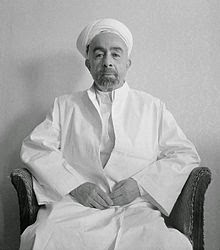
King Abdullah I

In 1951, King Abdullah I was assassinated while visiting Al-Aqsa Mosque in Jerusalem. The alleged reason was that his enemies suspected the King of engaging in secret talks to participate in a peace treaty with the new country of Israel. The regional distrust of the dynasty ruling Jordan continues today, partly because the peace treaty Jordan signed with Israel did come about (in 1994), despite pressure as recent as a few months ago to cancel it. We know from prophecy that in the end, no nation will be friends with Israel (Zechariah 12:3) so at some point that one remaining regional pact will disappear.

One last thing before we go to this week’s news. The Abdullah family traces its Hashemite ancestry back to Ishmael, (Abraham’s son by Hagar), and ancestry continuing through the prophet Muhammad and his daughter Fatima.

You might remember Genesis 16:11, where Sarai told Hagar to come to Abram and lay with Abram and Hagar did so. The LORD said the son from that union shall be called Ishmael.

You shall call his name Ishmael, because the Lord has listened to your affliction. 12He shall be a wild donkey of a man, his hand against everyone and everyone’s hand against him, and he shall dwell over against all his kinsmen. (Genesis 16:11-12)

The LORD promised blessings to the line of Ishmael, but His covenant would be with Abram’s son Isaac and his line.

As for Ishmael, I have heard you; behold, I have blessed him and will make him fruitful and multiply him greatly. He shall father twelve princes, and I will make him into a great nation. (Genesis 17:20)

Ishmael’s half-brother Isaac was born a year later. However due to the laws of primogeniture wherein the first-born son is considered the inheritor, the line from Ishmael never recognized Isaac’s right to inherit and still to this day considers Ishmael the proper heir. That is why King Abdullah traces his line back to “Ismail”. However it was the LORD’S decision that not only will the covenant be through Isaac’s line, but the elder shall serve the younger. This was stated when Jacob and Esau were in the womb-

And the LORD said to her, “Two nations are in your womb, and two peoples from within you shall be divided; the one shall be stronger than the other, the older shall serve the younger.” (Genesis 25:23)

In addition, the Ishmaelites forget that Esau purposely renounced his birthright for a bowl of lentil stew. (Genesis 25:34).

The News: Nothing New Under the Sun

King Abdullah II of Jordan was incensed this week that one of his pilots who crash landed in Assyrian ISIS territory was put in a cage and burned alive. It was a barbaric and brutal event, made worse by its videotaping by conscienceless terrorists. He vowed to crush ISIS and retaliate with everything the nation’s got.

Jordan unleashes wrath on ISIS: ‘This is just the beginning’

Jordanian Foreign Minister Nasser Judeh later stressed to CNN that the airstrikes marked the beginning of his nation’s retaliation over the pilot’s death, but not the start of its fight against terrorism. He vowed to destroy ISIS. “We are upping the ante. We’re going after them wherever they are, with everything that we have. But it’s not the beginning, and it’s certainly not the end,” Judeh said.

Jordanian fighter jets strike hard at ISIS, pay tribute to murdered pilot

Jordanian fighter pilots carried out devastating sorties against ISIS early Thursday, making good on their king’s vow of vengeance for the horrific burning death of a captured airman — whose hometown the jets buzzed triumphantly after the mission. Reports from the Middle East said the latest strikes killed 55 members of ISIS, including a senior commander known as the “Prince of Nineveh.”

You can see by that statement that ISIS purposely identifies with ancient Assyria and with Nineveh itself. Nineveh has a long and terrible history. The city’s history goes back to just after the Flood, to Genesis 10. After Noah was 500 years old, Noah begat three sons, one of them was Ham. (Genesis 5:32). Ham begat Cush, and Cush begat Nimrod. (Genesis 10:8-9). Noah’s great-grandson Nimrod is specifically noted as the first on earth to be a mighty man, AKA a tyrant. Nimrod built Nineveh.

A handshake between Hussein I of Jordan and Yitzhak Rabin,
accompanied by Bill Clinton, during the Israel-Jordan peace negotiations,
July 25th, 1994

Assyria was an actual nation and its name also stands for the type of nation which in the future, in all brutality will come against Israel. Another name for this type of nation is “Land of Nimrod.” Jesus will smite them and Israel will be at peace. This is an end-time Tribulation/Millennium prophecy. Some believe Micah refers to the antichrist when he says ‘the Assyrian’, but most commenters believe the Assyrian stands for the type of brutal enemy in general that the former nation of Assyria was. For example, Walvoord and Zuck’s Bible Knowledge Commentary says,

Though Assyria will not exist as a nation in the future, it represents nations who, like Assyria in Micah’s time, will threaten and attack Jerusalem (cf. Zech. 12:9; 14:2–3).

Micah 5:1-6 has the prophecy-.

Now muster your troops, O daughter of troops;
siege is laid against us;
with a rod they strike the judge of Israel
on the cheek.
But you, O Bethlehem Ephrathah,
who are too little to be among the clans of Judah,
from you shall come forth for me
one who is to be ruler in Israel,
whose coming forth is from of old,
from ancient days.
Therefore he shall give them up until the time
when she who is in labor has given birth;
then the rest of his brothers shall return
to the people of Israel.
And he shall stand and shepherd his flock in the strength of the Lord,
in the majesty of the name of the Lord his God.
And they shall dwell secure, for now he shall be great
to the ends of the earth.
And he shall be their peace.
When the Assyrian comes into our land
and treads in our palaces,
then we will raise against him seven shepherds
and eight princes of men;
they shall shepherd the land of Assyria with the sword,
and the land of Nimrod at its entrances;
and he shall deliver us from the Assyrian
when he comes into our land
and treads within our border.

Bible Knowledge Commentary again,

This is one of Messiah’s several accomplishments in bringing peace to Israel (vv. 5–15). He will be Israel’s peace because He will subdue the hostile powers around that nation. … The land of Nimrod (cf. Gen. 10:8–9; 1 Chron. 1:10) was a synonym for Assyria (cf. Assyria as a name for Persia in Ezra 6:22). Christ will enable Israel to defeat her foes, giving the nation a more-than-adequate number of shepherds or leaders (on the formula seven … even eight; cf. comments on “three … even four” in Amos 1:3). Whereas many nations have ruled Israel with the sword, in the Millennium the tables will be turned and Israel will rule over her foes because He, Messiah, will deliver her (cf. Zech. 14:3).

CONCLUSION

All of this to show several things:

1. The Preacher said,

What has been is what will be, and what has been done is what will be done, and there is nothing new under the sun. (Ecclesiastes 1:9)

and that which is done, is that which shall be done; what is done in the present age, nay, in this year, month, or day, shall be done over again in the next; Gill’s Exposition

War after war in the Middle East, man’s brutality, hatred of Israel, the long struggle between the two nations in Rebekah’s womb, the old Assyrians, the new Assyrians (ISIS) …all known to God and He will bring it to the good for those who love Him and to the justice of those who don’t. Either way, it all will end in glory.

2. God’s sovereignty, majesty, power, and might are demonstrated from the opening letter of the bible to the last amen. What’s happening now goes back to Genesis 10 and even before, to Genesis 3. All that is being done now on earth by men and demons are part of His sovereign plan which will culminate in the visible glory of our risen Christ coming to judge, rule, and reign. Prophecy is mighty in demonstration just Who is in control.

3. Prophecy marches apace. Today is one day closer to the fulfillment of all that is written. Hallelujah!

~~~~~~~~~~~~~~~~~~~~

Further Reading

Jordan braces for ISIS

Jordan has a great role to play in the end times

Petra, Jordan by night

Obadiah’s future prophecy regarding Jordan


Posted in angel, countenance, encouragement, prophecy, wisdom

A godly face radiates His glory

In Adult Bible Study we are going through Acts. I am also listening to John MacArthur preach through Acts. When reading the part where Stephen was dragged in front of the Sanhedrin and about to answer charges of blasphemy, we read the following:

And gazing at him, all who sat in the council saw that his face was like the face of an angel. (Acts 6:15)

As is the way with the Spirit, he got my attention to focus on the part that said ‘the face of an angel.’

I envisioned Stephen’s face full of serene glory, bright and shining. It reminded me of the verse when Moses had been with God and Moses’ face shone so brightly the people were scared and urged Moses to cover it with a veil. (Exodus 34:30, 35, cf. 2 Corinthians 3:13).

Other incidences of a person’s face shining with glory were also in the New Testament, this time it was Jesus-

There he was transfigured before them. His face shone like the sun, and his clothes became as white as the light. (Matthew 17:2)

Now about eight days after these sayings he took with him Peter and John and James and went up on the mountain to pray. And as he was praying, the appearance of his face was altered, and his clothing became dazzling white. (Luke 9:29)

Moses, Stephen, Jesus, faces shining with glory. I want that. I want that because when someone sees me I want them to see Jesus. I don’t want them to see my face, but a serenely joyful face, so different from the faces in the crowd. I want people to notice something different about me. The something different, of course, is Jesus.

But how? Moses was with God Himself on Mt Sinai. That was a unique occurrence. Jesus is, well, Jesus, and though He was fully man He was also fully God. So X that off the list. Stephen was filled with the spirit at a moment when supernatural ability was promised God’s people. (Matthew 10:19-20).

Still…if the Spirit’s ministry is to point people to Jesus I want Jesus to be evident in me. I know the fruit the Spirit grows will do that.

But if the ministry of death, in letters engraved on stones, came with glory, so that the sons of Israel could not look intently at the face of Moses because of the glory of his face, fading as it was, 8how will the ministry of the Spirit fail to be even more with glory? (2 Corinthians 3:7-8)

What else will do that? I found an answer in Ecclesiastes 8:1

Who is like the wise?
And who knows the interpretation of a thing?
A man’s wisdom makes his face shine,
and the hardness of his face is changed.

Wisdom. The kind of wisdom that emanates and makes a face soften. Here is what the Jamieson-Fausset Commentary explains about the Ecclesiastes verse:

Praise of true wisdom continued (Ec 7:11, &c.). “Who” is to be accounted “equal to the wise man?… Who (like him) knoweth the interpretation” of God’s providences (for example, Ec 7:8, 13, 14), and God’s word (for example, see on Ec 7:29; Pr 1:6)?

face to shine—(Ec 7:14; Ac 6:15). A sunny countenance, the reflection of a tranquil conscience and serene mind. Communion with God gives it (Ex 34:29, 30).

The Matthew Henry Commentary on the Whole Bible says of the Ecclesiastes verse,

Wisdom: It beautifies a man in the eyes of his friends: It makes his face to shine, as Moses’s did when he came down from the mount; it puts honour upon a man and a lustre on his whole conversation, makes him to be regarded and taken notice of, and gains him respect (as Job 29:7, etc.); it makes him lovely and amiable, and the darling and blessing of his country. The strength of his face, the sourness and severity of his countenance (so some understand the last clause), shall be changed by it into that which is sweet and obliging. Even those whose natural temper is rough and morose by wisdom are strangely altered; they become mild and gentle, and learn to look pleasant.

The way to softening our countenance is wisdom. We absorb wisdom from above by holding close communion with Christ. We read His word, the best – and only – wisdom. Prayer is close communion with Christ, an intimate privilege that delivers wisdom because in prayer we contemplate Him. Proclaiming His truths, as Stephen did, will increase our wisdom because if what comes out of us defiles us, alternately His truths enliven us with His glory. (Mark 7:20, James 3:6).

NH Old Man of the Mountains,
a granite face. Source

To understand this as a full truth we look at its opposite. If wisdom of God softens our face and makes it serenely radiant, a man with no Godly wisdom will have a hard face. The ultimate example of this is the antichrist. We read in Daniel 8, one of the antichrist’s qualities is that he has a hard face.

And in the latter time of their kingdom, when the transgressors are come to the full, a king of fierce countenance, and understanding dark sentences, shall stand up. (Daniel 8:23 KJV)

Friends, the gentle disciplines of reading the bible, prayer, and proclaiming His truth will transform us, and it’s not only the mind that is transformed (Romans 12:2) but when the mind is drenched with wisdom, truth, Jesus, it will alter our very countenance.

The upshot is, close communion with God will alter our face.

And we all, with unveiled face, beholding the glory of the Lord, are being transformed into the same image from one degree of glory to another. For this comes from the Lord who is the Spirit. (2 Corinthians 3:18).

For God, who said, “Let light shine out of darkness,” has shone in our hearts to give the light of the knowledge of the glory of God in the face of Jesus Christ. (2 Corinthians 4:6)

Behold His glory and it will shine upon you today, reflecting back to a dark world that needs to see it.